REVIEW 4 major objections 5 minor 1 cited by
Data Center Cooling System Optimization Using Offline Reinforcement Learning
T0 review · 4 major / 5 minor · reviewed 2026-08-10 · deepseek-v4-flash
Pith's one-line read An offline reinforcement learning controller replaced PID control in a production data center's cooling system and achieved 14–21% energy savings over 2,000 hours of operation without any safety constraint violations.
desk verdict A credible real-world deployment of offline RL for data center cooling, but the headline 14-21% savings claim is not yet causally established due to observational field comparisons lacking weather and replication controls. read the letter →
The pith
A machine-rendered reading of the paper's core claim, the machinery that carries it, and where it could break.
The reading
What carries the argument
The key machinery is the T-symmetry enforced Thermal Dynamics Model (TTDM): a graph neural network encoder that maps states and actions to latent codes, plus forward and reverse latent ODE dynamics constrained to be negatives of each other, i.e. $f(z_s,z_a) = -g(z_{s'},z_a)$ where $z_{s'} = z_s + f(z_s,z_a)$. Time-reversal symmetry means the underlying transition law is unchanged when time runs backwards; enforcing it acts as a physics-based regularizer that keeps policy-induced samples physically plausible even outside the training distribution. The Q-function and policy are then optimized in this latent space, using a TD3+BC-style objective with an added T-symmetry consistency loss, which is what enables sample-efficient, safe policy learning from limited historical data.
What would settle it
Run both controllers in the same server room on alternating days within the same week, or hold outdoor temperature, humidity, and entering water temperature fixed (or regress them out), and check whether the 14–21% ACLF drop survives; if the gap shrinks to near zero, the claimed energy savings are an artifact of period differences.
Extended reading notes
Core claim
The central discovery is that enforcing time-reversal symmetry in a learned latent dynamics model makes offline RL practical for real-world data center cooling. The paper's T-symmetry enforced Thermal Dynamics Model (TTDM) couples a pair of latent ODE dynamics, forward $f(z_s,z_a)$ and reverse $g(z_{s'},z_a)$, with the constraint $f(z_s,z_a)=-g(z_{s'},z_a)$, and a GNN encoder that captures spatial and control dependencies among sensor and ACU nodes. This yields well-behaved latent states in which the Q-function and policy can be learned from roughly 140,000 to 180,000 historical samples, far fewer than typical offline RL benchmarks. In field tests in two production server rooms, the learned policy achieved 14–21% lower air-side cooling load factor than PID controllers, and ablations on a 22-server testbed show that both the GNN structure and the T-symmetry term improve prediction error and policy performance.
Load-bearing premise
The crux is that the days when the PID controller ran and the days when the new policy ran are assumed to be otherwise comparable, even though they fall in different months with possibly different weather and water-side conditions.
Editorial extensions
If this is right
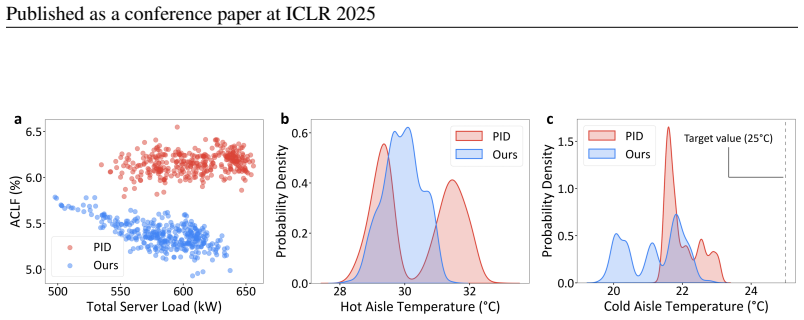
- Replacing local PID control with the offline RL policy lowers the air-side cooling load factor by 14–21% in the tested rooms, with larger savings when more ACUs are under policy control.
- The policy keeps cold-aisle temperatures below the operational threshold and yields a more concentrated hot-aisle temperature distribution, indicating safe and stable long-term operation.
- The ablations show that removing the GNN structure or the T-symmetry enforcement degrades multi-step prediction and policy energy efficiency, identifying these two design choices as the source of the gains.
- Because training uses only historical operational data and no simulator, the same framework should transfer to other data-limited industrial control settings with similar constraints.
Reading between the lines
- Since the reported savings come from comparing May PID days with September through November RL days, a cleaner causal test would be a randomized crossover or a matched-period comparison that also logs outdoor temperature, humidity, and chilled-water conditions; until then, some of the 14–21% could reflect seasonal differences.
- The same latent T-symmetry recipe could be tried on other thermal-regulation tasks, such as HVAC in buildings or liquid cooling loops, where dynamics are approximately reversible and data are scarce.
- The paper's claim that controlling more ACUs increases savings suggests an extrapolation to full-facility control across multiple rooms, but that scale-up remains unverified beyond the two rooms tested.
Signed reviews
Editorial analysis
A structured set of objections, weighed in public.
Referee Report
Summary. The paper presents a physics-informed offline reinforcement learning (RL) framework for optimizing air-side cooling in data centers. The method trains a T-symmetry-enforced graph neural network dynamics model (TTDM) to learn latent state representations, then performs offline Q-learning in the latent space with a TD3+BC-style policy regularizer. The framework is deployed in a commercial data center for closed-loop control of air-cooling units, with over 2000 hours of experiments, and the authors report 14–21% reductions in air-side cooling load factor (ACLF) relative to PID control, with no safety violations. The paper also includes testbed experiments comparing the method with PID, MPC, CCA, IQL, CQL, and FISOR, as well as ablations on the GNN and T-symmetry components.
Significance. If the reported 14–21% energy savings are real, this paper would be a significant demonstration of offline RL in a safety-critical industrial deployment, showing that a policy learned from limited historical data can replace conventional PID control. The strengths include a real production deployment with no safety violations, a physically motivated dynamics model combining GNN and T-symmetry regularization, and a testbed evaluation against multiple baselines. However, the evidence as presented does not yet rigorously establish the causal effect: the field comparisons are observational before-after studies without weather or water-side controls, and the testbed comparisons lack replication. The paper's contribution is therefore best evaluated as a promising case study rather than a definitive proof of the method's superiority.
major comments (4)
- [Section 4.1, Table 1] The headline 14–21% savings claim is based on non-randomized before-after comparisons. The PID baseline consists of two single days (May 5–6, 2024) per room, while the RL periods are May 7–9 (4 ACUs), September 23–29 (6 ACUs), and November 11–12 (all ACUs). No outdoor temperature, humidity, or water-side data are reported for any of these periods, and the server loads differ (e.g., Room A: PID 552.17–555.31 kW vs. 572.77 kW in the September period). Because ACLF is defined as ACU energy divided by server energy, a higher server load can mechanically lower the ACLF even with the same ACU power. The text says the periods were selected for 'similar server load patterns,' but no matching procedure or balance table is provided, and the durations are not comparable: the September period lasts 6 days while the PID baseline is 5.5–7.5 hours. Without covariate adjustment, confidence intervals, or a formal causal design, the 14–21% figure cannot be causally attributed to the RL policy based on the evidence presented.
- [Section 4.2, Figure 6; Section 4.1, Figures 3–4] The experimental comparisons are single-run with no replication. In the production DC, each RL condition is one multi-day run and the PID baseline is only two days per room; in the testbed, each method is run once per load condition. The paper therefore provides no estimate of day-to-day variability, sensor noise, or controller performance variance. The claim that the method outperforms all baselines under all load conditions in the testbed is based on single measurements, and the ACLF values in Figure 6 show no error bars. To support the reported effect sizes, the authors should provide multiple runs (or a resampling-based uncertainty estimate) for at least the testbed experiments.
- [Section 3.3, Eq. (9), and Appendix D.1] The policy regularization coefficient α was tuned in the range [2.5, 10] and the best-performing model was selected for deployment, and the reward weights β1–β4 and r0 are determined from the dataset statistics. This selection procedure means the reported results may partly reflect tuning on the deployment target rather than the inherent sample efficiency of the method. The paper should report the sensitivity of the deployed policy to α and to the reward weight scales, and ideally evaluate the offline training procedure across multiple seeds or via a validation protocol that avoids selecting the model on the same data used for the final comparison.
- [Appendix C.3, Figure 12] The analysis intended to show that the air-side optimization does not affect the water-side system is insufficient. It compares CWP frequency and EWT before and after the RL policy takes over in only two time windows (November 10–11 for Room A, October 29–30 for Room B), with no quantitative change measures, significance tests, or simultaneous outdoor/weather conditions. This does not rule out water-side or ambient confounders in the main field comparisons of Table 1, which span different seasons.
minor comments (5)
- [Abstract] The phrase '14∼21% energy savings' should be qualified as a reduction in air-side cooling load factor (ACLF) relative to the PID baseline, not total data-center energy, to avoid overstatement.
- [Section 4.1, paragraph after Table 1] The sentence 'we select several time periods (lengths from 5.5 to 7.5 hours)' is inconsistent with Table 1, which includes a 6-day period (September 23–29) and a 24-hour period (November 11–12). Please correct or clarify the matching criteria.
- [Equations (3) and (4)] The notation \dot{s} is used but never defined; define \dot{s} = (s' - s)/Δt to make the chain-rule derivation self-contained.
- [Algorithm 1] In the TTDM learning loop, the mini-batch is written as {(s,a,s',a')} but a' is never used; the reverse dynamics in Eq. (4) uses the same action a. Change the notation to {(s,a,s')}.
- [Appendix B.1] The listing of which ACUs were controlled (ACU 1-6, 1-5, 2-5, 2-4 in Room A; ACU 1-1, 1-2, 2-1, 2-2 in Room B) is hard to parse without the layout; consider adding a table or annotated figure.
Circularity Check
No significant circularity: the energy-savings claim rests on external field measurements, and the T-symmetry component is independently ablated in the paper; the only self-citation (TSRL) is not load-bearing.
full rationale
The central claim (14-21% energy savings, no safety violations) is an externally measured outcome against PID baselines in the production DC and testbed, not a quantity defined by the model's equations. The ACLF metric is computed from directly measured ACU and server energy consumption, so the reward function's fan-speed proxy does not make the result self-fulfilling. The offline RL method builds on the authors' own TSRL framework (Cheng et al., 2023) and borrows the T-symmetry regularization loss in Eqs. (6) and (9); this is a genuine self-citation, but it is not the sole support for the method's effectiveness. The paper includes its own ablations (Figure 7a-c) showing that removing the GNN structure or T-symmetry degrades prediction and policy performance, and the testbed comparisons (Figure 6) pit the method against PID, MPC, CCA, IQL, CQL, and FISOR under controlled conditions. Hyperparameter alpha is tuned on the deployment domain and the best model is selected by offline evaluation, but the reported savings are measured post-deployment in closed-loop operation, not predicted from the fitted model, so this is model selection rather than a fitted input renamed as a prediction. Field-experiment concerns about seasonal and weather confounders, lack of replication, and unadjusted before-after comparisons (Section 4.1, Table 1, Figures 3-4) are threats to causal validity, not circularity. No step reduces, by construction or self-citation, to its own inputs; the minor TSRL self-citation is not load-bearing because the central deployment result is independently measured and the T-symmetry design choice is ablated in this paper.
Assumptions & free parameters
free parameters (3)
- Policy regularization scale alpha =
tuned in [2.5, 10]
- Reward weights beta1-beta4 =
reciprocals of dataset means of each reward term
- Reward bias r0 =
max of other reward terms over dataset plus 1
assumptions (4)
- domain assumption Server-room thermal dynamics are approximately time-reversal symmetric.
- domain assumption The hand-designed GNN graph (sensor-sensor and sensor-ACU edges) captures the relevant spatial and control dependencies.
- domain assumption The historical PID-generated dataset provides sufficient coverage to learn a reliable dynamics model and a safe, effective policy.
- domain assumption The reward function in Eq. (1) correctly encodes the energy-safety trade-off.
Cite this review
Pith. "Pith review of Data Center Cooling System Optimization Using Offline Reinforcement Learning." pith.science (2026). https://pith.science/paper/7NY4XX4W
@misc{pith2026250115085,
  author       = {Pith},
  title        = {Pith review of: Data Center Cooling System Optimization Using Offline Reinforcement Learning},
  year         = {2026},
  howpublished = {\url{https://pith.science/paper/7NY4XX4W}},
  note         = {Machine review of arXiv:2501.15085}
}
read the original abstract
The recent advances in information technology and artificial intelligence have fueled a rapid expansion of the data center (DC) industry worldwide, accompanied by an immense appetite for electricity to power the DCs. In a typical DC, around 30~40% of the energy is spent on the cooling system rather than on computer servers, posing a pressing need for developing new energy-saving optimization technologies for DC cooling systems. However, optimizing such real-world industrial systems faces numerous challenges, including but not limited to a lack of reliable simulation environments, limited historical data, and stringent safety and control robustness requirements. In this work, we present a novel physics-informed offline reinforcement learning (RL) framework for energy efficiency optimization of DC cooling systems. The proposed framework models the complex dynamical patterns and physical dependencies inside a server room using a purposely designed graph neural network architecture that is compliant with the fundamental time-reversal symmetry. Because of its well-behaved and generalizable state-action representations, the model enables sample-efficient and robust latent space offline policy learning using limited real-world operational data. Our framework has been successfully deployed and verified in a large-scale production DC for closed-loop control of its air-cooling units (ACUs). We conducted a total of 2000 hours of short and long-term experiments in the production DC environment. The results show that our method achieves 14~21% energy savings in the DC cooling system, without any violation of the safety or operational constraints. Our results have demonstrated the significant potential of offline RL in solving a broad range of data-limited, safety-critical real-world industrial control problems.
Figures


Figures from the paper (11 more)


Forward citations
Cited by 1 Pith paper
-
Contextual Quality-Diversity Evolutionary Reinforcement Learning for HVAC Control in Tropical Commercial Buildings
A contextual quality-diversity evolutionary RL controller matches a single soft actor-critic policy on annual energy (about 3.4% savings over ASHRAE Guideline 36 in simulation) but with 272 times lower seed-to-seed va...
Reference graph
Works this paper leans on
-
[1]
Algorithm 1 Require: Preprocessed historical dataset D, initialized value network Q, policy network π, and the T-symmetry enforced thermal dynamics model (TTDM), which contains the state-action encoder ϕ(s, a), latent forward dynamics model f and latent reverse dynamics model g, state and action decoders ψ(zs) and ψ(za). / / Learning TTDM from offline dat...
work page 2018
-
[5]
https://www.iea.org/energy-system/buildings/ data-centres-and-data-transmission-networks
URL https://www.iea.org/energy-system/ buildings/data-centres-and-data-transmission-networks . https://www.iea.org/energy-system/buildings/ data-centres-and-data-transmission-networks . 11 Published as a conference paper at ICLR 2025 International Energy Agency. Electricity 2024 - analysis and forecast to 2026,
work page 2025
-
[8]
Transforming cooling optimization for green data center via deep reinforcement learning
Yuanlong Li, Yonggang Wen, Dacheng Tao, and Kyle Guan. Transforming cooling optimization for green data center via deep reinforcement learning. IEEE transactions on cybernetics, 50(5): 2002–2013,
work page 2002
-
[11]
The PID controller demonstrates limited adaptability in this scenario, with no adjustments to fan speeds and only marginal changes in valve opening percentage. In contrast, our offline RL approach was able to promptly adapt to external changes, resulting in a more optimal and energy-efficient strategy. These results underscore the effectiveness and adapta...
work page 2025
-
[12]
Toward physics-guided safe deep reinforcement learning for green data center cooling control
Ruihang Wang, Xinyi Zhang, Xin Zhou, Yonggang Wen, and Rui Tan. Toward physics-guided safe deep reinforcement learning for green data center cooling control. In 2022 ACM/IEEE 13th International Conference on Cyber-Physical Systems (ICCPS), pp. 159–169. IEEE,
work page 2022
-
[13]
13 Published as a conference paper at ICLR 2025 APPENDIX A S YSTEM DEPLOYMENT We have developed a full-function software system to facilitate the deployment and validation of our proposed physics-informed offline RL framework. We successfully deployed our system in a large- scale commercial data center for production environment performance validation and...
work page 2025
-
[14]
Our system has been operated safely for over 2000 hours. Through these comprehensive experiments, we verified that our proposed physics-informed offline RL framework and the resulting control system can operate both effectively and safely under the stringent safety and operational constraints of a real-world commercial data center. B.2 R EAL -WORLD TESTBE...
work page 2000
-
[17]
We provide detailed descriptions of these baseline methods as follows
and Conservative Q-Learning (CQL) (Kumar et al., 2020), and the state-of-the-art (SOTA) safe offline RL algorithm, FISOR (Zheng et al., 2024). We provide detailed descriptions of these baseline methods as follows. Default PID controller. The ACU in our experiments adopts a conventional PID controller (Ang et al.,
work page 2020
Show all 18 references
-
[1998]
Nevena Lazic, Craig Boutilier, Tyler Lu, E
doi: 10.1016/s0167-2789(97)00199-1. Nevena Lazic, Craig Boutilier, Tyler Lu, E. Wong, Binz Roy, M. Ryu, and Greg Imwalle. Data center cooling using model-predictive control. Advances in Neural Information Processing Systems, Jan
-
[2005]
to adjust its fan speed and compressor to minimize the error between the target CAT setpoint and the system’s actual CAT value. The controller consists of three components: the Proportional term, which responds to the current error; the Integral term, which accumulates past er...
2018
-
[2013]
D4rl: Datasets for deep data-driven reinforcement learning
Justin Fu, Aviral Kumar, Ofir Nachum, George Tucker, and Sergey Levine. D4rl: Datasets for deep data-driven reinforcement learning. arXiv preprint arXiv:2004.07219,
2004 arXiv
-
[2014]
Cooling control of data cen- ters using linear quadratic regulators
Winston Garcia-Gabin, Kateryna Mishchenko, and Erik Berglund. Cooling control of data cen- ters using linear quadratic regulators. In 2018 26th Mediterranean Conference on Control and Automation (MED), pp. 1–6. IEEE,
2018
-
[2018]
Trends in worldwide ict electricity consumption from 2007 to
Ward Van Heddeghem, Sofie Lambert, Bart Lannoo, Didier Colle, Mario Pickavet, and Piet Demeester. Trends in worldwide ict electricity consumption from 2007 to
2007
-
[2019]
Continuous control with deep reinforcement learning
Timothy P Lillicrap, Jonathan J Hunt, Alexander Pritzel, Nicolas Heess, Tom Erez, Yuval Tassa, David Silver, and Daan Wierstra. Continuous control with deep reinforcement learning. arXiv preprint arXiv:1509.02971,
-
[2021]
Off-policy deep reinforcement learning without exploration
Scott Fujimoto, David Meger, and Doina Precup. Off-policy deep reinforcement learning without exploration. In International conference on machine learning, pp. 2052–2062. PMLR,
-
[2022]
Cooling control based on model predictive control using temperature information of it equipment for modular data center utilizing fresh-air
12 Published as a conference paper at ICLR 2025 Masatoshi Ogawa, Hiroshi Endo, Hiroyuki Fukuda, Hiroyoshi Kodama, Toshio Sugimoto, Takeshi Horie, Tsugito Maruyama, and Masao Kondo. Cooling control based on model predictive control using temperature information of it equipment ...
2025
-
[2023]
Semi-analytical industrial cooling system model for reinforcement learning
Yuri Chervonyi, Praneet Dutta, Piotr Trochim, Octavian V oicu, Cosmin Paduraru, Crystal Qian, Emre Karagozler, Jared Quincy Davis, Richard Chippendale, Gautam Bajaj, et al. Semi-analytical industrial cooling system model for reinforcement learning. arXiv preprint arXiv:2207.13131,
-
[2024]
https://www.iea
URL https://www.iea.org/reports/electricity-2024. https://www.iea. org/reports/electricity-2024. Thomas N. Kipf and Max Welling. Semi-supervised classification with graph convolutional networks. In International Conference on Learning Representations,
2024
Reviewed August 10, 2026 · model on record in the stance chip above.
Discussion (0). Continue with ORCID to comment.