REVIEW 4 major objections 6 minor 3 cited by
Gaia-ESO Survey: massive stars in the Carina Nebula. II. The spectroscopic analysis of the O-star population
T0 review · 4 major / 6 minor · reviewed 2026-08-10 · deepseek-v4-flash
Pith's one-line read A complete census of single O-type stars in Carina reveals a slow-spinning, very young population with a gap near the zero-age main sequence.
desk verdict A solid, honest catalog paper: first homogeneous rotation/parameter census for Carina OB1, with selection caveats that are real but openly acknowledged. read the letter →
The pith
A machine-rendered reading of the paper's core claim, the machinery that carries it, and where it could break.
The reading
What carries the argument
The argument runs on three instruments. The first is the iacob-broad line-broadening tool, which combines Fourier-transform and goodness-of-fit measurements of metal and helium diagnostic lines to deliver $v \sin i$ values with uncertainties of 10--20%. The second is a grid of more than 100,000 FASTWIND non-LTE model spectra, fitted by the iacob-gbat tool, to derive effective temperature, surface gravity, helium abundance, and wind parameters. The third is Gaia astrometry with group-averaged distances, combined with the BONNSAI Bayesian tool on non-rotating Bonn evolutionary tracks, to convert those parameters into radii, luminosities, spectroscopic masses, evolutionary masses, and ages. The comparison of the Carina $v \sin i$ distribution with Milky Way and 30 Doradus samples using the Anderson-Darling k-sample test is the statistical machinery that turns the short fast-rotator tail into a quantitative claim.
What would settle it
A deep near-infrared spectroscopic survey of the heavily obscured parts of Trumpler 14 and the wider Carina Nebula would settle the near-main-sequence gap: finding many stars of roughly $32$--$55$ $M_{\odot}$ on or near the main sequence behind the optical extinction would make the dearth an observational artifact, and finding any Carina O star with $v \sin i$ above about $310$ km/s would refute the truncated rotation tail.
Extended reading notes
Core claim
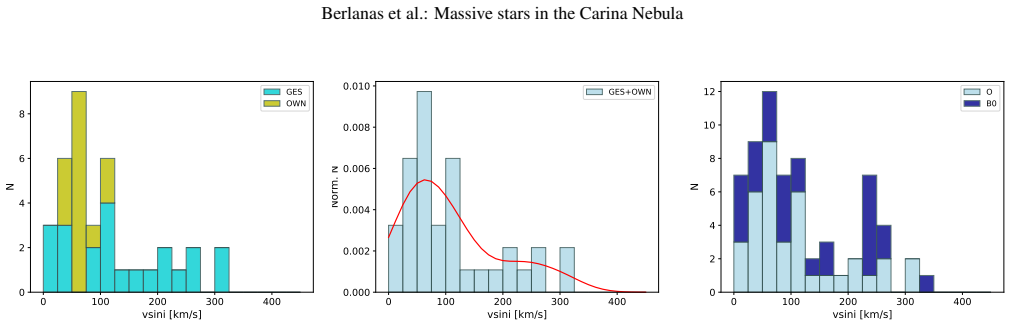
The central claim is that the Carina Nebula's O-star population, defined by 54 apparently single members of Car OB1, is young and slow-spinning. From 37 high-resolution spectra, the authors derive a bimodal $v \sin i$ distribution with a low-velocity peak at $60$ km/s, a gap at $75$--$100$ km/s (which they judge stochastic after adding B0 stars), and a fast-rotator tail that stops below $350$ km/s, with no star above $310$ km/s. Anderson-Darling tests reject the hypothesis that this distribution comes from the same parent population as the Milky Way or 30 Doradus $v \sin i$ distributions, while the samples agree below $250$ km/s. The paper also builds classical and spectroscopic Hertzsprung-Russell diagrams for 47 stars, finds the near-ZAMS gap between about $32$ and $55$ $M_{\odot}$, derives ages peaking at 1 Myr with a secondary 4--5 Myr peak, and reports a systematic trend in which evolutionary masses exceed spectroscopic masses for stars with evolutionary mass below $40$ $M_{\odot}$.
Load-bearing premise
The 37 stars with high-resolution spectra stand in for the full 54-star census, so heavily obscured, unresolved, or spectrum-less stars would not fill the $32$--$55$ $M_{\odot}$ near-main-sequence gap or extend the rotation tail past $310$ km/s.
Editorial extensions
If this is right
- If the short fast-rotator tail is real, Car OB1 has not yet produced the very fast rotators that binary-interaction channels are expected to create, implying an age or environment dependence of the tail length.
- If the near-main-sequence gap is intrinsic rather than an extinction effect, star formation in Carina has produced few stars near $32$--$55$ $M_{\odot}$ in its first million years.
- The 1 Myr age peak with a secondary 4--5 Myr peak implies a second burst of star formation across most Carina clusters, with Trumpler 14 the only group showing only the young component.
- For stars below about $40$ $M_{\odot}$, evolutionary models overpredict masses relative to spectroscopic masses, a discrepancy that appears in this sample without a clear dependence on rotation or age.
Reading between the lines
- A testable extension not made in the paper is to obtain high-resolution spectra for the ten stars observed only at low spectral resolution; if they populate the $75$--$100$ km/s gap or add stars above $200$ km/s, the bimodal shape and the short-tail conclusion would need revision.
- If the tail length is set by binary-interaction timescales, older associations should show progressively longer fast-rotator tails; comparing clusters spanning roughly 1--10 Myr would test this directly.
- The paper's own suggested near-infrared search for embedded O4--O5 dwarfs can be made quantitative: counting such stars in Trumpler 14 would tell whether the near-main-sequence gap is an artifact of extinction.
- The mass-discrepancy trend below $40$ $M_{\odot}$ could be checked independently with eclipsing binaries or asteroseismic masses in Carina, separating model systematics from a real offset between spectroscopic and evolutionary masses.
Signed reviews
Editorial analysis
A structured set of objections, weighed in public.
Referee Report
Summary. This paper presents a spectroscopic analysis of apparently single O-type stars in the Car OB1 association, using high-resolution GES and OWN spectra for 37 stars and lower-resolution GOSSS spectra for 10 additional stars. The authors derive projected rotational velocities with iacob-broad (FT and GOF methods), effective temperatures, gravities, helium abundances, radii, luminosities, and spectroscopic masses with FASTWIND/iacob-gbat, and evolutionary masses and ages with BONNSAI. The central claims are: (i) the v sin i distribution of 37 stars is bimodal, peaking near 60 km/s, with a short fast-rotator tail reaching about 320 km/s and no stars above about 310 km/s; (ii) the HRD shows a dearth of stars close to the ZAMS in the approximate range 32-55 solar masses; (iii) the region is very young, with an age distribution peaking at 1 Myr and a secondary 4-5 Myr peak; and (iv) evolutionary masses systematically exceed spectroscopic masses for stars below about 40 solar masses.
Significance. If the results hold, the paper provides the most complete spectroscopic characterization of the O-star population in Car OB1 to date and adds an important data point to studies of massive-star rotation in different Galactic environments. The v sin i comparison with the Milky Way and 30 Doradus samples, the apparent truncation of the fast-rotator tail, and the ZAMS gap in a very young region are meaningful observational constraints on models of massive star formation, binary interaction, and evolution. The paper's strengths include the systematic use of two independent line-broadening diagnostics (FT and GOF), a homogeneous quantitative analysis with FASTWIND models, cross-checks against previous parameter determinations, and explicit attempts to use GOSSS data and B0 stars to assess completeness of the rotation distribution. The main weaknesses are that the rotation-velocity and HRD-gap conclusions depend on a 37-star sample (68.5% of the census) whose representativeness is asserted rather than demonstrated, and that one of the paper's own conclusions concedes the ZAMS gap could be an observational artifact of missing embedded stars.
major comments (4)
- [§2 and §4.1, Figs. 2-3] The claim that the Car OB1 v sin i distribution has a short tail with no stars above about 310 km/s rests entirely on the 37-star high-resolution sample, which is only 68.5% of the 54-star census. Five stars have no optical spectra, the 10 GOSSS-only stars can only be screened above roughly 100 km/s, and [ARV2008]217 is excluded. The paper calls this sample 'representative' but provides no quantitative selection-bias test. Because the expected number of stars above 250 km/s from the Milky Way or 30 Doradus distributions is about 6-8 while only 4 are observed, adding even a small number of fast rotators among the missing or poorly observed stars could erase the claimed statistical distinction. I ask the authors to quantify the impact of the missing 17 stars (e.g., by injecting plausible v sin i values from the comparison distributions and recomputing the Anderson-Darling results) or to explicitly rephrase the tail claim as an upper limit conditioned on the observed subset.
- [§4.3, Fig. 4] The paper's own text states that the lack of known O4-O5 dwarfs and the inhomogeneous extinction imply that some of the youngest and most massive stars 'could also be hidden behind their natal clouds, thus producing the mentioned gap.' This admission directly undermines the strength of the headline conclusion that the ZAMS dearth at 32-55 M_sun is a real feature of Car OB1 rather than a completeness artifact. Since the same missing population is invoked as a possible explanation, the subsequent 'confirm the lack' language in the abstract and conclusions is too strong. The authors should either apply a completeness correction or present the ZAMS gap as a tentative result that is explicitly contingent on the unobserved embedded population; a simple estimate of how many embedded O4-O5 stars would be required to fill the gap would be valuable.
- [§3.3 and Table A.2] Luminosities, radii, spectroscopic masses, and ages are derived from group distances taken from Molina Lera et al. 2024 (in prep.), which is cited as unpublished. This is a reproducibility issue for a load-bearing input: the HRD gap, the age distribution, and the mass-discrepancy trend all depend on these luminosities. The statement that using individual distances gives no significant differences is reassuring, but the paper should show this comparison explicitly (e.g., a figure or table of parameters with individual versus group distances) so that readers can assess the sensitivity without access to the unpublished paper.
- [§4.5 and Fig. 7] There is an internal tension in the mass-discrepancy discussion. The abstract and Section 4.5 describe a 'clear trend' of Msp/Mev < 1 for Mev below about 40 M_sun, but the same section concludes that 'considering derived uncertainties, we cannot conclude any obvious systematic pattern on our sample.' The authors should reconcile these statements and, if the trend is statistically significant only in a bulk sense, provide a quantitative statement (e.g., a rank test, the fraction of stars with Msp/Mev more than 1-sigma below unity, or an error-weighted analysis). As written, the reader cannot tell whether the paper claims a robust mass-discrepancy trend or merely an intriguing hint.
minor comments (6)
- [Appendix B] The Zenodo DOI is given as 'http://doi.org/10.5281/zenodo.XXXXXXXX'; this placeholder must be replaced with the actual DOI before publication so that the best-fitting model figures are accessible.
- [Footnote 7, §4.1] Footnote 7 ends mid-sentence: 'Actually, the effect of a lower v sin i on the line width can be determined' is a dangling fragment. The intended statement should be completed or the footnote should be revised.
- [Table 1] Table 1 lists the GOSSS instrument telescope as 'LCO 2.5mm (du Pont)'; the unit should be '2.5 m' rather than '2.5 mm'.
- [Acknowledgements] The acknowledgements contain the typo 'with the the computer resources'; this should be corrected to 'with the computer resources'.
- [§4.1, Anderson-Darling test] The phrase 'rejected (at a significance level of 0.6% and 2.8%)' is ambiguous: the authors should state whether these are p-values or significance thresholds, and use standard notation (e.g., p = 0.006 and p = 0.028).
- [Appendix A, Table A.1] The uncertainty columns for loggtrue in Table A.1 contain repeated '−0.07' values and awkward formatting (e.g., '+0.07 −0.07'); this should be cleaned up for readability.
Circularity Check
No circular derivation: the central results are direct measurements plus independent model comparisons, and the self-citations are data/tool provenance rather than load-bearing arguments.
full rationale
The paper is an observational characterization, not a derivation of a predicted quantity from a fitted input. The v sin i distribution (Fig. 2) is obtained by applying the iacob-broad Fourier/GOF method directly to GES and OWN spectra of 37 stars; the bimodal shape and the ~310 km/s cutoff are measurements, and no parameter is fitted to the final distribution itself. The HRD and the reported ZAMS gap for roughly 32-55 solar masses are constructed from FASTWIND/iacob-gbat spectroscopic parameters, Gaia DR3 astrometry, and two independent evolutionary track families (Bonn and Geneva); the gap is compared with earlier work, and the paper explicitly acknowledges in Sect. 4.3 that embedded O4-O5 dwarfs could be hidden behind natal clouds, which is a completeness limitation rather than a circular reduction. The BONNSAI evolutionary masses and ages use the same Teff, log L, and logg inputs as the spectroscopic masses, but the Msp/Mev comparison is not an algebraic identity: it is an empirical check of whether observed gravities agree with model predictions, and the trend could have gone either way. Self-citations (Paper I census, Villafranca group distances, IACOB tools, and the comparison distributions of Holgado et al. and Ramirez-Agudelo et al.) are used for data provenance and comparison samples; the group distances are explicitly checked against individual distances with no significant difference, and no uniqueness theorem or ansatz is smuggled in to force the central claims. The only substantive weakness is sample representativeness (37 of 54 stars, with five having no optical spectra), which is a selection/completeness issue rather than a circularity.
Assumptions & free parameters
assumptions (5)
- domain assumption FASTWIND NLTE model grid at solar metallicity, without clumping, adequately reproduces the optical H and He lines of Carina O stars.
- domain assumption Bonn (Brott et al. 2011) non-rotating and Geneva (Ekstrom et al. 2012) rotating evolutionary tracks with their overshooting prescriptions (0.335 and 0.1) are appropriate for interpreting the HRD.
- domain assumption A constant R_V = 3.1 extinction law with the Rieke and Lebofsky (1985) coefficients holds across Carina.
- domain assumption The Villafranca group distances (Molina Lera et al., in prep) used for radii and luminosities are correct.
- domain assumption The 37-star high-resolution sample is representative of the 54-star apparently single O-star census for the rotation distribution and ZAMS gap.
Cite this review
Pith. "Pith review of Gaia-ESO Survey: massive stars in the Carina Nebula. II. The spectroscopic analysis of the O-star population." pith.science (2026). https://pith.science/paper/XNIVHGBD
@misc{pith2026250116508,
  author       = {Pith},
  title        = {Pith review of: Gaia-ESO Survey: massive stars in the Carina Nebula. II. The spectroscopic analysis of the O-star population},
  year         = {2026},
  howpublished = {\url{https://pith.science/paper/XNIVHGBD}},
  note         = {Machine review of arXiv:2501.16508}
}
abstract
The new census of massive stars in the Carina nebula reveals the presence of 54 apparently single O-type stars in the Car OB1 association, an extremely active star-forming region which hosts some of the most luminous stars of the Milky Way. A detailed spectroscopic analysis of the currently most complete sample of O-type stars in the association can be used to inspect the main physical properties of cluster members and test evolutionary and stellar atmospheres models. We perform quantitative spectroscopic analysis for the most complete sample of apparently single O-type stars in Car OB1 with available spectroscopic data. From the high-resolution GES and OWN spectra we obtain a reliable distribution of rotational velocities for a sample of 37 O-type stars. It shows a bimodal structure with a low velocity peak at 60 km s$^{-1}$ and a short tail of fast rotators reaching 320 km s$^{-1}$. We also perform quantitative spectroscopic analysis and derive effective temperature, surface gravity and He abundance for a sample of 47 O-type stars, now including further stars from GOSSS database. Radii, luminosities, and spectroscopic masses were also determined using $Gaia$ astrometry. We create the Hertzsprung-Russell Diagram to inspect the evolutionary status of the region and confirm the lack of stars close to the Zero Age Main Sequence (ZAMS) between $\sim$35 -- 55 M$_\odot$. We confirm a very young population with an age distribution peaking at 1 Myr, some stars close or even on the ZAMS, and a secondary peak at 4 -- 5 Myr in the age distribution. We confirm the youth of Trumpler 14, which is also the only cluster not showing the secondary peak. We also find a clear trend to evolutionary masses higher than derived spectroscopic masses for stars with evolutionary mass below 40 M$_{\odot}$.
Figures


Figures from the paper (4 more)


Forward citations
Cited by 3 Pith papers
-
You're Gonna Need a Bigger Core: Calibrating Massive Star Models against Galactic OB-type Stars
Galactic OB-star HR-diagram data imply a constant core overshoot α_ov ≈ 0.33 for 12–40 M_sun, yielding larger helium cores than standard prescriptions.
-
The Gaia-ESO Survey: Projected Rotational Velocities of B stars in the Carina Nebula
New v sin i measurements for 330 B stars in Carina, with 222 first estimates, show a peak at 100 to 150 km/s and cluster-to-cluster differences.
-
Unveiling the Milky Way with a Gaia DR3 census of OB-type stars within 2 kpc. I. Tracing local Galactic structure, massive star-forming regions and core-collapse supernova progenitors
A Gaia DR3-based census of 105,971 OB stars within 2 kpc maps local Galactic structure and identifies over 4,200 core-collapse supernova or black hole progenitor candidates.
Reference graph
Works this paper leans on
-
[1]
Alexander, M. J., Hanes, R. J., Povich, M. S., & McSwain, M. V . 2016, AJ, 152, 190 Barbá, R., Gamen, R., Arias, J. I., et al. 2014, in Revista Mexicana de Astronomia y Astrofisica Conference Series, V ol. 44, Revista Mexicana de Astronomia y Astrofisica Conference Series, 148–148 Barbá, R. H., Gamen, R., Arias, J. I., & Morrell, N. I. 2017, in The Lives ...
work page 2016
-
[2]
R., Herrero, A., Comerón, F., et al
Berlanas, S. R., Herrero, A., Comerón, F., et al. 2018, A&A, 612, A50
work page 2018
-
[3]
R., Herrero, A., Comerón, F., et al
Berlanas, S. R., Herrero, A., Comerón, F., et al. 2020, A&A, 642, A168
work page 2020
-
[4]
R., Herrero, A., Martins, F., et al
Berlanas, S. R., Herrero, A., Martins, F., et al. 2017, in Highlights on Spanish As- trophysics IX, ed. S. Arribas, A. Alonso-Herrero, F. Figueras, C. Hernández-
work page 2017
-
[5]
R., Maíz Apellániz, J., Herrero, A., et al
Berlanas, S. R., Maíz Apellániz, J., Herrero, A., et al. 2023, A&A, 671, A20
2023
-
[6]
Bernini-Peron, M., Sander, A. A. C., Ramachandran, V ., et al. 2024, A&A, 692, A89
2024
-
[7]
The Gaia-ESO Survey: The analysis of the hot-star spectra
Blomme, R., Daflon, S., Gebran, M., et al. 2022, arXiv e-prints, arXiv:2202.08662
work page Pith review arXiv 2022
-
[8]
C., Martins, F., Hillier, D
Bouret, J. C., Martins, F., Hillier, D. J., et al. 2021, A&A, 647, A134
2021
Show all 67 references
-
[9]
E., Cantiello, M., et al
Brott, I., de Mink, S. E., Cantiello, M., et al. 2011, A&A, 530, A115
2011
-
[10]
2014, A&A, 570, L13
Castro, N., Fossati, L., Langer, N., et al. 2014, A&A, 570, L13
2014
-
[11]
D., et al
Damiani, F., Klutsch, A., Jeffries, R. D., et al. 2017, A&A, 603, A81 de Mink, S. E., Langer, N., Izzard, R. G., Sana, H., & de Koter, A. 2013, ApJ, 764, 166 de Mink, S. E., Sana, H., Langer, N., Izzard, R. G., & Schneider, F. R. N. 2014, ApJ, 782, 7
2017
-
[12]
L., Langer, N., Dunstall, P
Dufton, P. L., Langer, N., Dunstall, P. R., et al. 2013, A&A, 550, A109 Ekström, S., Georgy, C., Eggenberger, P., et al. 2012, A&A, 537, A146
2013
-
[13]
J., Taylor, W
Evans, C. J., Taylor, W. D., Hénault-Brunet, V ., et al. 2011, A&A, 530, A108 Gaia Collaboration, Brown, A. G. A., Vallenari, A., et al. 2021, A&A, 649, A1 García-Vargas, M. L., Carrasco, E., Mollá, M., et al. 2020, MNRAS, 493, 871
2011
-
[14]
C., et al
Gilmore, G., Randich, S., Worley, C. C., et al. 2022, A&A, 666, A120
2022
-
[15]
Gray, D. F. 2008, The Observation and Analysis of Stellar Photospheres
2008
-
[16]
Gruner, D., Hainich, R., Sander, A. A. C., et al. 2019, A&A, 621, A63
2019
-
[17]
J., McSwain, M
Hanes, R. J., McSwain, M. V ., & Povich, M. S. 2018, AJ, 155, 190
2018
-
[18]
M., Rieke, G
Hanson, M. M., Rieke, G. H., & Luhman, K. L. 1998, AJ, 116, 1915
1998
-
[19]
2016, in Astronomical Society of the Pacific Conference Series, V ol
Herrero, A. 2016, in Astronomical Society of the Pacific Conference Series, V ol. 507, Multi-Object Spectroscopy in the Next Decade: Big Questions, Large Surveys, and Wide Fields, ed. I. Skillen, M. Balcells, & S. Trager, 135
2016
-
[20]
P., Vilchez, J
Herrero, A., Kudritzki, R. P., Vilchez, J. M., et al. 1992, in Lecture Notes in
1992
-
[21]
2002, A&A, 396, 949
Herrero, A., Puls, J., & Najarro, F. 2002, A&A, 396, 949
2002
-
[22]
2007, in Astronomical So- ciety of the Pacific Conference Series, V ol
Herrero, A., Simon-Diaz, S., Najarro, F., & Ribas, I. 2007, in Astronomical So- ciety of the Pacific Conference Series, V ol. 367, Massive Stars in Interactive Binaries, ed. N. St.-Louis & A. F. J. Moffat, 67
2007
-
[23]
Higgins, E. R. & Vink, J. S. 2019, A&A, 622, A50
2019
-
[24]
H., et al
Holgado, G., Simón-Díaz, S., Barbá, R. H., et al. 2018, A&A, 613, A65 Article number, page 11 A&A proofs: manuscript no. main
2018
-
[25]
2020, arXiv e-prints, arXiv:2005.05446
Holgado, G., Simón-Díaz, S., Haemmerlé, L., et al. 2020, arXiv e-prints, arXiv:2005.05446
2020
-
[26]
Holgado, G., Simón-Díaz, S., Herrero, A., & Barbá, R. H. 2022, arXiv e-prints, arXiv:2207.12776
2022 arXiv
-
[27]
Kiminki, M. M. & Smith, N. 2018, MNRAS, 477, 2068
2018
-
[28]
Kudritzki, R. P. 1980, A&A, 85, 174
1980
-
[29]
2012, ARA&A, 50, 107
Langer, N. 2012, ARA&A, 50, 107
2012
-
[30]
& Kudritzki, R
Langer, N. & Kudritzki, R. P. 2014, A&A, 564, A52
2014
-
[31]
& Hubeny, I
Lanz, T. & Hubeny, I. 2007, ApJS, 169, 83
2007
-
[32]
2021, A&A, 649, A4
Lindegren, L., Bastian, U., Biermann, M., et al. 2021, A&A, 649, A4
2021
-
[33]
2018, A&A, 616, A2
Lindegren, L., Hernández, J., Bombrun, A., et al. 2018, A&A, 616, A2
2018
-
[34]
A., Sana, H., et al
Mahy, L., Almeida, L. A., Sana, H., et al. 2020, A&A, 634, A119
2020
-
[35]
Mahy, L., Rauw, G., De Becker, M., Eenens, P., & Flores, C. A. 2015, A&A, 577, A23 Maíz Apellániz, J. 2001, AJ, 121, 2737 Maíz Apellániz, J. 2005, in ESA Special Publication, V ol. 576, The Three- Dimensional Universe with Gaia, ed. C. Turon, K. S. O’Flaherty, & M. A. C. Perry...
2015 arXiv
-
[36]
2020, A&A, 643, A138 (Villafranca I) Maíz Apellániz, J., Sana, H., Barbá, R
Sota, A. 2020, A&A, 643, A138 (Villafranca I) Maíz Apellániz, J., Sana, H., Barbá, R. H., Le Bouquin, J. B., & Gamen, R. C. 2017, MNRAS, 464, 3561 Maíz Apellániz, J., Sota, A., Walborn, N. R., et al. 2011, in Highlights of Spanish Astrophysics VI, ed. M. R. Zapatero Osorio, J....
2020
-
[37]
2018, A&A, 613, A12
Markova, N., Puls, J., & Langer, N. 2018, A&A, 613, A12
2018
-
[38]
J., & Rauw, G
Martins, F., Mahy, L., Hillier, D. J., & Rauw, G. 2012, A&A, 538, A39
2012
-
[39]
& Palacios, A
Martins, F. & Palacios, A. 2013, A&A, 560, A16
2013
-
[40]
& Plez, B
Martins, F. & Plez, B. 2006, A&A, 457, 637
2006
-
[41]
Martins, F., Schaerer, D., & Hillier, D. J. 2005, A&A, 436, 1049
2005
-
[42]
I., Neugent, K
Massey, P., Morrell, N. I., Neugent, K. F., et al. 2012, ApJ, 748, 96
2012
-
[43]
Massey, P., Puls, J., Pauldrach, A. W. A., et al. 2005, ApJ, 627, 477
2005
-
[44]
A., et al
Menon, A., Ercolino, A., Urbaneja, M. A., et al. 2024, ApJ, 963, L42
2024
-
[45]
E., Napiwotzki, R., et al
Mohr-Smith, M., Drew, J. E., Napiwotzki, R., et al. 2017, MNRAS, 465, 1807
2017
-
[46]
R., de Koter, A., Vink, J
Mokiem, M. R., de Koter, A., Vink, J. S., et al. 2007, A&A, 473, 603
2007
-
[47]
G., Levine, S
Monet, D. G., Levine, S. E., Canzian, B., et al. 2003, AJ, 125, 984
2003
-
[48]
Negueruela, I., Marco, A., Herrero, A., & Clark, J. S. 2008, A&A, 487, 575
2008
-
[49]
A., Venero, R., et al
Puls, J., Urbaneja, M. A., Venero, R., et al. 2005, A&A, 435, 669
2005
-
[50]
2022, A&A, 658, A198 Ramírez-Agudelo, O
Rainot, A., Reggiani, M., Sana, H., Bodensteiner, J., & Absil, O. 2022, A&A, 658, A198 Ramírez-Agudelo, O. H., Sana, H., de Koter, A., et al. 2017, A&A, 600, A81 Ramírez-Agudelo, O. H., Simón-Díaz, S., Sana, H., et al. 2013, A&A, 560, A29
2022
-
[51]
2022, A&A, 666, A121
Randich, S., Gilmore, G., Magrini, L., et al. 2022, A&A, 666, A121
2022
-
[52]
2004, A&A, 415, 349
Repolust, T., Puls, J., & Herrero, A. 2004, A&A, 415, 349
2004
-
[53]
Rieke, G. H. & Lebofsky, M. J. 1985, ApJ, 288, 618 Rivero González, J. G., Puls, J., Massey, P., & Najarro, F. 2012, A&A, 543, A95 Sabín-Sanjulián, C., Simón-Díaz, S., Herrero, A., et al. 2017, A&A, 601, A79
1985
-
[54]
E., de Koter, A., et al
Sana, H., de Mink, S. E., de Koter, A., et al. 2012, Science, 337, 444
2012
-
[55]
2010, A&A, 515, A26
Sana, H., Momany, Y ., Gieles, M., et al. 2010, A&A, 515, A26
2010
-
[56]
E., Puls, J., & Herrero, A
Santolaya-Rey, A. E., Puls, J., & Herrero, A. 1997, A&A, 323, 488
1997
-
[57]
Schneider, F. R. N., Langer, N., de Koter, A., et al. 2014, A&A, 570, A66
2014
-
[58]
2016, A&A, 591, A40
Schneider, N., Bontemps, S., Motte, F., et al. 2016, A&A, 591, A40
2016
-
[59]
Scholz, F. W. & Stephens, M. A. 1987, Journal of the American Statistical As- sociation, 82, 918
1987
-
[60]
2021, A&A, 646, A106
Schootemeijer, A., Langer, N., Lennon, D., et al. 2021, A&A, 646, A106
2021
-
[61]
C., Prinja, R
Searle, S. C., Prinja, R. K., Massa, D., & Ryans, R. 2008, A&A, 481, 777 Simón-Díaz, S., Castro, N., Garcia, M., Herrero, A., & Markova, N. 2011a, Bul- letin de la Societe Royale des Sciences de Liege, 80, 514 Simón-Díaz, S., Castro, N., Herrero, A., et al. 2011b, in Journal o...
2008
-
[62]
F., Cutri, R
Skrutskie, M. F., Cutri, R. M., Stiening, R., et al. 2006, AJ, 131, 1163
2006
-
[63]
& Brooks, K
Smith, N. & Brooks, K. J. 2008, in Handbook of Star Forming Regions, V olume II, ed. B. Reipurth, V ol. 5, 138
2008
-
[64]
I., et al
Sota, A., Maíz Apellániz, J., Morrell, N. I., et al. 2014, ApJS, 211, 10 (GOSSS II)
2014
-
[65]
O., Simón-Díaz, S., Puls, J., & Markova, N
Sundqvist, J. O., Simón-Díaz, S., Puls, J., & Markova, N. 2013, A&A, 559, L10
2013
-
[66]
2020, A&A, 637, A60 V oss, R., Martin, P., Diehl, R., et al
Tkachenko, A., Pavlovski, K., Johnston, C., et al. 2020, A&A, 637, A60 V oss, R., Martin, P., Diehl, R., et al. 2012, A&A, 539, A66
2020
-
[67]
J., Drew, J
Wright, N. J., Drew, J. E., & Mohr-Smith, M. 2015, MNRAS, 449, 741 Article number, page 12 Berlanas et al.: Massive stars in the Carina Nebula Appendix A: Tables In this appendix we present derived parameters for the O and B0 population of Car OB1 analyzed in this work. Tables...
2023
Reviewed August 10, 2026 · model on record in the stance chip above.
Discussion (0). Continue with ORCID to comment.