REVIEW 5 major objections 5 minor 1 cited by
Byzantine-Resilient Zero-Order Optimization for Communication-Efficient Heterogeneous Federated Learning
T0 review · 5 major / 5 minor · reviewed 2026-08-09 · deepseek-v4-flash
Pith's one-line read CYBER-0 is a Byzantine-resilient federated zero-order optimization framework that converges for general non-convex heterogeneous objectives while transmitting only a few scalars per client per round.
desk verdict The method and experiments are worth engaging with, but the central convergence proof rests on a transposed and unscaled JL lemma, so the theoretical claims are not currently supported. read the letter →
The pith
A machine-rendered reading of the paper's core claim, the machinery that carries it, and where it could break.
The reading
What carries the argument
The central mechanism is transformed robust aggregation in the perturbation space: each client sends the ν-dimensional vector of its zero-order estimates along shared pseudorandom directions, and the federator runs the robust rule on those projected vectors instead of on full gradients. Its work is to keep the global update inside the low-dimensional subspace spanned by the perturbation directions, which is what makes the few-scalar communication possible, and the paper's Lemma B.5, a Johnson-Lindenstrauss-type projection bound, is what transfers the (b,κ)-robustness of the original aggregation rule to this transformed space.
What would settle it
For a fixed set of honest gradients, compute the honest average, project it to one dimension with ν=1, and run coordinate-wise trimmed mean on the projected scalars; if the aggregated scalar deviates from the projection of the honest average by more than κ times the projected honest spread, the robustness-transfer premise fails in exactly the regime the theorems do not cover.
Extended reading notes
Core claim
The core discovery is that robust aggregation can be performed in the ν-dimensional space of scalar zero-order estimates rather than on reconstructed d-dimensional gradients. CYBER-0 has clients sample ν pseudorandom unit directions from a shared seed, evaluate loss differences along them, and send only the resulting scalars; the federator applies any (b,κ)-robust aggregation rule to those projected vectors, and because the aggregated update lies in the span of the perturbation directions, the downlink also carries only Kν scalars. A double application of a Johnson-Lindenstrauss-type projection lemma shows that the robustness inequality defining (b,κ)-robust aggregation is approximately preserved under this transformation, which closes the convergence proof. The paper proves convergence of the averaged squared gradient norm for general non-convex losses under bounded gradient divergence and a pseudo-Lipschitz heterogeneity condition, and it is explicit that the general theorem requires ν=Θ(d), with a secondary Lipschitz-objective theorem still carrying a d/ν term, even though the experiments converge at ν=1.
Load-bearing premise
The whole convergence story rests on the premise that a (b,κ)-robust aggregation rule stays (b,κ)-robust after the clients' updates are replaced by their projections onto ν random directions, a geometric preservation that the proof only establishes for ν large enough, of order d, not for the ν=1 regime where the communication savings are largest.
Editorial extensions
If this is right
- If correct, federated fine-tuning of large models can be made Byzantine-robust while clients and server exchange only a few scalars per round, because the aggregated update and the model broadcast both live in the low-dimensional perturbation span.
- Existing robust aggregation rules with proven (b,κ)-robustness, such as coordinate-wise trimmed mean and Krum, and heterogeneity-aware preprocessing like nearest-neighbor mixing, transfer directly to the zero-order setting without redesign.
- The convergence guarantee extends Byzantine-resilient federated optimization beyond convex and i.i.d. settings to general non-convex losses under bounded data heterogeneity, matching the regime where federated learning is actually deployed.
- Resource-constrained clients can participate using forward passes and in-place model perturbation, cutting memory needs compared with backpropagation while still receiving attack-robust training.
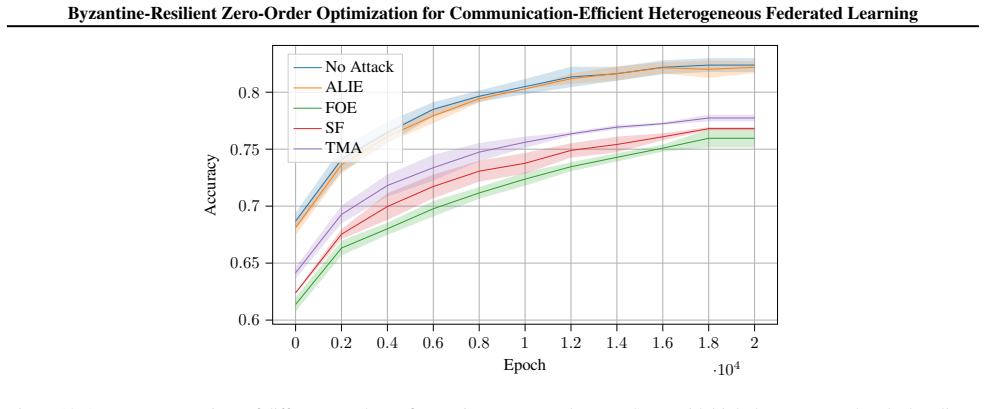
- Reported worst-case accuracy is close to full-gradient robust baselines on MNIST logistic regression and RoBERTa-large fine-tuning, with communication reduced by up to seven orders of magnitude.
Reading between the lines
- The sharpest gap the paper leaves open is its own: the general convergence theorem needs ν=Θ(d), and the Lipschitz theorem keeps a d/ν term, so the ν=1 regime that gives the largest communication savings is not yet covered by the proof; a bound that stays finite at constant ν would close the gap.
- A testable consequence of Theorem 5.9's d/ν scaling is that, with the total number of perturbation-function evaluations νT held fixed, accuracy should be roughly independent of ν; the paper's fine-tuning results are consistent with this, and checking it across model sizes would test the bound's tightness.
- The shared-seed projection trick suggests a natural extension: replace uniform random directions with data-dependent subspaces that capture the dominant gradient directions, which could keep ν small without paying the Johnson-Lindenstrauss dimension penalty.
- Because the experiments attack the projected scalars rather than the full gradients, the reported robustness is specifically about the low-dimensional bottleneck; a follow-up question is whether an adversary who knows the seed and the aggregation rule can craft projected updates that defeat the rule even when the honest projected spread is small.
Editorial analysis
A structured set of objections, weighed in public.
Referee Report
Summary. The paper proposes CYBER-0, a federated zero-order optimization algorithm that combines random perturbation directions, local epochs, a shared-seed pseudorandom direction protocol, and transformed robust aggregation in a low-dimensional perturbation space. The central claim is that CYBER-0 is Byzantine-resilient under general non-convex losses and bounded data heterogeneity, with convergence proved for arbitrary (b,κ)-robust aggregation rules, and with uplink/downlink communication reduced to a few scalars per round. The empirical section reports accuracy on MNIST logistic regression and RoBERTa-large fine-tuning tasks that is comparable to full-gradient Byzantine-resilient baselines, with up to seven orders of magnitude communication savings in the fine-tuning experiments.
Significance. The algorithmic idea is attractive and timely: combining zero-order estimation with robust aggregation in the perturbation space genuinely reduces communication in a Byzantine setting, and the empirical study is broad, covering multiple attacks, aggregation rules, heterogeneity levels, and LLM fine-tuning tasks. If the convergence theory were valid, this would be a substantial advance for communication-efficient robust FL. The paper also deserves credit for explicitly discussing the design trade-off between unbiased and biased local estimators and for performing sensitivity studies over ν, K, and the Byzantine ratio. However, the theoretical guarantees as stated do not cover the regime (ν = 1) that motivates the strongest communication claims, and a load-bearing proof step applies a Johnson–Lindenstrauss lemma in the wrong dimension direction.
major comments (5)
- [Appendix B.1, Lemma B.5 and Eq. (9)] Lemma B.5 is applied in the wrong dimension direction. The lemma states that for Z ∈ R^{ν×d} with rows uniform on S^{d−1}, the map x ↦ Zx nearly preserves norms of x ∈ R^d when ν ≥ 64ε^{-2} log(2/δ). In Algorithm 1, however, Z_{t,ℓ} is d×ν with columns as perturbation vectors, and the robustness term in Eq. (9) (and Eq. (22)) is E‖Z_{t,ℓ}(R_{t,ℓ} − ḡ_H)‖², where R_{t,ℓ} − ḡ_H ∈ R^ν. Bounding this term requires a near-isometry from R^ν to R^d, i.e., a condition of the form Z^T Z ≈ I_ν, which holds when d ≥ C ν ε^{-2} log(...), not when ν ≥ 64ε^{-2} log(...). The condition in the lemma is therefore reversed relative to what the proof needs, and the transfer of (b,κ)-robustness from R^ν to R^d is not established by the written argument.
- [Theorem 5.9] Theorem 5.9 does not bridge the gap to ν = 1. The final bound contains explicit d/ν factors, in particular the term 2η φ²G²d/ν (1/(5|H|) + 2Kε′κ + 8/|H|²), so for fixed d and ν = 1 this term is of order d and cannot be made small by the stated condition ν ≥ 64 log(2(|H|−1)TK/Δ) alone. Moreover, Theorem 5.7 already requires ν = Θ(d) for the condition c3 + c4c1 ≤ 1/2 to hold, as the paper itself notes. The claim that the analysis covers the ν = 1 empirical regime is therefore unsupported.
- [Theorem 5.9 and Lemma B.13] The symbol φ is never defined. It appears in the statement of Theorem 5.9, in Lemma B.10, and in Lemma B.13, and the convergence bound depends on φ², but the paper does not specify what φ is or what assumptions on it are needed. Without a definition, the theorem cannot be evaluated or used.
- [Lemma B.5] The statement of Lemma B.5 contains a sign typo: it reads (1−ε)‖x‖² ≤ ‖Zx‖² ≤ (1−ε)‖x‖², but the upper bound should be (1+ε)‖x‖². In addition, the condition as written allows ε = 1 at ν = 64 log(2/δ), which makes the denominator (1−ε) in Eq. (9) zero; the strict condition ε < 1 requires ν > 64 log(2/δ), not ν ≥ 64 log(2/δ). These are presentation issues in the lemma statement, but they matter because the lemma is the cornerstone of the robustness transfer.
- [Appendix B.1, Eq. (9) and Eq. (22)] Even if the dimension direction of Lemma B.5 were corrected, the proof applies the preservation bound to a single draw of Z_{t,ℓ} and then claims a union bound over |H| + 1 projections. The same random matrix is used for all honest clients in a round, so the events are not independent, and the union bound as written does not account for the dependence. The high-probability statement in Theorem 5.7 and Theorem 5.9 therefore needs a more careful probabilistic justification.
minor comments (5)
- [Section 3.1] There are typos such as 'aggregagation' in the bullet on transformed robust aggregation and 'al clients' in the same section; these should be corrected.
- [Appendix A.4] The text contains typos 'expecially' and 'normlized' in the local-epoch comparison section; please proofread the appendix.
- [Theorem 5.7] The condition (b) is stated as ν ≥ 64 log(2(|H|−1)TK/Δ), but the proof requires ε < 1 to keep the factor (1−ε) positive; the condition should be strict (ν > 64 log(...)) or the theorem should state ε < 1 explicitly.
- [Appendix B.1.1, Lemma B.7] The extracted lemma from Wang et al. (2025) is stated with a term 3L + 3ζ²‖·‖² that appears dimensionally inconsistent; a factor of 1/|H| or an expectation is likely missing. Please verify the statement against the source.
- [Table 6] The table in Appendix A.7 is referenced in the main text as 'Table 6' for i.i.d. results, but the numbering and the preceding sentence in Section 4.3 are confusing; please align the table captions with the in-text references.
Circularity Check
No significant circularity: the convergence bounds are derived from explicit assumptions and external lemmas, and the self-citations are not load-bearing.
full rationale
The paper's central theoretical claim is not circular. The convergence guarantees in Theorems 5.7 and 5.9 are proven from explicit assumptions (Assumptions 5.1-5.4 and 5.8) through a chain of intermediate lemmas (Lemmas B.1-B.7), with constants c1-c5 obtained as explicit bounds rather than fitted to the empirical results. The robustness transfer is justified by an external Johnson-Lindenstrauss statement (Lemma B.5, quoted as Proposition 8 of Li 2024) and the external (b, kappa)-robustness framework of Allouah et al. The self-citations in the paper are descriptive: the authors note that the preliminary version (Neto et al., 2024) treated a convex i.i.d. special case, but that result is not used to derive the non-convex heterogeneous convergence claim. The heterogeneity model is imported from Wang et al. (2025), which is independent external work. The paper also openly states the limitation that Theorem 5.7 requires nu = Theta(d), and Theorem 5.9 is presented with an explicitly added Assumption 5.8 to address the nu = 1 regime; this is an honest and visible assumption, not a parameter silently renamed as a prediction. The skeptic's concern that Lemma B.5 is applied in the wrong dimension direction would, if substantiated, be a correctness or validity flaw in the proof, not a circularity: the conclusion is not identified with an input by construction. Overall, no claim reduces to its own assumptions, and no fitted value is presented as a prediction.
Assumptions & free parameters
free parameters (4)
- ν (number of random perturbations) =
1 for LLM fine-tuning; 64 for MNIST experiments
- η (learning rate) =
0.01 for MNIST, 10^-6 for fine-tuning
- µ (perturbation scale) =
0.001 for both experiment suites
- K (local epochs) =
varied, e.g., 1, 3, 5, 10 in ablation
assumptions (7)
- domain assumption Assumption 5.1: Each local loss has L-Lipschitz gradients
- domain assumption Assumption 5.2: Bounded gradient estimation variance σ^2
- domain assumption Assumption 5.3: Bounded gradient divergence between each client and the honest average, ζ^2
- domain assumption Assumption 5.4: Pseudo-Lipschitz condition on averaged gradients with constant D^2
- domain assumption Assumption 5.8: Each local objective is G-Lipschitz
- standard math Johnson-Lindenstrauss embedding preserves Euclidean distances for ν random projections
- domain assumption The aggregation rule satisfies Definition 2.2 with (b,κ)-robustness
Cite this review
Pith. "Pith review of Byzantine-Resilient Zero-Order Optimization for Communication-Efficient Heterogeneous Federated Learning." pith.science (2026). https://pith.science/paper/PLAPXQH6
@misc{pith2026250200193,
  author       = {Pith},
  title        = {Pith review of: Byzantine-Resilient Zero-Order Optimization for Communication-Efficient Heterogeneous Federated Learning},
  year         = {2026},
  howpublished = {\url{https://pith.science/paper/PLAPXQH6}},
  note         = {Machine review of arXiv:2502.00193}
}
read the original abstract
We introduce CyBeR-0, a Byzantine-resilient federated zero-order optimization method that is robust under Byzantine attacks and provides significant savings in uplink and downlink communication costs. We introduce transformed robust aggregation to give convergence guarantees for general non-convex objectives under client data heterogeneity. Empirical evaluations for standard learning tasks and fine-tuning large language models show that CyBeR-0 exhibits stable performance with only a few scalars per-round communication cost and reduced memory requirements.
Figures


Figures from the paper (14 more)




Forward citations
Cited by 1 Pith paper
-
Private Aggregation for Byzantine-Resilient Heterogeneous Federated Learning
Nearest neighbor mixing can be composed with secure aggregation and private information retrieval to give information-theoretic privacy and Byzantine resilience for heterogeneous federated learning.
Reference graph
Works this paper leans on
-
[1]
Byzantine-resilient non-convex stochastic gradient descent
Allen-Zhu, Z., Ebrahimianghazani, F., Li, J., and Alistarh, D. Byzantine-resilient non-convex stochastic gradient descent. In International Conference on Learning Representations, 2021
work page 2021
-
[2]
Fixing by mixing: A recipe for optimal byzantine ml under heterogeneity
Allouah, Y., Farhadkhani, S., Guerraoui, R., Gupta, N., Pinot, R., and Stephan, J. Fixing by mixing: A recipe for optimal byzantine ml under heterogeneity. In International Conference on Artificial Intelligence and Statistics, pp.\ 1232--1300, 2023
work page 2023
-
[3]
Differential privacy has disparate impact on model accuracy
Bagdasaryan, E., Poursaeed, O., and Shmatikov, V. Differential privacy has disparate impact on model accuracy. Advances in neural information processing systems, 32, 2019
work page 2019
-
[4]
A little is enough: Circumventing defenses for distributed learning
Baruch, G., Baruch, M., and Goldberg, Y. A little is enough: Circumventing defenses for distributed learning. Advances in Neural Information Processing Systems, 32, 2019
work page 2019
-
[5]
M., Guerraoui, R., and Stainer, J
Blanchard, P., El Mhamdi, E. M., Guerraoui, R., and Stainer, J. Machine learning with adversaries: Byzantine tolerant gradient descent. Advances in neural information processing systems, 30, 2017
work page 2017
-
[6]
R., Angeli, G., Potts, C., and Manning, C
Bowman, S. R., Angeli, G., Potts, C., and Manning, C. D. A large annotated corpus for learning natural language inference. In Empirical Methods in Natural Language Processing, pp.\ 632--642, 2015
work page 2015
-
[7]
Charikar, M., Steinhardt, J., and Valiant, G. Learning from untrusted data. In ACM SIGACT Symposium on Theory of Computing, pp.\ 47--60, 2017
work page 2017
-
[8]
Fine-grained theoretical analysis of federated zeroth-order optimization
Chen, J., Chen, H., Gu, B., and Deng, H. Fine-grained theoretical analysis of federated zeroth-order optimization. In Neural Information Processing Systems, 2023
work page 2023
Show all 56 references
-
[9]
C., Jordan, M
Duchi, J. C., Jordan, M. I., Wainwright, M. J., and Wibisono, A. Optimal rates for zero-order convex optimization: The power of two function evaluations. IEEE Transactions on Information Theory, 61 0 (5): 0 2788--2806, 2015
2015
-
[10]
Private aggregation in wireless federated learning with heterogeneous clusters
Egger, M., Hofmeister, C., Wachter-Zeh, A., and Bitar, R. Private aggregation in wireless federated learning with heterogeneous clusters. In IEEE International Symposium on Information Theory (ISIT), pp.\ 54--59, 2023
2023
-
[11]
M., Farhadkhani, S., Guerraoui, R., Guirguis, A., Hoang, L.-N., and Rouault, S
El-Mhamdi, E. M., Farhadkhani, S., Guerraoui, R., Guirguis, A., Hoang, L.-N., and Rouault, S. Collaborative learning in the jungle (decentralized, byzantine, heterogeneous, asynchronous and nonconvex learning). Advances in neural information processing systems, 34: 0 25044--25...
2021
-
[12]
Local model poisoning attacks to byzantine-robust federated learning
Fang, M., Cao, X., Jia, J., and Gong, N. Local model poisoning attacks to byzantine-robust federated learning. In USENIX security symposium, pp.\ 1605--1622, 2020
2020
-
[13]
N., and Zhou, Y
Fang, W., Yu, Z., Jiang, Y., Shi, Y., Jones, C. N., and Zhou, Y. Communication-efficient stochastic zeroth-order optimization for federated learning. IEEE Transactions on Signal Processing, 70: 0 5058--5073, 2022
2022
-
[14]
D., Kalai, A
Flaxman, A. D., Kalai, A. T., and McMahan, H. B. Online convex optimization in the bandit setting: gradient descent without a gradient. In ACM-SIAM Symposium on Discrete Algorithms, pp.\ 385–394, 2005
2005
-
[15]
On the information-adaptive variants of the admm: an iteration complexity perspective
Gao, X., Jiang, B., and Zhang, S. On the information-adaptive variants of the admm: an iteration complexity perspective. Journal of Scientific Computing, 76: 0 327--363, 2018
2018
-
[16]
and Lan, G
Ghadimi, S. and Lan, G. Stochastic first- and zeroth-order methods for nonconvex stochastic programming. SIAM Journal on Optimization, 23 0 (4): 0 2341--2368, 2013
2013
-
[17]
Black-box adversarial attacks with limited queries and information
Ilyas, A., Engstrom, L., Athalye, A., and Lin, J. Black-box adversarial attacks with limited queries and information. In International Conference on Machine Learning, pp.\ 2137--2146, 2018
2018
-
[18]
A., Li, S., and Caire, G
Jahani-Nezhad, T., Maddah-Ali, M. A., Li, S., and Caire, G. SwiftAgg+ : Achieving asymptotically optimal communication loads in secure aggregation for federated learning. IEEE Journal on Selected Areas in Communications, 41 0 (4): 0 977--989, 2023
2023
-
[19]
and Lindenstrauss, J
Johnson, W. and Lindenstrauss, J. Extensions of lipschitz maps into a hilbert space. Contemporary Mathematics, 26: 0 189--206, 01 1984
1984
-
[20]
P., Rebjock, Q., Stich, S., and Jaggi, M
Karimireddy, S. P., Rebjock, Q., Stich, S., and Jaggi, M. Error feedback fixes SignSGD and other gradient compression schemes. In International Conference on Machine Learning, pp.\ 3252--3261, 2019
2019
-
[21]
P., He, L., and Jaggi, M
Karimireddy, S. P., He, L., and Jaggi, M. Byzantine-robust learning on heterogeneous datasets via bucketing. In International Conference on Learning Representations, 2022
2022
-
[22]
and Wolfowitz, J
Kiefer, J. and Wolfowitz, J. Stochastic Estimation of the Maximum of a Regression Function . The Annals of Mathematical Statistics, 23 0 (3): 0 462 -- 466, 1952
1952
-
[23]
Learning to detect malicious clients for robust federated learning
Li, S., Cheng, Y., Wang, W., Liu, Y., and Chen, T. Learning to detect malicious clients for robust federated learning. arXiv preprint arXiv:2002.00211, 2020
2002 arXiv
-
[24]
Simple, unified analysis of johnson-lindenstrauss with applications
Li, Y. Simple, unified analysis of johnson-lindenstrauss with applications. arXiv preprint arXiv:2402.10232, 2024
2024 arXiv
-
[25]
O., and Varshney, P
Liu, S., Chen, P.-Y., Kailkhura, B., Zhang, G., Hero III, A. O., and Varshney, P. K. A primer on zeroth-order optimization in signal processing and machine learning: Principals, recent advances, and applications. IEEE Signal Processing Magazine, 37 0 (5): 0 43--54, 2020
2020
-
[26]
Liu, S., Gupta, N., and Vaidya, N. H. Approximate byzantine fault-tolerance in distributed optimization. In ACM Symposium on Principles of Distributed Computing, pp.\ 379--389, 2021
2021
-
[27]
Roberta: A robustly optimized bert pretraining approach
Liu, Y. Roberta: A robustly optimized bert pretraining approach. arXiv preprint arXiv:1907.11692, 364, 2019
1907 arXiv
-
[28]
An efficient statistical-based gradient compression technique for distributed training systems
M Abdelmoniem, A., Elzanaty, A., Alouini, M.-S., and Canini, M. An efficient statistical-based gradient compression technique for distributed training systems. Proceedings of Machine Learning and Systems, 3: 0 297--322, 2021
2021
-
[29]
V., Bondaschi, M., Vogels, T., Jaggi, M., Kim, H., and Gastpar, M
Makkuva, A. V., Bondaschi, M., Vogels, T., Jaggi, M., Kim, H., and Gastpar, M. LASER : Linear compression in wireless distributed optimization. In International Conference on Machine Learning, 2024
2024
-
[30]
D., Chen, D., and Arora, S
Malladi, S., Gao, T., Nichani, E., Damian, A., Lee, J. D., Chen, D., and Arora, S. Fine-tuning language models with just forward passes. Advances in Neural Information Processing Systems, 36: 0 53038--53075, 2023
2023
-
[31]
McMahan, B., Moore, E., Ramage, D., Hampson, S., and y Arcas, B. A. Communication-efficient learning of deep networks from decentralized data. In Artificial intelligence and statistics, pp.\ 1273--1282, 2017
2017
-
[32]
Neto, A. d. S. D., Egger, M., Bakshi, M., and Bitar, R. Communication-efficient byzantine-resilient federated zero-order optimization. submitted to ICML 2024; arXiv preprint arXiv:2406.14362, 2024
2024 arXiv
-
[33]
Federated full-parameter tuning of billion-sized language models with communication cost under 18 kilobytes
Qin, Z., Chen, D., Qian, B., Ding, B., Li, Y., and Deng, S. Federated full-parameter tuning of billion-sized language models with communication cost under 18 kilobytes. arXiv preprint arXiv:2312.06353, 2023
2023 arXiv
-
[34]
Zeroth-order methods for nondifferentiable, nonconvex, and hierarchical federated optimization
Qiu, Y., Shanbhag, U., and Yousefian, F. Zeroth-order methods for nondifferentiable, nonconvex, and hierarchical federated optimization. Advances in Neural Information Processing Systems, 36, 2023
2023
-
[35]
V., Herrera, F., and Mart \' nez-C \'a mara, E
Rodr \' guez-Barroso, N., Jim \'e nez-L \'o pez, D., Luz \'o n, M. V., Herrera, F., and Mart \' nez-C \'a mara, E. Survey on federated learning threats: Concepts, taxonomy on attacks and defences, experimental study and challenges. Information Fusion, 90: 0 148--173, 2023
2023
-
[36]
Evolution strategies as a scalable alternative to reinforcement learning
Salimans, T., Ho, J., Chen, X., Sidor, S., and Sutskever, I. Evolution strategies as a scalable alternative to reinforcement learning. arXiv preprint arXiv:1703.03864, 2017
2017 arXiv
-
[37]
K., Moraes, M
Salmon, J. K., Moraes, M. A., Dror, R. O., and Shaw, D. E. Parallel random numbers: as easy as 1, 2, 3. In International conference for high performance computing, networking, storage and analysis, pp.\ 1--12, 2011
2011
-
[38]
Schlegel, R., Kumar, S., Rosnes, E., and i Amat, A. G. CodedPaddedFL and CodedSecAgg : Straggler mitigation and secure aggregation in federated learning. IEEE Transactions on Communications, 2023
2023
-
[39]
Auror: Defending against poisoning attacks in collaborative deep learning systems
Shen, S., Tople, S., and Saxena, P. Auror: Defending against poisoning attacks in collaborative deep learning systems. In Annual Conference on Computer Security Applications, pp.\ 508--519, 2016
2016
-
[40]
D., Ng, A
Socher, R., Perelygin, A., Wu, J., Chuang, J., Manning, C. D., Ng, A. Y., and Potts, C. Recursive deep models for semantic compositionality over a sentiment treebank. In Conference on empirical methods in natural language processing, pp.\ 1631--1642, 2013
2013
-
[41]
Multivariate stochastic approximation using a simultaneous perturbation gradient approximation
Spall, J. Multivariate stochastic approximation using a simultaneous perturbation gradient approximation. IEEE Transactions on Automatic Control, 37 0 (3): 0 332--341, 1992
1992
-
[42]
Private fine-tuning of large language models with zeroth-order optimization
Tang, X., Panda, A., Nasr, M., Mahloujifar, S., and Mittal, P. Private fine-tuning of large language models with zeroth-order optimization. CoRR, 2024 a
2024
-
[43]
Distributed zero-order algorithms for nonconvex multiagent optimization
Tang, Y., Zhang, J., and Li, N. Distributed zero-order algorithms for nonconvex multiagent optimization. IEEE Transactions on Control of Network Systems, 8 0 (1): 0 269--281, 2020
2020
-
[44]
z -SignFedAvg : A unified stochastic sign-based compression for federated learning
Tang, Z., Wang, Y., and Chang, T.-H. z -SignFedAvg : A unified stochastic sign-based compression for federated learning. In Proceedings of the AAAI Conference on Artificial Intelligence, volume 38, pp.\ 15301--15309, 2024 b
2024
-
[45]
A hybrid approach to privacy-preserving federated learning
Truex, S., Baracaldo, N., Anwar, A., Steinke, T., Ludwig, H., Zhang, R., and Zhou, Y. A hybrid approach to privacy-preserving federated learning. In ACM workshop on artificial intelligence and security, pp.\ 1--11, 2019
2019
-
[46]
P., and Jaggi, M
Vogels, T., Karimireddy, S. P., and Jaggi, M. PowerSGD : Practical low-rank gradient compression for distributed optimization. Advances in Neural Information Processing Systems, 32, 2019
2019
-
[47]
Voorhees, E. M. and Tice, D. M. Building a question answering test collection. In Annual international ACM SIGIR conference on Research and development in information retrieval, pp.\ 200--207, 2000
2000
-
[48]
Wang, J., Liu, Q., Liang, H., Joshi, G., and Poor, H. V. A novel framework for the analysis and design of heterogeneous federated learning. IEEE Transactions on Signal Processing, 69: 0 5234--5249, 2021
2021
-
[49]
A new theoretical perspective on data heterogeneity in federated optimization
Wang, J., Wang, S., Chen, R.-R., and Ji, M. A new theoretical perspective on data heterogeneity in federated optimization. In International Conference on Machine Learning, 2025
2025
-
[50]
H., Farokhi, F., Jin, S., Quek, T
Wei, K., Li, J., Ding, M., Ma, C., Yang, H. H., Farokhi, F., Jin, S., Quek, T. Q., and Poor, H. V. Federated learning with differential privacy: Algorithms and performance analysis. IEEE Transactions on Information Forensics and Security, 15: 0 3454--3469, 2020
2020
-
[51]
TernGrad : Ternary gradients to reduce communication in distributed deep learning
Wen, W., Xu, C., Yan, F., Wu, C., Wang, Y., Chen, Y., and Li, H. TernGrad : Ternary gradients to reduce communication in distributed deep learning. Advances in neural information processing systems, 30, 2017
2017
-
[52]
Fall of empires: Breaking byzantine-tolerant sgd by inner product manipulation
Xie, C., Koyejo, O., and Gupta, I. Fall of empires: Breaking byzantine-tolerant sgd by inner product manipulation. In Uncertainty in Artificial Intelligence, pp.\ 261--270, 2020
2020
-
[53]
Byzantine-robust distributed learning: Towards optimal statistical rates
Yin, D., Chen, Y., Kannan, R., and Bartlett, P. Byzantine-robust distributed learning: Towards optimal statistical rates. In International conference on machine learning, pp.\ 5650--5659, 2018
2018
-
[54]
Federated learning with non-iid data
Zhao, Y., Li, M., Lai, L., Suda, N., Civin, D., and Chandra, V. Federated learning with non-iid data. arXiv preprint arXiv:1806.00582, 2018
2018 arXiv
-
[55]
Federated learning on non-iid data: A survey
Zhu, H., Xu, J., Liu, S., and Jin, Y. Federated learning on non-iid data: A survey. Neurocomputing, 465: 0 371--390, 2021
2021
-
[56]
and Philip, S
Zhu, T. and Philip, S. Y. Applying differential privacy mechanism in artificial intelligence. In IEEE International Conference on Distributed Computing Systems (ICDCS), pp.\ 1601--1609, 2019
2019
Reviewed August 9, 2026 · model on record in the stance chip above.
Discussion (0). Continue with ORCID to comment.