REVIEW 2 major objections 6 minor 1 cited by
Minimal matroids in dependency posets: algorithms and applications to computing irreducible decompositions of circuit varieties
T0 review · 2 major / 6 minor · reviewed 2026-08-09 · deepseek-v4-flash
Pith's one-line read This paper presents an algorithm that computes all minimal matroids of a point-line configuration with respect to dependency order and uses them to decompose the circuit variety for five classical configurations.
desk verdict A real algorithmic result with a correct core; the X-matroid section has a genuine proof gap, but the main decomposition claims stand. read the letter →
The pith
A machine-rendered reading of the paper's core claim, the machinery that carries it, and where it could break.
The reading
What carries the argument
The central object is the dependency poset on matroids with a fixed ground set, ordered by $M \le N$ when every dependent set of $M$ is dependent in $N$; the paper computes $\min(M)$, the minimal elements strictly above $M$. The search engine is a depth-first traversal of formulas $F$ made of atoms $(x \sim y)$ and $(x \not\sim y)$: each formula prescribes which points are identified, and the lines of $M$ become a collapsed hypergraph $(L)_F$ on the equivalence classes. A formula has property $\Pi_X$ when no two edges of $(L)_F$ share more than one point; for such formulas Lemma 3.18 guarantees a unique minimal matroid $M_F$ realizing the formula's identifications. The class $B$ is handled by a separate walk over triples $x \notin C_3(M)$ that constructs minimal line extensions $M_x$, and the class $C$ is settled by the pointwise criterion of Lemma 3.30. The decomposition itself is carried by Proposition 4.1, which expresses $\mathrm{VC}(M)$ as $V_M$ together with the union of $\mathrm{VC}(N)$ over $N \in \min(M)$.
What would settle it
For the quadrilateral set QS, the paper reports that $\min\{A\}$ consists of 25 matroids up to automorphism. An independent brute-force enumeration of all rank-three matroids $N$ with $QS < N$, $\mathrm{C}_1(N) = \emptyset$, and $\mathrm{C}_2(N) \neq \emptyset$ would either reproduce those 25 orbits or refute Algorithm 3.35's correctness.
Extended reading notes
Core claim
The paper's central claim is that the set $\min(M)$ of minimal matroids of a point-line configuration $M$ can be computed by a terminating algorithm, and that this set is exactly what is needed to decompose the circuit variety $\mathrm{VC}(M)$. The algorithm partitions the matroids above $M$ into three classes: $A$ (no loops, some double points), $B$ (no loops and no double points), and $C$ (some loops). For $A$, a depth-first search over formulas $F$ that specify which points are identified builds a collapsed hypergraph $(L)_F$ from the lines of $M$; formulas whose collapsed lines intersect pairwise in at most one point have a unique minimal matroid above $M$, and the search visits enough formulas to cover every matroid in $A$. For $B$, the algorithm walks through triples $x$ that are not circuits of $M$, forming minimal extensions $M_x$ and sieving them for minimality. For $C$, the loop matroids $M^{(i)}$ are minimal precisely for points $i$ satisfying the three conditions of Lemma 3.30. Assembled as Algorithm 3.35, these pieces output $\min(M)$ (Theorem 3.36), and Proposition 4.1 gives $\mathrm{VC}(M) = (\bigcup_{N \in \min(M)} \mathrm{VC}(N)) \cup V_M$. Applying this identity recursively and replacing nilpotent and solvable circuit varieties via Theorem 2.13 yields the irreducible decompositions displayed for the five configurations.
Load-bearing premise
The load-bearing premise is that the depth-first search over formulas never prunes away a branch needed to certify some minimal matroid in class A, so the completeness proof in Theorem 3.21 is what holds the whole algorithm together.
Editorial extensions
If this is right
- For any point-line configuration $M$, the circuit variety satisfies $\mathrm{VC}(M) = V_M \cup \bigcup_{N \in \min(M)} \mathrm{VC}(N)$, so computing minimal matroids yields a finite first decomposition.
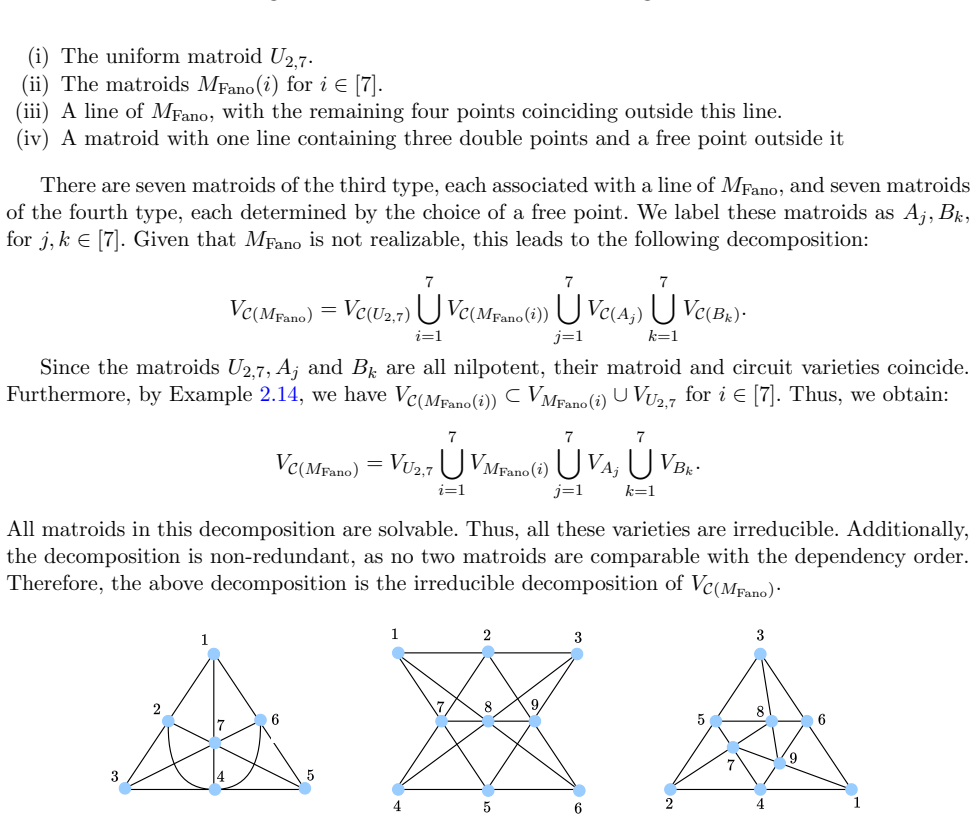
- The irreducible decompositions of the circuit varieties of the Fano plane, the MacLane configuration, the affine plane of order three, the Pappus configuration, and the second $9_3$ configuration are obtained explicitly, and the paper states that existing computer algebra systems cannot perform these computations.
- The same iterative recipe—decompose through $\min(M)$, reduce nilpotent and solvable circuit varieties by Theorem 2.13, and remove redundant matroid varieties—is proposed as a general strategy for point-line configurations.
- The Jackson–Tanigawa conjecture does not extend to its converse as stated: Example 6.5 gives a unique minimal $X$-matroid whose associated $\mathrm{val}_X$ is not a matroid rank function; the paper's refined function $v_X$ and Conjecture 6.11 provide a modified uniqueness criterion.
Reading between the lines
- Because only the A-class requires the exponential search over formulas, symmetric configurations with large automorphism groups are the natural testbed for scaling Algorithm 3.35; generic asymmetric configurations are likely to be the hard cases.
- If Conjecture 6.11 holds, the function $v_X$ would give a computable rank bound that decides uniqueness of the minimal $X$-matroid, which could translate directly into rigidity and low-rank matrix completion settings where $X$-matroids appear.
- The decompositions presented here could serve as a useful first step toward the defining equations of the associated matroid ideals, which the paper explicitly leaves open for configurations with points of degree greater than two.
Editorial analysis
A structured set of objections, weighed in public.
Referee Report
Summary. The paper studies point-line configurations, viewed as rank-three simple matroids, and their minimal matroids in the dependency order (the reverse of weak order). It proposes Algorithm 3.35, which computes the full set min(M) by separately handling matroids with double points (A), matroids with no loops or double points (B), and matroids with loops (C), using Algorithms 3.20, 3.27, and 3.33. The authors then use Proposition 4.1 to decompose the circuit variety VC(M) as a union of circuit varieties of these minimal matroids together with VM, and apply the resulting strategy to obtain irreducible decompositions for the Fano plane, MacLane configuration, affine plane of order three, Pappus configuration, and the second 9_3 configuration (Section 5). A final section relates the computation to X-matroids and proposes a refinement of a conjecture of Jackson and Tanigawa.
Significance. If the algorithmic and decomposition claims are correct, this is a useful contribution: it gives an explicit, implementable method for computing minimal matroids of point-line configurations and produces irreducible decompositions of circuit varieties for several classical configurations that are not accessible to current computer algebra systems. The paper is strengthened by the availability of an implementation and by the fact that the central algorithmic claims are backed by constructive proofs rather than by parameter fitting. I do not share the stress-test concern about Lemma 3.30, Case 3.2: in M(i), the set l\{i} has rank 2 with closure the line l, and because j is not on l, adjoining j gives rank 3; the presence of the dependent triple {j,k,r} does not cap the rank at 2. However, two parts of the manuscript need substantive revision: the proof of well-definedness of v_X in Section 6 contains an unjustified equality, and the infinitesimal-perturbation arguments of Section 7 are informal in a way that leaves the redundancy eliminations in Section 5 not fully proven.
major comments (2)
- [§6, Lemma 6.7] The proof of well-definedness of v_X is not valid as written. In Case 1, the chain of inequalities uses the equality v'_X(A∩B) = min{|A∩B|, |x|-1}, justified by the claim that this holds because x∈X and condition (i) does not hold for v'_X. Failure of condition (i) gives only the inequality v'_X(A∪B) ≤ v'_X(A)+v'_X(B)-min{|A∩B|,|x|-1}; it does not determine the value of v'_X on A∩B. The needed inequality is v'_X(A∩B) ≥ min{|A∩B|,|x|-1}, which would follow if v'_X were known to be an upper bound for the rank of every X-matroid, but that is exactly the content of Lemma 6.9, which is proved later and itself relies on the construction. Thus the confluence proof is incomplete or circular, and Definition 6.6 and Conjecture 6.11 are not established by the arguments given. The authors should either prove Lemma 6.9 first and use the lower bound v'_X(S) ≥ min{|S|,|x|-1} for S⊆x, or supply a different argument for confluence.
- [§7, Lemmas 5.4–5.6] The redundancy eliminations in Section 5 depend on perturbation arguments of the form: take a realization γ of the smaller matroid N, substitute parameters such as ε or λ that are 'infinitesimally close' to a limiting value, and assert that the resulting matrices realize the larger matroid M. To make these proofs rigorous, the authors should state and prove a general criterion: if there is a rational (or analytic) family γ(t) ∈ Γ_M for t in a punctured neighborhood of 0 with lim_{t→0} γ(t) = γ, then γ ∈ V_M. They should also verify explicitly that, for the matrices displayed in (7.4)–(7.12), the base-minor nonvanishing conditions define a Zariski open set, so that the finitely many additional polynomial conditions defining N can be avoided by an arbitrarily small perturbation. As written, the phrase 'taking ε infinitesimally close to 0' leaves open the possibility that some base minor vanishes identically on the chosen family; the authors should check each displayed family. Since Lemmas 5.4–5.6 are used to discard redundant components in the final irreducible decompositions, this formal gap is load-bearing for the main examples.
minor comments (6)
- [§3.1, Theorem 3.21] The proof of correctness of Algorithm 3.20 shows that every N∈A lies above some element of the final set Z, but it does not explicitly justify that the final comparison step removes exactly the non-minimal elements of A, so that Z equals min(A). This is easy to add: if M_F∈Y were not minimal in A, an N<M_F would, by Claim 2, lie above some N'∈Z, forcing M_F to be discarded in the comparison. Please include this argument.
- [§3.1, proof of Lemma 3.10] The proof of Lemma 3.10 says 'Applying Lemma 3.10 to the formula F=...' but the intended reference is Lemma 3.7, which is the lemma about minimal hypergraphs with forbidden intersections.
- [§5.4, Lemma 5.4(iii)] In Lemma 5.4(iii), the notation 'VC(C_k)=VC_k' appears to be a typo; it should read 'VC(C_k)=V_{C_k}', since the equality asserted is between the circuit variety and the matroid variety of a nilpotent matroid.
- [References [15,16,17]] References [15], [16], and [17] all list the same arXiv identifier 2403.13718 with different titles. Please correct the identifiers or clarify whether these are distinct papers that share a preprint number by error.
- [§6, Lemma 6.9] The word 'upper bond' in the proof of Lemma 6.9 should be 'upper bound'.
- [§5, non-redundancy checks] The phrase 'it is straightforward to verify that this decomposition is non-redundant' appears several times in Section 5. Given that the computations are claimed to be inaccessible to standard computer algebra systems, it would be helpful to state a concrete criterion (for example, pairwise incomparability of the relevant matroids in dependency order, together with distinctness of the corresponding varieties) or to include an auxiliary verification script.
Circularity Check
No significant circularity: the minimal-matroid algorithm and decomposition strategy are derived from definitions and independent prior theorems, with no output reduced to an input by construction.
full rationale
The paper's central chain—Algorithm 3.35 for min(M), Proposition 4.1 for VC(M), and the iterative decomposition strategy of Section 4—is not circular. Algorithm 3.20 is an exhaustive depth-first search over formulas, with correctness proved in Theorem 3.21 from the definition of Reali_M(F); Algorithm 3.27 is proved from Lemma 3.26; and Algorithm 3.33 is a direct translation of the three conditions in Lemma 3.30. Proposition 4.1 has a self-contained proof: any vector configuration in VC(M) either realizes M or defines a matroid strictly above M, hence lies in VC(N) for some N in min(M), with termination of the recursion guaranteed by the finite dependency poset. The paper does lean on the authors' earlier Theorem 2.13, quoted as 'We recall the following result from [16,17] on nilpotent and solvable point-line configurations,' but that theorem has stated assumptions about nilpotent/solvable configurations and does not restate the present conclusions; it is used as an independent prior result, and the examples additionally use external input such as [5, Table 4.1] and [11, Theorem 4.5]. The concern raised about Lemma 3.30, Case 3.2, concerns a rank computation in the sufficiency proof and is a correctness issue, not a circularity: no equation in the paper makes a predicted decomposition equal to a fitted parameter or defines a key object in terms of the very output it is supposed to produce.
Assumptions & free parameters
assumptions (5)
- domain assumption Theorem 2.13: For nilpotent/solvable point-line configurations, circuit varieties equal matroid varieties or unions with uniform matroids, and solvable matroid varieties are irreducible or empty.
- domain assumption Theorem 7.5 from [11]: configurations admitting an m-perturbation have moduli spaces described by a small set of polynomial equations.
- domain assumption The irreducible components of VM for MacLane, affine plane, Pappus, and the second 9_3 configuration are as stated in [5, Table 4.1].
- standard math Standard matroid axioms, Zariski closure definitions, and algebraic geometry facts about closures of images.
- ad hoc to paper The DFS in Algorithm 3.20, with the rule to push only formulas not already in the stack, eventually visits every formula F in Pi_X needed to capture all N in A.
Cite this review
Pith. "Pith review of Minimal matroids in dependency posets: algorithms and applications to computing irreducible decompositions of circuit varieties." pith.science (2026). https://pith.science/paper/55KMQAQD
@misc{pith2026250200799,
  author       = {Pith},
  title        = {Pith review of: Minimal matroids in dependency posets: algorithms and applications to computing irreducible decompositions of circuit varieties},
  year         = {2026},
  howpublished = {\url{https://pith.science/paper/55KMQAQD}},
  note         = {Machine review of arXiv:2502.00799}
}
read the original abstract
We study point-line configurations, their minimal matroids, and their associated circuit varieties. We present an algorithm for identifying the minimal matroids of these configurations with respect to dependency order, or equivalently, the maximal matroids with respect to weak order, and use it to determine the irreducible decomposition of their corresponding circuit varieties. Our algorithm is applied to several classical configurations, including the Fano matroid, affine plane of order three, MacLane, and Pappus configurations. Additionally, we explore the connection to a conjecture by Jackson and Tanigawa, which provides a criterion for the uniqueness of the minimal matroids.
Figures


Figures from the paper (8 more)


Forward citations
Cited by 1 Pith paper
-
Algebraic Geometry of Cactus, Pascal, and Pappus Matroids
For cactus, Pascal, and Pappus configurations, the matroid ideal is generated, up to radical, by circuit, Grassmann-Cayley, and liftability polynomials.
Reference graph
Works this paper leans on
-
[17]
Paving matroids: defining equations and associated varieties
Emiliano Liwski and Fatemeh Mohammadi. Paving matroids: defining equations and associated varieties. arXiv preprint arXiv:2403.13718 , 2024
arXiv 2024
-
[1]
Gr¨ obner bases and determinantal ideals
Winfried Bruns and Aldo Conca. Gr¨ obner bases and determinantal ideals. In Commutative Algebra, Singularities and Computer Algebra , pages 9–66. Springer Netherlands, 2003
work page 2003
-
[2]
Lattice conditional independence models and Hibi ideals
Peter Caines, Fatemeh Mohammadi, Eduardo S´ aenz-de Cabez´ on, and Henry Wynn. Lattice conditional independence models and Hibi ideals. Transactions of the London Mathematical Society, 9(1):1–19, 2022
work page 2022
-
[3]
Oliver Clarke, Kevin Grace, Fatemeh Mohammadi, and Harshit Motwani. Matroid stratifications of hypergraph varieties, their realization spaces, and discrete conditional independence models. International Mathematics Research Notices , 2022
work page 2022
-
[4]
Charles Colbourn and Rudolf Mathon. Steiner systems. In Handbook of Combinatorial Designs , pages 128–135. Chapman and Hall/CRC, 2006
work page 2006
-
[5]
Singular matroid realization spaces
Daniel Corey and Dante Luber. Singular matroid realization spaces. arXiv preprint arXiv:2307.11915, 2023. 31
work page Pith review arXiv 2023
-
[6]
Combinatorial geometries, convex polyhedra, and schubert cells
Israel Gelfand, Mark Goresky, Robert MacPherson, and Vera Serganova. Combinatorial geometries, convex polyhedra, and schubert cells. Advances in Mathematics, 63(3):301–316, 1987
work page 1987
-
[7]
Jack E Graver. Rigidity matroids. SIAM Journal on Discrete Mathematics , 4(3):355–368, 1991
work page 1991
Show all 23 references
-
[8]
Graver, Brigitte Servatius, and Herman Servatius
Jack E. Graver, Brigitte Servatius, and Herman Servatius. Combinatorial rigidity . Number 2. American Mathematical Soc., 1993
1993
-
[9]
Configurations and Steiner systems s(2, 4, 25)
Harald Gropp. Configurations and Steiner systems s(2, 4, 25). ii. trojan configurations n3. Combinatorics, 88:425–435, 1991
1991
-
[10]
Configurations and their realization
Harald Gropp. Configurations and their realization. Discrete Mathematics , 174(1-3):137–151, 1997
1997
-
[11]
Connectivity and combinatorial interplay in the moduli space of line arrangements
Benoit Guerville-Balle and Juan Viu-Sos. Connectivity and combinatorial interplay in the moduli space of line arrangements. arXiv preprint arXiv:2309.00322 , 2023
2023 arXiv
-
[12]
Maximal matroids in weak order posets
Bill Jackson and Shin-ichi Tanigawa. Maximal matroids in weak order posets. Journal of Combinatorial Theory, Series B , 165:20–46, 2024
2024
-
[13]
Mn¨ ev-sturmfels universality for schemes
Seok Hyeong Lee and Ravi Vakil. Mn¨ ev-sturmfels universality for schemes. A celebration of algebraic geometry, 18:457–468, 2013
2013
-
[14]
Topics on Steiner systems
Charles C Lindner and Alexander Rosa. Topics on Steiner systems . Elsevier, 2011
2011
-
[18]
On the connectivity of the realization spaces of line arrangements
Shaheen Nazir and Masahiko Yoshinaga. On the connectivity of the realization spaces of line arrangements. Annali della Scuola Normale Superiore di Pisa-Classe di Scienze , 11(4):921–937, 2012
2012
-
[19]
Matroid Theory
James Oxley. Matroid Theory. Second edition, Oxford University Press, 2011
2011
-
[20]
Piff and Dominic J.A
Mike J. Piff and Dominic J.A. Welsh. On the vector representation of matroids. Journal of the London Mathematical Society, 2(2):284–288, 1970
1970
-
[21]
Rybnikov
Grigori L. Rybnikov. On the fundamental group of the complement of a complex hyperplane arrangement. Functional Analysis and Its Applications , 45(2):137–148, 2011
2011
-
[22]
The maximum matroid of a graph
Meera Sitharam and Andrew Vince. The maximum matroid of a graph. arXiv preprint arXiv:1910.05390, 2, 2019
1910 arXiv
-
[23]
Murphy’s law in algebraic geometry: badly-behaved deformation spaces
Ravi Vakil. Murphy’s law in algebraic geometry: badly-behaved deformation spaces. Inventiones mathematicae, 164(3):569–590, 2006
2006
-
[24]
Some matroids from descrete applied geometry , volume 197
Walter Whiteley. Some matroids from descrete applied geometry , volume 197. Contemporary Mathematics, 1996
1996
-
[25]
On the abstract properties of linear dependence
Hassler Whitney. On the abstract properties of linear dependence. Hassler Whitney Collected Papers, pages 147–171, 1992. 32 Authors’ addresses Department of Mathematics, KU Leuven, Leuven, Belgium E-mail address: emiliano.liwski@kuleuven.be E-mail address: fatemeh.mohammadi@ku...
1992
Reviewed August 9, 2026 · model on record in the stance chip above.
Discussion (0). Continue with ORCID to comment.