REVIEW 3 major objections 4 minor 5 cited by
From Words to Collisions: LLM-Guided Evaluation and Adversarial Generation of Safety-Critical Driving Scenarios
T0 review · 3 major / 4 minor · reviewed 2026-08-09 · deepseek-v4-flash
Pith's one-line read The paper claims that an LLM prompted with ego-centric driving descriptions can evaluate collision and safety-critical scenarios and adversarially edit an agent's trajectory to turn a safe scene into a collision.
desk verdict The evaluation half is solid and the ego-prompt finding is the real contribution; the generation half leans on a self-scored LLM prompt and a single case study, so that claim is not yet supported. read the letter →
The pith
A machine-rendered reading of the paper's core claim, the machinery that carries it, and where it could break.
The reading
What carries the argument
The load-bearing mechanism is the ego-centric parser and prompt template, Promptego, contrasted with the Cartesian Promptcart. The parser re-expresses every agent's state in longitudinal and lateral coordinates relative to the ego vehicle, adding motion phrases such as 'approaching the EV longitudinally from the front', so the LLM receives a driver's-perspective description rather than absolute coordinates. The prompt stacks Contextual Prompting, which defines safety metrics such as time-to-collision and minimum distance to collision, with Chain-of-Thought reasoning and In-Context Learning examples. The generation module adds Self-Consistency, sampling several adversarial trajectories and selecting the one with the lowest LLM-assigned risk score.
What would settle it
Re-run every generated trajectory through the paper's 2D simulator with its motion planner and compare outcomes against the original safe runs; if the LLM-selected trajectories do not cause a significantly higher rate of collisions, near-misses, or metric values below critical thresholds, the generation claim fails. In parallel, run the collision evaluator on a fresh held-out set of simulated scenarios and check its verdicts against simulator ground truth.
Extended reading notes
Core claim
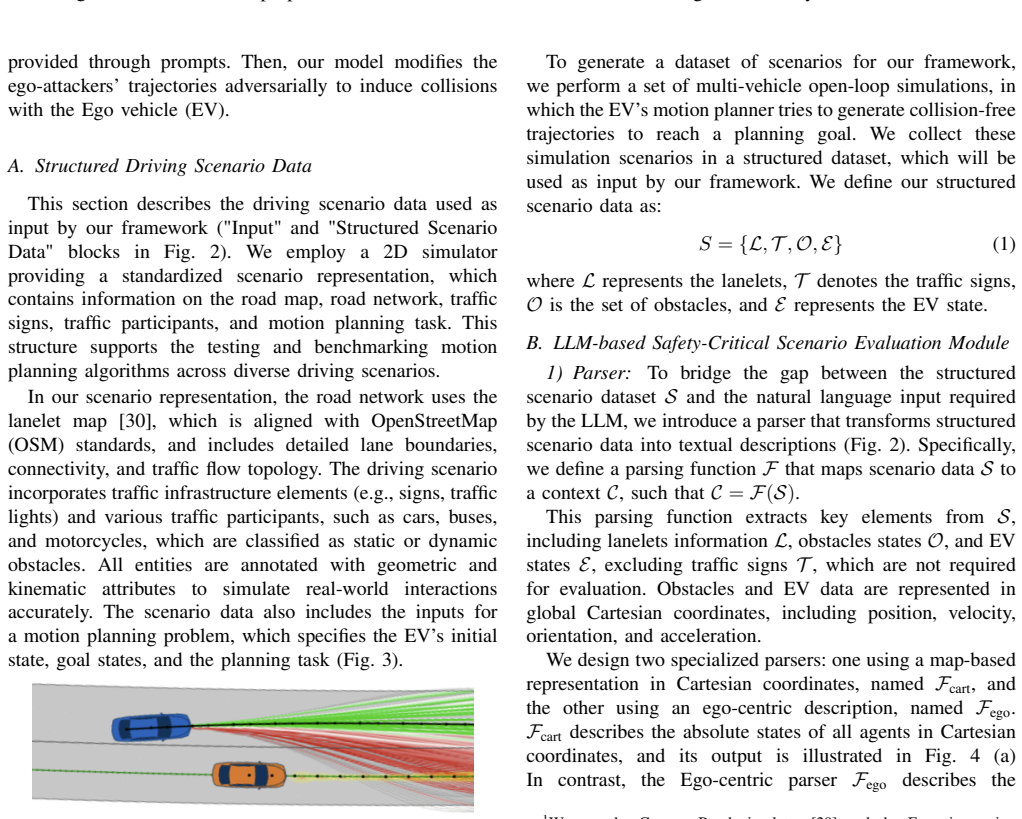
The authors claim that LLMs can act as both evaluator and generator of safety-critical driving scenarios. They compare two prompt families, Cartesian and ego-centric, and find the ego-centric representation is consistently superior: for Gemini-1.5Pro, F1 rises from 0.21 to 0.87 in collision evaluation and from 0.62 to 0.83 in safety inference, with DeepSeek-V3 reaching 0.90 and 0.87 on the same tasks. The generator uses a safety-metric prompt to score each obstacle, identifies an ego-attacker, creates multiple candidate trajectories through self-consistency, and keeps the candidate with the lowest risk score, producing a case where the ego-attacker's risk score falls over time and ends in collision. The paper concludes that this reduces dependence on handcrafted metrics while remaining controllable.
Load-bearing premise
The generation module's reported success is measured by the same LLM risk-score prompt that selected the trajectory, and the only validation is a single visualized case study, so the claim of realistic safety-critical generation assumes that self-scored risk drops correspond to genuinely critical driving situations.
Editorial extensions
If this is right
- Scenario evaluators can flag collisions and predict imminent risk directly from structured log data, without a human re-reading metric traces.
- The ego-centric framing, not the particular model, drives most of the gain, since all three tested LLMs perform far better with Promptego than with Promptcart.
- Adding Contextual Prompting, Chain-of-Thought, and In-Context Learning together improves the ego-prompt collision F1 from 0.70 to 0.87.
- The generation module offers a controllable way to produce targeted critical scenarios by editing one risk-inducing agent, complementing data-driven and knowledge-based generators.
- The safety inference output can serve as an online supplementary risk signal for motion planners, although the paper notes the current response time is seconds rather than real time.
Reading between the lines
- Beyond the paper, the same ego-centric relabeling could extend to vision-language models operating on camera views or rendered scenes, since the gain seems to come from spatial framing rather than from text generation itself.
- Beyond the paper, the generation module should be validated by re-simulating the generated trajectories and checking collisions or metric thresholds; the current evidence is one case study whose outcome is scored by the same prompt that selected it.
- Beyond the paper, a natural next test is to feed generated scenarios to a motion planner and measure how frequently it fails, converting scenario quality into a downstream safety statistic.
- Beyond the paper, the method reduces rather than eliminates handcrafted metrics, because metric thresholds still appear as prompt context and as the ground truth used to label the evaluation data.
Editorial analysis
A structured set of objections, weighed in public.
Referee Report
Summary. This paper proposes an LLM-based framework with two modules: an evaluation module that converts structured CommonRoad scenario data into natural-language descriptions via Cartesian or ego-centric parsers and prompts (with contextual prompting, chain-of-thought, and in-context learning), and a generation module that identifies an ego-attacker and adversarially modifies its trajectory to create safety-critical scenarios. The evaluation is tested on 200 randomly selected scenarios from a 6000-scenario simulation dataset; ego-centric prompts reach F1 0.87 for collision evaluation and 0.83 for safety inference with Gemini-1.5Pro, with ablations and comparisons across three LLMs. The generation module is validated by one case study and a plot of the selected trajectory's risk score over time. The paper argues that LLMs with domain-informed prompting can reduce dependence on handcrafted safety metrics.
Significance. If the evaluation results hold up, the ego-centric prompt design is a useful contribution: the ablations show clear gains from CP, CoT, and ICL, the comparison across three LLMs is informative, and the open-source release supports reproducibility. The collision-evaluation claim is not circular because the labels are external simulator collisions. The generation direction is novel—using an LLM to select an ego-attacker and synthesize adversarial trajectories—but the evidence for it is currently much weaker than for evaluation. The absence of baselines and uncertainty quantification for the evaluation, and the self-scored generation validation, mean the central two-part claim is only partially established.
major comments (3)
- [§III-C.2 and §IV-D] The central claim that the generation module 'synthesizes realistic, safety-critical scenarios' is supported only by the selected candidate's LLM-assigned risk score decreasing over time (Fig. 8) and by a single visualized case study (Fig. 9, BEL Antwerp-1_14_T-1). Because the same safety-critical metrics prompt is used both to score candidate trajectories under Self-Consistency and to produce the reported post-generation risk scores, the selection criterion and the evaluation metric coincide; a low risk score on a modified trajectory may reflect prompt bias rather than genuine safety-criticality. The authors should re-simulate the generated trajectories with the Frenetix planner for a distribution of generated scenarios, recompute TTC/MDC and collision outcomes from the modified geometry, and compare against a random trajectory-perturbation or rule-based attacker baseline.
- [§IV-B and §IV-C, Tables I–IV] The evaluation use cases report F1 scores without any comparison to the TTC/MDC threshold classifiers from which the ground-truth labels are derived (Section IV-A), and the prompts explicitly embed the same kinds of thresholds (Section III-B.2). A simple threshold-based baseline is therefore the natural lower bound for these tasks, and its omission leaves unclear how much the LLM adds over handcrafted metrics. Please add such baselines for both collision evaluation and safety inference, and report the threshold values used.
- [§IV-A and §III-C.2] The abstract's claim of 'reducing dependence on handcrafted metrics' is not reflected in the design details: TTC/MDC thresholds are handcrafted in the prompts, the same thresholds generate the ground truth for safety inference, and the generation module's ego-attacker selection depends on unspecified risk-score thresholds and a spatial search radius. Since these free parameters directly affect the reported F1 scores and the generation outcomes, they should be stated explicitly, and a sensitivity analysis should be provided for at least the main thresholds.
minor comments (4)
- [Table II] For GPT-4o and DeepSeek-V3, the confusion-matrix entries sum to 204 rather than 200 for both prompt types; please correct or explain the discrepancy.
- [Fig. 8] The mapping from TTC/MDC values to the 0–5 risk score is not defined; please state the thresholds and describe how the plotted risk scores are computed.
- [§IV-D] The text contains a likely typo: 'within 30 min front' should presumably read 'within 30 m in front'; other minor spacing errors (e.g., 'outcome,i.e.') should also be corrected.
- [§IV-C] The safety-inference results are point estimates from a single 100/100 scenario split without confidence intervals; given LLM API stochasticity, reporting intervals over repeated splits or samples would make the cross-model differences in Tables II and IV interpretable.
Circularity Check
Generation module is self-scored: the same LLM risk prompt both selects the adversarial trajectory and serves as the reported success metric; evaluation module remains independently grounded.
-
self definitional
[Section III-C.2, Prompt Formulations]
"To enhance the generation performance, we apply Self-Consistency (SC) by prompting the model to produce multiple adversarial trajectory candidates for the same ego-attacker. Each candidate is scored using the safety-critical metrics prompt, and the one with a low-risk score for the ego-attacker is selected."
The same safety-critical metrics prompt is used both to assess obstacle risk and to score every candidate trajectory. Selecting the candidate with the lowest LLM-assigned risk score means the generator's output is, by construction, the trajectory that this prompt deems most critical. Any later claim that the generated scenario is safety-critical because its risk score is low is therefore restating the selection criterion, not an independent evaluation.
-
self definitional
[Section IV-D, Generation of Safety-Critical Scenarios and Fig. 8]
"To assess the effectiveness of our framework, we conduct a case study using a scenario from the previous 4,700 safe scenarios from Sec IV-A. As shown in Fig. 8 and 9, the original scenario is safe, and the ego-attacker's trajectory has a safe risk level. Conversely, in the generated scenario, the ego-attacker's modified trajectory has a decreasing risk score over time (Fig. 8), ultimately leading to a collision."
The reported evidence for generation success is the decreasing risk score of the selected trajectory, but that trajectory was chosen precisely because the same safety-critical metrics prompt assigned it the lowest risk score. Thus Fig. 8's quantitative result is forced by the selection procedure. The only external anchor is a single visualized collision in Fig. 9; there is no re-simulation with the Frenetix planner, no recomputation of TTC/MDC on the modified geometry, and no distribution over generated scenarios. The generation module's central quantitative claim therefore reduces to the LLM grading its own output.
full rationale
Collision evaluation and safety inference (Sections IV-B and IV-C) are not circular: the ground-truth collision labels come from the CommonRoad/Frenetix simulator, the TTC/MDC risk labels are computed externally, and the LLM predictions are compared against those labels, e.g., F1=0.87 with Promptego. The ablation studies and cross-LLM comparisons are self-contained. The circularity is confined to the generation module. In Section III-C.2 the same safety-critical metrics prompt is used to score candidate adversarial trajectories, and the candidate with the lowest LLM-assigned risk score is selected. Section IV-D then uses that same risk score's decrease (Fig. 8) as the evidence that a safety-critical scenario was generated. The quantitative success measure is identical to the selection objective, so the reported risk-drop is forced by construction. The single visualized collision in Fig. 9 provides one external check, but it does not validate the quantitative claim across scenarios, and no re-simulation or independent metric recomputation is reported. The self-cited survey [17] and co-authored simulator reference [31] are used for context and tooling, not as load-bearing evidence. Overall score 6: the evaluation pillar is independent, while the generation pillar's central quantitative claim partially reduces to the model scoring its own output.
Assumptions & free parameters
free parameters (3)
- TTC/MDC risk-score thresholds =
not reported
- Ego-attacker search radius =
30 m
- Safety-inference history window =
10 timesteps (1 s)
assumptions (4)
- domain assumption TTC and MDC are valid indicators of safety criticality
- domain assumption LLM-assigned risk scores correlate with collision likelihood
- domain assumption CommonRoad 2D scenarios with Frenetix planner represent realistic driving situations
- domain assumption The selected 200 scenarios are representative of the 6000-scenario dataset
Cite this review
Pith. "Pith review of From Words to Collisions: LLM-Guided Evaluation and Adversarial Generation of Safety-Critical Driving Scenarios." pith.science (2026). https://pith.science/paper/5FZ5HJWT
@misc{pith2026250202145,
  author       = {Pith},
  title        = {Pith review of: From Words to Collisions: LLM-Guided Evaluation and Adversarial Generation of Safety-Critical Driving Scenarios},
  year         = {2026},
  howpublished = {\url{https://pith.science/paper/5FZ5HJWT}},
  note         = {Machine review of arXiv:2502.02145}
}
read the original abstract
Ensuring the safety of autonomous vehicles requires virtual scenario-based testing, which depends on the robust evaluation and generation of safety-critical scenarios. So far, researchers have used scenario-based testing frameworks that rely heavily on handcrafted scenarios as safety metrics. To reduce the effort of human interpretation and overcome the limited scalability of these approaches, we combine Large Language Models (LLMs) with structured scenario parsing and prompt engineering to automatically evaluate and generate safety-critical driving scenarios. We introduce Cartesian and Ego-centric prompt strategies for scenario evaluation, and an adversarial generation module that modifies trajectories of risk-inducing vehicles (ego-attackers) to create critical scenarios. We validate our approach using a 2D simulation framework and multiple pre-trained LLMs. The results show that the evaluation module effectively detects collision scenarios and infers scenario safety. Meanwhile, the new generation module identifies high-risk agents and synthesizes realistic, safety-critical scenarios. We conclude that an LLM equipped with domain-informed prompting techniques can effectively evaluate and generate safety-critical driving scenarios, reducing dependence on handcrafted metrics. We release our open-source code and scenarios at: https://github.com/TUM-AVS/From-Words-to-Collisions.
Figures


Figures from the paper (5 more)


Forward citations
Cited by 5 Pith papers
-
CrashAgent: Crash Scenario Generation via Multi-modal Reasoning
A multi-agent vision-language framework converts NHTSA crash reports into simulation-ready road layouts and collision scenarios, with modest accuracy gains over direct VLM baselines.
-
A Survey on Evaluating Quality and Trustworthiness in LLM-Generated Data
A metric-oriented survey that classifies intrinsic quality and trustworthiness metrics for LLM-generated data across six modalities and documents systematic evaluation gaps in the current literature.
-
Generative AI for Testing of Autonomous Driving Systems: A Survey
A systematic survey that organizes 91 studies of generative AI for autonomous driving testing into six scenario-based tasks and catalogs 27 limitations.
-
AutoODD: Agentic Audits via Bayesian Red Teaming in Black-Box Models
AutoODD combines an LLM agent with per-axis Gaussian Process uncertainty to automatically discover failure modes of black-box models, demonstrated on missing-digit MNIST and aircraft detect-and-avoid.
-
LLM Harms: A Taxonomy and Discussion
This paper proposes a taxonomy of LLM harms in five categories and suggests mitigation strategies plus a dynamic auditing system for responsible development.
Reference graph
Works this paper leans on
-
[1]
J. Betz, M. Lutwitzi, and S. Peters, “A new taxonomy for automated driving: Structuring applications based on their operational design domain, level of automation and automation readiness,” in 2024 IEEE Intelligent V ehicles Symposium (IV) , 2024, pp. 1–7
work page 2024
-
[2]
Safety testing of automated driving systems: A literature review,
F. Khan, M. Falco, H. Anwar, and D. Pfahl, “Safety testing of automated driving systems: A literature review,” IEEE Access , 2023
work page 2023
-
[3]
Survey on scenario-based safety assessment of automated vehicles,
S. Riedmaier, T. Ponn, D. Ludwig, B. Schick, and F. Diermeyer, “Survey on scenario-based safety assessment of automated vehicles,” IEEE access , vol. 8, pp. 87 456–87 477, 2020
work page 2020
-
[4]
Simulation-based identification of critical scenarios for cooperative and automated vehicles,
S. Hallerbach, Y . Xia, U. Eberle, and F. Koester, “Simulation-based identification of critical scenarios for cooperative and automated vehicles,” SAE International Journal of Connected and Automated V ehicles, vol. 1, no. 2018-01-1066, pp. 93–106, 2018
work page 2018
-
[5]
Language models are few-shot learners,
T. Brown, B. Mann, N. Ryder, M. Subbiah, J. D. Kaplan, P. Dhariwal, A. Neelakantan, P. Shyam, G. Sastry, A. Askell et al. , “Language models are few-shot learners,” Advances in neural information processing systems, vol. 33, pp. 1877–1901, 2020
1901
-
[6]
Attention is all you need,
A. Vaswani, “Attention is all you need,” Advances in Neural Information Processing Systems , 2017
2017
-
[7]
A systematic survey of prompt engineering in large language models: Techniques and applications,
P. Sahoo, A. K. Singh, S. Saha, V . Jain, S. Mondal, and A. Chadha, “A systematic survey of prompt engineering in large language models: Techniques and applications,” arXiv preprint arXiv:2402.07927 , 2024
arXiv 2024
-
[8]
Language prompt for autonomous driving,
D. Wu, W. Han, T. Wang, Y . Liu, X. Zhang, and J. Shen, “Language prompt for autonomous driving,” arXiv preprint arXiv:2309.04379 , 2023
arXiv 2023
Show all 36 references
-
[9]
Dualad: Dual-layer planning for reasoning in autonomous driving,
D. Wang, M. Kaufeld, and J. Betz, “Dualad: Dual-layer planning for reasoning in autonomous driving,” arXiv preprint arXiv:2409.18053 , 2024
2024 arXiv
-
[10]
Drivegpt4: Interpretable end-to-end autonomous driving via large language model,
Z. Xu, Y . Zhang, E. Xie, Z. Zhao, Y . Guo, K.-Y . K. Wong, Z. Li, and H. Zhao, “Drivegpt4: Interpretable end-to-end autonomous driving via large language model,” IEEE Robotics and Automation Letters , 2024
2024
-
[11]
Critical scenario identification for realistic testing of autonomous driving systems,
Q. Song, K. Tan, P. Runeson, and S. Persson, “Critical scenario identification for realistic testing of autonomous driving systems,” Software Quality Journal , vol. 31, no. 2, pp. 441–469, 2023
2023
-
[12]
Reality bites: Assessing the realism of driving scenarios with large language models,
J. Wu, C. Lu, A. Arrieta, T. Yue, and S. Ali, “Reality bites: Assessing the realism of driving scenarios with large language models,” in Proceedings of the 2024 IEEE/ACM First International Conference on AI F oundation Models and Software Engineering , 2024, pp. 40–51
2024
-
[13]
Deepscenario: An open driving scenario dataset for autonomous driving system testing,
C. Lu, T. Yue, and S. Ali, “Deepscenario: An open driving scenario dataset for autonomous driving system testing,” in 2023 IEEE/ACM 20th International Conference on Mining Software Repositories (MSR). IEEE, 2023, pp. 52–56
2023
-
[14]
A comprehensive llm-powered framework for driving intelligence evaluation,
S. You, X. Luo, X. Liang, J. Yu, C. Zheng, and J. Gong, “A comprehensive llm-powered framework for driving intelligence evaluation,” arXiv preprint arXiv:2503.05164 , 2025
2025 arXiv
-
[15]
CARLA: An open urban driving simulator,
A. Dosovitskiy, G. Ros, F. Codevilla, A. Lopez, and V . Koltun, “CARLA: An open urban driving simulator,” in Proceedings of the 1st Annual Conference on Robot Learning , 2017, pp. 1–16
2017
-
[16]
Multimodal large language model driven scenario testing for autonomous vehicles,
Q. Lu, X. Wang, Y . Jiang, G. Zhao, M. Ma, and S. Feng, “Multimodal large language model driven scenario testing for autonomous vehicles,” arXiv preprint arXiv:2409.06450 , 2024
2024 arXiv
-
[17]
Foundation models in autonomous driving: A survey on scenario generation and scenario analysis,
Y . Gao, M. Piccinini, Y . Zhang, D. Wang, K. Moller, R. Brusnicki, B. Zarrouki, A. Gambi, J. F. Totz, K. Stormset al., “Foundation models in autonomous driving: A survey on scenario generation and scenario analysis,” IEEE Open Journal of Intelligent Transportation Systems , 2...
2025
-
[18]
A survey on safety-critical driving scenario generation—a methodological perspective,
W. Ding, C. Xu, M. Arief, H. Lin, B. Li, and D. Zhao, “A survey on safety-critical driving scenario generation—a methodological perspective,” IEEE Transactions on Intelligent Transportation Systems, vol. 24, no. 7, pp. 6971–6988, 2023
2023
-
[19]
Factor graph scene distributions for automotive safety analysis,
T. A. Wheeler and M. J. Kochenderfer, “Factor graph scene distributions for automotive safety analysis,” in 2016 IEEE 19th International Conference on Intelligent Transportation Systems (ITSC). IEEE, 2016, pp. 1035–1040
2016
-
[20]
A new multi-vehicle trajectory generator to simulate vehicle-to-vehicle encounters,
W. Ding, W. Wang, and D. Zhao, “A new multi-vehicle trajectory generator to simulate vehicle-to-vehicle encounters,” arXiv preprint arXiv:1809.05680, 2018
2018 arXiv
-
[21]
Analyzing and improving neural networks by generating semantic counterexamples through differentiable rendering,
L. Jain, V . Chandrasekaran, U. Jang, W. Wu, A. Lee, A. Yan, S. Chen, S. Jha, and S. A. Seshia, “Analyzing and improving neural networks by generating semantic counterexamples through differentiable rendering,” arXiv preprint arXiv:1910.00727 , 2019
1910 arXiv
-
[22]
Corner case generation and analysis for safety assessment of autonomous vehicles,
H. Sun, S. Feng, X. Yan, and H. X. Liu, “Corner case generation and analysis for safety assessment of autonomous vehicles,” Transportation research record, vol. 2675, no. 11, pp. 587–600, 2021
2021
-
[23]
Building safer autonomous agents by leveraging risky driving behavior knowledge,
A. Rana and A. Malhi, “Building safer autonomous agents by leveraging risky driving behavior knowledge,” in 2021 International Conference on Communications, Computing, Cybersecurity, and Informatics (CCCI) . IEEE, 2021, pp. 1–6
2021
-
[24]
Robust trajectory prediction against adversarial attacks,
Y . Cao, D. Xu, X. Weng, Z. Mao, A. Anandkumar, C. Xiao, and M. Pavone, “Robust trajectory prediction against adversarial attacks,” in Conference on Robot Learning . PMLR, 2023, pp. 128–137
2023
-
[25]
Microscopic traffic simulation using sumo,
P. A. Lopez, M. Behrisch, L. Bieker-Walz, J. Erdmann, Y .-P. Flötteröd, R. Hilbrich, L. Lücken, J. Rummel, P. Wagner, and E. Wießner, “Microscopic traffic simulation using sumo,” in The 21st IEEE International Conference on Intelligent Transportation Systems . IEEE, 2018. [Onl...
2018
-
[26]
Chatscene: Knowledge-enabled safety-critical scenario generation for autonomous vehicles,
J. Zhang, C. Xu, and B. Li, “Chatscene: Knowledge-enabled safety-critical scenario generation for autonomous vehicles,” in Proceedings of the IEEE/CVF Conference on Computer Vision and Pattern Recognition, 2024, pp. 15 459–15 469
2024
-
[27]
Traffic scene generation from natural language description for autonomous vehicles with large language model,
B.-K. Ruan, H.-T. Tsui, Y .-H. Li, and H.-H. Shuai, “Traffic scene generation from natural language description for autonomous vehicles with large language model,” arXiv preprint arXiv:2409.09575 , 2024
2024
-
[28]
Chatsumo: Large language model for automating traffic scenario generation in simulation of urban mobility,
S. Li, T. Azfar, and R. Ke, “Chatsumo: Large language model for automating traffic scenario generation in simulation of urban mobility,” IEEE Transactions on Intelligent V ehicles , 2024
2024
-
[29]
Commonroad: Composable benchmarks for motion planning on roads,
M. Althoff, M. Koschi, and S. Manzinger, “Commonroad: Composable benchmarks for motion planning on roads,” in 2017 IEEE Intelligent V ehicles Symposium (IV). IEEE, 2017, pp. 719–726
2017
-
[30]
Lanelets: Efficient map representation for autonomous driving,
P. Bender, J. Ziegler, and C. Stiller, “Lanelets: Efficient map representation for autonomous driving,” in 2014 IEEE Intelligent V ehicles Symposium Proceedings. IEEE, 2014, pp. 420–425
2014
-
[31]
Frenetix: A high-performance and modular motion planning framework for autonomous driving,
R. Trauth, K. Moller, G. Würsching, and J. Betz, “Frenetix: A high-performance and modular motion planning framework for autonomous driving,” IEEE Access , pp. 1–1, 2024
2024
-
[32]
Gpt-4 technical report,
J. Achiam, S. Adler, S. Agarwal, L. Ahmad, I. Akkaya, F. L. Aleman, D. Almeida, J. Altenschmidt, S. Altman, S. Anadkat et al. , “Gpt-4 technical report,” arXiv preprint arXiv:2303.08774 , 2023
2023 arXiv
-
[33]
Structgpt: A general framework for large language model to reason over structured data,
J. Jiang, K. Zhou, Z. Dong, K. Ye, W. X. Zhao, and J.-R. Wen, “Structgpt: A general framework for large language model to reason over structured data,” arXiv preprint arXiv:2305.09645 , 2023
2023 arXiv
-
[34]
Gemini: a family of highly capable multimodal models,
G. Team, R. Anil, S. Borgeaud, J.-B. Alayrac, J. Yu, R. Soricut, J. Schalkwyk, A. M. Dai, A. Hauth, K. Millican et al. , “Gemini: a family of highly capable multimodal models,” arXiv preprint arXiv:2312.11805, 2023
2023 arXiv
-
[35]
Deepseek llm: Scaling open-source language models with longtermism,
X. Bi, D. Chen, G. Chen, S. Chen, D. Dai, C. Deng, H. Ding, K. Dong, Q. Du, Z. Fu et al. , “Deepseek llm: Scaling open-source language models with longtermism,” arXiv preprint arXiv:2401.02954 , 2024
2024 arXiv
-
[36]
Mptree: A sampling-based vehicle motion planner for real-time obstacle avoidance,
M. Piazza, M. Piccinini, S. Taddei, and F. Biral, “Mptree: A sampling-based vehicle motion planner for real-time obstacle avoidance,” IF AC-PapersOnLine, vol. 58, no. 10, pp. 146–153, 2024, 17th IFAC Symposium on Control of Transportation Systems CTS 2024
2024
Reviewed August 9, 2026 · model on record in the stance chip above.
Discussion (0). Continue with ORCID to comment.