REVIEW 3 major objections 5 minor 1 cited by
Harnessing omnipresent oscillator networks as computational resource
T0 review · 3 major / 5 minor · reviewed 2026-08-08 · deepseek-v4-flash
Pith's one-line read An autonomous Kuramoto oscillator network, trained on a chaotic signal and then closed on a learned readout, can reproduce the target attractor and its long-term climate once coupling exceeds a critical value.
desk verdict A genuine empirical step for oscillator-based reservoir computing, with an overreaching 'universal' framing and an unverified synchronization mechanism; deserves peer review. read the letter →
The pith
A machine-rendered reading of the paper's core claim, the machinery that carries it, and where it could break.
The reading
What carries the argument
Two objects carry the argument. The first is the complex order parameter $r(t)e^{i\Psi(t)} = \frac{1}{N}\sum_k e^{i\theta_k(t)}$; Kuramoto's identity rewrites the all-to-all coupling sum as $r \sin(\Psi - \theta_k)$, reducing vector-field evaluation from $O(N^2)$ to $O(N)$ and providing the collective observable through which learning is diagnosed. The second is the closed-loop readout substitution $u \mapsto W' f(\theta)$, with $f(\theta) = [1, \sin\theta, \sin^2\theta]$ and $W'$ obtained by ridge regression; it converts the input-driven system into the autonomous oscillator network whose long-term behavior is then classified using order-parameter bifurcations, consecutive-minima maps, Lyapunov exponents, and rotation numbers.
What would settle it
Train the Lorenz task with the reported parameters ($N=1000$, $F=37.545$, $K=20.680$, $c=1.159$), close the loop, integrate for about ten training lengths, and compute the three leading Lyapunov exponents of the autonomous network; if they fail to match $\lambda \approx (0.91,\,0,\,-14.57)$ within the paper's tolerance, the climate-reproduction claim is refuted. Alternatively, scan $K$ below the reported $K_c^{\mathrm{res}}$ with fixed $F$: if the consecutive-minima map of $r$ ever shows a Lorenz-like wing-switching structure, the claimed learning bifurcation is not where the paper places it.
Extended reading notes
Core claim
On the paper's own terms, the central discovery is that the autonomous Kuramoto oscillator network is a viable dynamical-system learner: synchronization to the input imprints the target dynamics, and once the feedback loop is closed the network keeps producing the target attractor and its climate. The collective computation is explainable through the complex order parameter $r(t)e^{i\Psi(t)}$, whose radius $r$ generates a consecutive-minima map whose domains encode whether the Lorenz trajectory stays on a wing or switches wings, reproducing the symbolic dynamics of the original chaotic system. For fixed forcing $F$, the network undergoes a learning bifurcation in the coupling $K$: above a critical $K_c^{\mathrm{res}}$ the order parameter traces a Lorenz-like pattern indefinitely, while below it the dynamics collapses into incoherence or a stationary state. A positive rotation number for any oscillator signals that the learned geometry will eventually be forgotten, giving a diagnostic for long-term failure.
Load-bearing premise
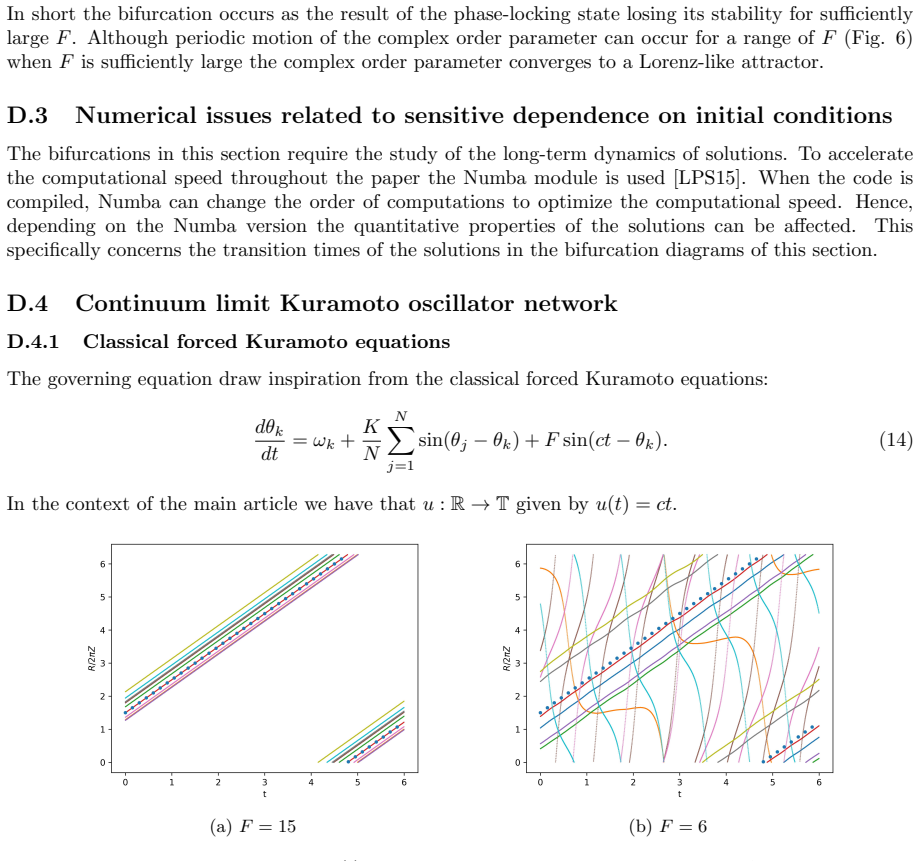
The load-bearing premise is that the trained readout keeps approximating the input after the input is removed, meaning the closed-loop network remains on the synchronization manifold established during training; the paper's analytical support proves this only for a constant input, not for a chaotic one.
Editorial extensions
If this is right
- All-to-all coupled oscillator networks can be used as computational resources with per-step cost linear in the number of oscillators, making large networks feasible.
- Successful configurations are abundant rather than finely tuned, so the network can be configured by satisfying a synchronization condition.
- The order parameter's time series provides an interpretable signature of what the collective has learned about the target attractor's symbolic dynamics.
- Oscillators with a nonzero rotation number signal that the learned geometry will be destroyed, giving an early-warning test for long-term prediction.
- The same driving, training, and closing procedure carries over to other chaotic targets and to Kuramoto-like interaction functions with different connectivity.
Reading between the lines
- Because the order parameter alone encodes the attractor's symbolic dynamics, a readout built from only $r$ and $\Psi$ might suffice for some tasks, which would make physical implementations cheaper; the paper does not test this.
- The rotation-number and consecutive-minima diagnostics could be monitored online, turning them into a drift alarm that flags when a physical oscillator network is about to lose its learned dynamics.
- The paper's genericity argument suggests that any hardware whose phase dynamics is approximately Kuramoto-like could inherit the same training recipe, but the paper does not demonstrate this on hardware.
Editorial analysis
A structured set of objections, weighed in public.
Referee Report
Summary. The manuscript proposes a reservoir-computing framework in which a Kuramoto oscillator network is driven by a target time series, trained with a ridge-regression readout f(theta)=[1,sin(theta),sin^2(theta)], and then closed into an autonomous feedback system (Eq. 2) that is claimed to emulate the target attractor. The central demonstrations use the Lorenz system: the autonomous oscillator network reproduces the attractor, its short-term predictions are accurate in a parameter region, its Lyapunov spectrum matches the Lorenz climate, and the order parameter r(t) exhibits a return-map structure with symbolic dynamics similar to the Lorenz stretching-and-folding mechanism. Additional tasks include Kuramoto-Sivashinsky, Mackey-Glass, NARMA10, a stacked music-generation architecture, and a partial replication for the Rössler system. The authors also show that the all-to-all coupling can be evaluated in O(N) time using the complex order parameter, and they analyze failure cases through the rotation number.
Significance. If the central mechanism is as claimed, this is a valuable contribution to physical reservoir computing: it shows that a ubiquitous oscillator model can be trained to become an autonomous generative model of a chaotic attractor, with linear-time simulation and a proposed order-parameter-based explanation. The paper's strengths include a reproducible code repository, multiple benchmark tasks, explicit Lyapunov-exponent comparisons against the Lorenz climate, a Rössler replication, an analytic continuum-limit treatment for constant inputs, and a clear statement of parameter values. The main reservation is that the synchronization-based explanation is asserted for chaotic inputs without direct numerical verification, and the 'universal' and 'generically successful' claims exceed what the presented evidence supports.
major comments (3)
- [Section 2.4 and SI D.4.2] The central claim that training succeeds because the forced reservoir synchronizes to the chaotic input, and that the autonomous network (Eq. 2) remains on the resulting generalized synchronization manifold, is not verified. No master-slave synchronization error between two reservoirs driven by the same Lorenz input is reported, and no conditional Lyapunov exponents transverse to the putative manifold are computed. The only analytical support, SI D.4.2, treats constant input u(t)=ct and explicitly leaves the M=3 chaotic case outside its scope. This is load-bearing because the failure mode in Fig. 4d (rotation-number drift) is precisely a departure from the learned geometry. Please add numerical generalized-synchronization diagnostics, or if that is not feasible, reformulate the explanation as an empirical observation rather than a synchronization mechanism.
- [Abstract and Section 3] The phrases 'universal framework' and 'generically successful' go beyond the evidence. For the chosen readout, random search over the parameter space yields NMSE<0.01 in 52.45% of samples (Table 3), and the additional benchmarks were configured by random search without a reported success-rate distribution. The paper demonstrates a working instance and a plausible parameter regime, but not genericity or universality. Please either provide success-rate statistics over a clearly defined parameter distribution for the Lorenz task and the benchmarks, or weaken the claims accordingly.
- [Section 2.5] The order-parameter symbolic-dynamics 'explanation' is post hoc: the domains I1-I4 are identified after training on the same trajectory that the network reproduces. This is a legitimate and informative description, but it does not by itself establish that the network learned the chaos-generating mechanism; it shows that r(t) carries information correlated with wing transitions. Please state this limitation explicitly or provide a predictive test, for example using the symbolic map to forecast a wing transition before it occurs.
minor comments (5)
- [Abstract] The abstract contains a typo: 'sychronization' should be 'synchronization'.
- [Section 2.6] In the attractor-type condition, 'lambda_res^2 < 0' should read 'lambda_res^3 < 0'; the text otherwise lists only two inequalities after 'lambda_res^2 = 0'.
- [SI F.2.2] The text refers to '(Fig. 5d) of the main paper', but the corresponding figure in the main paper is Fig. 4d; please correct the cross-reference.
- [SI B.3.1] The sentence 'the input has been divided by 30.92 which is the divisor of c divided by 10^3' is unclear; please clarify the scaling convention used for the Lorenz input.
- [Section 2.2] The notation is inconsistent: the equations use index k for oscillators, while the text says 'with 1<=k<=N and where omega_k...' and elsewhere refers to the 'ith oscillator'; please align the index terminology.
Circularity Check
No significant circularity: the core reservoir train/test split is genuine; order-parameter and self-citation elements are post hoc or non-load-bearing.
full rationale
The main derivation is a standard reservoir-computing train/test split: the readout W' is fitted by ridge regression to the input-driven Kuramoto system (1) over [0,100), and the autonomous feedback system (2) is then evaluated against Lorenz data on [100,...) that were not used in the fit. The stated success measures (NMSE on [100,102], Lyapunov exponents on [100,1100], rotation number) are external performance criteria, so the central 'prediction' is not equivalent to its input by construction. The order-parameter analysis in Section 2.5 is an observable of the already-trained network; it does not enter the training objective or parameter selection, so it is interpretive/post hoc rather than a fitted parameter renamed as a prediction. The only analytical synchronization argument, SI D.4.2, explicitly restricts itself to constant input u(t)=ct and states that the full M-dimensional chaotic case is 'outside the scope of the Supplementary Information'; this is a genuine limitation of supporting evidence, not a circular reduction. Self-citations in the paper ([dJAT+23] for numerical acceleration, [BdJD+24] for a chemical-reservoir analogy) are not load-bearing for the central claim, and no uniqueness theorem or ansatz is imported from the authors' prior work to force the result. Overall, the central derivation is self-contained and empirically tested against external benchmarks, so no significant circularity is present.
Assumptions & free parameters
free parameters (9)
- K (coupling strength) =
20.680 (Lorenz task)
- F (forcing strength) =
37.545 (Lorenz task)
- c (input/feedback strength) =
1.159 (Lorenz task)
- input scaling divisor =
30.92
- readout function f =
[1, sin, sin^2]
- ridge regularization epsilon =
1e-5
- N (oscillator count) =
1000 (500 also works)
- benchmark parameters (KS/MG/NARMA10) =
e.g., KS N=9000, F=47.27, K=32.17, c=0.271; MG F=68.5, K=52.2, c=0.872; NARMA10 F=14.3, K=1, c=0.1
- natural frequency distribution =
omega ~ 2*pi*N(1,1)
assumptions (5)
- standard math Ott-Antonsen ansatz and the continuum limit are valid for the forced Kuramoto model when natural frequencies are Cauchy distributed.
- domain assumption The input-driven network (1) enters a generalized synchronization state with the chaotic input during training, and the closed loop (2) remains on this manifold.
- domain assumption The readout span of [1, sin(theta), sin^2(theta)] is expressive enough to approximate the target input on the attractor.
- domain assumption The order parameter's consecutive-minima map is a faithful representation of the target attractor's symbolic dynamics.
- standard math The chosen numerical schemes (RK4, Gram-Schmidt Lyapunov computation) converge sufficiently for the reported invariant estimates.
Cite this review
Pith. "Pith review of Harnessing omnipresent oscillator networks as computational resource." pith.science (2026). https://pith.science/paper/XAQQNX5I
@misc{pith2026250204818,
  author       = {Pith},
  title        = {Pith review of: Harnessing omnipresent oscillator networks as computational resource},
  year         = {2026},
  howpublished = {\url{https://pith.science/paper/XAQQNX5I}},
  note         = {Machine review of arXiv:2502.04818}
}
read the original abstract
Nature is pervaded with oscillatory dynamics. In networks of coupled oscillators patterns can arise when the system synchronizes to an external input. Hence, these networks provide processing and memory of input. We present a universal framework for harnessing oscillator networks as computational resource. This computing framework is introduced by the ubiquitous model for phase-locking, the Kuramoto model. We force the Kuramoto model by a nonlinear target-system, then after substituting the target-system with a trained feedback-loop it emulates the target-system. Our results are two-fold. Firstly, the trained network inherits performance properties of the Kuramoto model, where all-to-all coupling is performed in linear time with respect to the number of nodes and parameters for synchronization are abundant. The latter implies that the network is generically successful since the system learns via sychronization. Secondly, the learning capabilities of the oscillator network, which describe a type of collective intelligence, can be explained using Kuramoto model's order parameter. In summary, this work provides the foundation for utilizing nature's oscillator networks as a new class of information processing systems.
Figures


Figures from the paper (14 more)




Forward citations
Cited by 1 Pith paper
-
Designing learning in high dimensional oscillator networks with low dimensional read-out
A mean-field Kuramoto reservoir with only population-averaged phases as read-out can predict time series, with numerical evidence that chaotic Lorenz dynamics need at least four oscillator populations.
Reference graph
Works this paper leans on
-
[1]
Antonsen, R.T
T.M. Antonsen, R.T. Faghih, M. Girvan, E. Ott, and J. Platig. External periodic driving of large systems of globally coupled phase oscillators. Chaos: An Interdisciplinary Journal of Nonlinear Science , 18(3), 2008
2008
-
[2]
A.F. Atiya and A.G. Parlos. New results on recurrent network training: unifying the algorithms and accelerating convergence. IEEE transactions on neural networks , 11(3):697--709, 2000
work page 2000
-
[3]
Baltussen, T.J
M.G. Baltussen, T.J. de Jong, Q. Duez, W.E. Robinson, and W.T.S. Huck. Chemical reservoir computation in a self-organizing reaction network. Nature , 631(8021):549--555, 2024
2024
-
[4]
G. Benettin, L. Galgani, A. Giorgilli, and J.M. Strelcyn. Lyapunov characteristic exponents for smooth dynamical systems and for hamiltonian systems; a method for computing all of them. part 1: Theory. Meccanica , 15:9--20, 1980
work page 1980
- [5]
-
[6]
Childs and S.H
L.M. Childs and S.H. Strogatz. Stability diagram for the forced kuramoto model. Chaos: An Interdisciplinary Journal of Nonlinear Science , 18(4):043128, 2008
2008
-
[7]
H Chiba, K. Taniguchi, and T. Sumi. Reservoir computing with the kuramoto model. arXiv:2407.16172 , 2024
arXiv 2024
-
[8]
de Jong, N
T.G. de Jong, N. Akashi, T. Taniguchi, H. Notsu, and K. Nakajima. Virtual reservoir acceleration for cpu and gpu: Case study for coupled spin-torque oscillator reservoir. In NeurIPS: ML with New Compute Paradigms Workshop . NeurIPS, 2023
2023
Show all 50 references
-
[9]
Furuta, K
T. Furuta, K. Fujii, K. Nakajima, S. Tsunegi, H. Kubota, Y. Suzuki, and S. Miwa. Macromagnetic simulation for reservoir computing utilizing spin dynamics in magnetic tunnel junctions. Physical Review Applied , 10(3):034063, 2018
2018
-
[10]
Flovik, F
V. Flovik, F. Macia, and E. Wahlstr \"o m. Describing synchronization and topological excitations in arrays of magnetic spin torque oscillators through the kuramoto model. Scientific reports , 6(1):32528, 2016
2016
-
[11]
Garg, S.V.H
N. Garg, S.V.H. Bhotla, P.K. Muduli, and D. Bhowmik. Kuramoto-model-based data classification using the synchronization dynamics of uniform-mode spin hall nano-oscillators. Neuromorphic Computing and Engineering , 1(2):024005, 2021
2021
-
[12]
H. Haken. At least one lyapunov exponent vanishes if the trajectory of an attractor does not contain a fixed point. Physics Letters A , 94(2):71--72, 1983
1983
-
[13]
Hoerl and R
A.E. Hoerl and R. W. Kennard. Ridge regression: Biased estimation for nonorthogonal problems. Technometrics , 12(1):55--67, 1970
1970
-
[14]
echo state
H. Jaeger. The "echo state" approach to analysing and training recurrent neural networks-with an erratum note. Bonn, Germany: German National Research Center for Information Technology GMD Technical Report , 148(34):13, 2001
2001
-
[15]
echo state network
H. Jaeger. A tutorial on training recurrent neural networks, covering bppt, rtrl, ekf and the "echo state network" approach. Technical report, International University Bremen, 2002
2002
-
[16]
Jaeger and H
H. Jaeger and H. Haas. Harnessing nonlinearity: Predicting chaotic systems and saving energy in wireless communication. Science , 304(5667):78--80, 2004
2004
-
[17]
Kuramoto and T
Y. Kuramoto and T. Tsuzuki. Persistent propagation of concentration waves in dissipative media far from thermal equilibrium. Progress of theoretical physics , 55(2):356--369, 1976
1976
-
[18]
Kuramoto
Y. Kuramoto. Self-entrainment of a population of coupled non-linear oscillators. In International Symposium on Mathematical Problems in Theoretical Physics: January 23--29, 1975, Kyoto University, Kyoto/Japan , pages 420--422. Springer, 1975
1975
-
[19]
Kuramoto
Y. Kuramoto. Chemical turbulence . Springer, 1984
1984
-
[20]
Lizier, F
J.T. Lizier, F. Bauer, F.M. Atay, and J. Jost. Analytic relationship of relative synchronizability to network structure and motifs. Proceedings of the National Academy of Sciences , 120(37):e2303332120, 2023
2023
-
[21]
Z. Lu, B.R. Hunt, and E. Ott. Attractor reconstruction by machine learning. Chaos: An Interdisciplinary Journal of Nonlinear Science , 28(6), 2018
2018
-
[22]
E.N. Lorenz. Deterministic nonperiodic flow. Journal of atmospheric sciences , 20(2):130--141, 1963
1963
-
[23]
S.K. Lam, A. Pitrou, and S. Seibert. Numba: A llvm-based python jit compiler. In Proceedings of the Second Workshop on the LLVM Compiler Infrastructure in HPC , pages 1--6, 2015
2015
-
[24]
Lymburn, D.M
T. Lymburn, D.M. Walker, M. Small, and T. J \"u ngling. The reservoir's perspective on generalized synchronization. Chaos: An Interdisciplinary Journal of Nonlinear Science , 29(9), 2019
2019
-
[25]
Mackey and L
M.C. Mackey and L. Glass. Oscillation and chaos in physiological control systems. Science , 197(4300):287--289, 1977
1977
-
[26]
Markovi \'c , N
D. Markovi \'c , N. Leroux, M. Riou, F. Abreu Araujo, J. Torrejon, D. Querlioz, A. Fukushima, S. Yuasa, J. Trastoy, P. Bortolotti, et al. Dynamic effects on reservoir computing with a hopf oscillator. Applied Physics Letters , 114(1):012409, 2019
2019
-
[27]
Nakajima
K. Nakajima. Physical reservoir computing: an introductory perspective. Japanese Journal of Applied Physics , 59(6):060501, 2020
2020
-
[28]
Nakajima, K
K. Nakajima, K. Fujii, M. Negoro, K. Mitarai, and M. Kitagawa. Boosting computational power through spatial multiplexing in quantum reservoir computing. Physical Review Applied , 11(3):034021, 2019
2019
-
[29]
Ott and T.M
E. Ott and T.M. Antonsen. Low dimensional behavior of large systems of globally coupled oscillators. Chaos: An Interdisciplinary Journal of Nonlinear Science , 18(3), 2008
2008
-
[30]
Parker and L
T.S. Parker and L. Chua. Practical numerical algorithms for chaotic systems . Springer Science & Business Media, 2012
2012
-
[31]
Peitgen, H
H.O. Peitgen, H. J \"u rgens, D. Saupe, and M.J. Feigenbaum. Chaos and fractals: new frontiers of science , volume 106. Springer, 2004
2004
-
[32]
Pathak, Z
J. Pathak, Z. Lu, B.R. Hunt, M. Girvan, and E. Ott. Using machine learning to replicate chaotic attractors and calculate lyapunov exponents from data. Chaos: An Interdisciplinary Journal of Nonlinear Science , 27(12), 2017
2017
-
[33]
Querlioz
D. Querlioz. Physics solves a training problem for artificial neural networks. Nature , 632(8024):264--265, 2024
2024
-
[34]
R \"o ssler
O.E. R \"o ssler. An equation for continuous chaos. Physics Letters A , 57(5):397--398, 1976
1976
-
[35]
Sakaguchi
H. Sakaguchi. Cooperative phenomena in coupled oscillator systems under external fields. Progress of theoretical physics , 79(1):39--46, 1988
1988
-
[36]
Sakaguchi and Y
H. Sakaguchi and Y. Kuramoto. A soluble active rotater model showing phase transitions via mutual entertainment. Progress of Theoretical Physics , 76(3):576--581, 1986
1986
-
[37]
Shougat, X.F
M.R.E.U. Shougat, X.F. Li, and E. Perkins. Dynamic effects on reservoir computing with a hopf oscillator. Physical Review E , 105(4):044212, 2022
2022
-
[38]
Strogatz
S.H. Strogatz. From kuramoto to crawford: exploring the onset of synchronization in populations of coupled oscillators. Physica D: Nonlinear Phenomena , 143(1-4):1--20, 2000
2000
-
[39]
Sanders, F
J.A. Sanders, F. Verhulst, and J. Murdock. Averaging methods in nonlinear dynamical systems , volume 59. Springer, 2007
2007
-
[40]
Tsunegi, T
S. Tsunegi, T. Kubota, A. Kamimaki, J. Grollier, V. Cros, K. Yakushiji, A. Fukushima, S. Yuasa, H. Kubota, K. Nakajima, et al. Information processing capacity of spintronic oscillator. Advanced Intelligent Systems , 5(9):2300175, 2023
2023
-
[41]
Torrejon, M
J. Torrejon, M. Riou, F. Abreu Araujo, S. Tsunegi, G. Khalsa, D. Querlioz, P. Bortolotti, V. Cros, K. Yakushiji, A. Fukushima, H. Kubota, S. Yuasa, M.D. Stiles, and J. Grollier. Neuromorphic computing with nanoscale spintronic oscillators. Nature , 547:428, 2017
2017
-
[42]
Tsunegi, T
S. Tsunegi, T. Taniguchi, K. Nakajima, S. Miwa, K. Yakushiji, A. Fukushima, S. Yuasa, and H. Kubota. Physical reservoir computing based on spin torque oscillator with forced synchronization. Applied Physics Letters , 114(16), 2019
2019
-
[43]
Verzelli, C
P. Verzelli, C. Alippi, and L. Livi. Learn to synchronize, synchronize to learn. Chaos: An Interdisciplinary Journal of Nonlinear Science , 31(8), 2021
2021
-
[44]
Vodenicarevic, N
D. Vodenicarevic, N. Locatelli, F. Abreu Araujo, J. Grollier, and D. Querlioz. A nanotechnology-ready computing scheme based on a weakly coupled oscillator network. Scientific reports , 7(1):44772, 2017
2017
-
[45]
Vodenicarevic, N
D. Vodenicarevic, N. Locatelli, J. Grollier, and D. Querlioz. Nano-oscillator-based classification with a machine learning-compatible architecture. Journal of Applied Physics , 124(15), 2018
2018
-
[46]
A.T. Winfree. Biological rhythms and the behavior of populations of coupled oscillators. Journal of theoretical biology , 16(1):15--42, 1967
1967
-
[47]
A.T. Winfree. The geometry of biological time , volume 2. Springer, 2001
2001
-
[48]
small-world
D.J. Watts and S.H. Strogatz. Collective dynamics of "small-world" networks. N ature , 393(6684):440--442, 1998
1998
-
[49]
T. Weng, H. Yang, C. Gu, J. Zhang, and M. Small. Synchronization of chaotic systems and their machine-learning models. Physical Review E , 99(4):042203, 2019
2019
-
[50]
Z. Zuo, Z. Gan, Y. Fan, V. Bobrovs, X. Pang, and O. Ozolins. Self-evolutionary reservoir computer based on kuramoto model. arXiv:2301.10654 , 2023
2023 arXiv
Reviewed August 8, 2026 · model on record in the stance chip above.
Discussion (0). Continue with ORCID to comment.