REVIEW 3 major objections 3 minor 4 cited by
Advancing Geometry with AI: Multi-agent Generation of Polytopes
T0 review · 3 major / 3 minor · reviewed 2026-08-09 · deepseek-v4-flash
Pith's one-line read A multi-agent AI system generated millions of new counterexamples to the Hirsch conjecture, including a 24-vertex prismatoid that yields the smallest known non-Hirsch polytope, in dimension 19.
desk verdict The 24-vertex prismatoid is either a major breakthrough or a direct contradiction of the Matschke–Santos–Weibel lower bound, and the paper does not give us enough to tell which. read the letter →
The pith
A machine-rendered reading of the paper's core claim, the machinery that carries it, and where it could break.
The reading
What carries the argument
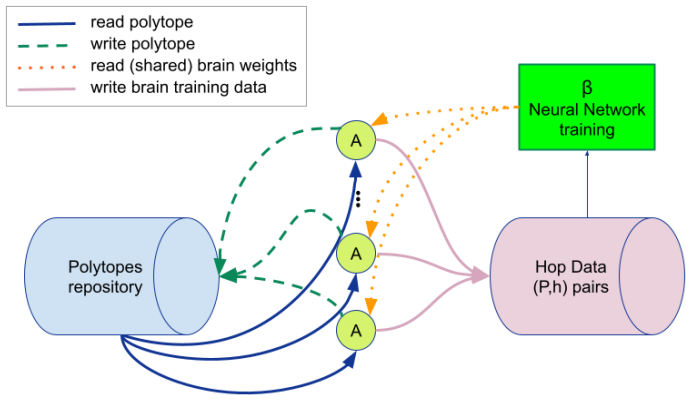
The load-bearing machinery is the Hopper algorithm combined with the prismatoid reduction used by previous counterexample constructions. Hopper treats polytope generation as a one-player game: an agent selects a polytope from a shared repository, computes all hyperplanes spanned by d of its vertices, scores them with a transformer-based neural network trained online on which hops improve a fitness function, samples a cell bounded by high-scoring hyperplanes, and 'hops' a vertex to the center of the largest inscribed ball in that cell, keeping only candidates with better fitness. The reduction converts a 5-dimensional prismatoid with n vertices and base-facet distance (width) w into a polytope of dimension n−5 whose diameter is at least w + n − 10; hence a width-6 prismatoid gives a non-Hirsch polytope, and n=24 yields dimension 19.
What would settle it
Recompute the facet-ridge graph of the 24-vertex prismatoid in Section A.13 in independent exact-rational arithmetic and measure the distance between its two base facets. Any value other than 6 would falsify the paper's record claim; a value of 6 would corroborate it.
Extended reading notes
Core claim
The central claim is that Hopper—a population of agents that modify polytopes by 'hopping' vertices, with a shared transformer-based policy trained online on which hops succeed—discovered genuinely new extremal polytopes for three classical problems. For the Hirsch conjecture, the paper reports finding a 24-vertex prismatoid of width 6 with 12 points in each base facet; applying the prismatoid-to-polytope reduction gives a non-Hirsch polytope in dimension 19, improving on the previous best of 25 vertices (dimension 20). The authors state that their constructions are qualitatively different from earlier human ones: a sample of 100 Hopper-built non-Hirsch polytopes is not explained by the directed-2-cycle criterion that covers all previously known examples, and the coordinate scales differ by many orders of magnitude. For the monotone-path problem the system matched or improved the best known lower bounds for several parameter pairs, and for the neighbourly problem it found new non-cyclic neighbourly polytopes. The paper presents these results as evidence that AI can address geometry problems long considered extremely hard.
Load-bearing premise
The load-bearing premise is that the 24-vertex prismatoid listed in Section A.13 really has width 6; the paper verifies this in exact arithmetic but provides no code, certificate, or independent check, so the record claim collapses if that computation is wrong.
Editorial extensions
If this is right
- If correct, the new record is a 24-vertex, width-6 prismatoid giving a non-Hirsch polytope in dimension 19, one dimension below the previous state of the art.
- The reported production of millions of width-6 prismatoids would imply that non-Hirsch polytopes are abundant, not rare, and that most of them fall outside the directed-2-cycle explanation that covers earlier human examples.
- The monotone-path results would update the state of the art to f(9,5)=30 and f(9,6)=29, and narrow the intervals for (10,5) and (11,5).
- The authors' switch from rigid to flexible mode—allowing vertex addition and deletion—cut the time to the first counterexample from weeks to hours, making flexible mutation a practical accelerator rather than a cosmetic option.
- Newly found non-cyclic neighbourly polytopes for pairs like (10,6) to (13,8) would enlarge the known range in which the cyclic-polytope conjecture fails.
Reading between the lines
- A consequence the authors leave implicit: if the 24-vertex prismatoid is independently confirmed, nothing in the method suggests a barrier to a 23-vertex example, so a focused search could lower the dimension record by one more step.
- Because the paper's defect-based fitness functions are what made prismatoid widths optimizable, a testable extension is to apply the same continuity trick to other diameter-type conjectures, such as the polynomial Hirsch conjecture.
- The reported sample of Hopper-built prismatoids that escape the directed-2-cycle explanation points to a concrete next experiment: search those examples for a new sufficient condition for non-Hirsch prismatoids, a step the paper does not take.
Editorial analysis
A structured set of objections, weighed in public.
Referee Report
Summary. The paper introduces Hopper, a multi-agent reinforcement-learning system that iteratively modifies the vertices of a polytope to optimize fitness functions encoding desired extremal properties. It reports applications to three problems: the Hirsch conjecture, longest monotone paths, and k-neighbourly polytopes. For the Hirsch conjecture the paper claims to have generated over a million width-6 five-dimensional prismatoids and, in particular, a 24-vertex width-6 prismatoid whose coordinates are listed in A.13, which would yield a 19-dimensional non-Hirsch polytope and beat the previous 'state of the art' of 25 vertices from [20]. For monotone paths, Table 1 reports new lower bounds, and for neighbourly polytopes it reports many new non-cyclic examples. The central evidence for the main record claim is the A.13 coordinate list, with final evaluation said to be done in exact arithmetic (A.6).
Significance. If the 24-vertex width-6 prismatoid existed and were verified, it would constitute a new record: a 19-dimensional non-Hirsch polytope, improving on the dimension-20 examples derived from the 25-vertex prismatoids of [20], and it would demonstrate that an AI-guided search can produce novel extremal polytopes. The paper also provides a reasonably detailed architectural description of the search system, states that final evaluations use exact rational arithmetic, and gives an explicit (though rounded) coordinate list for its main example. These are strengths that make the central claim in principle checkable. However, the main claim appears to conflict with a known theorem in the cited reference [20], and none of the reported computational discoveries is accompanied by verifiable exact data or code. As it stands, the record claims are not supported.
major comments (3)
- [§4.1, A.13, Reference [20]] The central claim of a 24-vertex width-6 five-dimensional prismatoid appears to contradict the main theorem of the cited paper [20], Matschke–Santos–Weibel, 'The width of five-dimensional prismatoids', which proves that the minimum number of vertices of a 5-prismatoid of width greater than 5 is 25. The manuscript cites [20] only as the source of the previous 25-vertex 'state of the art' and does not acknowledge that [20] establishes a lower bound. If the theorem in [20] is as stated, then no 24-vertex example with width 6 can exist, and the claimed 19-dimensional non-Hirsch polytope does not follow. The authors must state the exact theorem from [20] and explain how their 24-vertex example is compatible with it, or otherwise the main record claim collapses.
- [A.13, A.6] The coordinates in A.13 are printed to three decimal places, and the width of a prismatoid is a discrete invariant that can change under arbitrarily small perturbations. The statement in A.6 that final evaluation of candidates uses exact rational arithmetic cannot compensate for the absence of the exact coordinates from the paper. Without exact rational coordinates, a machine-checkable certificate, or a verification script, the width-6 computation for the A.13 example cannot be independently reproduced, and the rounded listing is not acceptable evidence for the record claim.
- [§4.2, §4.3] The monotone-path lower bounds in Table 1 (e.g., f(9,5)=30, 41≤f(10,5)≤42, f(9,6)=29) and the claimed new non-cyclic neighbourly polytopes in §4.3 are asserted with no polytope data, coordinates, or verification procedures. Since these results are part of the paper's abstract-level claim of success on three problems, at least one explicit, exact construction for each reported bound is needed for the claims to be checkable. As written, these sections are unverifiable and therefore do not support the stated conclusions.
minor comments (3)
- [§4.1.1, Figure 3] The name 'Maschke' is spelled inconsistently with the reference list, which uses 'Matschke'; this should be corrected throughout.
- [A.11.1] There is a typo: 'embelished' should be 'embellished'.
- [A.11.6] The heading 'T otal loss and the training' contains a spacing typo; it should read 'Total loss and the training'.
Circularity Check
No significant circularity: the polytope examples are independently verified constructions, and no load-bearing claim reduces to the model's own fitted inputs or to self-citation.
full rationale
The central mathematical claims are existence claims about concrete polytopes, and none of them is defined in terms of the model's parameters. The Hirsch claim rests on the width-6 computation for the 24-vertex prismatoid listed in A.13; width is the facet-ridge distance between the base facets, a combinatorial quantity independent of how the object was generated. A.6 states that final evaluations use exact arithmetic ('Final evaluation of candidates always uses the precise mode'), so the reported property is checked after the search rather than being an output of the neural network. The fitness functions in A.7 and A.8 do directly encode width-related quantities, since the defect counts shortest paths and the objective is to minimize or otherwise improve those counts; this explains why the search succeeded, but it is goal-directed search, not a fitted parameter later renamed as a prediction. The 'new bounds' in §4.2 and §4.3 are measured values of the found objects, not out-of-sample statistical inferences. No load-bearing result depends on a self-citation: refs [7] and [30] by overlapping authors are cited only as examples of prior RL successes, and the prismatoid-to-Hirsch-counterexample reduction is credited to Santos [23] and Matschke–Santos–Weibel [20], both external. No uniqueness theorem from the authors' own prior work is invoked, no ansatz is smuggled in via citation, and no known result is merely renamed. The genuine weaknesses are reproducibility and correctness concerns, not circularity: A.13 prints rounded decimal coordinates rather than exact rationals, and the claim to 'bea[t] the state of the art of 25 vertices [20]' should be checked against the actual theorem content of [20], which may prove that 25 vertices is minimal for a width-6 five-prismatoid; if so, the 24-vertex example would indicate a computational error. Those issues affect verification, not whether the derivation is equivalent to its own inputs.
Assumptions & free parameters
free parameters (2)
- hop_margin =
0.8
- defect_cap =
127
assumptions (4)
- standard math Santos's prismatoid reduction theorem
- domain assumption Exact arithmetic verification via cddlib is bug-free
- ad hoc to paper Neural network sampling produces feasible bounded regions often enough
- domain assumption The MSW digraph criterion is the only structural explanation of human examples
Cite this review
Pith. "Pith review of Advancing Geometry with AI: Multi-agent Generation of Polytopes." pith.science (2026). https://pith.science/paper/SWLI7VOY
@misc{pith2026250205199,
  author       = {Pith},
  title        = {Pith review of: Advancing Geometry with AI: Multi-agent Generation of Polytopes},
  year         = {2026},
  howpublished = {\url{https://pith.science/paper/SWLI7VOY}},
  note         = {Machine review of arXiv:2502.05199}
}
read the original abstract
Polytopes are one of the most primitive concepts underlying geometry. Discovery and study of polytopes with complex structures provides a means of advancing scientific knowledge. Construction of polytopes with specific extremal structure is very difficult and time-consuming. Having an automated tool for the generation of such extremal examples is therefore of great value. We present an Artificial Intelligence system capable of generating novel polytopes with very high complexity, whose abilities we demonstrate in three different and challenging scenarios: the Hirsch Conjecture, the k-neighbourly problem and the longest monotone paths problem. For each of these three problems the system was able to generate novel examples, which match or surpass the best previously known bounds. Our main focus was the Hirsch Conjecture, which had remained an open problem for over 50 years. The highly parallel A.I. system presented in this paper was able to generate millions of examples, with many of them surpassing best known previous results and possessing properties not present in the earlier human-constructed examples. For comparison, it took leading human experts over 50 years to handcraft the first example of a polytope exceeding the bound conjectured by Hirsch, and in the decade since humans were able to construct only a scarce few families of such counterexample polytopes. With the adoption of computer-aided methods, the creation of new examples of mathematical objects stops being a domain reserved only for human expertise. Advances in A.I. provide mathematicians with yet another powerful tool in advancing mathematical knowledge. The results presented demonstrate that A.I. is capable of addressing problems in geometry recognized as extremely hard, and also to produce extremal examples different in nature from the ones constructed by humans.
Figures


Figures from the paper (2 more)


Forward citations
Cited by 4 Pith papers
-
A ChatGPT-assisted Triangle Characterization of Affine Permutation Inversion Graphs
Weighted tournaments satisfying the zero-weight condition and Boolean triangle condition on shifted edge weights are exactly the affine inversion graphs.
-
Improved Upper Bounds for Slicing the Hypercube
All edges of the n-dimensional hypercube can be sliced with at most 4n/5 hyperplanes (with a small odd-multiple-of-5 exception), improving the 1971 Paterson bound of 5n/6 via an explicit 8-hyperplane slicing of Q10.
-
Using Reasoning Models to Generate Search Heuristics that Solve Open Instances of Combinatorial Design Problems
LLM-generated search heuristics run through the CPro1 protocol with the reasoning model o3-mini-high produced verified constructions resolving open instances in 7 Handbook design families and newer problems.
-
LLM Framework for Discovering Major Mathematical Conjectures: AI's Quest for the Next Riemann Hypothesis
The paper's claim of pipeline-validated 'major conjecture' discovery is unsupported: the Lean statements are uninterpreted placeholders and the quality scores are self-assigned by the generating model.
Reference graph
Works this paper leans on
-
[20]
The width of five-dimensional prismatoids
Benjamin Matschke, Francisco Santos, and Christophe Weibel. “The width of five-dimensional prismatoids”. In: Proceedings of the London Mathematical Society 110.3 (2015), pp. 647–672
work page 2015
-
[1]
Deformed products and maximal shadows of polytopes
Nina Amenta and Gunter M Ziegler. “Deformed products and maximal shadows of polytopes”. In: Contemporary Mathematics 223 (1999), pp. 57–90
work page 1999
-
[2]
Polytopes and machine learning
Jiakang Bao et al. “Polytopes and machine learning”. In: arXiv preprint arXiv:2109.09602 (2021)
arXiv 2021
-
[3]
The simplex method: a probabilistic analysis
Karl Heinz Borgwardt. The simplex method: a probabilistic analysis . Vol. 1. Springer Science & Business Media, 2012
work page 2012
-
[4]
Reverb: A Framework For Experience Replay
Albin Cassirer et al. Reverb: A Framework For Experience Replay . 2021. arXiv: 2102.04736 [cs.LG]
arXiv 2021
-
[5]
Machine learning: The di- mension of a polytope
Tom Coates, Johannes Hofscheier, and Alexander M Kasprzyk. “Machine learning: The di- mension of a polytope”. In: Machine Learning in Pure Mathematics and Thoeretical Physics . World Scientific, 2023, pp. 85–104
work page 2023
-
[6]
Linear programming and extensions
George Dantzig. Linear programming and extensions . Princeton university press, 1963
work page 1963
-
[7]
Advancing mathematics by guiding human intuition with AI
Alex Davies et al. “Advancing mathematics by guiding human intuition with AI”. In: Nature 600.7887 (2021), pp. 70–74
work page 2021
Show all 34 references
-
[8]
Jes´ us De Loera, J¨ org Rambau, and Francisco Santos.Triangulations: structures for algorithms and applications. Vol. 25. Springer Science & Business Media, 2010
2010
-
[9]
Neighbourly polytopes with few vertices
Rostislav A Devyatov. “Neighbourly polytopes with few vertices”. In: Sbornik: Mathematics 202.10 (2011), p. 1441. 15
2011
-
[10]
Discovering faster matrix multiplication algorithms with reinforcement learning
Alhussein Fawzi et al. “Discovering faster matrix multiplication algorithms with reinforcement learning”. In: Nature 610.7930 (2022), pp. 47–53. issn: 1476-4687. doi: 10.1038/s41586- 022-05172-4. url: https://doi.org/10.1038/s41586-022-05172-4
2022 doi
-
[11]
Combinatorial face enumeration in convex polytopes
Komei Fukuda and Vera Rosta. “Combinatorial face enumeration in convex polytopes”. In: Computational Geometry 4.4 (1994), pp. 191–198
1994
-
[12]
Neighborly and cyclic polytopes
David Gale. “Neighborly and cyclic polytopes”. In: Proc. Sympos. Pure Math . Vol. 7. 1963, pp. 225–232
1963
-
[13]
Polymake: a framework for analyzing convex poly- topes
Ewgenij Gawrilow and Michael Joswig. “Polymake: a framework for analyzing convex poly- topes”. In: Polytopes—combinatorics and computation. Springer. 2000, pp. 43–73
2000
-
[14]
Machine-learning mathematical structures
Yang-Hui He. “Machine-learning mathematical structures”. In: International Journal of Data Science in the Mathematical Sciences 1.01 (2023), pp. 23–47
2023
-
[15]
Machine Learning in Physics and Geometry
Yang-Hui He, Elli Heyes, and Edward Hirst. “Machine Learning in Physics and Geometry”. In: arXiv preprint arXiv:2303.12626 (2023)
2023 arXiv
-
[16]
Learning to reason in large theories without imitation
Dan Hendrycks and Kevin Gimpel. “Learning to reason in large theories without imitation”. In: arXiv:1606.08415 (2016)
2016 arXiv
-
[17]
A quasi-polynomial bound for the diameter of graphs of polyhedra
Gil Kalai and Daniel J Kleitman. “A quasi-polynomial bound for the diameter of graphs of polyhedra”. In: Bulletin of the American Mathematical Society 26.2 (1992), pp. 315–316
1992
-
[18]
Adam: A Method for Stochastic Optimization
Diederik P. Kingma and Jimmy Ba. “Adam: A Method for Stochastic Optimization”. In: CoRR abs/1412.6980 (2015)
2015 arXiv
-
[19]
How good is the simplex algorithm
Victor Klee and George J Minty. “How good is the simplex algorithm”. In: Inequalities 3.3 (1972), pp. 159–175
1972
-
[21]
polyDB: a database for polytopes and related objects
Andreas Paffenholz. “polyDB: a database for polytopes and related objects”. In: Algorithmic and experimental methods in algebra, geometry, and number theory (2017), pp. 533–547
2017
-
[22]
On the monotone upper bound problem
Julian Pfeifle and G¨ unter M Ziegler. “On the monotone upper bound problem”. In: Experi- mental Mathematics 13.1 (2004), pp. 1–11
2004
-
[23]
A counterexample to the Hirsch conjecture
Francisco Santos. “A counterexample to the Hirsch conjecture”. In: Annals of mathematics 176 (1 2012), pp. 383–412
2012
-
[24]
Recent progress on the combinatorial diameter of polytopes and simplicial complexes
Francisco Santos. “Recent progress on the combinatorial diameter of polytopes and simplicial complexes”. In: Top 21.3 (2013), pp. 426–460
2013
-
[25]
Neighborly polytopes
Ido Shemer. “Neighborly polytopes”. In: Israel Journal of Mathematics 43 (1982), pp. 291– 314
1982
-
[26]
Techniques for investigating neighborly polytopes
Ido Shemer. “Techniques for investigating neighborly polytopes”. In: North-Holland Mathe- matics Studies . Vol. 87. Elsevier, 1984, pp. 283–292
1984
-
[27]
An asymptotically improved upper bound on the diameter of polyhe- dra
Noriyoshi Sukegawa. “An asymptotically improved upper bound on the diameter of polyhe- dra”. In: Discrete & Computational Geometry 62 (2019), pp. 690–699
2019
-
[28]
An improved Kalai–Kleitman bound for the diameter of a polyhedron
Michael J Todd. “An improved Kalai–Kleitman bound for the diameter of a polyhedron”. In: SIAM Journal on Discrete Mathematics 28.4 (2014), pp. 1944–1947
2014
-
[29]
Attention Is All You Need
Ashish Vaswani et al. Attention Is All You Need . 2017. arXiv: 1706.03762 [cs.CL]. 16
2017 arXiv
-
[30]
Constructions in combinatorics via neural networks
Adam Zsolt Wagner. “Constructions in combinatorics via neural networks”. In: arXiv preprint arXiv:2104.14516 (2021)
2021 arXiv
-
[31]
Generalized cross entropy loss for training deep neural networks with noisy labels
Zhilu Zhang and Mert Sabuncu. “Generalized cross entropy loss for training deep neural networks with noisy labels”. In: Advances in neural information processing systems 31 (2018)
2018
-
[32]
Convex polytopes: extremal constructions and f -vector shapes
G¨ unter M. Ziegler. “Convex polytopes: extremal constructions and f -vector shapes”. In: Ge- ometric combinatorics. Vol. 13. IAS/Park City Math. Ser. Amer. Math. Soc., Providence, RI, 2007, pp. 617–691. isbn: 978-0-8218-3736-8; 0-8218-3736-2. doi: 10.1090/pcms/013/10. url: ht...
2007 doi
-
[33]
G¨ unter M. Ziegler. Lectures on polytopes. Vol. 152. Graduate Texts in Mathematics. Springer- Verlag, New York, 1995, pp. x+370.isbn: 0-387-94365-X. doi: 10.1007/978-1-4613-8431-1 . url: https://doi.org/10.1007/978-1-4613-8431-1
1995 doi
-
[34]
Polymath 3: Polynomial Hirsch Conjecture
Gil Kalai (coordinator). “Polymath 3: Polynomial Hirsch Conjecture”. In: (2010). url: http: //gilkalai.wordpress.com/2010/09/29/polymath-3-polynomial-hirsch-conjecture . 17 (a) (b) Figure 5: (a) The architecture of the Hopper brain. The input is a pair – a polytope and a hyper...
2010
Reviewed August 9, 2026 · model on record in the stance chip above.
Discussion (0). Continue with ORCID to comment.