REVIEW 4 major objections 6 minor 1 cited by
Understanding the Practices, Perceptions, and (Dis)Trust of Generative AI among Instructors: A Mixed-methods Study in the U.S. Higher Education
T0 review · 4 major / 6 minor · reviewed 2026-08-08 · deepseek-v4-flash
Pith's one-line read Instructors can simultaneously trust and distrust generative AI, a survey of 178 U.S. faculty suggests.
desk verdict A solid mixed-methods study of instructor trust/distrust in GenAI that overreaches in its quantitative claim of coexistence; the qualitative data is the real contribution. read the letter →
The pith
A machine-rendered reading of the paper's core claim, the machinery that carries it, and where it could break.
The reading
What carries the argument
The central machinery is a survey instrument with twelve Likert-scale items: six measuring trust (competence, personalization, adaptability, anticipation, transformation, enrichment) and six measuring distrust (malevolence, dishonesty, skepticism, inaccuracy, restriction, demotivation). Factor analysis confirms these load on two distinct factors, supporting the treatment of trust and distrust as separate dimensions; the four-group median split (high/low trust × high/low distrust) then operationalizes coexistence. The qualitative half uses the general inductive approach to code 294 open-ended responses into themes of trust and distrust, with 'blind distrust' identified when rejection is stated without direct experience or explicit reasons.
What would settle it
Re-analyze the publicly available raw data with a latent profile analysis or confirmatory factor model that compares the fit of a two-factor (trust and distrust separate) solution against a single bipolar dimension; the coexistence claim weakens if the high-trust–high-distrust cell vanishes when acquiescence bias or response-style effects are controlled. A second check: interview a subsample of the high-trust–high-distrust instructors to see whether their stated reasons for distrust are actually grounded in direct experience, which would contradict the 'blind distrust' interpretation.
Extended reading notes
Core claim
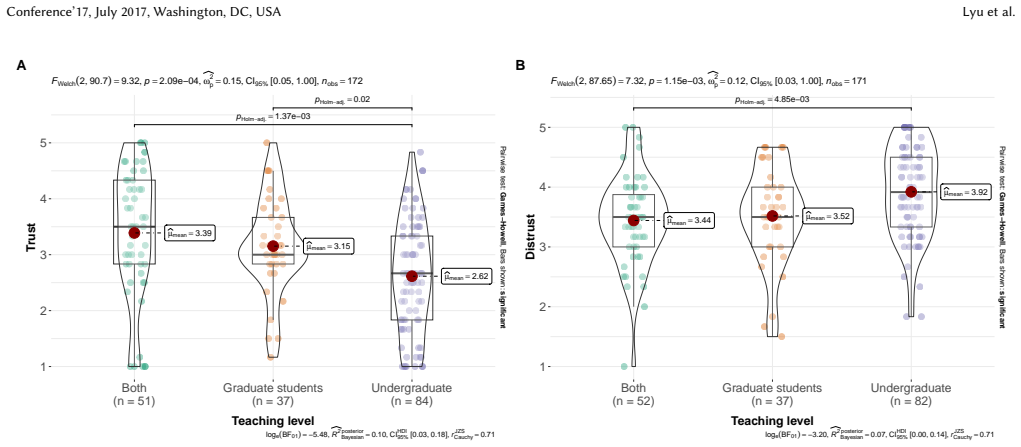
The paper's central claim is that, for instructors in higher education, trust and distrust in GenAI are related yet distinct constructs that may co-exist: a person can simultaneously hold high trust that GenAI can improve teaching and high distrust that it harms learning, integrity, or society. The authors establish this through a factor analysis showing six trust items and six distrust items load on two separate factors (with Cronbach's α of 0.924 and 0.860), a median-split plotting of instructors into four groups including a high-trust–high-distrust group of 55 (30.9%), and qualitative coding showing that instructors like P57 express both confidence in GenAI's factual outputs and concern about student misuse. The paper further shows that familiarity with GenAI differs significantly across these trust–distrust groups, with higher trust associated with higher familiarity, and that teaching level (undergraduate versus graduate) significantly relates to trust and distrust levels. Based on these results, the paper proposes that institutions should support (dis)trust calibration rather than trust maximization, and it outlines design implications such as sandbox experimentation platforms, storytelling features, and training programs that address root causes of blind trust and blind distrust.
Load-bearing premise
The load-bearing premise is that splitting instructors into four groups at the median trust and distrust scores reveals genuine psychological states rather than an artifact of two imperfectly correlated scales, and that open-ended rejections such as 'Generative AI does not belong here' are evidence of blind distrust rather than an unstated, experience-based judgment.
Editorial extensions
If this is right
- Instructor-facing AI support should target calibrated trust, pairing trust-building with tools that justify appropriate skepticism, rather than merely raising overall trust levels.
- Distrust-reduction cannot be assumed to follow from trust-building interventions; the two constructs may need separate interventions.
- Familiarity with GenAI does not automatically translate into classroom use; most surveyed instructors report moderate-to-high familiarity yet rarely use GenAI for direct instructional tasks, indicating a 'knowing-doing gap'.
- Undergraduate-only instructors show the lowest trust and highest distrust, suggesting that support efforts may need to be tailored by teaching level.
- Instructors who exhibit 'blind distrust' may require different engagement strategies, because they reject GenAI outright without direct experience or stated reasons.
Reading between the lines
- If trust and distrust are orthogonal, then attitude surveys that only measure trust will systematically misestimate the proportion of instructors who are genuinely wary, because a substantial group may score high on both.
- The four-group typology suggests a testable hypothesis: instructors in the high-trust–high-distrust cell are likely the best candidates for 'trust, but verify' behaviors, since they hold both the motivation to use GenAI and the vigilance to check its output.
- A longitudinal extension of this design could test whether the coexistence of trust and distrust is a transient state during an adoption period or a stable attitude structure; if stable, calibration interventions would need to maintain distrust, not eliminate it.
- The same factor-analytic approach could be applied to students, whose trust and distrust dynamics may differ from instructors and could affect how they respond to AI policies.
Editorial analysis
A structured set of objections, weighed in public.
Referee Report
Summary. The paper reports a mixed-methods survey of 178 instructors at a single U.S. university, examining their practices, familiarity, trust, and distrust regarding generative AI (GenAI) in March 2024. The quantitative component includes descriptive statistics, factor analysis of trust and distrust items, median-split group comparisons, and Welch's ANOVA across teaching levels and familiarity; the qualitative component uses open-ended responses with a general inductive approach. The central claim is that trust and distrust in GenAI are related yet distinct constructs that can co-exist among instructors, with implications for calibrating both rather than simply increasing trust. The paper also reports that familiarity with GenAI is higher in high-trust groups, and that trust and distrust differ by undergraduate/graduate teaching level. The authors propose design implications for platform design, institutional support, and training to foster calibrated (dis)trust.
Significance. The topic is timely and important for HCI and higher-education research. The mixed-methods design and the focus on instructors (rather than only students) are strengths, as is the public availability of anonymized survey materials, data, and analysis code on OSF. If the coexistence claim is supported, the practical implications for faculty support and AI literacy programs are meaningful. However, the quantitative evidence for the central claim is currently vulnerable to methodological artifacts: the factor analysis is confounded by item valence, and the four-group taxonomy is mechanically produced by median splits. The qualitative data, especially the 'trust, but verify' examples, provide some support for coexistence, but the quantitative foundation needs strengthening before the central claim can be considered established.
major comments (4)
- [Section 4.2.1, Table 3] The two-factor exploratory factor analysis does not provide sufficient evidence that trust and distrust are distinct, because all six trust items are positively worded benefits and all six distrust items are negatively worded risks. With Likert agreement scales, a general acquiescence or disacquiescence response style can create separate factors and a negative inter-factor correlation even if the underlying attitude is a single bipolar dimension. The authors should report a confirmatory factor analysis comparing a two-factor model against a one-factor model (or a one-factor model with a method factor), and provide discriminant validity evidence such as Fornell-Larcker or HTMT. Without such tests, the factor-analytic support for the 'related yet distinct' claim is not established.
- [Section 4.2.2, Figure 5] The four-group taxonomy is generated by median splits on the trust and distrust scales. For any two imperfectly correlated variables, median splits will populate all four quadrants, so the existence of a high-trust-high-distrust cell (n=55) is a mechanical consequence of the splitting procedure and does not by itself demonstrate that trust and distrust coexist as psychological states. To support the coexistence claim, the authors should use a method that is not an artifact of central splitting, for example, comparing the observed proportion of high-high respondents against the proportion expected under a bipolar model with measurement error, applying latent profile analysis, or reporting the number of respondents who score above a priori meaningful thresholds on both scales.
- [Section 5.1.1] The inference of 'blind distrust' is underjustified. The authors classify P31, P79, and P16 as blind distrust because their open-ended responses do not articulate reasons, but the survey prompt asked for examples and concerns rather than a justification of attitudes. An absence of a stated reason in a short response is not evidence of the absence of a reason. The label 'blind distrust' should be supported by a defined coding rule (e.g., an explicit statement that the respondent has no experience or cannot give a reason), or the interpretation should be softened to something like 'strongly asserted distrust without elaborated justification in the response.'
- [Section 6.2.4] The paper itself acknowledges in Section 6.2.4 that distrust may be context-specific and that some responses might reflect ideological positions rather than blanket rejection. This qualification is in tension with the earlier interpretation of the same responses as 'blind distrust' in Section 5.1.1. The authors should either apply this nuance when presenting the qualitative results or revise the earlier section to acknowledge that the open-ended data cannot distinguish between blind distrust and principled, experience-based rejection without further probing.
minor comments (6)
- [Section 3.3] The factor analysis description does not report the extraction method (e.g., principal axis factoring vs. maximum likelihood) or the rotation method (e.g., varimax vs. promax), which is needed for reproducibility.
- [Figure 4 caption] The caption states that the color gradient from blue to white represents increasing positive correlations, with white indicating no or negative correlation, but the text is ambiguous about how negative correlations are shown; please clarify the color scale.
- [Figure 6] The figure includes an 'Other' group (n=32), but the text does not explain what this group represents; please define it in Section 4.2.2 or in the figure caption.
- [Section 4.2.3] The discussion of familiarity differences uses causal language such as 'building high trust may help them become more familiar,' but the cross-sectional design cannot support causal claims; please temper these statements.
- [Section 3.1] Please report the response rate explicitly (219 responses from approximately 1000 invited, 178 complete) and briefly discuss possible non-response bias, given the relatively low completion rate.
- [Table 2] The Distrust dimension 'Dishonesty' is described in the text as 'a potential source of misinformation,' but the statement wording in Table 2 is 'GenAI is a potential source of misinformation for students in my courses'; please align the dimension label with the item content to avoid confusion.
Circularity Check
No significant circularity: the coexistence claim is an empirical finding, not a derivation that reduces to its inputs.
full rationale
The paper's central claim—that trust and distrust in GenAI are related yet distinct and can co-exist—rests on empirical correlations, an exploratory factor analysis, group comparisons, and qualitative responses. The trust and distrust items in Table 2 are selected from prior literature and differ in valence, but the factor loadings in Table 3 and the four-group median split in Figure 5 are data-dependent outputs; item selection alone does not force the reported two-factor solution or guarantee the existence of a high-trust-high-distrust cell. The qualitative findings in Section 5 independently quote instructors expressing both trust and distrust. The main risks to the claim, such as a possible item-valence/acquiescence confound and the absence of explicit discriminant-validity tests, are methodological validity threats rather than circular reductions. The self-citations ([74], [109], [125]) appear only as background or related-work support and are not load-bearing for the coexistence conclusion. No step in the paper's argument equals its input by construction.
Assumptions & free parameters
free parameters (1)
- Median split thresholds for trust and distrust =
Sample medians, values not reported in the paper
assumptions (4)
- domain assumption The six trust items and six distrust items in Table 2 validly operationalize the trust and distrust constructs.
- domain assumption Self-reported familiarity with GenAI is a valid proxy for informedness about GenAI capabilities and limitations.
- ad hoc to paper Absence of a written justification in an open-ended response is evidence of blind distrust.
- domain assumption The 178 responding instructors are treated as informative about U.S. higher education instructors generally.
Cite this review
Pith. "Pith review of Understanding the Practices, Perceptions, and (Dis)Trust of Generative AI among Instructors: A Mixed-methods Study in the U.S. Higher Education." pith.science (2026). https://pith.science/paper/2YPMSQBP
@misc{pith2026250205770,
  author       = {Pith},
  title        = {Pith review of: Understanding the Practices, Perceptions, and (Dis)Trust of Generative AI among Instructors: A Mixed-methods Study in the U.S. Higher Education},
  year         = {2026},
  howpublished = {\url{https://pith.science/paper/2YPMSQBP}},
  note         = {Machine review of arXiv:2502.05770}
}
read the original abstract
Generative AI (GenAI) has brought opportunities and challenges for higher education as it integrates into teaching and learning environments. As instructors navigate this new landscape, understanding their engagement with and attitudes toward GenAI is crucial. We surveyed 178 instructors from a single U.S. university to examine their current practices, perceptions, trust, and distrust of GenAI in higher education in March 2024. While most surveyed instructors reported moderate to high familiarity with GenAI-related concepts, their actual use of GenAI tools for direct instructional tasks remained limited. Our quantitative results show that trust and distrust in GenAI are related yet distinct; high trust does not necessarily imply low distrust, and vice versa. We also found significant differences in surveyed instructors' familiarity with GenAI across different trust and distrust groups. Our qualitative results show nuanced manifestations of trust and distrust among surveyed instructors and various approaches to support calibrated trust in GenAI. We discuss practical implications focused on (dis)trust calibration among instructors.
Figures


Figures from the paper (3 more)


Forward citations
Cited by 1 Pith paper
-
"Code Is Cheap. Show Me the Talk.": Lessons from Teaching and Managing AI Coding Tool Usage in a Visualization Course
In a CS visualization course, AI coding labs showed refinement as half of student prompts, explanation nearly absent, optional AI preferred by only 56%, and final projects more polished but visually homogeneous.
Reference graph
Works this paper leans on
-
[1]
Hanna Rahma Abdelwahab, Abdul Rauf, and Dadi Chen. 2023. Business students’ perceptions of Dutch higher educational institutions in preparing them for artificial intelligence work environments. Industry and Higher Education 37, 1 (2023), 22–34. doi:10.1177/09504222221087614
-
[2]
Ibrahim Adeshola and Adeola Praise Adepoju. 2023. The opportunities and challenges of ChatGPT in education. Interactive Learning Environments (2023), 1–14. doi:10.1080/10494820.2023.2253858
arXiv 2023
-
[3]
Khalida Akbar, Farai Donald Nyika, and Vicent Mbonye. 2024. Revolutionizing Creative Education: The Role of Generative AI in Enhancing Innovation and Learning in Higher Education. In Impacts of Generative AI on Creativity in Higher Education. IGI Global, 307–330
2024
-
[4]
Maryam Akbarilakeh, Alireza Razzaghi, and Hoseein Delavar Pour Moghaddam
-
[5]
Hayder Albayati. 2024. Investigating undergraduate students’ perceptions and awareness of using ChatGPT as a regular assistance tool: A user acceptance perspective study. Computers and Education: Artificial Intelligence 6 (2024), 100203. doi:10.1016/j.caeai.2024.100203
arXiv 2024
-
[6]
Sara Amani, Lance White, Trini Balart, Laksha Arora, Dr Kristi J Shryock, Dr Kelly Brumbelow, and Dr Karan L Watson. 2023. Generative AI perceptions: A survey to measure the perceptions of faculty, staff, and students on generative AI tools in academia. arXiv preprint arXiv:2304.14415 (2023). doi:10.48550/arXiv. 2304.14415
-
[7]
Matin Amoozadeh, David Daniels, Daye Nam, Aayush Kumar, Stella Chen, Michael Hilton, Sruti Srinivasa Ragavan, and Mohammad Amin Alipour. 2024. Trust in Generative AI among students: An exploratory study. In Proceedings of the 55th ACM Technical Symposium on Computer Science Education V. 1 . 67–73. doi:10.1145/3626252.3630842
arXiv 2024
-
[8]
Katerina Andreadis, Devon R Newman, Chelsea Twan, Amelia Shunk, Devin M Mann, and Elizabeth R Stevens. 2024. Mixed methods assessment of the influence of demographics on medical advice of ChatGPT.Journal of the American Medical Informatics Association (2024), ocae086. doi:10.1093/jamia/ocae086
Show all 134 references
-
[9]
2009.The Routledge international handbook of the sociology of education
Michael W Apple, Stephen J Ball, and Luís Armando Gandin. 2009.The Routledge international handbook of the sociology of education . Routledge
2009
-
[10]
Musa Adekunle Ayanwale, Owolabi Paul Adelana, and Tolulope Timothy Odu- fuwa. 2024. Exploring STEAM teachers’ trust in AI-based educational technolo- gies: A structural equation modelling approach. Discover Education 3, 1 (2024), 1–22. doi:10.1007/s44217-024-00092-z
2024 doi
-
[11]
ChatGPT seems too good to be true
Clare Baek, Tamara Tate, and Mark Warschauer. 2024. “ChatGPT seems too good to be true”: College students’ use and perceptions of generative AI. Computers and Education: Artificial Intelligence 7 (2024), 100294. doi:10.1016/j.caeai.2024. 100294
2024 doi
-
[12]
Manuel Beccerra and Anil K Gupta. 1999. Trust within the organization: Inte- grating the trust literature with agency theory and transaction costs economics. Public Administration Quarterly (1999), 177–203. doi:stable/40861779
1999
-
[13]
Maik Beege, Christopher Hug, and Josef Nerb. 2024. AI in STEM education: The relationship between teacher perceptions and ChatGPT use. Computers in Human Behavior Reports 16 (2024), 100494. doi:10.1016/j.chbr.2024.100494
2024
-
[14]
John “Skip” Benamati, Mark A Serva, and Mark A Fuller. 2010. The productive tension of trust and distrust: the coexistence and relative role of trust and distrust in online banking. Journal of Organizational Computing and Electronic Commerce 20, 4 (2010), 328–346. doi:10.1080/...
2010
- [15]
-
[16]
Abeba Birhane. 2021. Algorithmic injustice: a relational ethics approach.Patterns 2, 2 (2021). doi:10.1016/j.patter.2021.100205
2021
-
[17]
Nikita Bodani, Abhishek Lal, Afsheen Maqsood, Sara Altamash, Naseer Ahmed, and Artak Heboyan. 2023. Knowledge, attitude, and practices of general popula- tion toward utilizing ChatGPT: A cross-sectional study. SAGE Open 13, 4 (2023), 21582440231211079. doi:10.1177/21582440231211079
2023 doi
-
[18]
Can I trust you with this?
Gretchen Brion-Meisels. 2015. “Can I trust you with this?” Investigating middle school students’ use of learning supports. Urban Education 50, 6 (2015), 718–749. doi:10.1177/0042085914525788
2015 doi
-
[19]
Jennifer Bunk, Rui Li, Esther Smidt, Christopher Bidetti, and Brett Malize. 2015. Understanding Faculty Attitudes About Distance Education: The Importance of Excitement and Fear. Online Learning 19, 4 (2015), n4
2015
-
[20]
Keyan Cao, Yefan Liu, Gongjie Meng, and Qimeng Sun. 2020. An overview on edge computing research. IEEE access 8 (2020), 85714–85728. doi:10.1109/ ACCESS.2020.2991734
2020
-
[21]
Cecilia Ka Yuk Chan and Wenxin Zhou. 2023. Deconstructing student percep- tions of generative AI (GenAI) through an expectancy value theory (EVT)-based instrument. arXiv preprint arXiv:2305.01186 (2023). doi:10.48550/arXiv.2305. 01186
2023 doi
- [22]
-
[23]
Avishek Choudhury and Hamid Shamszare. 2023. Investigating the impact of user trust on the adoption and use of ChatGPT: survey analysis. Journal of Medical Internet Research 25 (2023), e47184. doi:10.2196/47184
2023 doi
-
[24]
William W Cobern. 1993. Constructivism. Journal of Educational and Psycho- logical Consultation 4, 1 (1993), 105–112. doi:10.1207/s1532768xjepc0401_8
1993 doi
-
[25]
Lauren Coffey. 2023. Most students outrunning faculty in AI use, study finds. https://www.insidehighered.com/news/tech-innovation/artificial- intelligence/2023/10/31/most-students-outrunning-faculty-ai-use
2023
-
[26]
Michael W Corrigan, Thomas J Klein, and Thelma Isaacs. 2010. TRUST US. Journal of Research in Character Education 8, 2 (2010)
2010
-
[27]
Kate Crawford. 2021. The Atlas of AI: Power, Politics, and the Planetary Costs of Artificial Intelligence
2021
-
[28]
Kate Crawford. 2024. Generative AI’s environmental costs are soaring - and mostly secret. https://www.nature.com/articles/d41586-024-00478-x
2024
-
[29]
Yun Dai. 2024. Why students use or not use generative AI: Student conceptions, concerns, and implications for engineering education.Digital Engineering (2024), 100019. doi:10.1016/j.dte.2024.100019
2024
-
[30]
Sarah J Daly, Greg Hearn, and Kyriaki Papageorgiou. 2024. Sensemaking with AI: How Trust Influences Human-AI Collaboration in Health and Creative Indus- tries. In ISPIM Innovation Symposium. The International Society for Professional Innovation Management (ISPIM), 1–11
2024
-
[31]
Martin Daumiller, Raven Rinas, Julia Hein, Stefan Janke, Oliver Dickhäuser, and Markus Dresel. 2021. Shifting from face-to-face to online teaching during COVID-19: The role of university faculty achievement goals for attitudes to- wards this sudden change, and their relevance ...
2021
-
[32]
Fred D Davis. 1989. Perceived usefulness, perceived ease of use, and user acceptance of information technology. MIS Quarterly (1989)
1989
-
[33]
Fred D Davis, RP Bagozzi, and PR Warshaw. 1989. Technology acceptance model. J Manag Sci 35, 8 (1989), 982–1003
1989
-
[34]
Paul Denny, Sami Sarsa, Arto Hellas, and Juho Leinonen. 2022. Robosourcing Educational Resources–Leveraging Large Language Models for Learnersourcing. arXiv preprint arXiv:2211.04715 (2022). doi:10.1145/3501385.3543957
2022 arXiv
-
[35]
Kurt T Dirks and Donald L Ferrin. 2001. The role of trust in organizational settings. Organization science 12, 4 (2001), 450–467. doi:10.1287/orsc.12.4.450. 10640
2001 doi
-
[36]
Virginia Donnell. 2009. The Relationship Between Student and Faculty Attitudes Toward Technology. Online Submission (2009)
2009
-
[37]
Stephen L Dorton, Samantha B Harper, and Kelly J Neville. 2022. Adaptations to trust incidents with artificial intelligence. In Proceedings of the Human Factors and Ergonomics Society Annual Meeting , Vol. 66. SAGE Publications Sage CA: Los Angeles, CA, 95–99. doi:10.1177/1071...
2022 doi
-
[38]
Susan D’Agostino. 2023. Why faculty members are polarized on AI. https://www.insidehighered.com/news/tech-innovation/artificial- intelligence/2023/09/13/why-faculty-members-are-polarized-ai
2023
-
[39]
Susan D’Agostino. 2023. Why Professors Are Polarized on AI. https://www.insidehighered.com/news/tech-innovation/artificial- intelligence/2023/09/13/why-faculty-members-are-polarized-ai. Accessed: 2023-09-13
2023
-
[40]
Eduaide.ai. 2024. Eduaide.ai. https://www.eduaide.ai/. Accessed: 2024-12-26
2024
-
[41]
Alma S Espartinez. 2024. Exploring student and teacher perceptions of ChatGPT use in higher education: A Q-Methodology study. Computers and Education: Artificial Intelligence 7 (2024), 100264. doi:10.1016/j.caeai.2024.100264
2024
-
[42]
William T Faranda. 2015. The effects of instructor service performance, im- mediacy, and trust on student–faculty out-of-class communication. Marketing Education Review 25, 2 (2015), 83–97. doi:10.1080/10528008.2015.1029853
2015
-
[43]
Faycal Farhi, Riadh Jeljeli, Ibtehal Aburezeq, Fawzi Fayez Dweikat, Samer Ali Al- shami, and Radouane Slamene. 2023. Analyzing the students’ views, concerns, and perceived ethics about chat GPT usage. Computers and Education: Artificial Intelligence (2023), 100180. doi:10.1016...
2023
-
[44]
Stefan Feuerriegel, Jochen Hartmann, Christian Janiesch, and Patrick Zschech
-
[45]
Kristen Fox and Catherine Shaw. 2023. Artificial Intelligence in higher education: Trick or treat? https://tytonpartners.com/artificial-intelligence-in-higher- education-trick-or-treat/
2023
- [46]
-
[47]
Jianping Gou, Baosheng Yu, Stephen J Maybank, and Dacheng Tao. 2021. Knowl- edge distillation: A survey.International Journal of Computer Vision 129, 6 (2021), 1789–1819. doi:10.1007/s11263-021-01453-z
2021 doi
-
[48]
Andrina Granić and Nikola Marangunić. 2019. Technology acceptance model in educational context: A systematic literature review. British Journal of Educa- tional Technology 50, 5 (2019), 2572–2593. doi:10.1111/bjet.12864
2019 doi
-
[49]
Jan Henrik Gruenhagen, Peter M Sinclair, Julie-Anne Carroll, Philip RA Baker, Ann Wilson, and Daniel Demant. 2024. The rapid rise of generative AI and its implications for academic integrity: Students’ perceptions and use of chatbots for assistance with assessments. Computers ...
2024
-
[50]
Owen P Hall et al. 2013. Assessing faculty attitudes toward technological change in graduate management education. Journal of Online Learning and Teaching 9, 1 (2013), 39–51
2013
-
[51]
Harvard University. 2024. Generative Artificial Intelligence (AI). https://huit. harvard.edu/ai Accessed: 2024-09-09
2024
-
[52]
William A Hensel and Teresa L Rasco. 1992. Storytelling as a method for teaching values and attitudes. Academic medicine 67, 8 (1992), 500–4
1992
- [53]
-
[54]
Md Athar Imtiaz and Nurazean Maarop. 2014. A review of technology acceptance studies in the field of education. Jurnal Teknologi 69, 2 (2014). doi:10.11113/jt. v69.3101
2014 doi
-
[55]
Alon Jacovi, Ana Marasović, Tim Miller, and Yoav Goldberg. 2021. Formalizing trust in artificial intelligence: Prerequisites, causes and goals of human trust in AI. In Proceedings of the 2021 ACM conference on fairness, accountability, and transparency. 624–635. doi:10.1145/34...
2021
-
[56]
Kokil Jaidka, Tsuhan Chen, Simon Chesterman, Wynne Hsu, Min-Yen Kan, Mohan Kankanhalli, Mong Li Lee, Gyula Seres, Terence Sim, Araz Taeihagh, et al. 2024. Misinformation, Disinformation, and Generative AI: Implications for Perception and Policy. Digital Government: Research an...
2024 doi
-
[57]
Adeeb M Jarrah, Yousef Wardat, and Patricia Fidalgo. 2023. Using ChatGPT in academic writing is (not) a form of plagiarism: What does the literature say. Online Journal of Communication and Media Technologies 13, 4 (2023), e202346. doi:10.30935/ojcmt/13572
2023 doi
-
[58]
Douglas Johnson, Rachel Goodman, J Patrinely, Cosby Stone, Eli Zimmerman, Rebecca Donald, Sam Chang, Sean Berkowitz, Avni Finn, Eiman Jahangir, et al
-
[59]
Hyun Kang. 2021. Sample size determination and power analysis using the G* Power software. Journal of educational evaluation for health professions 18 (2021)
2021
-
[60]
Enkelejda Kasneci, Kathrin Seßler, Stefan Küchemann, Maria Bannert, Daryna Dementieva, Frank Fischer, Urs Gasser, Georg Groh, Stephan Günnemann, Eyke Hüllermeier, et al. 2023. ChatGPT for good? On opportunities and challenges of large language models for education. Learning an...
2023
-
[61]
Rubaina Khan, Sreyoshi Bhaduri, Tammy Mackenzie, Animesh Paul, KJ Sankalp, and Indrani Sen. 2024. Path to Personalization: A Systematic Review of GenAI in Engineering Education. In KDD AI4Edu Workshop. doi:hal-04673700v1
2024
-
[62]
Jungkeun Kim, Marilyn Giroux, and Jacob C Lee. 2021. When do you trust AI? The effect of number presentation detail on consumer trust and acceptance of AI recommendations. Psychology & Marketing 38, 7 (2021), 1140–1155. doi:10. 1002/mar.21498
2021
-
[63]
Jeong Hyun Kim, Jungkeun Kim, Changju Kim, and Seongseop Kim. 2023. Do you trust ChatGPTs? Effects of the ethical and quality issues of generative AI on travel decisions. Journal of Travel & Tourism Marketing 40, 9 (2023), 779–801. doi:10.1080/10548408.2023.2293006
2023
-
[64]
Gabriela Kiryakova and Nadezhda Angelova. 2023. ChatGPT—A challenging tool for the university professors in their teaching practice. Education Sciences 13, 10 (2023), 1056. doi:10.3390/educsci13101056
2023 doi
-
[65]
Carrie Klein, Jaime Lester, Huzefa Rangwala, and Aditya Johri. 2019. Technolog- ical barriers and incentives to learning analytics adoption in higher education: Insights from users. Journal of Computing in Higher Education 31 (2019), 604–625. doi:10.1007/s12528-019-09210-5
2019 doi
-
[66]
Artur Klingbeil, Cassandra Grützner, and Philipp Schreck. 2024. Trust and reliance on AI—An experimental study on the extent and costs of overreliance on AI. Computers in Human Behavior 160 (2024), 108352. doi:10.1016/j.chb.2024. 108352
2024 doi
-
[67]
Theodore J Kopcha, Lloyd P Rieber, and Brandy B Walker. 2016. Understanding university faculty perceptions about innovation in teaching and technology. British Journal of Educational Technology 47, 5 (2016), 945–957. doi:10.1111/bjet. 12361
2016 doi
-
[68]
Lysa Kosak, Dionna Manning, Ellen Dobson, Lisa Rogerson, Shannon Cotnam, Susan Colaric, and Cheryl McFadden. 2004. Prepared to teach online? Perspec- tives of faculty in the University of North Carolina system. Online Journal of Distance Learning Administration 7, 3 (2004), 1–13
2004
-
[69]
Nancy K Lankton, D Harrison McKnight, and John Tripp. 2015. Technology, humanness, and trust: Rethinking trust in technology. Journal of the Association for Information Systems 16, 10 (2015), 1. doi:10.17705/1jais.00411
2015 doi
-
[70]
Ban it till we understand it
Sam Lau and Philip Guo. 2023. From" Ban it till we understand it" to" Resistance is futile": How university programming instructors plan to adapt as more students use AI code generation and explanation tools such as ChatGPT and GitHub Copilot. In Proceedings of the 2023 ACM Co...
2023
-
[71]
Roy J Lewicki, Daniel J McAllister, and Robert J Bies. 1998. Trust and distrust: New relationships and realities. Academy of management Review 23, 3 (1998), 438–458. doi:10.2307/259288
1998 doi
-
[72]
Jie Li, Hancheng Cao, Laura Lin, Youyang Hou, Ruihao Zhu, and Abdallah El Ali. 2024. User experience design professionals’ perceptions of generative artificial intelligence. In Proceedings of the CHI Conference on Human Factors in Computing Systems. 1–18. doi:10.1145/3613904.3642114
2024
-
[73]
originality
Jiahui Luo. 2024. A critical review of GenAI policies in higher education assess- ment: A call to reconsider the “originality” of students’ work. Assessment & Evaluation in Higher Education (2024), 1–14. doi:10.1080/02602938.2024.2309963
2024
-
[74]
Wenhan Lyu, Yimeng Wang, Tingting Chung, Yifan Sun, and Yixuan Zhang
-
[75]
MagicSchool. 2024. MagicSchool.ai. https://www.magicschool.ai/. Accessed: 2024-12-26
2024
- [76]
-
[77]
Roger C Mayer, James H Davis, and F David Schoorman. 1995. An integrative model of organizational trust. Academy of Management Review 20, 3 (1995), 709–734. doi:10.2307/258792 Conference’17, July 2017, Washington, DC, USA
1995 doi
-
[78]
In Proceedings of the Eleventh ACM Conference on Learning@ Scale
Evaluating the effectiveness of llms in introductory computer science education: A semester-long field study. In Proceedings of the Eleventh ACM Conference on Learning@ Scale . 63–74. doi:10.1145/3657604.3662036
-
[79]
Rosario Michel-Villarreal, Eliseo Vilalta-Perdomo, David Ernesto Salinas- Navarro, Ricardo Thierry-Aguilera, and Flor Silvestre Gerardou. 2023. Chal- lenges and opportunities of generative AI for higher education as explained by ChatGPT. Education Sciences 13, 9 (2023), 856. d...
2023 doi
-
[80]
Hanyi Min and Michael J Zickar. 2023. The development and validation of an interpersonal distrust scale. Journal of Business and Psychology 38, 5 (2023), 1099–1120. doi:10.1007/s10869-022-09854-8
2023 doi
-
[81]
Punya Mishra, Nicole Oster, and Danah Henriksen. 2024. Generative AI, Teacher Knowledge and Educational Research: Bridging Short-and Long-Term Perspec- tives. TechTrends 68, 2 (2024), 205–210. doi:10.1007/s11528-024-00938-1
2024 doi
- [82]
-
[83]
Tanya Nazaretsky, Mutlu Cukurova, and Giora Alexandron. 2022. An instrument for measuring teachers’ trust in AI-based educational technology. In LAK22: 12th international learning analytics and knowledge conference . 56–66. doi:10. 1145/3506860.3506866
2022
-
[84]
Thi Thuy An Ngo. 2023. The perception by university students of the use of ChatGPT in education. International Journal of Emerging Technologies in Learning (Online) 18, 17 (2023), 4. doi:10.3991/ijet.v18i17.39019
2023 doi
-
[85]
Sebastian Niedlich, Annika Kallfaß, Silvana Pohle, and Inka Bormann. 2021. A comprehensive view of trust in education: Conclusions from a systematic literature review. Review of Education 9, 1 (2021), 124–158. doi:10.1002/rev3.3239
2021 doi
-
[86]
Tanya Nazaretsky, Moriah Ariely, Mutlu Cukurova, and Giora Alexandron
-
[87]
Kazuo Okamura and Seiji Yamada. 2020. Adaptive trust calibration for human-AI collaboration. Plos One 15, 2 (2020), e0229132. doi:10.1371/journal.pone.0229132
2020 doi
-
[88]
Ismail Abdulfatai Olohunfunmi and Ahmad Zulfadhli Khairuddin. 2024. Ex- ploring Ethical Dilemmas of AI Generative Tools Among Higher Education Students: A Systematic Review. In International Conference on Innovation & Entrepreneurship in Computing, Engineering & Science Educat...
2024 doi
-
[89]
Bede Blaise Chukwunyere Onwuagboke and Termit Kaur Ranjit Singh. 2016. Faculty attitude and use of ICT in instructional delivery in tertiary institutions in a developing nation. International Journal of Research Studies in Educational Technology 5, 1 (2016), 77–88. doi:10.5861...
2016
-
[90]
Donna Venetta Palmore. 2011. Faculty attitude towards integrating technology in teaching at a four-year Southeastern University . Ph. D. Dissertation. Auburn University
2011
-
[91]
Hyacinth S Nwana. 1990. Intelligent tutoring systems: an overview. Artificial Intelligence Review 4, 4 (1990), 251–277. doi:10.1007/BF00168958
1990 doi
-
[92]
Tobias M Peters and Roel W Visser. 2023. The importance of distrust in AI. In World Conference on Explainable Artificial Intelligence . Springer, 301–317. doi:10.1007/978-3-031-44070-0_15
2023 doi
- [93]
-
[94]
Fen Qin, Kai Li, and Jianyuan Yan. 2020. Understanding user trust in artificial intelligence-based educational systems: Evidence from China. British Journal of Educational Technology 51, 5 (2020), 1693–1710. doi:10.1111/bjet.12994
2020 doi
-
[95]
Mahmoud Abu Qudais, Mosleh Al-Adhaileh, and Aieman Al-Omari. 2010. Senior Faculty Members’ Attitudes in Jordanian Universities towards Using Information and Communication Technology. The International Arab Journal of Information Technology 1, 4 (2010), 135–141
2010
-
[96]
Indrajeet Patil and Chuck Powell. 2018. ggstatsplot:“ggplot2” based plots with statistical details. CRAN 9 (2018)
2018
-
[97]
José-María Romero-Rodríguez, María-Soledad Ramírez-Montoya, Mariana Buenestado-Fernández, and Fernando Lara-Lara. 2023. Use of ChatGPT at university as a tool for complex thinking: Students’ perceived usefulness. Journal of New Approaches in Educational Research 12, 2 (2023), ...
2023 doi
-
[98]
Iqbal H Sarker. 2024. LLM potentiality and awareness: a position paper from the perspective of trustworthy and responsible AI modeling. Discover Artificial Intelligence 4, 1 (2024), 40. doi:10.1007/s44163-024-00129-0
2024 doi
-
[99]
Sami Sarsa, Paul Denny, Arto Hellas, and Juho Leinonen. 2022. Automatic gen- eration of programming exercises and code explanations using large language models. In Proceedings of the 2022 ACM Conference on International Computing Education Research-Volume 1. 27–43. doi:10.1145...
2022
-
[100]
G Saunders and F Oradini. 2024. MAKING SENSE OF GENERATIVE AI: SEEK- ING TO CATALYSE DIGITAL TRANSFORMATION IN EDUCATION. In ED- ULEARN24 Proceedings. IATED, 3738–3747. doi:10.21125/edulearn.2024.0959
2024
-
[101]
Susan Ramlo. 2021. The coronavirus and higher education: Faculty viewpoints about universities moving online during a worldwide pandemic. Innovative Higher Education 46, 3 (2021), 241–259. doi:10.1007/s10755-020-09532-8
2021 doi
-
[102]
Neil Selwyn. 2013. Distrusting educational technology: Critical questions for changing times. Routledge
2013
-
[103]
Abdulhadi Shoufan. 2023. Exploring students’ perceptions of ChatGPT: The- matic analysis and follow-up survey. IEEE Access 11 (2023), 38805–38818. doi:10.1109/ACCESS.2023.3268224
2023
-
[104]
Harpreet Singh, Mohammad-Hassan Tayarani-Najaran, and Muhammad Yaqoob
-
[105]
1982.Intelligent tutoring systems
Derek Sleeman and John Seely Brown. 1982.Intelligent tutoring systems. London: Academic Press
1982
-
[106]
Oliver Schilke, Martin Reimann, and Karen S Cook. 2021. Trust in social relations. Annual Review of Sociology 47, 1 (2021), 239–259. doi:10.1146/annurev-soc- 082120-082850
2021 doi
-
[107]
Emma Strubell, Ananya Ganesh, and Andrew McCallum. 2020. Energy and policy considerations for modern deep learning research. In Proceedings of the AAAI conference on artificial intelligence , Vol. 34. 13693–13696. doi:10.1609/aaai. v34i09.7123
2020 doi
-
[108]
Miriam Sullivan, Andrew Kelly, and Paul McLaughlan. 2023. ChatGPT in higher education: Considerations for academic integrity and student learning. Journal of Applied Learning & Teaching (2023). doi:10.37074/jalt.2023.6.1.17
2023 doi
- [109]
-
[110]
Education Sciences 13, 9 (2023),
Exploring computer science students’ perception of ChatGPT in higher education: A descriptive and correlation study. Education Sciences 13, 9 (2023),
2023
-
[111]
David R Thomas. 2006. A general inductive approach for analyzing qualitative evaluation data. American Journal of Evaluation 27, 2 (2006), 237–246. doi:10. 1177/1098214005283748
2006
-
[112]
Arizona State University. 2024. Generative AI. https://provost.asu.edu/ generative-ai Accessed: 2024-09-09
2024
-
[113]
Christian Stöhr, Amy Wanyu Ou, and Hans Malmström. 2024. Perceptions and usage of AI chatbots among students in higher education across genders, aca- demic levels and fields of study. Computers and Education: Artificial Intelligence 7 (2024), 100259. doi:10.1016/j.caeai.2024.100259
2024
-
[114]
Olga Viberg, Mutlu Cukurova, Yael Feldman-Maggor, Giora Alexandron, Shizuka Shirai, Susumu Kanemune, Barbara Wasson, Cathrine Tømte, Daniel Spikol, Marcelo Milrad, et al. 2024. What Explains Teachers’ Trust in AI in Education Across Six Countries? International Journal of Arti...
2024 doi
-
[115]
Harriet Louise Walker, Shahi Ghani, Christoph Kuemmerli, Christian Andreas Nebiker, Beat Peter Müller, Dimitri Aristotle Raptis, and Sebastian Manuel Staubli. 2023. Reliability of medical information provided by ChatGPT: assess- ment against clinical guidelines and patient inf...
2023 doi
-
[116]
Nan Wang, Xiao Wang, and Yu-Sheng Su. 2024. Critical analysis of the tech- nological affordances, challenges and future directions of Generative AI in education: a systematic review. Asia Pacific Journal of Education 44, 1 (2024), 139–155. doi:10.1080/02188791.2024.2305156
2024
-
[117]
Timothy Teo. 2011. Technology acceptance in education . Springer Science & Business Media
2011
-
[118]
Li Ping Wong. 2008. Data analysis in qualitative research: A brief guide to using NVivo. Malaysian family physician: the official journal of the Academy of Family Physicians of Malaysia 3, 1 (2008), 14
2008
- [119]
-
[120]
Geesje van den Berg and Elize du Plessis. 2023. ChatGPT and generative AI: Possibilities for its contribution to lesson planning, critical thinking and openness in teacher education. Education Sciences 13, 10 (2023), 998. doi:10. 3390/educsci13100998
2023
-
[121]
Abdullahi Yusuf, Shamsudeen Bello, Nasrin Pervin, and Abdullahi Kadage Tukur
-
[122]
Abdullahi Yusuf, Nasrin Pervin, and Marcos Román-González. 2024. Genera- tive AI and the future of higher education: a threat to academic integrity or reformation? Evidence from multicultural perspectives. International Journal of Educational Technology in Higher Education 21,...
2024 doi
-
[123]
Xiaoming Zhai. 2024. Transforming teachers’ roles and agencies in the era of generative ai: Perceptions, acceptance, knowledge, and practices. Journal of Science Education and Technology (2024), 1–11. doi:10.1007/s10956-024-10174-0
2024 doi
-
[124]
Shanyong Wang, Haotian Yu, Xianfeng Hu, and Jun Li. 2020. Participant or spectator? Comprehending the willingness of faculty to use intelligent tutoring systems in the artificial intelligence era.British Journal of Educational Technology 51, 5 (2020), 1657–1673. doi:10.1111/bjet.12998
2020 doi
-
[125]
Yixuan Zhang, Yimeng Wang, Nutchanon Yongsatianchot, Joseph D Gaggiano, Nurul M Suhaimi, Anne Okrah, Miso Kim, Jacqueline Griffin, and Andrea G Parker. 2024. Profiling the Dynamics of Trust & Distrust in Social Media: A Survey Study. In Proceedings of the CHI Conference on Hum...
2024
-
[126]
I forbid its use in my classes and therefore consider its use a violation of the honor code
Xue Zhou, Da Teng, and Hosam Al-Samarraie. 2024. The Mediating Role of Generative AI Self-Regulation on Students’ Critical Thinking and Problem- Solving. Education Sciences (2024). doi:10.3390/educsci14121302 A Codebook A.1 Theme 1: GenAI Usage Description: This theme captures...
2024 doi
- [127]
-
[129]
Thinking Skills and Creativity (2024), 101619
Implementing a proposed framework for enhancing critical thinking skills in synthesizing AI-generated texts. Thinking Skills and Creativity (2024), 101619. doi:10.1016/j.tsc.2024.101619
2024
-
[132]
Yunfeng Zhang, Q Vera Liao, and Rachel KE Bellamy. 2020. Effect of confidence and explanation on accuracy and trust calibration in AI-assisted decision making. In Proceedings of the 2020 conference on fairness, accountability, and transparency . 295–305. doi:10.1145/3351095.3372852
2020
-
[924]
doi:10.3390/educsci13090924
-
[2019]
Research and Development in Medical Education 8, 1 (2019), 12–19
Attitudes of faculty members towards using e-learning. Research and Development in Medical Education 8, 1 (2019), 12–19. doi:10.15171/rdme.2019.003
2019 doi
-
[2022]
British journal of educational technology 53, 4 (2022), 914–931
Teachers’ trust in AI-powered educational technology and a professional development program to improve it. British journal of educational technology 53, 4 (2022), 914–931. doi:10.1111/bjet.13232
2022 doi
-
[2023]
Research Square (2023)
Assessing the accuracy and reliability of AI-generated medical responses: an evaluation of the Chat-GPT model. Research Square (2023). doi:10.21203/rs.3. rs-2566942/v1
2023 doi
-
[2024]
Business & Information Systems Engineering 66, 1 (2024), 111–126
Generative AI. Business & Information Systems Engineering 66, 1 (2024), 111–126. doi:10.1007/s12599-023-00834-7
2024 doi
Reviewed August 8, 2026 · model on record in the stance chip above.
Discussion (0). Continue with ORCID to comment.