REVIEW 4 major objections 4 minor 36 references
LoRP-TTS: Low-Rank Personalized Text-To-Speech
T0 review · 4 major / 4 minor · reviewed 2026-08-08 · deepseek-v4-flash
Pith's one-line read By fine-tuning low-rank adapters on a single prompt during inference, the LoRP method turns even one noisy, spontaneously spoken recording into a viable voice for text-to-speech, raising speaker similarity by up to 30 percentage points.
desk verdict A plausible and practically useful LoRA-based per-prompt TTS adaptation recipe, but the headline 30pp gain is not yet convincing because the similarity metric is measured on the exact sample used for adaptation, with no held-out reference or human listening. read the letter →
The pith
A machine-rendered reading of the paper's core claim, the machinery that carries it, and where it could break.
The reading
What carries the argument
The central object is the LoRA adapter inserted into the Voicebox flow-matching transformer after every dense layer: a pair of low-rank matrices of rank 16 scaled by factor 16 that modify the model's activations without updating the base weights. The paper's key move is to optimize these 10 million extra parameters for only 100 steps on the single prompt audio at inference time, so the model is temporarily personalized to that voice. Speaker similarity is measured as the cosine similarity between TitaNet embeddings of the prompt and of the synthesized speech; content correctness uses Whisper's word/character error rate, and perceived quality uses the SpeechMOS automatic MOS.
What would settle it
Use a held-out reference recording of the same speaker—different from the adaptation prompt—and measure the TitaNet cosine similarity between the synthesized speech and that held-out reference. If the LoRP gain over the zero-shot baseline largely disappears, the method is overfitting to the adaptation prompt rather than learning a general speaker voice.
Extended reading notes
Core claim
The central claim is that LoRA fine-tuning during inference time enables zero-shot TTS to clone voices from a single low-quality sample. Concretely, after choosing one 3-second prompt, the authors initialize LoRA adapters of rank 16 with scaling factor 16, insert them after every dense layer of Voicebox (adding about 10 million parameters, 2.3% of the model), and optimize them for 100 steps on the prompt waveform. The resulting model, LoRP, produces speech whose TitaNet embedding is substantially closer to the prompt's embedding than the zero-shot baseline, with the largest relative gains on datasets with low baseline similarity such as emotional and expressive recordings. The paper further shows that LoRP outperforms simply increasing Voicebox's inference steps, and that the configuration is robust across rank values.
Load-bearing premise
The reported speaker-similarity gains are computed against the very same audio sample used to fine-tune the LoRA adapter, so the metric may reward memorizing that prompt rather than generalizing to the speaker's actual voice.
Editorial extensions
If this is right
- A single 3-second noisy sample is enough to adapt a zero-shot TTS model to a new speaker, with speaker similarity gains of up to 30 percentage points over the baseline.
- Adding more samples of the same speaker does not reliably improve results; with inconsistent real-world data, one good sample can outperform the full dataset.
- LoRP achieves these gains in 100 optimizer steps with about 2.3% additional parameters, keeping inference overhead modest compared with changing the model's base weights.
- The approach generalizes across datasets with different recording conditions, including expressive and spontaneous speech, and improves intelligibility (WER/CER) consistently, unlike plain LoRA which can degrade it.
- Increasing Voicebox's inference steps does not substitute for personalization: it slightly improves WER/CER but hurts speaker similarity, while LoRP improves both.
Reading between the lines
- Because the evaluation prompt is the one LoRP adapts to, a held-out reference test would likely show smaller absolute similarity gains; the reported 30pp gain may mix genuine personalization with prompt memorization.
- The same inference-time low-rank adaptation could be used to transfer expressive attributes such as speaking style, emotion, or laughter from a short clip, extending beyond voice identity.
- A natural testable variant is to run LoRP on several prompt samples separately and average the resulting adapters, or to adapt on a concatenation of a few samples, to see whether robustness to noisy prompts improves beyond the single-sample case.
- Cross-lingual personalization—adapting on a prompt in one language and synthesizing in another—is a direct next step the authors list as future work, and LoRP's low-data requirement makes it feasible.
Editorial analysis
A structured set of objections, weighed in public.
Referee Report
Summary. The paper proposes LoRP, a method for adapting a zero-shot TTS model (Voicebox) to a single short, noisy, spontaneous speech sample by fine-tuning a LoRA adapter for 100 optimizer steps at inference time, with rank and scaling both set to 16 and roughly 10M added parameters. The authors evaluate on four corpora (Kretes, Clarin, Fleurs, Nemo), measuring speaker similarity via TitaNet cosine similarity between the prompt and the synthesized audio, intelligibility via Whisper-based WER/CER, and quality via an automatic SpeechMOS. They report speaker-similarity gains of up to 30 percentage points over the zero-shot baseline, with content and naturalness preserved, and they provide sweeps over number of samples, optimization steps, inference steps, and LoRA hyperparameters.
Significance. If the reported gains are real and generalizable, LoRP is a practically valuable recipe: it turns a frozen zero-shot TTS model into a personalized one with only one noisy prompt sample and modest added parameters, targeting an important limitation for low-resource and spontaneous-speech speakers. The paper covers a commendably wide evaluation sweep across challenging data, and the design of comparing against both a zero-shot baseline and a multi-sample LoRA baseline is appropriate. The key weakness is that the central evidence does not yet establish the strength of the claim: speaker similarity is measured against the exact prompt sample used for adaptation, no held-out same-speaker reference is used, no human listening test is reported, and no confidence intervals or significance tests accompany the main figures.
major comments (4)
- [§4.1, Figure 2, §3.1] The TitaNet cosine-similarity metric is computed between the synthesized audio and the exact prompt sample on which LoRP was fine-tuned. Since LoRP is optimized for 100 steps to reproduce that sample's acoustic and prosodic content, the similarity metric is not independent of the adaptation objective, and the reported gains over the zero-shot baseline may be inflated by per-prompt overfitting rather than by genuine speaker-identity transfer. The paper should supplement the current metric with a held-out reference recording of the same speaker (different text and recording conditions) or a human listening test, and report similarity separately for the adapted prompt and for held-out references.
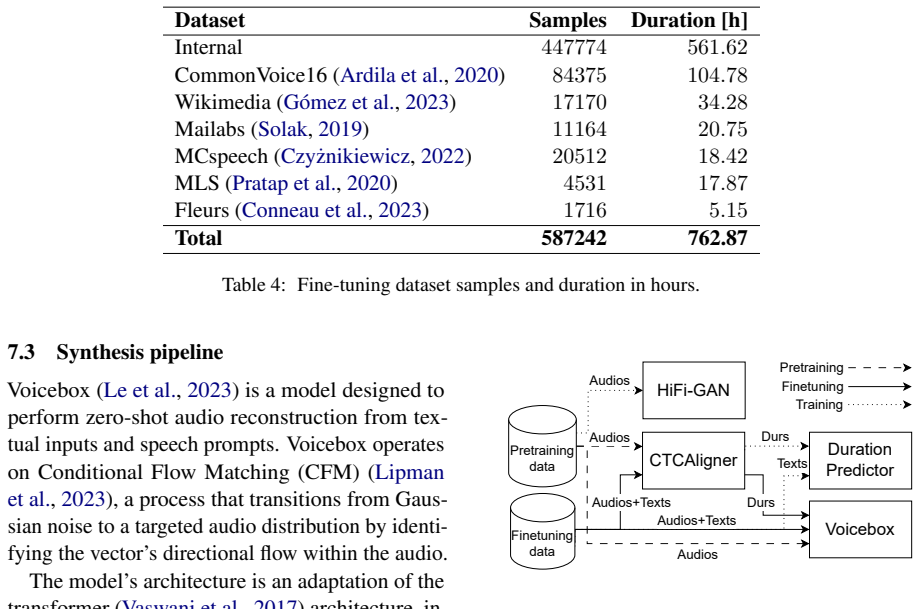
- [§4.1, Table 4, §3.2] Fleurs appears both in the fine-tuning corpus (Table 4 lists 5.15 hours of Fleurs) and among the evaluation datasets in §4.1, but the paper does not state that the sampled evaluation utterances or speakers were excluded from that fine-tuning data. Any overlap between the fine-tuning data and the test subset would directly inflate the generalization results. The authors should explicitly confirm disjointness of test utterances and, ideally, test speakers, or remove overlapping data from the fine-tuning corpus.
- [§4.1, Figure 2, Figure 1] The central comparison between LoRP and the baseline is reported as point estimates over 100 sampled prompts and 100 synthesized texts, with no confidence intervals, significance tests, or repeated runs with different random seeds and sample selections. The observed differences, particularly for datasets with low baseline similarity, may be within sampling noise. The authors should report variability (e.g., bootstrap confidence intervals, per-sample distributions, or multiple independent runs) before claiming universal improvements.
- [§5.2, Table 2, §4] The claim that LoRP preserves naturalness is not well supported by the reported MOS values. In Table 2, the full-data fine-tuning experiments produce automatic MOS scores of only 2.24 to 2.44, and §4 states that using all Kretes samples gives poorer results than using one sample. Since the paper's quality metric is an automatic SpeechMOS, not a subjective human Mean Opinion Score, the authors should either provide human listening results, report the automatic MOS separately from any claim of naturalness, or temper the naturalness claim to match the observed quality scores.
minor comments (4)
- [§4.1] The terms "classic LoRA" and "LoRP" are introduced in the text and Figure 2, but the precise difference between them is only implicit in the experimental description: clarifying that "classic LoRA" refers to fine-tuning on all 100 samples for 3200 steps while LoRP uses one sample for 100 steps would make the comparison easier to follow.
- [§5.2] The text says "we synthesized 10k sentences for each configuration" but does not state which prompt or data source was used for these 10,000 sentences; specifying the prompt and whether the evaluation sample overlapped with the training sample would improve reproducibility.
- [Table 1 and Table 2] Table 1 contains the typo "Simm" instead of "Sim," and the numerical formatting with spaces (e.g., "5 .47" and "3 .04") is inconsistent; these should be corrected for readability.
- [§7.2] The fine-tuning description does not report the optimizer, learning rate, batch size, or number of training steps used for the final model outside the LoRP setup; adding these details would be important for reproducibility.
Circularity Check
No significant circularity: the empirical LoRP-vs-baseline comparison is not definitionally tied to its inputs, though the TitaNet reference is the same sample used for adaptation.
full rationale
The paper's claims are empirical and not derived by definition. LoRA weights are optimized with Voicebox's flow-matching training objective, not by maximizing the TitaNet cosine-similarity metric, so the reported speaker similarity is not a fitted parameter renamed as a prediction. No equation is defined in terms of the result, and the references are all external; there is no load-bearing self-citation or uniqueness theorem. The only caveat is evaluation overlap: Section 4.1 states that "we fine-tuned LoRA for each individual sample for 100 steps" and then synthesized text "using the corresponding fine-tuned sample as the prompt," while Section 3.1 scores "cosine similarity" between "the prompt and synthesized audio samples." This means the TitaNet reference is also the fine-tuning sample, so the reported 30pp gain may partly reflect per-sample memorization rather than generalizable speaker identity. Additionally, Fleurs appears both in the fine-tuning corpus (Table 4) and among the evaluation datasets (Section 3.2) without an explicit statement that the test subset was excluded, which is a potential data-leakage risk. These are generalization and validity concerns that a held-out same-speaker recording or listening test could address, but they are not circularities of the derivation chain because the metric is not the training loss and the comparison against the zero-shot baseline is still informative.
Assumptions & free parameters
free parameters (5)
- LoRA rank r =
16
- LoRA scaling alpha =
16
- Fine-tuning steps =
100
- Number of prompt samples =
1 (approximately 3 seconds)
- LoRA placement =
after every dense layer
assumptions (5)
- domain assumption Voicebox and its open-source implementation provide a reliable zero-shot TTS backbone.
- domain assumption TitaNet-Large cosine similarity measures speaker similarity in a way that supports the central claim.
- domain assumption SpeechMOS reflects perceived naturalness and quality.
- ad hoc to paper The Kretes cartoon-voice dataset is a reasonable proxy for real-world noisy spontaneous speech.
- domain assumption Fine-tuning on the same prompt used for evaluation is a valid protocol for measuring speaker adaptation.
Cite this review
Pith. "Pith review of LoRP-TTS: Low-Rank Personalized Text-To-Speech." pith.science (2026). https://pith.science/paper/YQXVKTPS
@misc{pith2026250207562,
  author       = {Pith},
  title        = {Pith review of: LoRP-TTS: Low-Rank Personalized Text-To-Speech},
  year         = {2026},
  howpublished = {\url{https://pith.science/paper/YQXVKTPS}},
  note         = {Machine review of arXiv:2502.07562}
}
abstract
Speech synthesis models convert written text into natural-sounding audio. While earlier models were limited to a single speaker, recent advancements have led to the development of zero-shot systems that generate realistic speech from a wide range of speakers using their voices as additional prompts. However, they still struggle with imitating non-studio-quality samples that differ significantly from the training datasets. In this work, we demonstrate that utilizing Low-Rank Adaptation (LoRA) allows us to successfully use even single recordings of spontaneous speech in noisy environments as prompts. This approach enhances speaker similarity by up to $30pp$ while preserving content and naturalness. It represents a significant step toward creating truly diverse speech corpora, that is crucial in all speech-related tasks.
Figures


Reference graph
Works this paper leans on
- [1]
-
[2]
Tom Brown, Benjamin Mann, Nick Ryder, Melanie Subbiah, Jared D Kaplan, Prafulla Dhariwal, Arvind Neelakantan, Pranav Shyam, Girish Sastry, Amanda Askell, Sandhini Agarwal, Ariel Herbert-Voss, Gretchen Krueger, Tom Henighan, Rewon Child, Aditya Ramesh, Daniel Ziegler, Jeffrey Wu, Clemens Winter, Chris Hesse, Mark Chen, Eric Sigler, Mateusz Litwin, Scott Gr...
2020
-
[3]
Edresson Casanova, Kelly Davis, Eren Gölge, Görkem Göknar, Iulian Gulea, Logan Hart, Aya Aljafari, Joshua Meyer, Reuben Morais, Samuel Olayemi, and Julian Weber. 2024. https://arxiv.org/abs/2406.04904 Xtts: a massively multilingual zero-shot text-to-speech model . Preprint, arXiv:2406.04904
arXiv 2024
-
[4]
Mingjian Chen, Xu Tan, Bohan Li, Yanqing Liu, Tao Qin, Sheng Zhao, and Tie-Yan Liu. 2021. https://arxiv.org/abs/2103.00993 Adaspeech: Adaptive text to speech for custom voice . Preprint, arXiv:2103.00993
arXiv 2021
-
[5]
Yutian Chen, Yannis Assael, Brendan Shillingford, David Budden, Scott Reed, Heiga Zen, Quan Wang, Luis C. Cobo, Andrew Trask, Ben Laurie, Caglar Gulcehre, Aäron van den Oord, Oriol Vinyals, and Nando de Freitas. 2019. https://arxiv.org/abs/1809.10460 Sample efficient adaptive text-to-speech . Preprint, arXiv:1809.10460
arXiv 2019
-
[6]
Chung-Ming Chien, Andros Tjandra, Apoorv Vyas, Matt Le, Bowen Shi, and Wei-Ning Hsu. 2024. https://arxiv.org/abs/2406.06251 Learning fine-grained controllability on speech generation via efficient fine-tuning . Preprint, arXiv:2406.06251
work page Pith review arXiv 2024
-
[7]
Iwona Christop. 2024. https://aclanthology.org/2024.lrec-main.1059 n EMO : Dataset of emotional speech in P olish . In Proceedings of the 2024 Joint International Conference on Computational Linguistics, Language Resources and Evaluation (LREC-COLING 2024), pages 12111--12116, Torino, Italia. ELRA and ICCL
work page 2024
-
[8]
Joon Son Chung, Arsha Nagrani, and Andrew Zisserman. 2018. https://doi.org/10.21437/Interspeech.2018-1929 Voxceleb2: Deep speaker recognition . In Proc. Interspeech 2018, pages 1086--1090
Show all 36 references
-
[9]
Alexis Conneau, Min Ma, Simran Khanuja, Yu Zhang, Vera Axelrod, Siddharth Dalmia, Jason Riesa, Clara Rivera, and Ankur Bapna. 2023. https://doi.org/10.1109/SLT54892.2023.10023141 FLEURS : FEW -shot learning evaluation of universal representations of speech . In 2022 IEEE Spoke...
2023
-
[10]
Mateusz Czyżnikiewicz. 2022. https://doi.org/10.13140/RG.2.2.26293.24800 Analiza porównawcza korpusów nagrań mowy dla celów syntezy mowy w języku polskim . Available at http://dx.doi.org/10.13140/RG.2.2.26293.24800
2022
-
[11]
Rafael Mosquera Gómez, Julián Eusse, Juan Ciro, Daniel Galvez, Ryan Hileman, Kurt Bollacker, and David Kanter. 2023. https://arxiv.org/abs/2308.15710 Speech wikimedia: A 77 language multilingual speech dataset . Preprint, arXiv:2308.15710
2023 arXiv
-
[12]
Hu, Yelong Shen, Phillip Wallis, Zeyuan Allen-Zhu, Yuanzhi Li, Shean Wang, Lu Wang, and Weizhu Chen
Edward J. Hu, Yelong Shen, Phillip Wallis, Zeyuan Allen-Zhu, Yuanzhi Li, Shean Wang, Lu Wang, and Weizhu Chen. 2021. https://arxiv.org/abs/2106.09685 Lora: Low-rank adaptation of large language models . Preprint, arXiv:2106.09685
2021 arXiv
-
[13]
Ye Jia, Yu Zhang, Ron Weiss, Quan Wang, Jonathan Shen, Fei Ren, zhifeng Chen, Patrick Nguyen, Ruoming Pang, Ignacio Lopez Moreno, and Yonghui Wu. 2018. https://proceedings.neurips.cc/paper_files/paper/2018/file/6832a7b24bc06775d02b7406880b93fc-Paper.pdf Transfer learning from ...
2018
-
[14]
J. Kahn, M. Rivière, W. Zheng, E. Kharitonov, Q. Xu, P. E. Mazaré, J. Karadayi, V. Liptchinsky, R. Collobert, C. Fuegen, T. Likhomanenko, G. Synnaeve, A. Joulin, A. Mohamed, and E. Dupoux. 2020. https://doi.org/10.1109/ICASSP40776.2020.9052942 Libri-light: A benchmark for ASR ...
2020
-
[16]
Jungil Kong, Jaehyeon Kim, and Jaekyoung Bae. 2020. Hifi- GAN : generative adversarial networks for efficient and high fidelity speech synthesis. In Proceedings of the 34th International Conference on Neural Information Processing Systems, NIPS'20, Red Hook, NY, USA. Curran As...
2020
-
[17]
Danijel Koržinek, Krzysztof Marasek, Łukasz Brocki, and Krzysztof Wołk. 2017. https://arxiv.org/abs/1706.00245 Polish read speech corpus for speech tools and services . Preprint, arXiv:1706.00245
2017 arXiv
-
[18]
Matthew Le, Apoorv Vyas, Bowen Shi, Brian Karrer, Leda Sari, Rashel Moritz, Mary Williamson, Vimal Manohar, Yossi Adi, Jay Mahadeokar, and Wei-Ning Hsu. 2023. https://proceedings.neurips.cc/paper_files/paper/2023/file/2d8911db9ecedf866015091b28946e15-Paper-Conference.pdf Voice...
2023
-
[19]
Yaron Lipman, Ricky T. Q. Chen, Heli Ben-Hamu, Maximilian Nickel, and Matt Le. 2023. https://arxiv.org/abs/2210.02747 Flow matching for generative modeling . Preprint, arXiv:2210.02747
2023 arXiv
-
[20]
Simian Luo, Yiqin Tan, Suraj Patil, Daniel Gu, Patrick von Platen, Apolinário Passos, Longbo Huang, Jian Li, and Hang Zhao. 2023. https://arxiv.org/abs/2311.05556 Lcm-lora: A universal stable-diffusion acceleration module . Preprint, arXiv:2311.05556
2023 arXiv
-
[21]
Eleonora Mancini, Ana Tanevska, Andrea Galassi, Alessio Galatolo, Federico Ruggeri, and Paolo Torroni. 2024. https://arxiv.org/abs/2406.04116 Promoting fairness and diversity in speech datasets for mental health and neurological disorders research . Preprint, arXiv:2406.04116
2024 arXiv
-
[22]
Arsha Nagrani, Joon Son Chung, and Andrew Zisserman. 2017. https://doi.org/10.21437/Interspeech.2017-950 Voxceleb: A large-scale speaker identification dataset . In Proc. Interspeech 2017, pages 2616--2620
2017 doi
-
[23]
Vineel Pratap, Qiantong Xu, Anuroop Sriram, Gabriel Synnaeve, and Ronan Collobert. 2020. https://doi.org/10.21437/Interspeech.2020-2826 MLS : A large-scale multilingual dataset for speech research . In Proc. Interspeech 2020, pages 2757--2761
2020 doi
-
[24]
Smith, and Mike Lewis
Ofir Press, Noah A. Smith, and Mike Lewis. 2022. https://arxiv.org/abs/2108.12409 Train short, test long: Attention with linear biases enables input length extrapolation . Preprint, arXiv:2108.12409
2022 arXiv
-
[25]
Alec Radford, Jong Wook Kim, Tao Xu, Greg Brockman, Christine McLeavey, and Ilya Sutskever. 2023. Robust speech recognition via large-scale weak supervision. In International conference on machine learning, pages 28492--28518. PMLR
2023
-
[26]
Alec Radford and Karthik Narasimhan. 2018. https://api.semanticscholar.org/CorpusID:49313245 Improving language understanding by generative pre-training
2018
-
[27]
Chandan K A Reddy, Vishak Gopal, and Ross Cutler. 2022. https://doi.org/10.1109/ICASSP43922.2022.9746108 Dnsmos p.835: A non-intrusive perceptual objective speech quality metric to evaluate noise suppressors . In ICASSP 2022 - 2022 IEEE International Conference on Acoustics, S...
2022
-
[28]
James Seale Smith, Yen-Chang Hsu, Lingyu Zhang, Ting Hua, Zsolt Kira, Yilin Shen, and Hongxia Jin. 2024. https://arxiv.org/abs/2304.06027 Continual diffusion: Continual customization of text-to-image diffusion with c-lora . Preprint, arXiv:2304.06027
2024 arXiv
-
[29]
Imdat Solak. 2019. The m-ailabs speech dataset
2019
-
[30]
Jörgen Valk and Tanel Alumäe. 2021. https://doi.org/10.1109/SLT48900.2021.9383459 VOXLINGUA107 : A dataset for spoken language recognition . In 2021 IEEE Spoken Language Technology Workshop (SLT), pages 652--658
2021
-
[31]
Ashish Vaswani, Noam Shazeer, Niki Parmar, Jakob Uszkoreit, Llion Jones, Aidan N Gomez, ukasz Kaiser, and Illia Polosukhin. 2017. https://proceedings.neurips.cc/paper_files/paper/2017/file/3f5ee243547dee91fbd053c1c4a845aa-Paper.pdf Attention is all you need . In Advances in Ne...
2017
-
[32]
Christophe Veaux, Junichi Yamagishi, and Kirsten MacDonald. 2019. https://datashare.ed.ac.uk/handle/10283/3443 CSTR VCTK corpus: English multi-speaker corpus for CSTR voice cloning toolkit
2019
-
[33]
Apoorv Vyas, Bowen Shi, Matthew Le, Andros Tjandra, Yi-Chiao Wu, Baishan Guo, Jiemin Zhang, Xinyue Zhang, Robert Adkins, William Ngan, Jeff Wang, Ivan Cruz, Bapi Akula, Akinniyi Akinyemi, Brian Ellis, Rashel Moritz, Yael Yungster, Alice Rakotoarison, Liang Tan, Chris Summers, ...
2023 arXiv
-
[34]
Changhan Wang, Morgane Riviere, Ann Lee, Anne Wu, Chaitanya Talnikar, Daniel Haziza, Mary Williamson, Juan Pino, and Emmanuel Dupoux. 2021. https://doi.org/10.18653/v1/2021.acl-long.80 V ox P opuli: A large-scale multilingual speech corpus for representation learning, semi-sup...
2021 doi
-
[35]
Chengyi Wang, Sanyuan Chen, Yu Wu, Ziqiang Zhang, Long Zhou, Shujie Liu, Zhuo Chen, Yanqing Liu, Huaming Wang, Jinyu Li, Lei He, Sheng Zhao, and Furu Wei. 2023. https://arxiv.org/abs/2301.02111 Neural codec language models are zero-shot text to speech synthesizers . Preprint, ...
2023 arXiv
-
[36]
online" 'onlinestring :=
ENTRY address archivePrefix author booktitle chapter edition editor eid eprint eprinttype howpublished institution journal key month note number organization pages publisher school series title type volume year doi pubmed url lastchecked label extra.label sort.label short.list...
-
[37]
write newline
" write newline "" before.all 'output.state := FUNCTION n.dashify 't := "" t empty not t #1 #1 substring "-" = t #1 #2 substring "--" = not "--" * t #2 global.max substring 't := t #1 #1 substring "-" = "-" * t #2 global.max substring 't := while if t #1 #1 substring * t #2 gl...
Reviewed August 8, 2026 · model on record in the stance chip above.
Discussion (0). Continue with ORCID to comment.