REVIEW 4 major objections 5 minor 61 references
Inverse Design with Dynamic Mode Decomposition
T0 review · 4 major / 5 minor · reviewed 2026-08-07 · deepseek-v4-flash
Pith's one-line read A least-squares fit to snapshots can replace simulators for inverse design.
desk verdict ID-DMD is a simple and genuinely fast parametric DMD wrapper for inverse design, but the headline claims outrun the evidence because the optimized designs are only checked against the fitted surrogate. read the letter →
The pith
A machine-rendered reading of the paper's core claim, the machinery that carries it, and where it could break.
The reading
What carries the argument
The central object is the affine-in-parameter dynamic operator $A(\varepsilon)=A_0+\varepsilon_1 A_1+\cdots$, which carries the parameter dependence linearly so that one operator family serves all design points. The workhorse identity is the block least-squares factorization $Z=\Theta\Xi$ with shared operators $\Theta=[A_0\ A_1\ \cdots]$, followed by truncated SVDs of $Z$ and $\Xi$; the low-rank projected operators $\tilde A_i=U^*Z V_\Xi\Sigma_\Xi^{-1}U_{\Xi,i}^*U$ are what make the method computationally light. Proposition 2's eigen-equivalence turns the low-rank eigenvalues and eigenvectors into the system's dynamic modes, so design objectives such as frequencies, decay rates, and response energy can be evaluated from the reduced operator. For nonlinear systems, a polynomial Koopman lift $\psi(x)$ precedes the same regression, giving the parametric form $\psi(x_k)=(A_{\kappa,0}+\varepsilon_1 A_{\kappa,1}+\cdots)\psi(x_{k-1})$.
What would settle it
Run ID-DMD on a parametric problem whose dynamics change qualitatively within the design interval, such as a system crossing a bifurcation; if the surrogate's extrapolated trajectories and its recommended design deviate sharply from direct numerical simulation at that crossing, the general claim fails. A cheaper check is to compute the normalized projection residual $\lVert Z - UU^*Z\rVert_F/\lVert Z\rVert_F$ on the training data: when this residual is not small, the eigen-equivalence in Proposition 2 no longer holds.
Extended reading notes
Core claim
The central claim is that a low-rank parametric dynamic-mode-decomposition operator, fitted by least squares across several parameter values, is sufficient as a surrogate for inverse design of complex engineering systems. The construction is explicit: concatenate snapshot data from different parameter values into the block regression $Z=\Theta\Xi$, truncate the SVDs $Z\approx U\Sigma V^*$ and $\Xi\approx U_\Xi\Sigma_\Xi V_\Xi^*$, and form reduced operators $\tilde A_i=U^* Z V_\Xi\Sigma_\Xi^{-1} U_{\Xi,i}^* U$. Proposition 2 states that the eigenvalues of $\tilde A_0+\varepsilon_1\tilde A_1+\cdots$ are those of the full operator, and the eigenvectors are recovered by exact or projected DMD, giving the modal prediction $x_k=\Phi\exp[S(k-1)]b$. The paper reports this surrogate accurately predicts interpolated and extrapolated parameter values on a pitched airfoil, a four-story building, a viscous shock-forming PDE, cavity flow, a smoke plume, a limit-cycle oscillator, and a droplet-printing experiment, and that design optimization on the surrogate finds the target, such as a $7^\circ$ airfoil pitch angle or a stiffness value that places a resonant pole, with narrow uncertainty bands.
Load-bearing premise
The load-bearing assumption is that a single operator that depends affinely on the design parameters, after a fixed Koopman lift for nonlinear systems, remains accurate across the whole design range and beyond it; if the dynamics change qualitatively, as in a bifurcation or a discontinuity, that one operator family cannot represent the design space.
Editorial extensions
If this is right
- Design loops for periodic or damped systems can run on a laptop CPU, with the surrogate fit being a single least-squares solve rather than a network training run.
- Because the surrogate exposes eigenvalues and eigenvectors, design goals can be specified directly on the dynamics, such as target frequencies, damping rates, or mode content, and not only on output waveforms.
- The fitted operator family extrapolates in both time and design parameter, so a designer can query parameter values never present in the training snapshots, a capability the paper shows the neural-operator baselines lack.
- Bagging on random column subsets turns the optimal design parameter into a distribution, yielding uncertainty bars on the design at negligible extra cost.
Reading between the lines
- The Discussion's proposed extension, replacing the affine coefficients $\varepsilon_i$ with differentiable functions $f_i(\varepsilon)$, would preserve the least-squares core while covering systems with bifurcations; fitting those functions is a natural next test.
- Because the modal form makes design objectives cheap functions of the parameters, ID-DMD could be coupled with global search or multi-fidelity loops where the surrogate proposes parameters and a full solver validates them.
- Since Eq. (1) is a parametric state-space model, the same construction should transfer to control design, treating control inputs as additional affine parameters to produce a data-driven gain schedule.
- A testable prediction is that ID-DMD's relative advantage over operator learning grows as the parameter-to-dynamics map becomes smoother and more nearly linear, and shrinks where the Koopman lift must absorb strong nonlinearity.
Editorial analysis
A structured set of objections, weighed in public.
Referee Report
Summary. The paper proposes ID-DMD, a parametric dynamic-mode-decomposition variant in which the dynamics are modeled as x_k = (A_0 + ε_1 A_1 + ···) x_{k−1}, or with a polynomial Koopman lift for nonlinear systems, and the operators are identified by least squares over snapshots collected at several parameter values. The identified low-rank model is then used both to predict responses at unseen parameters and to evaluate design objectives and constraints, including eigen-based quantities such as resonant frequencies. The authors demonstrate reconstruction and interpolation/extrapolation on several structural and fluid systems and compare the method against PI-DON, PINNs, NIF, and FNO on the 1-D Burgers equation. They also report three inverse-design tasks: an airfoil pitch-angle optimization, a linear-building pole-placement design, and a nonlinear-damper energy-dissipation design.
Significance. If the central claims are supported, ID-DMD would be a useful low-cost baseline for parametric inverse design. Its strengths are real: the least-squares identification is simple and avoids expensive neural-network training; the Burgers interpolation and extrapolation tests are genuine out-of-sample evaluations; the low-rank projection follows standard DMD arguments; and the authors make code and data available on GitHub. The main burden is whether the optimized design parameters are valid in the true system rather than only in the affine fitted surrogate, and whether the broad accuracy and speed claims are supported by more than a single benchmark. These issues are fixable within the scope of the manuscript, so I view them as requiring a major revision rather than rejection.
major comments (4)
- [§II.A and §II.D] The inverse-design results are generated and evaluated with the same fitted ID-DMD surrogate. In the airfoil example, the optimum θ = 7° is selected from the ID-DMD model, and the only validation shown (Fig. 1(c), Fig. S2) compares the surrogate with training/test LBM snapshots at other angles; no fresh LBM run at θ = 7° is reported. Similarly, the pole-placement stiffness k = 2.82×10^9 N/m (§II.D, Fig. S9) is checked against ID-DMD's own estimated resonant frequencies, and the nonlinear-damper design c3 > 12.6 is judged by the same ψ(x_k) model. Because Eqs. (1) and (3) are affine in the design parameters and the Discussion concedes that this form fails for bifurcating or strongly nonlinear dynamics, a systematically biased surrogate can produce an optimum that is not valid in the true system. I ask the authors to rerun each reported design at its optimum with the original high-fidelity simulator or experiment; a single verification run per design task would settle this issue and is necessary to support the claim that ID-DMD enables reliable inverse design.
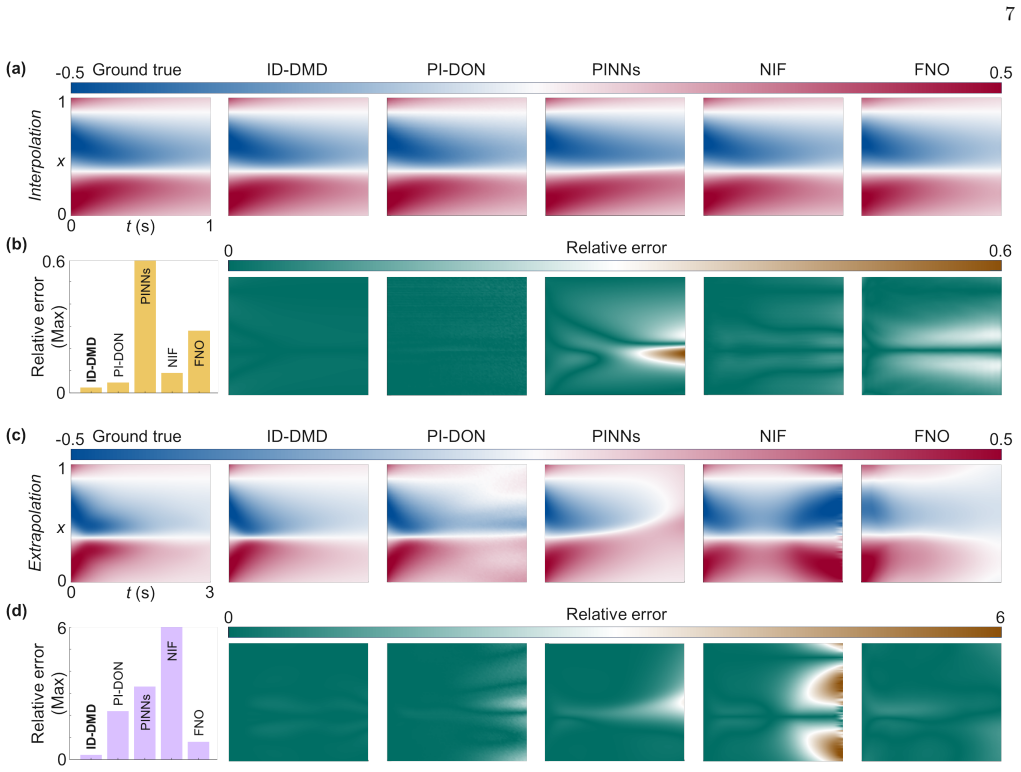
- [Table II and Fig. 2] The headline claim that ID-DMD is 'an order of magnitude more accurate' than competing methods is based on one interpolation viscosity (v = 0.02) and one extrapolation viscosity (v = 0.01), each reported as a single max-relative-error number. This is too thin a basis for the abstract's accuracy claim: there are no error bars, no multiple held-out parameter values, and no repeated training runs. In addition, the paper positions ID-DMD against prior parametric DMD methods (Refs. [52,53]) but reports no comparison with them. I recommend reporting error statistics over several held-out viscosity values and adding at least one parametric-DMD baseline to the comparison.
- [Methods §IV.C; Supp. §A.3] The stability-clipping rule 'set σ_j = 0 if σ_j > 0' is an unmodeled modification of the identified eigenvalues. Since the paper claims to prescribe intrinsic dynamics and uses eigen-based quantities for pole placement, this clipping can change the very quantities being optimized whenever an identified mode is unstable. The authors should state how often the clipping is active in the reported examples, justify it with respect to the design objective, and report the sensitivity of the optimized parameters to this rule.
- [§II.D vs Supp. §5.2] The design threshold for the nonlinear-damper example is internally inconsistent. The main text (§II.D) reports an energy dissipation of η_E > 30% achieved with c3 > 12.6 and states 'c3 > 12.6' as the design result, while the supplementary text (§5.2) states 'an energy loss of E_d < 0.013 is achieved when c3 > 6', with no definition connecting E_d to η_E. Since this is one of the three central design demonstrations, the discrepancy must be resolved before the design result can be assessed.
minor comments (5)
- [Abstract and title] The abstract uses 'dynamic mode composition' but the method is elsewhere called 'dynamic mode decomposition'; the terminology should be consistent.
- [Methods §IV.B] The sentence beginning 'These hyper-parameters can be determined by using The U_Ξ matrix is divided' is incomplete and appears to be a typographical error; the intended description of how to choose r_Z and r_Ξ should be completed.
- [Supp. Eq. (B2)] The constraint θ ∈ Z+ in Eq. (B2) restricts the airfoil pitch angle to positive integers; if this is intentional it should be stated, and if not it is likely a typo for a box constraint on the real-valued angle.
- [Supp. Table XI] The row 'Scaling factor for c3' is inconsistent with the design parameter k_s in the linear-building example; this appears to be a copy-paste error and should be corrected.
- [§II.B, Table I] The 'Van de Pol equation' is conventionally spelled 'van der Pol equation'; more importantly, the validation entries in Table I report results at single test parameter values, so it would be useful to state whether these are representative or the worst case.
Circularity Check
Core ID-DMD identification and held-out predictions are not circular; only the optimized designs are certified with the same surrogate, a validation gap that is partial circularity rather than a derivation flaw.
-
other
[Section II.A, Eqs. (B2)-(B3) in Supplementary; Section IV.D]
"The optimal airfoil pitched angle that meets the required dynamic properties is obtained as θ = 7◦ by solving the optimization problem in Fig.1(d). ... Here, Pair is defined as the root mean value of the sum square vorticity over time."
The optimization objective and constraint are evaluated from ID-DMD's own reconstructed snapshots: Pair is computed from x_k (Eq. B3), and x_k is produced by the fitted surrogate Eq. (1). Thus the reported θ=7° is, by construction, the minimizer of the surrogate's own output; saying it 'meets the required dynamic properties' restates that the surrogate's evaluation satisfies its own criterion. No fresh LBM run at θ=7° is reported to certify the design in the true system (Fig. S2 shows predicted vorticities). The same surrogate-only certification applies to the pole-placement and nonlinear-damper designs.
-
self citation load bearing
[Section IV.D; Section II.D; Refs. [43], [39], [35] in the paper]
"Uncertainties matrices of the design are assessed by integrating the bagging approach into the ID-DMD [43]. ... For more complex nonlinear systems, other projections, i.e., encoding-decoding networks [49], can be applied to implement the ID-DMD using the same method."
The bagging UQ step cites prior work by a co-author, and the Koopman/encoding-decoding extensions cite prior work by a co-author, but these citations are not used to justify the central affine-in-parameter ansatz or the eigen-equivalence; they provide standard algorithmic components. No uniqueness theorem is imported from the authors' own work, and the central claim of held-out predictive accuracy does not rest on those citations. This is therefore a minor self-citation pattern that is not load-bearing for the main derivation.
full rationale
The derivation of ID-DMD itself is self-contained least-squares regression: Eq. (8) writes X'=ΘE and the low-rank operators are obtained by SVD projection, with Proposition 2 resting on the standard approximate identity UU*Z≈Z rather than on a self-citation. Held-out predictions (airfoil θ=5°, Burgers v=0.02 interpolation and v=0.01 extrapolation, and the other systems in Table I) are genuine out-of-sample tests, so the accuracy and extrapolation claims are not circular. The self-citations to DMD, Koopman theory, and bagging are standard methodological references and are not used as an external uniqueness theorem; they do not force the paper's central results. The main circularity-adjacent issue is that the inverse-design results — the airfoil angle, the building stiffness, and the nonlinear damper value — are optimized and then effectively certified using the same ID-DMD surrogate, so their status as real-system designs is not independently established. This is a validation gap, or mild circularity in the demonstration, rather than a circular derivation of the model itself. The Discussion's concession that the affine-in-parameter form fails for bifurcations and severe nonlinearity is an honest stated limitation, not a hidden circular assumption.
Assumptions & free parameters
free parameters (5)
- Truncation ranks rZ and rXi =
Per example: 120, 100, 70, 150, 60, 350, 200, 40, 35, 16
- Scaling factors alpha_i for design parameters =
Examples: 1, 0.001, 0.1, 1e-9
- Polynomial Koopman lifting degree =
Up to 8th order (45 observables) for ODE examples; 11th order (77 observables) for Van der Pol
- Stability clipping rule =
sigma_j := 0 for all sigma_j > 0
- Bagging settings =
Half of columns per run; 30 runs
assumptions (5)
- domain assumption Dynamics are well approximated by x_k=(A0+sum epsilon_i A_i)x_{k-1} over the design range
- domain assumption The truncated SVD subspace U satisfies UU*Z approx Z, so the low-rank projected operator retains the full operator's eigenvalues
- domain assumption Polynomial observables span a nearly invariant Koopman subspace for the nonlinear systems
- domain assumption Initial states are known exactly for all predictions
- domain assumption Training parameter samples are representative of the design space
Cite this review
Pith. "Pith review of Inverse Design with Dynamic Mode Decomposition." pith.science (2026). https://pith.science/paper/NSML33HC
@misc{pith2026250209490,
  author       = {Pith},
  title        = {Pith review of: Inverse Design with Dynamic Mode Decomposition},
  year         = {2026},
  howpublished = {\url{https://pith.science/paper/NSML33HC}},
  note         = {Machine review of arXiv:2502.09490}
}
read the original abstract
We introduce a computationally efficient method for the automation of inverse design in science and engineering. Based on simple least-square regression, the underlying dynamic mode decomposition algorithm can be used to construct a low-rank subspace spanning multiple experiments in parameter space. The proposed inverse design dynamic mode composition (ID-DMD) algorithm leverages the computed low-dimensional subspace to enable fast digital design and optimization on laptop-level computing, including the potential to prescribe the dynamics themselves. Moreover, the method is robust to noise, physically interpretable, and can provide uncertainty quantification metrics. The architecture can also efficiently scale to large-scale design problems using randomized algorithms in the ID-DMD. The simplicity of the method and its implementation are highly attractive in practice, and the ID-DMD has been demonstrated to be an order of magnitude more accurate than competing methods while simultaneously being 3-5 orders faster on challenging engineering design problems ranging from structural vibrations to fluid dynamics. Due to its speed, robustness, interpretability, and ease-of-use, ID-DMD in comparison with other leading machine learning methods represents a significant advancement in data-driven methods for inverse design and optimization, promising a paradigm shift in how to approach inverse design in practice.
Figures


Figures from the paper (9 more)


Reference graph
Works this paper leans on
-
[1]
Ronald Aylmer Fisher, Ronald Aylmer Fisher, Statistiker Genetiker, Ronald Aylmer Fisher, Statistician Genetician, Great Britain, Ronald Aylmer Fisher, and Statisticien G´ en´ eticien.The design of experiments , volume 21. Springer, 1966
work page 1966
-
[2]
Engineering design optimization
Joaquim RRA Martins and Andrew Ning. Engineering design optimization . Cambridge University Press, 2021
work page 2021
-
[3]
Concepts and applications of finite element analysis
Robert D Cook et al. Concepts and applications of finite element analysis . John wiley & sons, 2007
work page 2007
-
[4]
Cyril Touz´ e, Alessandra Vizzaccaro, and Olivier Thomas. Model order reduction methods for geometrically nonlinear structures: a review of nonlinear techniques. Nonlinear Dynamics, 105(2):1141–1190, 2021
work page 2021
-
[5]
Modelling and design integration for engineering systems
SA Billings and Zi-Qiang Lang. Modelling and design integration for engineering systems. International patent , (PCT/GB2003/004505), 2003
work page 2003
-
[6]
Physics-informed neural networks with hard constraints for inverse design
Lu Lu, Raphael Pestourie, Wenjie Yao, Zhicheng Wang, Francesc Verdugo, and Steven G Johnson. Physics-informed neural networks with hard constraints for inverse design. SIAM Journal on Scientific Computing , 43(6):B1105–B1132, 2021
2021
-
[7]
Fourier neural operator with learned defor- mations for pdes on general geometries
Zongyi Li, Daniel Zhengyu Huang, Burigede Liu, and Anima Anandkumar. Fourier neural operator with learned defor- mations for pdes on general geometries. Journal of Machine Learning Research , 24(388):1–26, 2023
work page 2023
-
[8]
Physical design using differentiable learned simulators
Kelsey R Allen, Tatiana Lopez-Guevara, Kimberly Stachenfeld, Alvaro Sanchez-Gonzalez, Peter Battaglia, Jessica Hamrick, and Tobias Pfaff. Physical design using differentiable learned simulators. arXiv preprint arXiv:2202.00728 , 2022
arXiv 2022
Show all 61 references
-
[9]
Aerodynamic shape optimization using a novel optimizer based on machine learning techniques
Xinghui Yan, Jihong Zhu, Minchi Kuang, and Xiangyang Wang. Aerodynamic shape optimization using a novel optimizer based on machine learning techniques. Aerospace Science and Technology, 86:826–835, 2019
2019
-
[10]
Finite difference methods for ordinary and partial differential equations: steady-state and time- dependent problems
Randall J LeVeque. Finite difference methods for ordinary and partial differential equations: steady-state and time- dependent problems. SIAM, 2007
2007
-
[11]
Finite and boundary element methods in engineering
OP Gupta. Finite and boundary element methods in engineering . Routledge, 2022
2022
-
[12]
Optimization for engineering design: Algorithms and examples
Kalyanmoy Deb. Optimization for engineering design: Algorithms and examples . PHI Learning Pvt. Ltd., 2012
2012
-
[13]
Reduced order model based on principal component analysis for process simulation and optimization
Yi-dong Lang, Adam Malacina, Lorenz T Biegler, Sorin Munteanu, Jens I Madsen, and Stephen E Zitney. Reduced order model based on principal component analysis for process simulation and optimization. Energy & Fuels , 23(3):1695–1706, 2009
2009
-
[14]
A pod-based reduced order design scheme for shape optimization of air vehicles
Satyajit Ghoman, Zhicun Wang, Ping Chen, and Rakesh Kapania. A pod-based reduced order design scheme for shape optimization of air vehicles. In 53rd AIAA/ASME/ASCE/AHS/ASC Structures, Structural Dynamics and Materials Conference 20th AIAA/ASME/AHS Adaptive Structures Conferenc...
2012
-
[15]
Recent advances in convolutional neural networks
Jiuxiang Gu, Zhenhua Wang, Jason Kuen, Lianyang Ma, Amir Shahroudy, Bing Shuai, Ting Liu, Xingxing Wang, Gang Wang, Jianfei Cai, et al. Recent advances in convolutional neural networks. Pattern recognition, 77:354–377, 2018
2018
-
[16]
Reinforcement learning: An introduction
Richard S Sutton and Andrew G Barto. Reinforcement learning: An introduction. MIT press, 2018
2018
-
[17]
Deepmpc: Learning deep latent features for model predictive control
Ian Lenz, Ross A Knepper, and Ashutosh Saxena. Deepmpc: Learning deep latent features for model predictive control. In Robotics: Science and Systems , volume 10, page 25. Rome, Italy, 2015
2015
-
[18]
A general reinforcement learning algorithm that masters chess, shogi, and go through self-play
David Silver, Thomas Hubert, Julian Schrittwieser, Ioannis Antonoglou, Matthew Lai, Arthur Guez, Marc Lanctot, Laurent Sifre, Dharshan Kumaran, Thore Graepel, et al. A general reinforcement learning algorithm that masters chess, shogi, and go through self-play. Science, 362(64...
2018
-
[19]
Reinforcement learning in robotics: A survey
Jens Kober, J Andrew Bagnell, and Jan Peters. Reinforcement learning in robotics: A survey. The International Journal of Robotics Research, 32(11):1238–1274, 2013
2013
-
[20]
Real-time neural mpc: Deep learning model predictive control for quadrotors and agile robotic platforms
Tim Salzmann, Elia Kaufmann, Jon Arrizabalaga, Marco Pavone, Davide Scaramuzza, and Markus Ryll. Real-time neural mpc: Deep learning model predictive control for quadrotors and agile robotic platforms. IEEE Robotics and Automation Letters, 8(4):2397–2404, 2023
2023
-
[21]
Distilling free-form natural laws from experimental data
Michael Schmidt and Hod Lipson. Distilling free-form natural laws from experimental data. science, 324(5923):81–85, 2009
2009
-
[22]
Trans- formers in vision: A survey
Salman Khan, Muzammal Naseer, Munawar Hayat, Syed Waqas Zamir, Fahad Shahbaz Khan, and Mubarak Shah. Trans- formers in vision: A survey. ACM computing surveys (CSUR) , 54(10s):1–41, 2022
2022
-
[23]
On the opportunities and risks of foundation models
Rishi Bommasani, Drew A Hudson, Ehsan Adeli, Russ Altman, Simran Arora, Sydney von Arx, Michael S Bernstein, Jeannette Bohg, Antoine Bosselut, Emma Brunskill, et al. On the opportunities and risks of foundation models. arXiv preprint arXiv:2108.07258, 2021
2021 arXiv
-
[24]
Transformers: State-of-the-art natural language processing
Thomas Wolf, Lysandre Debut, Victor Sanh, Julien Chaumond, Clement Delangue, Anthony Moi, Pierric Cistac, Tim Rault, R´ emi Louf, Morgan Funtowicz, et al. Transformers: State-of-the-art natural language processing. InProceedings of the 2020 conference on empirical methods in n...
2020
-
[25]
Squeezeformer: An efficient transformer for automatic speech recognition
Sehoon Kim, Amir Gholami, Albert Shaw, Nicholas Lee, Karttikeya Mangalam, Jitendra Malik, Michael W Mahoney, and Kurt Keutzer. Squeezeformer: An efficient transformer for automatic speech recognition. Advances in Neural Information Processing Systems, 35:9361–9373, 2022
2022
-
[26]
Multifidelity deep neural operators for efficient learning of partial differential equations with application to fast inverse design of nanoscale heat transport
Lu Lu, Rapha¨ el Pestourie, Steven G Johnson, and Giuseppe Romano. Multifidelity deep neural operators for efficient learning of partial differential equations with application to fast inverse design of nanoscale heat transport. Physical Review Research, 4(2):023210, 2022
2022
-
[27]
Neural implicit flow: a mesh-agnostic dimensionality reduction 28 paradigm of spatio-temporal data
Shaowu Pan, Steven L Brunton, and J Nathan Kutz. Neural implicit flow: a mesh-agnostic dimensionality reduction 28 paradigm of spatio-temporal data. Journal of Machine Learning Research , 24(41):1–60, 2023
2023
-
[28]
Deep neural operators as accurate surrogates for shape optimization
Khemraj Shukla, Vivek Oommen, Ahmad Peyvan, Michael Penwarden, Nicholas Plewacki, Luis Bravo, Anindya Ghoshal, Robert M Kirby, and George Em Karniadakis. Deep neural operators as accurate surrogates for shape optimization. Engineering Applications of Artificial Intelligence , ...
2024
-
[29]
On universal approximation and error bounds for fourier neural operators
Nikola Kovachki, Samuel Lanthaler, and Siddhartha Mishra. On universal approximation and error bounds for fourier neural operators. Journal of Machine Learning Research , 22(290):1–76, 2021
2021
-
[30]
A comprehensive and fair comparison of two neural operators (with practical extensions) based on fair data
Lu Lu, Xuhui Meng, Shengze Cai, Zhiping Mao, Somdatta Goswami, Zhongqiang Zhang, and George Em Karniadakis. A comprehensive and fair comparison of two neural operators (with practical extensions) based on fair data. Computer Methods in Applied Mechanics and Engineering , 393:1...
2022
-
[31]
Blending neural operators and relaxation methods in pde numerical solvers
Enrui Zhang, Adar Kahana, Alena Kopaniˇ c´ akov´ a, Eli Turkel, Rishikesh Ranade, Jay Pathak, and George Em Karniadakis. Blending neural operators and relaxation methods in pde numerical solvers. Nature Machine Intelligence , pages 1–11, 2024
2024
-
[32]
Data-driven science and engineering: Machine learning, dynamical systems, and control
Steven L Brunton and J Nathan Kutz. Data-driven science and engineering: Machine learning, dynamical systems, and control. Cambridge University Press, 2022
2022
-
[33]
Dynamic mode decomposition: Theory and applications
Jonathan H Tu. Dynamic mode decomposition: Theory and applications . PhD thesis, Princeton University, 2013
2013
-
[34]
Dynamic mode decomposition with control
Joshua L Proctor, Steven L Brunton, and J Nathan Kutz. Dynamic mode decomposition with control. SIAM Journal on Applied Dynamical Systems , 15(1):142–161, 2016
2016
-
[35]
Deep learning for universal linear embeddings of nonlinear dynamics
Bethany Lusch, J Nathan Kutz, and Steven L Brunton. Deep learning for universal linear embeddings of nonlinear dynamics. Nature communications, 9(1):4950, 2018
2018
-
[36]
Dynamic mode decomposition and reconstruction of tip leakage vortex in a mixed flow pump as turbine at pump mode
Yadong Han and Lei Tan. Dynamic mode decomposition and reconstruction of tip leakage vortex in a mixed flow pump as turbine at pump mode. Renewable Energy, 155:725–734, 2020
2020
-
[37]
A survey of projection-based model reduction methods for parametric dynamical systems
Peter Benner, Serkan Gugercin, and Karen Willcox. A survey of projection-based model reduction methods for parametric dynamical systems. SIAM review, 57(4):483–531, 2015
2015
-
[38]
Compressed sensing and dynamic mode decomposition
Steven L Brunton, Joshua L Proctor, Jonathan H Tu, and J Nathan Kutz. Compressed sensing and dynamic mode decomposition. Journal of computational dynamics , 2(2):165–191, 2016
2016
-
[39]
Applied koopman theory for partial differential equations and data-driven modeling of spatio-temporal systems
J Nathan Kutz, Joshua L Proctor, and Steven L Brunton. Applied koopman theory for partial differential equations and data-driven modeling of spatio-temporal systems. Complexity, 2018(1):6010634, 2018
2018
-
[40]
Design of nonlinear systems in the frequency domain: an output frequency response function-based approach
Yunpeng Zhu and Zi-Qiang Lang. Design of nonlinear systems in the frequency domain: an output frequency response function-based approach. IEEE transactions on control systems technology , 26(4):1358–1371, 2017
2017
-
[41]
Design of a morphing airfoil using aerodynamic shape optimization
Marc Secanell, A Suleman, and P Gamboa. Design of a morphing airfoil using aerodynamic shape optimization. AIAA journal, 44(7):1550–1562, 2006
2006
-
[42]
Airfoil optimisation for vertical-axis wind turbines with variable pitch
Delphine De Tavernier, Carlos Ferreira, and Gerard van Bussel. Airfoil optimisation for vertical-axis wind turbines with variable pitch. Wind Energy, 22(4):547–562, 2019
2019
-
[43]
Bagging, optimized dynamic mode decomposition for robust, stable forecasting with spatial and temporal uncertainty quantification
Diya Sashidhar and J Nathan Kutz. Bagging, optimized dynamic mode decomposition for robust, stable forecasting with spatial and temporal uncertainty quantification. Philosophical Transactions of the Royal Society A , 380(2229):20210199, 2022
2022
-
[44]
Finding structure with randomness: Probabilistic algorithms for constructing approximate matrix decompositions
Nathan Halko, Per-Gunnar Martinsson, and Joel A Tropp. Finding structure with randomness: Probabilistic algorithms for constructing approximate matrix decompositions. SIAM review, 53(2):217–288, 2011
2011
-
[45]
pylom: A hpc open source reduced order model suite for fluid dynamics applications
Benet Eiximeno, Arnau Mir´ o, Beka Begiashvili, Eusebio Valero, Ivette Rodriguez, and Oriol Lehmkhul. pylom: A hpc open source reduced order model suite for fluid dynamics applications. Computer Physics Communications , page 109459, 2024
2024
-
[46]
Learning the solution operator of parametric partial differential equations with physics-informed deeponets
Sifan Wang, Hanwen Wang, and Paris Perdikaris. Learning the solution operator of parametric partial differential equations with physics-informed deeponets. Science advances, 7(40):eabi8605, 2021
2021
-
[47]
Theoretical study of the effects of nonlinear viscous damping on vibration isolation of sdof systems
ZQ Lang, XJ Jing, SA Billings, GR Tomlinson, and ZK Peng. Theoretical study of the effects of nonlinear viscous damping on vibration isolation of sdof systems. Journal of Sound and Vibration , 323(1-2):352–365, 2009
2009
-
[48]
Beneficial effects of antisymmetric nonlinear damping with application to energy harvesting and vibration isolation under general inputs
Yun-Peng Zhu and ZQ Lang. Beneficial effects of antisymmetric nonlinear damping with application to energy harvesting and vibration isolation under general inputs. Nonlinear Dynamics, 108(4):2917–2933, 2022
2022
-
[49]
Learning koopman invariant subspaces for dynamic mode decomposition
Naoya Takeishi, Yoshinobu Kawahara, and Takehisa Yairi. Learning koopman invariant subspaces for dynamic mode decomposition. Advances in neural information processing systems , 30, 2017
2017
-
[50]
Response surface methodology
Andr´ e I Khuri and Siuli Mukhopadhyay. Response surface methodology. Wiley interdisciplinary reviews: Computational statistics, 2(2):128–149, 2010
2010
-
[51]
Robustness issues of the best linear approximation of a nonlinear system
Johan Schoukens, John Lataire, Rik Pintelon, Gerd Vandersteen, and Tadeusz Dobrowiecki. Robustness issues of the best linear approximation of a nonlinear system. IEEE Transactions on Instrumentation and Measurement , 58(5):1737–1745, 2009
2009
-
[52]
Parametric dynamic mode decomposition for reduced order modeling
Quincy A Huhn, Mauricio E Tano, Jean C Ragusa, and Youngsoo Choi. Parametric dynamic mode decomposition for reduced order modeling. Journal of Computational Physics , 475:111852, 2023
2023
-
[53]
A dynamic mode decomposition extension for the forecasting of parametric dynamical systems
Francesco Andreuzzi, Nicola Demo, and Gianluigi Rozza. A dynamic mode decomposition extension for the forecasting of parametric dynamical systems. SIAM Journal on Applied Dynamical Systems , 22(3):2432–2458, 2023
2023
-
[54]
The optimal hard threshold for singular values is 4 / √
Matan Gavish and David L Donoho. The optimal hard threshold for singular values is 4 / √
-
[55]
IEEE Transactions on Information Theory, 60(8):5040–5053, 2014
2014
-
[56]
Dynamic mode decomposition of numerical and experimental data
Peter J Schmid. Dynamic mode decomposition of numerical and experimental data. Journal of fluid mechanics , 656:5–28, 2010
2010
-
[57]
A better measure of relative prediction accuracy for model selection and model estimation
Chris Tofallis. A better measure of relative prediction accuracy for model selection and model estimation. Journal of the Operational Research Society, 66(8):1352–1362, 2015. 29
2015
-
[58]
Lattice-boltzmann method for complex flows
Cyrus K Aidun and Jonathan R Clausen. Lattice-boltzmann method for complex flows. Annual review of fluid mechanics , 42(1):439–472, 2010
2010
-
[59]
The design of nonlinear damped building isolation systems by using mobility analysis
Yun-Peng Zhu, ZQ Lang, Kohei Fujita, and Izuru Takewaki. The design of nonlinear damped building isolation systems by using mobility analysis. Frontiers in Built Environment , 8:971260, 2022
2022
-
[60]
The 2d lid-driven cavity problem revisited
Charles-Henri Bruneau and Mazen Saad. The 2d lid-driven cavity problem revisited. Computers & fluids , 35(3):326–348, 2006
2006
-
[61]
Output frequency characteristics of nonlinear systems
Zi-Qiang Lang and SA Billings. Output frequency characteristics of nonlinear systems. International Journal of Control , 64(6):1049–1067, 1996
1996
Reviewed August 7, 2026 · model on record in the stance chip above.
Discussion (0). Continue with ORCID to comment.