REVIEW 5 major objections 7 minor 13 references
YNote: A Novel Music Notation for Fine-Tuning LLMs in Music Generation
T0 review · 5 major / 7 minor · reviewed 2026-08-08 · deepseek-v4-flash
Pith's one-line read A four-character note format lets small GPT-2 models write folk music
desk verdict YNote is a clean fixed-width notation with a plausible proof-of-concept, but the reported BLEU/ROUGE scores are computed after correcting invalid outputs and no baseline is run, so the central quality claim is unsupported. read the letter →
The pith
A machine-rendered reading of the paper's core claim, the machinery that carries it, and where it could break.
The reading
What carries the argument
The carrying mechanism is the fixed four-character note cell: pitch, consisting of a letter plus an octave digit, followed by a two-character duration code, with "00" as a rest. Because every note occupies the same number of characters and durations are normalized to two-character codes, including dotted, double-dotted, and triplet cases, the token stream has no variable-length grammar for the model to learn. This regularity is what the paper credits for easy human readability, easy conversion to audio through a tick-based timing system, and the low rate of format-invalid generated output.
What would settle it
Recompute BLEU and ROUGE on the GPT-2 outputs before any normalization, or have listeners rate the generated pieces against the originals; if the uncorrected scores are much lower than 0.883 and 0.766, or listeners cannot tell the generated style from unrelated notes, the claimed advantage of YNote is not demonstrated.
Extended reading notes
Core claim
YNote encodes pitch as one of C, D, E, F, G, A, B (lowercase for sharps and flats) plus an octave digit, and duration as exactly two characters, so each note occupies a constant four-character cell and rests are written as "00". Fine-tuning GPT-2 (124M) on a YNote-encoded dataset of 190 Jiangnan-style pieces produced BLEU 0.883 and ROUGE 0.766 when the prompt was the first and last notes of each bar, and the generated pieces resembled the originals even when the prompt was withheld from training. The paper argues that YNote's fixed format is the reason: it gives the language model a consistent token pattern and keeps correction of malformed output rare, with roughly 1.6 to 2.2 percent of generated characters needing repair.
Load-bearing premise
The claim that YNote produces coherent, stylistically relevant music rests on BLEU and ROUGE scores computed after malformed outputs were corrected to valid YNote, so if n-gram overlap on repaired tokens does not reflect perceived musical quality, the evaluation does not support the claim.
Editorial extensions
If this is right
- Any musical style can be targeted by converting a corpus of that style to YNote and fine-tuning a language model, since the format itself imposes no stylistic bias.
- Compact prompts, such as a single bar or the first and last notes of each bar, are enough to steer continuation, making interactive composition from a few notes practical.
- Because YNote maps directly to a tick grid with a quarter note defined as 480 ticks, generated notation can be rendered to audio without an external score parser.
- The low invalid-output rate means a simple normalizer can repair malformed generations, keeping the generation pipeline lightweight.
Reading between the lines
- Editorial extension: the same fixed-width cell idea could be applied to other sequence-generation tasks where variable-length encodings are an obstacle, such as choreography or control programs; YNote's benefit would then be token regularity rather than music semantics.
- Editorial extension: because only five held-out pieces were evaluated and the scores are n-gram overlaps, a direct comparison against GPT-2 fine-tuned on ABC or MIDI from the same corpus would isolate whether the notation choice or the model setup drives the reported numbers.
- Editorial extension: a human listening test or a musicality rubric would test whether the corrected outputs are perceptually coherent, since BLEU and ROUGE cannot distinguish a plausible continuation from a stylistically wrong one.
Editorial analysis
A structured set of objections, weighed in public.
Referee Report
Summary. The paper introduces YNote, a fixed-format symbolic music notation in which each note is represented by a pitch token (letter plus octave digit, with lowercase for accidentals and "00" for rest) and a two-character duration token. The authors convert 190 pieces of Jiangnan-style music into YNote, fine-tune GPT-2 (124M) on this corpus, and evaluate generation with BLEU and ROUGE on five withheld pieces under two prompt conditions (first bar, and first-plus-last notes of each bar). They report best-sample scores of BLEU 0.883 and ROUGE 0.766 and conclude that YNote is a practical alternative to existing notations for LLM-based music generation. The manuscript does not compare YNote against any other notation under the same experimental protocol.
Significance. If the empirical claims were substantiated, a compact, fixed-format music notation with predictable token boundaries could be a useful preprocessing choice for fine-tuning language models on symbolic music. The notation design itself is clear, internally consistent, and comes with a straightforward tick-based mapping to durations, which is a concrete and reusable contribution. However, the current evidence is not strong enough to support the central claims. The reported scores are computed after a normalization postprocessor repairs invalid model outputs, no baseline against ABC, MIDI, or MusicXML is provided, and BLEU/ROUGE on token strings are not validated as proxies for musical coherence or style. The significance is therefore conditional on substantially stronger evaluation.
major comments (5)
- [Section 4.2 and Section 5.3] The BLEU and ROUGE scores are computed after normalizing invalid YNote outputs. Section 4.2 states that "sometimes the YNote format generated by GPT-2 is invalid. Therefore, we must normalize it to conform to the standard YNote format," and Section 5.3 reports modifying 125 out of 7569 characters (1.6%) for the first-bar prompt and 149 out of 6485 characters (2.2%) for the first/last-note prompt. If these modifications are applied before scoring, the numbers reflect the model plus a repair postprocessor rather than the raw generation quality of the fine-tuned model. The paper should report the validity rate of raw outputs, the scores computed on raw outputs before any normalization, and a detailed description of the normalization rules.
- [Abstract and Section 5.3] The headline claims "BLEU and ROUGE scores of 0.883 and 0.766" are not average scores over the evaluation set; they are the values for Sample 5 in Figure 5(a) and Figure 5(b). Other samples score much lower; for instance, Figure 4(a) shows 1-gram BLEU ranging from 0.469 to 0.818 across the five samples. Reporting the maximum single-sample score as the result is misleading. The authors should report mean and standard deviation across all five reserved pieces, specify how many generations per prompt were used, and state whether each sample is a single generation or an aggregate.
- [Section 2 and Section 5] No baseline comparison is performed. Section 2 discusses ABC notation, MIDI, and MusicXML, and the introduction claims these formats are "too complex for effective fine-tuning of LLMs," but Section 5 does not fine-tune GPT-2 on any of these formats under the same data split, prompt, and scoring protocol. Without such a comparison, the claim that YNote is "more suitable" or "a practical alternative" to existing notations for machine learning is unsupported. At minimum, an ABC-based baseline should be run with identical settings.
- [Section 5.3 and Section 6] BLEU and ROUGE are n-gram overlap metrics for text; applying them to YNote token strings measures surface similarity to the reference encoding, not musical coherence, style, harmonic correctness, or perceptual quality. The conclusion that the model can "generate coherent and stylistically relevant music" therefore does not follow from the reported numbers. The paper needs either human listening or transcription evaluation, or musically motivated automatic metrics (e.g., key adherence, pitch-class histograms, rhythm accuracy), before making that claim.
- [Section 5.1 and Section 5.2] The evaluation set is very small: only five pieces are withheld for scoring, from a corpus of 190 pieces, with no error bars or significance testing. The variation across samples in Figures 4 and 5 is large (e.g., 1-gram BLEU from 0.469 to 0.818 in Figure 4(a)), so the five-sample evaluation is insufficient to support the general statement in Section 5.3 that the generated music "closely resembles the original compositions." Reporting confidence intervals or per-sample results with a larger held-out set would be necessary.
minor comments (7)
- [Sections 5.1 and 5.2] Both sections are titled "Dataset Description," but Section 5.2 actually describes the model, optimizer, learning rate, and data split. Rename the second section to "Training Details" or similar.
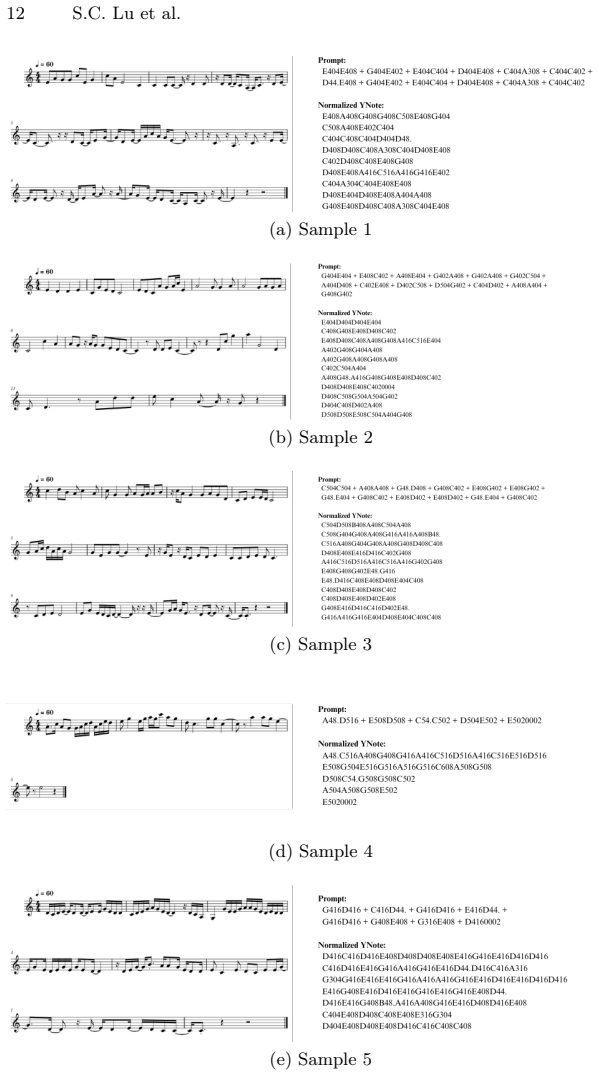
- [Figure 4 and Figure 5 captions] The captions say "Qualitative Evaluation" but the tables contain quantitative BLEU and ROUGE scores. The captions should be changed to "Quantitative Evaluation" or "BLEU and ROUGE Scores."
- [Section 5.3] The sentence "Figure 6 and 7 shows some examples of music generated by GPT-2" has a subject-verb agreement error; it should be "Figure 6 and Figure 7 show."
- [Section 4.2] The tokenization of YNote for GPT-2 is not described. The paper should state whether the model operates on character-level tokens, note-level tokens (e.g., "E5" + "04"), or byte-pair-encoded subwords, as this strongly affects both the generation behavior and the interpretation of n-gram overlap scores.
- [Section 5.1] The prompt construction is underspecified. "The first and last notes of each bar" is ambiguous for pieces with chords, rests, or multiple voices; a concrete YNote example of such a prompt should be provided.
- [Figure 1(e)] The YNote example in Figure 1(e) is not legible in the provided text. Please enlarge the figure or also provide the raw YNote string as text.
- [References] Several references are incomplete: [4] is missing venue and publisher details, [10] should include the page range or DOI, and [13] should cite the NeurIPS 2017 proceedings. The authors should also state whether the code and dataset will be released.
Circularity Check
No significant circularity: the paper is an empirical encoding and evaluation study, and its reported BLEU/ROUGE scores are measurements from a held-out split, not consequences of the YNote definition.
full rationale
The paper's central claim is that YNote is a practical simplified notation for fine-tuning LLMs and that a GPT-2 model fine-tuned on YNote-encoded Jiangnan-style music achieves BLEU and ROUGE scores of 0.883 and 0.766. There is no derivation chain in which a definition presupposes the result: YNote is defined independently in Section 3 (pitch name plus one-digit octave, two-character duration codes, and '00' for rest), the dataset is converted from 190 pieces in Section 5.1, GPT-2 is fine-tuned with a standard split (30% test, five withheld pieces), and BLEU/ROUGE are computed against withheld references in Section 5.3. The best-sample scores in Figures 4 and 5 are presented as measurements, not as formal consequences of the format's syntax. The normalization of invalid GPT-2 outputs described in Sections 4.2 and 5.3 (about 1.6% and 2.2% of characters modified) is a measurement-validity concern because the metrics may describe model-plus-repair rather than raw output quality, but it is not circular: the repair is not a fitted parameter renamed as a prediction, and no equation reduces the result to its inputs. No load-bearing self-citation or imported uniqueness theorem appears; references to prior ABC/MIDI GPT-2 work are external and from other groups. The absence of an ABC/MIDI comparison weakens the claim that YNote is a practical alternative, but that is an empirical benchmarking gap rather than circularity.
Assumptions & free parameters
assumptions (3)
- domain assumption BLEU and ROUGE n-gram overlap scores are valid proxies for music generation quality.
- domain assumption The 190-piece Jiangnan corpus is sufficient and representative for learning the target style.
- domain assumption Excluding rare notes and situations from YNote does not materially affect style representation.
invented entities (1)
-
YNote notation
Cite this review
Pith. "Pith review of YNote: A Novel Music Notation for Fine-Tuning LLMs in Music Generation." pith.science (2026). https://pith.science/paper/GCTXOOLK
@misc{pith2026250210467,
  author       = {Pith},
  title        = {Pith review of: YNote: A Novel Music Notation for Fine-Tuning LLMs in Music Generation},
  year         = {2026},
  howpublished = {\url{https://pith.science/paper/GCTXOOLK}},
  note         = {Machine review of arXiv:2502.10467}
}
read the original abstract
The field of music generation using Large Language Models (LLMs) is evolving rapidly, yet existing music notation systems, such as MIDI, ABC Notation, and MusicXML, remain too complex for effective fine-tuning of LLMs. These formats are difficult for both machines and humans to interpret due to their variability and intricate structure. To address these challenges, we introduce YNote, a simplified music notation system that uses only four characters to represent a note and its pitch. YNote's fixed format ensures consistency, making it easy to read and more suitable for fine-tuning LLMs. In our experiments, we fine-tuned GPT-2 (124M) on a YNote-encoded dataset and achieved BLEU and ROUGE scores of 0.883 and 0.766, respectively. With just two notes as prompts, the model was able to generate coherent and stylistically relevant music. We believe YNote offers a practical alternative to existing music notations for machine learning applications and has the potential to significantly enhance the quality of music generation using LLMs.
Figures


Figures from the paper (4 more)


Reference graph
Works this paper leans on
-
[1]
ABC Notation: The abcnotation.com wiki,https://abcnotation.com/wiki/
-
[2]
Banar, B., Colton, S.: A systematic evaluation of gpt-2-based music generation. In: International Conference on Computational Intelligence in Music, Sound, Art and Design (Part of EvoStar). pp. 19–35. Springer (2022)
work page 2022
-
[3]
In: Proceedings of the 1st Work- shop on NLP for Music and Audio (NLP4MusA)
Geerlings, C., Merono-Penuela, A.: Interacting with gpt-2 to generate controlled and believable musical sequences in abc notation. In: Proceedings of the 1st Work- shop on NLP for Music and Audio (NLP4MusA). pp. 49–53 (2020)
work page 2020
-
[4]
2019 Conference on Cog- nitive Computational Neuroscience (2019)
Heilbron, M., Ehinger, B.V., Hagoort, P., de Lange, F.P.: Tracking naturalistic linguistic predictions with deep neural language models. 2019 Conference on Cog- nitive Computational Neuroscience (2019)
work page 2019
-
[5]
arXiv preprint arXiv:2302.03917 (2023)
Huang, Q., Park, D.S., Wang, T., Denk, T.I., Ly, A., Chen, N., Zhang, Z., Zhang, Z., Yu, J., Frank, C., et al.: Noise2music: Text-conditioned music generation with diffusion models. arXiv preprint arXiv:2302.03917 (2023)
arXiv 2023
-
[6]
In: Text sum- marization branches out
Lin, C.Y.: Rouge: A package for automatic evaluation of summaries. In: Text sum- marization branches out. pp. 74–81 (2004)
2004
-
[7]
In: International Conference on Learning Representations (2017)
Loshchilov, I., Hutter, F.: Decoupled weight decay regularization. In: International Conference on Learning Representations (2017)
2017
-
[8]
MAKEMUSIC, I.: Musicxml for exchanging digital sheet music (Dec 2022),https: //www.musicxml.com/
work page 2022
Show all 13 references
-
[9]
MUSIC NOTATION COMMUNITY GROUP: Musicxml,https://www.w3.org/ 2021/06/musicxml40/
2021
-
[10]
arXiv e-prints pp
de Oliveira, H., de Oliveira, R.: Understanding midi: A painless tutorial on midi format. arXiv e-prints pp. arXiv–1705 (2017)
2017
-
[11]
In: Proceedings of the 40th annual meeting of the Association for Computational Linguistics
Papineni, K., Roukos, S., Ward, T., Zhu, W.J.: Bleu: a method for automatic evaluation of machine translation. In: Proceedings of the 40th annual meeting of the Association for Computational Linguistics. pp. 311–318 (2002)
2002
-
[12]
OpenAI blog1(8), 9 (2019)
Radford,A.,Wu,J.,Child,R.,Luan,D.,Amodei,D.,Sutskever,I.,etal.:Language models are unsupervised multitask learners. OpenAI blog1(8), 9 (2019)
2019
-
[13]
Advances in Neural Information Processing Systems (2017)
Vaswani, A.: Attention is all you need. Advances in Neural Information Processing Systems (2017)
2017
Reviewed August 8, 2026 · model on record in the stance chip above.
Discussion (0). Continue with ORCID to comment.