Naturalistic Computational Cognitive Science: Towards generalizable models and theories that capture the full range of natural behavior
Pith reviewed 2026-05-25 07:51 UTC · model grok-4.3
The pith
Cognitive science requires naturalistic paradigms and AI-accommodating models to build generalizable theories of natural intelligence.
A machine-rendered reading of the paper's core claim, the machinery that carries it, and where it could break.
Core claim
Incorporating a broader range of naturalistic experimental paradigms, together with computational models able to accommodate them, is necessary to resolve certain aspects of natural intelligence and to ensure that cognitive theories generalize beyond the specific conditions under which they were developed.
What carries the argument
Naturalistic experimental paradigms paired with computational models that learn from naturalistic data, enabling both broader behavioral coverage and reductive mechanistic understanding.
If this is right
- Theories built only on controlled tasks may miss or mischaracterize processes that appear only under naturalistic conditions.
- AI models trained on naturalistic data can supply new hypotheses about the roots of observed cognitive and neural phenomena.
- Integration of AI progress with cognitive science methods can preserve experimental control while addressing real-world cognitive problems.
- Adopting suggested methodological practices can produce cumulative, theoretically grounded progress in naturalistic computational cognitive science.
Where Pith is reading between the lines
- Future experiments might systematically vary the degree of naturalism within a single task to isolate which features drive the observed behavioral differences.
- Model comparisons could test whether the qualitative shifts seen in AI also appear when the same architecture is trained on progressively more naturalistic cognitive-science datasets.
- This framing suggests a possible division of labor in which controlled tasks isolate candidate mechanisms while naturalistic tasks test whether those mechanisms scale to everyday conditions.
Load-bearing premise
That naturalistic paradigms reliably elicit distinct behaviors or engage different processes than traditional controlled paradigms, providing the warrant for requiring them in generalizable theories.
What would settle it
A direct comparison in which the same cognitive model produces identical qualitative generalization patterns and process engagement when trained or tested on matched naturalistic versus controlled datasets.
Figures




read the original abstract
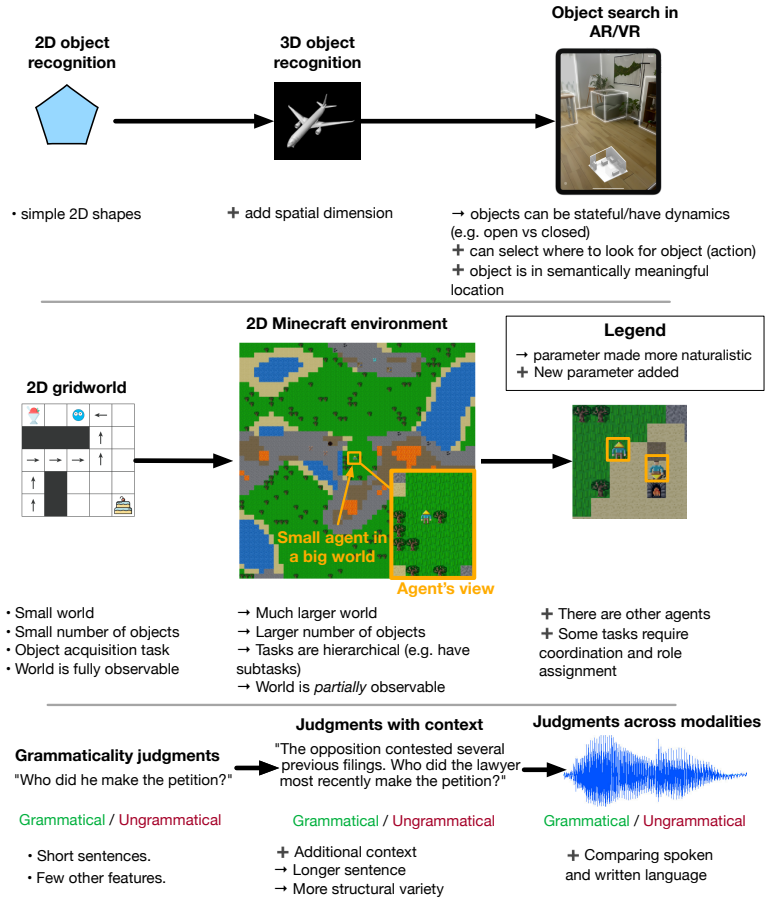
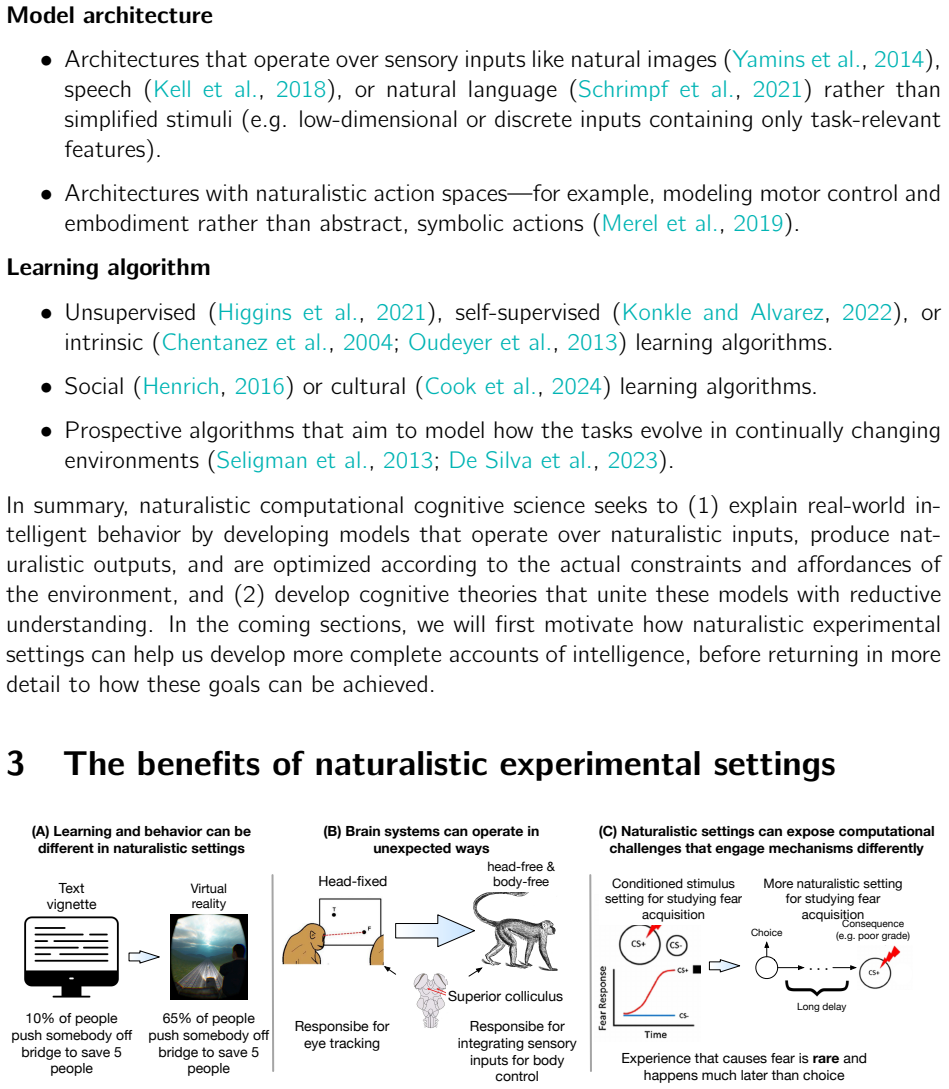
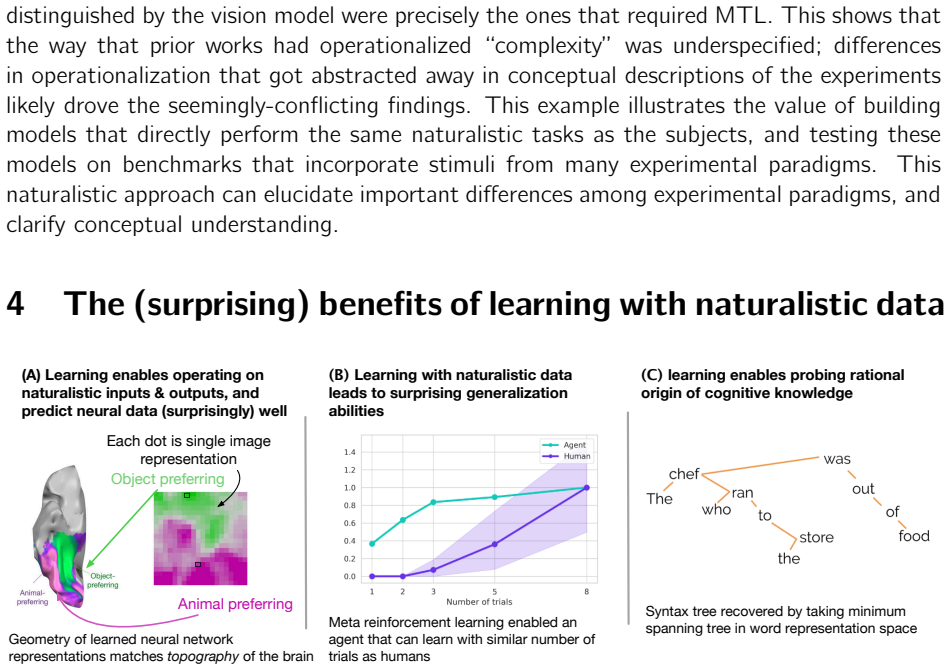
How can cognitive science build generalizable theories that span the full scope of natural situations and behaviors? We argue that progress in Artificial Intelligence (AI) offers timely opportunities for cognitive science to embrace experiments with increasingly naturalistic stimuli, tasks, and behaviors; and computational models that can accommodate these changes. We first review a growing body of research spanning neuroscience, cognitive science, and AI that suggests that incorporating a broader range of naturalistic experimental paradigms, and models that accommodate them, may be necessary to resolve some aspects of natural intelligence and ensure that our theories generalize. We review cases from cognitive science and neuroscience where naturalistic paradigms elicit distinct behaviors or engage different processes. We then discuss recent progress in AI that shows that learning from naturalistic data yields qualitatively different patterns of behavior and generalization, and examine how these findings impact the conclusions we draw from cognitive modeling, and can help yield new hypotheses for the roots of cognitive and neural phenomena. We then suggest that integrating recent progress in AI and cognitive science will enable us to engage with more naturalistic phenomena without giving up experimental control or the pursuit of theoretically grounded understanding. We offer practical guidance on how methodological practices can contribute to cumulative progress in naturalistic computational cognitive science, and illustrate a path towards building computational models that solve the real problems of natural cognition, together with a reductive understanding of the processes and principles by which they do so.
Editorial analysis
A structured set of objections, weighed in public.
Referee Report
Summary. The manuscript is a perspective paper arguing that cognitive science should incorporate broader naturalistic experimental paradigms (stimuli, tasks, behaviors) and computational models capable of handling them, drawing on recent AI progress, to build generalizable theories spanning the full range of natural behavior. It reviews cases from cognitive science and neuroscience where naturalistic setups elicit distinct behaviors or processes, discusses how AI models trained on naturalistic data produce qualitatively different generalization patterns, and offers practical guidance for integrating these approaches while retaining experimental control and theoretical grounding.
Significance. If the reviewed cases and AI findings hold, the perspective could encourage a productive shift toward more ecologically valid yet controlled research in cognitive science, potentially addressing gaps in generalizability. The manuscript explicitly credits the value of AI progress for generating new hypotheses about cognitive and neural phenomena and provides concrete methodological suggestions for cumulative progress, which strengthens its utility as a position piece.
minor comments (2)
- [Abstract] The abstract and introduction could more explicitly note the hedged nature of the central claim ('may be necessary') when summarizing the reviewed cases to avoid any implication of stronger necessity.
- A table or structured summary listing the key reviewed cases (with brief description of the naturalistic vs. controlled contrast and cited reference) would improve readability and allow readers to assess the breadth of evidence without scanning the full text.
Simulated Author's Rebuttal
We thank the referee for their positive and constructive review of our perspective paper. We are pleased that the manuscript was viewed as offering a timely argument for integrating naturalistic paradigms with computational modeling in cognitive science, and we appreciate the recommendation to accept.
Circularity Check
No circularity: position paper with external literature review
full rationale
The paper is a position statement reviewing existing literature from cognitive science, neuroscience, and AI to argue that naturalistic paradigms may be needed for generalizable theories. It contains no equations, fitted parameters, derivations, or predictions that could reduce to inputs by construction. The central claim is explicitly hedged ('may be necessary') and draws on external cases rather than self-citations or internal definitions. No load-bearing steps match any of the enumerated circularity patterns; the argument is self-contained against external benchmarks.
Axiom & Free-Parameter Ledger
Forward citations
Cited by 1 Pith paper
-
Active inference as a unified model of collision avoidance behavior in human drivers
Active inference model unifies human collision avoidance by reproducing meta-analysis aggregates and simulator-specific effects on response timing, maneuver selection, and execution.
Reference graph
Works this paper leans on
-
[1]
Abel, D., Barreto, A., Van Roy, B., Precup, D., van Hasselt, H. P., and Singh, S. (2024). A definition of continual reinforcement learning. Advances in Neural Information Processing Systems,
work page 2024
-
[2]
Agarwal, R., Schwarzer, M., Castro, P. S., Courville, A. C., and Bellemare, M. (2021). Deep reinforcement learning at the edge of the statistical precipice. Advances in neural information processing systems , 34:29304–29320. Allen, K., Br¨ andle, F., Botvinick, M., Fan, J. E., Gershman, S. J., Gopnik, A., Griffiths, T. L., Hartshorne, J. K., Hauser, T. U....
work page 2021
-
[3]
Cao, R. and Yamins, D. (2024a). Explanatory models in neuroscience, part 1: Taking mech- anistic abstraction seriously. Cognitive Systems Research , page 101244. Cao, R. and Yamins, D. (2024b). Explanatory models in neuroscience, part 2: Functional intelligibility and the contravariance principle. Cognitive Systems Research , 85:101200. Carlson, R. W. and...
-
[4]
Chomsky, N. (1957). Syntactic structures . Mouton de Gruyter. Chomsky, N. (1965). Aspects of the Theory of Syntax . MIT press. Chomsky, N. (2014). The minimalist program . MIT press. Cichy, R. M. and Kaiser, D. (2019). Deep neural networks as scientific models. Trends in cognitive sciences , 23(4):305–317. Cisek, P. (1999). Beyond the computer metaphor: B...
-
[5]
Elman, J. L. (1996). Rethinking innateness: A connectionist perspective on development , volume
work page 1996
-
[6]
MIT press. Engelhard, I. M., van den Hout, M. A., and McNally, R. J. (2008). Memory consistency for traumatic events in dutch soldiers deployed to iraq. Memory, 16(1):3–9. Erev, I. and Greiner, B. (2015). The 1-800 critique, counter-examples, and the future of behavioral economics. Handbook of experimental economic methodology , pages 151–165. Fan, L., Wa...
-
[7]
Harvard university press Cambridge, MA. Fodor, J. A. and Pylyshyn, Z. W. (1988). Connectionism and cognitive architecture: A critical analysis. Cognition, 28(1-2):3–71. Francis, K. B., Terbeck, S., Briazu, R. A., Haines, A., Gummerum, M., Ganis, G., and Howard, I. S. (2017). Simulating moral actions: An investigation of personal force in virtual moral dil...
work page 1988
-
[8]
Freeman, W. J. (1995). Chaos in the brain: Possible roles in biological intelligence. Interna- tional Journal of Intelligent Systems , 10(1):71–88. Fu, S., Tamir, N., Sundaram, S., Chai, L., Zhang, R., Dekel, T., and Isola, P. (2024). Dream- sim: Learning new dimensions of human visual similarity using synthetic data. Advances in Neural Information Proces...
work page 1995
-
[9]
Futrell, R., Gibson, E., Tily, H. J., Blank, I., Vishnevetsky, A., Piantadosi, S. T., and Fe- dorenko, E. (2021). The natural stories corpus: a reading-time corpus of english texts containing rare syntactic constructions. Language Resources and Evaluation , 55:63–77. Futrell, R. and Mahowald, K. (2025). How linguistics learned to stop worrying and love th...
-
[10]
L., Chater, N., Kemp, C., Perfors, A., and Tenenbaum, J
41 Griffiths, T. L., Chater, N., Kemp, C., Perfors, A., and Tenenbaum, J. B. (2010). Probabilis- tic models of cognition: Exploring representations and inductive biases. Trends in cognitive sciences, 14(8):357–364. Grim, P., Rosenberger, R., Rosenfeld, A., Anderson, B., and Eason, R. E. (2013). How simulations fail. Synthese, 190:2367–2390. Grimm, C., Bar...
work page 2010
-
[11]
He, K., Fan, H., Wu, Y., Xie, S., and Girshick, R
Springer. He, K., Fan, H., Wu, Y., Xie, S., and Girshick, R. (2020). Momentum contrast for unsu- pervised visual representation learning. In Proceedings of the IEEE/CVF conference on computer vision and pattern recognition , pages 9729–9738. He, K., Zhang, X., Ren, S., and Sun, J. (2016). Deep residual learning for image recognition. In Proceedings of the...
work page 2020
-
[12]
42 Henrich, J. (2016). The secret of our success: How culture is driving human evolution, domesticating our species, and making us smarter . princeton University press. Higgins, I., Chang, L., Langston, V., Hassabis, D., Summerfield, C., Tsao, D., and Botvinick, M. (2021). Unsupervised deep learning identifies semantic disentanglement in single infer- ote...
-
[13]
Krypotos, A.-M., Vervliet, B., and Engelhard, I. M. (2018). The validity of human avoidance paradigms. Behaviour Research and Therapy , 111:99–105. 44 Laird, J. E. (2019). The Soar cognitive architecture . MIT press. Lake, B. M. and Baroni, M. (2023). Human-like systematic generalization through a meta- learning neural network. Nature, 623(7985):115–121. ...
work page internal anchor Pith review Pith/arXiv arXiv 2018
-
[14]
Lee, I. (2014). Publish or perish: The myth and reality of academic publishing. Language teaching, 47(2):250–261. Lee, M. D. and Wagenmakers, E.-J. (2013). Bayesian cognitive modeling: A practical course . Cambridge university press. Levine, S., Finn, C., Darrell, T., and Abbeel, P. (2016). End-to-end training of deep visuo- motor policies. Journal of Mac...
-
[15]
Lyle, C., Rowland, M., and Dabney, W. (2022). Understanding and preventing capacity loss in reinforcement learning. arXiv preprint arXiv:2204.09560. Machado, M. C., Bellemare, M. G., Talvitie, E., Veness, J., Hausknecht, M., and Bowling, M. (2018). Revisiting the arcade learning environment: Evaluation protocols and open problems for general agents. Journ...
-
[16]
McCoy, R. T. and Griffiths, T. L. (2025). Modeling rapid language learning by distilling bayesian priors into artificial neural networks. Nature Communications , 16(1):1–14. Melis, G., Dyer, C., and Blunsom, P. (2017). On the state of the art of evaluation in neural language models. arXiv preprint arXiv:1707.05589. Merel, J., Botvinick, M., and Wayne, G. ...
work page internal anchor Pith review Pith/arXiv arXiv 2025
-
[17]
Misra, K. and Mahowald, K. (2024). Language models learn rare phenomena from less rare phenomena: The case of the missing aanns. arXiv preprint arXiv:2403.19827. Mnih, V., Kavukcuoglu, K., Silver, D., Rusu, A. A., Veness, J., Bellemare, M. G., Graves, A., Riedmiller, M., Fidjeland, A. K., Ostrovski, G., et al. (2015). Human-level control through deep rein...
-
[18]
Nanda, N., Chan, L., Lieberum, T., Smith, J., and Steinhardt, J. (2023). Progress measures for grokking via mechanistic interpretability. In The Eleventh International Conference on Learning Representations. Naselaris, T., Bassett, D. S., Fletcher, A. K., Kording, K., Kriegeskorte, N., Nienborg, H., Poldrack, R. A., Shohamy, D., and Kay, K. (2018). Cognit...
work page 2023
-
[19]
D., Conway, A., Cowan, N., Donkin, C., Farrell, S., Hitch, G
Oberauer, K., Lewandowsky, S., Awh, E., Brown, G. D., Conway, A., Cowan, N., Donkin, C., Farrell, S., Hitch, G. J., Hurlstone, M. J., et al. (2018). Benchmarks for models of short-term and working memory. Psychological bulletin , 144(9):885. Olshausen, B. A. and Field, D. J. (1996). Emergence of simple-cell receptive field properties by learning a sparse ...
-
[20]
Poldrack, R. A., Baker, C. I., Durnez, J., Gorgolewski, K. J., Matthews, P. M., Munaf` o, M. R., Nichols, T. E., Poline, J.-B., Vul, E., and Yarkoni, T. (2017). Scanning the horizon: towards transparent and reproducible neuroimaging research. Nature reviews neuroscience , 18(2):115–126. Prystawski, B., Li, M., and Goodman, N. (2024). Why think step by ste...
work page 2017
-
[21]
Puebla, G. and Bowers, J. S. (2022). Can deep convolutional neural networks support rela- tional reasoning in the same-different task? Journal of Vision , 22(10):11–11. 49 Quilty-Dunn, J., Porot, N., and Mandelbaum, E. (2023). The best game in town: The reemergence of the language-of-thought hypothesis across the cognitive sciences. Behav- ioral and Brain...
work page 2022
-
[22]
Rahnev, D. and Denison, R. N. (2018). Suboptimality in perceptual decision making. Be- havioral and brain sciences , 41:e223. Rahnev, D., Desender, K., Lee, A. L., Adler, W. T., Aguilar-Lleyda, D., Akdo˘ gan, B., Arbuzova, P., Atlas, L. Y., Balcı, F., Bang, J. W., et al. (2020). The confidence database. Nature human behaviour , 4(3):317–325. Recht, B. (20...
-
[23]
Yamins, D. L. and DiCarlo, J. J. (2016). Using goal-driven deep learning models to understand sensory cortex. Nature neuroscience , 19(3):356–365. Yamins, D. L., Hong, H., Cadieu, C. F., Solomon, E. A., Seibert, D., and DiCarlo, J. J. (2014). Performance-optimized hierarchical models predict neural responses in higher visual cortex. Proceedings of the nat...
work page 2016
-
[24]
Zhou, B., Khosla, A., Lapedriza, A., Oliva, A., and Torralba, A. (2014). Object detectors emerge in deep scene cnns. arXiv preprint arXiv:1412.6856. 55
work page internal anchor Pith review Pith/arXiv arXiv 2014
discussion (0)
Sign in with ORCID, Apple, or X to comment. Anyone can read and Pith papers without signing in.