Strong LensIng and Cluster Evolution (SLICE) with JWST: Early Results, Lens Models, and High-Redshift Detections
Pith reviewed 2026-05-22 22:16 UTC · model grok-4.3
The pith
JWST imaging supplies new multiple-image systems that tighten strong-lensing mass maps for 14 galaxy clusters.
A machine-rendered reading of the paper's core claim, the machinery that carries it, and where it could break.
Core claim
The addition of new lensing systems and constraints from substructure clumps in lensed galaxies improves the ability of strong lensing models to accurately reproduce the interior mass distribution of each cluster.
What carries the argument
Strong-lensing mass maps built from newly identified multiple-image systems and substructure clumps in JWST F150W2 and F322W2 imaging.
If this is right
- Mass enclosed within 200 kpc and 500 kpc is reported for each of the 14 clusters.
- Four clusters receive their first published strong-lensing models.
- Up to 19 new multiple-image systems are added in a single cluster.
- A candidate transient is identified in a lensed image of SPT-CL J0516-5755.
- All lens models are made available for download at the Strong Lensing Cluster Atlas Data Base.
Where Pith is reading between the lines
- The same JWST-based search for new constraints could be repeated on additional clusters once more NIRCam data become available.
- Tighter central mass maps may reduce systematic uncertainty when these clusters are used as gravitational telescopes for high-redshift source studies.
- The reported transient opens the possibility of monitoring time-delayed variability in lensed high-redshift objects with future JWST epochs.
Load-bearing premise
The newly detected multiple-image systems in the JWST imaging are correctly identified as lensed background galaxies rather than contaminants or artifacts.
What would settle it
Follow-up spectroscopy that places any reported new multiple-image system at a redshift inconsistent with the lensing geometry of its cluster would remove the claimed improvement in model accuracy.
Figures





read the original abstract
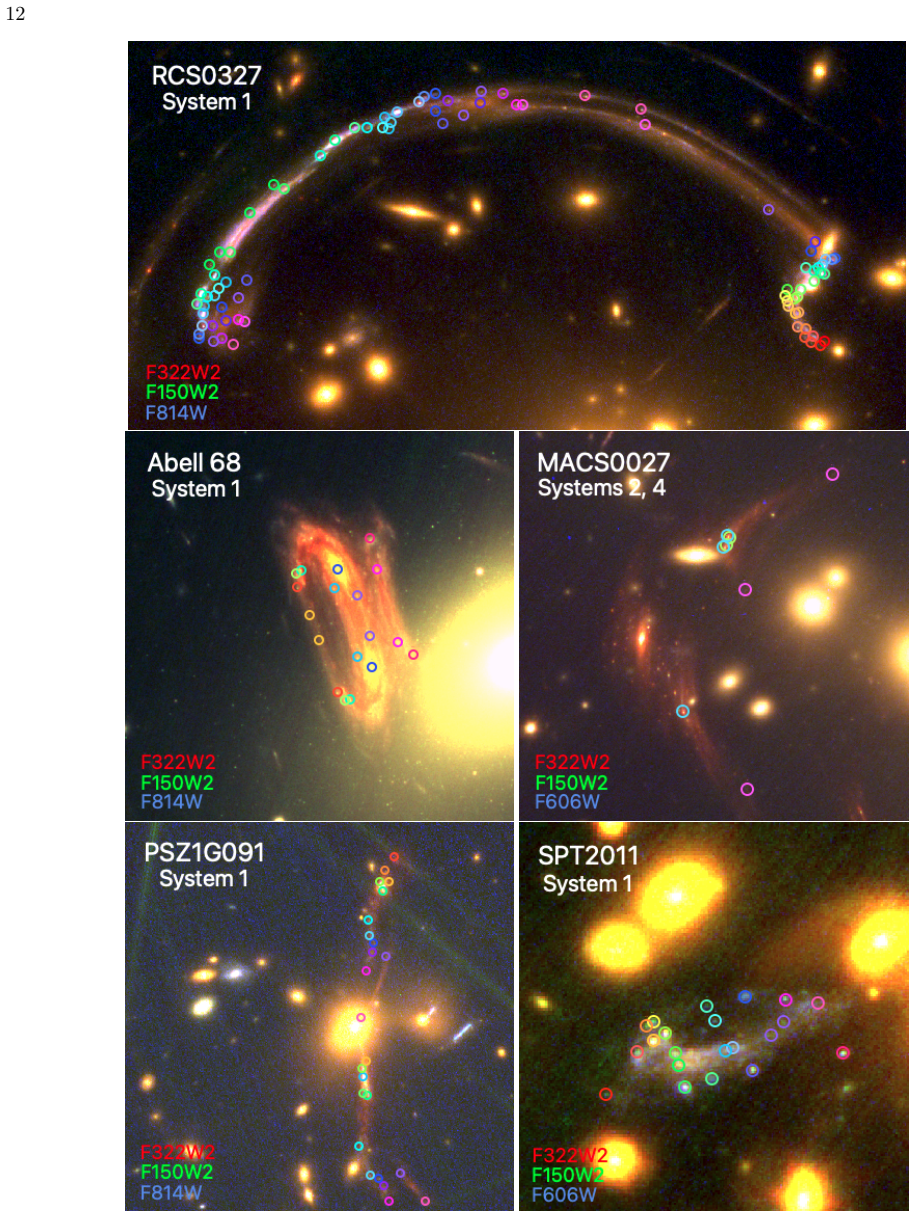
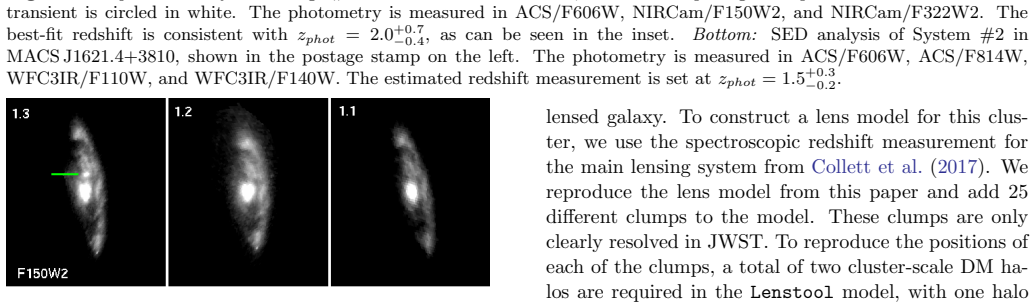
We leverage JWST's superb resolution to derive strong lensing mass maps of 14 clusters, spanning a redshift range of $z\sim0.25 - 1.06$ and a mass range of $M_{500}\sim2-12 \times 10^{14}M_\odot$, from the Strong LensIng and Cluster Evolution (SLICE) JWST program. These clusters represent a small subsample of the first clusters observed in the SLICE program that are chosen based on the detection of new multiple image constraints in the SLICE-JWST NIRCam/F150W2 and F322W2 imaging. These constraints include new lensed dusty galaxies and new substructures in previously identified lensed background galaxies. Four clusters have never been modeled before. For the remaining 10 clusters, we present updated models based on JWST and HST imaging and, where available, ground-based spectroscopy. We model the global mass profile for each cluster and report the mass enclosed within 200 and 500 kpc. We report the number of new systems identified in the JWST imaging, which in one cluster is as high as 19 new systems. The addition of new lensing systems and constraints from substructure clumps in lensed galaxies improves the ability of strong lensing models to accurately reproduce the interior mass distribution of each cluster. We also report the discovery of a candidate transient in a lensed image of the galaxy cluster SPT-CL J0516-5755. All lens models and their associated products are available for download at the Strong Lensing Cluster Atlas Data Base, which is hosted at Laboratoire d'Astrophysique de Marseille.
Editorial analysis
A structured set of objections, weighed in public.
Circularity Check
No significant circularity
full rationale
The paper is an observational data release presenting JWST-detected multiple-image systems and updated strong-lensing mass models for 14 clusters. Mass maps and enclosed masses (within 200/500 kpc) are direct outputs of models fitted to observed image positions and redshifts; the statement that additional constraints improve reproduction of interior mass distributions follows standard lensing practice and does not reduce to a self-definition, fitted input renamed as prediction, or self-citation chain. No equations, uniqueness theorems, or ansatzes are invoked that collapse to the paper's own inputs. The work is self-contained against external image data and does not rely on load-bearing prior results from the same authors.
Axiom & Free-Parameter Ledger
axioms (1)
- domain assumption Thin-lens approximation and standard parametric mass-profile forms (e.g., NFW or PIEMD) are sufficient to reproduce observed image positions.
Lean theorems connected to this paper
-
IndisputableMonolith/Foundation/RealityFromDistinction.leanreality_from_one_distinction unclear?
unclearRelation between the paper passage and the cited Recognition theorem.
We leverage JWST's superb resolution to derive strong lensing mass maps of 14 clusters... The addition of new lensing systems and constraints from substructure clumps in lensed galaxies improves the ability of strong lensing models to accurately reproduce the interior mass distribution of each cluster.
-
IndisputableMonolith/Cost/FunctionalEquation.leanwashburn_uniqueness_aczel unclear?
unclearRelation between the paper passage and the cited Recognition theorem.
Lenstool... dPIE... WSLAP+... image-plane scatter... mass enclosed within 200 and 500 kpc
What do these tags mean?
- matches
- The paper's claim is directly supported by a theorem in the formal canon.
- supports
- The theorem supports part of the paper's argument, but the paper may add assumptions or extra steps.
- extends
- The paper goes beyond the formal theorem; the theorem is a base layer rather than the whole result.
- uses
- The paper appears to rely on the theorem as machinery.
- contradicts
- The paper's claim conflicts with a theorem or certificate in the canon.
- unclear
- Pith found a possible connection, but the passage is too broad, indirect, or ambiguous to say the theorem truly supports the claim.
Forward citations
Cited by 2 Pith papers
-
SLICE -- Combining Strong Lensing and X-ray in AC 114. Further Insights into the Merger Scenario
Combined JWST lensing and X-ray analysis shows AC114 as the main cluster in a late post-collisional major merger with a gas-stripped companion AC114b located about 1 Mpc to the northwest.
-
Strong Gravitational Lensing with the James Webb Space Telescope
Strong gravitational lensing paired with JWST enables magnified high-resolution views of distant sources and improved constraints on dark matter.
Reference graph
Works this paper leans on
-
[1]
Abbott, T. M. C., Abdalla, F. B., Alarcon, A., et al. 2018, PhRvD, 98, 043526, doi: 10.1103/PhysRevD.98.043526
-
[2]
2019, ApJ, 874, 132, doi: 10.3847/1538-4357/ab0adf
Acebron, A., Alon, M., Zitrin, A., et al. 2019, ApJ, 874, 132, doi: 10.3847/1538-4357/ab0adf
-
[3]
Adamo, A., Bradley, L. D., Vanzella, E., et al. 2024, Nature, 632, 513, doi: 10.1038/s41586-024-07703-7
-
[4]
Anderson, M. E., Gaspari, M., White, S. D. M., Wang, W., & Dai, X. 2015, MNRAS, 449, 3806, doi: 10.1093/mnras/stv437
-
[5]
Artis, E., Adam, R., Ade, P., et al. 2022, arXiv e-prints, arXiv:2204.14052, doi: 10.48550/arXiv.2204.14052 Astropy Collaboration, Robitaille, T. P., Tollerud, E. J., et al. 2013, A&A, 558, A33, doi: 10.1051/0004-6361/201322068
-
[6]
Atek, H., Shuntov, M., Furtak, L. J., et al. 2023, MNRAS, 519, 1201, doi: 10.1093/mnras/stac3144
-
[7]
Ground-based and Airborne Instrumentation for Astronomy III , year = 2010, editor =
Bacon, R., Accardo, M., Adjali, L., et al. 2010, in Society of Photo-Optical Instrumentation Engineers (SPIE) Conference Series, Vol. 7735, Ground-based and Airborne Instrumentation for Astronomy III, ed. I. S. McLean, S. K. Ramsay, & H. Takami, 773508, doi: 10.1117/12.856027
-
[8]
2010a, Classical and Quantum Gravity, 27, 233001, doi: 10.1088/0264-9381/27/23/233001 —
Bartelmann, M. 2010a, Classical and Quantum Gravity, 27, 233001, doi: 10.1088/0264-9381/27/23/233001 —. 2010b, Classical and Quantum Gravity, 27, 233001, doi: 10.1088/0264-9381/27/23/233001
-
[9]
1996, A&AS, 117, 393, doi: 10.1051/aas:1996164
Bertin, E., & Arnouts, S. 1996a, A&AS, 117, 393, doi: 10.1051/aas:1996164 —. 1996b, A&AS, 117, 393, doi: 10.1051/aas:1996164
-
[10]
2024, SSRv, 220, 48, doi: 10.1007/s11214-024-01079-w
Birrer, S., Millon, M., Sluse, D., et al. 2024, SSRv, 220, 48, doi: 10.1007/s11214-024-01079-w
-
[11]
Bocquet, S., Dietrich, J. P., Schrabback, T., et al. 2019, ApJ, 878, 55, doi: 10.3847/1538-4357/ab1f10
-
[12]
Bordoloi, R., Rigby, J. R., Tumlinson, J., et al. 2016, MNRAS, 458, 1891, doi: 10.1093/mnras/stw449 Bradaˇ c, M., Strait, V., Mowla, L., et al. 2024, ApJL, 961, L21, doi: 10.3847/2041-8213/ad0e73
-
[13]
Calzetti, D., Armus, L., Bohlin, R. C., et al. 2000, ApJ, 533, 682, doi: 10.1086/308692
work page internal anchor Pith review doi:10.1086/308692 2000
-
[14]
B., Rosati, P., Grillo, C., et al
Caminha, G. B., Rosati, P., Grillo, C., et al. 2019, A&A, 632, A36, doi: 10.1051/0004-6361/201935454
-
[15]
Caputi, K. I., Caminha, G. B., Fujimoto, S., et al. 2021, ApJ, 908, 146, doi: 10.3847/1538-4357/abd4d0
-
[16]
2018, ApJ, 859, 159, doi: 10.3847/1538-4357/aabe7b
Cerny, C., Sharon, K., Andrade-Santos, F., et al. 2018, ApJ, 859, 159, doi: 10.3847/1538-4357/aabe7b
-
[17]
2024, arXiv e-prints, arXiv:2410.10974, doi: 10.48550/arXiv.2410.10974 —
Claeyssens, A., Adamo, A., Messa, M., et al. 2024, arXiv e-prints, arXiv:2410.10974, doi: 10.48550/arXiv.2410.10974 —. 2025, MNRAS, 537, 2535, doi: 10.1093/mnras/staf058
-
[18]
2023, MNRAS, 520, 2180, doi: 10.1093/mnras/stac3791
Claeyssens, A., Adamo, A., Richard, J., et al. 2023, MNRAS, 520, 2180, doi: 10.1093/mnras/stac3791
-
[19]
2013, ApJ, 762, 32, doi: 10.1088/0004-637X/762/1/32 56
Coe, D., Zitrin, A., Carrasco, M., et al. 2013, ApJ, 762, 32, doi: 10.1088/0004-637X/762/1/32 56
-
[20]
2019, ApJ, 884, 85, doi: 10.3847/1538-4357/ab412b
Coe, D., Salmon, B., Bradaˇ c, M., et al. 2019, ApJ, 884, 85, doi: 10.3847/1538-4357/ab412b
-
[21]
E., Buckley-Geer, E., Lin, H., et al
Collett, T. E., Buckley-Geer, E., Lin, H., et al. 2017, ApJ, 843, 148, doi: 10.3847/1538-4357/aa76e6 Di Gennaro, G., Br¨ uggen, M., van Weeren, R. J., et al. 2023, A&A, 675, A51, doi: 10.1051/0004-6361/202345905
-
[22]
M., Broadhurst, T., Wong, J., et al
Diego, J. M., Broadhurst, T., Wong, J., et al. 2016, MNRAS, 459, 3447, doi: 10.1093/mnras/stw865
-
[23]
Diego, J. M., Protopapas, P., Sandvik, H. B., & Tegmark, M. 2005, MNRAS, 360, 477, doi: 10.1111/j.1365-2966.2005.09021.x
-
[24]
Diego, J. M., Tegmark, M., Protopapas, P., & Sandvik, H. B. 2007, MNRAS, 375, 958, doi: 10.1111/j.1365-2966.2007.11380.x
-
[25]
M., Pascale, M., Frye, B., et al
Diego, J. M., Pascale, M., Frye, B., et al. 2023a, A&A, 679, A159, doi: 10.1051/0004-6361/202345868
-
[26]
Diego, J. M., Meena, A. K., Adams, N. J., et al. 2023b, A&A, 672, A3, doi: 10.1051/0004-6361/202245238
-
[27]
2017, MNRAS, 471, 3305, doi: 10.1093/mnras/stx1636
Ebeling, H., Qi, J., & Richard, J. 2017, MNRAS, 471, 3305, doi: 10.1093/mnras/stx1636
-
[28]
Ebeling, H., White, D. A., & Rangarajan, F. V. N. 2006, MNRAS, 368, 65, doi: 10.1111/j.1365-2966.2006.10135.x El´ ıasd´ ottir,´A., Limousin, M., Richard, J., et al. 2007, arXiv e-prints, arXiv:0710.5636, doi: 10.48550/arXiv.0710.5636
-
[29]
Forbes, D. A., & Romanowsky, A. J. 2023, MNRAS, 520, L58, doi: 10.1093/mnrasl/slac162
-
[30]
Fox, C., Mahler, G., Sharon, K., & Remolina Gonz´ alez, J. D. 2022, ApJ, 928, 87, doi: 10.3847/1538-4357/ac5024
-
[31]
E., Kashyap, V., Rosner, R., & Lamb, D
Freeman, P. E., Kashyap, V., Rosner, R., & Lamb, D. Q. 2002, ApJS, 138, 185, doi: 10.1086/324017
-
[32]
Fruscione, A., McDowell, J. C., Allen, G. E., et al. 2006, in Society of Photo-Optical Instrumentation Engineers (SPIE) Conference Series, Vol. 6270, Society of Photo-Optical Instrumentation Engineers (SPIE) Conference Series, ed. D. R. Silva & R. E. Doxsey, 62701V, doi: 10.1117/12.671760
-
[33]
J., Plat, A., Zitrin, A., et al
Furtak, L. J., Plat, A., Zitrin, A., et al. 2022, MNRAS, 516, 1373, doi: 10.1093/mnras/stac2169
-
[34]
Furtak, L. J., Zitrin, A., Weaver, J. R., et al. 2023, MNRAS, 523, 4568, doi: 10.1093/mnras/stad1627
-
[35]
J., Zitrin, A., Richard, J., et al
Furtak, L. J., Zitrin, A., Richard, J., et al. 2024, MNRAS, 533, 2242, doi: 10.1093/mnras/stae1943
-
[36]
Gladders, M. D., & Yee, H. K. C. 2000, AJ, 120, 2148, doi: 10.1086/301557
-
[37]
2021, ApJS, 253, 3, doi: 10.3847/1538-4365/abd023
Hilton, M., Sif´ on, C., Naess, S., et al. 2021, ApJS, 253, 3, doi: 10.3847/1538-4365/abd023
-
[38]
2013, MNRAS, 429, 833, doi: 10.1093/mnras/sts379
Hsu, L.-Y., Ebeling, H., & Richard, J. 2013, MNRAS, 429, 833, doi: 10.1093/mnras/sts379
-
[39]
2021, MNRAS, 508, 1206, doi: 10.1093/mnras/stab2270
Jauzac, M., Klein, B., Kneib, J.-P., et al. 2021, MNRAS, 508, 1206, doi: 10.1093/mnras/stab2270
-
[40]
2015, MNRAS, 452, 1437, doi: 10.1093/mnras/stv1402
Jauzac, M., Richard, J., Jullo, E., et al. 2015, MNRAS, 452, 1437, doi: 10.1093/mnras/stv1402
-
[41]
D., Leja, J., Conroy, C., & Speagle, J
Johnson, B. D., Leja, J., Conroy, C., & Speagle, J. S. 2021, ApJS, 254, 22, doi: 10.3847/1538-4365/abef67
work page internal anchor Pith review doi:10.3847/1538-4365/abef67 2021
-
[42]
Johnson, T. L., & Sharon, K. 2016, ApJ, 832, 82, doi: 10.3847/0004-637X/832/1/82
-
[43]
Johnson, T. L., Sharon, K., Bayliss, M. B., et al. 2014, ApJ, 797, 48, doi: 10.1088/0004-637X/797/1/48
-
[44]
Jullo, E., Kneib, J. P., Limousin, M., et al. 2007, New Journal of Physics, 9, 447, doi: 10.1088/1367-2630/9/12/447
-
[45]
Kale, R., Shende, K. M., & Parekh, V. 2019, MNRAS, 486, L80, doi: 10.1093/mnrasl/slz061
-
[46]
L., Rodney, S., Treu, T., et al
Kelly, P. L., Rodney, S., Treu, T., et al. 2023, Science, 380, abh1322, doi: 10.1126/science.abh1322
-
[47]
Khullar, G., Bayliss, M. B., Gladders, M. D., et al. 2022, ApJ, 934, 177, doi: 10.3847/1538-4357/ac7c0c
-
[48]
2011, A&A Rv, 19, 47, doi: 10.1007/s00159-011-0047-3
Kneib, J.-P., & Natarajan, P. 2011, A&A Rv, 19, 47, doi: 10.1007/s00159-011-0047-3
-
[49]
Ko, Y., Hwang, H. S., Lee, M. G., et al. 2017, ApJ, 835, 212, doi: 10.3847/1538-4357/835/2/212 Lah´ en, N., Naab, T., & Sz´ ecsi, D. 2024, MNRAS, 530, 645, doi: 10.1093/mnras/stae904
-
[50]
2022, A&A, 667, L3, doi: 10.1051/0004-6361/202244719
Laporte, N., Zitrin, A., Dole, H., et al. 2022, A&A, 667, L3, doi: 10.1051/0004-6361/202244719
-
[51]
Lee, M. G., Park, H. S., & Hwang, H. S. 2010, Science, 328, 334, doi: 10.1126/science.1186496
-
[52]
2016, A&A, 588, A99, doi: 10.1051/0004-6361/201527638
Limousin, M., Richard, J., Jullo, E., et al. 2016, A&A, 588, A99, doi: 10.1051/0004-6361/201527638
-
[53]
2018, Nature, 554, 493, doi: 10.1038/nature25436
Lopez, S., Tejos, N., Ledoux, C., et al. 2018, Nature, 554, 493, doi: 10.1038/nature25436
-
[54]
M., Koekemoer, A., Coe, D., et al
Lotz, J. M., Koekemoer, A., Coe, D., et al. 2017, ApJ, 837, 97, doi: 10.3847/1538-4357/837/1/97
-
[55]
Lucia, G. D., Fontanot, F., Hirschmann, M., & Xie, L. 2025, Cosmic quenching. https://arxiv.org/abs/2502.01724
-
[56]
2014, Annual Review of Astronomy and Astrophysics, 52, 415, doi: 10.1146/annurev-astro-081811-125615
Madau, P., & Dickinson, M. 2014, ARA&A, 52, 415, doi: 10.1146/annurev-astro-081811-125615
work page internal anchor Pith review doi:10.1146/annurev-astro-081811-125615 2014
-
[57]
2023, ApJ, 945, 49, doi: 10.3847/1538-4357/acaea9
Mahler, G., Jauzac, M., Richard, J., et al. 2023, ApJ, 945, 49, doi: 10.3847/1538-4357/acaea9
-
[58]
2019, PhD thesis, University of Arizona
Mainali, R. 2019, PhD thesis, University of Arizona
work page 2019
-
[59]
Martis, N. S., Sarrouh, G. T. E., Willott, C. J., et al. 2024, ApJ, 975, 76, doi: 10.3847/1538-4357/ad7735
-
[60]
K., Zitrin, A., Jim´ enez-Teja, Y., et al
Meena, A. K., Zitrin, A., Jim´ enez-Teja, Y., et al. 2023, ApJL, 944, L6, doi: 10.3847/2041-8213/acb645
-
[61]
2017, MNRAS, 472, 3177, doi: 10.1093/mnras/stx2064
Meneghetti, M., Natarajan, P., Coe, D., et al. 2017, MNRAS, 472, 3177, doi: 10.1093/mnras/stx2064
-
[62]
2022, ApJL, 940, L51, doi: 10.3847/2041-8213/ac98c5
Montes, M., & Trujillo, I. 2022, ApJL, 940, L51, doi: 10.3847/2041-8213/ac98c5
-
[63]
2023, ApJL, 947, L24, doi: 10.3847/2041-8213/acb99e 57
Morishita, T., Roberts-Borsani, G., Treu, T., et al. 2023, ApJL, 947, L24, doi: 10.3847/2041-8213/acb99e 57
-
[64]
Mowla, L., Iyer, K. G., Desprez, G., et al. 2022, ApJL, 937, L35, doi: 10.3847/2041-8213/ac90ca
-
[65]
Mowla, L., Iyer, K., Asada, Y., et al. 2024, arXiv e-prints, arXiv:2402.08696, doi: 10.48550/arXiv.2402.08696
-
[66]
Natarajan, P., Williams, L. L. R., Bradaˇ c, M., et al. 2024, SSRv, 220, 19, doi: 10.1007/s11214-024-01051-8
-
[67]
2017, MNRAS, 468, 1962, doi: 10.1093/mnras/stw3385
Natarajan, P., Chadayammuri, U., Jauzac, M., et al. 2017, MNRAS, 468, 1962, doi: 10.1093/mnras/stw3385
-
[68]
2023, Monthly Notices of the Royal Astronomical Society, 525, 1867–1884, doi: 10.1093/mnras/stad1019
Noirot, G., Desprez, G., Asada, Y., et al. 2023, Monthly Notices of the Royal Astronomical Society, 525, 1867–1884, doi: 10.1093/mnras/stad1019
-
[69]
Pascale, M., Frye, B. L., Diego, J., et al. 2022, ApJL, 938, L6, doi: 10.3847/2041-8213/ac9316
-
[70]
Pascale, M., Frye, B. L., Pierel, J. D. R., et al. 2024, arXiv e-prints, arXiv:2403.18902, doi: 10.48550/arXiv.2403.18902 P´ erez-Gonz´ alez, P. G., Barro, G., Annunziatella, M., et al. 2023, ApJL, 946, L16, doi: 10.3847/2041-8213/acb3a5
-
[71]
2022, NewAR, 95, 101659, doi: 10.1016/j.newar.2022.101659
Perivolaropoulos, L., & Skara, F. 2022, NewAR, 95, 101659, doi: 10.1016/j.newar.2022.101659
-
[72]
Pfeffer, J., Forbes, D. A., Romanowsky, A. J., et al. 2025, MNRAS, 536, 1878, doi: 10.1093/mnras/stae2665 Planck Collaboration, Ade, P. A. R., Aghanim, N., et al. 2016a, A&A, 594, A27, doi: 10.1051/0004-6361/201525823 —. 2016b, A&A, 594, A27, doi: 10.1051/0004-6361/201525823 Planck Collaboration, Aghanim, N., Akrami, Y., et al. 2020, A&A, 641, A6, doi: 10...
-
[73]
2012, ApJS, 199, 25, doi: 10.1088/0067-0049/199/2/25
Postman, M., Coe, D., Ben´ ıtez, N., et al. 2012, ApJS, 199, 25, doi: 10.1088/0067-0049/199/2/25
-
[74]
Rodney, S. A. 2017, MNRAS, 465, 1030, doi: 10.1093/mnras/stw2785 Remolina Gonz´ alez, J. D., Sharon, K., & Mahler, G. 2018, ApJ, 863, 60, doi: 10.3847/1538-4357/aacf8e
-
[75]
2018, MNRAS, 479, 844, doi: 10.1093/mnras/sty1489
Repp, A., & Ebeling, H. 2018, MNRAS, 479, 844, doi: 10.1093/mnras/sty1489
-
[76]
2007, ApJ, 662, 781, doi: 10.1086/517875
Richard, J., Kneib, J.-P., Jullo, E., et al. 2007, ApJ, 662, 781, doi: 10.1086/517875
-
[77]
2014, MNRAS, 444, 268, doi: 10.1093/mnras/stu1395
Richard, J., Jauzac, M., Limousin, M., et al. 2014, MNRAS, 444, 268, doi: 10.1093/mnras/stu1395
-
[78]
2021, A&A, 646, A83, doi: 10.1051/0004-6361/202039462
Richard, J., Claeyssens, A., Lagattuta, D., et al. 2021, A&A, 646, A83, doi: 10.1051/0004-6361/202039462
-
[79]
Rigby, J. R., Johnson, T. L., Sharon, K., et al. 2017, ApJ, 843, 79, doi: 10.3847/1538-4357/aa775e
-
[80]
Rigby, J. R., Vieira, J. D., Phadke, K. A., et al. 2023a, arXiv e-prints, arXiv:2312.10465, doi: 10.48550/arXiv.2312.10465 —. 2023b, arXiv e-prints, arXiv:2312.10465, doi: 10.48550/arXiv.2312.10465 —. 2025, ApJ, 978, 108, doi: 10.3847/1538-4357/ad7501 Rihtarˇ siˇ c, G., Bradaˇ c, M., Desprez, G., et al. 2024, arXiv e-prints, arXiv:2406.10332, doi: 10.4855...
discussion (0)
Sign in with ORCID, Apple, or X to comment. Anyone can read and Pith papers without signing in.