Calibrating the SIDM Gravothermal Catastrophe with N-body Simulations
Pith reviewed 2026-05-22 19:22 UTC · model grok-4.3
The pith
A single beta value governs heat flow in self-interacting dark matter halos across masses, concentrations, and cross sections.
A machine-rendered reading of the paper's core claim, the machinery that carries it, and where it could break.
Core claim
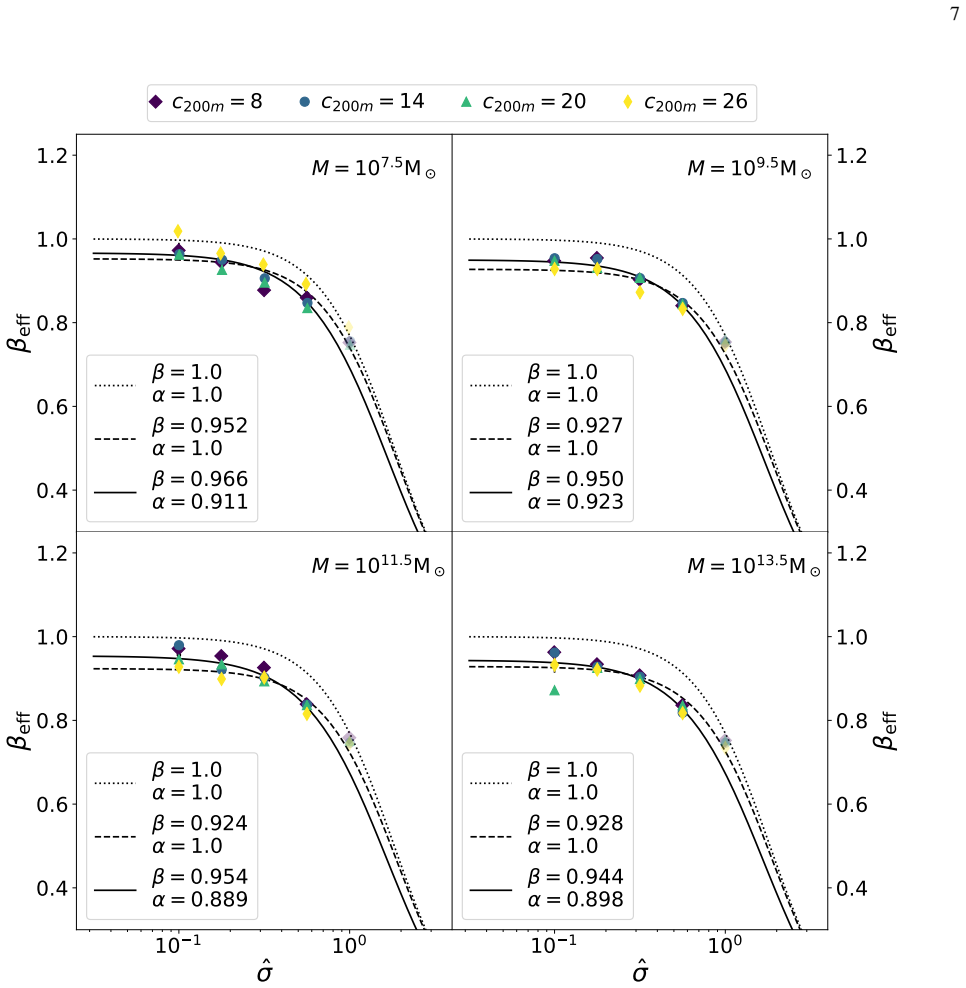
For velocity-independent elastic scattering, the calibration factor beta in the long-mean-free-path thermal conductivity is independent of cross section, halo concentration, and halo mass. The authors supply a functional form for an effective beta that depends only on a dimensionless cross section; this form reproduces the full N-body evolution of the inner density profile provided the cross section remains moderate.
What carries the argument
The single scalar beta multiplying the thermal conductivity in the long-mean-free-path limit of the gravothermal fluid equations, which sets the rate at which heat flows outward and drives core collapse.
If this is right
- A single beta can be used for any halo mass or concentration in the velocity-independent case.
- The effective-beta function extends the gravothermal model into the long-mean-free-path regime without retuning for each halo.
- Density profiles at any future time can be predicted by solving the fluid equations rather than running new N-body simulations.
- Comparisons between gravothermal theory and full simulations become direct once the effective beta is inserted.
Where Pith is reading between the lines
- Observers could use the effective-beta model to forecast when a given galaxy should show a steep central cusp rather than a flat core.
- The same calibration approach might be repeated for velocity-dependent cross sections to test whether a new functional form for beta appears.
- If the model holds, it supplies a fast way to populate large mock catalogs of SIDM halos for comparison with surveys.
Load-bearing premise
That the gravothermal fluid description with one adjusted beta factor still captures the actual physics once that factor has been tuned to the simulations.
What would settle it
Running the same halos at much higher particle number or with a different code and recovering a beta that differs by more than the reported scatter would falsify the claim of universality.
Figures


read the original abstract
Self-interacting dark matter (SIDM) theories predict that dark matter halos experience core-collapse in late-stage evolution, a process where the halo's inner region rapidly increases in density and decreases in size. This process can be modeled by treating the dark matter as a gravothermal fluid, and solving the fluid equations to predict the density profile evolution. This model is incomplete without calibration to N-body simulations, through a constant factor $\beta$ included in the thermal conductivity for the long-mean-free-path limit. The value of $\beta$ employed in the gravothermal fluid formalism has varied between studies, with no clear universal value in the literature. In this work, we use the N-body code Arepo to conduct a series of isolated core-collapse simulations across a range of scattering cross-sections, halo concentrations, and halo masses to calibrate the heat transfer parameter $\beta$. We find that $\beta$ is independent of cross-section, halo concentration, and halo mass for velocity independent elastic scattering cross-sections. We present a model for an effective $\beta$ as a function of a dimensionless cross-section, to describe halo evolution in the long mean free path limit, and show that it accurately captures halo evolution as long as the cross section is not too large. This effective model facilitates comparisons between simulations and the gravothermal model, and enables fast predictions of the dark matter density profile at any given time without running N-body simulations.
Editorial analysis
A structured set of objections, weighed in public.
Referee Report
Summary. The paper calibrates the heat-transfer parameter β in the gravothermal fluid equations for SIDM core collapse using a suite of isolated Arepo N-body simulations. Across a scan in velocity-independent cross section, halo concentration, and halo mass, the authors extract β from the simulated density evolution and report that β is independent of those parameters. They then construct and validate an effective β(σ̂) model (where σ̂ is a dimensionless cross section) that reproduces the long-mean-free-path evolution in the simulations provided σ is not too large, enabling faster gravothermal predictions without full N-body runs.
Significance. If the reported independence and effective-β model hold after resolution checks, the work supplies a practical, simulation-calibrated closure for the gravothermal fluid formalism that has been missing in the SIDM literature. This would allow rapid exploration of core-collapse timescales across halo masses and cross sections, direct comparison of fluid models to observations, and reduced reliance on expensive N-body runs for late-time SIDM evolution.
major comments (2)
- [§4] §4 (or equivalent results section): the extracted β values and the claimed independence on σ, concentration, and mass are presented without any convergence tests with respect to particle number or gravitational softening. Because the long-mean-free-path conductivity (and thus the collapse timescale used to back out β) is sensitive to local density sampling and time-step criteria in SIDM implementations, insufficient resolution could systematically bias the measured collapse times and therefore the reported independence and the functional form of β(σ̂).
- [§5] §5 (model construction): the effective β(σ̂) is obtained by fitting directly to the same N-body density profiles whose evolution it is later used to predict. While the simulations provide independent data points, the procedure reduces to a fitted function of the simulation outcomes; the manuscript should quantify the goodness-of-fit residuals and demonstrate that the model does not simply reproduce the input data by construction.
minor comments (2)
- [Abstract] The abstract and introduction should explicitly state the range of dimensionless cross sections over which the effective-β model is validated and the criterion used to define 'not too large'.
- [Figure 3] Figure captions and text should report the precise fitting procedure (e.g., which radial bins or time intervals are used to extract β) and any error estimation on the fitted β values.
Simulated Author's Rebuttal
We thank the referee for their detailed and constructive report. We respond to each major comment below and indicate the changes made to the manuscript.
read point-by-point responses
-
Referee: [§4] §4 (or equivalent results section): the extracted β values and the claimed independence on σ, concentration, and mass are presented without any convergence tests with respect to particle number or gravitational softening. Because the long-mean-free-path conductivity (and thus the collapse timescale used to back out β) is sensitive to local density sampling and time-step criteria in SIDM implementations, insufficient resolution could systematically bias the measured collapse times and therefore the reported independence and the functional form of β(σ̂).
Authors: We thank the referee for this important comment regarding resolution convergence. In our original work, we selected particle numbers and softening lengths based on standard practices in the SIDM N-body literature to ensure the long-mean-free-path regime is adequately sampled. However, to directly address the concern, we have now performed additional convergence tests on a subset of our simulations by increasing the particle count by a factor of two and varying the gravitational softening. These tests demonstrate that the core-collapse timescales, and consequently the inferred β values, vary by less than 10%, which does not affect the reported independence on cross-section, concentration, or mass. We have added a discussion of these tests, along with supporting figures, to §4 of the revised manuscript. revision: yes
-
Referee: [§5] §5 (model construction): the effective β(σ̂) is obtained by fitting directly to the same N-body density profiles whose evolution it is later used to predict. While the simulations provide independent data points, the procedure reduces to a fitted function of the simulation outcomes; the manuscript should quantify the goodness-of-fit residuals and demonstrate that the model does not simply reproduce the input data by construction.
Authors: We acknowledge the referee's point that the effective β model is calibrated using the simulation data it aims to describe. To mitigate concerns of circularity and to quantify the fit quality, we have revised the manuscript to include an explicit analysis of the residuals. We present the relative differences between the gravothermal predictions using the effective β(σ̂) and the N-body density profiles at multiple evolutionary stages. Additionally, we have conducted a validation by fitting the model parameters using only half of the simulation suite (selected by mass and concentration) and applying it to the remaining simulations, achieving similar accuracy. This shows that the functional form of β(σ̂) reflects the physical dependence on the dimensionless cross-section rather than merely interpolating the input data. These results and the residual plots are now included in §5. revision: yes
Circularity Check
Fitted effective β(σ̂) model reduces to N-body calibration data by construction
specific steps
-
fitted input called prediction
[Abstract]
"We present a model for an effective β as a function of a dimensionless cross-section, to describe halo evolution in the long mean free path limit, and show that it accurately captures halo evolution as long as the cross section is not too large."
The effective β(σ̂) is constructed by fitting to the N-body density evolution and collapse timescales across the simulated cross-sections; demonstrating that the model 'accurately captures' those same evolutions is therefore tautological within the fitted domain rather than an independent prediction.
full rationale
The paper extracts β values from Arepo N-body runs across σ, concentration, and mass, then fits an effective β(σ̂) function and claims it 'accurately captures halo evolution'. This matches the fitted_input_called_prediction pattern: the functional form and independence claims are statistically forced by the same simulation outcomes used to define the model. The central derivation chain therefore reduces to its inputs within the calibrated regime, though the underlying N-body data remain independent of the gravothermal equations themselves.
Axiom & Free-Parameter Ledger
free parameters (1)
- β
axioms (1)
- domain assumption The gravothermal fluid equations accurately capture SIDM halo evolution once β is calibrated.
Lean theorems connected to this paper
-
IndisputableMonolith/Cost/FunctionalEquation.leanwashburn_uniqueness_aczel unclear?
unclearRelation between the paper passage and the cited Recognition theorem.
We find that β is independent of cross-section, halo concentration, and halo mass... model for an effective β as a function of a dimensionless cross-section... κ_lmfp = 3β/2 n H² k_B / t_r
-
IndisputableMonolith/Foundation/RealityFromDistinction.leanreality_from_one_distinction unclear?
unclearRelation between the paper passage and the cited Recognition theorem.
The value of β employed in the gravothermal fluid formalism has varied between studies, with no clear universal value
What do these tags mean?
- matches
- The paper's claim is directly supported by a theorem in the formal canon.
- supports
- The theorem supports part of the paper's argument, but the paper may add assumptions or extra steps.
- extends
- The paper goes beyond the formal theorem; the theorem is a base layer rather than the whole result.
- uses
- The paper appears to rely on the theorem as machinery.
- contradicts
- The paper's claim conflicts with a theorem or certificate in the canon.
- unclear
- Pith found a possible connection, but the passage is too broad, indirect, or ambiguous to say the theorem truly supports the claim.
Reference graph
Works this paper leans on
-
[1]
Default heat conductivity model As a first approach, we will use the transition regime pre- scriptionofEquation4inEquation8,andcalculatetheimplied 𝛽eff as a function of𝛽. Expanding Equation 4 gives: ˆ𝜅total = 1 ˆ𝜅−1 lmfp + ˆ𝜅−1 smfp = 1 1 0.27 × 4𝜋𝛽 ˆ𝜌 ˆ𝑣 3rms ˆ𝜎 + ˆ𝜎 2.1ˆ𝑣 rms . (11) When the lmfp gravothermal solution is calibrated to an N- bodysimulati...
-
[2]
Generalized heat conductivity model As mentioned previously, Equation 4 is not necessarily an accurate model for the lmfp-smfp transition regime. We will nowrepeatthepreviouscalculationusingthegeneralizedtran- sition regime prescription in Equation 5. The effective𝛽 cali- bration process becomes: (3.4𝛽 ˆ𝜌 ˆ𝑣 3 rms ˆ𝜎) − 𝛼 + 2.1ˆ𝑣 rms ˆ𝜎 − 𝛼 −1/𝛼 = 3.4𝛽eff...
-
[3]
and further analyzed in [49] reports𝛽 = 0.75. This halo hasparameters 𝑀200𝑚 = 1010.56, 𝑐200𝑚 = 9.20,and ˆ𝜎 = 0.088, placing it well within the range of parameters we tested. Us- ing our best fit parameters in Equation 17, we would predict 𝛽eff = 0.949. When we apply our𝛽eff fitting method to the N-bodydatausedin[48],wefind 𝛽eff ≃ 0.7,whichclearlycon- trad...
-
[4]
D. N. Spergel and P. J. Steinhardt, Observational evidence for self-interacting cold dark matter, Phys. Rev. Lett. 84, 3760 (2000)
work page 2000
-
[5]
US Cosmic Visions: New Ideas in Dark Matter 2017: Community Report
M. Battaglieri, A. Belloni, et al., Us cosmic visions: New ideas in dark matter 2017: Community report (2017), arXiv:1707.04591 [hep-ph]
work page internal anchor Pith review Pith/arXiv arXiv 2017
-
[6]
S. Tulin and H.-B. Yu, Dark matter self-interactions and small scalestructure,PhysicsReports 730,1(2018),darkmatterself- interactions and small scale structure
work page 2018
-
[7]
M.R.BuckleyandA.H.Peter,Gravitationalprobesofdarkmat- ter physics, Physics Reports761, 1 (2018), gravitational probes of dark matter physics
work page 2018
-
[8]
Adhikari et al.,Astrophysical Tests of Dark Matter Self-Interactions,2207.10638
S. Adhikari, A. Banerjee, K. K. Boddy, F.-Y. Cyr-Racine, H.Desmond,C.Dvorkin,B.Jain,F.Kahlhoefer,M.Kaplinghat, A. Nierenberg, A. H. G. Peter, A. Robertson, J. Sakstein, and J. Zavala, Astrophysical tests of dark matter self-interactions (2022), arXiv:2207.10638 [astro-ph.CO]
-
[9]
J.L.Feng,M.Kaplinghat,H.Tu,andH.-B.Yu,Hiddencharged dark matter, Journal of Cosmology and Astroparticle Physics 2009(07), 004
work page 2009
-
[10]
S. Tulin, H.-B. Yu, and K. M. Zurek, Resonant dark forces and small-scale structure, Phys. Rev. Lett.110, 111301 (2013)
work page 2013
-
[11]
S. Tulin, H.-B. Yu, and K. M. Zurek, Beyond collisionless dark matter: Particlephysicsdynamicsfordarkmatterhalostructure, Phys. Rev. D87, 115007 (2013)
work page 2013
-
[12]
K.K.Boddy, J.L.Feng, M.Kaplinghat,andT.M.P.Tait,Self- interacting dark matter from a non-abelian hidden sector, Phys. Rev. D89, 115017 (2014)
work page 2014
-
[13]
J. M. Cline, Z. Liu, G. D. Moore, and W. Xue, Scattering prop- erties of dark atoms and molecules, Phys. Rev. D89, 043514 (2014)
work page 2014
-
[14]
F.-Y.Cyr-Racine,K.Sigurdson,J.Zavala,T.Bringmann,M.Vo- gelsberger, and C. Pfrommer, Ethos—an effective theory of structure formation: From dark particle physics to the matter distribution of the universe, Phys. Rev. D93, 123527 (2016)
work page 2016
-
[15]
R. K. de Naray and S. S. McGaugh, The inner dynamical mass across galaxy morphology: A weak scaling with total stellar mass, The Astrophysical Journal Letters782, L12 (2014)
work page 2014
-
[16]
K. A. Oman, J. F. Navarro, A. Fattahi, C. S. Frenk, T. Sawala, S.D.M.White,R.Bower,R.A.Crain,M.Furlong,M.Schaller, J. Schaye, and T. Theuns, The unexpected diversity of dwarf galaxy rotation curves, Monthly Notices of the Royal Astro- nomical Society452, 3650 (2015)
work page 2015
-
[17]
R.Errani,J.Peñarrubia,andM.G.Walker,Systematicsinvirial mass estimators for pressure-supported systems, Monthly No- tices of the Royal Astronomical Society481, 5073 (2018)
work page 2018
-
[18]
J. I. Read, M. G. Walker, and P. Steger, Dark matter heats up in dwarf galaxies, Monthly Notices of the Royal Astronomical Society 484, 1401 (2019)
work page 2019
-
[19]
N. C. Relatores, A. B. Newman, J. D. Simon, R. S. Ellis, P. Truong, L. Blitz, A. Bolatto, C. Martin, M. Matuszewski, P. Morrissey, and J. D. Neill, The dark matter distributions in low-massdiskgalaxies.ii.theinnerdensityprofiles,TheAstro- physical Journal887, 94 (2019)
work page 2019
-
[20]
I.M.E.Santos-Santos,J.F.Navarro,A.Robertson,A.Benítez- Llambay,K.A.Oman,M.R.Lovell,C.S.Frenk,A.D.Ludlow, A.Fattahi,andA.Ritz,Baryoniccluestothepuzzlingdiversity of dwarf galaxy rotation curves, Monthly Notices of the Royal Astronomical Society495, 58 (2020)
work page 2020
-
[21]
K.Hayashi,M.Chiba,andT.Ishiyama,Diversityofdarkmatter density profiles in the galactic dwarf spheroidal satellites, The Astrophysical Journal904, 45 (2020)
work page 2020
-
[22]
P. Li, F. Lelli, S. McGaugh, and J. Schombert, A comprehen- sive catalog of dark matter halo models for sparc galaxies, The Astrophysical Journal Supplement Series247, 31 (2020)
work page 2020
-
[23]
M.Kaplinghat,S.Tulin,andH.-B.Yu,Darkmatterhalosaspar- ticle colliders: Unified solution to small-scale structure puzzles from dwarfs to clusters, Phys. Rev. Lett.116, 041302 (2016). 10
work page 2016
- [24]
-
[25]
O.Sameie,H.-B.Yu,L.V.Sales,M.Vogelsberger,andJ.Zavala, Self-interacting dark matter subhalos in the milky way’s tides, Phys. Rev. Lett.124, 141102 (2020)
work page 2020
-
[26]
C. A. Correa, Constraining velocity-dependent self-interacting dark matter with the Milky Way’s dwarf spheroidal galaxies, Monthly Notices of the Royal Astronomical Society503, 920 (2021)
work page 2021
-
[27]
Z. C. Zeng, A. H. G. Peter, X. Du, A. Benson, S. Kim, F. Jiang, F.-Y. Cyr-Racine, and M. Vogelsberger, Core-collapse, evapo- ration, and tidal effects: the life story of a self-interacting dark mattersubhalo,MonthlyNoticesoftheRoyalAstronomicalSo- ciety 513, 4845 (2022)
work page 2022
-
[28]
C. A. Correa, M. Schaller, S. Ploeckinger, N. Anau Montel, C. Weniger, and S. Ando, TangoSIDM: tantalizing models of self-interacting dark matter, Monthly Notices of the Royal As- tronomical Society517, 3045 (2022)
work page 2022
-
[29]
E. O. Nadler, D. Yang, and H.-B. Yu, A self-interacting dark matter solution to the extreme diversity of low-mass halo prop- erties, The Astrophysical Journal Letters958, L39 (2023)
work page 2023
-
[30]
D. Yang, E. O. Nadler, and H.-B. Yu, Strong dark matter self- interactions diversify halo populations within and surrounding the milky way, The Astrophysical Journal949, 67 (2023)
work page 2023
- [31]
- [32]
- [33]
-
[34]
R. A. Flores and J. R. Primack, Observational and Theoretical Constraints on Singular Dark Matter Halos,427, L1 (1994), arXiv:astro-ph/9402004 [astro-ph]
work page internal anchor Pith review Pith/arXiv arXiv 1994
-
[35]
B. Moore, Evidence against dissipation-less dark matter from observations of galaxy haloes,370, 629 (1994)
work page 1994
-
[36]
J. F. Navarro, C. S. Frenk, and S. D. M. White, A Universal Density Profile from Hierarchical Clustering,490, 493 (1997), arXiv:astro-ph/9611107 [astro-ph]
work page internal anchor Pith review Pith/arXiv arXiv 1997
- [37]
-
[38]
D. H. Weinberg, J. S. Bullock, F. Governato, R. K. de Naray, and A. H. G. Peter, Cold dark matter: Controversies on small scales, Proceedings of the National Academy of Sciences112, 12249 (2015)
work page 2015
-
[39]
G. Gentile, P. Salucci, U. Klein, D. Vergani, and P. Kalberla, The cored distribution of dark matter in spiral galax- ies, Monthly Notices of the Royal Astronomical Soci- ety 351, 903 (2004), https://academic.oup.com/mnras/article- pdf/351/3/903/3595222/351-3-903.pdf
work page 2004
-
[40]
M. Kaplinghat, T. Ren, and H.-B. Yu, Dark matter cores and cusps in spiral galaxies and their explanations, Journal of Cos- mology and Astroparticle Physics2020 (06), 027
-
[41]
J.Bhattacharyya,S.Adhikari,A.Banerjee,S.More,A.Kumar, E.O.Nadler,andS.Chatterjee,Thesignaturesofself-interacting dark matter and subhalo disruption on cluster substructure, The Astrophysical Journal932, 30 (2022)
work page 2022
-
[42]
K. T. E. Chua, K. Dibert, M. Vogelsberger, and J. Zavala, The impactofinelasticself-interactingdarkmatteronthedarkmatter structure of a Milky Way halo, Monthly Notices of the Royal Astronomical Society500, 1531 (2020)
work page 2020
-
[43]
S. O’Neil, M. Vogelsberger, S. Heeba, K. Schutz, J. C. Rose, P. Torrey, J. Borrow, R. Low, R. Adhikari, M. V. Medvedev, T. R. Slatyer, and J. Zavala, Endothermic self-interacting dark matter in Milky Way-like dark matter haloes,524, 288 (2023), arXiv:2210.16328 [astro-ph.GA]
- [44]
- [45]
-
[46]
C. S. Kochanek and M. J. White, A Quantitative study of in- teracting dark matter in halos, Astrophys. J.543, 514 (2000), arXiv:astro-ph/0003483
work page internal anchor Pith review Pith/arXiv arXiv 2000
-
[47]
S. Balberg and S. L. Shapiro, Gravothermal collapse of self- interacting dark matter halos and the origin of massive black holes, Phys. Rev. Lett.88, 101301 (2002)
work page 2002
-
[48]
D. Lynden-Bell and P. P. Eggleton, On the consequences of the gravothermal catastrophe, Monthly Notices of the Royal Astronomical Society191, 483 (1980)
work page 1980
-
[49]
M. Rocha, A. H. G. Peter, J. S. Bullock, M. Kaplinghat, S. Garrison-Kimmel, J. Oñorbe, and L. A. Moustakas, Cos- mological simulations with self-interacting dark matter - I. Constant-density cores and substructure, 430, 81 (2013), arXiv:1208.3025 [astro-ph.CO]
work page internal anchor Pith review Pith/arXiv arXiv 2013
-
[50]
F. Kahlhoefer, M. Kaplinghat, T. R. Slatyer, and C.-L. Wu, Di- versityindensityprofilesofself-interactingdarkmattersatellite halos, 2019, 010 (2019), arXiv:1904.10539 [astro-ph.GA]
-
[51]
J. Koda and P. R. Shapiro, Gravothermal collapse of isolated self-interacting dark matter haloes: N-body simulation versus the fluid model, Monthly Notices of the Royal Astronomical Society 415, 1125 (2011)
work page 2011
- [52]
-
[53]
H. Nishikawa, K. K. Boddy, and M. Kaplinghat, Accelerated core collapse in tidally stripped self-interacting dark matter ha- los,Phys.Rev.D 101,063009(2020),arXiv:1901.00499[astro- ph.GA]
- [54]
-
[55]
S. Yang, X. Du, Z. C. Zeng, A. Benson, F. Jiang, E. O. Nadler, andA.H.G.Peter,Gravothermalsolutionsofsidmhalos: Map- ping from constant to velocity-dependent cross section, The Astrophysical Journal946, 47 (2023)
work page 2023
-
[56]
S. Gad-Nasr, K. K. Boddy, M. Kaplinghat, N. J. Out- mezguine, and L. Sagunski, On the late-time evolution of velocity-dependent self-interacting dark matter halos (2023), arXiv:2312.09296 [astro-ph.GA]
-
[57]
Y.-M. Zhong, D. Yang, and H.-B. Yu, The impact of baryonic potentialsonthegravothermalevolutionofself-interactingdark matter haloes, Monthly Notices of the Royal Astronomical So- ciety 526, 758 (2023), https://academic.oup.com/mnras/article- pdf/526/1/758/51771239/stad2765.pdf
work page 2023
- [58]
-
[59]
J.BinneyandS.Tremaine, GalacticDynamics: SecondEdition 11 (2008)
work page 2008
-
[60]
L. Pitaevskii and E. Lifshitz,Physical Kinetics: Volume 10, v. 10 (Butterworth-Heinemann, 2012)
work page 2012
- [61]
-
[62]
V. Springel, E pur si muove: Galilean-invariant cosmological hydrodynamical simulations on a moving mesh, Monthly No- tices of the Royal Astronomical Society401, 791 (2010)
work page 2010
-
[63]
M. Vogelsberger, J. Zavala, and A. Loeb, Subhaloes in self- interacting galactic dark matter haloes, Monthly Notices of the Royal Astronomical Society423, 3740 (2012)
work page 2012
-
[64]
M. Vogelsberger and J. Zavala, Direct detection of self- interacting dark matter, Monthly Notices of the Royal Astro- nomical Society430, 1722 (2013)
work page 2013
-
[65]
M. Vogelsberger, J. Zavala, C. Simpson, and A. Jenkins, Dwarf galaxiesinCDMandSIDMwithbaryons: observationalprobes of the nature of dark matter, Monthly Notices of the Royal Astronomical Society444, 3684 (2014)
work page 2014
-
[66]
P.deSalas,K.Malhan,K.Freese,K.Hattori,andM.Valluri,On theestimationofthelocaldarkmatterdensityusingtherotation curveofthemilkyway,JournalofCosmologyandAstroparticle Physics 2019(10), 037
work page 2019
-
[67]
J. I. Read, G. Iorio, O. Agertz, and F. Fraternali, Understand- ing the shape and diversity of dwarf galaxy rotation curves in ΛCDM, Monthly Notices of the Royal Astronomical Soci- ety 462, 3628 (2016), https://academic.oup.com/mnras/article- pdf/462/4/3628/18513003/stw1876.pdf
work page 2016
-
[68]
S. Garrison-Kimmel, M. Rocha, M. Boylan-Kolchin, J. S. Bul- lock, and J. Lally, Can feedback solve the too-big-to-fail prob- lem?, Monthly Notices of the Royal Astronomical Society433, 3539 (2013)
work page 2013
-
[69]
F. C. van den Bosch and G. Ogiya, Dark matter substructure in numerical simulations: a tale of discreteness noise, runaway instabilities, and artificial disruption, Monthly Notices of the Royal Astronomical Society475, 4066 (2018)
work page 2018
-
[70]
K. W. Vugrin, L. P. Swiler, R. M. Roberts, N. J. Stucky-Mack, and S. P. Sullivan, Confidence region estimation techniques for nonlinear regression in groundwater flow: Three case studies, Water Resources Research43, W03423 (2007)
work page 2007
-
[71]
P. Virtanen, R. Gommers, T. E. Oliphant, M. Haber- land, T. Reddy, D. Cournapeau, E. Burovski, P. Peterson, W.Weckesser,J.Bright,S.J.vanderWalt, M.Brett,J.Wilson, K. J. Millman, N. Mayorov, A. R. J. Nelson, E. Jones, R. Kern, E.Larson,C.J.Carey,İ.Polat,Y.Feng,E.W.Moore,J.Vander- Plas, D. Laxalde, J. Perktold, R. Cimrman, I. Henriksen, E. A. Quintero, C. R...
work page 2020
discussion (0)
Sign in with ORCID, Apple, or X to comment. Anyone can read and Pith papers without signing in.