REVIEW 3 major objections 8 minor 44 references
A Modularized Design Approach for GelSight Family of Vision-based Tactile Sensors
T0 review · 3 major / 8 minor · reviewed 2026-08-16 · deepseek-v4-flash
Pith's one-line read The paper claims that designing a GelSight-style vision-based tactile sensor can be turned from expert trial-and-error into an objective-driven optimization problem, solved in hours by non-specialists using physically accurate optical…
desk verdict A genuinely useful engineering framework for GelSight-style sensor design, with real prototypes and one strong sim-to-real result; the main weakness is that the objective functions are only validated in simulation, yet it deserves a serious referee. read the letter →
The pith
A machine-rendered reading of the paper's core claim, the machinery that carries it, and where it could break.
The reading
What carries the argument
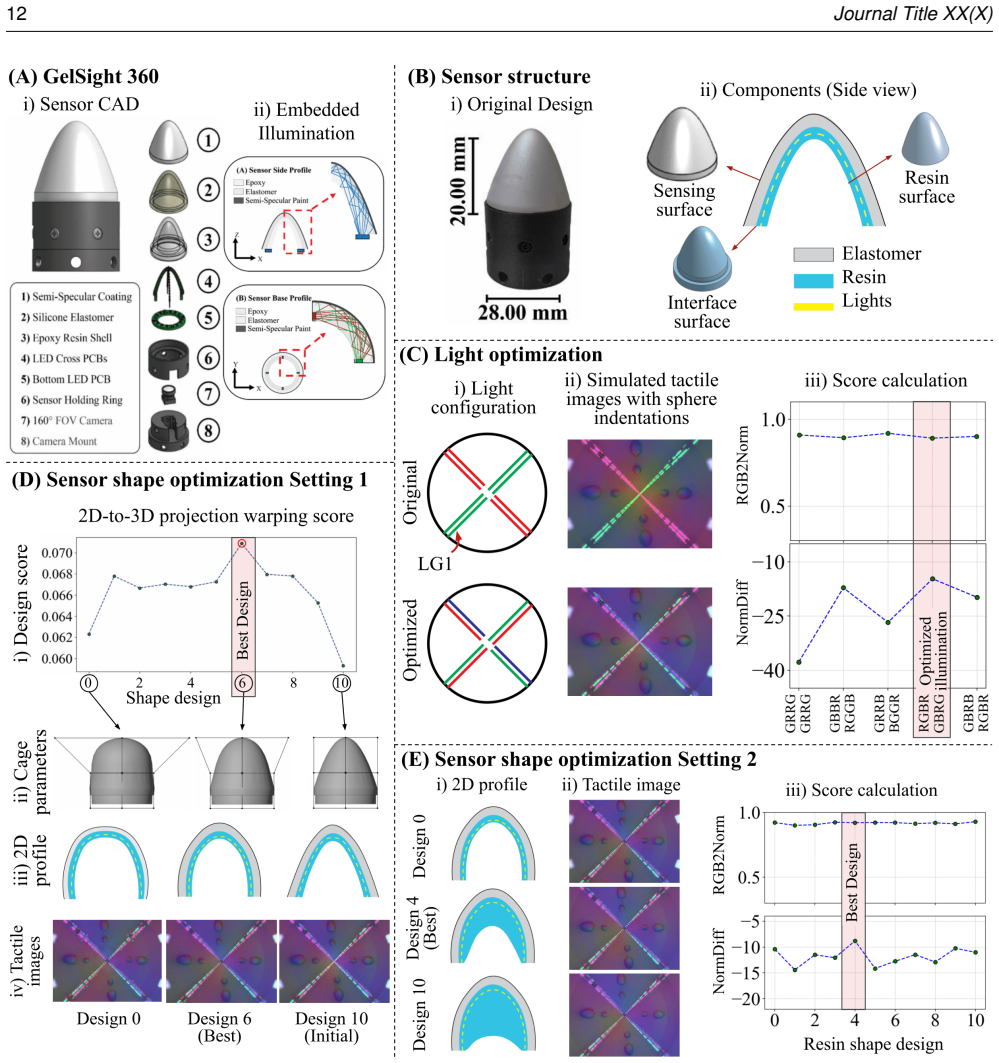
The load-bearing mechanism is a simulation-to-optimization loop built on stochastic progressive photon mapping (SPPM), a physics-based rendering algorithm that traces both camera rays and light photons and is well suited to the many refractive and reflective surfaces inside these sensors; the paper uses it to render a tactile image for any proposed design. Around that loop sit three supports. First, a cage-based shape representation, a 27-vertex bounding cage whose deformation deforms the surface mesh, cuts shape optimization from roughly $10^4$ mesh coordinates down to 81 cage parameters. Second, a component library of calibrated materials and light sources: a rough-reflective coating model whose single specularity value $\rho$ spans the coatings used across the GelSight family, refractive models for the elastomer and resin, and LED light models with manufacturer intensity profiles, all calibrated by optical experiments. Third, the four objective functions, each capturing a different failure mode of geometry measurement: nonlinear color-to-normal mapping, color confusion under sensor noise, oblique camera rays, and pixel footprint warping. The user chooses forward design (manual parameter changes with immediate simulated feedback) or inverse design (grid search for discrete parameters, CMA-ES for continuous ones), and the same simulated scores drive both.
What would settle it
Build two otherwise-identical curved GelSight Mini sensors whose coating specularities the simulation ranks far apart, press the same calibrated sphere into each at the same grid of locations, and reconstruct the contact surface with a standard GelSight photometric-stereo calibration; if the real reconstruction errors reverse the simulated ranking, the objective functions do not predict hardware performance. A cheaper version runs the paper's Section 8.1 plane-misalignment task on the physical prototypes and checks whether the claimed mean error near $0.5^\circ$ at low specularity survives sim-to-real transfer.
Extended reading notes
Core claim
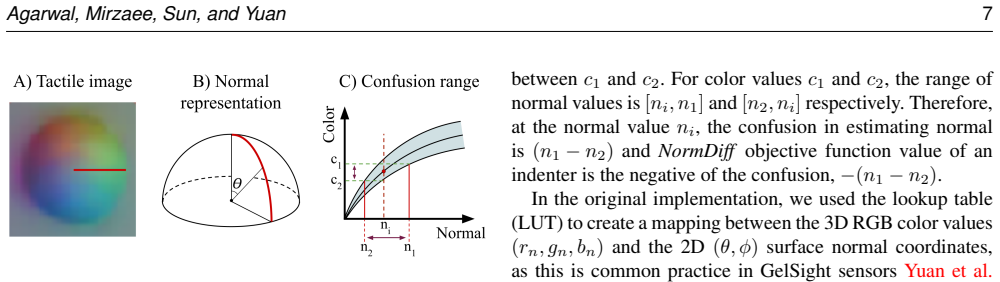
The central claim is that the entire optical system of a GelSight-like tactile sensor — the soft elastomer, support structure, opaque coating, lights, and camera — can be decomposed into parameterized modules, and that a design's quality can be measured by four objective functions that predict how well the sensor will measure contact geometry: RGB2Normal (linearity between image color and surface normal angle $\theta$, averaged over indenter locations and directions), NormDiff (distinctness of image colors for different surface normals under camera noise), as-orthographic-as-possible (AOAP, camera rays meeting the sensing surface at near-zero incidence), and 2D-to-3D projection warping (2to3PW, each image pixel mapping to a near-square patch on the sensing surface). The paper further claims that stochastic progressive photon mapping, a physics-based rendering technique, produces simulated tactile images accurate enough that optimizing these scores in simulation transfers to real hardware: in the case studies, best coating specularities around $\rho = 0.2$ (cylindrical) and $0.4$ (spherical), a light placement found by forward search for the new GelBelt roller, a light color ordering chosen by score for GelSight360, and a CMA-ES-optimized mirror shape that raised the AOAP score from $0.236$ to $0.635$ and removed the image "smearing" in GelSight Svelte. The paper also states what the framework does not yet cover: shadow artifacts, manufacturing variance between simulation and prototype, mechanical properties of the skin, and marker-based sensors such as the TacTip family. Curved variants of GelSight Mini, the GelBelt roller, and the corrected Svelte mirror were built as physical prototypes whose tactile images match the simulation.
Load-bearing premise
The whole pipeline assumes that a design that scores higher in the optical simulation genuinely measures touch better in real hardware, but the paper's hardware comparisons are mostly visual image pairs rather than quantitative measurement-error statistics.
Editorial extensions
If this is right
- A GelSight-style sensor for a new robot hand can go from a CAD sketch to an optimized optical design in hours, entirely in simulation, before anything is fabricated.
- Curved sensing surfaces, mirror layouts, and light-piping configurations — the features that previously made each sensor a bespoke project — become searchable design parameters.
- The four objective functions give designers a common quantitative language: designs can be compared, ranked, and iterated by score instead of by an expert's eye.
- The optimized designs transfer to hardware: the curved GelSight Mini variants, the new GelBelt roller sensor, and the mirror-corrected GelSight Svelte were all built as prototypes whose tactile images match the simulation.
- The authors expect the same modularized loop to extend to other vision-based tactile sensors and optical sensors, provided new objective functions are derived from each sensor's working principle.
Reading between the lines
- If the simulated scores truly rank real designs, the loop could be closed end-to-end: an optimizer could invent entirely new sensor shapes rather than deform an initial CAD, and the human could drop out of parameter selection altogether.
- The paper does not report quantitative sim-to-real error on the prototypes, so a natural hardening test is to measure normal-map or point-cloud reconstruction error against known indenters and compare it with the simulated scores; that comparison would show where simulation and hardware diverge.
- The signal-to-noise ratio introduced in Section 8.1 is model-free, so it could be computed on real tactile images as a cheap proxy for the objective scores, flagging designs whose simulated promise does not survive fabrication.
- The recipe — score, render, optimize, fabricate — is arguably generic to any camera read through shaped optics and controlled illumination, not just touch sensors; the authors hint at this, but the modular decomposition itself does not depend on the contact surface being soft gel.
Signed reviews
Editorial analysis
A structured set of objections, weighed in public.
Referee Report
Summary. This paper presents a modularized design methodology for GelSight-style vision-based tactile sensors. The authors parameterize optical components (geometry, material, light sources, camera), define four objective functions (RGB2Normal linearity, NormDiff, AOAP, 2to3PW), and build a Blender/Mitsuba-based toolbox (OptiSense Studio) that uses SPPM rendering to evaluate and optimize sensor designs. They demonstrate the pipeline on four sensors: GelSight Mini (curved variants), a new GelBelt roller sensor, GelSight360, and GelSight Svelte, and they fabricate prototypes of GelBelt and a modified Svelte together with curved GelSight Mini variants to support sim-to-real transfer. The main claimed contribution is that non-experts can optimize real sensor designs in hours using simulated objective scores.
Significance. The contribution is potentially significant: if the objective functions and simulation are reliable, this would transform the heuristic, expert-driven process of GelSight design into an accessible quantitative pipeline, and the component library plus calibrated material models are valuable community assets. The qualitative sim-to-real matches in Sections 7.2 and 7.4, particularly the Svelte mirror optimization that visibly removes distortion in a real prototype, provide encouraging evidence. The paper's central claim, however, rests on the assumption that simulated objective scores rank real sensors correctly; this assumption is not yet quantitatively validated, and one validation loop in Section 8.1 is internal to the simulator. The paper also does not report a user study, so the non-expert usability claim is an extrapolation.
major comments (3)
- [Sections 5, 7.2, 7.4] The optimization decisions (coating specularity, light placement, light type, mirror shape) are all selected using simulated objective scores, but no quantitative comparison of objective scores computed from real sensor images is provided, and no real-sensor task metric (e.g., 3D reconstruction error, force error, or estimation MAE) is reported for the optimized versus baseline designs. For example, the Svelte mirror optimization in Section 7.4 reports an AOAP improvement from 0.236 to 0.635 in simulation and qualitative de-smearing in real tactile images, but it does not measure whether the optimized mirror actually reduces reconstruction error or improves calibrated indenter shape estimation on the real prototype. Without a quantitative rank test on real hardware, the central claim that the simulation-based scores predict real sensor quality is unsupported.
- [Section 8.1] The validation of the objective functions via random-forest regression and SNR analysis is self-referential for the purpose of establishing the functions as valid proxies. The tactile datasets are generated with the same SPPM simulator and the same calibrated material model that produced the objective scores, so the agreement between objective scores and task performance confirms consistency of the simulator, not predictive power for real sensors. The authors should either add real-hardware validation (e.g., fabricating two or three coatings that span the score range and measuring reconstruction or task error) or substantially qualify the claim that the objective functions predict real sensor performance.
- [Section 7.4] The strongest demonstration is presented as a proof-of-concept on a simplified sensing surface, with the optimization focused on the center of the sensing surface. The improvement is shown as a simulated AOAP score and as qualitative real-world image pairs; there is no quantitative real-world metric (e.g., sphere-radius estimation error or reconstruction error) to support the statement that the pipeline can be used to obtain the best optical component shapes to reduce optical distortion and improve shape perception. A quantitative measurement on the real prototype would make this demonstration load-bearing rather than anecdotal.
minor comments (8)
- [Section 5.2] Typo: 'RBG2Normal' should be 'RGB2Normal'. Also, the noise model uses 30% of the RGB value as a heuristic, and the assertion that 'a different choice of the value can lead to very similar optima' is not supported by any sensitivity analysis; a one-line experiment or reference would help.
- [Section 8.2] The sentence 'While our current objective functions describe the most important metrics for the design of GelSight sensors, but some corner cases or specific design goals are not considered' contains a dangling 'but' and should be rephrased.
- [Section 8.4] Typo: 'We will also incoperate the mareker distribution pattern as the a design factor' should read 'incorporate the marker distribution pattern as a design factor'.
- [References] Xu et al. (2021a) and (2021b) are the same arXiv paper (arXiv:2107.07501) and should be consolidated into a single reference.
- [Figure 16 caption] Typo: 'Singnal-to-nise ratio' should be 'Signal-to-noise ratio'.
- [Throughout] The text frequently has missing spaces after colons and between words (e.g., 'five parts:Soft elastomer,' 'theRoughConductormodel,' 'theOpticalSystemcollection'). A careful copyedit is needed.
- [Section 10] The paper lacks a data/code availability statement; the OptiSense Studio toolbox is described but no link or repository is given, which limits reproducibility of the claimed 'hours' design pipeline.
- [Section 7.1] The statement that shape optimization 'did not find substantial improvements' is a negative result reported without quantitative data; consider reporting the objective scores for the flat baseline and the curved variants to support the claim that the curved designs match the flat design's performance.
Circularity Check
No construction-level circularity: objective functions are explicit design metrics and the central claims are independently anchored by real prototypes.
full rationale
I walked the claimed derivation chain and found no step in which a prediction or first-principles result is equivalent to its inputs by construction. The four objective functions in Section 5 are explicit, independently defined metrics on simulated tactile images; using them as optimization objectives and then examining the resulting images is not circular because the same qualitative improvements are shown against manufactured prototypes. For GelBelt (Section 7.2) and GelSight Svelte (Section 7.4), real-world tactile images are compared with simulation and the optimized designs are shown to improve in the real sensor as well. The Svelte AOAP optimization is therefore not merely the objective function re-reading its own score; it is externally anchored by the real prototype images in Figure 14C. Section 8.1 does validate the objective functions only in simulation, and the random-forest and SNR trends are computed from the same simulated images as the objectives, which is a sim-to-real evidence gap rather than a derivation-level circularity. The authors themselves acknowledge this in Section 8.2, noting manufacturing error and the sim-to-real gap. The citations to prior work by the authors (Agarwal et al. 2021 for the rendering technique, and Mirzaee et al. 2025 for the GelBelt concept) are not used as a uniqueness theorem or as the proof of the central claim; the rendering pipeline is re-implemented with SPPM and the sensor designs are independently prototyped. Overall, the core contribution—modular parameterization, objective-driven simulation, and sim-to-real transfer—does not reduce to its own inputs.
Assumptions & free parameters
free parameters (6)
- Calibrated BSDF material parameters (RoughDielectric index/roughness; RoughConductor reflectance/eta/specularity) =
Not reported in paper (deferred to supplementary)
- Calibrated LED emission models (IES profiles for OSRAM, area light dims for Chanzon 5730) =
Not reported in paper
- NormDiff camera noise level (30% of RGB value) =
0.30 (hand-set heuristic)
- AOAP coverage regularizer k1 =
0.01
- Evaluation protocol parameters (default indenter radius, number of locations, directions) =
1.5 mm, 9 locations, 8 directions
- GelSight Mini cage displacement amounts =
6 mm (cylindrical), 9 mm (spherical)
assumptions (5)
- domain assumption Color-to-normal mapping in GelSight sensors should be locally linear and independent of contact shape.
- domain assumption SPPM/PBR simulation of the full optical path is accurate enough for design optimization.
- domain assumption Camera noise is proportional to sensor response, with a 30% scaled standard deviation.
- domain assumption Spherical indenters at nine locations provide sufficient normal coverage to evaluate a design.
- domain assumption Thin, conformable contact surface can be assumed; mechanical deformation need not be simulated.
Cite this review
Pith. "Pith review of A Modularized Design Approach for GelSight Family of Vision-based Tactile Sensors." pith.science (2026). https://pith.science/paper/YD46GFRB
@misc{pith2026250414739,
  author       = {Pith},
  title        = {Pith review of: A Modularized Design Approach for GelSight Family of Vision-based Tactile Sensors},
  year         = {2026},
  howpublished = {\url{https://pith.science/paper/YD46GFRB}},
  note         = {Machine review of arXiv:2504.14739}
}
read the original abstract
GelSight family of vision-based tactile sensors has proven to be effective for multiple robot perception and manipulation tasks. These sensors are based on an internal optical system and an embedded camera to capture the deformation of the soft sensor surface, inferring the high-resolution geometry of the objects in contact. However, customizing the sensors for different robot hands requires a tedious trial-and-error process to re-design the optical system. In this paper, we formulate the GelSight sensor design process as a systematic and objective-driven design problem and perform the design optimization with a physically accurate optical simulation. The method is based on modularizing and parameterizing the sensor's optical components and designing four generalizable objective functions to evaluate the sensor. We implement the method with an interactive and easy-to-use toolbox called OptiSense Studio. With the toolbox, non-sensor experts can quickly optimize their sensor design in both forward and inverse ways following our predefined modules and steps. We demonstrate our system with four different GelSight sensors by quickly optimizing their initial design in simulation and transferring it to the real sensors.
Figures


Figures from the paper (13 more)






Reference graph
Works this paper leans on
-
[1]
Wiley interdisciplinary reviews: computational statistics 2(4): 433--459
Abdi H and Williams LJ (2010) Principal component analysis. Wiley interdisciplinary reviews: computational statistics 2(4): 433--459
work page 2010
-
[3]
Advanced Intelligent Systems 5(8): 2300042
Andrussow I, Sun H, Kuchenbecker KJ and Martius G (2023) Minsight: A fingertip-sized vision-based tactile sensor for robotic manipulation. Advanced Intelligent Systems 5(8): 2300042
work page 2023
-
[4]
IEEE Robotics and Automation Letters 3(4): 3300--3307
Calandra R, Owens A, Jayaraman D, Lin J, Yuan W, Malik J, Adelson EH and Levine S (2018) More than a feeling: Learning to grasp and regrasp using vision and touch. IEEE Robotics and Automation Letters 3(4): 3300--3307
work page 2018
-
[5]
Cao G, Jiang J, Lu C, Gomes DF and Luo S (2023) Touchroller: A rolling optical tactile sensor for rapid assessment of textures for large surface areas. Sensors 23(5): 2661
work page 2023
-
[6]
Blender Foundation, Stichting Blender Foundation, Amsterdam
Community BO (2018) Blender - a 3D modelling and rendering package. Blender Foundation, Stichting Blender Foundation, Amsterdam. ://www.blender.org
work page 2018
-
[7]
arXiv preprint arXiv:2309.08860
Do WK, Dhawan AK, Kitzmann M and Kennedy III M (2023) Densetact-mini: An optical tactile sensor for grasping multi-scale objects from flat surfaces. arXiv preprint arXiv:2309.08860
arXiv 2023
-
[9]
In: 2017 IEEE/RSJ International Conference on Intelligent Robots and Systems (IROS)
Dong S, Yuan W and Adelson EH (2017) Improved gelsight tactile sensor for measuring geometry and slip. In: 2017 IEEE/RSJ International Conference on Intelligent Robots and Systems (IROS). pp. 137--144. doi:10.1109/IROS.2017.8202149
arXiv 2017
-
[10]
In: 2018 IEEE/RSJ International Conference on Intelligent Robots and Systems (IROS)
Donlon E, Dong S, Liu M, Li J, Adelson E and Rodriguez A (2018) Gelslim: A high-resolution, compact, robust, and calibrated tactile-sensing finger. In: 2018 IEEE/RSJ International Conference on Intelligent Robots and Systems (IROS). pp. 1927--1934. doi:10.1109/IROS.2018.8593661
arXiv 2018
Show all 44 references
-
[11]
ACM Trans
Dupuy J and Jakob W (2018) An adaptive parameterization for efficient material acquisition and rendering. ACM Trans. Graph. 37(6). doi:10.1145/3272127.3275059. ://doi.org/10.1145/3272127.3275059
2018
-
[12]
ACM Transactions on Graphics (TOG) 28(5): 1--8
Hachisuka T and Jensen HW (2009) Stochastic progressive photon mapping. ACM Transactions on Graphics (TOG) 28(5): 1--8
2009
-
[13]
arXiv preprint arXiv:1604.00772
Hansen N (2016) The cma evolution strategy: A tutorial. arXiv preprint arXiv:1604.00772
2016 arXiv
-
[14]
jit: a just-in-time compiler for differentiable rendering
Jakob W, Speierer S, Roussel N and Vicini D (2022) Dr. jit: a just-in-time compiler for differentiable rendering. ACM Transactions on Graphics (TOG) 41(4): 1--19
2022
-
[15]
(2010) Mitsuba renderer
Jakob W et al. (2010) Mitsuba renderer
2010
-
[16]
(2024) B S D F s - M itsuba 3 --- mitsuba.readthedocs.io ://mitsuba.readthedocs.io/en/latest/src/generated/plugins_bsdfs.html
Jakob W et al. (2024) B S D F s - M itsuba 3 --- mitsuba.readthedocs.io ://mitsuba.readthedocs.io/en/latest/src/generated/plugins_bsdfs.html
2024
-
[17]
In: 2009 IEEE Conference on Computer Vision and Pattern Recognition
Johnson MK and Adelson EH (2009) Retrographic sensing for the measurement of surface texture and shape. In: 2009 IEEE Conference on Computer Vision and Pattern Recognition. IEEE, pp. 1070--1077
2009
-
[18]
(2020) Digit: A novel design for a low-cost compact high-resolution tactile sensor with application to in-hand manipulation
Lambeta M, Chou PW, Tian S, Yang B, Maloon B, Most VR, Stroud D, Santos R, Byagowi A, Kammerer G et al. (2020) Digit: A novel design for a low-cost compact high-resolution tactile sensor with application to in-hand manipulation. IEEE Robotics and Automation Letters 5(3): 3838--3845
2020
-
[19]
In: 2014 IEEE/RSJ International Conference on Intelligent Robots and Systems
Li R, Platt R, Yuan W, Ten Pas A, Roscup N, Srinivasan MA and Adelson E (2014) Localization and manipulation of small parts using gelsight tactile sensing. In: 2014 IEEE/RSJ International Conference on Intelligent Robots and Systems. IEEE, pp. 3988--3993
2014
-
[20]
IEEE Robotics and Automation Letters
Lin C, Zhang H, Xu J, Wu L and Xu H (2023 a ) 9dtact: A compact vision-based tactile sensor for accurate 3d shape reconstruction and generalizable 6d force estimation. IEEE Robotics and Automation Letters
2023
-
[21]
IEEE Robotics and Automation Letters 8(9): 5982--5989
Lin Z, Zhuang J, Li Y, Wu X, Luo S, Gomes DF, Huang F and Yang Z (2023 b ) Gelfinger: A novel visual-tactile sensor with multi-angle tactile image stitching. IEEE Robotics and Automation Letters 8(9): 5982--5989. doi:10.1109/LRA.2023.3302191
2023
-
[22]
In: 2022 IEEE 5th International Conference on Soft Robotics (RoboSoft)
Liu SQ and Adelson EH (2022) Gelsight fin ray: Incorporating tactile sensing into a soft compliant robotic gripper. In: 2022 IEEE 5th International Conference on Soft Robotics (RoboSoft). Edinburgh, United Kingdom: IEEE, pp. 925--931. doi:10.1109/RoboSoft54090.2022.9762175
2022
-
[24]
In: 2023 IEEE International Conference on Soft Robotics (RoboSoft)
Liu SQ, Yañez LZ and Adelson EH (2023 b ) Gelsight endoflex: A soft endoskeleton hand with continuous high-resolution tactile sensing. In: 2023 IEEE International Conference on Soft Robotics (RoboSoft). pp. 1--6. doi:10.1109/RoboSoft55895.2023.10122053
2023
-
[25]
IEEE Robotics and Automation Letters 10(2): 2016--2023
Mirzaee MA, Huang HJ and Yuan W (2025) Gelbelt: A vision-based tactile sensor for continuous sensing of large surfaces. IEEE Robotics and Automation Letters 10(2): 2016--2023. doi:10.1109/LRA.2025.3527306
2025
-
[26]
Journal of Electronic Imaging 26(1): 013014--013014
Pagnutti M, Ryan RE, Cazenavette G, Gold M, Harlan R, Leggett E and Pagnutti J (2017) Laying the foundation to use raspberry pi 3 v2 camera module imagery for scientific and engineering purposes. Journal of Electronic Imaging 26(1): 013014--013014
2017
-
[27]
In: Siciliano B, Laschi C and Khatib O (eds.) Experimental Robotics
Patel R, Ouyang R, Romero B and Adelson E (2021) Digger finger: Gelsight tactile sensor for object identification inside granular media. In: Siciliano B, Laschi C and Khatib O (eds.) Experimental Robotics. Cham: Springer International Publishing. ISBN 978-3-030-71151-1, pp. 105--115
2021
-
[28]
MIT Press
Pharr M, Jakob W and Humphreys G (2023) Physically based rendering: From theory to implementation. MIT Press
2023
-
[29]
In: Conference on Robot Learning
Qi H, Yi B, Suresh S, Lambeta M, Ma Y, Calandra R and Malik J (2023) General in-hand object rotation with vision and touch. In: Conference on Robot Learning. PMLR, pp. 2549--2564
2023
-
[31]
In: 2020 IEEE International Conference on Robotics and Automation (ICRA)
She Y, Liu SQ, Yu P and Adelson E (2020) Exoskeleton-covered soft finger with vision-based proprioception and tactile sensing. In: 2020 IEEE International Conference on Robotics and Automation (ICRA). pp. 10075--10081. doi:10.1109/ICRA40945.2020.9197369
2020
-
[32]
IEEE Robotics and Automation Letters 7(2): 2361--2368
Si Z and Yuan W (2022) Taxim: An example-based simulation model for gelsight tactile sensors. IEEE Robotics and Automation Letters 7(2): 2361--2368
2022
-
[33]
In: 2022 IEEE/RSJ International Conference on Intelligent Robots and Systems (IROS)
Si Z, Zhu Z, Agarwal A, Anderson S and Yuan W (2022) Grasp stability prediction with sim-to-real transfer from tactile sensing. In: 2022 IEEE/RSJ International Conference on Intelligent Robots and Systems (IROS). pp. 7809--7816. doi:10.1109/IROS47612.2022.9981863
2022
-
[34]
Springer Science & Business Media
Stroud I (2006) Boundary representation modelling techniques. Springer Science & Business Media
2006
-
[35]
In: 2022 International Conference on Robotics and Automation (ICRA)
Suresh S, Si Z, Mangelson JG, Yuan W and Kaess M (2022) Shapemap 3-d: Efficient shape mapping through dense touch and vision. In: 2022 International Conference on Robotics and Automation (ICRA). IEEE, pp. 7073--7080
2022
-
[36]
In: 2022 International Conference on Robotics and Automation (ICRA)
Taylor IH, Dong S and Rodriguez A (2022) Gelslim 3.0: High-resolution measurement of shape, force and slip in a compact tactile-sensing finger. In: 2022 International Conference on Robotics and Automation (ICRA). Philadelphia, PA, USA: IEEE, pp. 10781--10787. doi:10.1109/ICRA4...
2022
-
[37]
arXiv preprint arXiv:2304.04268
Tippur MH and Adelson EH (2023) Gelsight360: An omnidirectional camera-based tactile sensor for dexterous robotic manipulation. arXiv preprint arXiv:2304.04268
2023 arXiv
-
[38]
Nature Methods 17: 261--272
Virtanen P, Gommers R, Oliphant TE, Haberland M, Reddy T, Cournapeau D, Burovski E, Peterson P, Weckesser W, Bright J, van der Walt SJ, Brett M, Wilson J, Millman KJ, Mayorov N, Nelson ARJ, Jones E, Kern R, Larson E, Carey CJ, Polat \.I , Feng Y, Moore EW, VanderPlas J, Laxald...
2020
-
[39]
In: 2021 IEEE International Conference on Robotics and Automation (ICRA)
Wang S, She Y, Romero B and Adelson E (2021) Gelsight wedge: Measuring high-resolution 3d contact geometry with a compact robot finger. In: 2021 IEEE International Conference on Robotics and Automation (ICRA). Xi'an, China: IEEE, pp. 6468--6475. doi:10.1109/ICRA48506.2021.9560783
2021
-
[40]
Soft robotics 5(2): 216--227
Ward-Cherrier B, Pestell N, Cramphorn L, Winstone B, Giannaccini ME, Rossiter J and Lepora NF (2018) The tactip family: Soft optical tactile sensors with 3d-printed biomimetic morphologies. Soft robotics 5(2): 216--227
2018
-
[42]
arXiv preprint arXiv:2107.07501
Xu J, Chen T, Zlokapa L, Foshey M, Matusik W, Sueda S and Agrawal P (2021 b ) An end-to-end differentiable framework for contact-aware robot design. arXiv preprint arXiv:2107.07501
2021 arXiv
-
[43]
Sensors 17(12): 2762
Yuan W, Dong S and Adelson EH (2017) Gelsight: High-resolution robot tactile sensors for estimating geometry and force. Sensors 17(12): 2762
2017
-
[44]
Sensors and Actuators A: Physical 367: 115090
Zhang S, Sun Y, Sun F, Yang Y and Fang B (2024) Pfs 1.0: A development tool applied to vision-based tactile sensor process formulation and fabrication. Sensors and Actuators A: Physical 367: 115090
2024
-
[45]
In: 2023 IEEE/RSJ International Conference on Intelligent Robots and Systems (IROS)
Zhao J and Adelson EH (2023) Gelsight svelte: A human finger-shaped single-camera tactile robot finger with large sensing coverage and proprioceptive sensing. In: 2023 IEEE/RSJ International Conference on Intelligent Robots and Systems (IROS). IEEE, pp. 8979--8984
2023
-
[46]
, " * write output.state after.block = add.period write newline
ENTRY address author booktitle chapter doi edition editor eid howpublished institution isbn journal key month note number organization pages publisher school series title type url volume year label extra.label sort.label short.list INTEGERS output.state before.all mid.sentence...
-
[47]
write newline
" write newline "" before.all 'output.state := FUNCTION n.dashify 't := "" t empty not t #1 #1 substring "-" = t #1 #2 substring "--" = not "--" * t #2 global.max substring 't := t #1 #1 substring "-" = "-" * t #2 global.max substring 't := while if t #1 #1 substring * t #2 gl...
-
[48]
, " * write output.state after.block = add.period write newline
ENTRY address archive author booktitle chapter doi edition editor eid eprint howpublished institution isbn journal key month note number organization pages publisher school series title type url volume year label INTEGERS output.state before.all mid.sentence after.sentence aft...
-
[49]
write newline
" write newline "" before.all 'output.state := FUNCTION n.dashify 't := "" t empty not t #1 #1 substring "-" = t #1 #2 substring "--" = not "--" * t #2 global.max substring 't := t #1 #1 substring "-" = "-" * t #2 global.max substring 't := while if t #1 #1 substring * t #2 gl...
Reviewed August 16, 2026 · model on record in the stance chip above.
Discussion (0). Continue with ORCID to comment.