Conley-Morse persistence barcode: a homological signature of combinatorial bifurcations
Pith reviewed 2026-05-22 17:30 UTC · model grok-4.3
The pith
A persistence barcode from Conley indices tracks combinatorial bifurcations in dynamical systems.
A machine-rendered reading of the paper's core claim, the machinery that carries it, and where it could break.
Core claim
The paper establishes that the persistence module obtained from the Conley index of invariant sets indexed over a poset decomposes into simple intervals via gentle algebras. This decomposition supports the definition of the Conley-Morse persistence barcode and permits its computation through an adaptation of the zigzag persistence algorithm, yielding a homological signature that characterizes the nature of combinatorial bifurcations.
What carries the argument
The Conley-Morse persistence barcode, formed by decomposing a poset-indexed persistence module of Conley indices into interval bars through the structure of gentle algebras.
If this is right
- Structural changes in Morse decompositions become visible as algebraic bars when parameters vary.
- Observed transitions receive a characterization based on the Conley index of the invariant sets involved.
- The barcode supplies a compact algebraic descriptor for the overall bifurcation diagram.
- Computation of the signature becomes possible by adapting the existing zigzag persistence algorithm.
Where Pith is reading between the lines
- The same construction could be tested on discretized models of well-known continuous systems to see whether the bars align with classically known bifurcation points.
- Links may appear to other parameter-sweep techniques in topological data analysis that also produce barcodes from homological data.
- If the poset can be refined or coarsened, the barcode might serve as a tool for comparing bifurcation diagrams across different levels of combinatorial approximation.
Load-bearing premise
The persistence module built from Conley indices of invariant sets over a poset decomposes into simple intervals when gentle algebras are applied.
What would settle it
A concrete combinatorial dynamical system whose poset-indexed Conley-index module fails to decompose into interval bars under gentle algebras, or an instance where the adapted zigzag algorithm produces bars that do not match the expected decomposition.
Figures





read the original abstract
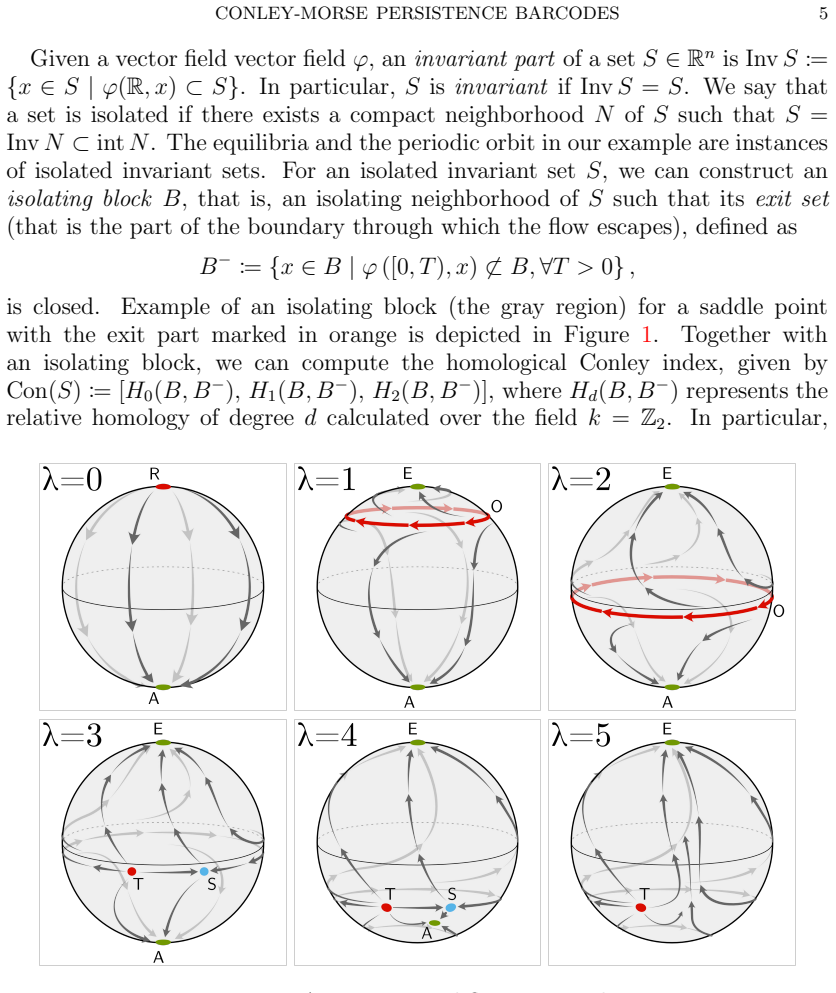
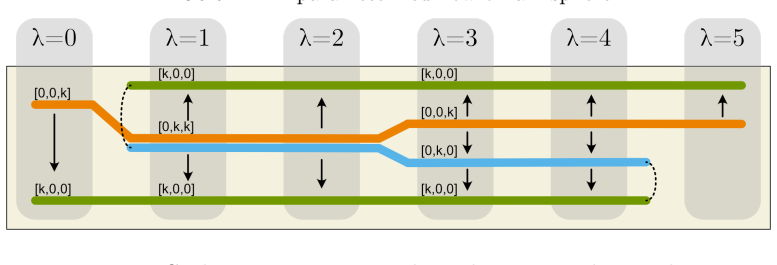
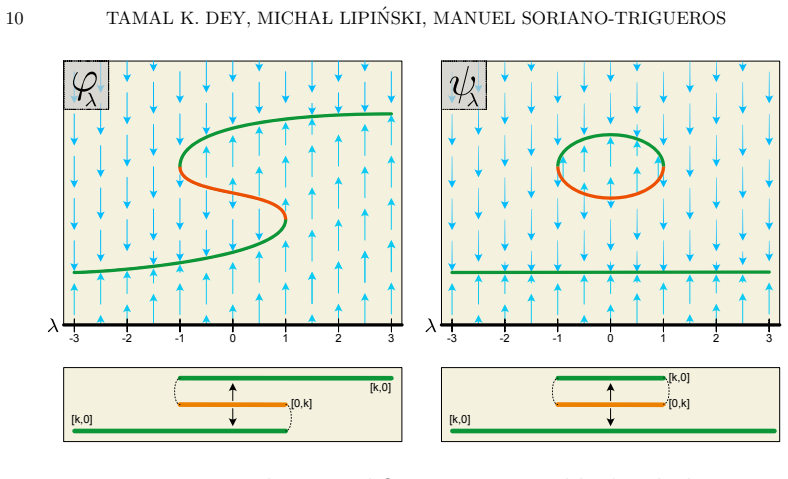
Bifurcation characterizes the qualitative changes in parameterized dynamical systems and is one of the major topics in the field. In this work, we study combinatorial bifurcations within the framework of combinatorial dynamical systems -- a young but already well-established theory. We introduce the Conley-Morse persistence barcode, a compact algebraic descriptor of combinatorial bifurcations. This barcode captures structural changes in a dynamical system at the level of Morse decompositions and provides a characterization of the nature of observed transitions in terms of the Conley index. The construction of Conley-Morse persistence barcode builds upon ideas from topological persistence. Specifically, we consider a persistence module obtained from the Conley index of invariant sets indexed over a poset. Using gentle algebras, we prove that this module decomposes into simple intervals (bars) and compute them by adapting the zigzag persistence algorithm to our purpose.
Editorial analysis
A structured set of objections, weighed in public.
Referee Report
Summary. The manuscript introduces the Conley-Morse persistence barcode as a compact algebraic descriptor of combinatorial bifurcations. It constructs a persistence module from the Conley index of invariant sets indexed over a poset, proves that this module decomposes into simple interval modules (bars) via the representation theory of gentle algebras, and computes the barcode by adapting the zigzag persistence algorithm to string modules arising from combinatorial dynamical systems, thereby characterizing the nature of transitions in Morse decompositions in terms of Conley indices.
Significance. If the central claims hold, the work supplies a homological signature that links Conley-Morse theory with persistence methods, yielding a parameter-free algebraic tool for detecting and classifying combinatorial bifurcations. Strengths include the explicit use of gentle-algebra classification for the decomposition (avoiding ad-hoc fitting) and the direct algorithmic adaptation in §4, which supports reproducibility and potential computational implementation for parameterized dynamical systems.
major comments (1)
- [§3.2] §3.2 and Definition 3.4: the decomposition into interval modules is asserted to follow from the classification of representations of gentle algebras; while internally consistent, the manuscript would benefit from a one-paragraph recall of the precise classification theorem (including the role of string and band modules) to make the step self-contained rather than relying solely on external references.
minor comments (3)
- The introduction would be strengthened by citing one or two foundational references for combinatorial dynamical systems and the Conley index in the combinatorial setting.
- [§4] Notation for the poset-indexed Conley index and the resulting persistence module could be illustrated with a small concrete example (e.g., a two-element poset) to clarify the string-module structure before the general algorithm.
- Figure captions and axis labels in any diagrams of barcodes or Morse decompositions should explicitly indicate the poset ordering and the Conley index grading.
Simulated Author's Rebuttal
We thank the referee for the positive assessment of our work and the constructive suggestion for improving the exposition. We address the single major comment below.
read point-by-point responses
-
Referee: [§3.2] §3.2 and Definition 3.4: the decomposition into interval modules is asserted to follow from the classification of representations of gentle algebras; while internally consistent, the manuscript would benefit from a one-paragraph recall of the precise classification theorem (including the role of string and band modules) to make the step self-contained rather than relying solely on external references.
Authors: We agree that a concise recall of the classification theorem would enhance self-containment. In the revised manuscript we will insert a one-paragraph summary of the relevant results on representations of gentle algebras, explicitly noting the roles of string modules and band modules and indicating how the absence of band modules in our setting yields the decomposition into interval modules. This addition will clarify the transition from the poset-indexed Conley index to the persistence barcode without changing any proofs or results. revision: yes
Circularity Check
No significant circularity; derivation relies on independent external theorems
full rationale
The paper defines the Conley-Morse persistence barcode by forming a poset-indexed persistence module from the Conley index of invariant sets, then applies the classification of representations of gentle algebras (a standard result in representation theory) to obtain a decomposition into interval modules. Computation proceeds by an explicit adaptation of the zigzag persistence algorithm to the resulting string modules. These steps invoke established results from Conley index theory, algebraic persistence, and gentle algebra representation theory without any reduction of the central claim to a self-definition, a fitted parameter renamed as prediction, or a load-bearing self-citation chain. The characterization of combinatorial bifurcations therefore follows from independent mathematical foundations rather than circular construction.
Axiom & Free-Parameter Ledger
axioms (2)
- domain assumption The Conley index is a well-defined topological invariant for isolated invariant sets in combinatorial dynamical systems.
- standard math Persistence modules over posets indexed by gentle algebras decompose into direct sums of interval modules.
invented entities (1)
-
Conley-Morse persistence barcode
no independent evidence
Lean theorems connected to this paper
-
IndisputableMonolith/Foundation/RealityFromDistinction.leanreality_from_one_distinction unclear?
unclearRelation between the paper passage and the cited Recognition theorem.
we consider a persistence module obtained from the Conley index of invariant sets indexed over a poset. Using gentle algebras, we prove that this module decomposes into simple intervals (bars)
-
IndisputableMonolith/Cost/FunctionalEquation.leanwashburn_uniqueness_aczel unclear?
unclearRelation between the paper passage and the cited Recognition theorem.
the Conley-Morse persistence barcode captures structural changes ... at the level of Morse decompositions
What do these tags mean?
- matches
- The paper's claim is directly supported by a theorem in the formal canon.
- supports
- The theorem supports part of the paper's argument, but the paper may add assumptions or extra steps.
- extends
- The paper goes beyond the formal theorem; the theorem is a base layer rather than the whole result.
- uses
- The paper appears to rely on the theorem as machinery.
- contradicts
- The paper's claim conflicts with a theorem or certificate in the canon.
- unclear
- Pith found a possible connection, but the passage is too broad, indirect, or ambiguous to say the theorem truly supports the claim.
Reference graph
Works this paper leans on
-
[1]
Alexandrov, Diskrete r¨ aume, Mathematiceskii Sbornik (N.S.) 2 (1937), 501–518
P.S. Alexandrov, Diskrete r¨ aume, Mathematiceskii Sbornik (N.S.) 2 (1937), 501–518
work page 1937
-
[2]
Zin Arai, William Kalies, Hiroshi Kokubu, Konstantin Mischaikow, Hiroe Oka, and Pawel Pilarczyk, A database schema for the analysis of global dynamics of multiparameter sys- tems, SIAM Journal on Applied Dynamical Systems 8 (2009), no. 3, 757–789
work page 2009
-
[3]
Ibrahim Assem, Thomas Br¨ ustle, Gabrielle Charbonneau-Jodoin, and Pierre-Guy Plam- ondon, Gentle algebras arising from surface triangulations , Algebra & Number Theory 4 (2010), no. 2, 201 – 229. 52 TAMAL K. DEY, MICHA L LIPI ´NSKI, MANUEL SORIANO-TRIGUEROS
work page 2010
-
[4]
Ibrahim Assem and Dieter Happel, Generalized tilted algebras of type An, Communications in Algebra 9 (1981), no. 20, 2101–2125
work page 1981
-
[5]
Ibrahim Assem and Andrzej Skowro´ nski,Iterated tilted algebras of type ˜An, Mathematische Zeitschrift 195 (1987), no. 2, 269–290
work page 1987
-
[6]
Magnus Botnan and William Crawley-Boevey, Decomposition of persistence modules, Pro- ceedings of the American Mathematical Society 148 (2020), no. 11, 4581–4596
work page 2020
-
[7]
Justin Bush, Marcio Gameiro, Shaun Harker, Hiroshi Kokubu, Konstantin Mischaikow, Ippei Obayashi, and Pawe l Pilarczyk,Combinatorial-topological framework for the analysis of global dynamics. , Chaos 22 (2012), no. 4, 047508
work page 2012
-
[8]
M. C. R. Butler and Claus Michael Ringel, Auslander-reiten sequences with few middle terms and applications to string algebrass , Communications in Algebra 15 (1987), 145– 179
work page 1987
-
[9]
Gunnar Carlsson and Vin De Silva, Zigzag persistence , Foundations of Computational Mathematics 10 (2010), no. 4, 367–405
work page 2010
-
[10]
Fr´ ed´ eric Chazal, Vin De Silva, Marc Glisse, and Steve Oudot,The structure and stability of persistence modules, SpringerBriefs in Mathematics, Springer International Publishing, 2016
work page 2016
-
[11]
38, American Mathematical Society, Providence, R.I., 1978
Charles Conley, Isolated invariant sets and the Morse index , CBMS Regional Conference Series in Mathematics, vol. 38, American Mathematical Society, Providence, R.I., 1978
work page 1978
- [12]
-
[13]
Tamal K. Dey and Tao Hou, Fast computation of zigzag persistence, 30th Annual European Symposium on Algorithms, ESA 2022, September 5-9, 2022, Berlin/Potsdam, Germany, LIPIcs, vol. 244, Schloss Dagstuhl - Leibniz-Zentrum f¨ ur Informatik, 2022, pp. 43:1–43:15
work page 2022
-
[14]
Tamal K. Dey, Mateusz Juda, Tomasz Kapela, Jacek Kubica, Micha l Lipi´ nski, and Marian Mrozek, Persistent homology of Morse decompositions in combinatorial dynamics , SIAM Journal on Applied Dynamical Systems 18 (2019), no. 1, 510–530
work page 2019
-
[15]
Tamal K. Dey, Micha l Lipi´ nski, Marian Mrozek, and Ryan Slechta, Tracking dynamical features via continuation and persistence , 38th Symposium on Computational Geometry, 2022
work page 2022
-
[16]
Tamal K. Dey, Micha l Lipi´ nski, Marian Mrozek, and Ryan Slechta,Computing connection matrices via persistence-like reductions, SIAM Journal on Applied Dynamical Systems 23 (2024), no. 1, 81–97
work page 2024
-
[17]
Tamal K. Dey, Marian Mrozek, and Ryan Slechta, Persistence of the Conley-Morse graph in combinatorial dynamical systems , SIAM Journal on Applied Dynamical Systems 21 (2022), no. 2, 817–839
work page 2022
-
[18]
Dey and Yusu Wang, Computational topology for data analysis , Cambridge University Press, 2022
Tamal K. Dey and Yusu Wang, Computational topology for data analysis , Cambridge University Press, 2022
work page 2022
-
[19]
Alex K. Dowling, William D. Kalies, and Robert C.A.M. Vandervorst, Continuation sheaves in dynamics: Sheaf cohomology and bifurcation , Journal of Differential Equations 367 (2023), 124–198
work page 2023
-
[20]
Engelking, General topology, Heldermann Verlag, Berlin, 1989
R. Engelking, General topology, Heldermann Verlag, Berlin, 1989
work page 1989
-
[21]
Robin Forman, Combinatorial vector fields and dynamical systems , Mathematische Zeitschrift 228 (1998), no. 4, 629–681
work page 1998
- [22]
-
[23]
Robert D. Franzosa, The continuation theory for Morse decompositions and connection matrices, Transactions of the American Mathematical Society 310 (1988), no. 2, 781–803
work page 1988
- [24]
-
[25]
˙Ismail G¨ uzel, Elizabeth Munch, and Firas A. Khasawneh,Detecting bifurcations in dynam- ical systems with crocker plots , Chaos: An Interdisciplinary Journal of Nonlinear Science 32 (2022), no. 9, 093111
work page 2022
-
[26]
Ruth Stella Huerfano and Mikhail Khovanov, Categorification of some level two represen- tations of quantum sln, Journal of Knot Theory and Its Ramifications 15 (2006), 695–713
work page 2006
-
[27]
Henry King, Kevin Knudson, and Neˇ za Mramor Kosta,Birth and death in discrete Morse theory, Journal of Symbolic Computation 78 (2017), 41–60
work page 2017
-
[28]
Micha l Lipi´ nski, Konstantin Mischaikow, and Marian Mrozek,Morse predecomposition of an invariant set , Qualitative Theory of Dynamical Systems 24 (2025), no. 1, 5:1–5:33
work page 2025
-
[29]
Micha l Lipi´ nski, Jacek Kubica, Marian Mrozek, and Thomas Wanner, Conley-Morse- Forman theory for generalized combinatorial multivector fields on finite topological spaces , Journal of Applied and Computational Topology 7 (2023), no. 2, 139–184
work page 2023
-
[30]
2, Elsevier Science, 2002, ISSN: 1874-575X, pp
Konstantin Mischaikow and Marian Mrozek, The Conley index , Handbook of Dynamical Systems (Bernold Fiedler, ed.), Handbook of Dynamical Systems, vol. 2, Elsevier Science, 2002, ISSN: 1874-575X, pp. 393–460
work page 2002
-
[31]
Marian Mrozek, Conley–Morse–Forman theory for combinatorial multivector fields on Lef- schetz complexes, Foundations of Computational Mathematics17 (2017), no. 6, 1585–1633
work page 2017
-
[32]
Marian Mrozek, Roman Srzednicki, Justin Thorpe, and Thomas Wanner, Combinatorial vs. classical dynamics : recurrence , Communications in Nonlinear Science and Numerical Simulation 108 (2022), 1–30
work page 2022
-
[33]
Marian Mrozek and Thomas Wanner, Creating semiflows on simplicial complexes from combinatorial vector fields, Journal of Differential Equations 304 (2021), 375–434
work page 2021
-
[34]
Marian Mrozek and Thomas Wanner, Connection matrices in combinatorial topological dynamics, 1 ed., SpringerBriefs in Mathematics, Springer Cham, July 2025
work page 2025
-
[35]
Daniel Simson and Andrzej Skowro´ nski,Elements of the representation theory of associa- tive algebras, London Mathematical Society Student Texts, Cambridge University Press, 2007
work page 2007
-
[36]
Sarah Tymochko, Elizabeth Munch, and Firas A. Khasawneh, Using zigzag persistent homology to detect hopf bifurcations in dynamical systems , Algorithms 13 (2020), no. 11, 1–16
work page 2020
-
[37]
Donald Woukeng, Damian Sadowski, Jakub Le´ skiewicz, Micha l Lipi´ nski, and Tomasz Kapela, Rigorous computation in dynamics based on topological methods for multivector fields, Journal of Applied and Computational Topology 8 (2024), no. 4, 875–908
work page 2024
-
[38]
Lin Yan, Hanqi Guo, Thomas Peterka, Bei Wang, and Jiali Wang, Trophy: A topologically robust physics-informed tracking framework for tropical cyclones , IEEE Transactions on Visualization and Computer Graphics 30 (2024), no. 1, 1249–1259
work page 2024
-
[39]
Lin Yan, Talha Bin Masood, Farhan Rasheed, Ingrid Hotz, and Bei Wang, Geometry- Aware Merge Tree Comparisons for Time-Varying Data With Interleaving Distances , IEEE Transactions on Visualization & Computer Graphics 29 (2023), no. 08, 3489–3506. 54 TAMAL K. DEY, MICHA L LIPI ´NSKI, MANUEL SORIANO-TRIGUEROS Appendix A. Notation and Symbols Category Notatio...
work page 2023
discussion (0)
Sign in with ORCID, Apple, or X to comment. Anyone can read and Pith papers without signing in.