A Composable Game-Theoretic Framework for Blockchains
Pith reviewed 2026-05-22 19:13 UTC · model grok-4.3
The pith
Blockchain protocols can be modeled as interacting games across layers to analyze incentive compatibility under composition.
A machine-rendered reading of the paper's core claim, the machinery that carries it, and where it could break.
Core claim
The authors claim that by representing blockchain protocols as interacting games across the application, network, and consensus layers, and by defining the cross-layer game and cross-application composition abstractions, one can formally reason about incentive compatibility under composition, revealing new incentive vulnerabilities and supporting modular security proofs, as illustrated in case studies including new conditions for timelock robustness using a rational miner model.
What carries the argument
The cross-layer game abstraction that models strategy influences across layers and the cross-application composition that captures concurrent protocol interactions via shared infrastructure.
If this is right
- Compositional analysis reveals subtle incentive vulnerabilities not apparent in isolated analyses.
- Modular security proofs are supported for composed systems.
- New conditions are derived for the robustness of timelocks to bribing attacks.
- The framework applies to layer-2 protocols and MEV to identify incentive issues.
Where Pith is reading between the lines
- If correct, the framework could guide the design of new blockchain protocols that maintain incentive compatibility when combined with others.
- It implies that incentive analysis in blockchains should routinely include cross-layer and cross-application effects.
- Extensions might include applying the model to decentralized finance or other multi-protocol environments.
Load-bearing premise
The cross-layer game and cross-application composition abstractions, together with the rational miner model, sufficiently capture the incentive dynamics present in actual deployments of composed blockchain protocols.
What would settle it
An empirical observation or simulation showing a composed blockchain protocol where an incentive vulnerability exists that the framework does not identify, or where the derived timelock robustness conditions fail to hold against bribing attacks.
Figures

read the original abstract
Blockchains rely on economic incentives to ensure secure and decentralised operation, making incentive compatibility a core design concern. However, protocols are rarely deployed in isolation. Applications interact with the underlying consensus and network layers, and multiple protocols may run concurrently on the same chain. These interactions give rise to complex incentive dynamics that traditional, isolated analyses often fail to capture. We propose the first compositional game-theoretic framework for blockchain protocols. Our model represents blockchain protocols as interacting games across the application, network, and consensus layers. It enables formal reasoning about incentive compatibility under composition by introducing two key abstractions: the cross-layer game, which models how strategies in one layer influence others, and cross-application composition, which captures how application protocols interact concurrently through shared infrastructure. We illustrate our framework through case studies on Hashed Timelock Contracts (HTLCs), Layer-2 protocols, and Maximal Extractable Value (MEV) showing how compositional analysis reveals new subtle incentive vulnerabilities and supports modular security proofs. Also, by introduction of a novel rational miner model, we derive new conditions for the robustness of timelocks to bribing attacks.
Editorial analysis
A structured set of objections, weighed in public.
Referee Report
Summary. The paper proposes the first compositional game-theoretic framework for blockchain protocols, representing them as interacting games across application, network, and consensus layers. It introduces two key abstractions—the cross-layer game (modeling strategy influence across layers) and cross-application composition (capturing concurrent interactions via shared infrastructure)—to enable formal reasoning about incentive compatibility under composition. The framework is illustrated via case studies on HTLCs, Layer-2 protocols, and MEV that purportedly reveal new incentive vulnerabilities and support modular security proofs; a novel rational miner model is also introduced to derive new conditions for timelock robustness against bribing attacks.
Significance. If the abstractions are rigorously formalized and the case studies hold, the work could be significant for blockchain game theory by filling a gap in analyzing composed systems rather than isolated protocols. The rational miner model provides a concrete, falsifiable extension to existing timelock analyses, and the emphasis on modular proofs aligns with practical needs in layered blockchain deployments. Credit is due for focusing on composition as a first-class concern rather than ad-hoc extensions of single-layer models.
major comments (2)
- [§3] §3 (Framework Definition): The cross-layer game is introduced as an abstraction that composes strategy spaces and payoff functions, but no explicit mathematical construction (e.g., a product or fibered game definition, or how utility functions are lifted across layers) is supplied. This is load-bearing for the central claim that the framework 'enables formal reasoning about incentive compatibility under composition.'
- [§5.3] §5.3 (Timelock Case Study): The novel rational miner model adds a bribing parameter to derive robustness conditions, yet the derivation does not address whether the model remains valid under concurrent bribers or when mining power is heterogeneous; the resulting conditions therefore risk being artifacts of the single-miner assumption rather than general robustness guarantees.
minor comments (2)
- [Abstract] Abstract: The phrase 'new subtle incentive vulnerabilities' is used without a single concrete example; adding one sentence summarizing a specific vulnerability uncovered in the HTLC or MEV case study would improve readability.
- [§4] Notation: Several composition operators are used in the case-study sections without a consolidated definition or table; a short notation summary early in the paper would aid readers.
Simulated Author's Rebuttal
We thank the referee for their constructive comments, which help clarify the formal foundations and scope of our framework. We address each major comment below and indicate planned revisions to strengthen the manuscript.
read point-by-point responses
-
Referee: [§3] §3 (Framework Definition): The cross-layer game is introduced as an abstraction that composes strategy spaces and payoff functions, but no explicit mathematical construction (e.g., a product or fibered game definition, or how utility functions are lifted across layers) is supplied. This is load-bearing for the central claim that the framework 'enables formal reasoning about incentive compatibility under composition.'
Authors: We agree that an explicit mathematical construction would make the central claim more rigorous. In the revised manuscript we will add a formal definition of the cross-layer game as a fibered product of the layer-specific games, with explicit lifting of strategy spaces via projection maps and payoff functions composed through a shared state variable representing the blockchain state. This construction will be placed in §3 with a dedicated subsection on the composition operator. revision: yes
-
Referee: [§5.3] §5.3 (Timelock Case Study): The novel rational miner model adds a bribing parameter to derive robustness conditions, yet the derivation does not address whether the model remains valid under concurrent bribers or when mining power is heterogeneous; the resulting conditions therefore risk being artifacts of the single-miner assumption rather than general robustness guarantees.
Authors: The rational miner model in §5.3 is presented as a baseline single-miner analysis to isolate the effect of the bribing parameter on timelock robustness. We acknowledge that concurrent bribers and heterogeneous mining power are important extensions. In the revision we will add a subsection discussing these limitations, derive a generalized condition for the case of multiple bribers under uniform mining power, and explicitly state that heterogeneous power remains an open direction for future work. revision: partial
Circularity Check
No significant circularity; framework definitions are self-contained
full rationale
The paper proposes a new modeling framework consisting of cross-layer games and cross-application composition abstractions plus a rational miner model. These are introduced as definitional constructs to enable compositional reasoning, not as outputs derived from equations or parameters that reduce back to the inputs. The case studies on HTLCs, L2s, and MEV apply the framework to surface interactions but contain no fitted predictions, self-definitional loops, or load-bearing self-citations that would make the central claims equivalent to their premises by construction. The contribution remains a modeling tool whose internal consistency does not depend on circular reductions.
Axiom & Free-Parameter Ledger
invented entities (3)
-
cross-layer game
no independent evidence
-
cross-application composition
no independent evidence
-
novel rational miner model
no independent evidence
Lean theorems connected to this paper
-
IndisputableMonolith/Foundation/ArithmeticFromLogic.leanreality_from_one_distinction unclear?
unclearRelation between the paper passage and the cited Recognition theorem.
We propose the first compositional game-theoretic framework... cross-layer game... cross-application composition... novel rational miner model... conditions for the robustness of timelocks to bribing attacks.
-
IndisputableMonolith/Foundation/BranchSelection.leanbranch_selection unclear?
unclearRelation between the paper passage and the cited Recognition theorem.
Definition 3.8 (IC w.r.t. β). ... strategy profile σ_p^a is a Nash equilibrium for every CR of (A_p, β, ω).
What do these tags mean?
- matches
- The paper's claim is directly supported by a theorem in the formal canon.
- supports
- The theorem supports part of the paper's argument, but the paper may add assumptions or extra steps.
- extends
- The paper goes beyond the formal theorem; the theorem is a base layer rather than the whole result.
- uses
- The paper appears to rely on the theorem as machinery.
- contradicts
- The paper's claim conflicts with a theorem or certificate in the canon.
- unclear
- Pith found a possible connection, but the passage is too broad, indirect, or ambiguous to say the theorem truly supports the claim.
Forward citations
Cited by 2 Pith papers
-
Ark: Offchain Transaction Batching in Bitcoin
Ark is the first Bitcoin-compatible commit-chain that batches offchain virtual UTXO transactions via an untrusted operator into succinct onchain commitments with constant footprint and simplified deployment.
-
Blockchain and AI: Securing Intelligent Networks for the Future
Blockchain and AI integration for network security has strong conceptual fit but mostly prototype-level evidence; the paper offers a taxonomy, integration patterns, and the BASE evaluation checklist to organize the field.
Reference graph
Works this paper leans on
-
[1]
Ittai Abraham, Danny Dolev, and Joseph Y Halpern. 2013. Distributed protocols for leader election: A game-theoretic perspective. In Distributed Computing: Zeta Avarikioti, Georg Fuchsbauer, Pim Keer, Matteo Maffei, and Fabian Regen 13 27th International Symposium, DISC 2013, Jerusalem, Israel, October 14-18, 2013. Proceedings 27. Springer, 61–75
work page 2013
-
[2]
Amitanand S Aiyer, Lorenzo Alvisi, Allen Clement, Mike Dahlin, Jean-Philippe Martin, and Carl Porth. 2005. BAR fault tolerance for cooperative services. In Proceedings of the twentieth ACM symposium on Operating systems principles . 45–58
work page 2005
-
[3]
Yackolley Amoussou-Guenou, Bruno Biais, Maria Potop-Butucaru, and Sara Tucci- Piergiovanni. 2019. Rationals vs byzantines in consensus-based blockchains. arXiv preprint arXiv:1902.07895 (2019)
work page internal anchor Pith review Pith/arXiv arXiv 2019
-
[4]
Lukas Aumayr, Zeta Avarikioti, Matteo Maffei, and Subhra Mazumdar. 2024. Securing Lightning Channels against Rational Miners. In Proceedings of the 2024 on ACM SIGSAC Conference on Computer and Communications Security . 393–407
work page 2024
-
[5]
Lukas Aumayr, Zeta Avarikioti, Iosfi Salem, Stefan Schmid, and Michelle Yeo. 2025. X-Transfer: Enabling and Optimizing Cross-PCN Transactions. In Financial Cryptography and Data Security (FC)
work page 2025
-
[6]
Zeta Avarikioti, Lioba Heimbach, Yuyi Wang, and Roger Wattenhofer
-
[7]
In Financial Cryptography and Data Security (FC)
Ride the Lightning: The Game Theory of Payment Channels. In Financial Cryptography and Data Security (FC) . 264–283. https://doi.org/10. 1007/978-3-030-51280-4_15
-
[8]
Zeta Avarikioti, Eleftherios Kokoris Kogias, Roger Wattenhofer, and Dionysis Zindros. 2021. Brick: Asynchronous Incentive-Compatible Payment Channels. In Financial Cryptography and Data Security (FC)
work page 2021
-
[9]
Zeta Avarikioti and Orfeas Stefanos Thyfronitis Litos. 2022. Suborn Channels: Incentives Against Timelock Bribes. In Financial Cryptography and Data Security (FC)
work page 2022
-
[10]
Zeta Avarikioti, Orfeas Stefanos Thyfronitis Litos, and Roger Watten- hofer. 2020. Cerberus Channels: Incentivizing Watchtowers for Bitcoin. Financial Cryptography and Data Security (FC) (2020), 346–366. https://doi.org/ 10.1007/978-3-030-51280-4_19
-
[11]
Zeta Avarikioti, Stefan Schmid, and Samarth Tiwari. 2024. Musketeer: Incentive- Compatible Rebalancing for Payment Channel Networks. Advances in Financial Technologies (AFT) (2024). https://ia.cr/2023/938
work page 2024
-
[12]
Zeta Avarikioti, Yuheng Wang, and Yuyi Wang. 2025. Thunderdome: Timelock- Free Rationally-Secure Virtual Channels. In USENIX Security Symposium
work page 2025
-
[13]
Moshe Babaioff, Shahar Dobzinski, Sigal Oren, and Aviv Zohar. 2012. On bitcoin and red balloons. In Proceedings of the 13th ACM Conference on Electronic Com- merce, EC 2012, Valencia, Spain, June 4-8, 2012 , Boi Faltings, Kevin Leyton-Brown, and Panos Ipeirotis (Eds.). ACM, 56–73. https://doi.org/10.1145/2229012.2229022
-
[14]
Christian Badertscher, Juan Garay, Ueli Maurer, Daniel Tschudi, and Vassilis Zikas. 2018. But why does it work? A rational protocol design treatment of bitcoin. In Advances in Cryptology–EUROCRYPT 2018: 37th Annual International Conference on the Theory and Applications of Cryptographic Techniques, Tel A viv, Israel, April 29-May 3, 2018 Proceedings, Part...
work page 2018
-
[15]
Maryam Bahrani, Pranav Garimidi, and Tim Roughgarden. 2024. Transaction Fee Mechanism Design in a Post-MEV World. In 6th Conference on Advances in Financial Technologies, AFT 2024, September 23-25, 2024, Vienna, Austria (LIPIcs, Vol. 316), Rainer Böhme and Lucianna Kiffer (Eds.). Schloss Dagstuhl - Leibniz- Zentrum für Informatik, 29:1–29:24. https://doi....
-
[16]
Maryam Bahrani, Pranav Garimidi, and Tim Roughgarden. 2024. Transaction Fee Mechanism Design with Active Block Producers. In Financial Cryptography and Data Security. FC 2024 International Workshops - Voting, DeFI, WTSC, CoDecFin, Willemstad, Curaçao, March 4-8, 2024, Revised Selected Papers (Lecture Notes in Computer Science, Vol. 14746) , Jurlind Buduru...
-
[17]
Iddo Bentov, Pavel Hubáček, Tal Moran, and Asaf Nadler. 2021. Tortoise and hares consensus: the meshcash framework for incentive-compatible, scalable cryptocurrencies. In Cyber Security Cryptography and Machine Learning: 5th Inter- national Symposium, CSCML 2021, Be’er Sheva, Israel, July 8–9, 2021, Proceedings
work page 2021
-
[18]
Lea Salome Brugger, Laura Kovács, Anja Petkovic Komel, Sophie Rain, and Michael Rawson. 2023. CheckMate: Automated Game-Theoretic Security Rea- soning. In Proceedings of the 2023 ACM SIGSAC Conference on Computer and Communications Security (Copenhagen, Denmark) (CCS ’23). Association for Computing Machinery, New York, NY, USA, 1407–1421. https://doi.org/...
-
[19]
Eric Budish, Andrew Lewis-Pye, and Tim Roughgarden. 2024. The Economic Limits of Permissionless Consensus. In Proceedings of the 25th ACM Conference on Economics and Computation, EC 2024, New Haven, CT, USA, July 8-11, 2024 , Dirk Bergemann, Robert Kleinberg, and Daniela Sabán (Eds.). ACM, 704–731. https://doi.org/10.1145/3670865.3673548
-
[20]
Ran Canetti. 2001. Universally composable security: A new paradigm for cryp- tographic protocols. In Proceedings 42nd IEEE Symposium on Foundations of Computer Science. IEEE, 136–145
work page 2001
-
[21]
Xi Chen, Christos Papadimitriou, and Tim Roughgarden. 2019. An Axiomatic Approach to Block Rewards. In Proceedings of the 1st ACM Conference on Ad- vances in Financial Technologies (AFT ’19). Association for Computing Machinery, 124–131. https://doi.org/10.1145/3318041.3355470
- [22]
-
[23]
Philip Daian, Steven Goldfeder, Tyler Kell, Yunqi Li, Xueyuan Zhao, Iddo Bentov, Lorenz Breidenbach, and Ari Juels. 2020. Flash boys 2.0: Frontrunning in decen- tralized exchanges, miner extractable value, and consensus instability. In 2020 IEEE symposium on security and privacy (SP) . IEEE, 910–927
work page 2020
-
[24]
Phil Daian, Rafael Pass, and Elaine Shi. 2019. Snow White: Robustly Reconfig- urable Consensus and Applications to Provably Secure Proof of Stake. Springer- Verlag, Berlin, Heidelberg, 23–41. https://doi.org/10.1007/978-3-030-32101-7_2
-
[25]
Daniel Mawunyo Doe, Jing Li, Dusit Niyato, Li Wang, and Zhu Han. 2023. In- centive Mechanism Design for Mitigating Frontrunning and Transaction Re- ordering in Decentralized Exchanges. IEEE Access 11 (2023), 96014–96028. https://doi.org/10.1109/ACCESS.2023.3236891
-
[26]
Ittay Eyal and Emin Gün Sirer. 2018. Majority is not enough: Bitcoin mining is vulnerable. Commun. ACM 61, 7 (2018), 95–102
work page 2018
-
[27]
Juan Garay, Jonathan Katz, Ueli Maurer, Björn Tackmann, and Vassilis Zikas. 2013. Rational protocol design: Cryptography against incentive-driven adversaries. In 2013 IEEE 54th Annual Symposium on Foundations of Computer Science . IEEE, 648–657
work page 2013
-
[28]
Garay, Aggelos Kiayias, and Nikos Leonardos
Juan A. Garay, Aggelos Kiayias, and Nikos Leonardos. 2024. The Bitcoin Backbone Protocol: Analysis and Applications. J. ACM (apr 2024). https://doi.org/10.1145/ 3653445 Just Accepted
work page 2024
-
[29]
Neil Ghani, Jules Hedges, Viktor Winschel, and Philipp Zahn. 2018. Compositional Game Theory. In Proceedings of the 33rd Annual ACM/IEEE Symposium on Logic in Computer Science (LICS). ACM, 472–481. https://doi.org/10.1145/3209108.3209165
-
[30]
Yossi Gilad, Rotem Hemo, Silvio Micali, Georgios Vlachos, and Nickolai Zel- dovich. 2017. Algorand: Scaling Byzantine Agreements for Cryptocurrencies. In Proceedings of the 26th Symposium on Operating Systems Principles (Shanghai, China) (SOSP ’17). Association for Computing Machinery, New York, NY, USA, 51–68. https://doi.org/10.1145/3132747.3132757
-
[31]
Aggelos Kiayias, Elias Koutsoupias, Maria Kyropoulou, and Yiannis Tselekounis
-
[32]
In Proceedings of the 2016 ACM Conference on Economics and Computation
Blockchain mining games. In Proceedings of the 2016 ACM Conference on Economics and Computation. 365–382
work page 2016
-
[33]
Aggelos Kiayias, Alexander Russell, Bernardo David, and Roman Oliynykov. 2017. Ouroboros: A Provably Secure Proof-of-Stake Blockchain Protocol. In Advances in Cryptology - CRYPTO 2017 - 37th Annual International Cryptology Conference, Santa Barbara, CA, USA, August 20-24, 2017, Proceedings, Part I (Lecture Notes in Computer Science, Vol. 10401), Jonathan ...
-
[34]
Aggelos Kiayias and Aikaterini-Panagiota Stouka. 2021. Coalition-safe equilibria with virtual payoffs. In Proceedings of the 3rd ACM Conference on Advances in Financial Technologies. 71–85
work page 2021
-
[35]
Kevin Liao and Jonathan Katz. 2017. Incentivizing blockchain forks via whale transactions. In Financial Cryptography and Data Security: FC 2017 International Workshops, W AHC, BITCOIN, VOTING, WTSC, and TA, Sliema, Malta, April 7, 2017, Revised Selected Papers 21 . Springer, 264–279
work page 2017
-
[36]
Ziyao Liu, Nguyen Cong Luong, Wenbo Wang, Dusit Niyato, Ping Wang, Ying- Chang Liang, and Dong In Kim. 2019. A survey on blockchain: A game theoretical perspective. IEEE Access 7 (2019), 47615–47643
work page 2019
-
[37]
Giulio Malavolta, Pedro Moreno-Sanchez, Clara Schneidewind, Aniket Kate, and Matteo Maffei. 2018. Anonymous multi-hop locks for blockchain scalability and interoperability. Cryptology ePrint Archive (2018)
work page 2018
-
[38]
Tejaswi Nadahalli, Majid Khabbazian, and Roger Wattenhofer. 2021. Timelocked bribing. In Financial Cryptography and Data Security: 25th International Confer- ence, FC 2021, Virtual Event, March 1–5, 2021, Revised Selected Papers, Part I 25 . Springer, 53–72
work page 2021
-
[39]
Rafael Pass and Elaine Shi. 2017. Fruitchains: A fair blockchain. In Proceedings of the ACM symposium on principles of distributed computing . 315–324
work page 2017
-
[40]
Joseph Poon and Thaddeus Dryja. 2016. The bitcoin lightning network: Scalable off-chain instant payments
work page 2016
- [41]
-
[42]
Tim Roughgarden. 2024. Transaction Fee Mechanism Design. J. ACM 71, 4 (2024), 30:1–30:25. https://doi.org/10.1145/3674143
-
[43]
Itay Tsabary, Matan Yechieli, Alex Manuskin, and Ittay Eyal. 2021. MAD-HTLC: Because HTLC is Crazy-Cheap to Attack. In 2021 IEEE Symposium on Security and Privacy (SP). 1230–1248. https://doi.org/10.1109/SP40001.2021.00080
-
[44]
Sarisht Wadhwa, Jannis Stoeter, Fan Zhang, and Kartik Nayak. 2022. He-HTLC: Revisiting Incentives in HTLC. Cryptology ePrint Archive, Paper 2022/546. https://doi.org/10.14722/ndss.2023.24775 https://eprint.iacr.org/2022/546
-
[45]
Yuheng Wang, Jiliang Li, Zhou Su, and Yuyi Wang. 2022. Arbitrage attack: Miners of the world, unite!. In International Conference on Financial Cryptography and Data Security. Springer, 464–487. Zeta Avarikioti, Georg Fuchsbauer, Pim Keer, Matteo Maffei, and Fabian Regen 14
work page 2022
-
[46]
Fredrik Winzer, Benjamin Herd, and Sebastian Faust. 2019. Temporary censorship attacks in the presence of rational miners. In 2019 IEEE European Symposium on Security and Privacy Workshops (EuroS&PW) . IEEE, 357–366
work page 2019
-
[47]
Reiter, Guy Golan Gueta, and Ittai Abraham
Maofan Yin, Dahlia Malkhi, Michael K. Reiter, Guy Golan Gueta, and Ittai Abraham. 2019. HotStuff: BFT Consensus with Linearity and Responsiveness (PODC ’19). Association for Computing Machinery, New York, NY, USA, 347–356. https://doi.org/10.1145/3293611.3331591
-
[48]
Paolo Zappalà, Marianna Belotti, Maria Potop-Butucaru, and Stefano Secci. 2021. Game Theoretical Framework for Analyzing Blockchains Robustness. In Leibniz International Proceedings in Informatics (LIPIcs) (Leibniz International Proceedings in Informatics (LIPIcs), Vol. 209). Schloss Dagstuhl, Freiburg, Germany, 42:1–42:18. https://doi.org/10.4230/LIPIcs....
-
[49]
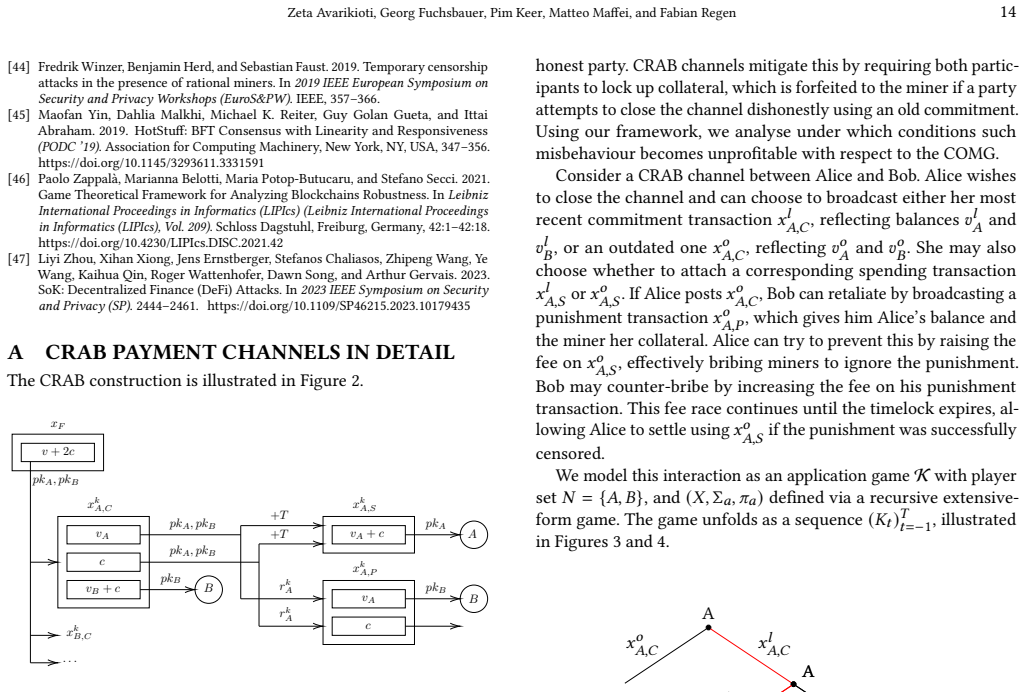
Liyi Zhou, Xihan Xiong, Jens Ernstberger, Stefanos Chaliasos, Zhipeng Wang, Ye Wang, Kaihua Qin, Roger Wattenhofer, Dawn Song, and Arthur Gervais. 2023. SoK: Decentralized Finance (DeFi) Attacks. In 2023 IEEE Symposium on Security and Privacy (SP). 2444–2461. https://doi.org/10.1109/SP46215.2023.10179435 A CRAB PAYMENT CHANNELS IN DETAIL The CRAB construc...
discussion (0)
Sign in with ORCID, Apple, or X to comment. Anyone can read and Pith papers without signing in.