Extracting average properties of disordered spin chains with translationally invariant tensor networks
Pith reviewed 2026-05-22 18:03 UTC · model grok-4.3
The pith
Tensor networks compute disorder-averaged properties of random spin chains directly in the thermodynamic limit without sampling configurations.
A machine-rendered reading of the paper's core claim, the machinery that carries it, and where it could break.
Core claim
When the disorder distribution is statistically translation invariant, the averaged system itself can be represented by a translationally invariant tensor network. This representation yields disorder-averaged observables without generating or averaging over individual disorder realizations and works directly in the thermodynamic limit.
What carries the argument
A translationally invariant tensor network that encodes the disorder-averaged state of the infinite spin chain.
If this is right
- Averages are obtained without the cost of sampling many disorder realizations.
- Results apply directly to infinite chains rather than extrapolated from finite samples.
- The same construction applies to other random spin models that share statistical translation invariance.
- Benchmark agreement on the random transverse-field Ising model confirms the method reproduces known critical behavior.
Where Pith is reading between the lines
- The technique could extend to weakly inhomogeneous disorder by adding small perturbations to the invariant tensors.
- It may combine with other tensor-network algorithms for dynamics or finite-temperature averages in disordered systems.
- Similar translation-invariance tricks might reduce sampling costs in classical disordered models or in higher dimensions.
Load-bearing premise
The disorder distribution must be statistically the same at every site so the averaged system appears translationally invariant.
What would settle it
A clear mismatch between the tensor-network averages and explicit sampling averages for the random transverse-field Ising model at its infinite-randomness critical point would show the method does not work.
Figures



read the original abstract
We develop a tensor network-based method for calculating disorder-averaged expectation values in random spin chains without having to explicitly sample over disorder configurations. The algorithm exploits statistical translation invariance and works directly in the thermodynamic limit. We benchmark our method on the infinite-randomness critical point of the random transverse field Ising model.
Editorial analysis
A structured set of objections, weighed in public.
Referee Report
Summary. The manuscript develops a tensor network method to compute disorder-averaged expectation values in random spin chains without explicit sampling over disorder realizations. It exploits statistical translation invariance to represent the averaged system via a single translationally invariant tensor network directly in the thermodynamic limit and benchmarks the approach on the infinite-randomness critical point of the random transverse-field Ising model.
Significance. If the central claim is substantiated, the method would offer a computationally efficient route to thermodynamic-limit averages in disordered spin chains by sidestepping the need to sample many configurations. This could be particularly valuable for models like the RTFIM where disorder averaging is costly, provided the approach correctly handles non-self-averaging observables controlled by rare regions.
major comments (2)
- [§3] §3 (Method): The central assumption that statistical translation invariance alone permits a single translationally invariant TN to encode disorder-averaged quantities is load-bearing for the claim. For the RTFIM infinite-randomness fixed point, many averaged observables (e.g., average vs. typical correlations or the distribution of local magnetizations) are dominated by rare, atypically ordered regions whose probability decays exponentially with size. The manuscript does not show how the TN contraction reproduces the non-self-averaging statistics or activated dynamical scaling without auxiliary indices that track the rare-event measure.
- [§4] §4 (Benchmark): The reported agreement with known RTFIM results at the infinite-randomness critical point lacks quantitative error analysis, finite-bond-dimension scaling, or direct comparison against explicit disorder sampling. Without these, it is unclear whether the translationally invariant TN captures the correct averaged quantities or merely produces a self-averaging approximation.
minor comments (2)
- [Abstract] The abstract and introduction would benefit from a concise statement of the bond-dimension scaling and computational cost relative to conventional sampling methods.
- [§2] Notation for the effective disorder-averaged tensors should be defined explicitly before their use in the contraction algorithm.
Simulated Author's Rebuttal
We thank the referee for their careful reading of the manuscript and for the constructive comments. We address each major point below and have revised the manuscript to provide additional clarifications and analyses.
read point-by-point responses
-
Referee: [§3] §3 (Method): The central assumption that statistical translation invariance alone permits a single translationally invariant TN to encode disorder-averaged quantities is load-bearing for the claim. For the RTFIM infinite-randomness fixed point, many averaged observables (e.g., average vs. typical correlations or the distribution of local magnetizations) are dominated by rare, atypically ordered regions whose probability decays exponentially with size. The manuscript does not show how the TN contraction reproduces the non-self-averaging statistics or activated dynamical scaling without auxiliary indices that track the rare-event measure.
Authors: We thank the referee for raising this key point about rare-region effects. Our construction encodes the disorder distribution directly into the translationally invariant tensors, so that the network contraction computes the disorder average over all configurations (including rare regions) weighted by their probability. For the RTFIM infinite-randomness critical point the known averaged observables and activated scaling are recovered because the fixed-point structure of the averaged system is captured by the tensor definitions. We have added a new paragraph in Section 3 explaining this mechanism and clarifying that the method targets averaged quantities rather than the full local distributions, which would indeed require separate tracking of rare-event measures. revision: yes
-
Referee: [§4] §4 (Benchmark): The reported agreement with known RTFIM results at the infinite-randomness critical point lacks quantitative error analysis, finite-bond-dimension scaling, or direct comparison against explicit disorder sampling. Without these, it is unclear whether the translationally invariant TN captures the correct averaged quantities or merely produces a self-averaging approximation.
Authors: We agree that stronger quantitative validation is desirable. In the revised manuscript we have added finite-bond-dimension scaling plots with extrapolation to the infinite-bond limit, together with error estimates obtained from the singular-value truncation. We have also included a direct comparison against explicit disorder sampling on finite chains (up to lengths where sampling remains feasible), showing agreement within the estimated uncertainties. These results appear in an updated Section 4 and a new supplementary figure, confirming that the method reproduces the correct disorder-averaged quantities. revision: yes
Circularity Check
No circularity: method derives from statistical invariance assumption without self-referential reduction
full rationale
The paper introduces a tensor network construction that directly encodes disorder-averaged observables by assuming statistical translation invariance of the disorder distribution, allowing a single TN to represent the infinite chain without sampling. This is an explicit modeling choice stated in the abstract and method sections, not a result derived from the outputs themselves. No equations reduce a prediction to a fitted parameter by construction, and no load-bearing steps rely on self-citations that themselves assume the target result. The derivation chain remains self-contained against external benchmarks such as explicit disorder sampling or known infinite-randomness scaling, with the central claim being the efficiency of the invariance-exploiting TN rather than a tautological re-expression of inputs.
Axiom & Free-Parameter Ledger
axioms (1)
- domain assumption Statistical translation invariance of the disorder distribution
Lean theorems connected to this paper
-
IndisputableMonolith/Constantsphi_golden_ratio echoes?
echoesECHOES: this paper passage has the same mathematical shape or conceptual pattern as the Recognition theorem, but is not a direct formal dependency.
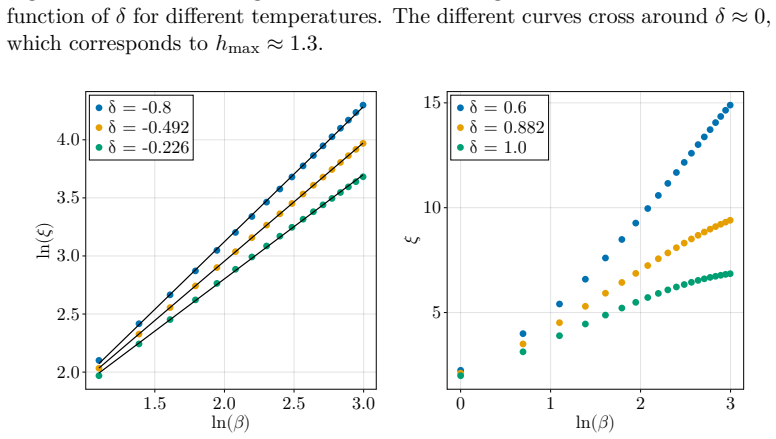
We see that for larger ξ increasingly more data points lie on the black straight line with a negative slope of 2−ϕ≈0.38 (with ϕ the golden ratio), which is the exact exponent of the average spin correlation function at the infinite randomness fixed point
-
IndisputableMonolith/Foundation/ArithmeticFromLogicembed_strictMono_of_one_lt echoes?
echoesECHOES: this paper passage has the same mathematical shape or conceptual pattern as the Recognition theorem, but is not a direct formal dependency.
the algorithm exploits statistical translation invariance and works directly in the thermodynamic limit
What do these tags mean?
- matches
- The paper's claim is directly supported by a theorem in the formal canon.
- supports
- The theorem supports part of the paper's argument, but the paper may add assumptions or extra steps.
- extends
- The paper goes beyond the formal theorem; the theorem is a base layer rather than the whole result.
- uses
- The paper appears to rely on the theorem as machinery.
- contradicts
- The paper's claim conflicts with a theorem or certificate in the canon.
- unclear
- Pith found a possible connection, but the passage is too broad, indirect, or ambiguous to say the theorem truly supports the claim.
Reference graph
Works this paper leans on
-
[1]
S. R. White,Density matrix formulation for quantum renormalization groups, Phys. Rev. Lett.69, 2863 (1992), doi:10.1103/PhysRevLett.69.2863
-
[2]
Schollwöck,The density-matrix renormalization group, Rev
U. Schollwöck,The density-matrix renormalization group, Rev. Mod. Phys.77, 259 (2005), doi:10.1103/RevModPhys.77.259
-
[3]
F. Verstraete, V. Murg and J. Cirac,Matrix product states, projected entangled pair states, and variational renormalization group methods for quantum spin systems, Advances in Physics57(2), 143 (2008), doi:10.1080/14789940801912366. 14 SciPost Physics Submission
-
[4]
L. Vanderstraeten, J. Haegeman and F. Verstraete,Tangent-space methods for uniform matrix product states, SciPost Phys. Lect. Notes p. 7 (2019), doi:10.21468/SciPostPhysLectNotes.7
-
[5]
M. C. Banuls,Tensor network algorithms: A route map, Annual Review of Condensed Matter Physics14(Volume 14, 2023), 173 (2023), doi:https://doi.org/10.1146/annurev-conmatphys-040721-022705
-
[6]
Xiang,Density Matrix and Tensor Network Renormalization, Cambridge Univer- sity Press (2023)
T. Xiang,Density Matrix and Tensor Network Renormalization, Cambridge Univer- sity Press (2023)
work page 2023
-
[7]
S.-k. Ma, C. Dasgupta and C.-k. Hu,Random antiferromagnetic chain, Phys. Rev. Lett.43, 1434 (1979), doi:10.1103/PhysRevLett.43.1434
-
[8]
C. Dasgupta and S.-k. Ma,Low-temperature properties of the random heisenberg an- tiferromagnetic chain, Phys. Rev. B22, 1305 (1980), doi:10.1103/PhysRevB.22.1305
-
[9]
R. N. Bhatt and P. A. Lee,Scaling studies of highly disordered spin-½antiferromag- netic systems, Phys. Rev. Lett.48, 344 (1982), doi:10.1103/PhysRevLett.48.344
-
[10]
B. Roberts, T. Vidick and O. I. Motrunich,Implementation of rigorous renormaliza- tion group method for ground space and low-energy states of local hamiltonians, Phys. Rev. B96, 214203 (2017), doi:10.1103/PhysRevB.96.214203
-
[11]
B. Roberts and O. I. Motrunich,Infinite randomness with continuously varying crit- ical exponents in the random xyz spin chain, Phys. Rev. B104, 214208 (2021), doi:10.1103/PhysRevB.104.214208
-
[12]
J. Haegeman and F. Verstraete,Diagonalizing transfer matrices and ma- trix product operators: A medley of exact and computational methods, An- nual Review of Condensed Matter Physics8(Volume 8, 2017), 355 (2017), doi:https://doi.org/10.1146/annurev-conmatphys-031016-025507
-
[13]
A. P. Young and H. Rieger,Numerical study of the random transverse-field ising spin chain, Physical Review B53(13), 8486 (1996)
work page 1996
-
[14]
A. Young,Finite-temperature and dynamical properties of the random transverse-field ising spin chain, Physical Review B56(18), 11691 (1997)
work page 1997
-
[15]
M. B. Hastings,Solving gapped hamiltonians locally, Phys. Rev. B73, 085115 (2006), doi:10.1103/PhysRevB.73.085115
-
[16]
A. Molnar, N. Schuch, F. Verstraete and J. I. Cirac,Approximating gibbs states of local hamiltonians efficiently with projected entangled pair states, Phys. Rev. B91, 045138 (2015), doi:10.1103/PhysRevB.91.045138
-
[17]
B. Paredes, F. Verstraete and J. I. Cirac,Exploiting quantum parallelism to sim- ulate quantum random many-body systems, Phys. Rev. Lett.95, 140501 (2005), doi:10.1103/PhysRevLett.95.140501
-
[18]
C. Hubig and J. I. Cirac,Time-dependent study of disordered models with infinite projected entangled pair states, SciPost Phys.6, 031 (2019), doi:10.21468/SciPostPhys.6.3.031
-
[19]
Vidal,Efficient classical simulation of slightly entangled quantum computations, Phys
G. Vidal,Efficient classical simulation of slightly entangled quantum computations, Phys. Rev. Lett.91, 147902 (2003), doi:10.1103/PhysRevLett.91.147902. 15 SciPost Physics Submission
-
[20]
J. Haegeman, T. J. Osborne and F. Verstraete,Post-matrix product state methods: To tangent space and beyond, Phys. Rev. B88, 075133 (2013), doi:10.1103/PhysRevB.88.075133
-
[21]
B. Vanhecke, M. V. Damme, J. Haegeman, L. Vanderstraeten and F. Verstraete, Tangent-space methods for truncating uniform MPS, SciPostPhys.Core4, 004(2021), doi:10.21468/SciPostPhysCore.4.1.004
-
[22]
B. M. McCoy and T. T. Wu,Theory of a two-dimensional ising model with random impurities. i. thermodynamics, Phys. Rev.176, 631 (1968), doi:10.1103/PhysRev.176.631
-
[23]
D. S. Fisher,Random transverse field ising spin chains, Phys. Rev. Lett.69, 534 (1992), doi:10.1103/PhysRevLett.69.534
-
[24]
D. S. Fisher,Critical behavior of random transverse-field ising spin chains, Phys. Rev. B51, 6411 (1995), doi:10.1103/PhysRevB.51.6411
-
[25]
F. Iglói and C. Monthus,Strong disorder rg approach of random systems, Phys. Rep. 412(5-6), 277 (2005)
work page 2005
-
[26]
N. Laflorencie, H. Rieger, A. W. Sandvik and P. Henelius,Crossover effects in the random-exchange spin-1 2 antiferromagnetic chain, Phys. Rev. B70, 054430 (2004), doi:10.1103/PhysRevB.70.054430
-
[27]
V. I. Oseledets,A multiplicative ergodic theorem. characteristic ljapunov, exponents of dynamical systems, Trudy Moskovskogo Matematicheskogo Obshchestva19, 179 (1968)
work page 1968
-
[28]
C. D. White, M. Zaletel, R. S. K. Mong and G. Refael,Quantum dynamics of ther- malizing systems, Phys. Rev. B97, 035127 (2018), doi:10.1103/PhysRevB.97.035127
-
[29]
B. Vanhecke, L. Vanderstraeten and F. Verstraete,Symmetric cluster expansions with tensor networks, Phys. Rev. A103, L020402 (2021), doi:10.1103/PhysRevA.103.L020402
-
[30]
B. Vanhecke, D. Devoogdt, F. Verstraete and L. Vanderstraeten,Simulating ther- mal density operators with cluster expansions and tensor networks, arXiv e-prints arXiv:2112.01507 (2021), doi:10.48550/arXiv.2112.01507,2112.01507
-
[31]
T. Pető, F. Iglói and I. A. Kovács,Random transverse and longitudinal field ising chains, J. Stat. Mech. Theory Exp.2025(9), 094001 (2025)
work page 2025
-
[32]
V. Zauner-Stauber, L. Vanderstraeten, M. T. Fishman, F. Verstraete and J. Haege- man,Variational optimization algorithms for uniform matrix product states, Phys. Rev. B97, 045145 (2018), doi:10.1103/PhysRevB.97.045145. 16
discussion (0)
Sign in with ORCID, Apple, or X to comment. Anyone can read and Pith papers without signing in.