Hardware-Efficient Universal Linear Transformations for Optical Modes in the Synthetic Time Dimension
Pith reviewed 2026-05-22 16:40 UTC · model grok-4.3
The pith
A synthetic time-domain photonic processor implements arbitrary linear transformations on optical modes using exponentially fewer hardware components than spatial interferometers.
A machine-rendered reading of the paper's core claim, the machinery that carries it, and where it could break.
Core claim
The central claim is that a hardware-efficient synthetic time-domain photonic processor achieves at least an exponential reduction in hardware component count for implementing arbitrary linear transformations on optical modes, with dynamic connectivity that permits pruning to minimize loss while preserving universality, and that this design exceeds universal cluster-state thresholds on boosted Bell state measurements under realistic hardware constraints due to localization effects in multi-photon transport.
What carries the argument
Synthetic time dimension with dynamic connectivity and systematic pruning of redundant elements to minimize optical loss while retaining all-to-all connectivity.
If this is right
- Boosted Bell state measurements in this architecture exceed thresholds for universal cluster-state quantum computation even with realistic imperfections.
- Systematic pruning reduces optical loss without sacrificing all-to-all connectivity for arbitrary linear transformations.
- Localization from redundant hardware enhances robustness to coherent errors via multi-photon transport geometry.
- The design provides a practical route to scalable reconfigurable photonic processors without quadratic component growth.
Where Pith is reading between the lines
- The time-domain approach could be extended to other linear optical tasks such as quantum simulation or sensing by reusing the same pruned connectivity.
- Deliberate engineering of the multi-photon localization geometry might be used to suppress specific error channels beyond what the paper models.
- Integration with existing time-bin encoding techniques in fiber or integrated photonics could accelerate experimental tests of the exponential scaling claim.
Load-bearing premise
The model of multi-photon transport and localization effects from redundant imperfect hardware accurately reflects real-device behavior without introducing unmodeled errors that would block exceeding cluster-state thresholds.
What would settle it
An experimental implementation of the boosted Bell state measurement protocol in the synthetic time processor that fails to reach the success probability or fidelity required for universal cluster-state quantum computation under the stated hardware constraints.
Figures




read the original abstract
Recent progress in photonic information processing has spurred strong demand in scalable and reconfigurable photonic circuitry. Conventional spatially-meshed multi-port interferometers require a number of components growing quadratically with the system size, posing a fundamental scaling challenge ahead. Here, we introduce a hardware-efficient synthetic time-domain photonic processor that achieves at least an exponential reduction in hardware component count for implementing arbitrary linear transformations. The processor's dynamic connectivity allows systematic pruning, minimizing optical loss while preserving all-to-all connectivity. We benchmark our architecture on the task of boosted Bell state measurements -- a protocol essential for linear optical quantum computation, and show that it exceeds thresholds for universal cluster-state quantum computation under realistic hardware constraints. We link the device performance to the geometry of multi-photon transport, showing that localization effects from redundant, imperfect hardware may enhance robustness to coherent errors. Our design establishes a practical pathway toward near-term, scalable, and reconfigurable photonic processors in the synthetic time dimension.
Editorial analysis
A structured set of objections, weighed in public.
Referee Report
Summary. The manuscript introduces a synthetic time-domain photonic processor that implements arbitrary linear transformations on optical modes using dynamic connectivity and systematic pruning of redundant elements. This yields at least an exponential reduction in hardware component count relative to spatially meshed interferometers. The architecture is benchmarked on boosted Bell-state measurements, with the claim that it exceeds the thresholds required for universal cluster-state quantum computation under realistic hardware constraints. Performance is attributed to localization effects in the multi-photon transport geometry induced by imperfect redundant hardware.
Significance. If the benchmarking claims are substantiated with explicit models and data, the work would offer a concrete route to scalable reconfigurable photonic processors by replacing quadratic spatial scaling with time-multiplexed dynamic connectivity. The geometric link between redundancy-induced localization and enhanced robustness to coherent errors could inform error-mitigation strategies in linear-optical quantum computing.
major comments (1)
- [Benchmarking section (results on boosted Bell-state measurements)] The central claim that the boosted Bell-state measurement benchmark exceeds universal cluster-state thresholds under realistic constraints rests on the multi-photon transport and localization model. The manuscript does not supply the explicit error model (including timing jitter, group-velocity dispersion, or pulse-to-pulse overlap), simulation parameters, or quantitative fidelity data that would allow verification that the predicted gain survives these effects. This is load-bearing because the threshold-exceeding result is the primary concrete evidence offered for practical utility.
minor comments (1)
- [Abstract and Introduction] The abstract and introduction would benefit from a precise statement of the scaling exponent (e.g., O(N) vs. O(log N) components) together with the precise definition of system size N.
Simulated Author's Rebuttal
We thank the referee for their careful review and constructive criticism of our manuscript. We address the major comment point-by-point below.
read point-by-point responses
-
Referee: [Benchmarking section (results on boosted Bell-state measurements)] The central claim that the boosted Bell-state measurement benchmark exceeds universal cluster-state thresholds under realistic constraints rests on the multi-photon transport and localization model. The manuscript does not supply the explicit error model (including timing jitter, group-velocity dispersion, or pulse-to-pulse overlap), simulation parameters, or quantitative fidelity data that would allow verification that the predicted gain survives these effects. This is load-bearing because the threshold-exceeding result is the primary concrete evidence offered for practical utility.
Authors: We appreciate the referee pointing out the need for more explicit details in the benchmarking section. The manuscript links the performance to localization effects in the multi-photon transport geometry due to redundant hardware, which enhances robustness to coherent errors. However, we acknowledge that the specific error models for timing jitter, group-velocity dispersion, and pulse-to-pulse overlap, as well as the simulation parameters and quantitative fidelity data, require further elaboration to allow full verification. In the revised manuscript, we will expand this section to provide the explicit error model, list the simulation parameters used, and include quantitative fidelity results demonstrating that the gain over thresholds persists under these realistic effects. This will be done in the main text where possible, with additional details in the supplementary information. revision: yes
Circularity Check
No load-bearing circularity; claims rely on external hardware models and geometric interpretations without self-referential reductions
full rationale
The abstract and provided context present the architecture's exponential hardware reduction and Bell-state benchmark performance as following from dynamic connectivity, systematic pruning, and multi-photon localization geometry under realistic constraints. No equations, fitted parameters, or self-citations are shown that define a result in terms of itself or rename a fitted quantity as a prediction. Benchmarking is described as resting on external hardware models rather than internal fits, and the localization-robustness link is presented as an interpretive connection rather than a definitional equivalence. This yields a minor self-citation tolerance score with the central claims retaining independent content from the described geometry and benchmarks.
Axiom & Free-Parameter Ledger
axioms (1)
- domain assumption Realistic hardware constraints and multi-photon transport geometry allow the architecture to exceed thresholds for universal cluster-state quantum computation.
Lean theorems connected to this paper
-
IndisputableMonolith/Foundation/DimensionForcing.leanreality_from_one_distinction (8-tick period) echoes?
echoesECHOES: this paper passage has the same mathematical shape or conceptual pattern as the Recognition theorem, but is not a direct formal dependency.
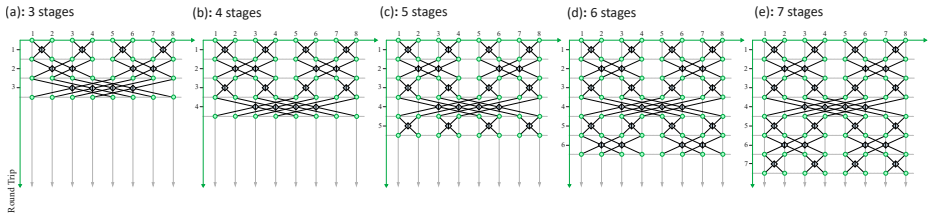
Sine-Cosine Fractal Configuration... log2 N delay lines of length 2^k τ... 8 time bins... self-similar structure... localization effects... nonmonotonic behavior
-
IndisputableMonolith/Foundation/ArithmeticFromLogic.leanembed_strictMono_of_one_lt (self-similar orbit embedding) echoes?
echoesECHOES: this paper passage has the same mathematical shape or conceptual pattern as the Recognition theorem, but is not a direct formal dependency.
recursive architecture... fractal, self-similar structure that leads to complex and nonmonotonic transport patterns
What do these tags mean?
- matches
- The paper's claim is directly supported by a theorem in the formal canon.
- supports
- The theorem supports part of the paper's argument, but the paper may add assumptions or extra steps.
- extends
- The paper goes beyond the formal theorem; the theorem is a base layer rather than the whole result.
- uses
- The paper appears to rely on the theorem as machinery.
- contradicts
- The paper's claim conflicts with a theorem or certificate in the canon.
- unclear
- Pith found a possible connection, but the passage is too broad, indirect, or ambiguous to say the theorem truly supports the claim.
Reference graph
Works this paper leans on
-
[1]
Y. Shen, N. C. Harris, S. Skirlo, M. Prabhu, T. Baehr-Jones, M. Hochberg, X. Sun, S. Zhao, H. Larochelle, D. Englund,et al., Deep learning with coherent nanophotonic circuits, Nature Pho- tonics11, 441 (2017)
work page 2017
-
[2]
S. Bandyopadhyay, A. Sludds, S. Krastanov, R. Hamerly, N. Harris, D. Bunandar, M. Streshin- sky, M. Hochberg, and D. Englund, Single-chip pho- tonic deep neural network with forward-only train- ing, Nature Photonics18, 1335 (2024)
work page 2024
-
[3]
S. R. Ahmed, R. Baghdadi, M. Bernadskiy, N. Bow- man, R. Braid, J. Carr, C. Chen, P. Ciccarella, M. Cole, J. Cooke,et al., Universal photonic ar- tificial intelligence acceleration, Nature640, 368 (2025)
work page 2025
-
[4]
S. Hua, E. Divita, S. Yu, B. Peng, C. Roques- Carmes, Z. Su, Z. Chen, Y. Bai, J. Zou, Y. Zhu, et al., An integrated large-scale photonic accelera- tor with ultralow latency, Nature640, 361 (2025)
work page 2025
- [5]
- [6]
-
[7]
C. Cui, K. P. Seshadreesan, S. Guha, and L. Fan, High-dimensional frequency-encoded quantum in- formation processing with passive photonics and time-resolving detection, Physical Review Letters 124, 190502 (2020)
work page 2020
-
[8]
Y. Chi, J. Huang, Z. Zhang, J. Mao, Z. Zhou, X. Chen, C. Zhai, J. Bao, T. Dai, H. Yuan,et al., A programmable qudit-based quantum processor, Na- ture Communications13, 1166 (2022)
work page 2022
-
[9]
J. R. Basani, M. Y. Niu, and E. Waks, Universal logical quantum photonic neural network processor via cavity-assisted interactions, npj Quantum Infor- mation11, 142 (2025)
work page 2025
-
[10]
J. Carolan, C. Harrold, C. Sparrow, E. Martín- López, N. J. Russell, J. W. Silverstone, P. J. Shad- bolt, N. Matsuda, M. Oguma, M. Itoh,et al., Uni- versal linear optics, Science349, 711 (2015)
work page 2015
- [11]
-
[12]
B. Fischer, M. Chemnitz, B. MacLellan, P. Roz- tocki, R. Helsten, B. Wetzel, B. E. Little, S. T. Chu, D. J. Moss, J. Azaña,et al., Autonomous on-chip interferometry for reconfigurable optical waveform generation, Optica8, 1268 (2021)
work page 2021
-
[13]
S. Ou, K. Xue, L. Zhou, C.-h. Lee, A. Sludds, R. Hamerly, K. Zhang, H. Feng, Y. Yu, R. Kopparapu,et al., Hypermultiplexed integrated photonics–based optical tensor processor, Science Advances11, eadu0228 (2025)
work page 2025
-
[14]
C. Sparrow, E. Martín-López, N. Maraviglia, A. Neville, C. Harrold, J. Carolan, Y. N. Joglekar, T. Hashimoto, N. Matsuda, J. L. O’Brien,et al., Simulating the vibrational quantum dynamics of molecules using photonics, Nature557, 660 (2018)
work page 2018
- [15]
-
[16]
J. Bao, Z. Fu, T. Pramanik, J. Mao, Y. Chi, Y. Cao, C. Zhai, Y. Mao, T. Dai, X. Chen,et al., Very-large- scale integrated quantum graph photonics, Nature Photonics , 1 (2023)
work page 2023
-
[17]
L. S. Madsen, F. Laudenbach, M. F. Askarani, F. Rortais, T. Vincent, J. F. Bulmer, F. M. Miatto, L. Neuhaus, L. G. Helt, M. J. Collins,et al., Quan- tum computational advantage with a programmable photonic processor, Nature606, 75 (2022)
work page 2022
- [18]
-
[19]
Y. Xia, W. Li, Q. Zhuang, and Z. Zhang, Quantum- enhanced data classification with a variational en- tangled sensor network, Physical Review X11, 021047 (2021)
work page 2021
-
[20]
Z.-H. Liu, R. Brunel, E. E. Østergaard, O. Cordero, S. Chen, Y. Wong, J. A. Nielsen, A. B. Bregnsbo, S. Zhou, H.-Y. Huang,et al., Quantum learning advantage on a scalable photonic platform, Science 389, 1332 (2025)
work page 2025
-
[21]
S. Guha, Structured optical receivers to attain su- peradditive capacity and the holevo limit, Physical Review Letters106, 240502 (2011)
work page 2011
-
[22]
C. Cui, J. Postlewaite, B. N. Saif, L. Fan, and S. Guha, Superadditive communication with the green machine as a practical demonstration of non- locality without entanglement, Nature Communica- tions16, 3760 (2025)
work page 2025
-
[23]
M. Rosati and A. Solana, Joint-detection learning for optical communication at the quantum limit, Optica Quantum2, 390 (2024)
work page 2024
-
[24]
M. Rosati and G. Cincotti, A fourier machine for quantum optical communications, Journal of Light- wave Technology43, 3770 (2025)
work page 2025
-
[25]
M. Reck, A. Zeilinger, H. J. Bernstein, and P. Bertani, Experimental realization of any discrete unitary operator, Physical Review Letters73, 58 (1994)
work page 1994
-
[26]
W. R. Clements, P. C. Humphreys, B. J. Metcalf, W. S. Kolthammer, and I. A. Walmsley, Optimal de- sign for universal multiport interferometers, Optica 3, 1460 (2016). 16
work page 2016
-
[27]
J. Carolan, M. Mohseni, J. P. Olson, M. Prabhu, C. Chen, D. Bunandar, M. Y. Niu, N. C. Harris, F. N. Wong, M. Hochberg,et al., Variational quan- tum unsampling on a quantum photonic processor, Nature Physics16, 322 (2020)
work page 2020
-
[28]
S. Bandyopadhyay, R. Hamerly, and D. Englund, Hardware error correction for programmable pho- tonics, Optica8, 1247 (2021)
work page 2021
-
[29]
R. Hamerly, S. Bandyopadhyay, and D. Englund, Accurate self-configuration of rectangular multi- port interferometers, Physical Review Applied18, 024019 (2022)
work page 2022
-
[30]
R. Hamerly, S. Bandyopadhyay, and D. Englund, Stability of self-configuring large multiport inter- ferometers, Physical Review Applied18, 024018 (2022)
work page 2022
-
[31]
R. Hamerly, S. Bandyopadhyay, and D. Englund, Asymptotically fault-tolerant programmable pho- tonics, Nature Communications13, 6831 (2022)
work page 2022
-
[32]
R. Burgwal, W. R. Clements, D. H. Smith, J. C. Gates, W. S. Kolthammer, J. J. Renema, and I. A. Walmsley, Using an imperfect photonic network to implement random unitaries, Optics Express25, 28236 (2017)
work page 2017
- [33]
-
[34]
J. Ewaniuk, J. Carolan, B. J. Shastri, and N. Roten- berg, Imperfect quantum photonic neural networks, AdvancedQuantumTechnologies6,2200125(2023)
work page 2023
-
[35]
R. Hamerly, S. Bandyopadhyay, A. Sludds, Z. Chen, L. Bernstein, S. K. Vadlamani, J. Basani, R. Davis, and D. Englund, Multiplexing methods for scaling up photonic logic, inAI and Optical Data Sciences IV, Vol. 12438 (SPIE, 2023) p. 1243802
work page 2023
-
[36]
J.R.Basani, M.Heuck, D.R.Englund,andS.Kras- tanov, All-photonic artificial-neural-network proces- sor via nonlinear optics, Physical Review Applied 22, 014009 (2024)
work page 2024
-
[37]
R. Hamerly, L. Bernstein, A. Sludds, M. Soljačić, and D. Englund, Large-scale optical neural networks based on photoelectric multiplication, Physical Re- view X9, 021032 (2019)
work page 2019
-
[38]
K. R. Motes, A. Gilchrist, J. P. Dowling, and P. P. Rohde, Scalable boson sampling with time-bin en- coding using a loop-based architecture, Physical Re- view Letters113, 120501 (2014)
work page 2014
-
[39]
Y. He, X. Ding, Z.-E. Su, H.-L. Huang, J. Qin, C. Wang, S. Unsleber, C. Chen, H. Wang, Y.-M. He,et al., Time-bin-encoded boson sampling with a single-photon device, Physical Review Letters118, 190501 (2017)
work page 2017
-
[40]
S. Sempere-Llagostera, R. Patel, I. Walmsley, and W. Kolthammer, Experimentally finding dense sub- graphs using a time-bin encoded gaussian boson sampling device, Physical Review X12, 031045 (2022)
work page 2022
- [41]
- [42]
-
[43]
Demonstration of a quantum C-NOT Gate in a Time-Multiplexed fully reconfigurable photonic processor
F. Pegoraro, P. Held, J. Lammers, B. Brecht, and C. Silberhorn, Demonstration of a pho- tonic time-multiplexed c-not gate, arXiv preprint arXiv:2412.02478 (2024)
work page internal anchor Pith review Pith/arXiv arXiv 2024
-
[44]
F. Bouchard, K. Fenwick, K. Bonsma-Fisher, D. England, P. J. Bustard, K. Heshami, and B. Sussman, Programmable photonic quantum cir- cuits with ultrafast time-bin encoding, Physical Re- view Letters133, 090601 (2024)
work page 2024
-
[45]
F. Ewert and P. van Loock, 3/4-efficient bell mea- surement with passive linear optics and unentan- gled ancillae, Physical Review Letters113, 140403 (2014)
work page 2014
- [46]
-
[47]
M. Pant, D. Towsley, D. Englund, and S. Guha, Percolation thresholds for photonic quantum com- puting, Nature Communications10, 1070 (2019)
work page 2019
-
[48]
J. R. Basani, S. K. Vadlamani, S. Bandyopadhyay, D. R. Englund, and R. Hamerly, A self-similar sine– cosine fractal architecture for multiport interferom- eters, Nanophotonics12, 975 (2023)
work page 2023
-
[49]
S. K. Vadlamani, D. Englund, and R. Hamerly, Transferable learning on analog hardware, Science Advances9, eadh3436 (2023)
work page 2023
- [50]
-
[51]
J. Calsamiglia and N. Lütkenhaus, Maximum effi- ciencyofalinear-opticalbell-stateanalyzer,Applied Physics B72, 67 (2001)
work page 2001
-
[52]
N. C. Harris, G. R. Steinbrecher, M. Prabhu, Y. Lahini, J. Mower, D. Bunandar, C. Chen, F. N. Wong, T. Baehr-Jones, M. Hochberg,et al., Quantum transport simulations in a programmable nanophotonic processor, Nature Photonics11, 447 (2017)
work page 2017
-
[53]
P. W. Anderson, Absence of diffusion in certain ran- dom lattices, Physical Review109, 1492 (1958)
work page 1958
-
[54]
D. Su, C. R. Myers, and K. K. Sabapathy, Con- version of gaussian states to non-gaussian states using photon-number-resolving detectors, Physical Review A100, 052301 (2019). 17
work page 2019
- [55]
-
[56]
H. Aghaee Rad, T. Ainsworth, R. Alexander, B. Al- tieri, M. Askarani, R. Baby, L. Banchi, B. Baragi- ola, J. Bourassa, R. Chadwick,et al., Scaling and networking a modular photonic quantum computer, Nature , 1 (2025)
work page 2025
-
[57]
S. Guha, T. C. John, Z. Gong, and P. Basu, Quantum-enhanced quickest change detection of transmission loss, Physical Review Letters135, 210801 (2025)
work page 2025
- [58]
-
[59]
R. Hamerly, J. R. Basani, A. Sludds, S. K. Vad- lamani, and D. Englund, Toward the information- theoretic limit of programmable photonics, APL Photonics10, 10.1063/5.0269741 (2025)
- [60]
-
[61]
C. Taballione, T. A. Wolterink, J. Lugani, A. Eck- stein, B. A. Bell, R. Grootjans, I. Visscher, D.Geskus, C.G.Roeloffzen, J.J.Renema,et al.,8× 8 reconfigurable quantum photonic processor based on silicon nitride waveguides, Optics Express27, 26842 (2019)
work page 2019
- [62]
- [63]
-
[64]
L. He, M. Zhang, A. Shams-Ansari, R. Zhu, C.Wang,andL.Marko,Low-lossfiber-to-chipinter- face for lithium niobate photonic integrated circuits, Optics Letters44, 2314 (2019)
work page 2019
-
[65]
L. Chang, M. H. Pfeiffer, N. Volet, M. Zervas, J. D. Peters, C. L. Manganelli, E. J. Stanton, Y. Li, T. J. Kippenberg, and J. E. Bowers, Heterogeneous inte- gration of lithium niobate and silicon nitride waveg- uides for wafer-scale photonic integrated circuits on silicon, Optics Letters42, 803 (2017)
work page 2017
-
[66]
A manufacturable platform for photonic quantum computing, Nature , 1 (2025)
work page 2025
-
[67]
N. T. Arnold, M. Victora, M. E. Goggin, and P. G. Kwiat, Free-space photonic quantum memory, in Quantum Computing, Communication, and Simu- lation III, Vol. 12446 (SPIE, 2023) pp. 25–30
work page 2023
-
[68]
A. Melkozerov, A. Avanesov, I. Dyakonov, and S. Straupe, Analysis of optical loss thresholds in the fusion-based quantum computing architecture, APL Quantum1, 10.1063/5.0214728 (2024)
- [69]
-
[70]
C. Oh, M. Liu, Y. Alexeev, B. Fefferman, and L. Jiang, Classical algorithm for simulating experi- mentalgaussianbosonsampling,NaturePhysics20, 1461 (2024)
work page 2024
-
[71]
J. Basani, Cascaded optical systems approach to neural networks (casoptax),https://github.com/ JasvithBasani/CasOptAx(2024)
work page 2024
-
[72]
N. J. Russell, L. Chakhmakhchyan, J. L. O’Brien, andA.Laing,Directdiallingofhaarrandomunitary matrices, New journal of physics19, 033007 (2017)
work page 2017
-
[73]
D. A. Miller, Perfect optics with imperfect compo- nents, Optica2, 747 (2015)
work page 2015
- [74]
discussion (0)
Sign in with ORCID, Apple, or X to comment. Anyone can read and Pith papers without signing in.