REVIEW 4 major objections 5 minor 54 references
Incentivizing Inclusive Contributions in Model Sharing Markets
T0 review · 4 major / 5 minor · reviewed 2026-08-16 · deepseek-v4-flash
Pith's one-line read A market for AI models where every participant gains and liars lose
desk verdict Interesting mechanism, but the central individual-rationality theorem fails as stated under finite over-reporting of data size, which is a self-reported variable. read the letter →
The pith
A machine-rendered reading of the paper's core claim, the machinery that carries it, and where it could break.
The reading
What carries the argument
The load-bearing object is the pair of a directed collaboration graph $A$ and a concave collaboration gain $G_i(a_i)=\sqrt{K_i/N_i}-\sqrt{K_i/(N_i+\sum_j a_{ij}N_j)}$, where $K_i$ is client $i$'s eagerness for data and $N_i$ its data volume. The mechanism's working part is a greedy threshold rule: for each potential collaborator $j$, the server computes a threshold $N_j^{\mathrm{Th}}$ by solving $g_i(N_j^{\mathrm{Th}})-g_i(N_j^{\mathrm{Th}}-N_j)=c_j+\lambda (N_j/N_i)d(\theta_i,\theta_j)$, and client $i$ imports the collaborator with the largest threshold until the accumulated data reaches it. The payment for an import is the marginal gain minus the model-difference penalty, so the same graph serves as both the training topology and the billing ledger; that coupling is what makes the individual-rationality and truthfulness proofs go through.
What would settle it
A direct test is to simulate a client whose true gain from importing a collaborator's data is much larger than the concave volume-based $G_i$ predicts, for instance a small high-quality dataset that exactly answers the buyer's task; if the buyer's true gain exceeds $G_i$, the payment $r_{ij}$ undercharges the seller and the seller's utility can become negative, breaking individual rationality. The paper's own Table 2 already varies reported data size and cost; running the same table with a lying report of $K_i$ would settle whether the truthfulness guarantee extends beyond $c_i$, since the theorem does not cover $K_i$.
Extended reading notes
Core claim
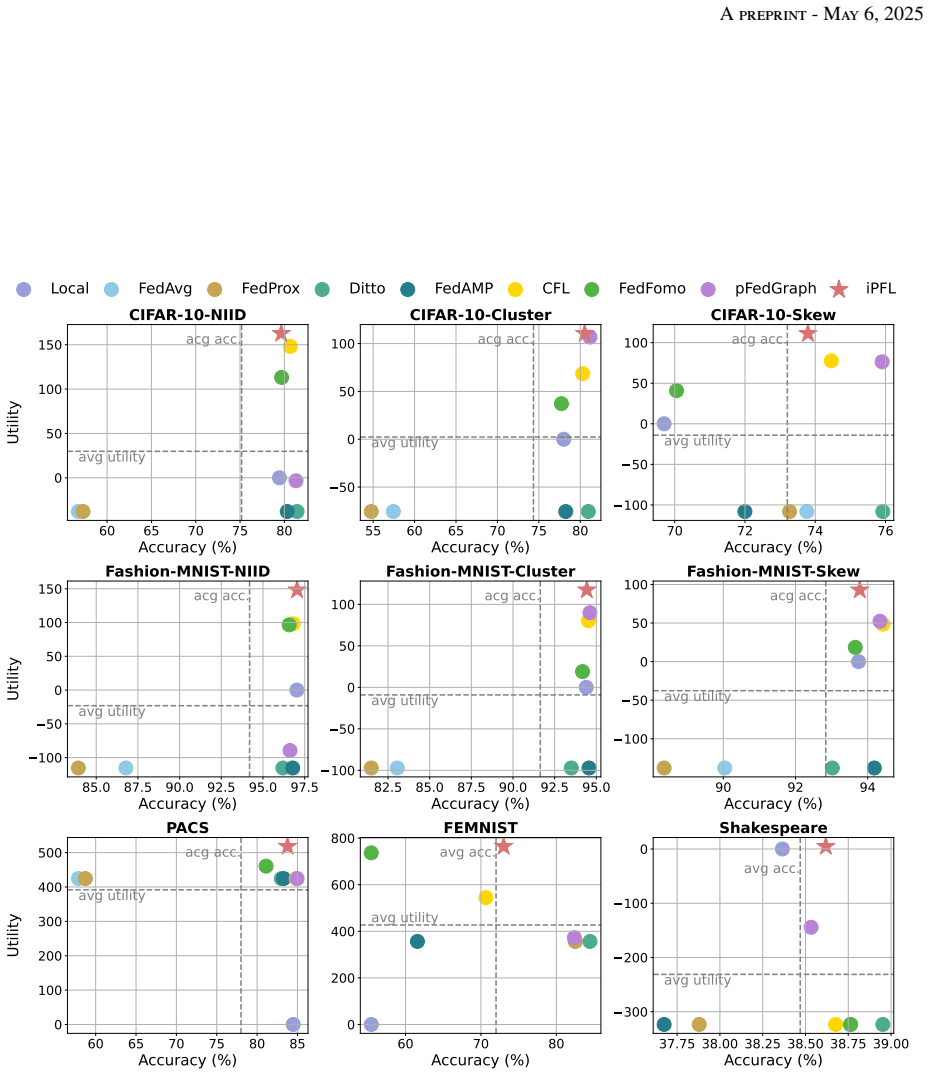
The central claim is that economic incentives and personalized model training can be driven by the same object: a directed collaboration graph $A$ in which $a_{ij}=1$ means client $i$ imports client $j$'s model, with each row chosen to balance model similarity, sharing cost, and a concave data-gain $G_i(a_i)=\sqrt{K_i/N_i}-\sqrt{K_i/(N_i+\sum_j a_{ij}N_j)}$. The server learns that graph with a greedy threshold rule and then bills each client the difference between the marginal benefit of each imported model and the model-distance penalty. Under that rule the paper proves that every client's utility is non-negative in every round (Theorem 1), that over-reporting one's cost $c_i$ cannot raise utility (Theorem 2), and that a client reporting an infinite data amount is never imported (Theorem 3). Empirically, across nine classification settings and two instruction-tuning scenarios, iPFL reports the highest economic utility with accuracy comparable to or better than FedAvg, FedProx, Ditto, FedAMP, CFL, FedFomo, and pFedGraph, including a 49% higher economic utility and 9% higher model utility than the best baseline in the LLM instruction-tuning case.
Load-bearing premise
The load-bearing premise is that a client's true value for imported data is fully captured by the concave function $G_i(a_i)=\sqrt{K_i/N_i}-\sqrt{K_i/(N_i+\sum_j a_{ij}N_j)}$ with a single reported scalar $K_i$, and that the only strategic degrees of freedom are the reports of cost $c_i$ and data size $N_i$; if institutions value content rather than just data volume, or can profitably misreport $K_i$ or $N_i$, the threshold selection and payment rule can lose their individual-rationality and truthfulness guarantees.
Editorial extensions
If this is right
- If the claims hold, institutions with purely financial motives and institutions with purely accuracy motives can share one federation without one subsidizing the other.
- A server that does not see any client's raw data can still set prices that leave every client with non-negative utility each round.
- Over-reporting private cost becomes self-defeating, so the mechanism gives clients a reason to reveal their true unwillingness to share.
- Attackers who upload poisoned or infinite-data models are structurally isolated through the model-difference and threshold rules rather than by a separate verification step.
- The same mechanism extends to instruction-following language-model training, where the reported gains are 49% in economic utility and 9% in model utility over the best baseline.
Reading between the lines
- The paper's truthfulness theorem is stated for over-reporting the cost $c_i$; its experiments also test lying on data size, but a formal truthfulness guarantee for $K_i$ and $N_i$ is not derived, so the honesty result is cost-specific as proved.
- Because the gain function counts only total imported data volume, the mechanism implicitly rewards quantity over content quality; a testable extension is to weight each collaborator's data by quality and check whether the greedy threshold rule still runs in $O(m)$ time.
- The Discussion concedes the federation is assumed static; a natural extension is to add refund or escrow rules so buyers who exit before round $T$ are not charged for model value they never received.
Signed reviews
Editorial analysis
A structured set of objections, weighed in public.
Referee Report
Summary. The paper proposes iPFL, a personalized federated learning framework coupled with a model-sharing market. Clients report their data size N_i, sharing cost c_i, and data eagerness K_i; a neutral server learns a collaboration graph (Algorithm 2) from model similarities and reported quantities, and charges payments defined by Eq. (10) as marginal collaboration gain minus model-difference cost. The paper claims that iPFL satisfies individual rationality and truthfulness, is robust to malicious model/data-size reports, and achieves higher economic utility than several PFL baselines across classification and instruction-tuning tasks.
Significance. The idea of combining personalized federated learning with a graphical game and a payment mechanism is genuinely interesting, and the experimental scope is broad. However, the central theoretical claims are not supported as stated: the individual-rationality guarantee fails under finite overreporting of N_i, the truthfulness theorem covers only c_i, and the economic-utility comparison is partly circular because the same utility function is both the objective optimized by iPFL and the evaluation metric. The proofs of Theorems 1-3 are deferred to an appendix that is not present. If the mechanism could be repaired to handle strategic reports of N_i, the framework would be a useful contribution; with the current text, the headline incentive guarantees are falsified.
major comments (4)
- [Sec. 4.3, Theorem 1 (with Algorithm 2 and Eq. (10))] The unconditional individual-rationality statement is false when a participant overreports N_i by a finite factor. Concrete counterexample: a buyer has N_b=100, K_b=1, so G_b(x)=sqrt(1/100)-sqrt(1/(100+x)); a seller has true N_s=1, c_s=0.05, and d=0, lambda=0. If the seller reports N_s=1000, Algorithm 2's threshold equation G_b(T)-G_b(T-1000)=0.05 has a solution T around 1055, which exceeds 1000, so the buyer imports the seller's model. Eq. (10) then charges r_bs=G_b(1000)-G_b(0)=sqrt(1/100)-sqrt(1/1100)≈0.0699, while the true marginal gain from the seller's actual one data point is G_b(1)-G_b(0)≈0.0005. The honest buyer's utility is therefore about -0.0694, violating Theorem 1, and the seller gains about +0.0199. Because N_i is a self-report in Algorithm 1, finite overreporting is a strategic option, not merely an adversarial extreme; Theorem 3 only excludes N_i to infinity and does not cover this case. The theorem needs an explicit honesty assumption or, more importantly, the mechanism needs a payment rule that is robust to finite misreports of N_i.
- [Sec. 2.1 and Eq. (4)] The economic-utility comparison is circular. The utility function in Definition 1, Eq. (1)-(4), is the social-welfare term SW(A) that iPFL explicitly optimizes in Eq. (4), and the same utility is then used in Section 2.1 as the evaluation metric for 'economic utility'. Consequently, iPFL is being evaluated on the objective it is designed to maximize, while the baselines optimize different training objectives and do not use this payment/utility model at all. The finding that iPFL 'consistently achieves the highest economic utility' is therefore partly by construction and does not by itself demonstrate a superior market outcome. A fair comparison would evaluate all methods under a common, externally specified utility or welfare metric that is not the training objective of one of the methods.
- [Sec. 4.3, proofs of Theorems 1-3] The text states that the proofs of Theorems 1-3 are in the Appendix, but the manuscript as provided contains no appendix. Since these theorems carry the paper's central incentive and robustness claims, the absence of the proofs is a blocking omission: the reader cannot verify the conditions under which individual rationality, truthfulness, and robustness actually hold. Even without the counterexample above, the theoretical contribution is unverifiable in the submitted text.
- [Sec. 4.3, Theorem 2 and the abstract's truthfulness claim] The truthfulness guarantee is narrower than the abstract's claim. Theorem 2 only addresses overreporting of c_i, while the paper itself acknowledges in Section 4.3 that clients can exaggerate N_i to extract extra payment. The counterexample in my first comment shows that the mechanism is not truthful in N_i for finite overreports, and Section 2.2's Table 2 only tests lying about data size and cost at a few ratios in one setting, not a strategic equilibrium analysis over the full report space. The abstract's statement that iPFL adheres to 'truthfulness' therefore overstates the proven and demonstrated property.
minor comments (5)
- [Eq. (10)] The payment r_ij can be negative when the model-difference penalty lambda*(N_j/N_i)*d(theta_i,theta_j) exceeds the marginal collaboration gain, which would mean the seller pays the buyer for importing its model. The paper does not discuss negative transfers, whether they are allowed, or how they affect the individual-rationality argument.
- [Algorithm 2] The pseudocode does not specify how to break ties when multiple clients have the same maximal threshold NTh_j, and it does not define what happens if the threshold equation has no solution for every j; the statement 'Set NTh_j = 0' covers the former but the loop's arg max over zero-valued thresholds is still underspecified.
- [Sec. 2.2, Table 2] The rows for lying on cost show utility exactly 0.00 for lying ratios 2, 5, and 10. It would be helpful to clarify whether this is because the liar is no longer selected as a collaborator, a boundary effect of the payment rule, or an artifact of the experimental setting; the current table does not explain why utility is exactly zero rather than merely lower.
- [Sec. 2.2, Fig. 4] The robustness experiments appear to use a single run per attack type, with no reported variance. Given the claim that only iPFL reduces the attacker's utility while preserving benign clients' accuracy, some measure of variability across multiple runs or seeds would strengthen the claim.
- [Sec. 2.1, Fig. 2 labels] The horizontal-axis labels such as '50 0 50 100' appear to be misformatted tick labels; the reader cannot tell whether utilities are negative or positive without reading the figure more carefully. Rewriting the axis labels and adding a legend would improve clarity.
Circularity Check
Highest-utility result partly re-states the iPFL objective; inclusive-market roles are hard-coded; theoretical IR/truthfulness claims remain independent.
-
self definitional
[Section 2.1 (Performance Evaluation); Section 4.1, Definition 5 and Eq. (4)]
"To evaluate the economic performance of iPFL, we introduce the utility function, as defined in definition 1. It consists of three components: collaboration gain (eq. (2)) with preference K, the sharing cost with individual unwillingness c and accumulated payment (eq. (10)) in all rounds."
The 'economic utility' used as the headline evaluation metric is Definition 1's U_i, and Definition 5 defines social welfare as SW(A^t) = Σ_i U^t_i. The iPFL training objective in Eq. (4) explicitly includes −SW(A), so iPFL is constructed to maximize exactly the quantity later reported as 'average utility.' Thus 'iPFL consistently achieves the highest economic utility' is partly a restatement of the optimization target rather than an independent external outcome. The model-accuracy comparisons (CIFAR, instruction tuning, HumanEval) are external and do provide independent content.
-
self definitional
[Section 2.3 (Inclusive Market), Fig. 5]
"These are achieved by setting the profiles of clients: we set the level of data eagerness as a random positive value for traders and buyers, while zero for sellers and attackers; we set the cost as a random positive number for traders, +∞ for buyers, zero for sellers and attackers; see details in supplementary material."
The roles in the 'inclusive market' simulation are not emergent: setting K_i=0 makes G_i(a_i)=0 in Eq. (2), so sellers and attackers have zero demand for imported models by construction; setting c_i=+∞ for buyers makes the threshold equation in Algorithm 2 unsolvable, so no other client imports them. Observing in Fig. 5 that traders trade, buyers only buy, sellers only sell, and attackers are isolated is a direct consequence of these parameter choices, not an independent validation of inclusivity.
full rationale
The central theoretical mechanism---individual rationality and truthfulness---is presented as theorems with proofs in the appendix and is not shown in the main text to reduce to its own assumptions. The payment rule in Eq. (10) is deliberately decoupled from the reported cost c_i, so Theorem 2 reflects a designed incentive property rather than a circular use of the theorem. There is no load-bearing self-citation chain or imported uniqueness theorem. The circular component is confined to evaluation design: the economic-utility metric is the same welfare term that iPFL's objective maximizes, and the inclusive-market demonstration hard-codes participant roles into the K_i and c_i parameters that drive the mechanism. These make parts of the empirical claims true by construction, but the model-performance results are measured against external benchmarks, and the theoretical incentive statements have independent content. I also note correctness gaps, not circularity: Theorem 3 only handles N_i→+∞ while finite over-reports of N_i remain strategic, and the paper itself acknowledges that under-reporting c_i 'risks selling his model at a low price' without a guarantee. These affect soundness but do not turn the derivation into a tautology.
Assumptions & free parameters
free parameters (4)
- K_i (data eagerness) =
reported by each client, not fitted
- c_i (sharing cost or unwillingness) =
reported by each client, not fitted
- lambda (collaboration-similarity weight) =
not reported in main text
- eta (proximal step size) =
not reported in main text
assumptions (4)
- domain assumption Clients are rational and only manipulate the reported scalars K_i, c_i, and N_i; they do not collude or use other strategic behavior beyond the studied attacks.
- ad hoc to paper The benefit of a collaborator is a concave function of total imported data volume, rather than of data content or task relevance beyond the model-similarity penalty.
- domain assumption The server is neutral, trusted, and able to compute the collaboration graph and payments correctly without leaking model information.
- domain assumption Sharing model parameters instead of raw data preserves privacy.
Cite this review
Pith. "Pith review of Incentivizing Inclusive Contributions in Model Sharing Markets." pith.science (2026). https://pith.science/paper/TSEAI3AE
@misc{pith2026250502462,
  author       = {Pith},
  title        = {Pith review of: Incentivizing Inclusive Contributions in Model Sharing Markets},
  year         = {2026},
  howpublished = {\url{https://pith.science/paper/TSEAI3AE}},
  note         = {Machine review of arXiv:2505.02462}
}
read the original abstract
While data plays a crucial role in training contemporary AI models, it is acknowledged that valuable public data will be exhausted in a few years, directing the world's attention towards the massive decentralized private data. However, the privacy-sensitive nature of raw data and lack of incentive mechanism prevent these valuable data from being fully exploited. Addressing these challenges, this paper proposes inclusive and incentivized personalized federated learning (iPFL), which incentivizes data holders with diverse purposes to collaboratively train personalized models without revealing raw data. iPFL constructs a model-sharing market by solving a graph-based training optimization and incorporates an incentive mechanism based on game theory principles. Theoretical analysis shows that iPFL adheres to two key incentive properties: individual rationality and truthfulness. Empirical studies on eleven AI tasks (e.g., large language models' instruction-following tasks) demonstrate that iPFL consistently achieves the highest economic utility, and better or comparable model performance compared to baseline methods. We anticipate that our iPFL can serve as a valuable technique for boosting future AI models on decentralized private data while making everyone satisfied.
Figures


Figures from the paper (2 more)


Reference graph
Works this paper leans on
-
[1]
Exploring the limits of transfer learning with a unified text-to-text transformer
Colin Raffel, Noam Shazeer, Adam Roberts, Katherine Lee, Sharan Narang, Michael Matena, Yanqi Zhou, Wei Li, and Peter J Liu. Exploring the limits of transfer learning with a unified text-to-text transformer. The Journal of Machine Learning Research, 21(1):5485–5551, 2020
2020
-
[2]
The pile: An 800gb dataset of diverse text for language modeling
Leo Gao, Stella Biderman, Sid Black, Laurence Golding, Travis Hoppe, Charles Foster, Jason Phang, Horace He, Anish Thite, Noa Nabeshima, et al. The pile: An 800gb dataset of diverse text for language modeling. arXiv preprint arXiv:2101.00027, 2020
arXiv 2020
-
[3]
Laion-400m: Open dataset of clip-filtered 400 million image-text pairs
Christoph Schuhmann, Richard Vencu, Romain Beaumont, Robert Kaczmarczyk, Clayton Mullis, Aarush Katta, Theo Coombes, Jenia Jitsev, and Aran Komatsuzaki. Laion-400m: Open dataset of clip-filtered 400 million image-text pairs. arXiv preprint arXiv:2111.02114, 2021
arXiv 2021
-
[4]
Laion-5b: An open large-scale dataset for training next generation image-text models.Advances in Neural Information Processing Systems, 35:25278–25294, 2022
Christoph Schuhmann, Romain Beaumont, Richard Vencu, Cade Gordon, Ross Wightman, Mehdi Cherti, Theo Coombes, Aarush Katta, Clayton Mullis, Mitchell Wortsman, et al. Laion-5b: An open large-scale dataset for training next generation image-text models.Advances in Neural Information Processing Systems, 35:25278–25294, 2022
2022
-
[5]
Language models are few-shot learners
Tom Brown, Benjamin Mann, Nick Ryder, Melanie Subbiah, Jared D Kaplan, Prafulla Dhariwal, Arvind Nee- lakantan, Pranav Shyam, Girish Sastry, Amanda Askell, et al. Language models are few-shot learners. Advances in neural information processing systems, 33:1877–1901, 2020
1901
-
[6]
Training language models to follow instructions with human feedback
Long Ouyang, Je ffrey Wu, Xu Jiang, Diogo Almeida, Carroll Wainwright, Pamela Mishkin, Chong Zhang, Sandhini Agarwal, Katarina Slama, Alex Ray, et al. Training language models to follow instructions with human feedback. Advances in Neural Information Processing Systems, 35:27730–27744, 2022
work page 2022
-
[7]
High-resolution image synthesis with latent di ffusion models
Robin Rombach, Andreas Blattmann, Dominik Lorenz, Patrick Esser, and Björn Ommer. High-resolution image synthesis with latent di ffusion models. In Proceedings of the IEEE /CVF conference on computer vision and pattern recognition, pages 10684–10695, 2022
work page 2022
-
[8]
Zero-shot text-to-image generation
Aditya Ramesh, Mikhail Pavlov, Gabriel Goh, Scott Gray, Chelsea V oss, Alec Radford, Mark Chen, and Ilya Sutskever. Zero-shot text-to-image generation. In International Conference on Machine Learning, pages 8821–
Show all 54 references
-
[9]
Gpt-4 technical repor
OpenAI. Gpt-4 technical repor. arXiv preprint arXiv:2303.08774, 2023
2023 arXiv
-
[10]
Scaling laws for neural language models
Jared Kaplan, Sam McCandlish, Tom Henighan, Tom B Brown, Benjamin Chess, Rewon Child, Scott Gray, Alec Radford, Je ffrey Wu, and Dario Amodei. Scaling laws for neural language models. arXiv preprint arXiv:2001.08361, 2020
2001 arXiv
-
[11]
Will we run out of data? an analysis of the limits of scaling datasets in machine learning
Pablo Villalobos, Jaime Sevilla, Lennart Heim, Tamay Besiroglu, Marius Hobbhahn, and Anson Ho. Will we run out of data? an analysis of the limits of scaling datasets in machine learning. arXiv preprint arXiv:2211.04325, 2022
2022 arXiv
-
[12]
Scaling data-constrained language models
Niklas Muennighoff, Alexander M Rush, Boaz Barak, Teven Le Scao, Nouamane Tazi, Aleksandra Piktus, Sampo Pyysalo, Thomas Wolf, and Colin Raffel. Scaling data-constrained language models. In Thirty-seventh Conference on Neural Information Processing Systems, 2023
2023
-
[13]
Bloomberggpt: A large language model for finance
Shijie Wu, Ozan Irsoy, Steven Lu, Vadim Dabravolski, Mark Dredze, Sebastian Gehrmann, Prabhanjan Kambadur, David Rosenberg, and Gideon Mann. Bloomberggpt: A large language model for finance. arXiv preprint arXiv:2303.17564, 2023
2023 arXiv
-
[14]
Towards expert-level medical question answering with large language models
Karan Singhal, Tao Tu, Juraj Gottweis, Rory Sayres, Ellery Wulczyn, Le Hou, Kevin Clark, Stephen Pfohl, Heather Cole-Lewis, Darlene Neal, et al. Towards expert-level medical question answering with large language models. arXiv preprint arXiv:2305.09617, 2023
2023 arXiv
-
[15]
How far can camels go? exploring the state of instruction tuning on open resources
Yizhong Wang, Hamish Ivison, Pradeep Dasigi, Jack Hessel, Tushar Khot, Khyathi Raghavi Chandu, David Wadden, Kelsey MacMillan, Noah A Smith, Iz Beltagy, et al. How far can camels go? exploring the state of instruction tuning on open resources. arXiv preprint arXiv:2306.04751, 2023
2023 arXiv
-
[16]
Pointgpt: Auto-regressively generative pre-training from point clouds
Guangyan Chen, Meiling Wang, Yi Yang, Kai Yu, Li Yuan, and Yufeng Yue. Pointgpt: Auto-regressively generative pre-training from point clouds. arXiv preprint arXiv:2305.11487, 2023
2023 arXiv
-
[17]
The eu general data protection regulation (gdpr).A Practical Guide, 1st Ed., Cham: Springer International Publishing, 10(3152676):10–5555, 2017
Paul V oigt and Axel V on dem Bussche. The eu general data protection regulation (gdpr).A Practical Guide, 1st Ed., Cham: Springer International Publishing, 10(3152676):10–5555, 2017
2017
-
[18]
Advances and open problems in federated learning
Peter Kairouz, H Brendan McMahan, Brendan Avent, Aurélien Bellet, Mehdi Bennis, Arjun Nitin Bhagoji, Kallista Bonawitz, Zachary Charles, Graham Cormode, Rachel Cummings, et al. Advances and open problems in federated learning. Foundations and Trends® in Machine Learning, 14(1–...
2021
-
[19]
Privacy in the age of medical big data
W Nicholson Price and I Glenn Cohen. Privacy in the age of medical big data. Nature medicine, 25(1):37–43, 2019
2019
-
[20]
An exhaustive survey on security and privacy issues in healthcare 4.0
Jigna J Hathaliya and Sudeep Tanwar. An exhaustive survey on security and privacy issues in healthcare 4.0. Computer Communications, 153:311–335, 2020
2020
-
[21]
Improving information security behaviour in the healthcare context
Debra Box and Dalenca Pottas. Improving information security behaviour in the healthcare context. Procedia Technology, 9:1093–1103, 2013
2013
-
[22]
Differentially private knowledge transfer for federated learning
Tao Qi, Fangzhao Wu, Chuhan Wu, Liang He, Yongfeng Huang, and Xing Xie. Differentially private knowledge transfer for federated learning. Nature Communications, 14(1):3785, 2023
2023
-
[23]
End-to-end privacy preserving deep learning on multi-institutional medical imaging
Georgios Kaissis, Alexander Ziller, Jonathan Passerat-Palmbach, Théo Ryffel, Dmitrii Usynin, Andrew Trask, Ionésio Lima Jr, Jason Mancuso, Friederike Jungmann, Marc-Matthias Steinborn, et al. End-to-end privacy preserving deep learning on multi-institutional medical imaging. N...
2021
-
[24]
Federated machine learning: Concept and applications
Qiang Yang, Yang Liu, Tianjian Chen, and Yongxin Tong. Federated machine learning: Concept and applications. ACM Transactions on Intelligent Systems and Technology (TIST), 10(2):1–19, 2019
2019
-
[25]
Mechanisms that incentivize data sharing in federated learning
Sai Praneeth Karimireddy, Wenshuo Guo, and Michael I Jordan. Mechanisms that incentivize data sharing in federated learning. arXiv preprint arXiv:2207.04557, 2022
2022 arXiv
-
[26]
A federated graph neural network framework for privacy-preserving personalization
Chuhan Wu, Fangzhao Wu, Lingjuan Lyu, Tao Qi, Yongfeng Huang, and Xing Xie. A federated graph neural network framework for privacy-preserving personalization. Nature Communications, 13(1):3091, 2022
2022
-
[27]
Personalized federated learning with moreau envelopes
Canh T Dinh, Nguyen Tran, and Josh Nguyen. Personalized federated learning with moreau envelopes. Advances in Neural Information Processing Systems, 33:21394–21405, 2020
2020
-
[28]
Personalized federated learning with theoretical guarantees: A model-agnostic meta-learning approach
Alireza Fallah, Aryan Mokhtari, and Asuman Ozdaglar. Personalized federated learning with theoretical guarantees: A model-agnostic meta-learning approach. Advances in Neural Information Processing Systems, 33:3557–3568, 2020
2020
-
[29]
Personalized federated learning with inferred collaboration graphs
Rui Ye, Zhenyang Ni, Fangzhao Wu, Siheng Chen, and Yanfeng Wang. Personalized federated learning with inferred collaboration graphs. In International Conference on Machine Learning, pages 39801–39817. PMLR, 2023. 14 A preprint - May 6, 2025
2023
-
[30]
Ditto: Fair and robust federated learning through personalization
Tian Li, Shengyuan Hu, Ahmad Beirami, and Virginia Smith. Ditto: Fair and robust federated learning through personalization. In International Conference on Machine Learning, pages 6357–6368. PMLR, 2021
2021
-
[31]
Personalized cross-silo federated learning on non-iid data
Yutao Huang, Lingyang Chu, Zirui Zhou, Lanjun Wang, Jiangchuan Liu, Jian Pei, and Yong Zhang. Personalized cross-silo federated learning on non-iid data. In Proceedings of the AAAI conference on artificial intelligence, volume 35, pages 7865–7873, 2021
2021
-
[32]
Clustered federated learning: Model-agnostic distributed multitask optimization under privacy constraints
Felix Sattler, Klaus-Robert Müller, and Wojciech Samek. Clustered federated learning: Model-agnostic distributed multitask optimization under privacy constraints. IEEE transactions on neural networks and learning systems, 32(8):3710–3722, 2020
2020
-
[33]
Boosting geoscience data sharing in china
Xin Li, Guodong Cheng, Liangxu Wang, Juanle Wang, Youhua Ran, Tao Che, Guoqing Li, Honglin He, Qiang Zhang, Xiaoyi Jiang, et al. Boosting geoscience data sharing in china. Nature Geoscience, 14(8):541–542, 2021
2021
-
[34]
A learning-based incentive mechanism for federated learning
Yufeng Zhan, Peng Li, Zhihao Qu, Deze Zeng, and Song Guo. A learning-based incentive mechanism for federated learning. IEEE Internet of Things Journal, 7(7):6360–6368, 2020
2020
-
[35]
Llama 2: Open foundation and fine-tuned chat models
Hugo Touvron, Louis Martin, Kevin Stone, Peter Albert, Amjad Almahairi, Yasmine Babaei, Nikolay Bashlykov, Soumya Batra, Prajjwal Bhargava, Shruti Bhosale, et al. Llama 2: Open foundation and fine-tuned chat models. arXiv preprint arXiv:2307.09288, 2023
2023 arXiv
-
[36]
Learning multiple layers of features from tiny images
Alex Krizhevsky, Geoffrey Hinton, et al. Learning multiple layers of features from tiny images. 2009
2009
-
[37]
Fashion-mnist: a novel image dataset for benchmarking machine learning algorithms
Han Xiao, Kashif Rasul, and Roland V ollgraf. Fashion-mnist: a novel image dataset for benchmarking machine learning algorithms. arXiv preprint arXiv:1708.07747, 2017
2017 arXiv
-
[38]
Deeper, broader and artier domain generalization
Da Li, Yongxin Yang, Yi-Zhe Song, and Timothy M Hospedales. Deeper, broader and artier domain generalization. In Proceedings of the IEEE international conference on computer vision, pages 5542–5550, 2017
2017
-
[39]
Leaf: A benchmark for federated settings
Sebastian Caldas, Sai Meher Karthik Duddu, Peter Wu, Tian Li, Jakub Koneˇcn`y, H Brendan McMahan, Virginia Smith, and Ameet Talwalkar. Leaf: A benchmark for federated settings. arXiv preprint arXiv:1812.01097, 2018
2018 arXiv
-
[40]
Www’18 open challenge: Financial opinion mining and question answering
Macedo Maia, Siegfried Handschuh, André Freitas, Brian Davis, Ross McDermott, Manel Zarrouk, and Alexandra Balahur. Www’18 open challenge: Financial opinion mining and question answering. Companion Proceedings of the The Web Conference 2018, 2018
2018
-
[41]
Twitter financial news sentiment
Neural Magic. Twitter financial news sentiment. https://huggingface.co/datasets/zeroshot/twitter-financial-news- sentiment, 2022
2022
-
[42]
Data-centric fingpt
Hongyang Yang. Data-centric fingpt. open-source for open finance. https://github.com/ AI4Finance-Foundation/FinGPT, 2023
2023
-
[43]
Code alpaca: An instruction-following llama model for code generation
Sahil Chaudhary. Code alpaca: An instruction-following llama model for code generation. https://github. com/sahil280114/codealpaca, 2023
2023
-
[44]
Communication- efficient learning of deep networks from decentralized data
Brendan McMahan, Eider Moore, Daniel Ramage, Seth Hampson, and Blaise Aguera y Arcas. Communication- efficient learning of deep networks from decentralized data. In Artificial intelligence and statistics , pages 1273–1282. PMLR, 2017
2017
-
[45]
Federated optimization in heterogeneous networks
Tian Li, Anit Kumar Sahu, Manzil Zaheer, Maziar Sanjabi, Ameet Talwalkar, and Virginia Smith. Federated optimization in heterogeneous networks. Proceedings of Machine Learning and Systems, 2:429–450, 2020
2020
-
[46]
Personalized federated learning with first order model optimization
Michael Zhang, Karan Sapra, Sanja Fidler, Serena Yeung, and Jose M Alvarez. Personalized federated learning with first order model optimization. arXiv preprint arXiv:2012.08565, 2020. FedFomo, weighted combination method, heterogeneity, exchange all
2012 arXiv
-
[47]
Mark Chen, Jerry Tworek, Heewoo Jun, Qiming Yuan, Henrique Ponde de Oliveira Pinto, Jared Kaplan, Harri Edwards, Yuri Burda, Nicholas Joseph, Greg Brockman, Alex Ray, Raul Puri, Gretchen Krueger, Michael Petrov, Heidy Khlaaf, Girish Sastry, Pamela Mishkin, Brooke Chan, Scott G...
2021
-
[48]
Federated learning with matched averaging
Hongyi Wang, Mikhail Yurochkin, Yuekai Sun, Dimitris Papailiopoulos, and Yasaman Khazaeni. Federated learning with matched averaging. In International Conference on Learning Representations, 2020
2020
-
[49]
Bayesian nonparametric federated learning of neural networks
Mikhail Yurochkin, Mayank Agarwal, Soumya Ghosh, Kristjan Greenewald, Nghia Hoang, and Yasaman Khazaeni. Bayesian nonparametric federated learning of neural networks. In International Conference on Machine Learning, pages 7252–7261. PMLR, 2019. 15 A preprint - May 6, 2025
2019
-
[50]
Federated learning based on dynamic regularization
Durmus Alp Emre Acar, Yue Zhao, Ramon Matas, Matthew Mattina, Paul Whatmough, and Venkatesh Saligrama. Federated learning based on dynamic regularization. In International Conference on Learning Representations, 2020
2020
-
[51]
Fake it till make it: Federated learning with consensus-oriented generation
Rui Ye, Yaxin Du, Zhenyang Ni, Siheng Chen, and Yanfeng Wang. Fake it till make it: Federated learning with consensus-oriented generation. arXiv preprint arXiv:2312.05966, 2023
2023 arXiv
-
[52]
Incentive mechanism for reliable federated learning: A joint optimization approach to combining reputation and contract theory
Jiawen Kang, Zehui Xiong, Dusit Niyato, Shengli Xie, and Junshan Zhang. Incentive mechanism for reliable federated learning: A joint optimization approach to combining reputation and contract theory. IEEE Internet of Things Journal, 6(6):10700–10714, 2019
2019
-
[53]
A comprehensive survey of incentive mechanism for federated learning
Rongfei Zeng, Chao Zeng, Xingwei Wang, Bo Li, and Xiaowen Chu. A comprehensive survey of incentive mechanism for federated learning. arXiv preprint arXiv:2106.15406, 2021. 16
2021 arXiv
-
[8831]
13 A preprint - May 6, 2025
PMLR, 2021. 13 A preprint - May 6, 2025
2021
Reviewed August 16, 2026 · model on record in the stance chip above.
Discussion (0). Continue with ORCID to comment.