REVIEW 5 major objections 5 minor 58 references
Does Low Rank Adaptation Lead to Lower Robustness against Training-Time Attacks?
T0 review · 5 major / 5 minor · reviewed 2026-08-15 · deepseek-v4-flash
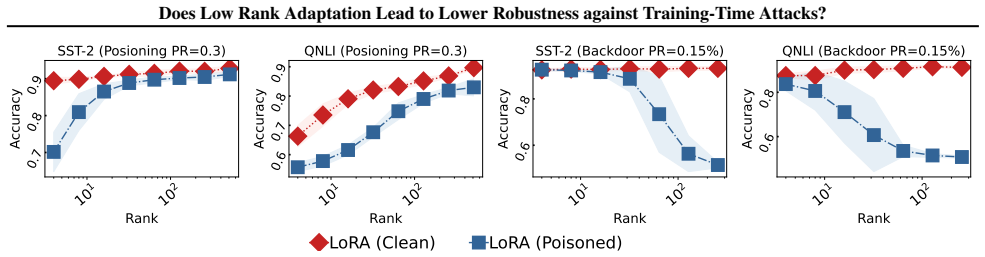
Pith's one-line read LoRA is harder to backdoor than full fine-tuning but more vulnerable to untargeted data poisoning, with the trade-off governed by its rank and initialization variance.
desk verdict The empirical headline that LoRA is more robust than full fine-tuning against backdoor attacks but less robust against untargeted poisoning is new and mostly supported by the experiments; the theoretical framework, however, overreaches and does not actually derive the double-edged-sword conclusion. read the letter →
The pith
A machine-rendered reading of the paper's core claim, the machinery that carries it, and where it could break.
The reading
What carries the argument
The load-bearing object is the kernel-matrix difference $M_\Delta^{(l)} = A^{(l)T}A^{(l)} - I$, which is shown to be negative semi-definite under the rank and variance conditions. This single comparison converts the LoRA-versus-FF question into an eigenvalue comparison: negative semi-definiteness makes LoRA's NTK, Fisher information, information bits, and R\'enyi entropy all no larger than FF's. The attack-specific conclusions are then carried by the orthogonality of gradient inner products, expressed in Eqs. (16)-(17), which is where the two attack objectives diverge.
What would settle it
On a fixed task and model, sweep LoRA rank from 4 to 512 and initialization variance scale $k$ from 0.1 to 2.0 under fixed poisoning rates; the claimed trade-off predicts that backdoor attack success rate falls as rank or variance decreases while untargeted-poisoning accuracy loss rises. A configuration where lower rank or lower variance improves both metrics, or degrades both, would contradict the proposed mechanism.
Extended reading notes
Core claim
The central claim is that, when LoRA's matrix $A$ has rank $r \leq n_{l-1}$ and initialization variance $\sigma^2 \leq 1/n_{l-1}$, the neural tangent kernel of LoRA is no larger than that of full fine-tuning, so LoRA's Fisher information, information bits, and R\'enyi entropy are all no larger than FF's. That smoother information geometry is a double-edged sword: it gives backdoor triggers a smaller search space, improving backdoor resistance, while making the model more sensitive to untargeted poisoning because poisoned and clean gradient directions align more easily on an oversimplified manifold. Experiments on BERT-large and GLUE tasks corroborate both halves of the trade-off, and rank and initialization variance are identified as the controlling factors.
Load-bearing premise
The load-bearing premise is that smoother information geometry (lower information bits and lower $H_\alpha$) is what makes LoRA more robust to backdoor triggers yet more susceptible to untargeted poisoning, a sign flip the theorems do not prove and which rests on the orthogonality heuristic of Eqs. (16)-(17).
Editorial extensions
If this is right
- LoRA-fine-tuned models should be more resistant than full fine-tuning to backdoor attacks, with the paper reporting up to roughly 30% accuracy gains on some GLUE tasks under trigger-injected attacks.
- LoRA-fine-tuned models should suffer larger accuracy drops than full fine-tuning under untargeted label-flipping poisoning, with the gap widening as the poisoning rate increases.
- Raising LoRA's rank improves robustness against untargeted poisoning but weakens backdoor resistance, so rank defines a security trade-off rather than a single monotone improvement.
- Lowering the initialization variance of the $A$ matrix improves backdoor resistance with little effect on clean performance, supporting the paper's recommendation to use small initialization variance.
- Practical guidance follows directly: set the rank as low as performance allows and keep the initialization variance small when backdoor attacks are the main threat.
Reading between the lines
- If the geometric mechanism is right, any intervention that smooths the fine-tuning manifold, such as weight decay or spectral-norm constraints, should shift the same backdoor-versus-poisoning trade-off rather than only low rank doing so.
- A cheap security audit could be derived: compute the information bits of the adapter's Fisher matrix before deployment, since low IB would flag both poisoning vulnerability and backdoor resistance in one number.
- The same NTK comparison could be extended to other parameter-efficient fine-tuning methods by writing their kernel difference as a semi-definite correction, which would test whether the trade-off is specific to LoRA or generic to constrained fine-tuning.
- The theory predicts that the trade-off should appear even without explicit attacks, simply from measuring how much label noise changes the model's predictions; this could be checked as a direct probe of the proposed mechanism.
Signed reviews
Editorial analysis
A structured set of objections, weighed in public.
Referee Report
Summary. The paper proposes an analytical framework, combining neural tangent kernels and information geometry, to compare the training-time robustness of LoRA fine-tuning with full fine-tuning against untargeted poisoning attacks (UPA) and backdoor attacks (BPA). It claims theoretically, and supports experimentally on GLUE tasks with BERT-large plus additional generative-model experiments, that LoRA is more robust than full fine-tuning against backdoor attacks but more vulnerable to untargeted poisoning, and that LoRA rank and initialization variance are the key control parameters. The stated main contribution is the theoretical framework, with the experiments presented as corroboration.
Significance. If the central claim is correct, the paper addresses a genuinely underexplored and practically important question: whether the efficiency gains of LoRA come with systematic changes in vulnerability to training-time attacks. The empirical comparison is broad for this literature: four GLUE tasks, two attack families, rank and initialization ablations, four additional backdoor variants, and a generative-language-model extension. The authors also ship source code and give concrete design guidance (low rank for backdoor defense, small initialization variance for robustness). These are real strengths. However, the significance hinges on the theoretical bridge between kernel/information-geometric ordering and attack-specific behavior, which is where the manuscript's load-bearing defects lie.
major comments (5)
- [Section 2.3, Eq. (7)] The sign of the proposed TTR metric appears reversed. Kntk(xc,x~c) is defined in Eq. (6) as the gradient inner product; a large inner product means the clean and poisoned samples induce nearly aligned gradient updates, so the parameter-update difference in Eq. (5) is small. That is high robustness, not low robustness. The text states the opposite ('a large value of Kntk ... reflects lower training-time robustness'). With the correct sign, Theorem 3.6 (K_LoRA <= K_FF under the stated conditions) would predict that LoRA has lower robustness for every perturbation type, including backdoor attacks, which contradicts the paper's central backdoor claim. The definition or the interpretive sentence must be corrected, and the direction of all subsequent conclusions re-examined.
- [Section 2.4, Eq. (9)] The definition of information bits is mathematically wrong: 1/2 log det I Theta equals 1/2 sum_i log lambda_i, not 1/2 sum_i lambda_i. As written, Eq. (9) defines half the trace, not a log-determinant. The proof of Theorem 3.6 in Appendix A.5 actually establishes an inequality for the sum of eigenvalues (trace), so the proof and the definition are inconsistent even under a charitable reading. Since IB is one of the two central quantities connecting geometry to attack robustness, this must be fixed.
- [Section 3.2, Theorem 3.4] The stated eigenvalue distribution of M_Delta^(l) = A^(l)T A^(l) - I is incorrect. Because rank(A^(l)T A^(l)) <= r, the matrix A^(l)T A^(l) has n_{l-1}-r zero eigenvalues and r positive eigenvalues; consequently A^(l)T A^(l) - I has n_{l-1}-r eigenvalues equal to -1 and r eigenvalues approximately equal to sigma_a^2 n_{l-1} - 1. The theorem's claim of 'r eigenvalues equal to sigma_a^2 n_{l-1} and n-r eigenvalues equal to 0' describes A^(l)T A^(l), not the shifted matrix. The negative-semi-definiteness conclusion survives, but the subsequent heuristic in Section 3.3 explicitly appeals to '(n_{l-1}-r) zero eigenvalues' to argue for a smaller backdoor-trigger search space; that argument is invalid because the corresponding eigenvalues of M_Delta^(l) are -1, not 0. The eigenvalue claim must be corrected and the orthogonality argument rebuilt or removed.
- [Section 3.3, Eqs. (16)-(17)] The double-edged-sword conclusion—that lower IB/H_alpha improves backdoor robustness but harms poisoning robustness—is not derived. Theorem 3.6 only establishes an ordering of Fisher information under the stated conditions; combined with the (corrected) TTR metric it predicts the same robustness direction for all perturbations. The sign flip is introduced through an informal orthogonality heuristic involving inner products between clean and poisoned gradients, with no proof that the global spectral quantities IB/H_alpha control this pairwise, attack-specific inner product in opposite directions. The paper's own caveats weaken the claim further: footnote 3 says UPA susceptibility may disappear for over-parameterized models, and Section 4.4.2 reports that initialization variance 'slightly influences the poisoning' and 'deviates from our theoretical analysis'. Since the abstract and Section 4.5 state the double-edged effect as a headline theoretical finding, this unsupported bridge is load-bearing and must be either rigorously established or explicitly downgraded to an empirically motivated conjecture.
- [Appendix A.6.1] The generalized proof beyond the OOLD assumption contains a sign error. From Delta^(2,k)' <= 0 and Delta^(l)_r <= 0, the recursion Delta^(l,k)' = Delta^(l-1,k)' * Sigma_dot^(l) + Delta^(l)_r yields a non-positive quantity, not 'Delta^(l,k)' >= 0' as written. The subsequent sentence 'Delta^(l,k)' >= 0 holds for l=1,...,L' contradicts the inductive base and reverses the conclusion of the generalization. This needs correction for the generalized version of Theorem 3.6 in Section 3.4 to be valid.
minor comments (5)
- [Section 2.4, Eqs. (9)-(10) vs Eq. (18) and Figure 3] H_alpha is defined on the eigenvalues of the Fisher information matrix, but the visualization in Eq. (18) and Figure 3 uses eigenvalues of A^(l)T A^(l) instead; no theorem connects these two spectra, so the figure's supporting role is unclear.
- [Appendix A.5, proof of Theorem 3.6] The statement 'for all lambda_LoRA and all lambda_FF, lambda_LoRA <= lambda_FF' is imprecise; the correct argument is Weyl's monotonicity for sorted eigenvalues (lambda_k(I_LoRA) <= lambda_k(I_FF) for each k), and the proof should state this explicitly.
- [Section 2.4, Theorem 2.2] The notation 'gradient_theta L^T gradient_theta L' treats the Fisher information as a scalar; for a parameter vector it should be the outer product or the quadratic form in Eq. (8). The intended meaning is clear from context, but the notation should be made consistent.
- [Section 4.1 and Figure 1/2] The learning rates differ between LoRA (3e-5) and FF (3e-6). Because attack resistance can be sensitive to step size, this hyperparameter difference should be justified or ablated; otherwise the UPA/BPA comparisons may partly reflect optimization dynamics rather than the low-rank structure.
- [Section 3 title and several figure captions] The Section 3 title contains a repeated word ('Does LoRA Lead to LoRA'), and several appendix figures (e.g., Figure 11, 12) omit dataset names or axis labels in some panels. These should be cleaned up.
Circularity Check
No significant circularity: the NTK comparison is a self-contained algebraic derivation, and the attack-specific conclusions are unsupported inferences rather than inputs recycled as predictions.
full rationale
The paper's formal core is not circular. The derivation in Section 3 establishes K_LoRA = K_ff + Delta_r with Delta_r negative semi-definite under stated conditions (Theorem 3.4), and Theorem 3.6 derives IB_LoRA <= IB_FF and H_alpha_LoRA <= H_alpha_FF from that algebraic fact. This is a genuine mathematical comparison of kernel matrices, not a parameter fitted to the attack results. The LoRA conditions (r <= n_{l-1}, sigma^2 <= 1/n_{l-1}) are taken from standard LoRA settings and not calibrated to the experimental outcomes. The experiments are run on external GLUE benchmarks with held-out attack configurations, so there is no sense in which the empirical UPA/BPA comparison is forced by the theory. The suspected circularity in the 'double-edged sword' narrative does not reduce to a definitional identity: the paper asserts, but does not prove, that lower IB/H_alpha implies stronger backdoor resistance and weaker poisoning resistance. That is an unproven interpretive bridge, and arguably a correctness gap, but it is not circularity because the conclusion is not equivalent to the theorem's input by construction. The self-citations (e.g., Liang et al. 2025, Zhang et al. 2025, Wang et al. 2024b) appear only as related-work or background context and are not load-bearing for the NTK derivation. The paper's own caveats, including footnote 3 and the Section 4.4.2 admission that initialization variance has minimal effect on poisoning, weaken the empirical support for the theory but do not constitute circular reasoning. Overall, the derivation chain is self-contained; no load-bearing step reduces to its own inputs.
Assumptions & free parameters
free parameters (3)
- Learning rate per method =
LoRA: 3e-5; FF: 3e-6
- LoRA rank r (default) =
8
- Initialization variance scale k =
1/3 default; varied 0.001 to 2.0
assumptions (5)
- domain assumption Infinite-width NTK convergence and constancy during training (Theorem 2.1)
- domain assumption LoRA fine-tuning operates in the NTK regime
- ad hoc to paper Training-time robustness can be measured by the NTK inner product M' (Eq. 7)
- ad hoc to paper Lower IB/H_alpha implies higher backdoor robustness but lower poisoning robustness
- domain assumption At initialization B=0, the LoRA NTK is determined by A^T A and the frozen branch vanishes
invented entities (2)
-
Information bits (IB) as 1/2 log det of the Fisher matrix
-
Training-time robustness (TTR) and metric M'
Cite this review
Pith. "Pith review of Does Low Rank Adaptation Lead to Lower Robustness against Training-Time Attacks?." pith.science (2026). https://pith.science/paper/BBCBBYH3
@misc{pith2026250512871,
  author       = {Pith},
  title        = {Pith review of: Does Low Rank Adaptation Lead to Lower Robustness against Training-Time Attacks?},
  year         = {2026},
  howpublished = {\url{https://pith.science/paper/BBCBBYH3}},
  note         = {Machine review of arXiv:2505.12871}
}
read the original abstract
Low rank adaptation (LoRA) has emerged as a prominent technique for fine-tuning large language models (LLMs) thanks to its superb efficiency gains over previous methods. While extensive studies have examined the performance and structural properties of LoRA, its behavior upon training-time attacks remain underexplored, posing significant security risks. In this paper, we theoretically investigate the security implications of LoRA's low-rank structure during fine-tuning, in the context of its robustness against data poisoning and backdoor attacks. We propose an analytical framework that models LoRA's training dynamics, employs the neural tangent kernel to simplify the analysis of the training process, and applies information theory to establish connections between LoRA's low rank structure and its vulnerability against training-time attacks. Our analysis indicates that LoRA exhibits better robustness to backdoor attacks than full fine-tuning, while becomes more vulnerable to untargeted data poisoning due to its over-simplified information geometry. Extensive experimental evaluations have corroborated our theoretical findings.
Figures


Figures from the paper (9 more)


Reference graph
Works this paper leans on
-
[1]
write newline
" write newline "" before.all 'output.state := FUNCTION n.dashify 't := "" t empty not t #1 #1 substring "-" = t #1 #2 substring "--" = not "--" * t #2 global.max substring 't := t #1 #1 substring "-" = "-" * t #2 global.max substring 't := while if t #1 #1 substring * t #2 global.max substring 't := if while FUNCTION format.date year duplicate empty "emp...
-
[2]
Intrinsic dimensionality explains the effectiveness of language model fine-tuning
Aghajanyan, A., Gupta, S., and Zettlemoyer, L. Intrinsic dimensionality explains the effectiveness of language model fine-tuning. In Zong, C., Xia, F., Li, W., and Navigli, R. (eds.), Proceedings of the 59th Annual Meeting of the Association for Computational Linguistics and the 11th International Joint Conference on Natural Language Processing, ACL/IJCNL...
2021
-
[3]
Information geometry and its applications, volume 194
Amari, S.-i. Information geometry and its applications, volume 194. Springer, 2016
2016
-
[4]
S., Hu, W., Li, Z., Salakhutdinov, R., and Wang, R
Arora, S., Du, S. S., Hu, W., Li, Z., Salakhutdinov, R., and Wang, R. On exact computation with an infinitely wide neural net, 2019. URL https://arxiv.org/abs/1904.11955
arXiv 2019
-
[5]
Burns, C., Izmailov, P., Kirchner, J. H., Baker, B., Gao, L., Aschenbrenner, L., Chen, Y., Ecoffet, A., Joglekar, M., Leike, J., Sutskever, I., and Wu, J. Weak-to-strong generalization: Eliciting strong capabilities with weak supervision, 2023. URL https://arxiv.org/abs/2312.09390
arXiv 2023
-
[6]
C., Roxo, T., Proença, H., and Inácio, P
Costa, J. C., Roxo, T., Proença, H., and Inácio, P. R. M. How deep learning sees the world: A survey on adversarial attacks and defenses. IEEE Access, 12: 0 61113–61136, 2024. ISSN 2169-3536. doi:10.1109/access.2024.3395118. URL http://dx.doi.org/10.1109/ACCESS.2024.3395118
arXiv 2024
-
[7]
BERT : Pre-training of deep bidirectional transformers for language understanding
Devlin, J., Chang, M.-W., Lee, K., and Toutanova, K. BERT : Pre-training of deep bidirectional transformers for language understanding. In Burstein, J., Doran, C., and Solorio, T. (eds.), Proceedings of the 2019 Conference of the North A merican Chapter of the Association for Computational Linguistics: Human Language Technologies, Volume 1 (Long and Short...
-
[8]
Dolan, W. B. and Brockett, C. Automatically constructing a corpus of sentential paraphrases. In IWP 2005, 2005. URL https://aclanthology.org/I05-5002
work page 2005
Show all 58 references
-
[9]
A survey on data poisoning attacks and defenses
Fan, J., Yan, Q., Li, M., Qu, G., and Xiao, Y. A survey on data poisoning attacks and defenses. In 2022 7th IEEE International Conference on Data Science in Cyberspace (DSC), pp.\ 48--55, 2022. doi:10.1109/DSC55868.2022.00014
2022
-
[10]
Fisher, R. A. On the mathematical foundations of theoretical statistics. Philosophical transactions of the Royal Society of London. Series A, containing papers of a mathematical or physical character, 222 0 (594-604): 0 309--368, 1922
1922
-
[11]
Badnets: Identifying vulnerabilities in the machine learning model supply chain
Gu, T., Dolan - Gavitt, B., and Garg, S. Badnets: Identifying vulnerabilities in the machine learning model supply chain. CoRR, abs/1708.06733, 2017. URL http://arxiv.org/abs/1708.06733
2017 arXiv
-
[12]
Gunter, T., Wang, Z., Wang, C., Pang, R., Narayanan, A., Zhang, A., Zhang, B., Chen, C., Chiu, C., Qiu, D., Gopinath, D., Yap, D. A., Yin, D., Nan, F., Weers, F., Yin, G., Huang, H., Wang, J., Lu, J., Peebles, J., Ye, K., Lee, M., Du, N., Chen, Q., Keunebroek, Q., Wiseman, S.,...
2024 doi
-
[13]
Han, Z., Gao, C., Liu, J., Zhang, J., and Zhang, S. Q. Parameter-efficient fine-tuning for large models: A comprehensive survey. arXiv preprint arXiv:2403.14608, 2024
2024 arXiv
-
[14]
The impact of initialization on lora finetuning dynamics, 2024
Hayou, S., Ghosh, N., and Yu, B. The impact of initialization on lora finetuning dynamics, 2024. URL https://arxiv.org/abs/2406.08447
2024 arXiv
-
[15]
Delving deep into rectifiers: Surpassing human-level performance on imagenet classification, 2015
He, K., Zhang, X., Ren, S., and Sun, J. Delving deep into rectifiers: Surpassing human-level performance on imagenet classification, 2015. URL https://arxiv.org/abs/1502.01852
2015 arXiv
-
[16]
Data poisoning attacks to local differential privacy protocols for graphs, 2024
He, X., Huang, K., Ye, Q., and Hu, H. Data poisoning attacks to local differential privacy protocols for graphs, 2024. URL https://arxiv.org/abs/2412.19837
2024 arXiv
-
[17]
Recovering the pre-fine-tuning weights of generative models
Horwitz, E., Kahana, J., and Hoshen, Y. Recovering the pre-fine-tuning weights of generative models. In Forty-first International Conference on Machine Learning, ICML 2024, Vienna, Austria, July 21-27, 2024 . OpenReview.net, 2024. URL https://openreview.net/forum?id=761UxjOTHB
2024
-
[18]
J., Shen, Y., Wallis, P., Allen-Zhu, Z., Li, Y., Wang, S., Wang, L., and Chen, W
Hu, E. J., Shen, Y., Wallis, P., Allen-Zhu, Z., Li, Y., Wang, S., Wang, L., and Chen, W. Lora: Low-rank adaptation of large language models. arXiv preprint arXiv:2106.09685, 2021
2021 arXiv
-
[19]
M., Maxwell, T., Cheng, N., Jermyn, A
Hubinger, E., Denison, C., Mu, J., Lambert, M., Tong, M., MacDiarmid, M., Lanham, T., Ziegler, D. M., Maxwell, T., Cheng, N., Jermyn, A. S., Askell, A., Radhakrishnan, A., Anil, C., Duvenaud, D., Ganguli, D., Barez, F., Clark, J., Ndousse, K., Sachan, K., Sellitto, M., Sharma,...
-
[20]
Neural tangent kernel: convergence and generalization in neural networks (invited paper)
Jacot, A., Gabriel, F., and Hongler, C. Neural tangent kernel: convergence and generalization in neural networks (invited paper). In Khuller, S. and Williams, V. V. (eds.), STOC '21: 53rd Annual ACM SIGACT Symposium on Theory of Computing, Virtual Event, Italy, June 21-25, 202...
2021
-
[21]
D., and Ryu, E
Jang, U., Lee, J. D., and Ryu, E. K. Lora training in the NTK regime has no spurious local minima. In Forty-first International Conference on Machine Learning, ICML 2024, Vienna, Austria, July 21-27, 2024 . OpenReview.net, 2024. URL https://openreview.net/forum?id=s1sdx6vNsU
2024
-
[22]
Advlora: Adversarial low-rank adaptation of vision-language models
Ji, Y., Liu, Y., Zhang, Z., Zhang, Z., Zhao, Y., Zhou, G., Zhang, X., Liu, X., and Zheng, X. Advlora: Adversarial low-rank adaptation of vision-language models. CoRR, abs/2404.13425, 2024. doi:10.48550/ARXIV.2404.13425. URL https://doi.org/10.48550/arXiv.2404.13425
- [23]
-
[24]
Kumar, S. K. On weight initialization in deep neural networks. CoRR, abs/1704.08863, 2017. URL http://arxiv.org/abs/1704.08863
2017 arXiv
-
[25]
S., Pennington, J., and Sohl - Dickstein, J
Lee, J., Bahri, Y., Novak, R., Schoenholz, S. S., Pennington, J., and Sohl - Dickstein, J. Deep neural networks as gaussian processes. In 6th International Conference on Learning Representations, ICLR 2018, Vancouver, BC, Canada, April 30 - May 3, 2018, Conference Track Procee...
2018
-
[26]
Backdoorllm: A comprehensive benchmark for backdoor attacks on large language models
Li, Y., Huang, H., Zhao, Y., Ma, X., and Sun, J. Backdoorllm: A comprehensive benchmark for backdoor attacks on large language models. CoRR, abs/2408.12798, 2024. doi:10.48550/ARXIV.2408.12798. URL https://doi.org/10.48550/arXiv.2408.12798
-
[27]
yes, my lord
Liang, Z., Ye, Q., Wang, Y., Zhang, S., Xiao, Y., Li, R., Xu, J., and Hu, H. "yes, my lord." guiding language model extraction with locality reinforced distillation, 2025. URL https://arxiv.org/abs/2409.02718
2025 arXiv
-
[28]
Lora-as-an-attack! piercing llm safety under the share-and-play scenario, 2024
Liu, H., Liu, Z., Tang, R., Yuan, J., Zhong, S., Chuang, Y.-N., Li, L., Chen, R., and Hu, X. Lora-as-an-attack! piercing llm safety under the share-and-play scenario, 2024. URL https://arxiv.org/abs/2403.00108
2024 arXiv
-
[29]
A kernel-based view of language model fine-tuning
Malladi, S., Wettig, A., Yu, D., Chen, D., and Arora, S. A kernel-based view of language model fine-tuning. In Krause, A., Brunskill, E., Cho, K., Engelhardt, B., Sabato, S., and Scarlett, J. (eds.), International Conference on Machine Learning, ICML 2023, 23-29 July 2023, Hon...
2023
-
[30]
Peft: State-of-the-art parameter-efficient fine-tuning methods
Mangrulkar, S., Gugger, S., Debut, L., Belkada, Y., Paul, S., and Bossan, B. Peft: State-of-the-art parameter-efficient fine-tuning methods. https://github.com/huggingface/peft, 2022
2022
- [31]
-
[32]
An information geometric perspective to adversarial attacks and defenses
Naddeo, K., Bouaynaya, N., and Shterenberg, R. An information geometric perspective to adversarial attacks and defenses. In 2022 International Joint Conference on Neural Networks (IJCNN), pp.\ 1--8, 2022. doi:10.1109/IJCNN55064.2022.9892170
2022
-
[33]
An elementary introduction to information geometry
Nielsen, F. An elementary introduction to information geometry. Entropy, 22 0 (10): 0 1100, 2020
2020
-
[34]
Hidden trigger backdoor attack on NLP models via linguistic style manipulation
Pan, X., Zhang, M., Sheng, B., Zhu, J., and Yang, M. Hidden trigger backdoor attack on NLP models via linguistic style manipulation. In Butler, K. R. B. and Thomas, K. (eds.), 31st USENIX Security Symposium, USENIX Security 2022, Boston, MA, USA, August 10-12, 2022 , pp.\ 3611...
2022
-
[35]
A survey on recognizing textual entailment as an NLP evaluation
Poliak, A. A survey on recognizing textual entailment as an NLP evaluation. In Eger, S., Gao, Y., Peyrard, M., Zhao, W., and Hovy, E. (eds.), Proceedings of the First Workshop on Evaluation and Comparison of NLP Systems, pp.\ 92--109, Online, November 2020. Association for Com...
2020 doi
-
[36]
Geoda: A geometric framework for black-box adversarial attacks
Rahmati, A., Moosavi-Dezfooli, S.-M., Frossard, P., and Dai, H. Geoda: A geometric framework for black-box adversarial attacks. In Proceedings of the IEEE/CVF Conference on Computer Vision and Pattern Recognition (CVPR), June 2020
2020
-
[37]
A., Kim, S.-K., Hamadi, H
Ramirez, M. A., Kim, S.-K., Hamadi, H. A., Damiani, E., Byon, Y.-J., Kim, T.-Y., Cho, C.-S., and Yeun, C. Y. Poisoning attacks and defenses on artificial intelligence: A survey, 2022. URL https://arxiv.org/abs/2202.10276
2022 arXiv
-
[38]
On measures of entropy and information
R \'e nyi, A. On measures of entropy and information. In Proceedings of the fourth Berkeley symposium on mathematical statistics and probability, volume 1: contributions to the theory of statistics, volume 4, pp.\ 547--562. University of California Press, 1961
1961
-
[39]
Natural language understanding with the quora question pairs dataset
Sharma, L., Graesser, L., Nangia, N., and Evci, U. Natural language understanding with the quora question pairs dataset. CoRR, abs/1907.01041, 2019. URL http://arxiv.org/abs/1907.01041
1907 arXiv
-
[40]
D., Ng, A., and Potts, C
Socher, R., Perelygin, A., Wu, J., Chuang, J., Manning, C. D., Ng, A., and Potts, C. Recursive deep models for semantic compositionality over a sentiment treebank. In EMNLP, pp.\ 1631--1642, Seattle, Washington, USA, October 2013. URL https://www.aclweb.org/anthology/D13-1170
2013
-
[41]
Taori, R., Gulrajani, I., Zhang, T., Dubois, Y., Li, X., Guestrin, C., Liang, P., and Hashimoto, T. B. Stanford alpaca: An instruction-following llama model. https://github.com/tatsu-lab/stanford_alpaca, 2023
2023
-
[42]
Attention is all you need
Vaswani, A. Attention is all you need. Advances in Neural Information Processing Systems, 2017
2017
-
[43]
Poisoning language models during instruction tuning
Wan, A., Wallace, E., Shen, S., and Klein, D. Poisoning language models during instruction tuning. In Proceedings of the 40th International Conference on Machine Learning, ICML'23. JMLR.org, 2023
2023
-
[44]
GLUE : A multi-task benchmark and analysis platform for natural language understanding
Wang, A., Singh, A., Michael, J., Hill, F., Levy, O., and Bowman, S. GLUE : A multi-task benchmark and analysis platform for natural language understanding. In Linzen, T., Chrupa a, G., and Alishahi, A. (eds.), Proceedings of the 2018 EMNLP Workshop B lackbox NLP : Analyzing a...
2018 doi
-
[45]
Lora meets dropout under a unified framework
Wang, S., Chen, L., Jiang, J., Xue, B., Kong, L., and Wu, C. Lora meets dropout under a unified framework. In Ku, L., Martins, A., and Srikumar, V. (eds.), Findings of the Association for Computational Linguistics, ACL 2024, Bangkok, Thailand and virtual meeting, August 11-16,...
2024
-
[46]
New paradigm of adversarial training: Breaking inherent trade-off between accuracy and robustness via dummy classes, 2024 b
Wang, Y., Liu, L., Liang, Z., Ye, Q., and Hu, H. New paradigm of adversarial training: Breaking inherent trade-off between accuracy and robustness via dummy classes, 2024 b . URL https://arxiv.org/abs/2410.12671
2024 arXiv
-
[47]
Warstadt, A., Singh, A., and Bowman, S. R. Neural network acceptability judgments. arXiv preprint arXiv:1805.12471, 2018
2018 arXiv
-
[48]
Xu, H., Ma, Y., Liu, H., Deb, D., Liu, H., Tang, J., and Jain, A. K. Adversarial attacks and defenses in images, graphs and text: A review, 2019. URL https://arxiv.org/abs/1909.08072
2019 arXiv
-
[49]
D., Wang, F., Xiao, C., and Chen, M
Xu, J., Ma, M. D., Wang, F., Xiao, C., and Chen, M. Instructions as backdoors: Backdoor vulnerabilities of instruction tuning for large language models. In Duh, K., G \' o mez - Adorno, H., and Bethard, S. (eds.), Proceedings of the 2024 Conference of the North American Chapte...
2024
-
[50]
Dp-dylora: Fine-tuning transformer-based models on-device under differentially private federated learning using dynamic low-rank adaptation
Xu, J., Saravanan, K., van Dalen, R., Mehmood, H., Tuckey, D., and Ozay, M. Dp-dylora: Fine-tuning transformer-based models on-device under differentially private federated learning using dynamic low-rank adaptation. arXiv preprint arXiv:2405.06368, 2024 b
2024 arXiv
-
[51]
J., Tao, X., and Wang, F
Xu, L., Xie, H., Qin, S.-Z. J., Tao, X., and Wang, F. L. Parameter-efficient fine-tuning methods for pretrained language models: A critical review and assessment, 2023. URL https://arxiv.org/abs/2312.12148
2023 arXiv
-
[52]
Backdooring instruction-tuned large language models with virtual prompt injection
Yan, J., Yadav, V., Li, S., Chen, L., Tang, Z., Wang, H., Srinivasan, V., Ren, X., and Jin, H. Backdooring instruction-tuned large language models with virtual prompt injection. In Duh, K., G \' o mez - Adorno, H., and Bethard, S. (eds.), Proceedings of the 2024 Conference of ...
2024
-
[53]
Rethinking stealthiness of backdoor attack against NLP models
Yang, W., Lin, Y., Li, P., Zhou, J., and Sun, X. Rethinking stealthiness of backdoor attack against NLP models. In Zong, C., Xia, F., Li, W., and Navigli, R. (eds.), Proceedings of the 59th Annual Meeting of the Association for Computational Linguistics and the 11th Internatio...
2021 doi
-
[54]
Lobam: Lora-based backdoor attack on model merging, 2024
Yin, M., Zhang, J., Sun, J., Fang, M., Li, H., and Chen, Y. Lobam: Lora-based backdoor attack on model merging, 2024. URL https://arxiv.org/abs/2411.16746
2024 arXiv
-
[55]
and Lee, K
Zeng, Y. and Lee, K. The expressive power of low-rank adaptation. In The Twelfth International Conference on Learning Representations, ICLR 2024, Vienna, Austria, May 7-11, 2024 . OpenReview.net, 2024. URL https://openreview.net/forum?id=likXVjmh3E
2024
-
[56]
Mer-inspector: Assessing model extraction risks from an attack-agnostic perspective
Zhang, X., Hu, H., Ye, Q., Bai, L., and Zheng, H. Mer-inspector: Assessing model extraction risks from an attack-agnostic perspective. In Proceedings of the ACM on Web Conference 2025, WWW '25, pp.\ 4300–4315, New York, NY, USA, 2025. Association for Computing Machinery. ISBN ...
2025
-
[57]
T., Yu, M., Peng, Y., Zhang, G., and Shen, C
Zhao, C., Fletcher, P. T., Yu, M., Peng, Y., Zhang, G., and Shen, C. The adversarial attack and detection under the fisher information metric. Proceedings of the AAAI Conference on Artificial Intelligence, 33 0 (01): 0 5869--5876, Jul. 2019. doi:10.1609/aaai.v33i01.33015869. U...
2019 doi
-
[58]
H., Nadjahi, K., de Oc \' a riz Borde, H
Zhu, J., Greenewald, K. H., Nadjahi, K., de Oc \' a riz Borde, H. S., Gabrielsson, R. B., Choshen, L., Ghassemi, M., Yurochkin, M., and Solomon, J. Asymmetry in low-rank adapters of foundation models. In Forty-first International Conference on Machine Learning, ICML 2024, Vien...
2024
Reviewed August 15, 2026 · model on record in the stance chip above.
Discussion (0). Continue with ORCID to comment.