Quantum Systems with jump-discontinuous mass. I
Pith reviewed 2026-05-22 01:37 UTC · model grok-4.3
The pith
A quantum particle with jump-discontinuous mass supports infinitely many distinct semiclassical limits, each labeled by a point on a spectral curve in the two-torus.
A machine-rendered reading of the paper's core claim, the machinery that carries it, and where it could break.
Core claim
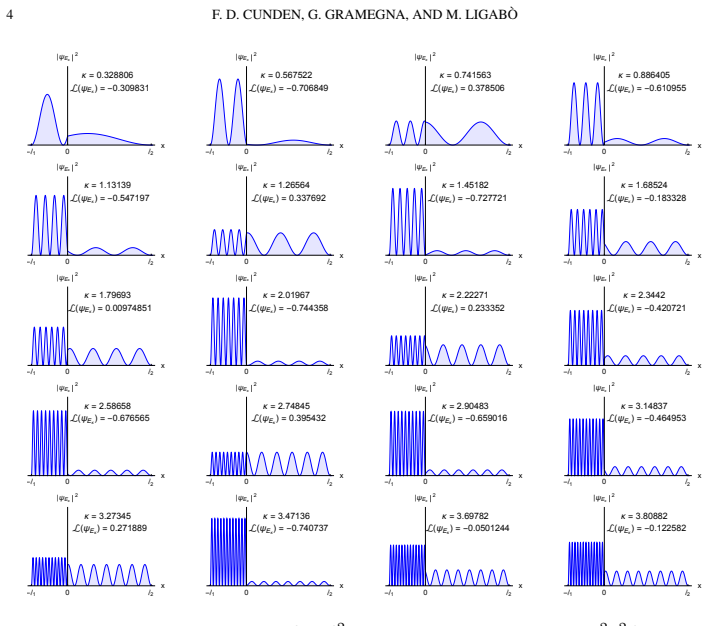
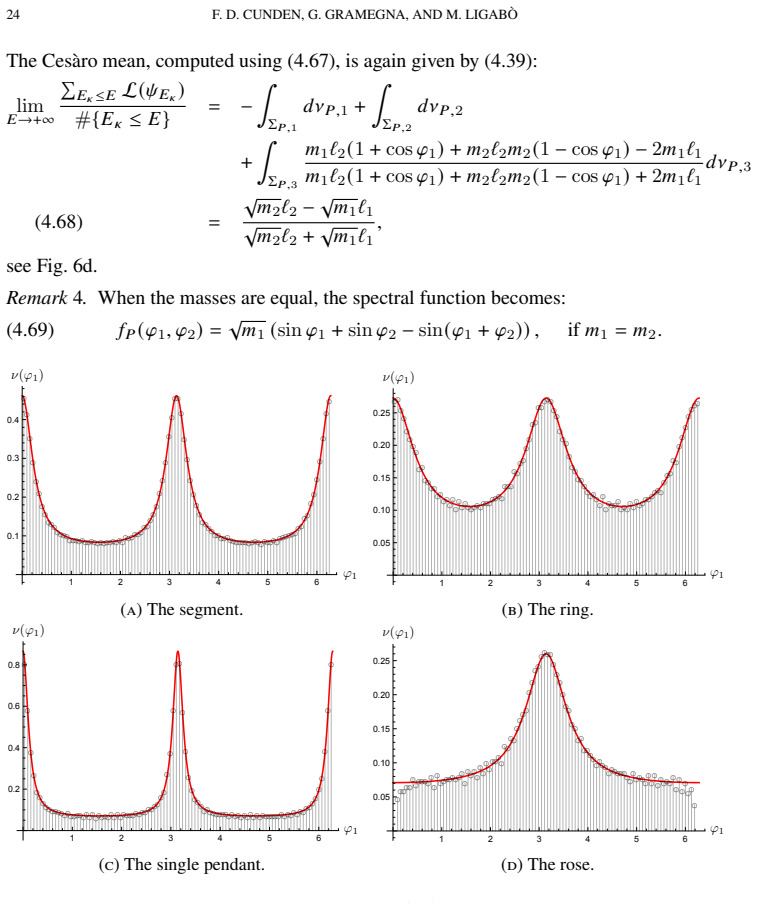
For the kinetic-energy operator on the line with jump-discontinuous mass and scale-free boundary conditions at the jumps, the associated spectral problem yields eigenfunctions whose energy dependence is highly sensitive and erratic. Consequently the system admits infinitely many distinct semiclassical limits, each labeled by a point on a spectral curve embedded in the two-torus.
What carries the argument
The spectral curve embedded in the two-torus that parametrizes the distinct semiclassical limits arising from the erratic energy dependence of the eigenfunctions.
If this is right
- The spectrum and eigenfunctions cannot be captured by a single semiclassical approximation.
- Spectral asymptotics must be described by a curve-worth of limiting regimes rather than one.
- The interplay between discontinuous mass and boundary data controls the structure of high-energy states.
- Self-adjoint extensions are selected by the scale-free conditions to produce the observed erratic behavior.
Where Pith is reading between the lines
- Similar multiple-limit phenomena may occur in other one-dimensional Schrödinger operators whose coefficients change abruptly.
- Phase-space analysis on the two-torus could become a standard tool for asymptotics of variable-mass or piecewise-constant-coefficient systems.
- Engineered mass profiles in ultracold-atom or semiconductor experiments might exhibit signatures of these distinct semiclassical regimes.
- The construction suggests a general mechanism by which boundary data at discontinuities can enrich the semiclassical picture beyond the usual single-limit case.
Load-bearing premise
The boundary conditions at each mass discontinuity are taken from a specific scale-free family that fixes a unique self-adjoint realization of the kinetic-energy operator.
What would settle it
An explicit computation or numerical diagonalization that yields only a single or finitely many semiclassical limits for the chosen scale-free boundary conditions would disprove the claim of infinitely many limits.
Figures





read the original abstract
We consider a free quantum particle in one dimension whose mass profile exhibits jump discontinuities. The corresponding Hamiltonian is a self-adjoint realisation of the kinetic-energy operator, with the specific realisation determined by the boundary conditions at the points of mass discontinuity. For a family of scale-free boundary conditions, we analyse the associated spectral problem. We find that the eigenfunctions exhibit a highly sensitive and erratic dependence on the energy. Notably, the system supports infinitely many distinct semiclassical limits, each labeled by a point on a spectral curve embedded in the two-torus. These results demonstrate a rich interplay between discontinuous coefficients, boundary data, and spectral asymptotics.
Editorial analysis
A structured set of objections, weighed in public.
Referee Report
Summary. The manuscript studies a one-dimensional free quantum particle whose mass profile has jump discontinuities. The Hamiltonian is realized as a self-adjoint extension of the kinetic-energy operator, with the extension fixed by a family of scale-free boundary conditions imposed at each discontinuity. The central claim is that the associated spectral problem yields eigenfunctions with highly sensitive, erratic energy dependence, and that the system admits infinitely many distinct semiclassical limits, each parametrized by a point on a spectral curve embedded in the two-torus.
Significance. If the construction is correct, the result exhibits a concrete mechanism by which discontinuous coefficients together with scale-free boundary data can generate a positive-dimensional family of distinct high-energy asymptotics. This provides a mathematically explicit example of multiplicity in semiclassical limits that is not reducible to a single effective potential or a finite set of phases, and may serve as a benchmark for spectral theory of operators with singular or piecewise-constant coefficients.
major comments (2)
- [Abstract / Hamiltonian definition] Abstract and the paragraph defining the Hamiltonian: the claim that the chosen scale-free boundary conditions produce a well-defined spectral curve in T² with the property that distinct points generate genuinely different semiclassical limits is load-bearing. The manuscript must show explicitly that the matching conditions at each mass jump remain energy-independent in the E→∞ regime and that the resulting transfer matrix yields an embedded curve whose points correspond to distinct limiting distributions of eigenfunctions or eigenvalue spacings; otherwise the asserted infinitude of distinct limits collapses.
- [Spectral curve construction] The section constructing the spectral curve: it is not yet clear whether the high-energy phase accumulation across jumps is controlled uniformly for all points on the putative curve. If the erratic energy dependence noted in the abstract arises from rapid oscillations that average out differently for different boundary parameters, the limiting set may be a single point or a lower-dimensional subset rather than a curve of positive dimension; a concrete test (e.g., explicit computation of the limiting WKB phase or numerical sampling of high eigenvalues for two distinct curve points) is required.
minor comments (1)
- The abstract would benefit from a one-sentence statement of the explicit form of the mass profile (e.g., number and locations of jumps) to orient the reader before the spectral claims.
Simulated Author's Rebuttal
We thank the referee for the thorough reading and the constructive major comments, which help clarify the presentation of our results on the spectral curve and its implications for distinct semiclassical limits. We address each point in turn and indicate the revisions planned for the next version of the manuscript.
read point-by-point responses
-
Referee: [Abstract / Hamiltonian definition] Abstract and the paragraph defining the Hamiltonian: the claim that the chosen scale-free boundary conditions produce a well-defined spectral curve in T² with the property that distinct points generate genuinely different semiclassical limits is load-bearing. The manuscript must show explicitly that the matching conditions at each mass jump remain energy-independent in the E→∞ regime and that the resulting transfer matrix yields an embedded curve whose points correspond to distinct limiting distributions of eigenfunctions or eigenvalue spacings; otherwise the asserted infinitude of distinct limits collapses.
Authors: The scale-free boundary conditions are introduced in Section 2 and are formulated without any dependence on the spectral parameter E; they involve only the values and derivatives of the wave function at the discontinuity points, scaled by the local mass values. The transfer matrix across each jump is therefore energy-independent by construction. In Section 3 we compose these matrices with the free propagation phases on each interval and extract the high-energy asymptotics, showing that the limiting phase map on the two-torus is parametrized by the boundary data. Distinct points on the resulting spectral curve produce distinct limiting rotation numbers and hence distinct distributions of eigenfunction oscillations. To make the argument fully explicit we will add a short subsection that writes the limiting transfer matrix in closed form and verifies that the associated invariant measures differ for generic pairs of curve points. revision: yes
-
Referee: [Spectral curve construction] The section constructing the spectral curve: it is not yet clear whether the high-energy phase accumulation across jumps is controlled uniformly for all points on the putative curve. If the erratic energy dependence noted in the abstract arises from rapid oscillations that average out differently for different boundary parameters, the limiting set may be a single point or a lower-dimensional subset rather than a curve of positive dimension; a concrete test (e.g., explicit computation of the limiting WKB phase or numerical sampling of high eigenvalues for two distinct curve points) is required.
Authors: We agree that uniform control of the phase accumulation must be stated more clearly. The total semiclassical phase is the sum of the free WKB integrals on each mass interval plus the fixed phase shifts from the scale-free conditions; because the mass is piecewise constant the integrals are linear in sqrt(E) and the boundary phases remain bounded independently of E. Consequently the limiting map is a continuous function of the boundary parameters and traces a curve of positive dimension in the torus for the family we consider. To supply the requested concrete test we will include, in the revised manuscript, an explicit evaluation of the limiting WKB phase for two representative points on the curve together with a brief numerical check of the high-energy eigenvalue spacings for those same parameters. revision: yes
Circularity Check
No circularity: spectral analysis proceeds from chosen boundary conditions without self-referential reduction
full rationale
The paper defines the Hamiltonian via a specific family of scale-free boundary conditions at mass discontinuities, then directly analyzes the resulting spectral problem to derive the erratic energy dependence of eigenfunctions and the existence of an embedded spectral curve in the two-torus parametrizing distinct semiclassical limits. This is a standard forward derivation from the operator domain and matching conditions; no step equates a derived quantity (such as the curve or the limits) to a fitted parameter or prior self-citation by construction. The abstract and reader's summary confirm the central claim rests on explicit analysis of the chosen self-adjoint realization rather than any load-bearing loop.
Axiom & Free-Parameter Ledger
axioms (1)
- domain assumption The kinetic-energy operator admits self-adjoint realizations determined by boundary conditions at mass discontinuities.
Lean theorems connected to this paper
-
IndisputableMonolith/Foundation/AlexanderDuality.leanalexander_duality_circle_linking unclear?
unclearRelation between the paper passage and the cited Recognition theorem.
the system supports infinitely many distinct semiclassical limits, each labeled by a point on a spectral curve embedded in the two-torus
-
IndisputableMonolith/Cost/FunctionalEquation.leanwashburn_uniqueness_aczel unclear?
unclearRelation between the paper passage and the cited Recognition theorem.
scale-free boundary conditions... U = I−2P... spectral function S_{I−2P}(κ) = κ^r f_P(ω1 κ, ω2 κ) g_P(κ)
What do these tags mean?
- matches
- The paper's claim is directly supported by a theorem in the formal canon.
- supports
- The theorem supports part of the paper's argument, but the paper may add assumptions or extra steps.
- extends
- The paper goes beyond the formal theorem; the theorem is a base layer rather than the whole result.
- uses
- The paper appears to rely on the theorem as machinery.
- contradicts
- The paper's claim conflicts with a theorem or certificate in the canon.
- unclear
- Pith found a possible connection, but the passage is too broad, indirect, or ambiguous to say the theorem truly supports the claim.
Reference graph
Works this paper leans on
-
[1]
N. Anantharaman,Quantum Ergodicity and Delocalization of Schr ¨odinger Eigenfunctions, Zurich Lectures in Advanced Mathematics, EMS Press, 2022
work page 2022
-
[2]
G. Angelone, P. Facchi, M. Ligab `o,Classical echoes of quantum boundary conditionJournal of Physics A: Mathematical and Theoretical57, 425304 (2024)
work page 2024
-
[3]
F. Ares, J. G. Esteve, F. Falceto, A. Us ´on,Complex behavior of the density in composite quantum systems, Phys. Rev. B102, 165121 (2020)
work page 2020
-
[4]
V. I. Arnold,Mathematical Methods of Classical Mechanics, Graduate Texts in Mathematics, Springer New York, NY, 1989
work page 1989
- [5]
- [6]
- [7]
- [8]
- [9]
-
[10]
D. J. BenDaniel and C. B. Duke,Space-Charge Effects on Electron Tunneling, Phys. Rev.152, 683-692 (1966)
work page 1966
-
[11]
G. Berkolaiko, J. P. Keating, B. Winn,Intermediate Wave Function Statistics, Phys. Rev. Lett.91, 134103 (2003)
work page 2003
-
[12]
G. Berkolaiko, J. P. Keating, B. Winn,No Quantum Ergodicity for Star Graphs, Commun. Math. Phys.250, 259-285 (2004). QUANTUM SYSTEMS WITH JUMP-DISCONTINOUS MASS. I 31
work page 2004
-
[13]
G. Berkolaiko and P. Kuchment,Introduction to Quantum Graphs, American Mathematical Society, 2013
work page 2013
-
[14]
R. Bl¨ umel, P. M. Koch, L. Sirko,Ray-Splitting Billiards, Foundations of Physics31(2), 269-281 (2001)
work page 2001
-
[15]
R. Bl¨ umel, Y. Dabaghian, R. V. JensenExact, convergent periodic-orbit expansions of individual energy eigenvalues of regular quantum graphs, Phys. Rev. E65, 046222 (2002)
work page 2002
- [16]
-
[17]
J. Br¨ uning, V. Geyler, K. Pankrashkin,Spectra of self-adjoint extensions and applications to solvable Schr¨odinger operators, Reviews in Mathematical Physics20.01, 1-70 (2008)
work page 2008
-
[18]
F. D. Cunden, F. Mezzadri, N. O’Connell,Free fermions and the classical compact groups, J. Stat. Phys. 171, 768-801 (2018)
work page 2018
-
[19]
F. D. Cunden, M. Ligab `o, M. C. Susca,Truncated quantum observables and their semiclassical limit, J. Four. Anal. Appl.31, 46 (2025)
work page 2025
-
[20]
F. D. Cunden, G. Gramegna, M. Ligab`o,Quantum Systems with jump-discontinuous mass. II, in preparation
- [21]
- [22]
-
[23]
G. B. Folland,Harmonic analysis in phase space.Princeton university press, 2016
work page 2016
-
[24]
D. Jakobson, Y. Safarov, A. Strohmaier, Y. Colin de Verdi `ere,The semiclassical theory of discontinuous systems and ray-splitting billiards, American Journal of Mathematics137 (4), 859-906 (2015)
work page 2015
-
[25]
Kaplan,Eigenstate structure in graphs and disordered lattices, Phys
L. Kaplan,Eigenstate structure in graphs and disordered lattices, Phys. Rev. E64, 036225 (2001)
work page 2001
-
[26]
J. P. Keating, J. Marklof, B. Winn,Value Distribution of the Eigenfunctions and Spectral Determinants of Quantum Star Graphs, Commun. Math. Phys.241, 421-452 (2003)
work page 2003
- [27]
-
[28]
V. Kostrykin, R. Schrader,Kirchhoff’s rule for quantum wires, J. Phys. A: Math. Gen.32, 595-630 (1999)
work page 1999
-
[29]
V. Kostrykin, R. Schrader,Kirchhoff’s rule for quantum wires. II: The inverse problem with possible applications to quantum computers, Fortschritte der Physik: Progress of Physics48.8, 703-716 (2000)
work page 2000
-
[30]
P. L. Lions and T. Paul,Sur les mesures de Wigner, Revista Matematica Iberoamericana9(3), 553-618 (1993)
work page 1993
-
[31]
J. J. Pe ˜na, J. Morales, J. Garc ´ıa-Ravelo, L. Arcos-D´ıaz,Schro ¨odinger Equation with Position-Dependent Mass: Staggered Mass Distributions, International Journal of Physical and Mathematical Sciences8, 11 (2017)
work page 2017
-
[32]
M. Reed, B. Simon,Methods of modern mathematical physics. II. Fourier analysis, self-adjointness.Aca- demic Press [Harcourt Brace Jovanovich, Publishers], New York-London, 1975
work page 1975
-
[33]
von Ross,Position-dependent effective mass in semiconductor theory, Phys
O. von Ross,Position-dependent effective mass in semiconductor theory, Phys. Rev. B27, 7547-7552 (1983)
work page 1983
-
[34]
Y. Colin de Verdi`ere.Semi-Classical Measures on Quantum Graphs and the Gauss Map of the Determinant Manifold, Ann. Henri Poincar´e16, 347-364 (2015). Dipartimento di Matematica, Univerisit`a degli Studi di Bari, I-70125 Bari, Italy, and INFN, Sezione di Bari, I-70126 Bari, Italy Email address:fabio.cunden@uniba.it Dipartimento di Fisica, Univerisit `a de...
work page 2015
discussion (0)
Sign in with ORCID, Apple, or X to comment. Anyone can read and Pith papers without signing in.