REVIEW 4 major objections 5 minor 22 references
Private Geometric Median in Nearly-Linear Time
T0 review · 4 major / 5 minor · reviewed 2026-08-07 · deepseek-v4-flash
Pith's one-line read This paper claims that the geometric median can be estimated under differential privacy with the optimal number of samples and in nearly-linear time, closing most of the runtime gap between private and non-private solvers.
desk verdict Real algorithmic contribution with a load-bearing sample-complexity gap in Theorem 4 and a constant-factor mismatch in the warm-start proof; both repairable, but the paper needs revision. read the letter →
The pith
A machine-rendered reading of the paper's core claim, the machinery that carries it, and where it could break.
The reading
What carries the argument
The argument is carried by three components. Radius estimation uses the sparse-vector technique with subsampled neighbor counts: a random set of $O(\log(1/\delta))$ points per query suffices to distinguish whether many or few points lie within a candidate radius, cutting the pairwise-comparison cost from quadratic to $O(nd \log(R/r))$. Centerpoint estimation applies a subsampled FriendlyCore-style weighted average, which privately outputs a point within $O(\hat{r})$ of the median once the effective radius $\hat{r}$ is known. The boosting phase relies on a contraction lemma specific to the geometric median: if two coupled SGD iterates $z, z'$ both step toward the same data point with step size $\eta$, then their distance can only grow to $\max(\|z-z'\|, 3\eta)$; this bounds the sensitivity of every iterate by $(2m+1)\eta$ in each phase and lets the algorithm use Gaussian noise with geometrically decaying variance across logarithmically many phases. Privacy is concluded by coupling the real algorithm to an idealized one, applying Rényi DP composition, and converting to $(\varepsilon,\delta)$-DP.
What would settle it
Run Algorithm 4 on two neighboring datasets with the same random index sequence, forcing the differing element to appear exactly $m$ times, and measure the distance between the two iterate sequences; if after any single phase the distance exceeds $(2m+1)\eta^{(k)}$, the sensitivity bound behind the privacy proof is false. Alternatively, on the paper's GaussianCluster data with $n$ just above and below the stated sample threshold, the empirical failure probability should jump near the threshold; a large deviation from this would contradict Theorem 4.
Extended reading notes
Core claim
The central claim is Theorem 4: given a dataset contained in a ball of radius $R$, a user-supplied lower bound $r$ on the effective radius $r(0.9)$, and $n \ge C \cdot \frac{\sqrt{d}}{\alpha\varepsilon} \operatorname{polylog}$ samples, there is an $(\varepsilon,\delta)$-DP algorithm that with probability at least $1-\delta$ returns $\hat{x}$ with $f_D(\hat{x}) \le (1+\alpha) f_D(x^*(D))$, running in time $\widetilde{O}(nd + d/\alpha^2)$. The error scales with the effective radius rather than the worst-case diameter, so datasets with outliers do not force the estimator's error to grow with $R$. The paper also establishes a constant-factor warm start that computes an approximate centerpoint in $\widetilde{O}(nd)$, and a custom stability analysis of DP-SGD showing that the nonsmooth geometric-median objective can be boosted privately in nearly-linear time.
Load-bearing premise
The load-bearing premise is that the user supplies a radius $r$ with $0 < r \le 4r_{(0.9)}(D)$, i.e., a lower bound on the ball around the median that already contains 90% of the data; without such an $r$, the runtime's $\log(R/r)$ factor and the stated guarantees can degrade.
Editorial extensions
If this is right
- If the theorem is correct, private geometric-median estimation with optimal sample complexity runs in time matching the best non-private first-order solver up to an additive $d/\alpha^2$ term.
- For constant approximation $\alpha$, the runtime is $O(nd \log(R/r) \operatorname{polylog})$, so large datasets with moderate aspect ratios can be handled in nearly-linear time.
- The constant-factor warm start can be computed privately in $\widetilde{O}(nd)$, isolating the remaining computational cost to the boosting phase rather than the radius-search or centerpoint steps.
- The stability lemma implies DP-SGD can solve at least one structured nonsmooth empirical risk minimization problem in nearly-linear time, a regime where generic nonsmooth DP-SGD analyses require stronger sample-size assumptions.
- The authors explicitly leave removing the additive $d/\alpha^2$ term, or proving it impossible, as future work.
Reading between the lines
- The contraction lemma likely extends to other nonsmooth losses whose subgradients are unit vectors pointing toward data points, such as Huber losses or $\ell_p$ location losses; if so, this nearly-linear DP-SGD template may apply more broadly than the geometric median.
- Because the runtime depends only polylogarithmically on $R/r$, a private procedure for choosing the effective-radius lower bound $r$ itself, rather than receiving it as user input, would remove the last user-supplied parameter; the paper does not provide such a procedure.
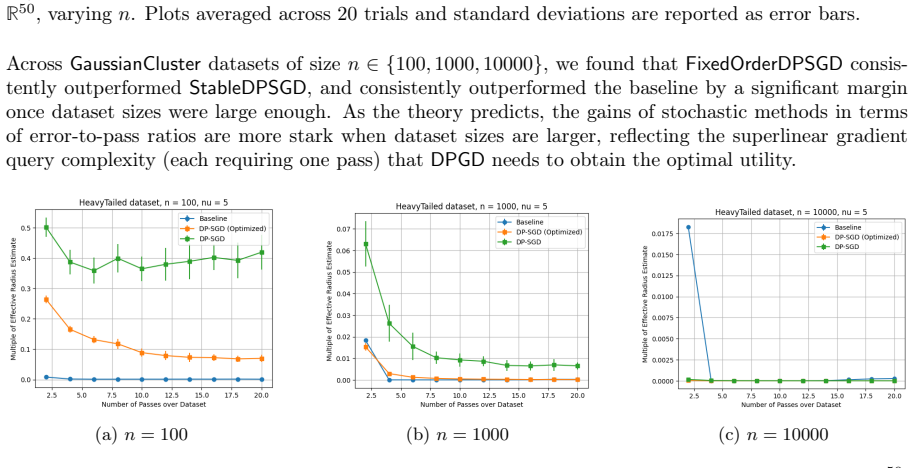
- The experiments show that a parallelized full-batch baseline can beat the fixed-order SGD variant in wall-clock time at moderate dataset sizes, so the practical case for DP-SGD strengthens as $n$ and $d$ grow; benchmarking with minibatches and adaptive step sizes would test that claim.
- The authors report that the centerpoint estimation step's constants are loose and that this step was not benchmarked; improving it is a concrete next step before the full pipeline becomes practical.
Editorial analysis
A structured set of objections, weighed in public.
Referee Report
Summary. The paper studies (ε,δ)-differentially private computation of the geometric median. It proposes a pipeline consisting of (i) a subsampled radius-estimation routine (FastRadius, Algorithm 2), (ii) a subsampled FriendlyCore-style centerpoint estimator (FastCenter, Algorithm 3), and (iii) a phased DP-SGD booster (StableDPSGD, Algorithm 4) with a sensitivity analysis tailored to the unit-norm subgradients of the geometric median objective. The main formal claims are Theorem 3 (a constant-factor warm start in nearly-linear time) and Theorem 4 (a (1+α)-multiplicative approximation in time \tilde{O}(nd + d/α²) under sample complexity roughly √d/(αε)). The paper also reports experiments on Gaussian-cluster and heavy-tailed synthetic data.
Significance. If the main theorems were fully correct, this would be a substantial improvement over the superlinear algorithms of HSU24, achieving the same near-optimal sample complexity in nearly-linear time, and the structural sensitivity analysis for non-smooth DP-SGD would be of independent interest. The paper is unusually self-contained: helper lemmas are proved rather than deferred, and the experimental section is honest about the parts of the pipeline that were not implemented (Algorithm 3). The main caveat is that two load-bearing proof gaps and one sample-complexity omission currently prevent the theorems from being accepted as stated; all appear locally repairable.
major comments (4)
- [Theorem 4 (Section 4); Lemma 6 (Section 3.1)] The sample bound stated in Theorem 4, n ≥ C·(√d/(αε))·log^{2.5}(log(d/(αδε))/δ), is not sufficient for the proof as written. The proof invokes Theorem 3, whose hypothesis contains the term n ≥ C·log(log(R/r)/δ)/ε inherited from Lemma 6, where Lemma 6 requires n ≥ (2400/ε)log(4T/δ) with T=⌈log₂(R/r)⌉. For fixed d, α, ε, and δ, taking R/r sufficiently large makes the Lemma 6 requirement exceed the Theorem 4 bound, since the latter is independent of R/r. Thus the warm-start guarantee used by Algorithm 4 is unsupported in exactly the regime the theorem claims to cover, and the statement in Section 1.1 that the sample complexity is independent of R/r is not established. The theorem should include the log log(R/r)/ε term (or the paper must provide a radius-estimation analysis whose sample complexity is independent of R/r); neither is currently present.
- [Theorem 3 (Section 3.2); Lemma 7] The proof of Theorem 3 applies Lemma 7 to the output \hat r of Algorithm 2, but Lemma 7 assumes \hat r ≥ r(0.75), while Lemma 6 only establishes \hat r ≥ (1/4)r(0.75). In the display following Eq. (11) the proof says 'Lemma 6 guarantees' \|\bar x−x*\|≤3\hat r; that conclusion is actually Lemma 7's and requires the stronger assumption. When \hat r<r(0.75), Lemma 7's conclusions (positive-weight points within B(x*,3\hat r) and Z≥0.6n) are not guaranteed, and Algorithm 3 may return 0_d on Line 10 with no proven proximity to x*. This invalidates the warm-start bound (10) and propagates to Theorem 4. A constant-inflation fix (e.g., passing 4\hat r to Algorithm 3 so that the effective counting radius is large enough) appears to repair the argument, but as written the proof is incomplete.
- [Lemma 6 (Section 3.1)] The proof of Lemma 6 is not complete in the case where Algorithm 2 returns R without any threshold crossing. The text sets t=T+1 'by default' and then applies the AboveThreshold utility guarantee as though there were a query q_t with q_t≥0.76n; no such lower bound exists when the algorithm never halts. The upper-bound argument for \hat r≤4r(0.9) must instead use the fact that q_T≤0.79n (hence q*_T≤0.8n) together with r_T≥R/2 to conclude R≤4r(0.9). Also, the sentence 'by the utility guarantees of Lemma 6' should refer to Lemma 2. These are local but necessary corrections to a lemma on which Theorem 3 relies.
- [Corollary 1 (Section 4.1)] The induction proving the sensitivity bound (14) is not justified in the case where the differing index n is sampled. If m_t=0, the induction hypothesis gives Φ_t≤3η and the triangle inequality gives Φ_{t+1}≤5η, which exceeds the claimed (2m_{t+1}+1)η=3η. The bound is salvageable by observing that before the first occurrence of n the two runs are identical, so Φ_t=0 in that case; but the proof as written needs this additional argument. Since Corollary 1 supplies the sensitivity bound used in Lemma 12 for the privacy of Algorithm 4, this step should be spelled out.
minor comments (5)
- [Theorem 4 (Section 4)] The stated runtime omits log n factors. Because Algorithm 4 sets T = 2^K−1 ≥ n, K is O(log n), so the polylog terms in the runtime should include log n unless the theorem states a looser \tilde{O} bound; the displayed expression appears to bound log n using the sample-complexity lower bound, which is valid only for the minimal n and not for all n satisfying the theorem's hypothesis.
- [Lemma 6 (Section 3.1)] The Chernoff bound should be applied to the unscaled success count S_t = k·q_t, whose mean is k·q*_t, rather than to n·q_t; as written, the phrase 'n q_t as a random sum of Bernoulli variables' is not literally correct, and the constants in the proof of (5) should be re-derived from this count.
- [Algorithm 4, line 3] The displayed definition of σ^(k) appears to read η√ρ, but the privacy calculation in Lemma 12 requires σ^(k) = 3^{−k}(2m+1)η/√ρ (or an equivalent normalization). Please correct the typesetting.
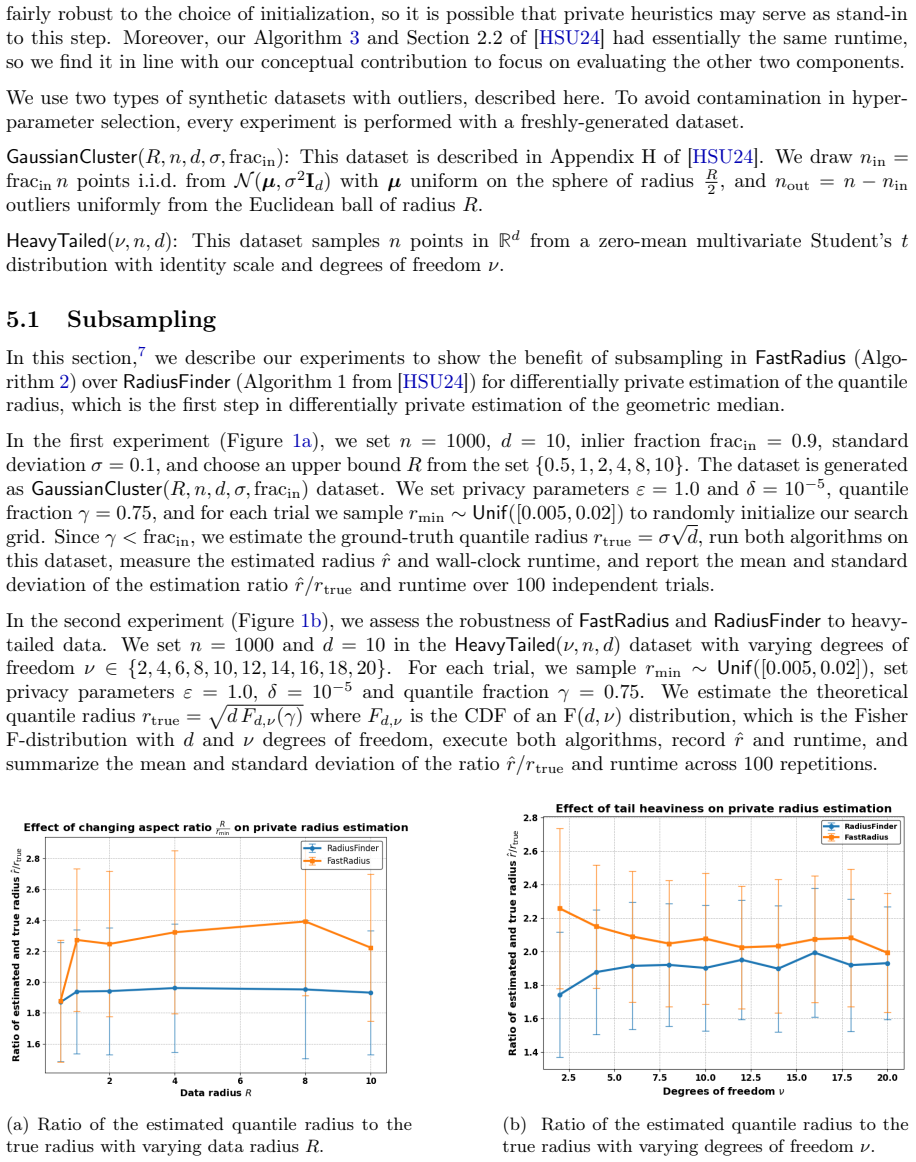
- [Section 5] The experiments evaluate Algorithm 2 and Algorithm 4 but not Algorithm 3, which the authors disclose; a sentence making explicit that the experimental validation covers only part of the proposed pipeline would be helpful.
- [Theorems 3 and 4] Both theorems require a user-supplied lower bound r with r≤4r(0.9), and the runtime degrades polylogarithmically in R/r; a brief remark on the sensitivity of the guarantees to a poor choice of r would help practitioners, especially since no private procedure for choosing r is provided.
Circularity Check
No significant circularity: the derivation is self-contained and rests on external standard tools; the flagged sample-complexity gap is a correctness issue, not a circularity.
full rationale
I found no step where a claimed prediction or derived guarantee is equivalent by construction to a fitted parameter or to an input assumption. Algorithm 2's radius guarantee is derived from the external AboveThreshold lemma (Lemma 2), Chernoff bounds, and Lemma 4 of [CLM+16]; the numerical constants are proof artifacts and are not fit to any data. Algorithm 3's privacy proof is a coupling argument (Lemma 1) combined with the bounded Laplace and Gaussian mechanisms, whose hypotheses do not include the geometric-median target. Section 4's boosting analysis uses the FKT20 localization framework and proves a new contractivity bound (Lemma 11) for subgradient steps; the final error expression is standard mirror-descent plus noise accounting, with no output quantity reused as an input. The only self-citations with author overlap ([ALT24] for the bounded Laplace fact and coupling technique) are to general, parameter-free privacy tools, which qualify as independent support rather than load-bearing self-citation. I do explicitly flag a separate correctness gap, located in Theorem 4's statement and proof: Lemma 6 requires n ≥ (2400/ε) log(4T/δ) with T = ceil(log2(R/r)), but Theorem 4's stated sample bound n ≥ C sqrt(d)/(αε) log^{2.5}(log(d/(αδε))/δ) has no dependence on R/r and does not imply the Lemma 6 requirement when R/r is very large. This may invalidate the warm-start guarantee in Theorem 4 in that regime, but it is a missing-support issue, not circularity.
Assumptions & free parameters
free parameters (5)
- Quantile 0.9 for effective radius =
0.9
- Threshold tau = 0.775n in Algorithm 2 =
0.775n
- Counting radius factor 2 in Algorithm 3 =
2 * hat r
- Noise scale constant 1600 in Algorithm 3 =
1600
- Step size schedule in Algorithm 4 =
eta * 4^{-k}, noise 3^{-k}
assumptions (5)
- standard math Chernoff bound, Gaussian and bounded Laplace mechanisms, RDP composition (Facts 1-4)
- standard math Projection onto a convex set is non-expansive (Fact 5)
- standard math Mirror descent regret bound (Theorem 3.2, Bub15)
- domain assumption Robustness Lemma 4 from CLM+16
- domain assumption Dataset lies in B_d(R) and r <= 4 r(0.9) is known
Cite this review
Pith. "Pith review of Private Geometric Median in Nearly-Linear Time." pith.science (2026). https://pith.science/paper/YD2R7N27
@misc{pith2026250520189,
  author       = {Pith},
  title        = {Pith review of: Private Geometric Median in Nearly-Linear Time},
  year         = {2026},
  howpublished = {\url{https://pith.science/paper/YD2R7N27}},
  note         = {Machine review of arXiv:2505.20189}
}
abstract
Estimating the geometric median of a dataset is a robust counterpart to mean estimation, and is a fundamental problem in computational geometry. Recently, [HSU24] gave an $(\varepsilon, \delta)$-differentially private algorithm obtaining an $\alpha$-multiplicative approximation to the geometric median objective, $\frac 1 n \sum_{i \in [n]} \|\cdot - \mathbf{x}_i\|$, given a dataset $\mathcal{D} := \{\mathbf{x}_i\}_{i \in [n]} \subset \mathbb{R}^d$. Their algorithm requires $n \gtrsim \sqrt d \cdot \frac 1 {\alpha\varepsilon}$ samples, which they prove is information-theoretically optimal. This result is surprising because its error scales with the \emph{effective radius} of $\mathcal{D}$ (i.e., of a ball capturing most points), rather than the worst-case radius. We give an improved algorithm that obtains the same approximation quality, also using $n \gtrsim \sqrt d \cdot \frac 1 {\alpha\epsilon}$ samples, but in time $\widetilde{O}(nd + \frac d {\alpha^2})$. Our runtime is nearly-linear, plus the cost of the cheapest non-private first-order method due to [CLM+16]. To achieve our results, we use subsampling and geometric aggregation tools inspired by FriendlyCore [TCK+22] to speed up the "warm start" component of the [HSU24] algorithm, combined with a careful custom analysis of DP-SGD's sensitivity for the geometric median objective.
Figures

Figures from the paper (2 more)


Reference graph
Works this paper leans on
-
[1]
Deep learning with differential privacy
[ACG+16] Martin Abadi, Andy Chu, Ian Goodfellow, H Brendan McMahan, Ilya Mironov, Kunal Talwar, and Li Zhang. Deep learning with differential privacy. InProceedings of the 2016 ACM SIGSAC conference on computer and communications security, pages 308–318,
2016
-
[7]
[BHS23] Gavin Brown, Samuel B. Hopkins, and Adam D. Smith. Fast, sample-efficient, affine- invariant private mean and covariance estimation for subgaussian distributions. InThe Thirty Sixth Annual Conference on Learning Theory, COLT 2023, volume195ofProceedings of Machine Learning Research, pages 5578–5579. PMLR,
work page 2023
-
[12]
Differentially-private clustering of easy instances
[CKM+21] Edith Cohen, Haim Kaplan, Yishay Mansour, Uri Stemmer, and Eliad Tsfadia. Differentially-private clustering of easy instances. InProceedings of the 38th International Conference on Machine Learning, ICML 2021, volume 139 ofProceedings of Machine Learn- ing Research, pages 2049–2059. PMLR,
work page 2021
-
[13]
Differentially private confidence intervals.arXiv preprint arXiv:2001.02285,
[DFM+20] Wenxin Du, Canyon Foot, Monica Moniot, Andrew Bray, and Adam Groce. Differentially private confidence intervals.arXiv preprint arXiv:2001.02285,
arXiv 2001
-
[14]
Private stochastic convex optimization: optimal rates in linear time
[FKT20] Vitaly Feldman, Tomer Koren, and Kunal Talwar. Private stochastic convex optimization: optimal rates in linear time. InProceedings of the 52nd Annual ACM SIGACT Symposium on Theory of Computing, STOC 2020, pages 439–449. ACM,
work page 2020
-
[15]
Private convex optimization via exponential mechanism
[GLL22] Sivakanth Gopi, Yin Tat Lee, and Daogao Liu. Private convex optimization via exponential mechanism. InConference on Learning Theory, pages 1948–1989. PMLR,
work page 1948
-
[16]
Private convex optimization in general norms
[GLL+23] Sivakanth Gopi, Yin Tat Lee, Daogao Liu, Ruoqi Shen, and Kevin Tian. Private convex optimization in general norms. InProceedings of the 2023 Annual ACM-SIAM Symposium on Discrete Algorithms (SODA), pages 5068–5089. SIAM,
work page 2023
-
[17]
[KLSU19] Gautam Kamath, Jerry Li, Vikrant Singhal, and Jonathan R. Ullman. Privately learning high-dimensional distributions. InConference on Learning Theory, COLT 2019, 25-28 June 2019, volume 99 ofProceedings of Machine Learning Research, pages 1853–1902. PMLR,
work page 2019
Show all 22 references
-
[21]
[NRS07] Kobbi Nissim, Sofya Raskhodnikova, and Adam D. Smith. Smooth sensitivity and sampling in private data analysis. InProceedings of the 39th Annual ACM Symposium on Theory of Computing, San Diego, California, USA, June 11-13, 2007, pages 75–84. ACM,
2007
-
[1991]
Rényi differential privacy
[Mir17] Ilya Mironov. Rényi differential privacy. In30th IEEE Computer Security Foundations Symposium, CSF 2017, pages 263–275. IEEE Computer Society,
2017
-
[2007]
[NSV16] Kobbi Nissim, Uri Stemmer, and Salil P. Vadhan. Locating a small cluster privately. In Tova Milo and Wang-Chiew Tan, editors,Proceedings of the 35th ACM SIGMOD-SIGACT- SIGAI Symposium on Principles of Database Systems, PODS 2016, pages 413–427. ACM,
2016
-
[2012]
Finite sample differentially private confidence intervals
[KV17] Vishesh Karwa and Salil Vadhan. Finite sample differentially private confidence intervals. arXiv preprint arXiv:1711.03908,
-
[2014]
Coinpress: Practical private mean and covariance estimation
[BDKU20] SouravBiswas, YiheDong, GautamKamath, andJonathanR.Ullman. Coinpress: Practical private mean and covariance estimation. InAdvances in Neural Information Processing Systems 33: Annual Conference on Neural Information Processing Systems 2020,
2020
-
[2015]
Optimal rates for o(1)-smooth dp-sco with a single epoch and large batches.arXiv preprint arXiv:2406.02716,
[CCGT24] Christopher A Choquette-Choo, Arun Ganesh, and Abhradeep Thakurta. Optimal rates for o(1)-smooth dp-sco with a single epoch and large batches.arXiv preprint arXiv:2406.02716,
-
[2016]
Smith, and Abhradeep Thakurta
[BST14] Raef Bassily, Adam D. Smith, and Abhradeep Thakurta. Private empirical risk minimiza- tion: Efficient algorithms and tight error bounds. In55th IEEE Annual Symposium on Foundations of Computer Science, FOCS 2014, pages 464–473. IEEE Computer Society,
2014
-
[2017]
DP-PCA: statistically optimal and differentially private PCA
[LKJO22] Xiyang Liu, Weihao Kong, Prateek Jain, and Sewoong Oh. DP-PCA: statistically optimal and differentially private PCA. InAdvances in Neural Information Processing Systems 35: Annual Conference on Neural Information Processing Systems 2022,
2022
-
[2019]
Concentrated differential privacy: Simplifications, exten- sions, and lower bounds
22 [BS16] Mark Bun and Thomas Steinke. Concentrated differential privacy: Simplifications, exten- sions, and lower bounds. InTheory of Cryptography - 14th International Conference, TCC 2016-B, Proceedings, Part I, volume 9985 ofLecture Notes in Computer Science, pages 635–658,
2016
-
[2020]
More asymmetry yields faster matrix multiplication
[ADV+25] Josh Alman, Ran Duan, Virginia Vassilevska Williams, Yinzhan Xu, Zixuan Xu, and Renfei Zhou. More asymmetry yields faster matrix multiplication. InProceedings of the 2025 Annual ACM-SIAM Symposium on Discrete Algorithms, SODA 2025, pages 2005–2039. SIAM,
2025
-
[2021]
Privacy and statistical risk: Formalisms and mini- max bounds.arXiv preprint arXiv:1412.4451,
[BD14] Rina Foygel Barber and John C Duchi. Privacy and statistical risk: Formalisms and mini- max bounds.arXiv preprint arXiv:1412.4451,
-
[2022]
User-level differentially private stochastic convex optimization: Efficient algorithms with optimal rates.arXiv preprint arXiv:2311.03797,
[AL23] Hilal Asi and Daogao Liu. User-level differentially private stochastic convex optimization: Efficient algorithms with optimal rates.arXiv preprint arXiv:2311.03797,
-
[2023]
Private stochastic convex optimization with heavy tails: Near-optimalityfromsimplereductions
[ALT24] Hilal Asi, Daogao Liu, and Kevin Tian. Private stochastic convex optimization with heavy tails: Near-optimalityfromsimplereductions. InAdvances in Neural Information Processing Systems 38: Annual Conference on Neural Information Processing Systems 2024,
2024
-
[2024]
Resqueing parallel and private stochastic convex optimization
[CJJ+23] Yair Carmon, Arun Jambulapati, Yujia Jin, Yin Tat Lee, Daogao Liu, Aaron Sidford, and Kevin Tian. Resqueing parallel and private stochastic convex optimization. In64th IEEE Annual Symposium on Foundations of Computer Science, FOCS 2023, pages 2031–2058. IEEE,
2023
Reviewed August 7, 2026 · model on record in the stance chip above.
Discussion (0). Continue with ORCID to comment.