Geometry-Editable and Appearance-Preserving Object Compositon
Pith reviewed 2026-05-22 02:09 UTC · model grok-4.3
The pith
A disentangled diffusion model uses semantic embeddings for geometry edits and cross-attention to preserve appearance details in object composition.
A machine-rendered reading of the paper's core claim, the machinery that carries it, and where it could break.
Core claim
The paper claims that by first integrating semantic embeddings into pre-trained diffusion models to implicitly capture geometric transformations and then applying a dense cross-attention retrieval mechanism to align fine-grained appearance features with the edited geometry, the DGAD model achieves both precise geometry editing and faithful appearance preservation in general object composition tasks.
What carries the argument
The Disentangled Geometry-editable and Appearance-preserving Diffusion (DGAD) model, which builds semantic embeddings and appearance representations from CLIP/DINO and reference networks, then integrates them disentangled into diffusion encoding and decoding with cross-attention for alignment.
Load-bearing premise
Semantic embeddings from models like CLIP and DINO can sufficiently encode object geometry for manipulation in diffusion processes, and cross-attention can then perfectly match appearance features to those edited regions.
What would settle it
Generate composites where an object is rotated or resized significantly, then compare the output's fine details such as specific patterns or edges against the input reference; any systematic loss or distortion in those details would indicate failure of the preservation mechanism.
Figures


read the original abstract
General object composition (GOC) aims to seamlessly integrate a target object into a background scene with desired geometric properties, while simultaneously preserving its fine-grained appearance details. Recent approaches derive semantic embeddings and integrate them into advanced diffusion models to enable geometry-editable generation. However, these highly compact embeddings encode only high-level semantic cues and inevitably discard fine-grained appearance details. We introduce a Disentangled Geometry-editable and Appearance-preserving Diffusion (DGAD) model that first leverages semantic embeddings to implicitly capture the desired geometric transformations and then employs a cross-attention retrieval mechanism to align fine-grained appearance features with the geometry-edited representation, facilitating both precise geometry editing and faithful appearance preservation in object composition. Specifically, DGAD builds on CLIP/DINO-derived and reference networks to extract semantic embeddings and appearance-preserving representations, which are then seamlessly integrated into the encoding and decoding pipelines in a disentangled manner. We first integrate the semantic embeddings into pre-trained diffusion models that exhibit strong spatial reasoning capabilities to implicitly capture object geometry, thereby facilitating flexible object manipulation and ensuring effective editability. Then, we design a dense cross-attention mechanism that leverages the implicitly learned object geometry to retrieve and spatially align appearance features with their corresponding regions, ensuring faithful appearance consistency. Extensive experiments on public benchmarks demonstrate the effectiveness of the proposed DGAD framework.
Editorial analysis
A structured set of objections, weighed in public.
Referee Report
Summary. The manuscript introduces the Disentangled Geometry-editable and Appearance-preserving Diffusion (DGAD) model for general object composition. It first integrates CLIP/DINO-derived semantic embeddings into pre-trained diffusion models to implicitly capture desired geometric transformations for flexible editing, then applies a dense cross-attention retrieval mechanism to align and preserve fine-grained appearance features from reference images, with the components integrated in a disentangled manner into the diffusion encoding and decoding pipelines. Extensive experiments on public benchmarks are claimed to demonstrate effectiveness.
Significance. If the implicit geometry capture and cross-attention alignment prove reliable, the DGAD approach could meaningfully advance object composition methods by addressing the loss of fine-grained details in compact semantic embeddings while leveraging the spatial reasoning of frozen diffusion backbones, potentially enabling more controllable and faithful edits without explicit geometric supervision.
major comments (2)
- [§3.2 and Fig. 2] §3.2 and Fig. 2: The headline claim of disentangled geometry editing rests on the assumption that injecting compact CLIP/DINO semantic embeddings into the pre-trained U-Net implicitly captures precise object geometry sufficiently for controllable manipulation. No ablation isolating this implicit-geometry step is described, nor is there a quantitative evaluation (e.g., geometric accuracy metrics such as keypoint error or transformation fidelity against ground-truth edits) to verify that the latent representation matches desired transformations. This is load-bearing for both the editability and disentanglement arguments.
- [Method and Experiments sections] Method and Experiments sections: The dense cross-attention retrieval is presented as ensuring faithful appearance consistency by spatially aligning features conditioned on the implicit geometry. However, the manuscript provides no failure-case analysis or robustness metrics for out-of-distribution geometric edits, leaving open the possibility of misalignment or loss that would undermine the appearance-preservation claim.
minor comments (1)
- The abstract and method overview could more explicitly contrast the proposed disentangled integration against prior semantic-embedding approaches to highlight the precise novelty in the cross-attention retrieval step.
Simulated Author's Rebuttal
We thank the referee for the constructive feedback on our DGAD framework for object composition. We address each major comment below with clarifications from the manuscript and indicate planned revisions to strengthen the presentation of the implicit geometry capture and robustness aspects.
read point-by-point responses
-
Referee: [§3.2 and Fig. 2] §3.2 and Fig. 2: The headline claim of disentangled geometry editing rests on the assumption that injecting compact CLIP/DINO semantic embeddings into the pre-trained U-Net implicitly captures precise object geometry sufficiently for controllable manipulation. No ablation isolating this implicit-geometry step is described, nor is there a quantitative evaluation (e.g., geometric accuracy metrics such as keypoint error or transformation fidelity against ground-truth edits) to verify that the latent representation matches desired transformations. This is load-bearing for both the editability and disentanglement arguments.
Authors: We agree that an explicit ablation isolating the contribution of the semantic embeddings to geometry capture, along with quantitative metrics such as keypoint error or transformation fidelity, would provide stronger validation for the implicit mechanism described in §3.2. While the manuscript relies on the spatial reasoning capabilities of the frozen pre-trained diffusion backbone to enable the observed editability (as shown through the overall framework results and Fig. 2), we did not include a dedicated isolation study or those specific geometric accuracy metrics. We will add such an ablation and quantitative evaluation in the revised manuscript to better support the disentanglement claims. revision: yes
-
Referee: [Method and Experiments sections] Method and Experiments sections: The dense cross-attention retrieval is presented as ensuring faithful appearance consistency by spatially aligning features conditioned on the implicit geometry. However, the manuscript provides no failure-case analysis or robustness metrics for out-of-distribution geometric edits, leaving open the possibility of misalignment or loss that would undermine the appearance-preservation claim.
Authors: We acknowledge that including failure-case analysis and robustness metrics specifically for out-of-distribution geometric edits would better substantiate the reliability of the dense cross-attention retrieval mechanism. The current experiments on public benchmarks demonstrate appearance preservation through spatial alignment conditioned on the learned geometry, but we did not provide dedicated OOD robustness evaluation or failure cases. We will expand the Experiments section to include such analysis and discuss potential limitations for extreme edits in the revision. revision: yes
Circularity Check
No significant circularity; new integration steps on pre-trained models remain independent of inputs
full rationale
The paper proposes DGAD as a constructive architecture: semantic embeddings (from CLIP/DINO) are integrated into a pre-trained diffusion backbone to implicitly capture geometry, followed by a dense cross-attention retrieval step for appearance features. This is presented as a novel disentangled pipeline rather than a derivation that reduces by construction to fitted parameters, self-citations, or renamed inputs. No equations, uniqueness theorems, or load-bearing self-citations are exhibited in the abstract or method outline that would force the claimed editability and preservation to be tautological. The central claims rest on the proposed mechanisms having independent content beyond the pre-trained components, consistent with standard model-building papers.
Axiom & Free-Parameter Ledger
Reference graph
Works this paper leans on
-
[1]
An Image is Worth One Word: Personalizing Text-to-Image Generation using Textual Inversion
Rinon Gal, Yuval Alaluf, Yuval Atzmon, Or Patashnik, Amit H Bermano, Gal Chechik, and Daniel Cohen-Or. An image is worth one word: Personalizing text-to-image generation using textual inversion. arXiv preprint arXiv:2208.01618,
work page internal anchor Pith review Pith/arXiv arXiv
-
[2]
Classifier-Free Diffusion Guidance
Jonathan Ho and Tim Salimans. Classifier-free diffusion guidance. arXiv preprint arXiv:2207.12598,
work page internal anchor Pith review Pith/arXiv arXiv
-
[3]
Adam: A Method for Stochastic Optimization
Diederik P Kingma. Adam: A method for stochastic optimization. arXiv preprint arXiv:1412.6980,
work page internal anchor Pith review Pith/arXiv arXiv
-
[4]
Microsoft coco: Common objects in context
Tsung-Yi Lin, Michael Maire, Serge Belongie, James Hays, Pietro Perona, Deva Ramanan, Piotr Dollár, and C Lawrence Zitnick. Microsoft coco: Common objects in context. In Computer vision– ECCV 2014: 13th European conference, zurich, Switzerland, September 6-12, 2014, proceedings, part v 13, pages 740–755. Springer,
work page 2014
-
[5]
DINOv2: Learning Robust Visual Features without Supervision
Maxime Oquab, Timothée Darcet, Théo Moutakanni, Huy V o, Marc Szafraniec, Vasil Khalidov, Pierre Fernandez, Daniel Haziza, Francisco Massa, Alaaeldin El-Nouby, et al. Dinov2: Learning robust visual features without supervision. arXiv preprint arXiv:2304.07193,
work page internal anchor Pith review Pith/arXiv arXiv
-
[6]
Gaugan: semantic image synthesis with spatially adaptive normalization
Taesung Park, Ming-Yu Liu, Ting-Chun Wang, and Jun-Yan Zhu. Gaugan: semantic image synthesis with spatially adaptive normalization. In ACM SIGGRAPH 2019 Real-Time Live!, pages 1–1
work page 2019
-
[7]
Denoising Diffusion Implicit Models
Jiaming Song, Chenlin Meng, and Stefano Ermon. Denoising diffusion implicit models. arXiv preprint arXiv:2010.02502,
work page internal anchor Pith review Pith/arXiv arXiv 2010
-
[8]
Chong Su, Yingbin Fu, Zheyuan Hu, Jing Yang, Param Hanji, Shaojun Wang, Xuan Zhao, Cengiz Öztireli, and Fangcheng Zhong. Chord: Generation of collision-free, house-scale, and organized digital twins for 3d indoor scenes with controllable floor plans and optimal layouts. arXiv preprint arXiv:2503.11958,
-
[9]
Zhihua Xu, Tianshui Chen, Zhijing Yang, Chunmei Qing, Yukai Shi, and Liang Lin. Self-supervised emotion representation disentanglement for speech-preserving facial expression manipulation. In ACM Multimedia 2024,
work page 2024
-
[10]
IP-Adapter: Text Compatible Image Prompt Adapter for Text-to-Image Diffusion Models
Hu Ye, Jun Zhang, Sibo Liu, Xiao Han, and Wei Yang. Ip-adapter: Text compatible image prompt adapter for text-to-image diffusion models. arXiv preprint arXiv:2308.06721,
work page internal anchor Pith review Pith/arXiv arXiv
-
[11]
Adaptive composition gan towards realistic image synthesis
Fangneng Zhan, Jiaxing Huang, and Shijian Lu. Adaptive composition gan towards realistic image synthesis. arXiv preprint arXiv:1905.04693, 2,
-
[12]
Zero-shot image editing with reference imitation
Hengshuang Zhao. Zero-shot image editing with reference imitation. Neural Information Processing Systems (NeurIPS), 2024 (10/12/2024-15/12/2024, V ancouver , Canada),
work page 2024
-
[13]
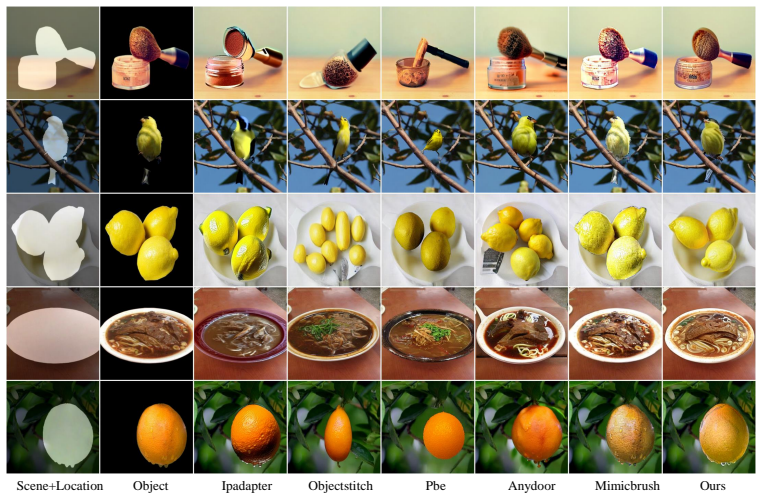
Ablation Study The results presented in the main text are based on CLIP-derived semantic embed- dings. To verify the robustness of the proposed framework across different semantic embeddings, we 14 Scene+Location Object Ipadapter Objectstitch Pbe Anydoor Mimicbrush Ours Figure 7: Qualitative comparison with recent advanced methods. The images shown are so...
work page 2023
discussion (0)
Sign in with ORCID, Apple, or X to comment. Anyone can read and Pith papers without signing in.