REVIEW 3 major objections 4 minor 6 cited by
STARFlow: Scaling Latent Normalizing Flows for High-resolution Image Synthesis
T0 review · 3 major / 4 minor · reviewed 2026-08-07 · deepseek-v4-flash
Pith's one-line read Normalizing flows hit diffusion-level image quality at scale.
desk verdict STARFlow is a genuine scaling demonstration for latent autoregressive flows, with a mostly sound empirical core, but the FID attribution to the flow versus the finetuned decoder and a few overclaims need tightening before it should appear. read the letter →
The pith
A machine-rendered reading of the paper's core claim, the machinery that carries it, and where it could break.
The reading
What carries the argument
The central object is Transformer Autoregressive Flow (TARFlow): a stack of invertible autoregressive blocks, each predicting per-coordinate mean and scale from previously processed coordinates under an alternating ordering, so the whole stack is a single end-to-end normalizing flow optimized by exact likelihood. STARFlow modifies this in three ways: a deep-shallow architecture with one deep $l$-layer block followed by $T-1$ two-layer shallow blocks; modeling of latents from a pretrained autoencoder, corrupted by Gaussian noise at $\sigma_L=0.3$ and decoded by a decoder fine-tuned with $L_2$, LPIPS, and GAN losses; and a guidance rule proved for Gaussian conditionals, $\tilde{\mu}_c = \mu_c + \frac{\omega s}{1+\omega-\omega s}(\mu_c-\mu_u)$ and $\tilde{\sigma}_c = \frac{\sigma_c}{\sqrt{1+\omega-\omega s}}$, with $s=\sigma_c^2/\sigma_u^2$ clipped to $[0,1]$. The universality proposition, that stacked autoregressive flows with $T \geq 3$ blocks are dense in $L^1(\mathbb{R}^D)$, is what licenses scaling the architecture rather than adding more flow blocks.
What would settle it
Decode 50K real ImageNet images from latents corrupted at $\sigma_L=0.3$ and compute rFID; the paper reports 2.73, while STARFlow's best gFID is 2.40. If this rFID is not reproduced, or if at 512x512 with an unfinetuned decoder the gFID/rFID gap inverts, the scaling claim would be shown to be decoder-limited rather than flow-limited.
Extended reading notes
Core claim
The paper's central claim is that the apparent small-scale ceiling of normalizing flows is not a fundamental limitation of the flow formulation. With a causal Transformer autoregressive flow performing exact maximum-likelihood training in continuous space, the reported results on class- and text-conditioned image synthesis approach state-of-the-art diffusion models at 256, 512, and 1024 resolutions and variable aspect ratios. The load-bearing components are a deep-shallow parameter allocation (one deep block near the prior plus shallow refinement blocks), latent-space modeling on a pretrained autoencoder's noisy latents with a decoder fine-tuned to invert the noise, and a score-derived guidance update that, for Gaussian conditionals, rescales the conditional mean and standard deviation by factors depending on the variance ratio. The paper treats these as the first successful demonstration of normalizing flows at this scale.
Load-bearing premise
The load-bearing premise is that a pretrained autoencoder's latent space, after Gaussian noise at $\sigma_L=0.3$ and decoder finetuning, remains a faithful, smooth proxy for the image distribution, so the reported FID is the flow's quality rather than the decoder's ceiling.
Editorial extensions
If this is right
- Normalizing flows become a scalable third family for high-resolution generation, with exact densities available for downstream uses such as likelihood scoring and principled training objectives.
- At ImageNet-256 the reported rFID of 2.73 for the decoder is already above the flow's gFID of 2.40, so further quality gains at this resolution are expected to come from better latent decoders, not bigger flows.
- The model's end-to-end invertibility transfers to training-free inpainting via a Metropolis-Hastings sampler in latent space and to interactive editing after finetuning, because one forward pass encodes an image and one reverse pass decodes it.
- The deep block can be initialized from a pretrained LLM and conditioned only there, while shallow blocks refine locally, so the image generator can be dropped into an LLM's semantic space without a separate text encoder.
- The proposed guidance rule keeps sample quality nearly flat across a wide range of guidance weights, whereas the earlier AF guidance rule degrades quickly away from one optimal weight.
Reading between the lines
- The same deep-shallow, latent-space recipe could plausibly transfer to video, audio, or 3D data, but the paper only demonstrates images, so that transfer is an untested extension.
- One direct test this account suggests is training STARFlow on clean latents with a small denoising regularizer; if stable, it would remove the noise-injection and decoder-finetuning stages and lift the likelihood ceiling above the current decoder-limited rFID.
- Because the guidance derivation only assumes Gaussian conditionals, the formula may be applicable to any flow or VAE whose per-variable predictive distributions are Gaussian, not only TARFlow-style models.
- The gap between rFID 2.73 and gFID 2.40 indicates the flow is already working near the decoder's reconstruction boundary; at resolutions or aspect ratios where the decoder was not fine-tuned, the scaling behavior could differ from the headline numbers.
Editorial analysis
A structured set of objections, weighed in public.
Referee Report
Summary. STARFlow is a latent-space autoregressive normalizing flow for high-resolution image synthesis. It extends TARFlow with a deep-shallow stack of Transformer AF blocks, trains in the latent space of a frozen pretrained autoencoder corrupted by Gaussian noise at sigma_L = 0.3, and uses a finetuned pixel decoder. The paper also introduces a score-based classifier-free guidance rule (Prop. 2) with variance-ratio clipping and claims a universality result for stacked AFs (Prop. 1). Experiments report FID 2.40 on ImageNet-256 with a 1.4B model, FID 3.00 on ImageNet-512, and zero-shot COCO FID 9.1 with a 3.8B model, plus qualitative text-to-image samples, inpainting, and editing results.
Significance. If the results are taken at face value, this is a meaningful demonstration that exact-likelihood latent normalizing flows can be trained at billion-parameter scale and achieve competitive FIDs, while retaining exact maximum-likelihood training and invertibility. The deep-shallow architecture study, the comparison with TARFlow, and the CFG analysis are useful and largely internally consistent. However, the FID numbers are not cleanly attributable to the flow because of the finetuned decoder, and the headline breadth claims are stronger than the tables support: on ImageNet-256, FID 2.40 is close to DiT's 2.27 but with 1.4B versus 675M parameters; on ImageNet-512, FID 3.00 trails EDM2-XXL's 1.25; on zero-shot COCO, FID 9.1 trails Imagen, Parti, and eDiff-I. With proper decoder-controlled baselines and recalibrated claims, the contribution would be solid.
major comments (3)
- [§3.3, Appendix B.3, Tables 1–3] The FID attribution is confounded by the finetuned decoder. Appendix B.3 reports rFID ≈ 2.73 for real latents corrupted at sigma_L = 0.3 and decoded by the finetuned decoder, while Table 1 reports gFID 2.40; the text calls 2.73 an upper bound and a performance ceiling, which is internally inconsistent because the generated samples score better than the decoded noisy real latents. No analogous rFID is reported for ImageNet-512 or MS-COCO, where the headline scaling claims (FID 3.00 and 9.1) are made, and the decoder is finetuned only on 256x256 ImageNet. The authors should report rFID at 512 and COCO, and ideally a decoding-only baseline (e.g., decoding random or naive latents) to separate the flow prior's contribution to FID from the decoder's.
- [§3.1, Proposition 1, Appendix A.1] The universality result is not proven at the level claimed. Equation (5) shows that each conditional density is an infinite Gaussian mixture, but the mixture weights are p(y_{>d} | x_{<d}) produced by the previous flow block; the argument does not demonstrate that the set of achievable conditional densities is dense in L1(R^D), only that Gaussian mixtures are dense. The discussion for T ≥ 3 repeats the same reasoning, and no consistency argument is given for approximating the joint density by choosing conditionals independently. Please provide a rigorous proof or explicitly downgrade the statement to a conjecture.
- [Abstract, §4.2, Tables 1–3] The claim of 'approaching state-of-the-art diffusion models' is broader than the evidence. On ImageNet-256, STARFlow's FID 2.40 is close to DiT's 2.27 but with 1.4B parameters versus 675M; on ImageNet-512, STARFlow's FID 3.00 is far from EDM2-XXL's 1.25 at comparable model size; on zero-shot COCO, FID 9.1 trails Imagen (7.3), Parti (7.2), and eDiff-I (7.0). Given that the FID metric is decoder-confounded (see the first major comment), the 'approaching SOTA' wording should be recalibrated and the comparison should be placed on a parameter-, compute-, and decoder-matched footing.
minor comments (4)
- [§3.3, §4.1, Appendix B.1] There are small presentation errors: 'prertaiend' in §3.3, 'the the realism' in §4.1, and Appendix B.1 references 'Fig. 10(b–e)' while Figure 10 contains panels (a)–(f).
- [§3.4, Proposition 2] The clipping s = CLIP(s, 0, 1) is a heuristic that changes the guided distribution; the paper should state this explicitly and analyze the regime sigma_u < sigma_c, where the current 'mode-seeking' motivation is only intuitive.
- [Appendix D.1] The Metropolis–Hastings inpainting derivation should be more explicit: the proposal applies f^{-1} and then replaces observed pixels, and it is not immediate that this kernel is symmetric or that the acceptance ratio based on p_theta(x') yields p_theta(x_M | x_O) as the stationary distribution.
- [Appendix B.3] The statement that the finetuned decoder 'seamlessly generalizes to arbitrary resolutions, aspect ratios, and text-to-image domains' is supported only by qualitative samples; quantitative reconstruction/rFID numbers at other resolutions and domains should be reported.
Circularity Check
No circular derivation: FID numbers come from sampling the trained model, and the two theoretical propositions are closed-form or standard density arguments rather than self-imported conclusions.
full rationale
The claimed derivation chain is not circular. Proposition 1 argues universality of alternating autoregressive flows via Gaussian-mixture density (citing an external textbook) plus neural-network expressivity; Proposition 2 is an explicit closed-form solution of the guided-score equation for Gaussian conditionals, verified by derivation in Appendix A.2. Neither proposition presupposes STARFlow's benchmark performance. The headline FID numbers (2.40 ImageNet-256, 3.00 ImageNet-512, 9.1 COCO) come from actual forward sampling of the trained model, not from fitting those benchmark numbers; the training losses in Eqs. (3), (6), and (7) do not contain FID as a target. The latent-space pipeline does rely on the authors' prior TARFlow (Zhai et al., 2024) for the flow formulation and noise-injection idea, and this self-citation is contextual, but the paper reproduces that baseline from the official codebase and contrasts it with external baselines (DiT, LlamaGen, GIVT), so the central scaling claim has independent support. The manuscript's own Appendix B.3 limitation (rFID 2.73 for decoded noisy real latents vs gFID 2.40) is an acknowledged reconstruction-ceiling concern about attributing quality to the flow versus the finetuned decoder; it is a substantive correctness/attribution caveat, not a definitional or fitted-input circularity. Overall circularity burden is low.
Assumptions & free parameters
free parameters (5)
- sigma_L (latent noise scale) =
0.3
- deep-shallow block allocation l(N)-d =
18(6)-2048 for class models; 24(6)-3072 for text-to-image models
- CFG variance-ratio clipping bounds =
CLIP(s, 0, 1)
- latent norm penalty weight =
1e-4
- guidance weight omega =
3.0 for class-conditional, 4.0 for text-to-image
assumptions (5)
- standard math The change-of-variable formula justifies maximum likelihood training of invertible flows.
- domain assumption Gaussian mixtures are dense in the space of continuous densities, and neural networks can approximate the required conditional parameters.
- domain assumption A pretrained autoencoder provides a continuous latent space in which Gaussian-noise-corrupted inputs remain decodable after finetuning the decoder.
- domain assumption Each coordinate's conditional predictive distribution in the deep block is an isotropic Gaussian, so the score-based CFG derivation applies.
- ad hoc to paper Clipping the variance ratio s to [0,1] preserves the intended guided distribution.
Cite this review
Pith. "Pith review of STARFlow: Scaling Latent Normalizing Flows for High-resolution Image Synthesis." pith.science (2026). https://pith.science/paper/XJYHRPXO
@misc{pith2026250606276,
  author       = {Pith},
  title        = {Pith review of: STARFlow: Scaling Latent Normalizing Flows for High-resolution Image Synthesis},
  year         = {2026},
  howpublished = {\url{https://pith.science/paper/XJYHRPXO}},
  note         = {Machine review of arXiv:2506.06276}
}
read the original abstract
We present STARFlow, a scalable generative model based on normalizing flows that achieves strong performance in high-resolution image synthesis. The core of STARFlow is Transformer Autoregressive Flow (TARFlow), which combines the expressive power of normalizing flows with the structured modeling capabilities of Autoregressive Transformers. We first establish the theoretical universality of TARFlow for modeling continuous distributions. Building on this foundation, we introduce several key architectural and algorithmic innovations to significantly enhance scalability: (1) a deep-shallow design, wherein a deep Transformer block captures most of the model representational capacity, complemented by a few shallow Transformer blocks that are computationally efficient yet substantially beneficial; (2) modeling in the latent space of pretrained autoencoders, which proves more effective than direct pixel-level modeling; and (3) a novel guidance algorithm that significantly boosts sample quality. Crucially, our model remains an end-to-end normalizing flow, enabling exact maximum likelihood training in continuous spaces without discretization. STARFlow achieves competitive performance in both class-conditional and text-conditional image generation tasks, approaching state-of-the-art diffusion models in sample quality. To our knowledge, this work is the first successful demonstration of normalizing flows operating effectively at this scale and resolution.
Figures


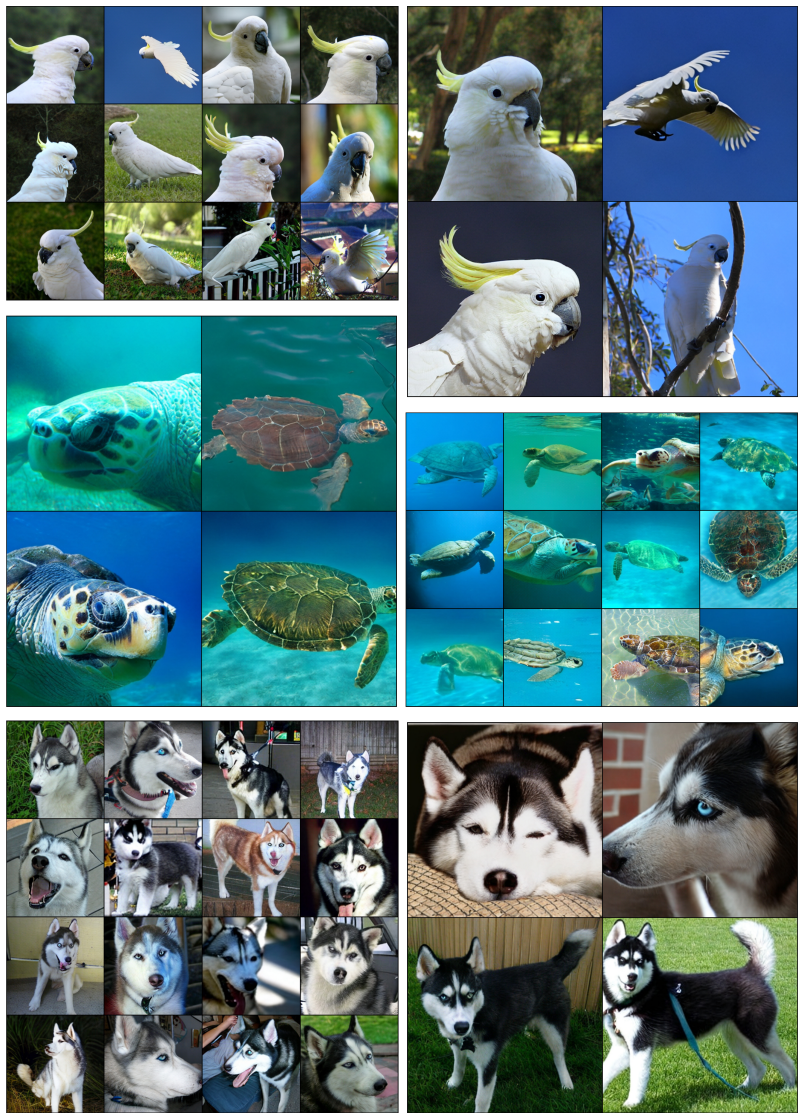
Figures from the paper (14 more)




Forward citations
Cited by 6 Pith papers
-
IB-Flow: Information Bottleneck-Guided CFG Distillation for Few-Step Text-to-Image Generation
Information-Bottleneck closed forms for adaptive CFG supervisor timestep and strength yield SOTA 2-NFE text-to-image fidelity across FLUX, OpenUni, and Qwen-Image.
-
MIMFlow: Integrating Masked Image Modeling with Normalizing Flows for End-to-End Image Generation
MIMFlow uses a VAE on masked images to feed semantic latents to a normalizing flow while a decoder handles high-frequency details, reporting FID 2.50 and 71.3% linear probing on ImageNet 256x256 with 128 tokens.
-
SRC-Flow: Compact Semantic Representations Enable Normalizing Flows for Image Generation
SRC-Flow compresses RAE features via a Semantic Representation Compressor into a low-dimensional space, enabling normalizing flows to reach gFID 1.65 on ImageNet 256x256 and 2.07 on 512x512 while retaining exact likelihoods.
-
Flow Stochastic Segmentation Networks
Flow-SSNs model high-rank pixel covariances for ambiguous medical image segmentation by mapping a learned diagonal-Gaussian prior through a lightweight flow, outperforming prior SOTA with fewer parameters.
-
A Generative Model-Free Form Deformation Approach for the Generation of Mesh Motions with Applications to PDE
A control-point ODE flow with a Bernstein-polynomial drift can match genus-0 meshes of different topology, and a POD+autoencoder+normalizing-flow generative model on the control trajectories yields lower-dimensional s...
-
Fractal Flow: Hierarchical and Interpretable Normalizing Flow via Topic Modeling and Recursive Strategy
Fractal Flow combines a Dirichlet-topic latent prior with recursive coupling layers in a normalizing flow, reporting lower bits-per-dim than a custom RealNVP baseline on MNIST and FashionMNIST.
Reference graph
Works this paper leans on
-
[1]
write newline
" write newline "" before.all 'output.state := FUNCTION n.dashify 't := "" t empty not t #1 #1 substring "-" = t #1 #2 substring "--" = not "--" * t #2 global.max substring 't := t #1 #1 substring "-" = "-" * t #2 global.max substring 't := while if t #1 #1 substring * t #2 global.max substring 't := if while FUNCTION format.date year duplicate empty "emp...
-
[2]
ediffi: Text-to-image diffusion models with an ensemble of expert denoisers
Balaji, Y., Nah, S., Huang, X., Vahdat, A., Song, J., Kreis, K., Aittala, M., Aila, T., Laine, S., Catanzaro, B., et al. ediffi: Text-to-image diffusion models with an ensemble of expert denoisers. arXiv preprint arXiv:2211.01324, 2022
arXiv 2022
-
[3]
Improving image generation with better captions
Betker, J., Goh, G., Jing, L., Brooks, T., Wang, J., Li, L., Ouyang, L., Zhuang, J., Lee, J., Guo, Y., et al. Improving image generation with better captions. Computer Science. https://cdn. openai. com/papers/dall-e-3. pdf, 2 0 (3): 0 8, 2023
2023
-
[4]
Brown, T. B., Mann, B., Ryder, N., Subbiah, M., Kaplan, J., Dhariwal, P., Neelakantan, A., Shyam, P., Sastry, G., Askell, A., Agarwal, S., Herbert-Voss, A., Krueger, G., Henighan, T., Child, R., Ramesh, A., Ziegler, D. M., Wu, J., Winter, C., Hesse, C., Chen, M., Sigler, E., Litwin, M., Gray, S., Chess, B., Clark, J., Berner, C., McCandlish, S., Radford, ...
work page 2020
-
[5]
Chang, H., Zhang, H., Barber, J., Maschinot, A., Lezama, J., Jiang, L., Yang, M.-H., Murphy, K. P., Freeman, W. T., Rubinstein, M., Li, Y., and Krishnan, D. Muse: Text-to-image generation via masked generative transformers. In Krause, A., Brunskill, E., Cho, K., Engelhardt, B., Sabato, S., and Scarlett, J. (eds.), Proceedings of the 40th International Con...
work page 2023
-
[6]
Conceptual 12M : Pushing web-scale image-text pre-training to recognize long-tail visual concepts
Changpinyo, S., Sharma, P., Ding, N., and Soricut, R. Conceptual 12M : Pushing web-scale image-text pre-training to recognize long-tail visual concepts. In CVPR, 2021
work page 2021
-
[7]
Pixart-alpha: Fast training of diffusion transformer for photorealistic text-to-image synthesis
Chen, J., Yu, J., Ge, C., Yao, L., Xie, E., Wu, Y., Wang, Z., Kwok, J., Luo, P., Lu, H., et al. Pixart-alpha: Fast training of diffusion transformer for photorealistic text-to-image synthesis. arXiv preprint arXiv:2310.00426, 2023
-
[8]
T., Rubanova, Y., Bettencourt, J., and Duvenaud, D
Chen, R. T., Rubanova, Y., Bettencourt, J., and Duvenaud, D. K. Neural ordinary differential equations. Advances in neural information processing systems, 31, 2018
2018
Show all 70 references
-
[9]
W., Hou, L., Longpre, S., Zoph, B., Tay, Y., Fedus, W., Li, E., Wang, X., Dehghani, M., Brahma, S., Webson, A., Gu, S
Chung, H. W., Hou, L., Longpre, S., Zoph, B., Tay, Y., Fedus, W., Li, E., Wang, X., Dehghani, M., Brahma, S., Webson, A., Gu, S. S., Dai, Z., Suzgun, M., Chen, X., Chowdhery, A., Narang, S., Mishra, G., Yu, A., Zhao, V., Huang, Y., Dai, A., Yu, H., Petrov, S., Chi, E. H., Dean...
2022 arXiv
-
[10]
ImageNet: A Large-scale Hierarchical Image Database
Deng, J., Dong, W., Socher, R., Li, L.-J., Li, K., and Fei-Fei, L. ImageNet: A Large-scale Hierarchical Image Database . IEEE Conference on Computer Vision and Pattern Recognition, pp.\ 248--255, 2009
2009
-
[11]
and Nichol, A
Dhariwal, P. and Nichol, A. Diffusion models beat gans on image synthesis. Advances in Neural Information Processing Systems, 34: 0 8780--8794, 2021
2021
-
[12]
Cogview: Mastering text-to-image generation via transformers
Ding, M., Yang, Z., Hong, W., Zheng, W., Zhou, C., Yin, D., Lin, J., Zou, X., Shao, Z., Yang, H., et al. Cogview: Mastering text-to-image generation via transformers. Advances in Neural Information Processing Systems, 34: 0 19822--19835, 2021
2021
-
[13]
Nice: Non-linear independent components estimation
Dinh, L., Krueger, D., and Bengio, Y. Nice: Non-linear independent components estimation. arXiv preprint arXiv:1410.8516, 2014
2014 arXiv
-
[14]
Density estimation using real nvp
Dinh, L., Sohl-Dickstein, J., and Bengio, S. Density estimation using real nvp. arXiv preprint arXiv:1605.08803, 2016
2016 arXiv
-
[15]
The llama 3 herd of models
Dubey, A., Jauhri, A., Pandey, A., Kadian, A., Al-Dahle, A., Letman, A., Mathur, A., Schelten, A., Yang, A., Fan, A., et al. The llama 3 herd of models. arXiv preprint arXiv:2407.21783, 2024
2024 arXiv
-
[16]
Tweedie’s formula and selection bias
Efron, B. Tweedie’s formula and selection bias. Journal of the American Statistical Association, 106 0 (496): 0 1602--1614, 2011
2011
-
[17]
Taming transformers for high-resolution image synthesis
Esser, P., Rombach, R., and Ommer, B. Taming transformers for high-resolution image synthesis. In Proceedings of the IEEE/CVF Conference on Computer Vision and Pattern Recognition, pp.\ 12873--12883, 2021
2021
-
[18]
Scaling rectified flow transformers for high-resolution image synthesis
Esser, P., Kulal, S., Blattmann, A., Entezari, R., M \"u ller, J., Saini, H., Levi, Y., Lorenz, D., Sauer, A., Boesel, F., et al. Scaling rectified flow transformers for high-resolution image synthesis. In Forty-first International Conference on Machine Learning, 2024
2024
-
[19]
Fluid: Scaling autoregressive text-to-image generative models with continuous tokens
Fan, L., Li, T., Qin, S., Li, Y., Sun, C., Rubinstein, M., Sun, D., He, K., and Tian, Y. Fluid: Scaling autoregressive text-to-image generative models with continuous tokens. arXiv preprint arXiv:2410.13863, 2024
2024 arXiv
-
[20]
Make-a-scene: Scene-based text-to-image generation with human priors
Gafni, O., Polyak, A., Ashual, O., Sheynin, S., Parikh, D., and Taigman, Y. Make-a-scene: Scene-based text-to-image generation with human priors. 2022. doi:10.48550/ARXIV.2203.13131. URL https://arxiv.org/abs/2203.13131
-
[21]
Geneval: An object-focused framework for evaluating text-to-image alignment
Ghosh, D., Hajishirzi, H., and Schmidt, L. Geneval: An object-focused framework for evaluating text-to-image alignment. Advances in Neural Information Processing Systems, 36: 0 52132--52152, 2023
2023
-
[22]
Deep Learning
Goodfellow, I., Bengio, Y., and Courville, A. Deep Learning. MIT Press, 2016. http://www.deeplearningbook.org
2016
-
[23]
T., Bettencourt, J., Sutskever, I., and Duvenaud, D
Grathwohl, W., Chen, R. T., Bettencourt, J., Sutskever, I., and Duvenaud, D. Ffjord: Free-form continuous dynamics for scalable reversible generative models. arXiv preprint arXiv:1810.01367, 2018
2018 arXiv
-
[24]
Gu, J., Shen, Y., Zhai, S., Zhang, Y., Jaitly, N., and Susskind, J. M. Kaleido diffusion: Improving conditional diffusion models with autoregressive latent modeling. arXiv preprint arXiv:2405.21048, 2024 a
2024 arXiv
-
[25]
Dart: Denoising autoregressive transformer for scalable text-to-image generation
Gu, J., Wang, Y., Zhang, Y., Zhang, Q., Zhang, D., Jaitly, N., Susskind, J., and Zhai, S. Dart: Denoising autoregressive transformer for scalable text-to-image generation. arXiv preprint arXiv:2410.08159, 2024 b
2024 arXiv
-
[26]
Deepseek-r1: Incentivizing reasoning capability in llms via reinforcement learning
Guo, D., Yang, D., Zhang, H., Song, J., Zhang, R., Xu, R., Zhu, Q., Ma, S., Wang, P., Bi, X., et al. Deepseek-r1: Incentivizing reasoning capability in llms via reinforcement learning. arXiv preprint arXiv:2501.12948, 2025
2025 arXiv
-
[27]
Gans trained by a two time-scale update rule converge to a local nash equilibrium
Heusel, M., Ramsauer, H., Unterthiner, T., Nessler, B., and Hochreiter, S. Gans trained by a two time-scale update rule converge to a local nash equilibrium. Advances in neural information processing systems, 30, 2017
2017
-
[28]
and Salimans, T
Ho, J. and Salimans, T. Classifier-free diffusion guidance. In NeurIPS 2021 Workshop on Deep Generative Models and Downstream Applications, 2021
2021
-
[29]
Flow++: Improving flow-based generative models with variational dequantization and architecture design
Ho, J., Chen, X., Srinivas, A., Duan, Y., and Abbeel, P. Flow++: Improving flow-based generative models with variational dequantization and architecture design. In International conference on machine learning, pp.\ 2722--2730. PMLR, 2019
2019
-
[30]
Denoising diffusion probabilistic models
Ho, J., Jain, A., and Abbeel, P. Denoising diffusion probabilistic models. Advances in Neural Information Processing Systems, 33: 0 6840--6851, 2020
2020
-
[31]
P., Poole, B., Norouzi, M., Fleet, D
Ho, J., Chan, W., Saharia, C., Whang, J., Gao, R., Gritsenko, A., Kingma, D. P., Poole, B., Norouzi, M., Fleet, D. J., et al. Imagen video: High definition video generation with diffusion models. arXiv preprint arXiv:2210.02303, 2022 a
-
[32]
J., Norouzi, M., and Salimans, T
Ho, J., Saharia, C., Chan, W., Fleet, D. J., Norouzi, M., and Salimans, T. Cascaded diffusion models for high fidelity image generation. J. Mach. Learn. Res., 23: 0 47--1, 2022 b
2022
-
[33]
Hutchinson, M. F. A stochastic estimator of the trace of the influence matrix for laplacian smoothing splines. Communications in Statistics-Simulation and Computation, 18 0 (3): 0 1059--1076, 1989
1989
-
[34]
Scalable adaptive computation for iterative generation
Jabri, A., Fleet, D., and Chen, T. Scalable adaptive computation for iterative generation. arXiv preprint arXiv:2212.11972, 2022
2022 arXiv
-
[35]
Scaling up gans for text-to-image synthesis
Kang, M., Zhu, J.-Y., Zhang, R., Park, J., Shechtman, E., Paris, S., and Park, T. Scaling up gans for text-to-image synthesis. In Proceedings of the IEEE/CVF Conference on Computer Vision and Pattern Recognition, pp.\ 10124--10134, 2023
2023
-
[36]
B., Chess, B., Child, R., Gray, S., Radford, A., Wu, J., and Amodei, D
Kaplan, J., McCandlish, S., Henighan, T., Brown, T. B., Chess, B., Child, R., Gray, S., Radford, A., Wu, J., and Amodei, D. Scaling laws for neural language models. arXiv preprint arXiv:2001.08361, 2020
2001 arXiv
-
[37]
Guiding a diffusion model with a bad version of itself
Karras, T., Aittala, M., Kynk \"a \"a nniemi, T., Lehtinen, J., Aila, T., and Laine, S. Guiding a diffusion model with a bad version of itself. Advances in Neural Information Processing Systems, 37: 0 52996--53021, 2024
2024
-
[38]
Kingma, D. P. and Welling, M. Auto-encoding variational bayes. arXiv preprint arXiv:1312.6114, 2013
2013 arXiv
-
[39]
P., Salimans, T., Jozefowicz, R., Chen, X., Sutskever, I., and Welling, M
Kingma, D. P., Salimans, T., Jozefowicz, R., Chen, X., Sutskever, I., and Welling, M. Improved variational inference with inverse autoregressive flow. Advances in neural information processing systems, 29, 2016
2016
-
[40]
Autoregressive image generation using residual quantization
Lee, D., Kim, C., Kim, S., Cho, M., and Han, W.-S. Autoregressive image generation using residual quantization. In Proceedings of the IEEE/CVF Conference on Computer Vision and Pattern Recognition, pp.\ 11523--11532, 2022
2022
-
[41]
Autoregressive image generation without vector quantization
Li, T., Tian, Y., Li, H., Deng, M., and He, K. Autoregressive image generation without vector quantization. arXiv preprint arXiv:2406.11838, 2024
2024 arXiv
-
[42]
Fractal generative models
Li, T., Sun, Q., Fan, L., and He, K. Fractal generative models. arXiv preprint arXiv:2502.17437, 2025
2025 arXiv
-
[43]
A survey of multimodel large language models
Liang, Z., Xu, Y., Hong, Y., Shang, P., Wang, Q., Fu, Q., and Liu, K. A survey of multimodel large language models. In Proceedings of the 3rd International Conference on Computer, Artificial Intelligence and Control Engineering, pp.\ 405--409, 2024
2024
-
[44]
Lin, T.-Y., Maire, M., Belongie, S., Hays, J., Perona, P., Ramanan, D., Doll \' a r, P., and Zitnick, C. L. Microsoft COCO: Common Objects in Context . European Conference on Computer Vision, pp.\ 740--755, 2014
2014
-
[45]
Lipman, Y., Chen, R. T. Q., Ben-Hamu, H., Nickel, M., and Le, M. Flow matching for generative modeling. In The Eleventh International Conference on Learning Representations, 2023. URL https://openreview.net/forum?id=PqvMRDCJT9t
2023
-
[46]
S., Boffi, N
Ma, N., Goldstein, M., Albergo, M. S., Boffi, N. M., Vanden-Eijnden, E., and Xie, S. Sit: Exploring flow and diffusion-based generative models with scalable interpolant transformers. arXiv preprint arXiv:2401.08740, 2024
2024 arXiv
-
[47]
Gpt‑4o system card
OpenAI. Gpt‑4o system card. https://openai.com/index/gpt-4o-system-card/, 2024. Accessed: April 12, 2025
2024
-
[48]
Masked autoregressive flow for density estimation
Papamakarios, G., Murray, I., and Pavlakou, T. Masked autoregressive flow for density estimation. In Guyon, I., von Luxburg, U., Bengio, S., Wallach, H. M., Fergus, R., Vishwanathan, S. V. N., and Garnett, R. (eds.), Advances in Neural Information Processing Systems 30: Annual...
2017
-
[49]
and Xie, S
Peebles, W. and Xie, S. Scalable diffusion models with transformers. In Proceedings of the IEEE/CVF International Conference on Computer Vision, pp.\ 4195--4205, 2023
2023
-
[50]
Sdxl: improving latent diffusion models for high-resolution image synthesis
Podell, D., English, Z., Lacey, K., Blattmann, A., Dockhorn, T., M \"u ller, J., Penna, J., and Rombach, R. Sdxl: improving latent diffusion models for high-resolution image synthesis. arXiv preprint arXiv:2307.01952, 2023
2023 arXiv
-
[51]
Raffel, C., Shazeer, N., Roberts, A., Lee, K., Narang, S., Matena, M., Zhou, Y., Li, W., and Liu, P. J. Exploring the limits of transfer learning with a unified text-to-text transformer. Journal of machine learning research, 21 0 (140): 0 1--67, 2020
2020
-
[52]
Zero-shot text-to-image generation
Ramesh, A., Pavlov, M., Goh, G., Gray, S., Voss, C., Radford, A., Chen, M., and Sutskever, I. Zero-shot text-to-image generation. In International Conference on Machine Learning, pp.\ 8821--8831. PMLR, 2021
2021
-
[53]
Hierarchical text-conditional image generation with clip latents
Ramesh, A., Dhariwal, P., Nichol, A., Chu, C., and Chen, M. Hierarchical text-conditional image generation with clip latents. arXiv preprint arXiv:2204.06125, 2022
2022 arXiv
-
[54]
and Mohamed, S
Rezende, D. and Mohamed, S. Variational inference with normalizing flows. In Bach, F. and Blei, D. (eds.), Proceedings of the 32nd International Conference on Machine Learning, volume 37 of Proceedings of Machine Learning Research, pp.\ 1530--1538, Lille, France, 07--09 Jul 20...
2015
-
[55]
High-resolution image synthesis with latent diffusion models
Rombach, R., Blattmann, A., Lorenz, D., Esser, P., and Ommer, B. High-resolution image synthesis with latent diffusion models. In Proceedings of the IEEE/CVF conference on computer vision and pattern recognition, pp.\ 10684--10695, 2022
2022
-
[56]
Roformer: Enhanced transformer with rotary position embedding
Su, J., Ahmed, M., Lu, Y., Pan, S., Bo, W., and Liu, Y. Roformer: Enhanced transformer with rotary position embedding. Neurocomputing, 568: 0 127063, 2024
2024
-
[57]
Autoregressive model beats diffusion: Llama for scalable image generation
Sun, P., Jiang, Y., Chen, S., Zhang, S., Peng, B., Luo, P., and Yuan, Z. Autoregressive model beats diffusion: Llama for scalable image generation. arXiv preprint arXiv:2406.06525, 2024
2024 arXiv
-
[58]
Chameleon: Mixed-modal early-fusion foundation models, 2024
Team, C. Chameleon: Mixed-modal early-fusion foundation models, 2024
2024
-
[59]
G., Hardin, C., Bhupatiraju, S., Hussenot, L., Mesnard, T., Shahriari, B., Ram \'e , A., et al
Team, G., Riviere, M., Pathak, S., Sessa, P. G., Hardin, C., Bhupatiraju, S., Hussenot, L., Mesnard, T., Shahriari, B., Ram \'e , A., et al. Gemma 2: Improving open language models at a practical size. arXiv preprint arXiv:2408.00118, 2024
2024 arXiv
-
[60]
Visual autoregressive modeling: Scalable image generation via next-scale prediction
Tian, K., Jiang, Y., Yuan, Z., Peng, B., and Wang, L. Visual autoregressive modeling: Scalable image generation via next-scale prediction. arXiv preprint arXiv:2404.02905, 2024
2024 arXiv
-
[61]
Givt: Generative infinite-vocabulary transformers
Tschannen, M., Eastwood, C., and Mentzer, F. Givt: Generative infinite-vocabulary transformers. In European Conference on Computer Vision, pp.\ 292--309. Springer, 2024 a
2024
-
[62]
S., and Kolesnikov, A
Tschannen, M., Pinto, A. S., and Kolesnikov, A. Jetformer: An autoregressive generative model of raw images and text. arXiv preprint arXiv:2411.19722, 2024 b
2024 arXiv
-
[63]
N., Kaiser, L., and Polosukhin, I
Vaswani, A., Shazeer, N., Parmar, N., Uszkoreit, J., Jones, L., Gomez, A. N., Kaiser, L., and Polosukhin, I. Attention Is All You Need . Advances in Neural Information Processing Systems, pp.\ 5998--6008, 2017
2017
-
[64]
Emu3: Next-token prediction is all you need
Wang, X., Zhang, X., Luo, Z., Sun, Q., Cui, Y., Wang, J., Zhang, F., Wang, Y., Li, Z., Yu, Q., et al. Emu3: Next-token prediction is all you need. arXiv preprint arXiv:2409.18869, 2024
2024 arXiv
-
[65]
J., Wang, W., Lin, K
Xie, J., Mao, W., Bai, Z., Zhang, D. J., Wang, W., Lin, K. Q., Gu, Y., Chen, Z., Yang, Z., and Shou, M. Z. Show-o: One single transformer to unify multimodal understanding and generation. arXiv preprint arXiv:2408.12528, 2024
2024 arXiv
-
[66]
Y., Luong, T., Baid, G., Wang, Z., Vasudevan, V., Ku, A., Yang, Y., Ayan, B
Yu, J., Xu, Y., Koh, J. Y., Luong, T., Baid, G., Wang, Z., Vasudevan, V., Ku, A., Yang, Y., Ayan, B. K., et al. Scaling autoregressive models for content-rich text-to-image generation. Transactions on Machine Learning Research, 2022
2022
-
[67]
A., Jaitly, N., and Susskind, J
Zhai, S., Zhang, R., Nakkiran, P., Berthelot, D., Gu, J., Zheng, H., Chen, T., Bautista, M. A., Jaitly, N., and Susskind, J. Normalizing flows are capable generative models. arXiv preprint arXiv:2412.06329, 2024
2024 arXiv
-
[68]
Fast training of diffusion models with masked transformers
Zheng, H., Nie, W., Vahdat, A., and Anandkumar, A. Fast training of diffusion models with masked transformers. In Transactions on Machine Learning Research (TMLR), 2024 a
2024
-
[69]
Learning stackable and skippable LEGO bricks for efficient, reconfigurable, and variable-resolution diffusion modeling
Zheng, H., Wang, Z., Yuan, J., Ning, G., He, P., You, Q., Yang, H., and Zhou, M. Learning stackable and skippable LEGO bricks for efficient, reconfigurable, and variable-resolution diffusion modeling. In The Twelfth International Conference on Learning Representations, 2024 b ...
2024
-
[70]
Transfusion: Predict the next token and diffuse images with one multi-modal model
Zhou, C., Yu, L., Babu, A., Tirumala, K., Yasunaga, M., Shamis, L., Kahn, J., Ma, X., Zettlemoyer, L., and Levy, O. Transfusion: Predict the next token and diffuse images with one multi-modal model. arXiv preprint arXiv:2408.11039, 2024
2024 arXiv
Reviewed August 7, 2026 · model on record in the stance chip above.
Discussion (0). Sign in to comment.