REVIEW 3 major objections 4 minor 145 references
Diffusion Counterfactual Generation with Semantic Abduction
T0 review · 3 major / 4 minor · reviewed 2026-08-07 · deepseek-v4-flash
Pith's one-line read This paper claims that diffusion-based image counterfactuals can preserve identity by abducting a semantic latent code that stays fixed under intervention, at a small cost in effectiveness.
desk verdict Solid empirical contribution with a real but acknowledged identifiability caveat; worth reading for diffusion counterfactual work, though the central identity-preservation claim is not fully settled. read the letter →
The pith
A machine-rendered reading of the paper's core claim, the machinery that carries it, and where it could break.
The reading
What carries the argument
The load-bearing object is the decomposed exogenous noise $\epsilon=(u,z)$ with the approximate posterior $p_S(\epsilon|x,pa)\approx q_\phi(z|e_\phi(x))\,\delta(u-h^{-1}_\theta(x,(z,pa)))$, together with the amortised anti-causal guidance update $\epsilon_\theta(x_t,\emptyset,t)+\omega(\epsilon_\theta(x_t,\tilde{c}_{sem},t)-\epsilon_\theta(x_t,\emptyset,t))$. The spatial term $u$ encodes low-level structure via DDIM inversion; the semantic term $z$ is the decodable invariant content; dynamic abduction adds per-timestep guidance tokens $\emptyset^*_t$ optimised by counterfactual trajectory alignment. The mechanism carries the argument because holding $z$ fixed is exactly what localises the edit to the intervened parents, while the sharpened anti-causal score enforces effectiveness.
What would settle it
Train a probe to predict the intervened attribute from the abducted semantic code $z$ alone; if the probe recovers the attribute substantially above chance on images where the intervention changes only the parents, the semantic code is entangled with the parents and the method's core assumption fails.
Extended reading notes
Core claim
The central discovery is a clean split of diffusion exogenous noise into a spatial term and a semantic term, with the semantic term drawn from a learned amortised posterior and kept invariant under intervention. Formally, the image mechanism is written as $x := f_\theta(\epsilon, pa) \approx h^\omega_\theta(u, (z, pa))$, where $u$ is obtained by DDIM inversion of $x$ given $(z, pa)$, and $z \sim q_\phi(z|e_\phi(x))$ is a variational code learned end-to-end with a $\beta$-KL regulariser. At intervention time the parents change from $pa$ to $\tilde{pa}$ while $z$ stays fixed, so the generated counterfactual continues to share the high-level content of the original. The paper's headline evidence is Table 3: at $\omega=2$, $p_\emptyset=0.1$, the semantic mechanism reaches LPIPS 0.096 for eyeglasses against 0.171 for the spatial mechanism, with F1 effectiveness staying within a few points; Figure 3c shows that dynamic semantic abduction additionally preserves background, hairstyle, skin tone and facial structure.
Load-bearing premise
The whole method rests on the assumption that the semantic code $z$ carries only identity information, not the attribute being edited; if the code secretly contains the intervened attribute, holding it fixed will leak the original attribute value into the counterfactual.
Editorial extensions
If this is right
- At fixed guidance settings, semantic mechanisms match spatial mechanisms on intervention faithfulness (F1 or accuracy within a few points) while roughly halving perceptual identity loss, so the identity/effectiveness trade-off becomes a controllable operating point rather than a fixed property of diffusion.
- Increasing the guidance scale $\omega$ improves effectiveness but monotonically worsens composition and reversibility in both mechanisms, so users can choose where to sit on the curve.
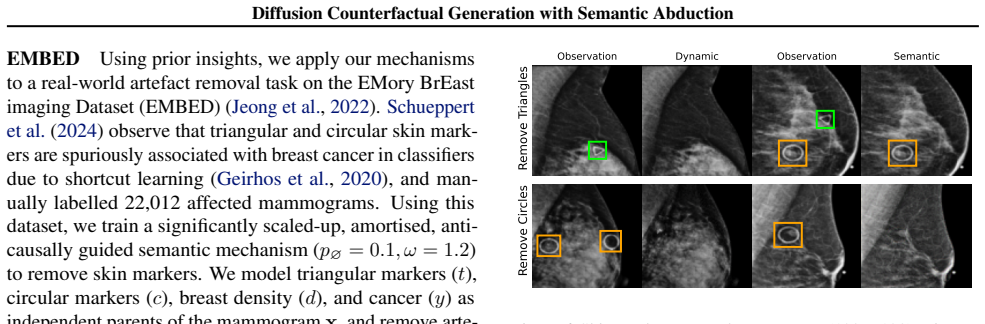
- Dynamic semantic abduction with counterfactual trajectory alignment improves preservation of background, hairstyle, skin tone, and facial structure; on EMBED it removes 95.16% of triangular and 91.69% of circular skin markers while holding density and cancer labels fixed.
- Diffusion models tuned for diverse random sampling (large $\omega$, small $p_\emptyset$) turn out to be the wrong operating regime for counterfactual soundness, so L3-style causal evaluation should guide conditioning design.
Reading between the lines
- Beyond the paper, the same semantic-abduction idea should be testable in text-guided latent diffusion: a fixed identity embedding could play the role of $z$, holding the subject stable while a prompt changes the attribute.
- A direct probe experiment---train a classifier to predict the intervened attribute from $z$ alone on held-out images---would quantify how much of the identity-preservation result depends on the exogeneity assumption the paper leaves unverified.
- The reported trade-off curves suggest that counterfactual benchmarks should report soundness as a function of $\omega$ and $p_\emptyset$ rather than at a single operating point, because a single point can rank methods almost arbitrarily.
- Counterfactual trajectory alignment could transfer to image-conditional editing beyond null-text inversion, potentially improving reversibility in any guided diffusion editor that optimises per-step tokens.
Editorial analysis
A structured set of objections, weighed in public.
Referee Report
Summary. The paper introduces a suite of diffusion-based structural causal mechanisms for counterfactual image generation, framed through Pearl's abduction-action-prediction procedure. It proposes (i) a spatial mechanism using conditional DDIM inversion for abduction, (ii) a semantic mechanism that adds a variational encoder producing a latent z treated as an exogenous noise term and held fixed under interventions, and (iii) dynamic semantic abduction with counterfactual trajectory alignment (CTA), which optimizes guidance tokens to align inverse and guided trajectories. The methods are evaluated on Morpho-MNIST, CelebA-HQ, and EMBED mammography data using axiomatic soundness metrics (composition, reversibility, effectiveness) and LPIPS-based identity preservation, with comparisons against VAE, HVAE, VCI, and DiffSCM baselines. The central claim is that semantic abduction improves identity preservation over purely spatial abduction at a modest cost in intervention effectiveness, and that dynamic ablation further preserves backgrounds and facial structure.
Significance. If the claims hold, the paper is a useful empirical contribution: it extends diffusion-based deep SCMs with a high-level semantic latent, introduces a practical test-time optimization for counterfactual trajectory alignment, and evaluates on three datasets with established external metrics and reported standard deviations in the main CelebA-HQ table. The writing is clear and the limitations are honestly stated. However, the central interpretation depends on an exogeneity assumption for z that the paper explicitly does not guarantee, and the main quantitative tables do not include the dynamic mechanism that is presented as a headline contribution. These issues are concrete and addressable within the paper's scope, so the appropriate disposition is major revision rather than acceptance in the current form.
major comments (3)
- [§3.2 and Limitations] The load-bearing claim that semantic abduction enables a 'principled trade-off' between causal control and identity preservation rests on treating z as exogenous noise independent of pa in Equations (12)-(14). The paper explicitly states in the Limitations that 'we do not guarantee that pa⊥⊥z|x'. With the non-identifiable unconditional prior p(z)=N(0,I), there is no mechanism preventing z from encoding the intervened attribute. If z encodes 'eyeglasses' or 'smiling', holding z fixed during do(g) or do(s) can carry the original attribute into the counterfactual, simultaneously lowering LPIPS and lowering effectiveness. Table 3 is consistent with this alternative explanation: for do(g) at ω=2, p∅=0.1, semantic obtains F1(g)=96.86 vs. spatial 99.07 while LPIPS improves from 0.171 to 0.096. The manuscript therefore does not rule out the possibility that the reported identity gain is an artifact of attribute leakage rather than a genuine causal property. A concrete fix within scope would be to train a probe to predict pa from abducted z, to ablate by re-sampling z from the prior p(z) during prediction, or to condition the semantic prior on pa and re-run Table 3.
- [§4, Table 3 and Figure 3c/5] Dynamic semantic abduction is presented as a headline contribution in Section 3.3, and the text claims it further improves preservation of backgrounds, hairstyle, skin tone, and facial structure. However, Table 3 contains no rows for 'Semantic w/ Dynamic Abd.', and Figure 5 only shows IDP as a function of η for dynamic abduction, without a matched static-semantic baseline in the same plot. The quantitative evidence for the dynamic claim is therefore limited to qualitative panels in Figure 3c. Please add a quantitative soundness table (composition, reversibility, IDP, effectiveness) for dynamic semantic abduction under matched ω, p∅, and η, including an η=0 no-update control.
- [Table 3, do(s) block] The abstract and Section 4 characterize the effectiveness cost of semantic abduction as 'minor' or 'small'. For the smiling intervention at ω=2, p∅=0.1, semantic obtains F1(s)=94.93 vs. spatial F1(s)=99.09, a drop of 4.16 points on the primary effectiveness metric, while IDP improves from 0.139 to 0.066. This is a substantial cost on the direct intervention target and should be discussed as such; the current wording understates a result that is central to the claimed trade-off.
minor comments (4)
- [Equation (13)] The expectation in the training objective is written as E_{x,c,t,ε,z} without specifying the distribution of z; please clarify that z is sampled from the variational posterior q_φ(z|e_φ(x)), since this matters for the correct interpretation of the objective.
- [Equation (20) and Algorithm 1] The notation x_{t-1}=h^{-1}_{t-1|C}(x_{t-2}) is inconsistent with Equation (7), where h^{-1}_{t|C} maps x_{t-1} to x_t, and with Algorithm 1, which takes the already-inverted trajectory as input. Please clarify whether x_{t-1} is recomputed from x_{t-2} or read from the stored inversion trajectory.
- [References] The citation 'Anonymous, 2024' appears in the Introduction and in the reference list as a submission under review; a published proceedings paper should not cite an anonymous under-review manuscript, so this should be replaced with a citable source or removed.
- [Tables 1 and 2] Standard deviations are reported for the CelebA-HQ results in Table 3 but not for the Morpho-MNIST results in Tables 1 and 2, making it difficult to assess whether small differences, such as the composition values separating spatial and semantic mechanisms, are meaningful.
Circularity Check
No circular derivation found; the paper is an empirical methods paper with an acknowledged identifiability caveat that could confound, but does not define, its central comparison.
full rationale
This is an empirical methods paper, not a derivation chain, and its central claims are supported by external benchmark metrics rather than by construction. Semantic abduction (Eqs. 12-15) holds a latent z fixed during intervention; the paper explicitly disclaims the key independence condition in the Limitations: 'we do not guarantee that pa⊥⊥z|x, but instead set the dimensionality of z and value of β such that we can control pa whilst improving identity preservation.' This is an identifiability and confounding caveat that could explain part of the reported IDP gain as attribute leakage, but it is not circular: IDP is not defined in terms of z, and no fitted parameter is renamed as a prediction. Counterfactual trajectory alignment (Eq. 20) optimizes guidance tokens to minimize trajectory mismatch, so the dynamic-abduction improvements partly reflect the optimization objective, but the headline semantic-vs-spatial comparison at matched ω and p∅ is not generated by that objective. Self-citations (e.g., Monteiro et al. 2023 for soundness metrics, De Sousa Ribeiro et al. 2023 as baseline) are standard prior work and are not used to force the central claim. I found no step where Eq. X equals Eq. Y by construction or where a parameter fitted to the target metric is presented as a prediction.
Assumptions & free parameters
free parameters (5)
- guidance scale omega =
1.2 to 4.5 (e.g., 1.5, 2, 3)
- conditioning dropout probability p_empty =
0.1, 0.2, 0.5
- CTA step size eta =
0.001 to 0.01 (fine-tuned per observation in Figure 3c)
- semantic KL weight beta =
not reported
- semantic latent dimensionality z =
8 (Morpho-MNIST), 32 (CelebA-HQ), 512 (EMBED)
assumptions (5)
- domain assumption Markovian SCM with acyclic, invertible mechanisms and independent exogenous noise
- domain assumption DDIM inversion is a bijection under the null intervention with a perfect noise estimator
- ad hoc to paper The semantic posterior is approximated by a diagonal Gaussian q_phi(z|e_phi(x)), and z is treated as independent exogenous noise, p(z)=N(0,I)
- domain assumption The causal graphs for CelebA-HQ (s implies m, o as independent parent of x) and EMBED (t, c, d, y as independent parents) are correct
- domain assumption The denoiser can amortise conditional and unconditional representations for classifier-free guidance
Cite this review
Pith. "Pith review of Diffusion Counterfactual Generation with Semantic Abduction." pith.science (2026). https://pith.science/paper/NGBGEBW7
@misc{pith2026250607883,
  author       = {Pith},
  title        = {Pith review of: Diffusion Counterfactual Generation with Semantic Abduction},
  year         = {2026},
  howpublished = {\url{https://pith.science/paper/NGBGEBW7}},
  note         = {Machine review of arXiv:2506.07883}
}
read the original abstract
Counterfactual image generation presents significant challenges, including preserving identity, maintaining perceptual quality, and ensuring faithfulness to an underlying causal model. While existing auto-encoding frameworks admit semantic latent spaces which can be manipulated for causal control, they struggle with scalability and fidelity. Advancements in diffusion models present opportunities for improving counterfactual image editing, having demonstrated state-of-the-art visual quality, human-aligned perception and representation learning capabilities. Here, we present a suite of diffusion-based causal mechanisms, introducing the notions of spatial, semantic and dynamic abduction. We propose a general framework that integrates semantic representations into diffusion models through the lens of Pearlian causality to edit images via a counterfactual reasoning process. To our knowledge, this is the first work to consider high-level semantic identity preservation for diffusion counterfactuals and to demonstrate how semantic control enables principled trade-offs between faithful causal control and identity preservation.
Figures


Figures from the paper (13 more)



Reference graph
Works this paper leans on
-
[1]
write newline
" write newline "" before.all 'output.state := FUNCTION n.dashify 't := "" t empty not t #1 #1 substring "-" = t #1 #2 substring "--" = not "--" * t #2 global.max substring 't := t #1 #1 substring "-" = "-" * t #2 global.max substring 't := while if t #1 #1 substring * t #2 global.max substring 't := if while FUNCTION format.date year duplicate empty "emp...
-
[2]
Diffusion-based representation learning
Abstreiter, K., Mittal, S., Bauer, S., Sch \"o lkopf, B., and Mehrjou, A. Diffusion-based representation learning. arXiv preprint arXiv:2105.14257, 2021
arXiv 2021
-
[3]
Scaling in-the-wild training for diffusion-based illumination harmonization and editing by imposing consistent light transport
Anonymous. Scaling in-the-wild training for diffusion-based illumination harmonization and editing by imposing consistent light transport. In Submitted to The Thirteenth International Conference on Learning Representations, 2024. URL https://openreview.net/forum?id=u1cQYxRI1H. under review
2024
-
[4]
Atad, M., Schinz, D., Moeller, H., Graf, R., Wiestler, B., Rueckert, D., Navab, N., Kirschke, J. S., and Keicher, M. Counterfactual explanations for medical image classification and regression using diffusion autoencoder. arXiv preprint arXiv:2408.01571, 2024
work page Pith review arXiv 2024
-
[5]
Diffusion visual counterfactual explanations
Augustin, M., Boreiko, V., Croce, F., and Hein, M. Diffusion visual counterfactual explanations. Advances in Neural Information Processing Systems, 35: 0 364--377, 2022
2022
-
[6]
Bareinboim, E., Correa, J. D., Ibeling, D., and Icard, T. On Pearl’s Hierarchy and the Foundations of Causal Inference, pp.\ 507–556. Association for Computing Machinery, New York, NY, USA, 1 edition, 2022. ISBN 9781450395861. URL https://doi.org/10.1145/3501714.3501743
arXiv 2022
-
[7]
Variational diffusion auto-encoder: Latent space extraction from pre-trained diffusion models
Batzolis, G., Stanczuk, J., and Sch \"o nlieb, C.-B. Variational diffusion auto-encoder: Latent space extraction from pre-trained diffusion models. arXiv preprint arXiv:2304.12141, 2023
arXiv 2023
-
[8]
P., Higgins, I., Pal, A., Matthey, L., Watters, N., Desjardins, G., and Lerchner, A
Burgess, C. P., Higgins, I., Pal, A., Matthey, L., Watters, N., Desjardins, G., and Lerchner, A. Understanding disentangling in beta- VAE . arXiv preprint arXiv:1804.03599, 2018
arXiv 2018
Show all 145 references
-
[9]
C., Tan, J., Kainz, B., Konukoglu, E., and Glocker, B
Castro, D. C., Tan, J., Kainz, B., Konukoglu, E., and Glocker, B. Morpho-MNIST : Quantitative assessment and diagnostics for representation learning. Journal of Machine Learning Research, 20 0 (178), 2019
2019
-
[10]
Chao, P., Bl \"o baum, P., and Kasiviswanathan, S. P. Interventional and counterfactual inference with diffusion models. arXiv preprint arXiv:2302.00860, 2023
2023 arXiv
-
[11]
Generalizable single-source cross-modality medical image segmentation via invariant causal mechanisms
Chen, B., Zhu, Y., Ao, Y., Caprara, S., Sutter, R., R \"a tsch, G., Konukoglu, E., and Susmelj, A. Generalizable single-source cross-modality medical image segmentation via invariant causal mechanisms. In 2025 IEEE/CVF Winter Conference on Applications of Computer Vision (WACV...
2025
-
[12]
Q., Li, X., Grosse, R., and Duvenaud, D
Chen, T. Q., Li, X., Grosse, R., and Duvenaud, D. Isolating sources of disentanglement in variational autoencoders. In Advances in Neural Information Processing Systems, 2018
2018
-
[13]
Infogan: Interpretable representation learning by information maximizing generative adversarial nets
Chen, X., Duan, Y., Houthooft, R., Schulman, J., Sutskever, I., and Abbeel, P. Infogan: Interpretable representation learning by information maximizing generative adversarial nets. Advances in neural information processing systems, 29, 2016
2016
-
[14]
Very deep vaes generalize autoregressive models and can outperform them on images
Child, R. Very deep vaes generalize autoregressive models and can outperform them on images. arXiv preprint arXiv:2011.10650, 2020
2011 arXiv
-
[15]
K., Lu, J., Inouye, D
Cho, W., Ravi, H., Harikumar, M., Khuc, V., Singh, K. K., Lu, J., Inouye, D. I., and Kale, A. Towards enhanced controllability of diffusion models. arXiv preprint arXiv:2302.14368, 2023
2023 arXiv
-
[16]
Y., Nam, H., and Ye, J
Chung, H., Kim, J., Park, G. Y., Nam, H., and Ye, J. C. Cfg++: Manifold-constrained classifier free guidance for diffusion models. arXiv preprint arXiv:2406.08070, 2024
2024 arXiv
-
[17]
and Jaini, P
Clark, K. and Jaini, P. Text-to-image diffusion models are zero shot classifiers. Advances in Neural Information Processing Systems, 36, 2024
2024
-
[18]
Diffedit: Diffusion-based semantic image editing with mask guidance
Couairon, G., Verbeek, J., Schwenk, H., and Cord, M. Diffedit: Diffusion-based semantic image editing with mask guidance. arXiv preprint arXiv:2210.11427, 2022
2022 arXiv
-
[19]
N., and Sharma, A
Dash, S., Balasubramanian, V. N., and Sharma, A. Evaluating and mitigating bias in image classifiers: A causal perspective using counterfactuals. In Proceedings of the IEEE/CVF Winter Conference on Applications of Computer Vision, pp.\ 915--924, 2022
2022
-
[20]
High fidelity image counterfactuals with probabilistic causal models
De Sousa Ribeiro, F., Xia, T., Monteiro, M., Pawlowski, N., and Glocker, B. High fidelity image counterfactuals with probabilistic causal models. In Proceedings of the 40th International Conference on Machine Learning, pp.\ 7390--7425, 2023
2023
-
[21]
and Nichol, A
Dhariwal, P. and Nichol, A. Diffusion models beat gans on image synthesis. Advances in neural information processing systems, 34: 0 8780--8794, 2021
2021
-
[22]
Rethinking conditional diffusion sampling with progressive guidance
Dinh, A.-D., Liu, D., and Xu, C. Rethinking conditional diffusion sampling with progressive guidance. In Oh, A., Naumann, T., Globerson, A., Saenko, K., Hardt, M., and Levine, S. (eds.), Advances in Neural Information Processing Systems, volume 36, pp.\ 42285--42297. Curran As...
2023
-
[23]
Diffusion self-guidance for controllable image generation
Epstein, D., Jabri, A., Poole, B., Efros, A., and Holynski, A. Diffusion self-guidance for controllable image generation. Advances in Neural Information Processing Systems, 36: 0 16222--16239, 2023
2023
-
[24]
Diffexplainer: Unveiling black box models via counterfactual generation
Fang, Y., Wu, S., Jin, Z., Wang, S., Xu, C., Walsh, S., and Yang, G. Diffexplainer: Unveiling black box models via counterfactual generation. In International Conference on Medical Image Computing and Computer-Assisted Intervention, pp.\ 208--218. Springer, 2024
2024
-
[25]
H., Chechik, G., and Cohen-Or, D
Gal, R., Alaluf, Y., Atzmon, Y., Patashnik, O., Bermano, A. H., Chechik, G., and Cohen-Or, D. An image is worth one word: Personalizing text-to-image generation using textual inversion. arXiv preprint arXiv:2208.01618, 2022
2022 arXiv
-
[26]
and Pearl, J
Galles, D. and Pearl, J. An axiomatic characterization of causal counterfactuals. Foundations of Science, 3: 0 151--182, 1998
1998
-
[27]
Geirhos, R., Jacobsen, J.-H., Michaelis, C., Zemel, R., Brendel, W., Bethge, M., and Wichmann, F. A. Shortcut learning in deep neural networks. Nature Machine Intelligence, 2 0 (11): 0 665--673, 2020
2020
-
[28]
Generative adversarial nets
Goodfellow, I., Pouget-Abadie, J., Mirza, M., Xu, B., Warde-Farley, D., Ozair, S., Courville, A., and Bengio, Y. Generative adversarial nets. Advances in neural information processing systems, 27, 2014
2014
-
[29]
P., Gao, J., and Poon, H
Gu, Y., Yang, J., Usuyama, N., Li, C., Zhang, S., Lungren, M. P., Gao, J., and Poon, H. Biomedjourney: Counterfactual biomedical image generation by instruction-learning from multimodal patient journeys. arXiv preprint arXiv:2310.10765, 2023
-
[30]
S., and Michaeli, T
Haas, R., Huberman-Spiegelglas, I., Mulayoff, R., Gra hof, S., Brandt, S. S., and Michaeli, T. Discovering interpretable directions in the semantic latent space of diffusion models. In 2024 IEEE 18th International Conference on Automatic Face and Gesture Recognition (FG), pp.\...
2024
-
[31]
Halpern, J. Y. Axiomatizing causal reasoning. Journal of Artificial Intelligence Research, 12: 0 317--337, 2000
2000
-
[32]
Prompt-to-prompt image editing with cross attention control
Hertz, A., Mokady, R., Tenenbaum, J., Aberman, K., Pritch, Y., and Cohen-Or, D. Prompt-to-prompt image editing with cross attention control. arXiv preprint arXiv:2208.01626, 2022
2022 arXiv
-
[33]
beta- VAE : Learning basic visual concepts with a constrained variational framework
Higgins, I., Matthey, L., Pal, A., Burgess, C., Glorot, X., Botvinick, M., Mohamed, S., and Lerchner, A. beta- VAE : Learning basic visual concepts with a constrained variational framework. In International Conference on Learning Representations, 2017. URL https://openreview.n...
2017
-
[34]
and Salimans, T
Ho, J. and Salimans, T. Classifier-free diffusion guidance. arXiv preprint arXiv:2207.12598, 2022
2022 arXiv
-
[35]
Denoising diffusion probabilistic models
Ho, J., Jain, A., and Abbeel, P. Denoising diffusion probabilistic models. Advances in neural information processing systems, 33: 0 6840--6851, 2020
2020
-
[36]
Enforcing conditional independence for fair representation learning and causal image generation
Hwa, J., Zhao, Q., Lahiri, A., Masood, A., Salimi, B., and Adeli, E. Enforcing conditional independence for fair representation learning and causal image generation. In Proceedings of the IEEE/CVF Conference on Computer Vision and Pattern Recognition, pp.\ 103--112, 2024
2024
-
[37]
and Morioka, H
Hyvarinen, A. and Morioka, H. Unsupervised feature extraction by time-contrastive learning and nonlinear ica. Advances in neural information processing systems, 29, 2016
2016
-
[38]
Nonlinear ica using auxiliary variables and generalized contrastive learning
Hyvarinen, A., Sasaki, H., and Turner, R. Nonlinear ica using auxiliary variables and generalized contrastive learning. In The 22nd International Conference on Artificial Intelligence and Statistics, pp.\ 859--868. PMLR, 2019
2019
-
[39]
Semi-supervised learning for deep causal generative models
Ibrahim, Y., Warr, H., and Kamnitsas, K. Semi-supervised learning for deep causal generative models. arXiv preprint arXiv:2403.18717, 2024
2024 arXiv
-
[40]
Intriguing properties of generative classifiers
Jaini, P., Clark, K., and Geirhos, R. Intriguing properties of generative classifiers. arXiv preprint arXiv:2309.16779, 2023
2023 arXiv
-
[41]
J., Vey, B
Jeong, J. J., Vey, B. L., Reddy, A., Kim, T., Santos, T., Correa, R., Dutt, R., Mosunjac, M., Oprea-Ilies, G., Smith, G., et al. The emory breast imaging dataset (embed): a racially diverse, granular dataset of 3.5 m screening and diagnostic mammograms. arXiv preprint arXiv:22...
2022 arXiv
-
[42]
Progressive growing of gans for improved quality, stability, and variation
Karras, T. Progressive growing of gans for improved quality, stability, and variation. arXiv preprint arXiv:1710.10196, 2017
2017 arXiv
-
[43]
A style-based generator architecture for generative adversarial networks
Karras, T. A style-based generator architecture for generative adversarial networks. arXiv preprint arXiv:1812.04948, 2019
2019 arXiv
-
[44]
Analyzing and improving the image quality of stylegan
Karras, T., Laine, S., Aittala, M., Hellsten, J., Lehtinen, J., and Aila, T. Analyzing and improving the image quality of stylegan. In Proceedings of the IEEE/CVF conference on computer vision and pattern recognition, pp.\ 8110--8119, 2020
2020
-
[45]
Guiding a diffusion model with a bad version of itself
Karras, T., Aittala, M., Kynk \"a \"a nniemi, T., Lehtinen, J., Aila, T., and Laine, S. Guiding a diffusion model with a bad version of itself. arXiv preprint arXiv:2406.02507, 2024
2024 arXiv
-
[46]
Variational autoencoders and nonlinear ica: A unifying framework
Khemakhem, I., Kingma, D., Monti, R., and Hyvarinen, A. Variational autoencoders and nonlinear ica: A unifying framework. In International conference on artificial intelligence and statistics, pp.\ 2207--2217. PMLR, 2020 a
2020
-
[47]
Ice-beem: Identifiable conditional energy-based deep models based on nonlinear ica
Khemakhem, I., Monti, R., Kingma, D., and Hyvarinen, A. Ice-beem: Identifiable conditional energy-based deep models based on nonlinear ica. Advances in Neural Information Processing Systems, 33: 0 12768--12778, 2020 b
2020
-
[48]
and Mnih, A
Kim, H. and Mnih, A. Disentangling by factorising. In International Conference on Machine Learning, 2018
2018
-
[49]
Auto-encoding variational bayes
Kingma, D. Auto-encoding variational bayes. arXiv preprint arXiv:1312.6114, 2013
2013 arXiv
-
[50]
Kingma, D. P. Adam: A method for stochastic optimization. arXiv preprint arXiv:1412.6980, 2014
2014 arXiv
-
[51]
u gelgen, J., Sch \
Kladny, K.-R., von K \"u gelgen, J., Sch \"o lkopf, B., and Muehlebach, M. Deep backtracking counterfactuals for causally compliant explanations. arXiv preprint arXiv:2310.07665, 2023
2023 arXiv
-
[52]
G., and Vishwanath, S
Kocaoglu, M., Snyder, C., Dimakis, A. G., and Vishwanath, S. Causalgan: Learning causal implicit generative models with adversarial training. arXiv preprint arXiv:1709.02023, 2017
2017 arXiv
-
[53]
From identifiable causal representations to controllable counterfactual generation: A survey on causal generative modeling
Komanduri, A., Wu, X., Wu, Y., and Chen, F. From identifiable causal representations to controllable counterfactual generation: A survey on causal generative modeling. arXiv preprint arXiv:2310.11011, 2023
2023 arXiv
-
[54]
Causal diffusion autoencoders: Toward counterfactual generation via diffusion probabilistic models
Komanduri, A., Zhao, C., Chen, F., and Wu, X. Causal diffusion autoencoders: Toward counterfactual generation via diffusion probabilistic models. arXiv preprint arXiv:2404.17735, 2024
2024 arXiv
-
[55]
Variational inference of disentangled latent concepts from unlabeled observations
Kumar, A., Sattigeri, P., and Balakrishnan, A. Variational inference of disentangled latent concepts from unlabeled observations. In International Conference on Learning Representations, 2018
2018
-
[56]
Li, S., Hooi, B., and Lee, G. H. Identifying through flows for recovering latent representations. arXiv preprint arXiv:1909.12555, 2019
1909 arXiv
-
[57]
Common diffusion noise schedules and sample steps are flawed
Lin, S., Liu, B., Li, J., and Yang, X. Common diffusion noise schedules and sample steps are flawed. In Proceedings of the IEEE/CVF winter conference on applications of computer vision, pp.\ 5404--5411, 2024
2024
-
[58]
R., and Hand, E
Lingenfelter, B., Davis, S. R., and Hand, E. M. A quantitative analysis of labeling issues in the celeba dataset. In Advances in Visual Computing: 17th International Symposium, ISVC 2022, San Diego, CA, USA, October 3–5, 2022, Proceedings, Part I, pp.\ 129–141, Berlin, Heidelb...
2022 doi
-
[59]
Deep learning face attributes in the wild
Liu, Z., Luo, P., Wang, X., and Tang, X. Deep learning face attributes in the wild. In Proceedings of International Conference on Computer Vision (ICCV), December 2015
2015
-
[60]
Challenging common assumptions in the unsupervised learning of disentangled representations
Locatello, F., Bauer, S., Lucic, M., Raetsch, G., Gelly, S., Sch \"o lkopf, B., and Bachem, O. Challenging common assumptions in the unsupervised learning of disentangled representations. In international conference on machine learning, pp.\ 4114--4124. PMLR, 2019
2019
-
[61]
a tsch, G., Gelly, S., Sch \
Locatello, F., Bauer, S., Lucic, M., R \"a tsch, G., Gelly, S., Sch \"o lkopf, B., and Bachem, O. A sober look at the unsupervised learning of disentangled representations and their evaluation. Journal of Machine Learning Research, 21 0 (209): 0 1--62, 2020
2020
-
[62]
Understanding diffusion models: A unified perspective
Luo, C. Understanding diffusion models: A unified perspective. arXiv preprint arXiv:2208.11970, 2022
2022 arXiv
-
[63]
Melistas, T., Spyrou, N., Gkouti, N., Sanchez, P., Vlontzos, A., Papanastasiou, G., and Tsaftaris, S. A. Benchmarking counterfactual image generation. arXiv preprint arXiv:2403.20287, 2024
2024 arXiv
-
[64]
Sdedit: Guided image synthesis and editing with stochastic differential equations
Meng, C., He, Y., Song, Y., Song, J., Wu, J., Zhu, J.-Y., and Ermon, S. Sdedit: Guided image synthesis and editing with stochastic differential equations. arXiv preprint arXiv:2108.01073, 2021
2021 arXiv
-
[65]
and Osindero, S
Mirza, M. and Osindero, S. Conditional generative adversarial nets. arXiv preprint arXiv:1411.1784, 2014
2014 arXiv
-
[66]
Diffusion based representation learning
Mittal, S., Abstreiter, K., Bauer, S., Sch\" o lkopf, B., and Mehrjou, A. Diffusion based representation learning. In Krause, A., Brunskill, E., Cho, K., Engelhardt, B., Sabato, S., and Scarlett, J. (eds.), Proceedings of the 40th International Conference on Machine Learning, ...
2023
-
[67]
Null-text inversion for editing real images using guided diffusion models
Mokady, R., Hertz, A., Aberman, K., Pritch, Y., and Cohen-Or, D. Null-text inversion for editing real images using guided diffusion models. In Proceedings of the IEEE/CVF Conference on Computer Vision and Pattern Recognition, pp.\ 6038--6047, 2023
2023
-
[68]
Monteiro, M., Ribeiro, F. D. S., Pawlowski, N., Castro, D. C., and Glocker, B. Measuring axiomatic soundness of counterfactual image models. arXiv preprint arXiv:2303.01274, 2023
2023 arXiv
-
[69]
Glide: Towards photorealistic image generation and editing with text-guided diffusion models
Nichol, A., Dhariwal, P., Ramesh, A., Shyam, P., Mishkin, P., McGrew, B., Sutskever, I., and Chen, M. Glide: Towards photorealistic image generation and editing with text-guided diffusion models. arXiv preprint arXiv:2112.10741, 2021
2021 arXiv
-
[70]
Nichol, A. Q. and Dhariwal, P. Improved denoising diffusion probabilistic models. In International conference on machine learning, pp.\ 8162--8171. PMLR, 2021
2021
-
[71]
and Bareinboim, E
Pan, Y. and Bareinboim, E. Counterfactual image editing. arXiv preprint arXiv:2403.09683, 2024
2024 arXiv
-
[72]
Diffusevae: Efficient, controllable and high-fidelity generation from low-dimensional latents
Pandey, K., Mukherjee, A., Rai, P., and Kumar, A. Diffusevae: Efficient, controllable and high-fidelity generation from low-dimensional latents. arXiv preprint arXiv:2201.00308, 2022
2022 arXiv
-
[73]
J., Mohamed, S., and Lakshminarayanan, B
Papamakarios, G., Nalisnick, E., Rezende, D. J., Mohamed, S., and Lakshminarayanan, B. Normalizing flows for probabilistic modeling and inference. Journal of Machine Learning Research, 22 0 (57): 0 1--64, 2021
2021
-
[74]
Understanding the latent space of diffusion models through the lens of riemannian geometry
Park, Y.-H., Kwon, M., Choi, J., Jo, J., and Uh, Y. Understanding the latent space of diffusion models through the lens of riemannian geometry. Advances in Neural Information Processing Systems, 36: 0 24129--24142, 2023
2023
-
[75]
Zero-shot image-to-image translation
Parmar, G., Kumar Singh, K., Zhang, R., Li, Y., Lu, J., and Zhu, J.-Y. Zero-shot image-to-image translation. In ACM SIGGRAPH 2023 Conference Proceedings, pp.\ 1--11, 2023
2023
-
[76]
Deep structural causal models for tractable counterfactual inference
Pawlowski, N., Coelho de Castro, D., and Glocker, B. Deep structural causal models for tractable counterfactual inference. Advances in Neural Information Processing Systems, 33: 0 857--869, 2020
2020
-
[77]
Direct and indirect effects
Pearl, J. Direct and indirect effects. Proceedings of the Seventeenth Conference on Uncertainty in Artificial Intelligence, pp.\ 411--420, 2001
2001
-
[78]
Causality
Pearl, J. Causality. Cambridge University Press, 2 edition, 2009. doi:10.1017/CBO9780511803161
2009 doi
-
[79]
The seven tools of causal inference, with reflections on machine learning
Pearl, J. The seven tools of causal inference, with reflections on machine learning. Communications of the ACM, 62 0 (3): 0 54--60, 2019
2019
-
[80]
The hessian penalty: A weak prior for unsupervised disentanglement
Peebles, W., Peebles, J., Zhu, J.-Y., Efros, A., and Torralba, A. The hessian penalty: A weak prior for unsupervised disentanglement. In Computer Vision--ECCV 2020: 16th European Conference, Glasgow, UK, August 23--28, 2020, Proceedings, Part VI 16, pp.\ 581--597. Springer, 2020
2020
-
[81]
P., van Breugel, B., Castro, D
P \'e rez-Garc \' a, F., Bond-Taylor, S., Sanchez, P. P., van Breugel, B., Castro, D. C., Sharma, H., Salvatelli, V., Wetscherek, M. T., Richardson, H., Lungren, M. P., et al. Radedit: stress-testing biomedical vision models via diffusion image editing. arXiv preprint arXiv:23...
2023 arXiv
-
[82]
Elements of Causal Inference: Foundations and Learning Algorithms
Peters, J., Janzing, D., and Schlkopf, B. Elements of Causal Inference: Foundations and Learning Algorithms. The MIT Press, 2017. ISBN 0262037319
2017
-
[83]
Sdxl: Improving latent diffusion models for high-resolution image synthesis
Podell, D., English, Z., Lacey, K., Blattmann, A., Dockhorn, T., M \"u ller, J., Penna, J., and Rombach, R. Sdxl: Improving latent diffusion models for high-resolution image synthesis. arXiv preprint arXiv:2307.01952, 2023
2023 arXiv
-
[84]
Learning structural causal models through deep generative models: Methods, guarantees, and challenges
Poinsot, A., Leite, A., Chesneau, N., S \'e bag, M., and Schoenauer, M. Learning structural causal models through deep generative models: Methods, guarantees, and challenges. arXiv preprint arXiv:2405.05025, 2024
2024 arXiv
-
[85]
Lance: Stress-testing visual models by generating language-guided counterfactual images
Prabhu, V., Yenamandra, S., Chattopadhyay, P., and Hoffman, J. Lance: Stress-testing visual models by generating language-guided counterfactual images. Advances in Neural Information Processing Systems, 36: 0 25165--25184, 2023
2023
-
[86]
Diffusion autoencoders: Toward a meaningful and decodable representation
Preechakul, K., Chatthee, N., Wizadwongsa, S., and Suwajanakorn, S. Diffusion autoencoders: Toward a meaningful and decodable representation. In Proceedings of the IEEE/CVF Conference on Computer Vision and Pattern Recognition, pp.\ 10619--10629, 2022
2022
-
[87]
M., Jordan, M., and Kocaoglu, M
Rahman, M. M., Jordan, M., and Kocaoglu, M. Conditional generative models are sufficient to sample from any causal effect estimand. arXiv preprint arXiv:2402.07419, 2024
2024 arXiv
-
[88]
C., Pawlowski, N., and Glocker, B
Rasal, R., Castro, D. C., Pawlowski, N., and Glocker, B. Deep structural causal shape models. In European Conference on Computer Vision, pp.\ 400--432. Springer, 2022
2022
-
[89]
C., Oxtoby, N
Ravi, D., Alexander, D. C., Oxtoby, N. P., and Initiative, A. D. N. Degenerative adversarial neuroimage nets: generating images that mimic disease progression. In International Conference on Medical Image Computing and Computer-Assisted Intervention, pp.\ 164--172. Springer, 2019
2019
-
[90]
C., Carass, A., and Prince, J
Reinhold, J. C., Carass, A., and Prince, J. L. A structural causal model for mr images of multiple sclerosis. In Medical Image Computing and Computer Assisted Intervention--MICCAI 2021: 24th International Conference, Strasbourg, France, September 27--October 1, 2021, Proceedin...
2021
-
[91]
Rezende, D. J. and Viola, F. Taming vaes. arXiv preprint arXiv:1810.00597, 2018
2018 arXiv
-
[92]
Ribeiro, F. D. S. and Glocker, B. Demystifying variational diffusion models. arXiv preprint arXiv:2401.06281, 2024
2024 arXiv
-
[93]
On linear identifiability of learned representations
Roeder, G., Metz, L., and Kingma, D. On linear identifiability of learned representations. In International Conference on Machine Learning, pp.\ 9030--9039. PMLR, 2021
2021
-
[94]
High-resolution image synthesis with latent diffusion models
Rombach, R., Blattmann, A., Lorenz, D., Esser, P., and Ommer, B. High-resolution image synthesis with latent diffusion models. In Proceedings of the IEEE/CVF conference on computer vision and pattern recognition, pp.\ 10684--10695, 2022
2022
-
[95]
U-net: Convolutional networks for biomedical image segmentation
Ronneberger, O., Fischer, P., and Brox, T. U-net: Convolutional networks for biomedical image segmentation. In Medical image computing and computer-assisted intervention--MICCAI 2015: 18th international conference, Munich, Germany, October 5-9, 2015, proceedings, part III 18, ...
2015
-
[96]
Counterfactual contrastive learning: robust representations via causal image synthesis
Roschewitz, M., de Sousa Ribeiro, F., Xia, T., Khara, G., and Glocker, B. Counterfactual contrastive learning: robust representations via causal image synthesis. In MICCAI Workshop on Data Engineering in Medical Imaging, pp.\ 22--32. Springer, 2024
2024
-
[97]
Dreambooth: Fine tuning text-to-image diffusion models for subject-driven generation
Ruiz, N., Li, Y., Jampani, V., Pritch, Y., Rubinstein, M., and Aberman, K. Dreambooth: Fine tuning text-to-image diffusion models for subject-driven generation. In Proceedings of the IEEE/CVF conference on computer vision and pattern recognition, pp.\ 22500--22510, 2023
2023
-
[98]
L., Ghasemipour, K., Gontijo Lopes, R., Karagol Ayan, B., Salimans, T., et al
Saharia, C., Chan, W., Saxena, S., Li, L., Whang, J., Denton, E. L., Ghasemipour, K., Gontijo Lopes, R., Karagol Ayan, B., Salimans, T., et al. Photorealistic text-to-image diffusion models with deep language understanding. Advances in neural information processing systems, 35...
2022
-
[99]
and Ho, J
Salimans, T. and Ho, J. Progressive distillation for fast sampling of diffusion models. arXiv preprint arXiv:2202.00512, 2022
2022 arXiv
-
[100]
and Tsaftaris, S
Sanchez, P. and Tsaftaris, S. A. Diffusion causal models for counterfactual estimation. arXiv preprint arXiv:2202.10166, 2022
2022 arXiv
-
[101]
Q., and Tsaftaris, S
Sanchez, P., Kascenas, A., Liu, X., O’Neil, A. Q., and Tsaftaris, S. A. What is healthy? generative counterfactual diffusion for lesion localization. In MICCAI Workshop on Deep Generative Models, pp.\ 34--44. Springer, 2022 a
2022
-
[102]
P., Xia, T., Watson, H
Sanchez, P., Voisey, J. P., Xia, T., Watson, H. I., O’Neil, A. Q., and Tsaftaris, S. A. Causal machine learning for healthcare and precision medicine. Royal Society Open Science, 9 0 (8): 0 220638, 2022 b
2022
-
[103]
and Geiger, A
Sauer, A. and Geiger, A. Counterfactual generative networks. arXiv preprint arXiv:2101.06046, 2021
2021 arXiv
-
[104]
Radio-opaque artefacts in digital mammography: automatic detection and analysis of downstream effects
Schueppert, A., Glocker, B., and Roschewitz, M. Radio-opaque artefacts in digital mammography: automatic detection and analysis of downstream effects. arXiv preprint arXiv:2410.03809, 2024
2024 arXiv
-
[105]
Generating interpretable counterfactual explanations by implicit minimisation of epistemic and aleatoric uncertainties
Schut, L., Key, O., Mc Grath, R., Costabello, L., Sacaleanu, B., Gal, Y., et al. Generating interpretable counterfactual explanations by implicit minimisation of epistemic and aleatoric uncertainties. In International Conference on Artificial Intelligence and Statistics, pp.\ ...
2021
-
[106]
Weakly supervised disentangled generative causal representation learning
Shen, X., Liu, F., Dong, H., Lian, Q., Chen, Z., and Zhang, T. Weakly supervised disentangled generative causal representation learning. Journal of Machine Learning Research, 23 0 (241): 0 1--55, 2022
2022
-
[107]
Promptable counterfactual diffusion model for unified brain tumor segmentation and generation with mris
Shen, Y., He, G., and Unberath, M. Promptable counterfactual diffusion model for unified brain tumor segmentation and generation with mris. In International Workshop on Foundation Models for General Medical AI, pp.\ 81--90. Springer, 2024
2024
-
[108]
and Ermon, S
Shu, R. and Ermon, S. Bit prioritization in variational autoencoders via progressive coding. In Chaudhuri, K., Jegelka, S., Song, L., Szepesvari, C., Niu, G., and Sabato, S. (eds.), Proceedings of the 39th International Conference on Machine Learning, volume 162 of Proceedings...
2022
-
[109]
Deep unsupervised learning using nonequilibrium thermodynamics
Sohl-Dickstein, J., Weiss, E., Maheswaranathan, N., and Ganguli, S. Deep unsupervised learning using nonequilibrium thermodynamics. In Bach, F. and Blei, D. (eds.), Proceedings of the 32nd International Conference on Machine Learning, volume 37 of Proceedings of Machine Learni...
2015
-
[110]
Learning structured output representation using deep conditional generative models
Sohn, K., Lee, H., and Yan, X. Learning structured output representation using deep conditional generative models. In Cortes, C., Lawrence, N., Lee, D., Sugiyama, M., and Garnett, R. (eds.), Advances in Neural Information Processing Systems, volume 28. Curran Associates, Inc.,...
2015
-
[111]
Denoising diffusion implicit models
Song, J., Meng, C., and Ermon, S. Denoising diffusion implicit models. arXiv preprint arXiv:2010.02502, 2020 a
2010 arXiv
-
[112]
Doubly abductive counterfactual inference for text-based image editing
Song, X., Cui, J., Zhang, H., Chen, J., Hong, R., and Jiang, Y.-G. Doubly abductive counterfactual inference for text-based image editing. In Proceedings of the IEEE/CVF Conference on Computer Vision and Pattern Recognition, pp.\ 9162--9171, 2024
2024
-
[113]
and Ermon, S
Song, Y. and Ermon, S. Generative modeling by estimating gradients of the data distribution. Advances in neural information processing systems, 32, 2019
2019
-
[114]
P., Kumar, A., Ermon, S., and Poole, B
Song, Y., Sohl-Dickstein, J., Kingma, D. P., Kumar, A., Ermon, S., and Poole, B. Score-based generative modeling through stochastic differential equations. arXiv preprint arXiv:2011.13456, 2020 b
2011 arXiv
-
[115]
Consistency models
Song, Y., Dhariwal, P., Chen, M., and Sutskever, I. Consistency models. arXiv preprint arXiv:2303.01469, 2023
2023 arXiv
-
[116]
Disentanglement by nonlinear ica with general incompressible-flow networks (gin)
Sorrenson, P., Rother, C., and K \"o the, U. Disentanglement by nonlinear ica with general incompressible-flow networks (gin). arXiv preprint arXiv:2001.04872, 2020
2001 arXiv
-
[117]
Locinv: Localization-aware inversion for text-guided image editing
Tang, C., Wang, K., Yang, F., and van de Weijer, J. Locinv: Localization-aware inversion for text-guided image editing. arXiv preprint arXiv:2405.01496, 2024
2024 arXiv
-
[118]
What the daam: Interpreting stable diffusion using cross attention
Tang, R., Liu, L., Pandey, A., Jiang, Z., Yang, G., Kumar, K., Stenetorp, P., Lin, J., and Ture, F. What the daam: Interpreting stable diffusion using cross attention. arXiv preprint arXiv:2210.04885, 2022
2022 arXiv
-
[119]
Causal generative explainers using counterfactual inference: a case study on the morpho-mnist dataset
Taylor-Melanson, W., Sadeghi, Z., and Matwin, S. Causal generative explainers using counterfactual inference: a case study on the morpho-mnist dataset. Pattern Analysis and Applications, 27 0 (3): 0 89, 2024
2024
-
[120]
Identifying incorrect annotations in multi-label classification data
Thyagarajan, A., Snorrason, E., Northcutt, C., and Mueller, J. Identifying incorrect annotations in multi-label classification data. arXiv preprint arXiv:2211.13895, 2022
2022 arXiv
-
[121]
Diffuse, attend, and segment: Unsupervised zero-shot segmentation using stable diffusion
Tian, J., Aggarwal, L., Colaco, A., Kira, Z., and Gonzalez-Franco, M. Diffuse, attend, and segment: Unsupervised zero-shot segmentation using stable diffusion. arXiv preprint arXiv:2308.12469, 2023
2023 arXiv
-
[122]
Plug-and-play diffusion features for text-driven image-to-image translation
Tumanyan, N., Geyer, M., Bagon, S., and Dekel, T. Plug-and-play diffusion features for text-driven image-to-image translation. In Proceedings of the IEEE/CVF Conference on Computer Vision and Pattern Recognition, pp.\ 1921--1930, 2023
1921
-
[123]
E., Diaconu, C.-D., Markou, S., Shysheya, A., Foong, A
Turner, R. E., Diaconu, C.-D., Markou, S., Shysheya, A., Foong, A. Y., and Mlodozeniec, B. Denoising diffusion probabilistic models in six simple steps. arXiv preprint arXiv:2402.04384, 2024
2024 arXiv
-
[124]
and Kautz, J
Vahdat, A. and Kautz, J. Nvae: A deep hierarchical variational autoencoder. Advances in neural information processing systems, 33: 0 19667--19679, 2020
2020
-
[125]
and Klaise, J
Van Looveren, A. and Klaise, J. Interpretable counterfactual explanations guided by prototypes. In Joint European Conference on Machine Learning and Knowledge Discovery in Databases, pp.\ 650--665. Springer, 2021
2021
-
[126]
u gelgen, J., Sharma, Y., Gresele, L., Brendel, W., Sch \
Von K \"u gelgen, J., Sharma, Y., Gresele, L., Brendel, W., Sch \"o lkopf, B., Besserve, M., and Locatello, F. Self-supervised learning with data augmentations provably isolates content from style. Advances in neural information processing systems, 34: 0 16451--16467, 2021
2021
-
[127]
and Vastola, J
Wang, B. and Vastola, J. J. The hidden linear structure in score-based models and its application. arXiv preprint arXiv:2311.10892, 2023
2023 arXiv
-
[128]
A., and van de Weijer, J
Wang, K., Yang, F., Yang, S., Butt, M. A., and van de Weijer, J. Dynamic prompt learning: Addressing cross-attention leakage for text-based image editing. arXiv preprint arXiv:2309.15664, 2023 a
2023 arXiv
-
[129]
Instructedit: Improving automatic masks for diffusion-based image editing with user instructions
Wang, Q., Zhang, B., Birsak, M., and Wonka, P. Instructedit: Improving automatic masks for diffusion-based image editing with user instructions. arXiv preprint arXiv:2305.18047, 2023 b
2023 arXiv
-
[130]
Concept algebra for (score-based) text-controlled generative models
Wang, Z., Gui, L., Negrea, J., and Veitch, V. Concept algebra for (score-based) text-controlled generative models. Advances in Neural Information Processing Systems, 36, 2024
2024
-
[131]
Fast diffusion-based counterfactuals for shortcut removal and generation
Weng, N., Pegios, P., Feragen, A., Petersen, E., and Bigdeli, S. Fast diffusion-based counterfactuals for shortcut removal and generation. arXiv preprint arXiv:2312.14223, 2023
2023 arXiv
-
[132]
and Paige, B
Willetts, M. and Paige, B. I don't need u: Identifiable non-linear ica without side information. arXiv preprint arXiv:2106.05238, 2021
2021 arXiv
-
[133]
Learning likelihoods with conditional normalizing flows
Winkler, C., Worrall, D., Hoogeboom, E., and Welling, M. Learning likelihoods with conditional normalizing flows. arXiv preprint arXiv:1912.00042, 2019
1912 arXiv
-
[134]
C., and Bowyer, K
Wu, H., Bezold, G., G \"u nther, M., Boult, T., King, M. C., and Bowyer, K. W. Consistency and accuracy of celeba attribute values. In Proceedings of the IEEE/CVF Conference on Computer Vision and Pattern Recognition, pp.\ 3258--3266, 2023
2023
-
[135]
Counterfactual generative modeling with variational causal inference
Wu, Y., McConnell, L., and Iriondo, C. Counterfactual generative modeling with variational causal inference. arXiv preprint arXiv:2410.12730, 2024
2024 arXiv
-
[136]
M., Pan, Y., and Bareinboim, E
Xia, K. M., Pan, Y., and Bareinboim, E. Neural causal models for counterfactual identification and estimation. In The Eleventh International Conference on Learning Representations, 2023
2023
-
[137]
Xia, T., Roschewitz, M., Ribeiro, F. D. S., Jones, C., and Glocker, B. Mitigating attribute amplification in counterfactual image generation. arXiv preprint arXiv:2403.09422, 2024
2024 arXiv
-
[138]
Counterfactual generation with identifiability guarantees
Yan, H., Kong, L., Gui, L., Chi, Y., Xing, E., He, Y., and Zhang, K. Counterfactual generation with identifiability guarantees. Advances in Neural Information Processing Systems, 36: 0 56256--56277, 2023
2023
-
[139]
Paint by example: Exemplar-based image editing with diffusion models
Yang, B., Gu, S., Zhang, B., Zhang, T., Chen, X., Sun, X., Chen, D., and Wen, F. Paint by example: Exemplar-based image editing with diffusion models. In Proceedings of the IEEE/CVF Conference on Computer Vision and Pattern Recognition, pp.\ 18381--18391, 2023 a
2023
-
[140]
A., van de Weijer, J., et al
Yang, F., Yang, S., Butt, M. A., van de Weijer, J., et al. Dynamic prompt learning: Addressing cross-attention leakage for text-based image editing. Advances in Neural Information Processing Systems, 36, 2024
2024
-
[141]
Causalvae: Disentangled representation learning via neural structural causal models
Yang, M., Liu, F., Chen, Z., Shen, X., Hao, J., and Wang, J. Causalvae: Disentangled representation learning via neural structural causal models. In Proceedings of the IEEE/CVF conference on computer vision and pattern recognition, pp.\ 9593--9602, 2021
2021
-
[142]
Disdiff: Unsupervised disentanglement of diffusion probabilistic models
Yang, T., Wang, Y., Lv, Y., and Zheng, N. Disdiff: Unsupervised disentanglement of diffusion probabilistic models. arXiv preprint arXiv:2301.13721, 2023 b
2023 arXiv
-
[143]
Pearl causal hierarchy on image data: Intricacies & challenges
Ze c evi \'c , M., Willig, M., Singh Dhami, D., and Kersting, K. Pearl causal hierarchy on image data: Intricacies & challenges. arXiv e-prints, pp.\ arXiv--2212, 2022
2022
-
[144]
A., Shechtman, E., and Wang, O
Zhang, R., Isola, P., Efros, A. A., Shechtman, E., and Wang, O. The unreasonable effectiveness of deep features as a perceptual metric. In CVPR, 2018
2018
-
[145]
Unsupervised representation learning from pre-trained diffusion probabilistic models
Zhang, Z., Zhao, Z., and Lin, Z. Unsupervised representation learning from pre-trained diffusion probabilistic models. Advances in neural information processing systems, 35: 0 22117--22130, 2022
2022
Reviewed August 7, 2026 · model on record in the stance chip above.
Discussion (0). Sign in to comment.