REVIEW 5 major objections 7 minor 113 references
Multi-Agent Language Models: Advancing Cooperation, Coordination, and Adaptation
T0 review · 5 major / 7 minor · reviewed 2026-08-07 · deepseek-v4-flash
Pith's one-line read This thesis claims that language models become better cooperators when retrained on in-game transitions selected by state features, or used as distillation teachers for RL agents, with average per-game gains around 53% and fivefold sample…
desk verdict A transparent thesis proposal that compiles two earlier papers; the theory-of-mind framing is unsupported, the headline 53% gain is inflated and oracle-dependent, but the Hanabi-text benchmark and distillation result are worth a look. read the letter →
The pith
A machine-rendered reading of the paper's core claim, the machinery that carries it, and where it could break.
The reading
What carries the argument
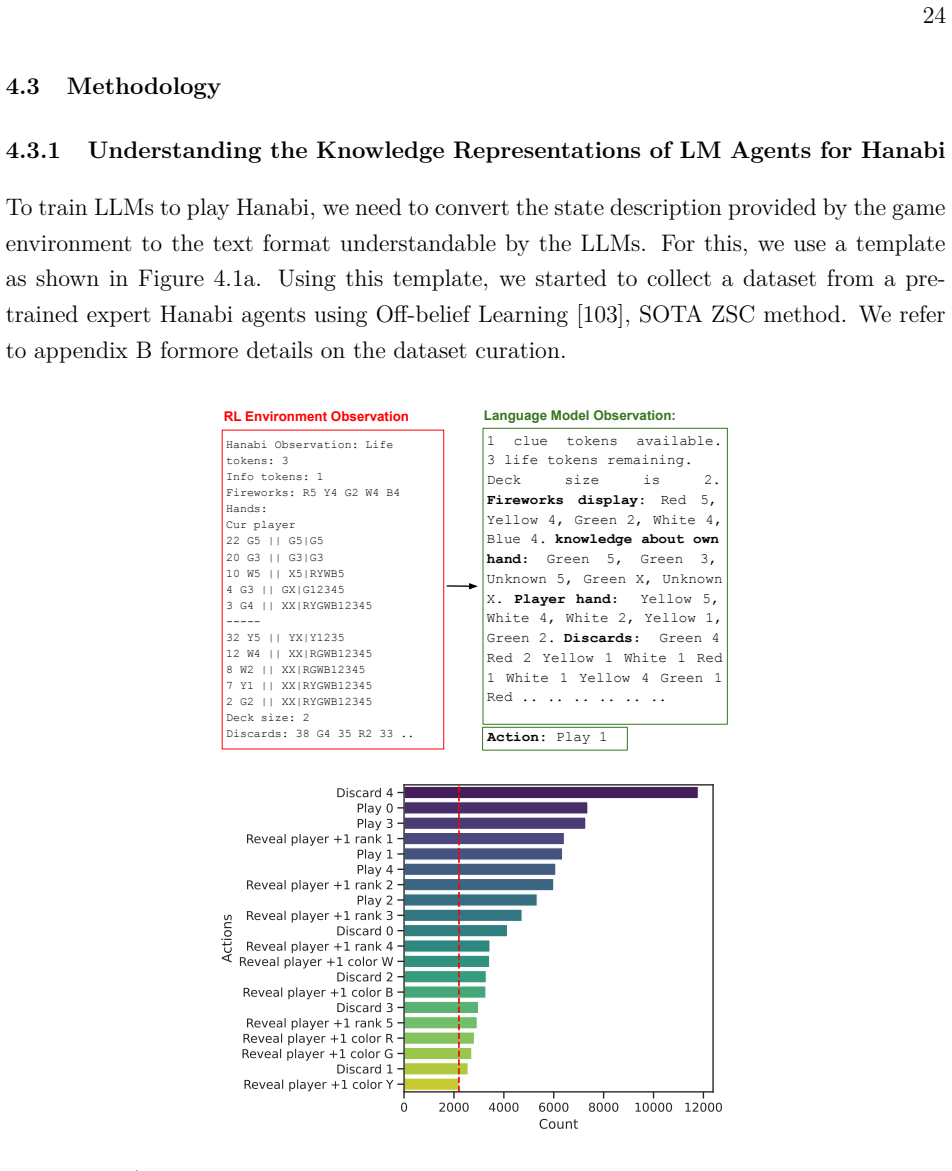
Chapter 3's mechanism is LM-in-the-Loop: a GPT-2 model already finetuned on human demonstration data is periodically retrained on in-game transitions stored in replay buffers, with the transitions split into $D^+$ and $D^-$ by a heuristic; the decisive variant is the state-feature oracle (OC), which labels a transition as useful if the action moved the agent to a new location or increased reward, trained with a weighted cross-entropy loss. Chapter 4's mechanism is a text rendering of Hanabi plus a distillation objective: observations are templated into text, expert trajectories from an off-belief-learning agent are filtered and category-sampled into a balanced dataset, a DistilBERT teacher is finetuned on it, and a Rainbow student is trained with $L = L_{\mathrm{TD}} + \lambda \mathbb{E}_{s\sim D}\big[\sum_a \pi_{\mathrm{LM}}(a|s)\log \pi_{\mathrm{student}}(a|s)\big]$, which transfers the LM's action distribution to the RL policy and produces the reported sample-efficiency jump.
What would settle it
Re-run the LM-in-the-Loop procedure on a suite of text games whose observations contain no location-change signal and whose rewards are sparse, so the OC oracle can never fire: if the normalized score does not exceed the 19.1% uncategorized baseline, the Chapter 3 claim collapses. Separately, measure the number of environment steps a Rainbow agent needs to reach a fixed Hanabi-text score with and without the DistilBERT distillation loss; the '5x sample efficient' claim is false if the two learning curves reach the same score at the same step count.
Extended reading notes
Core claim
The central discovery, on the thesis's own terms, is that a language model earns its place inside the cooperative learning loop in two distinct roles. As an action recommender in text games, the LM improves only when the transitions used to retrain it are selected by a heuristic: labeling a transition as useful when the agent's location changes or reward increases (the 'OC' oracle) yields 24.0% average normalized score versus 20.1% for the frozen CALM baseline, which the paper describes as roughly a 53% average per-game improvement, and it also lets the agent reach that performance with only 10% of the human-annotated adaptation data (21.8% versus 20.1% for CALM at 100%). As a teacher in the Hanabi-text environment, a DistilBERT model finetuned on expert game trajectories is distilled into a Rainbow student policy through a combined TD-plus-distillation loss, producing a jump in score and about five times better sample efficiency than a from-scratch Rainbow. The author presents these as evidence that LM-in-the-Loop training and LM-to-RL distillation are viable mechanisms for adaptive, cooperative language agents, and as the first steps toward a benchmark for theory of mind in LLMs.
Load-bearing premise
The Chapter 3 gains ride on an oracle that marks a transition as useful only when the agent's location changes or the reward rises; if a target game does not expose those features, the improvement falls back to the 19.1% uncategorized baseline, and the thesis provides no independent check that Hanabi-text scores measure theory of mind.
Editorial extensions
If this is right
- With state-feature categorization, the LM-in-the-Loop agent needs only a tenth of the human-annotated adaptation data to beat the full-data baseline, so in-game retraining can substitute for large human-annotation efforts.
- Because LM-in-the-Loop reaches the baseline's best score in about half the environment steps, the same compute budget can cover more games or longer horizons.
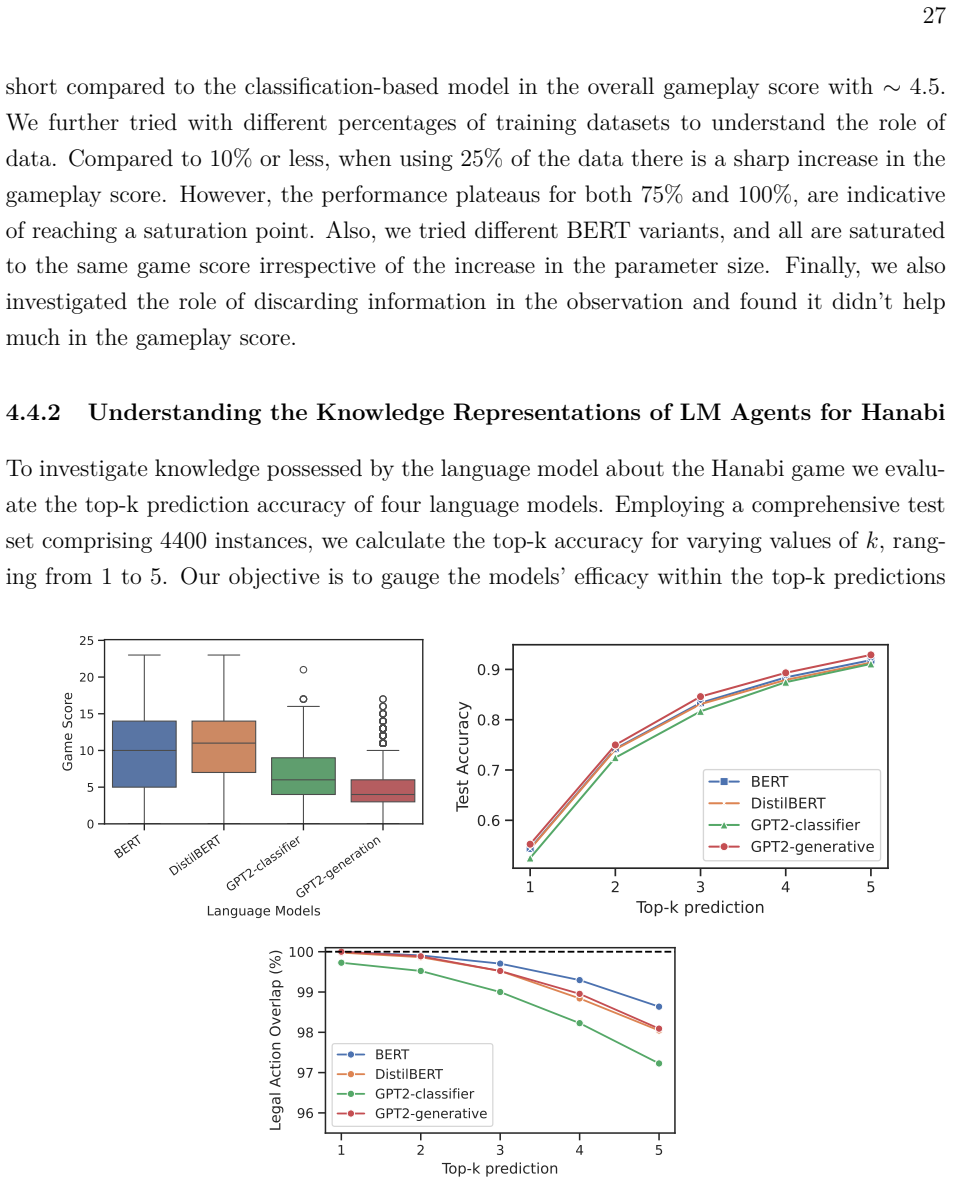
- Finetuned classifier LMs (BERT and DistilBERT) can act directly as Hanabi-text agents, scoring up to 23 of 25, which makes a text-based cooperative benchmark available to the NLP community.
- Distilling the LM teacher into a Rainbow student yields about fivefold sample efficiency, so a single finetuned LM can amortize its expert knowledge across many RL runs.
- Text-based Hanabi is proposed as a common testbed for multi-agent LM research, connecting MARL coordination metrics with language-model capabilities.
Reading between the lines
- If the Chapter 3 mechanism is what produces the gain, replacing the location/reward oracle with learned intrinsic-motivation signals (curiosity or state-visit counts) would preserve the improvement, implying the benefit comes from selecting useful transitions rather than game-specific features.
- The fivefold sample-efficiency figure likely depends on the teacher and student sharing the same two-player coordination regime; a stronger experiment would pair the distilled student with novel partners, where the teacher's expert distribution may mislead.
- Because neither chapter measures a partner's predicted mental state directly, a direct theory-of-mind test would hold out the partner's next action and measure the LM's predictive accuracy against it, separately from the final game score.
- Since the OC oracle is admitted to be a loose upper bound, deployment would require inferring transition usefulness without privileged state features, for example by estimating advantages from the agent's own returns.
Editorial analysis
A structured set of objections, weighed in public.
Referee Report
Summary. This manuscript is a PhD thesis/proposal from Polytechnique Montréal that combines two studies around language models in multi-agent settings. Chapter 3 (LM-in-the-Loop) extends the CALM approach by finetuning GPT-2 on in-game transitions from ten Jericho text games, comparing several transition-selection heuristics: Uncategorized Transitions (UT), State Feature Categorized (OC), Reward Trajectories (RT), and advantage-weighted variants (UTEA, UTLA). Chapter 4 introduces a text-based version of Hanabi, finetunes BERT/DistilBERT/GPT-2 variants on expert Off-Belief Learning trajectories, and distills a DistilBERT teacher into a Rainbow agent. The abstract frames the work as investigating theory of mind in LLMs through cooperative multi-agent reinforcement learning. The main reported results are a ~53% improvement in normalized score for the OC heuristic over CALM on ten Jericho games (20.1% to 24.0%) and an 'almost 5x' sample-efficiency gain from distillation in Hanabi. Chapters 5-8 contain future goals, risks, a timeline, and a concluding chapter.
Significance. The empirical material has genuine value. The authors benchmark against the external CALM baseline rather than only against themselves, report five runs with standard errors for the Chapter 3 experiments, provide ablations over several transition-selection strategies, and give extensive appendix studies for Chapter 4 (data scaling, LoRA ranks, model sizes, discard-pile information). The proposed text-based Hanabi environment is a potentially useful testbed for multi-agent language-model research. If the results hold as stated, the contribution is an incremental empirical study of in-game LM finetuning under a game-specific oracle and a distillation pipeline for text-based Hanabi. However, the headline gains are conditional on a privileged state-feature oracle, the relative improvement metric is inflated by games with tiny absolute scores, and no experiment measures theory of mind despite the title and abstract claiming that focus. The work is therefore best regarded as a set of empirical findings with an overreaching framing, not as a demonstrated advance in theory-of-mind reasoning.
major comments (5)
- [§3.5.1, Table 3.1] The headline '~53% improvement' is the mean of per-game relative deltas, and it is inflated by games with negligible absolute scores (Zork3: 0.3 to 0.7; Dragon: 0.1 to 0.3). The aggregate normalized score moves only from 20.1% to 24.0%, a relative improvement of 19.4%, not 53%. The caption's statement that OC 'scored the highest in all tasks' is also contradicted by the Detective row, where CALM scores 290.9 and OC scores 288.5. In addition, the Uncategorized Transitions baseline (19.1%) is below CALM (20.1%), so the only variant that beats the baseline is the one using the OC oracle. The paper should report absolute normalized gains as the primary metric and treat per-game relative changes as secondary.
- [§3.3.2, §3.5.1] The OC gain is entirely driven by a privileged heuristic: a transition is labeled useful when the agent's location changes or the reward increases. The text itself calls this 'a loose upperbound to in-game learning.' Without such state features, the method reverts to the UT level (19.1%), below the CALM baseline, and reward-based RT reaches only 20.7%. Because the method's general transition-selection mechanism does not beat the baseline, the central claim that LM-in-the-Loop 'enables improved performance' should be rephrased as an oracle-conditional upper-bound result. A target game that does not expose room-change or reward features cannot be expected to reproduce the reported gain.
- [§3.4.3] The key hyperparameters p+, k, buffer sizes, dLM, and nRL are described as game-specific, and p+ is varied over [0,1] in 0.1 increments and k over {2k, 5k, 10k, 20k} on the ten evaluation games, with no held-out selection or sensitivity analysis. This means the reported margin over CALM may partly reflect per-game tuning on the test games. The paper should report the selected per-game values and show that the gains are robust to fixed or cross-game hyperparameters.
- [Abstract, Chapter 1, Chapter 5, Chapter 8] The abstract and introduction claim that the work 'investigates theory of mind in LLMs through the lens of cooperative multi-agent reinforcement learning,' but no experiment in the thesis measures belief inference, intention modeling, perspective-taking, or partner-specific adaptation. The Hanabi and text-game tasks are asserted as cooperative proxies for theory of mind without validation. The research goals in §1.1 and Chapter 5 are future work, not results. The title, abstract, and introductory claims should be aligned with what is actually demonstrated: in-game finetuning of an LM action recommender and distillation of a finetuned LM into an RL agent.
- [§4.4.3, Figure 4.4] The claim that distillation makes the Rainbow agent 'almost 5x more sample efficient' is not defined or quantified anywhere in the text. Figure 4.4 shows no error bars, no explicit timestep markers, and no comparison protocol that would let a reader verify a 5x factor. The schedule for λt is described only as a 'scheduler' that weans the student off the teacher. The paper should define the sample-efficiency measure (e.g., area under the learning curve or steps to reach a fixed score), report multiple seeds with standard errors, and state the exact λ schedule.
minor comments (7)
- [§2.1.2, Eq. (2.3)] Equation (2.3) defines L_LLM using log p(A|S), but the following sentence says 'p(S|A) represents the conditional probability of predicting an action A, given the state S'; the notation should be corrected to p(A|S).
- [§2.2.4] The section title 'Deep Relevence Recurrent Network' contains a typo ('Relevence' should be 'Relevance').
- [§3.5.1] The text says 'Table A.1 compares the different methods,' but the table that appears is Table 3.1; the cross-reference should be corrected.
- [§4.3.2] The dataset split is described as reserving 10% for testing and then splitting the remainder into 90% train and 10% validation; please state explicitly whether the validation split is taken from the remaining 90% after the test set is removed, and report the final instance counts.
- [Table 3.1] The column header 'R T' in Table 3.1 should be 'RT' to match the method name 'Reward Trajectories (RT)' in §3.3.2.
- [§3.5.2, Table 3.2] The comparison of OC with 10% data (21.8%) to CALM with 100% (20.1%) is interesting, but the standard errors in Table 3.2 are large for several games (e.g., Inhumane 15.7 [14.7]); a paired statistical test across the ten games would strengthen the claim.
- [§4.4.1, Appendix B.1] The LoRA/LLaMA results in Appendix B.1 are presented without error bars or number of seeds; since the gameplay scores are around 0-1 on a 25-point scale, please report the variance before concluding that LLaMA performs poorly.
Circularity Check
No significant circularity: the central comparisons are against external baselines (CALM and Rainbow); the OC oracle is an acknowledged upper bound, not a definitionally forced prediction.
full rationale
I walked the paper's claimed derivation chain and found no step where a prediction or first-principles result is equivalent to its input by construction. Chapter 3 compares LM-in-the-Loop against the external CALM baseline on the Jericho benchmark; the OC transition-selection heuristic is an input to training, not a term in the evaluation metric, and the paper explicitly labels it 'a loose upperbound to in-game learning' (Section 3.5.1). The reported 24.0% normalized score is an empirical outcome, not a restatement of the OC labeling rule. The game-specific hyperparameters p+ and k are tuned on the evaluation games, which raises a generalization or overfitting concern but is not circularity. Chapter 4's distillation result is measured against a Rainbow agent trained from scratch, an external baseline; the distillation loss (Eq. 4.1) encourages imitation of the teacher, but the claimed jump in performance and sample efficiency is not logically forced by that loss and is validated by the learning curves. The thesis does cite the author's own prior papers ([42], [71], [72]) and reproduces their content as chapters; these self-citations are normal for a thesis and are not load-bearing external justification. The theory-of-mind framing is not operationalized by any direct experiment, which is a construct-validity gap rather than a circular reduction. Overall, the paper is self-contained against external benchmarks, so the circularity score is low.
Assumptions & free parameters
free parameters (5)
- p+ (probability of sampling positive transitions) =
swept 0.0 to 1.0 in 0.1 increments, game-specific
- k (LM finetuning frequency) =
swept 2k, 5k, 10k, 20k, game-specific
- dLM (LM training sample size) =
not specified, buffer size 100K
- Trajectory filter threshold for Hanabi expert data =
score > 20
- Per-action class balance =
2200 samples per action type
assumptions (4)
- domain assumption Cooperative performance in text games (Hanabi, Jericho) is a valid proxy for theory of mind and real-world cooperation.
- ad hoc to paper The OC oracle (room change or reward increase) identifies useful transitions for LM finetuning.
- ad hoc to paper Filtering expert Hanabi trajectories with score > 20 and balancing action types yields a representative expert policy distribution.
- standard math Standard background in MDP/POMDP, DQN, DRRN, and transformer language models is correct and applicable.
invented entities (1)
-
Hanabi-text environment
Cite this review
Pith. "Pith review of Multi-Agent Language Models: Advancing Cooperation, Coordination, and Adaptation." pith.science (2026). https://pith.science/paper/XXLAC5JU
@misc{pith2026250609331,
  author       = {Pith},
  title        = {Pith review of: Multi-Agent Language Models: Advancing Cooperation, Coordination, and Adaptation},
  year         = {2026},
  howpublished = {\url{https://pith.science/paper/XXLAC5JU}},
  note         = {Machine review of arXiv:2506.09331}
}
read the original abstract
Modern Large Language Models (LLMs) exhibit impressive zero-shot and few-shot generalization capabilities across complex natural language tasks, enabling their widespread use as virtual assistants for diverse applications such as translation and summarization. Despite being trained solely on large corpora of text without explicit supervision on author intent, LLMs appear to infer the underlying meaning of textual interactions. This raises a fundamental question: can LLMs model and reason about the intentions of others, i.e., do they possess a form of theory of mind? Understanding other's intentions is crucial for effective collaboration, which underpins human societal success and is essential for cooperative interactions among multiple agents, including humans and autonomous systems. In this work, we investigate the theory of mind in LLMs through the lens of cooperative multi-agent reinforcement learning (MARL), where agents learn to collaborate via repeated interactions, mirroring human social reasoning. Our approach aims to enhance artificial agent's ability to adapt and cooperate with both artificial and human partners. By leveraging LLM-based agents capable of natural language interaction, we move towards creating hybrid human-AI systems that can foster seamless collaboration, with broad implications for the future of human-artificial interaction.
Figures


Figures from the paper (7 more)




Reference graph
Works this paper leans on
-
[1]
R. S. Sutton and A. G. Barto,Reinforcement Learning: An Introduction. Cambridge, MA, USA: A Bradford Book, 2018
2018
-
[2]
OpenAI, “GPT-4 Technical Report,”arXiv e-prints, p. arXiv:2303.08774, Mar. 2023
arXiv 2023
-
[3]
Gemini: A Family of Highly Capable Multimodal Models,
Gemini Team, “Gemini: A Family of Highly Capable Multimodal Models,”arXiv e- prints, p. arXiv:2312.11805, Dec. 2023
arXiv 2023
-
[4]
The Claude 3 Model Family: Opus, Sonnet, Haiku,
Anthropic, “The Claude 3 Model Family: Opus, Sonnet, Haiku,”arXiv e-prints, 2024
2024
-
[5]
Large language models are zero-shot reasoners,
T. Kojima, S. S. Gu, M. Reid, Y. Matsuo, and Y. Iwasawa, “Large language models are zero-shot reasoners,”Advances in neural information processing systems, vol. 35, pp. 22199–22213, 2022
2022
-
[6]
Prompt- ing palm for translation: Assessing strategies and performance,
D. Vilar, M. Freitag, C. Cherry, J. Luo, V. Ratnakar, and G. Foster, “Prompt- ing palm for translation: Assessing strategies and performance,” arXiv preprint arXiv:2211.09102, 2022
arXiv 2022
-
[7]
Pegasus: Pre-training with extracted gap-sentences for abstractive summarization,
J. Zhang, Y. Zhao, M. Saleh, and P. Liu, “Pegasus: Pre-training with extracted gap-sentences for abstractive summarization,” inInternational conference on machine learning. PMLR, 2020, pp. 11328–11339
2020
-
[8]
On the nature of language,
N. Chomsky, “On the nature of language,” Origins and evolution of language and speech, vol. 280, pp. 46–57, 1976
1976
Show all 113 references
-
[9]
The synthetic modeling of language origins,
L. Steels, “The synthetic modeling of language origins,”Evolution of communication, vol. 1, no. 1, pp. 1–34, 1997
1997
-
[10]
Evaluating wordnet-based measures of lexical semantic relatedness,
A. Budanitsky and G. Hirst, “Evaluating wordnet-based measures of lexical semantic relatedness,” Computational linguistics, vol. 32, no. 1, pp. 13–47, 2006
2006
-
[11]
Computational linguistics and deep learning,
C. D. Manning, “Computational linguistics and deep learning,”Computational Lin- guistics, vol. 41, no. 4, pp. 701–707, 2015
2015
-
[12]
The hanabi challenge: A new frontier for ai research,
N. Bard, J. N. Foerster, S. Chandar, N. Burch, M. Lanctot, H. F. Song, E. Parisotto, V. Dumoulin, S. Moitra, E. Hugheset al., “The hanabi challenge: A new frontier for ai research,”Artificial Intelligence, vol. 280, p. 103216, 2020. 37
2020
-
[13]
Does the chimpanzee have a theory of mind?
D. Premack and G. Woodruff, “Does the chimpanzee have a theory of mind?”Behav- ioral and brain sciences, vol. 1, no. 4, pp. 515–526, 1978
1978
-
[14]
Machine theory of mind,
N. Rabinowitz, F. Perbet, F. Song, C. Zhang, S. A. Eslami, and M. Botvinick, “Machine theory of mind,” inInternational conference on machine learning. PMLR, 2018, pp. 4218–4227
2018
-
[15]
Llama 2: Open Foundation and Fine-Tuned Chat Models,
H. Touvron, L. Martin, K. Stone, P. Albert, A. Almahairi, Y. Babaei, N. Bash- lykov, S. Batra, P. Bhargava, S. Bhosale, D. Bikel, L. Blecher, C. Canton Ferrer, M. Chen, G. Cucurull, D. Esiobu, J. Fernandes, J. Fu, W. Fu, B. Fuller, C. Gao, V. Goswami, N. Goyal, A. Hartshorn, S...
2023 arXiv
-
[16]
Rein- carnating reinforcement learning: Reusing prior computation to accelerate progress,
R. Agarwal, M. Schwarzer, P. S. Castro, A. C. Courville, and M. Bellemare, “Rein- carnating reinforcement learning: Reusing prior computation to accelerate progress,” Advances in Neural Information Processing Systems, vol. 35, pp. 28955–28971, 2022
2022
-
[17]
Towards few-shot coordination: Revisiting ad-hoc teamplay challenge in the game of hanabi,
H. Nekoei, X. Zhao, J. Rajendran, M. Liu, and S. Chandar, “Towards few-shot coordination: Revisiting ad-hoc teamplay challenge in the game of hanabi,” in Proceedings of The 2nd Conference on Lifelong Learning Agents, ser. Proceedings of Machine Learning Research, S. Chandar, R...
2023
-
[18]
“Other-play
H. Hu, A. Lerer, A. Peysakhovich, and J. Foerster, ““Other-play” for zero-shot coor- dination,” in Proceedings of the 37th International Conference on Machine Learning, ser. Proceedings of Machine Learning Research, H. D. III and A. Singh, Eds., vol. 119. PMLR, 13–18 Jul 2020,...
2020
-
[19]
Llm-coordination: Evaluating and analyzing multi-agent coordination abilities in large language models,
S. Agashe, Y. Fan, A. Reyna, and X. E. Wang, “Llm-coordination: Evaluating and analyzing multi-agent coordination abilities in large language models,” 2024
2024
-
[20]
Generative agents: Interactive simulacra of human behavior,
J. S. Park, J. C. O’Brien, C. J. Cai, M. R. Morris, P. Liang, and M. S. Bernstein, “Generative agents: Interactive simulacra of human behavior,” 2023. 38
2023
-
[21]
A survey of large language models,
W. X. Zhao, K. Zhou, J. Li, T. Tang, X. Wang, Y. Hou, Y. Min, B. Zhang, J. Zhang, Z. Dong, Y. Du, C. Yang, Y. Chen, Z. Chen, J. Jiang, R. Ren, Y. Li, X. Tang, Z. Liu, P. Liu, J.-Y. Nie, and J.-R. Wen, “A survey of large language models,” 2023
2023
-
[22]
A practical survey on faster and lighter transformers,
Q. Fournier, G. M. Caron, and D. Aloise, “A practical survey on faster and lighter transformers,” ACM Comput. Surv., vol. 55, no. 14s, jul 2023. [Online]. Available: https://doi.org/10.1145/3586074
2023 doi
-
[23]
Attention is all you need,
A. Vaswani, N. Shazeer, N. Parmar, J. Uszkoreit, L. Jones, A. N. Gomez, L. Kaiser, and I. Polosukhin, “Attention is all you need,” CoRR, vol. abs/1706.03762, 2017. [Online]. Available: http://arxiv.org/abs/1706.03762
2017 arXiv
-
[24]
Attention-based models for speech recognition,
J. Chorowski, D. Bahdanau, D. Serdyuk, K. Cho, and Y. Bengio, “Attention-based models for speech recognition,”CoRR, vol. abs/1506.07503, 2015. [Online]. Available: http://arxiv.org/abs/1506.07503
2015 arXiv
-
[25]
BERT: Pre-training of deep bidirectional transformers for language understanding,
J. Devlin, M.-W. Chang, K. Lee, and K. Toutanova, “BERT: Pre-training of deep bidirectional transformers for language understanding,” in Proceedings of the 2019 Conference of the North American Chapter of the Association for Computational Linguistics: Human Language Technologi...
2019
-
[26]
Character-level convolutional networks for text classification,
X. Zhang, J. Zhao, and Y. LeCun, “Character-level convolutional networks for text classification,” in Advances in Neural Information Processing Systems, C. Cortes, N. Lawrence, D. Lee, M. Sugiyama, and R. Garnett, Eds., vol. 28. Curran Associates, Inc., 2015. [Online]. Availab...
2015
-
[27]
Learning word vectors for sentiment analysis,
A. L. Maas, R. E. Daly, P. T. Pham, D. Huang, A. Y. Ng, and C. Potts, “Learning word vectors for sentiment analysis,” inProceedings of the 49th Annual Meeting of the Association for Computational Linguistics: Human Language Technologies. Portland, Oregon, USA: Association for ...
2011
-
[29]
Language models are few-shot learners,
T. B. Brown, B. Mann, N. Ryder, M. Subbiah, J. Kaplan, P. Dhariwal, A. Nee- lakantan, P. Shyam, G. Sastry, A. Askell, S. Agarwal, A. Herbert-Voss, G. Krueger, T. Henighan, R. Child, A. Ramesh, D. M. Ziegler, J. Wu, C. Winter, C. Hesse, M. Chen, E. Sigler, M. Litwin, S. Gray, B...
2020
-
[30]
Language models are unsupervised multitask learners,
A. Radford, J. Wu, R. Child, D. Luan, D. Amodei, and I. Sutskever, “Language models are unsupervised multitask learners,” 2019
2019
-
[31]
Opt: Openpre-trainedtransformerlanguage models,
S. Zhang, S. Roller, N. Goyal, M. Artetxe, M. Chen, S. Chen, C. Dewan, M. Diab, X. Li, X. V. Lin, T. Mihaylov, M. Ott, S. Shleifer, K. Shuster, D. Simig, P. S. Koura, A.Sridhar, T.Wang, andL.Zettlemoyer, “Opt: Openpre-trainedtransformerlanguage models,” 2022
2022
-
[32]
Llama: Open and efficient foundation language models,
H. Touvron, T. Lavril, G. Izacard, X. Martinet, M.-A. Lachaux, T. Lacroix, B. Rozière, N. Goyal, E. Hambro, F. Azhar, A. Rodriguez, A. Joulin, E. Grave, and G. Lample, “Llama: Open and efficient foundation language models,” 2023
2023
-
[33]
Interactive fiction games: A colossal adventure,
M. Hausknecht, P. Ammanabrolu, M.-A. Côté, and X. Yuan, “Interactive fiction games: A colossal adventure,” Proceedings of the AAAI Conference on Artificial Intelligence, vol. 34, no. 05, pp. 7903–7910, Apr. 2020. [Online]. Available: https://ojs.aaai.org/index.php/AAAI/article...
2020
-
[34]
Do as i can, not as i say: Grounding language in robotic affordances,
M. Ahn, A. Brohan, N. Brown, Y. Chebotar, O. Cortes, B. David, C. Finn, C. Fu, K.Gopalakrishnan, K.Hausman, A.Herzog, D.Ho, J.Hsu, J.Ibarz, B.Ichter, A.Irpan, E. Jang, R. J. Ruano, K. Jeffrey, S. Jesmonth, N. J. Joshi, R. Julian, D. Kalashnikov, Y. Kuang, K.-H. Lee, S. Levine,...
2022
-
[35]
Deep reinforcement learning for autonomous driving: A survey,
B. R. Kiran, I. Sobh, V. Talpaert, P. Mannion, A. A. A. Sallab, S. Yogamani, and P. Pérez, “Deep reinforcement learning for autonomous driving: A survey,” 2021
2021
-
[36]
M. T. J. Spaan, Partially Observable Markov Decision Processes . Berlin, Heidelberg: Springer Berlin Heidelberg, 2012, pp. 387–414. [Online]. Available: https://doi.org/10.1007/978-3-642-27645-3_12
2012 doi
-
[37]
Playing atari with deep reinforcement learning,
V. Mnih, K. Kavukcuoglu, D. Silver, A. Graves, I. Antonoglou, D. Wierstra, and M. A. Riedmiller, “Playing atari with deep reinforcement learning,” CoRR, vol. abs/1312.5602, 2013. [Online]. Available: http://arxiv.org/abs/1312.5602 40
2013 arXiv
-
[38]
Deep reinforcement learning with a natural language action space,
J. He, J. Chen, X. He, J. Gao, L. Li, L. Deng, and M. Ostendorf, “Deep reinforcement learning with a natural language action space,” 2016
2016
-
[39]
Empirical evaluation of gated recurrent neural networks on sequence modeling,
J. Chung, Ç. Gülçehre, K. Cho, and Y. Bengio, “Empirical evaluation of gated recurrent neural networks on sequence modeling,”CoRR, vol. abs/1412.3555, 2014. [Online]. Available: http://arxiv.org/abs/1412.3555
2014 arXiv
-
[40]
Textworld: A learning environment for text-based games,
M. Côté, Á. Kádár, X. Yuan, B. Kybartas, T. Barnes, E. Fine, J. Moore, M. J. Hausknecht, L. E. Asri, M. Adada, W. Tay, and A. Trischler, “Textworld: A learning environment for text-based games,” 2018. [Online]. Available: http://arxiv.org/abs/1806.11532
2018 arXiv
-
[41]
Deep reinforcement learning with a natural language action space,
J. He, J. Chen, X. He, J. Gao, L. Li, L. Deng, and M. Ostendorf, “Deep reinforcement learning with a natural language action space,” inProceedings of the 54th Annual Meeting of the Association for Computational Linguistics (Volume 1: Long Papers). Berlin, Germany: Association ...
2016
-
[42]
Language model- in-the-loop: Data optimal approach to learn-to-recommend actions in text games,
A. V. Sudhakar, P. Parthasarathi, J. Rajendran, and S. Chandar, “Language model- in-the-loop: Data optimal approach to learn-to-recommend actions in text games,” 2023
2023
-
[43]
Language models are unsupervised multitask learners,
A. Radford, J. Wu, R. Child, D. Luan, D. Amodei, and I. Sutskever, “Language models are unsupervised multitask learners,” 2019. [Online]. Available: https://api.semanticscholar.org/CorpusID:160025533
2019
-
[45]
A primer in bertology: What we know about how bert works,
A. Rogers, O. Kovaleva, and A. Rumshisky, “A primer in bertology: What we know about how bert works,”Transactions of the Association for Computational Linguistics, vol. 8, pp. 842–866, 2020
2020
-
[46]
Do prompt-based models really understand the meaning of their prompts?
A. Webson and E. Pavlick, “Do prompt-based models really understand the meaning of their prompts?”arXiv preprint arXiv:2109.01247, 2021
2021 arXiv
-
[47]
Experience grounds language,
Y. Bisk, A. Holtzman, J. Thomason, J. Andreas, Y. Bengio, J. Chai, M. Lapata, A. Lazaridou, J. May, A. Nisnevich, N. Pinto, and J. Turian, 41 “Experience grounds language,” in Proceedings of the 2020 Conference on Empirical Methods in Natural Language Processing (EMNLP). Onlin...
2020
-
[48]
Placing language in an integrated understanding system: Next steps toward human-level performance in neural language models,
J. L. McClelland, F. Hill, M. Rudolph, J. Baldridge, and H. Schütze, “Placing language in an integrated understanding system: Next steps toward human-level performance in neural language models,”Proceedings of the National Academy of Sciences, vol. 117, no. 42, pp. 25966–25974, 2020
2020
-
[49]
Word meaning in minds and machines,
B. M. Lake and G. L. Murphy, “Word meaning in minds and machines,”Psychological review, 2021
2021
-
[50]
Keep CALM and explore: Language models for action generation in text-based games,
S. Yao, R. Rao, M. Hausknecht, and K. Narasimhan, “Keep CALM and explore: Language models for action generation in text-based games,” in Proceedings of the 2020 Conference on Empirical Methods in Natural Language Processing (EMNLP). Online: Association for Computational Lingui...
2020
-
[51]
Graph constrained reinforcement learning for natural language action spaces,
P. Ammanabrolu and M. Hausknecht, “Graph constrained reinforcement learning for natural language action spaces,” inInternational Conference on Learning Representa- tions, 2020. [Online]. Available: https://openreview.net/forum?id=B1x6w0EtwH
2020
-
[53]
Decision transformer: Reinforcement learning via sequence modeling,
L. Chen, K. Lu, A. Rajeswaran, K. Lee, A. Grover, M. Laskin, P. Abbeel, A. Srinivas, and I. Mordatch, “Decision transformer: Reinforcement learning via sequence modeling,” in Advances in Neural Information Processing Systems, A. Beygelzimer, Y. Dauphin, P. Liang, and J. W. Vau...
2021
-
[54]
Offline reinforcement learning as one big sequence modeling problem,
M. Janner, Q. Li, and S. Levine, “Offline reinforcement learning as one big sequence modeling problem,” inAdvances in Neural Information Processing Systems, M. Ranzato, A. Beygelzimer, Y. Dauphin, P. Liang, and J. W. Vaughan, Eds., vol. 34. Curran Associates, Inc., 2021, pp. 1...
2021
-
[55]
Deep reinforcement learning with transformers for text adventure games,
Y. Xu, L. Chen, M. Fang, Y. Wang, and C. Zhang, “Deep reinforcement learning with transformers for text adventure games,” in2020 IEEE Conference on Games (CoG), 2020, pp. 65–72
2020
-
[56]
Stabilizing transformers for reinforcement learning,
E. Parisotto, H. F. Song, J. W. Rae, R. Pascanu, Ç. Gülçehre, S. M. Jayakumar, M. Jaderberg, R. L. Kaufman, A. Clark, S. Noury, M. M. Botvinick, N. Heess, and R. Hadsell, “Stabilizing transformers for reinforcement learning,” CoRR, vol. abs/1910.06764, 2019. [Online]. Availabl...
1910 arXiv
-
[57]
Training language models to follow instructions with human feedback,
L. Ouyang, J. Wu, X. Jiang, D. Almeida, C. Wainwright, P. Mishkin, C. Zhang, S. Agarwal, K. Slama, A. Gray, J. Schulman, J. Hilton, F. Kelton, L. Miller, M. Simens, A. Askell, P. Welinder, P. Christiano, J. Leike, and R. Lowe, “Training language models to follow instructions w...
2022
-
[58]
Can wikipedia help offline reinforcement learning?
M. Reid, Y. Yamada, and S. S. Gu, “Can wikipedia help offline reinforcement learning?” CoRR, vol. abs/2201.12122, 2022. [Online]. Available: https: //arxiv.org/abs/2201.12122
2022 arXiv
-
[59]
Prompts and pre-trained language models for offline reinforcement learning,
D. Tarasov, V. Kurenkov, and S. Kolesnikov, “Prompts and pre-trained language models for offline reinforcement learning,” in ICLR 2022 Workshop on Generalizable Policy Learning in Physical World , 2022. [Online]. Available: https://openreview.net/forum?id=Spf4TE6NkWq
2022
-
[60]
Do as i can, not as i say: Grounding language in robotic affordances,
M. Ahn, A. Brohan, N. Brown, Y. Chebotar, O. Cortes, B. David, C. Finn, C. Fu, K. Gopalakrishnan, K. Hausman, A. Herzog, D. Ho, J. Hsu, J. Ibarz, B. Ichter, A. Irpan, E. Jang, R. J. Ruano, K. Jeffrey, S. Jesmonth, N. J. Joshi, R. Julian, D. Kalashnikov, Y. Kuang, K.-H. Lee, S....
2022 arXiv
-
[61]
Multi-stage episodic control for strategic exploration in text games,
J. Tuyls, S. Yao, S. M. Kakade, and K. R. Narasimhan, “Multi-stage episodic control for strategic exploration in text games,” in International Conference on Learning Representations, 2022. [Online]. Available: https://openreview.net/forum? id=Ek7PSN7Y77z 43
2022
-
[62]
Pre-trained language models for interactive decision-making,
S. Li, X. Puig, C. Paxton, Y. Du, C. Wang, L. Fan, T. Chen, D. Huang, E. Akyürek, A. Anandkumar, J. Andreas, I. Mordatch, A. Torralba, and Y. Zhu, “Pre-trained language models for interactive decision-making,”arXiv, 2022
2022
-
[63]
BERT: pre-training of deep bidirectional transformers for language understanding,
J. Devlin, M. Chang, K. Lee, and K. Toutanova, “BERT: pre-training of deep bidirectional transformers for language understanding,” in Proceedings of the 2019 Conference of the North American Chapter of the Association for Computational Linguistics: Human Language Technologies,...
2019
-
[64]
UNIFIEDQA: Crossing format boundaries with a single QA system,
D. Khashabi, S. Min, T. Khot, A. Sabharwal, O. Tafjord, P. Clark, and H. Hajishirzi, “UNIFIEDQA: Crossing format boundaries with a single QA system,” inFindings of the Association for Computational Linguistics: EMNLP 2020. Online: Association for Computational Linguistics, Nov...
2020
-
[65]
SQuAD: 100,000+ questions for machine comprehension of text,
P. Rajpurkar, J. Zhang, K. Lopyrev, and P. Liang, “SQuAD: 100,000+ questions for machine comprehension of text,” in Proceedings of the 2016 Conference on Empirical Methods in Natural Language Processing. Austin, Texas: Association for Computational Linguistics, Nov. 2016, pp. ...
2016
-
[66]
A survey of data augmentation approaches for nlp,
S. Y. Feng, V. Gangal, J. Wei, S. Chandar, S. Vosoughi, T. Mitamura, and E. Hovy, “A survey of data augmentation approaches for nlp,”arXiv preprint arXiv:2105.03075, 2021
2021 arXiv
-
[67]
Improving language understanding by generative pre-training,
A. Radford, K. Narasimhan, T. Salimans, I. Sutskever et al., “Improving language understanding by generative pre-training,” 2018
2018
-
[68]
Insights into pre-training via simpler synthetic tasks,
Y. Wu, F. Li, and P. Liang, “Insights into pre-training via simpler synthetic tasks,” arXiv preprint arXiv:2206.10139, 2022
2022 arXiv
-
[69]
Feature diversity in self-supervised learning,
P. Malviya and A. V. Sudhakar, “Feature diversity in self-supervised learning,” 2022. [Online]. Available: https://arxiv.org/abs/2209.01275
2022 arXiv
-
[70]
Neural text generation with unlikelihood training,
S. Welleck, I. Kulikov, S. Roller, E. Dinan, K. Cho, and J. Weston, “Neural text generation with unlikelihood training,”arXiv preprint arXiv:1908.04319, 2019. 44
1908 arXiv
-
[71]
Multi-agent text-based hanabi challenge,
Anonymous, “Multi-agent text-based hanabi challenge,” inSubmitted to ICLR 2024 Workshop on Generative Models for Decision Making, 2024, under review. [Online]. Available: https://openreview.net/forum?id=SGPUu7msST
2024
-
[72]
A generalist hanabi agent,
A. V. Sudhakar, H. Nekoei, M. Reymond, M. Liu, J. Rajendran, and S. Chandar, “A generalist hanabi agent,” 2025. [Online]. Available: https://arxiv.org/abs/2503.14555
2025 arXiv
-
[73]
Large language model based multi-agents: A survey of progress and challenges,
T. Guo, X. Chen, Y. Wang, R. Chang, S. Pei, N. V. Chawla, O. Wiest, and X. Zhang, “Large language model based multi-agents: A survey of progress and challenges,” 2024
2024
-
[74]
Evaluating multi-agent coordination abilities in large language models,
S. Agashe, Y. Fan, and X. E. Wang, “Evaluating multi-agent coordination abilities in large language models,” 2023
2023
-
[75]
How far are large language models from agents with theory-of-mind?
P. Zhou, A. Madaan, S. P. Potharaju, A. Gupta, K. R. McKee, A. Holtzman, J. Pujara, X. Ren, S. Mishra, A. Nematzadehet al., “How far are large language models from agents with theory-of-mind?”arXiv preprint arXiv:2310.03051, 2023
-
[76]
Training language models to follow instructions with human feedback,
L. Ouyang, J. Wu, X. Jiang, D. Almeida, C. L. Wainwright, P. Mishkin, C. Zhang, S. Agarwal, K. Slama, A. Ray, J. Schulman, J. Hilton, F. Kelton, L. Miller, M. Simens, A. Askell, P. Welinder, P. Christiano, J. Leike, and R. Lowe, “Training language models to follow instructions...
2022
-
[77]
Mistral 7b,
A. Q. Jiang, A. Sablayrolles, A. Mensch, C. Bamford, D. S. Chaplot, D. de las Casas, F. Bressand, G. Lengyel, G. Lample, L. Saulnier, L. R. Lavaud, M.-A. Lachaux, P. Stock, T. L. Scao, T. Lavril, T. Wang, T. Lacroix, and W. E. Sayed, “Mistral 7b,” 2023
2023
-
[78]
The hanabi challenge: A new frontier for AI research,
N. Bard, J. N. Foerster, S. Chandar, N. Burch, M. Lanctot, H. F. Song, E. Parisotto, V. Dumoulin, S. Moitra, E. Hughes, I. Dunning, S. Mourad, H. Larochelle, M. G. Bellemare, and M. Bowling, “The hanabi challenge: A new frontier for AI research,” CoRR, vol. abs/1902.00506, 201...
1902 arXiv
-
[79]
Mastering the game of go with deep neural networks and tree search,
D. Silver, A. Huang, C. J. Maddison, A. Guez, L. Sifre, G. van den Driessche, J. Schrit- twieser, I. Antonoglou, V. Panneershelvam, M. Lanctot, S. Dieleman, D. Grewe, J. Nham, N. Kalchbrenner, I. Sutskever, T. P. Lillicrap, M. Leach, K. Kavukcuoglu, T. Graepel, and D. Hassabis...
2016
-
[80]
Proximal policy optimization algorithms,
J. Schulman, F. Wolski, P. Dhariwal, A. Radford, and O. Klimov, “Proximal policy optimization algorithms,”ArXiv, vol. abs/1707.06347, 2017. 45
2017 arXiv
-
[81]
Dher: Hindsight experience replay for dynamic goals,
M. Fang, C. Zhou, B. Shi, B. Gong, J. Xu, and T. Zhang, “Dher: Hindsight experience replay for dynamic goals,” inInternational Conference on Learning Representations, 2018
2018
-
[82]
Learning how to active learn: A deep reinforcement learning approach,
M. Fang, Y. Li, and T. Cohn, “Learning how to active learn: A deep reinforcement learning approach,” inConference on Empirical Methods in Natural Language Process- ing, 2017
2017
-
[83]
Counting to explore and generalize in text-based games,
X. Yuan, M. Côté, A. Sordoni, R. Laroche, R. T. des Combes, M. J. Hausknecht, and A. Trischler, “Counting to explore and generalize in text-based games,”CoRR, vol. abs/1806.11525, 2018. [Online]. Available: http://arxiv.org/abs/1806.11525
2018 arXiv
-
[84]
Learn how to cook a new recipe in a new house: Using map familiarization, curriculum learning, and bandit feedback to learn families of text-based adventure games,
X. Yin and J. May, “Learn how to cook a new recipe in a new house: Using map familiarization, curriculum learning, and bandit feedback to learn families of text-based adventure games,” 2019. [Online]. Available: https://arxiv.org/abs/1908.04777
2019 arXiv
-
[85]
Enhancing text-based reinforcement learning agents with commonsense knowledge,
K. Murugesan, M. Atzeni, P. Shukla, M. Sachan, P. Kapanipathi, and K. Talamadupula, “Enhancing text-based reinforcement learning agents with commonsense knowledge,” CoRR, vol. abs/2005.00811, 2020. [Online]. Available: https://arxiv.org/abs/2005.00811
2005 arXiv
-
[86]
Scienceworld: Is your agent smarter than a 5th grader?
R. Wang, P. A. Jansen, M.-A. Côté, and P. Ammanabrolu, “Scienceworld: Is your agent smarter than a 5th grader?” in Conference on Empirical Methods in Natural Language Processing, 2022
2022
-
[87]
A survey of text games for reinforcement learning informed by natural language,
P. Osborne, H. Nõmm, and A. Freitas, “A survey of text games for reinforcement learning informed by natural language,” Transactions of the Association for Computational Linguistics , vol. 10, pp. 873–887, 2022. [Online]. Available: https://aclanthology.org/2022.tacl-1.51
2022
-
[88]
Climbing towards NLU: On meaning, form, and understanding in the age of data,
E. M. Bender and A. Koller, “Climbing towards NLU: On meaning, form, and understanding in the age of data,” in Proceedings of the 58th Annual Meeting of the Association for Computational Linguistics . Online: Association for Computational Linguistics, Jul. 2020, pp. 5185–5198....
2020
-
[89]
Deep reinforcement learning with a natural language action space,
J. He, J. Chen, X. He, J. Gao, L. Li, L. Deng, and M. Ostendorf, “Deep reinforcement learning with a natural language action space,”arXiv: Artificial Intelligence, 2015. 46
2015
-
[90]
Algorithmic improvements for deep reinforcement learning applied to interactive fiction,
V. Jain, W. Fedus, H. Larochelle, D. Precup, and M. G. Bellemare, “Algorithmic improvements for deep reinforcement learning applied to interactive fiction,” inAAAI Conference on Artificial Intelligence, 2019
2019
-
[91]
Deep reinforcement learning with transformers for text adventure games,
Y. Xu, L. Chen, M. Fang, Y. Wang, and C. Zhang, “Deep reinforcement learning with transformers for text adventure games,”2020 IEEE Conference on Games (CoG), pp. 65–72, 2020
2020
-
[92]
Monte-carlo planning and learning with language action value estimates,
Y. Jang, S. Seo, J. Lee, and K.-E. Kim, “Monte-carlo planning and learning with language action value estimates,” in International Conference on Learning Representations, 2021. [Online]. Available: https://openreview.net/forum?id=7_ G8JySGecm
2021
-
[93]
Keep CALM and explore: Language models for action generation in text-based games,
S. Yao, R. Rao, M. Hausknecht, and K. Narasimhan, “Keep CALM and explore: Language models for action generation in text-based games,” in Proceedings of the 2020 Conference on Empirical Methods in Natural Language Processing (EMNLP), B. Webber, T. Cohn, Y. He, and Y. Liu, Eds. ...
2020
-
[94]
Pre-trained language models as prior knowledge for playing text-based games,
I. Singh, G. Singh, and A. Modi, “Pre-trained language models as prior knowledge for playing text-based games,”ArXiv, vol. abs/2107.08408, 2021
2021 arXiv
-
[95]
Does the chimpanzee have a theory of mind?
D. Premack and G. Woodruff, “Does the chimpanzee have a theory of mind?”Behav- ioral and Brain Sciences, vol. 1, no. 4, p. 515–526, 1978
1978
-
[96]
Machine theory of mind,
N. Rabinowitz, F. Perbet, F. Song, C. Zhang, S. M. A. Eslami, and M. Botvinick, “Machine theory of mind,” in Proceedings of the 35th International Conference on Machine Learning, ser. Proceedings of Machine Learning Research, J. Dy and A. Krause, Eds., vol. 80. PMLR, 10–15 Jul...
2018
-
[97]
Large language models fail on trivial alterations to theory-of-mind tasks,
T. Ullman, “Large language models fail on trivial alterations to theory-of-mind tasks,” arXiv preprint arXiv:2302.08399, 2023
2023 arXiv
-
[98]
Human-level play in the game of <i>diplomacy</i> by combining language models with strategic 47 reasoning,
M. F. A. R. D. T. (FAIR)†, A. Bakhtin, N. Brown, E. Dinan, G. Farina, C. Flaherty, D. Fried, A. Goff, J. Gray, H. Hu, A. P. Jacob, M. Komeili, K. Konath, M. Kwon, A. Lerer, M. Lewis, A. H. Miller, S. Mitts, A. Renduchintala, S. Roller, D. Rowe, W. Shi, J. Spisak, A. Wei, D. Wu...
2022
-
[99]
Bayesian action decoder for deep multi-agent reinforcement learning,
J. Foerster, F. Song, E. Hughes, N. Burch, I. Dunning, S. Whiteson, M. Botvinick, and M. Bowling, “Bayesian action decoder for deep multi-agent reinforcement learning,” in International Conference on Machine Learning. PMLR, 2019, pp. 1942–1951
2019
-
[100]
Simplified action decoder for deep multi-agent reinforcement learning,
H. Hu and J. N. Foerster, “Simplified action decoder for deep multi-agent reinforcement learning,” arXiv preprint arXiv:1912.02288, 2019
1912 arXiv
-
[101]
Continuous coor- dination as a realistic scenario for lifelong learning,
H. Nekoei, A. Badrinaaraayanan, A. Courville, and S. Chandar, “Continuous coor- dination as a realistic scenario for lifelong learning,” inInternational Conference on Machine Learning. PMLR, 2021, pp. 8016–8024
2021
-
[102]
Trajectory diversity for zero-shot coordination,
A. Lupu, B. Cui, H. Hu, and J. Foerster, “Trajectory diversity for zero-shot coordination,” in Proceedings of the 38th International Conference on Machine Learning, ser. Proceedings of Machine Learning Research, M. Meila and T. Zhang, Eds., vol. 139. PMLR, 18–24 Jul 2021, pp. ...
2021
-
[103]
Off- belief learning,
H. Hu, A. Lerer, B. Cui, L. Pineda, N. Brown, and J. Foerster, “Off- belief learning,” in Proceedings of the 38th International Conference on Machine Learning, ser. Proceedings of Machine Learning Research, M. Meila and T. Zhang, Eds., vol. 139. PMLR, 18–24 Jul 2021, pp. 4369–...
2021
-
[104]
K-level reasoning for zero-shot coordination in hanabi,
B. Cui, H. Hu, L. Pineda, and J. Foerster, “K-level reasoning for zero-shot coordination in hanabi,” in Advances in Neural Information Processing Systems, M. Ranzato, A. Beygelzimer, Y. Dauphin, P. Liang, and J. W. Vaughan, Eds., vol. 34. Curran Associates, Inc., 2021, pp. 821...
2021
-
[105]
Any-play: An intrinsic augmentation for zero-shot coordination,
K. Lucas and R. E. Allen, “Any-play: An intrinsic augmentation for zero-shot coordination,” 2022. [Online]. Available: https://arxiv.org/abs/2201.12436
2022 arXiv
-
[106]
Towards few-shot coor- dination: Revisiting ad-hoc teamplay challenge in the game of hanabi,
H. Nekoei, X. Zhao, J. Rajendran, M. Liu, and S. Chandar, “Towards few-shot coor- dination: Revisiting ad-hoc teamplay challenge in the game of hanabi,” inConference on Lifelong Learning Agents. PMLR, 2023, pp. 861–877
2023
-
[107]
Language instructed reinforcement learning for human-ai coor- dination,
H. Hu and D. Sadigh, “Language instructed reinforcement learning for human-ai coor- dination,” 2023. 48
2023
-
[108]
Distilbert, a distilled version of BERT: smaller, faster, cheaper and lighter,
V. Sanh, L. Debut, J. Chaumond, and T. Wolf, “Distilbert, a distilled version of BERT: smaller, faster, cheaper and lighter,” CoRR, vol. abs/1910.01108, 2019. [Online]. Available: http://arxiv.org/abs/1910.01108
1910 arXiv
-
[109]
R. S. Sutton and A. G. Barto, Reinforcement Learning: An Introduction , 2nd ed. Cambridge, MA, USA: The MIT Press, 2018. [Online]. Available: http://incompleteideas.net/book/the-book-2nd.html
2018
-
[110]
Lora: Low-rank adaptation of large language models,
E. J. Hu, Y. Shen, P. Wallis, Z. Allen-Zhu, Y. Li, S. Wang, L. Wang, and W. Chen, “Lora: Low-rank adaptation of large language models,” 2021
2021
-
[111]
Rainbow: Combining improvements in deep reinforcement learning,
M. Hessel, J. Modayil, H. van Hasselt, T. Schaul, G. Ostrovski, W. Dabney, D. Hor- gan, B. Piot, M. Azar, and D. Silver, “Rainbow: Combining improvements in deep reinforcement learning,” 2017
2017
-
[112]
Transformers: State-of-the-art natural language processing,
T. Wolf, L. Debut, V. Sanh, J. Chaumond, C. Delangue, A. Moi, P. Cistac, T. Rault, R. Louf, M. Funtowicz, J. Davison, S. Shleifer, P. von Platen, C. Ma, Y. Jernite, J. Plu, C. Xu, T. Le Scao, S. Gugger, M. Drame, Q. Lhoest, and A. Rush, “Transformers: State-of-the-art natural ...
2020
-
[113]
Bag of tricks for efficient text classification,
A. Joulin, E. Grave, P. Bojanowski, and T. Mikolov, “Bag of tricks for efficient text classification,” inProceedings of the 15th Conference of the European Chapter of the Association for Computational Linguistics: Volume 2, Short Papers. Valencia, Spain: Association for Comput...
2017
-
[114]
Experiment tracking with weights and biases,
L. Biewald, “Experiment tracking with weights and biases,” 2020, software available from wandb.com. [Online]. Available: https://www.wandb.com/
2020
-
[115]
Off-belief learning,
H. Hu, A. Lerer, B. Cui, L. Pineda, D. J. Wu, N. Brown, and J. N. Foerster, “Off-belief learning,”CoRR, vol. abs/2103.04000, 2021. [Online]. Available: https://arxiv.org/abs/2103.04000
2021 arXiv
-
[116]
ChandarLab, “RLHive,” https://github.com/chandar-lab/RLHive?tab= readme-ov-file#installing, 2021. 49 APPENDIX A LANGUAGE MODEL IN THE LOOP: TOWARDS ADAPTATION A.1 Language Model Setup We use a GPT-2 (Base) [43] model with12-layers, 768-hidden units, and12- attention heads with...
2021
Reviewed August 7, 2026 · model on record in the stance chip above.
Discussion (0). Sign in to comment.