REVIEW 4 major objections 4 minor 4 cited by
Black-hole - neutron-star mergers: new numerical-relativity simulations and multipolar effective-one-body model with spin precession and eccentricity
T0 review · 4 major / 4 minor · reviewed 2026-08-06 · deepseek-v4-flash
Pith's one-line read The paper claims an order-of-magnitude improvement in black-hole–neutron-star merger waveform amplitude from a new effective-one-body model informed by 52 numerical-relativity simulations and validated on a precessing 12-orbit run.
desk verdict A serious BHNS catalog and EOB extension; the model claims are about as strong as the calibration allows, and the fit-generalization question is the one to press. read the letter →
The pith
A machine-rendered reading of the paper's core claim, the machinery that carries it, and where it could break.
The reading
What carries the argument
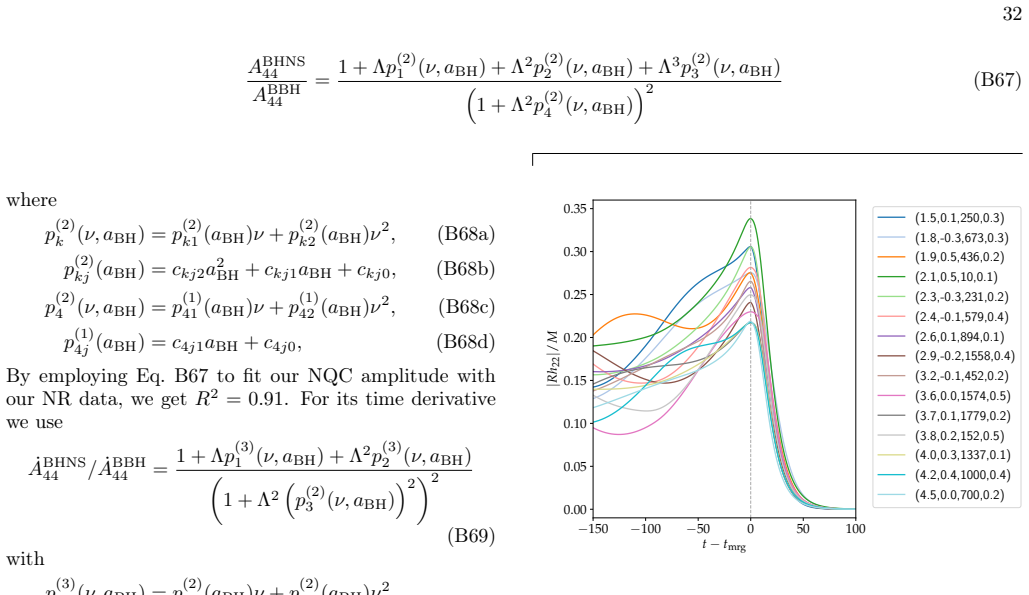
The load-bearing machinery is the NR-informed deviation fit for each multipole. For a modeled mode, quantities such as peak amplitude, merger frequency, ringdown quasi-normal-mode damping time and frequency, and the next-to-quasicircular (NQC) correction values and their derivatives are written as a ratio F_BHNS/F_BBH given by a Padé approximant in the tidal polarizability Λ, with polynomial coefficients in the symmetric mass ratio ν and black-hole spin a_BH fitted to the simulations; the BBH fit supplies the Λ=0 limit. The (2,2) peak-amplitude ratio A_BHNS/A_BBH < 0.85 marks tidal disruption (Type I) and selects a damped ringdown, while the NQC attachment time is set to Δt_NQC = 4 for BHNS. This combination turns a small set of short simulations into a smooth model over the tidal-disruption boundary.
What would settle it
Run a new, error-controlled BHNS simulation with at least ten orbits in an under-sampled region, for example q≈2 with Λ>3000 or a precessing spin with a different orientation, and compute the sky-maximized mismatch against TEOBResumS-Dalí over the same [276, 2048] Hz band used for BAM:0223; a low-inclination mismatch clearly above the one-percent level, or an inspiral phase difference growing beyond about 0.5 rad, would refute the generalization claim.
Extended reading notes
Core claim
On the paper's own terms, the discovery is that the strong-field BHNS waveform can be represented as a systematic, multipole-by-multipole deformation of the binary-black-hole waveform, with every merger/ringdown quantity written as a Padé-type ratio to its BBH value and fitted against new numerical data. The model, TEOBResumS-Dalí, models the (2,2), (2,1), (3,2), (3,3), and (4,4) modes; the (2,2) amplitude at merger is improved by an order of magnitude relative to the earlier BHNS model, and the ringdown is deformed according to a phenomenological classification of tidal-disruption type based on the (2,2) peak amplitude. Validation against the held-out 12-orbit precessing simulation BAM:0223 shows inspiral phase differences under 0.5 rad and low-inclination mismatches around 1%, and the same fits yield updated remnant mass, spin, and gravitational-recoil models. The numerics also find that the (2,0) and (3,0) modes carry proportionally more amplitude than in BBH systems, a memory-related tidal signature worth modeling in future templates.
Load-bearing premise
The whole generalization rests on fits trained with 51 short (3–4 orbit) quasicircular simulations plus one precessing 12-orbit simulation, with some fits showing R²≈0.85 and artificial binary-black-hole data added to prevent extreme values; if those fits do not transfer to the uncalibrated parts of parameter space, the claimed merger accuracy and the eccentric/precessing predictions would not hold.
Editorial extensions
If this is right
- BHNS template banks can reach merger/ringdown faithfulness near one percent at low inclination for precessing systems, rather than the order-of-magnitude-worse accuracy of the older model.
- The enhanced (2,0) and (3,0) modes give a gravitational-wave-only route to recognizing tidal disruption, useful when no kilonova or gamma-ray counterpart is observed.
- The greedy selection identifies the most informative next NR simulations: high tidal polarizability (Λ > 3000), mass ratio q ≤ 2, and large aligned spin.
- Eccentric and precessing BHNS waveforms can now be produced, allowing parameter-estimation studies of events like GW200105 with an EOB model instead of post-Newtonian approximants only.
- The new remnant mass, spin, and recoil fits quantify how tides suppress the gravitational-recoil kick in comparable-mass, tidal-disruption systems.
Reading between the lines
- If the (2,0)/(3,0) enhancement survives extraction at null infinity, which the paper itself notes requires Cauchy-characteristic evolution, gravitational-wave memory analyses could become a practical BHNS-versus-BBH diagnostic.
- Because several fits have R² as low as 0.85 and artificial BBH points were added to tame extreme values, the claimed accuracy away from the calibration region, especially for eccentric orbits, is an extrapolation that an independent long simulation with different parameters would settle.
- The early-inspiral oscillations seen in eccentric waveforms only when tides are active might be a genuine tidal effect or a model artifact; distinguishing them requires eccentric NR data that do not yet exist.
- The validation mismatches rise to about 0.1 at edge-on inclination, so the one-percent claim should not be read as holding for all orientations.
Editorial analysis
A structured set of objections, weighed in public.
Referee Report
Summary. The paper presents 52 new numerical-relativity (NR) simulations of black-hole–neutron-star mergers, with a detailed error budget including convergence tests, finite-extraction-radius estimates, and Richardson extrapolation. The data are used to build TEOBResumS-Dalí, a multipolar effective-one-body model with precession and eccentricity, by adding BHNS-specific next-to-quasicircular corrections and ringdown fits for the (2,2), (2,1), (3,2), (3,3), and (4,4) modes, together with remnant-mass, remnant-spin, and recoil-velocity fits. The central claims are that the new model improves the merger amplitude by an order of magnitude over TEOBResumS-GIOTTO, that it is validated against a new 12-orbit precessing simulation BAM:0223 with sub-0.5-rad phase differences in the inspiral and about 1% all-mode mismatches at low inclinations, and that it robustly produces the first eccentric and eccentric-plus-precessing BHNS waveforms.
Significance. If the claims hold, this is a substantial advance for BHNS waveform modelling: it provides the largest set of publicly released convergent multipolar BHNS waveforms, a careful treatment of NR errors, and the first EOB model that combines tides, precession, and eccentricity in a single framework. The held-out precessing simulation BAM:0223 is a genuine independent check of the inspiral, and the open data/code release is a strong community resource. The main open risk is that the most novel model components—the multipolar NQC and ringdown fits of Appendix B—are calibrated on only 51 short (3–4 orbit) quasicircular simulations, with several fits of modest quality and with artificial BBH anchor points; the validation against BAM:0223 is restricted to the inspiral band and does not directly test the merger where those fits act. The eccentric and precessing waveform capability is explicitly unvalidated against NR.
major comments (4)
- [Sec. V B and Table III] The reported 1%-level mismatches for BAM:0223 use f_high = 2048 Hz, which for M ≈ 5 M⊙ is below the (2,2) merger frequency of about 3 kHz. Figure 12 shows the phase difference growing to 2.3 rad at merger. Since the new NQC and ringdown fits in Appendix B act precisely in this band, the validation does not test the component of the model that is most changed relative to TEOBResumS-GIOTTO. I ask for a mismatch budget restricted to the merger-ringdown band, or for validation against a simulation with a longer merger-band waveform, before the headline 'order-of-magnitude improvement at merger' is regarded as established.
- [Appendix B, esp. B1c and B2b] The out-of-sample test for the (3,2) peak amplitude reports a 9.92% relative error, and several fits have R² = 0.85–0.89 (e.g., ω_NQC^(21), A_dot_NQC^(22), A_dot_NQC^(44)). The appendix states that artificial BBH data were added 'to mitigate extreme values' and that results outside the data region 'could reach up to a 10% error.' These fits are used to claim accurate multipolar merger and ringdown behaviour. A leave-one-out cross-validation over the 51 calibration runs, with per-mode errors, would directly address whether the chosen Pade forms generalize rather than overfit the small dataset.
- [Sec. V B and Fig. 13] The 'median mismatch of about 0.01 against all available simulations' includes the CoRe runs that were used for calibration, so it is not an independent accuracy statement. The independent evidence is the single held-out BAM:0223, whose mismatch band ends before merger. The worst catalogue mismatch, 18% for SACRA 2H-Q2M12a75 (a_BH = 0.75, Λ = 4392), lies in the extrapolation region that the paper's own greedy analysis (Sec. VI A) identifies as most urgent. Please report calibration-set and held-out-set mismatches separately, with the parameter-space coverage of each.
- [Sec. VI B and Conclusions] The eccentric and eccentric-plus-precessing waveforms are explicitly not validated against NR data: the text says 'we cannot directly assess the faithfulness of our model against numerical data,' and Appendix C provides only smoothness checks and BBH-vs-BHNS mismatch trends. The abstract's claim of 'robust waveforms with both eccentricity and precession' should therefore be softened to a demonstration of numerical stability and internal consistency. In addition, the unexplained early-inspiral oscillations for high-Λ eccentric cases (Fig. 15 and Appendix C) should be investigated against known eccentric BBH and tidal behaviour before the word 'robust' is used.
minor comments (4)
- [Eq. (8)] The third term in the numerator for the remnant-spin model appears to be Λ³ p_2^(3), which is likely a typo for Λ³ p_3^(3).
- [Throughout] There are several typos, including 'paramaters' in the Table I caption, 'Aditionally' in Appendix A1, 'faiththful' in Sec. VI, 'verticle' in the Fig. 9 caption, and 'unfaithfullness' in Sec. V B.
- [Sec. II C and Sec. VI B] The initial eccentricity is said to be below e ~ 0.02 for the NR runs, while the generated waveforms use e_0 up to 0.5; the paper should state explicitly which eccentricity definition is used in each context.
- [Sec. VI A] The greedy-algorithm recommendations rely on the model's fidelity in the very region (Λ > 3000, q ≤ 2) where the fits are least tested; the paper should note this circularity when presenting the simulation priorities.
Circularity Check
Genuine out-of-sample inspiral validation on the held-out precessing run BAM:0223, but the headline merger-amplitude improvement and the 1% median mismatch are partly demonstrated on the very calibration data that produced the fits.
-
fitted input called prediction
[Abstract; Sec. II C; Sec. IV A and Fig. 9; fits in App. B1a/B2a]
"We show an overall order of magnitude improvement in the waveform's amplitude at merger and more consistent multipoles over our older TEOBResumS-GIOTTO for BHNS. ... Since we are interested in extracting information from the merger and post-merger, we evolve the 51 configurations for 3-4 orbits which are used to inform our EOB model."
The claimed order-of-magnitude improvement at merger is displayed in Fig. 9 for BAM:0190 and BAM:0200, two configurations of the 52-run calibration set ('used to inform our EOB model'). The quantities that set the merger amplitude and ringdown shape - A_peak^22, A_NQC^22, omega_NQC^22, alpha_221 and omega_221 - are precisely the quantities fitted to those same runs in App. B (R^2 = 0.99 for A_NQC^22, 0.97 for the peak amplitude). The Fig. 9 agreement therefore largely restates the fits evaluated at their own training points. The independent validation, BAM:0223, is integrated over [276, 2048] Hz, which for M ~ 5 Msun terminates below the merger frequency, so the new NQC/ringdown content has no out-of-sample confirmation; the phase difference at merger is 2.3 rad (Fig. 12).
-
fitted input called prediction
[Sec. V B and Fig. 13; Conclusions (Sec. VII)]
"Finally, we comment on the mismatches previously computed in [105] for 184 BHNS simulations across the available datasets including the CoRe data produced in this work. ... Additionally, we obtained a median mismatch of 0.01 against all available simulations, demonstrating the accurate performance of the model."
The 'median mismatch of 0.01 against all available simulations' is computed over a set that explicitly includes 'the CoRe data produced in this work' - i.e., the same 51+1 simulations used to inform the model's NQC, ringdown, and remnant fits. Low mismatch on calibration entries is the expected outcome of a fit, not independent evidence of accuracy. The genuine out-of-sample portion (SXS, SACRA) is reported collectively, with the 18% SACRA outlier honestly disclosed; but the summary sentence presents the aggregate median as 'demonstrating the accurate performance of the model' without separating the in-sample contribution, so part of that validation claim reduces to fit quality on the training set.
full rationale
The paper's derivation chain is otherwise self-contained: TEOBResumS-Dali's BHNS-specific content (NQC and ringdown fits, remnant and kick models) is calibrated to the 51 new short quasicircular NR runs plus older data, and the headline validation is a genuinely held-out 12-orbit precessing simulation (BAM:0223), never used to inform the model. That out-of-sample check endows the central claim (phase difference below ~0.5 rad through the inspiral; ~1% all-mode mismatches at low inclination) with independent content. Two milder circularity-adjacent points are flagged. First, the abstract's 'order of magnitude improvement in the waveform's amplitude at merger' is demonstrated in Fig. 9 on BAM:0190 and BAM:0200, both in the calibration set, and the merger-amplitude and ringdown quantities shown are exactly the ones fitted to those runs in Appendix B; the independent BAM:0223 mismatch band ([276, 2048] Hz for M ~ 5 Msun) ends below the merger frequency where the new fits act, so the novel merger/ringdown content lacks out-of-sample confirmation. Second, the 'median mismatch of 0.01 against all available simulations' includes the CoRe calibration data alongside the genuinely external SXS/SACRA runs, whose worst case (18% for SACRA 2H-Q2M12a75) lies outside the calibrated range and is honestly reported. Neither point destroys the central claim: the inspiral validation on BAM:0223 is real, the paper transparently discloses R^2 values (down to 0.85), artificial BBH anchor points, and the 'up to a 10% error' extrapolation caveat, and it explicitly admits that the eccentric+precessing capability cannot yet be assessed against NR ('we cannot directly assess the faithfulness of our model against numerical data'). No uniqueness theorem is invoked, and the cosh-rescaled ringdown ansatz is a standard published form adopted from prior work rather than smuggled in as an external fact. The circularity burden is therefore partial and localized to the in-sample basis of the merger-amplitude and aggregate-mismatch claims, yielding score 3.
Assumptions & free parameters
free parameters (8)
- Remnant mass model polynomial coefficients c_kji =
Table V coefficients
- Remnant spin model polynomial coefficients =
Table V coefficients
- Kick velocity model coefficients c_kji =
Table VI coefficients
- Ringdown fit coefficients for (2,2),(2,1),(3,2),(3,3),(4,4) =
Tables VII-XI coefficients
- NQC fit coefficients for (2,2),(2,1),(3,3),(4,4) =
Tables XII-XV coefficients
- NQC time shift Delta t_NQC =
4 (in units of M)
- Type I/II/III classification thresholds =
A_BHNS/A_BBH < 0.85 for Type I and > 0.99 for Type II
- Artificial BBH data points in higher-mode fits =
unspecified count and placement
assumptions (7)
- domain assumption General relativity and the Z4c formulation with BAM's finite-difference discretization provide a faithful representation of BHNS merger dynamics.
- domain assumption The neutron star is irrotational and described by piecewise polytropic EoS SLy, MS1b, or ALF2, ignoring temperature, magnetic fields, and neutrino transport.
- domain assumption The EOB BBH baseline from TEOBResumS-Dalí accurately describes the point-particle sector of BHNS inspiral before tidal and near-merger corrections.
- domain assumption The waveform is the strain obtained from Psi_4 via fixed-frequency integration; the m=0 modes are not modelled, but their contribution is assumed negligible for the model's target accuracy.
- domain assumption Finite-extraction-radius and truncation errors are captured by the M8 grid choice and the reported error budget.
- domain assumption Eccentricity e~0.02 in the initial data is small enough that quasicircular templates can be calibrated without eccentricity reduction.
- ad hoc to paper Artificial BBH data added to higher-mode fits behave like physical data and do not distort the BHNS parameter dependence.
Cite this review
Pith. "Pith review of Black-hole - neutron-star mergers: new numerical-relativity simulations and multipolar effective-one-body model with spin precession and eccentricity." pith.science (2026). https://pith.science/paper/RA2XLOZ4
@misc{pith2026250700113,
  author       = {Pith},
  title        = {Pith review of: Black-hole - neutron-star mergers: new numerical-relativity simulations and multipolar effective-one-body model with spin precession and eccentricity},
  year         = {2026},
  howpublished = {\url{https://pith.science/paper/RA2XLOZ4}},
  note         = {Machine review of arXiv:2507.00113}
}
abstract
In this paper, we present 52 new numerical-relativity (NR) simulations of black-hole-neutron-star merger (BHNS) mergers and employ the data to inform TEOBResumS-Dal\'i: a multipolar effective-one-body model also including precession and eccentricity. Our simulations target quasicircular mergers and the parameter space region characterized by significant tidal disruption of the star. Convergent gravitational waveforms are produced with a detailed error budget after extensive numerical tests. We study in detail the multipolar amplitude hierarchy and identify a characteristic tidal signature in the $(\ell,m)=(2,0)$, and $(3,0)$ modes. We also develop new NR-informed models for the remnant black hole and for the recoil velocity. The numerical data is then used to inform next-to-quasicircular corrections and the ringdown of TEOBResumS-Dal\'i for BHNS. We show an overall order of magnitude improvement in the waveform's amplitude at merger and more consistent multipoles over our older TEOBResumS-GIOTTO for BHNS. TEOBResumS-Dal\'i is further validated with a new 12 orbit precessing simulation, showing phase and relative amplitude differences below $\sim 0.5$ (rad) throughout the inspiral. The computed mismatches including all the modes lie at the one percent level for low inclinations. Finally, we demonstrate for the first time that TEOBResumS-Dal\'i can produce robust waveforms with both eccentricity and precession, and use the model to identify the most urgent BHNS to simulate for waveform development. Our new numerical data are publicly released as part of the CoRe database.
Figures


Figures from the paper (25 more)




Forward citations
Cited by 4 Pith papers
-
Fast gravitational waveform models for quasi-circular coalescences of neutron star--black hole binaries
Presents new NSBH waveform models IMRPhenomXHM_NSBH, SEOBNRv5HM_ROM_NRTidalv3_NSBH, and IMRPhenomXPHM_NSBH incorporating higher modes and tidal effects via NRTidalv3 extensions, validated against NR simulations and ap...
-
Accurate waveforms for generic planar-orbit binary black holes: The multipolar effective-one-body model SEOBNRv6EHM
SEOBNRv6EHM is a multipolar EOB model for eccentric planar-orbit BBHs calibrated to NR simulations, showing low waveform mismatches up to eccentricity 0.9.
-
From the confluent Heun equation to a new factorized and resummed gravitational waveform for circularized, nonspinning, compact binaries
A new resummation absorbs all test-mass logarithms and transcendental numbers into closed-form factors, leaving rational polynomial waveform corrections up to 10PN.
-
GWTC-5.0: Methods for Identifying and Characterizing Gravitational-wave Transients
Describes the methods for producing the fifth gravitational-wave transient catalog (GWTC-5.0) from O4b data of LIGO, Virgo and KAGRA.
Reference graph
Works this paper leans on
-
[1]
cheapest
Data quality In this section we assess the convergence of our simu- lations and justify our grid configuration choices for the production runs. We consider four resolutions and three different refinement levels on the BH, see Table IV. For these studies we employ the configuration ofBAM:0206 to find the "cheapest", highest resolution configuration to empl...
-
[2]
Table V shows the best coefficients obtained fora • andM • as a deviation from the BBH case
Remnant Black Hole In this appendix we present the fitting parameters for the updated remnant BH model. Table V shows the best coefficients obtained fora • andM • as a deviation from the BBH case
-
[3]
The 22 TABLE V
Kick velocity In the following, we describe the effects of resolution and integration errors on the computation ofvGW kick. The 22 TABLE V. Fitting parameters fora• andM • withR 2 = 0.914andR 2 = 0.930respectively. Here, we make a fit of a quantity FasF BHNS/F BBH. Fk c k12 ck11 ck10 ck22 ck21 ck20 ck32 ck31 ck30 a• 11.4×10 −3 4.6×10 −3 9.1×10 −4 −5.0×10 ...
2000
-
[4]
V we compared our model to a new 12 orbit precessing simulation,BAM:0223, performed in 3 different resolutions: M8, H8, F8 (see Table IV)
Long simulation accuracy In Sec. V we compared our model to a new 12 orbit precessing simulation,BAM:0223, performed in 3 different resolutions: M8, H8, F8 (see Table IV). We inspect the self convergence of the configuration in Fig. 28, where we show the amplitude and phase differences between the available datasets. The amplitude differences for all reso...
2000
-
[5]
Ringdown model parameters Here we present the fit models and corresponding co- efficients for the quantities needed to build the ringdown model described in Sec. IVA. All fitting models for each quantityF, are based on a deviation from the BBH fits from [90] asF BHNS/F BBH and modelled using a Pade approximant function with dependence on masses, spins and...
-
[6]
IVB for more details on how these fits are used
NQC extraction points In this subsection we present the fits developed for the NQC extraction points for all multipoles available (not available for the (3,2) mode), namely the quanti- ties (ANQC ℓm , ˙ANQC ℓm ,ω NQC ℓm ,˙ωNQC ℓm ), see Sec. IVB for more details on how these fits are used. Note that both the amplitudeA NQC ℓm and its time derivative ˙ANQC...
-
[7]
Aasiet al.(LIGO Scientific), Class
J. Aasiet al.(LIGO Scientific), Class. Quant. Grav.32, 074001 (2015), arXiv:1411.4547 [gr-qc]
arXiv 2015
-
[8]
F. Acerneseet al.(VIRGO), Class. Quant. Grav.32, 024001 (2015), arXiv:1408.3978 [gr-qc]
arXiv 2015
Show all 138 references
-
[9]
A. G. Abacet al.(LIGO Scientific, Virgo„ KA- GRA, VIRGO), Astrophys. J. Lett.970, L34 (2024), arXiv:2404.04248 [astro-ph.HE]
2024 arXiv
-
[10]
Zappa, S
F. Zappa, S. Bernuzzi, F. Pannarale, M. Mapelli, and N. Giacobbo, Phys. Rev. Lett.123, 041102 (2019), arXiv:1903.11622 [gr-qc]
2019 arXiv
-
[11]
Kunnumkai, A
K. Kunnumkai, A. Palmese, M. Bulla, T. Diet- rich, A. M. Farah, and P. T. H. Pang, (2024), arXiv:2409.10651 [astro-ph.HE]
2024
-
[12]
Xinget al., (2024), arXiv:2410.20415 [astro-ph.HE]
Z. Xinget al., (2024), arXiv:2410.20415 [astro-ph.HE]
2024 arXiv
-
[13]
Colombo, O
A. Colombo, O. S. Salafia, G. Ghirlanda, F. Iacovelli, M. Mancarella, F. S. Broekgaarden, L. Nava, B. Giaco- mazzo, and M. Colpi, (2025), arXiv:2503.00116 [astro- ph.HE]
2025
-
[14]
Abbottet al.(LIGO Scientific, KAGRA, VIRGO), Astrophys
R. Abbottet al.(LIGO Scientific, KAGRA, VIRGO), Astrophys. J. Lett.915, L5 (2021), arXiv:2106.15163 [astro-ph.HE]
2021 arXiv
-
[15]
Morras, G
G. Morras, G. Pratten, and P. Schmidt, (2025), arXiv:2503.15393 [astro-ph.HE]
2025
-
[16]
M.Pillaset al., (2025),arXiv:2503.15422[astro-ph.HE]
2025
-
[17]
Mahapatra, D
P. Mahapatra, D. Chattopadhyay, A. Gupta, F. An- tonini, M. Favata, B. S. Sathyaprakash, and K. G. Arun, (2025), arXiv:2503.17872 [astro-ph.HE]
2025
-
[18]
Chandra, I
K. Chandra, I. Gupta, R. Gamba, R. Kashyap, D. Chattopadhyay, A. Gonzalez, S. Bernuzzi, and B. S. Sathyaprakash, Astrophys. J.977, 167 (2024), arXiv:2405.03841 [astro-ph.HE]
2024 arXiv
-
[19]
Y.-W. Xue, Y. Qin, L. Yuan, W.-H. Guo, J.-Q. Li, Y.- Q. Zhang, Z.-Y. Wang, and D.-H. Wu, Res. Astron. Astrophys.25, 045009 (2025)
2025
-
[20]
J. A. Faber, T. W. Baumgarte, S. L. Shapiro, K. Taniguchi, and F. A. Rasio, Phys. Rev.D73, 024012 (2006), arXiv:astro-ph/0511366
2006 arXiv
-
[21]
Grandclement, Phys
P. Grandclement, Phys. Rev. D74, 124002 (2006), [Erratum: Phys.Rev.D 75, 129903 (2007)], arXiv:gr- qc/0609044
2006
-
[22]
Taniguchi, T
K. Taniguchi, T. W. Baumgarte, J. A. Faber, and S. L. Shapiro, Phys. Rev. D75, 084005 (2007), arXiv:gr- qc/0701110
2007
-
[23]
Taniguchi, T
K. Taniguchi, T. W. Baumgarte, J. A. Faber, and S. L. Shapiro, Phys. Rev. D77, 044003 (2008), arXiv:0710.5169 [gr-qc]
2008 arXiv
-
[24]
Z. B. Etienneet al., Phys. Rev.D77, 084002 (2008), arXiv:0712.2460 [astro-ph]
2008 arXiv
-
[25]
M. D. Duez, F. Foucart, L. E. Kidder, H. P. Pfeiffer, M. A. Scheel, and S. A. Teukolsky, Phys. Rev.D78, 104015 (2008), arXiv:0809.0002 [gr-qc]
2008 arXiv
-
[26]
Z. B. Etienne, Y. T. Liu, S. L. Shapiro, and T. W. Baumgarte, Phys. Rev.D79, 044024 (2009), arXiv:0812.2245 [astro-ph]
2009 arXiv
-
[27]
Foucart, D
F. Foucart, D. Desai, W. Brege, M. D. Duez, D. Kasen, D. A. Hemberger, L. E. Kidder, H. P. Pfeiffer, and M. A. Scheel, Class. Quant. Grav.34, 044002 (2017), arXiv:1611.01159 [astro-ph.HE]
2017 arXiv
-
[28]
Brege, M
W. Brege, M. D. Duez, F. Foucart, M. B. Deaton, J. Caro, D. A. Hemberger, L. E. Kidder, E. O’Connor, H. P. Pfeiffer, and M. A. Scheel, Phys. Rev. D98, 063009 (2018), arXiv:1804.09823 [gr-qc]
2018 arXiv
- [29]
-
[30]
Chawla, M
S. Chawla, M. Anderson, M. Besselman, L. Lehner, S.L.Liebling,et al.,Phys.Rev.Lett.105,111101(2010), arXiv:1006.2839 [gr-qc]
2010 arXiv
-
[31]
Paschalidis, M
V. Paschalidis, M. Ruiz, and S. L. Shapiro, Astrophys. J.Lett.806,L14(2015),arXiv:1410.7392[astro-ph.HE]
2015 arXiv
-
[32]
Kiuchi, Y
K. Kiuchi, Y. Sekiguchi, K. Kyutoku, M. Shibata, K. Taniguchi, and T. Wada, Phys. Rev. D92, 064034 (2015), arXiv:1506.06811 [astro-ph.HE]
2015 arXiv
- [33]
-
[34]
M. Ruiz, V. Paschalidis, A. Tsokaros, and S. L. Shapiro, Phys. Rev. D102, 124077 (2020), arXiv:2011.08863 [astro-ph.HE]
2020 arXiv
-
[35]
W. E. East, L. Lehner, S. L. Liebling, and C. Palenzuela, Astrophys. J. Lett.912, L18 (2021), arXiv:2101.12214 [astro-ph.HE]
2021 arXiv
-
[36]
E. R. Most, L. J. Papenfort, S. D. Tootle, and L. Rez- zolla, Mon. Not. Roy. Astron. Soc.506, 3511 (2021), arXiv:2106.06391 [astro-ph.HE]
2021 arXiv
-
[37]
M. R. Izquierdo, M. Bezares, S. Liebling, and C. Palen- zuela, (2024), arXiv:2403.09770 [astro-ph.HE]
2024 arXiv
-
[38]
Foucart, E
F. Foucart, E. O’Connor, L. Roberts, M. D. Duez, R. Haas, L. E. Kidder, C. D. Ott, H. P. Pfeiffer, M. A. Scheel, andB.Szilagyi,Phys.Rev.D91,124021(2015), arXiv:1502.04146 [astro-ph.HE]
2015 arXiv
-
[39]
Kyutoku, K
K. Kyutoku, K. Kiuchi, Y. Sekiguchi, M. Shibata, and K. Taniguchi, Phys. Rev. D97, 023009 (2018), arXiv:1710.00827 [astro-ph.HE]
2018 arXiv
-
[40]
Hayashi, K
K. Hayashi, K. Kiuchi, K. Kyutoku, Y. Sekiguchi, and M. Shibata, Phys. Rev. D107, 123001 (2023), arXiv:2211.07158 [astro-ph.HE]
2023 arXiv
-
[41]
Foucart, M
F. Foucart, M. D. Duez, L. E. Kidder, and S. A. Teukol- sky, Phys. Rev.D83, 024005 (2011), arXiv:1007.4203 [astro-ph.HE]
2011 arXiv
-
[42]
Lovelace, M
G. Lovelace, M. D. Duez, F. Foucart, L. E. Kidder, H. P. Pfeiffer, M. A. Scheel, and B. Szilágyi, Class. Quant. Grav.30, 135004 (2013), arXiv:1302.6297 [gr-qc]
2013 arXiv
-
[43]
Kyutoku, H
K. Kyutoku, H. Okawa, M. Shibata, and K. Taniguchi, Phys. Rev. D84, 064018 (2011), arXiv:1108.1189 [astro- ph.HE]
2011 arXiv
- [44]
-
[45]
Foucart, L
F. Foucart, L. Buchman, M. D. Duez, M. Grudich, L. E. Kidder, I. MacDonald, A. Mroue, H. P. Pfeiffer, M. A. Scheel, andB.Szilagyi,Phys.Rev.D88,064017(2013), arXiv:1307.7685 [gr-qc]
2013 arXiv
-
[46]
Kyutoku, K
K. Kyutoku, K. Ioka, and M. Shibata, Phys.Rev.D88, 041503 (2013), arXiv:1305.6309 [astro-ph.HE]
2013 arXiv
-
[47]
Yamamoto, M
T. Yamamoto, M. Shibata, and K. Taniguchi, Phys. Rev.D78, 064054 (2008), arXiv:0806.4007 [gr-qc]
2008 arXiv
-
[48]
Kiuchi, K
K. Kiuchi, K. Kawaguchi, K. Kyutoku, Y. Sekiguchi, M. Shibata, and K. Taniguchi, Phys. Rev.D96, 084060 (2017), arXiv:1708.08926 [astro-ph.HE]
2017 arXiv
-
[49]
Kyutoku, M
K. Kyutoku, M. Shibata, and K. Taniguchi, Phys. Rev.D82, 044049 (2010), [Erratum: Phys. Rev.D84,049902(2011)], arXiv:1008.1460 [astro-ph.HE]
2010 arXiv
-
[50]
Hayashi, K
K. Hayashi, K. Kawaguchi, K. Kiuchi, K. Kyutoku, and M. Shibata, Phys. Rev. D103, 043007 (2021), 40 arXiv:2010.02563 [astro-ph.HE]. [45]http://www.black-holes.org/SpEC.html, spEC - Spectral Einstein Code
2021 arXiv
-
[51]
SXS Gravitational Waveform Database,
“SXS Gravitational Waveform Database,”https:// data.black-holes.org/waveforms/index.html
-
[52]
Foucartet al., Phys
F. Foucartet al., Phys. Rev. D99, 044008 (2019), arXiv:1812.06988 [gr-qc]
2019 arXiv
-
[53]
Foucartet al., Phys
F. Foucartet al., Phys. Rev. D103, 064007 (2021), arXiv:2010.14518 [gr-qc]
2021 arXiv
-
[54]
Bernuzzi, M
S. Bernuzzi, M. Thierfelder, and B. Brügmann, Phys.Rev.D85, 104030 (2012), arXiv:1109.3611 [gr-qc]
2012 arXiv
-
[55]
Bernuzzi and T
S. Bernuzzi and T. Dietrich, Phys. Rev.D94, 064062 (2016), arXiv:1604.07999 [gr-qc]
2016 arXiv
-
[56]
Kiuchi, K
K. Kiuchi, K. Kyohei, K. Kyutoku, Y. Sekiguchi, and M. Shibata, (2019), arXiv:1907.03790 [astro-ph.HE]
2019 arXiv
-
[57]
G.Doulis, F.Atteneder, S.Bernuzzi, andB.Brügmann, Phys. Rev. D106, 024001 (2022), arXiv:2202.08839 [gr- qc]
2022 arXiv
-
[58]
B. D. Lackey, K. Kyutoku, M. Shibata, P. R. Brady, and J. L. Friedman, Phys.Rev.D85, 044061 (2012), arXiv:1109.3402 [astro-ph.HE]
2012 arXiv
-
[59]
B. D. Lackey, K. Kyutoku, M. Shibata, P. R. Brady, and J. L. Friedman, Phys.Rev.D89, 043009 (2014), arXiv:1303.6298 [gr-qc]
2014 arXiv
-
[60]
Pannarale, E
F. Pannarale, E. Berti, K. Kyutoku, and M. Shibata, Phys. Rev.D88, 084011 (2013), arXiv:1307.5111 [gr- qc]
2013 arXiv
-
[61]
Pannarale, E
F. Pannarale, E. Berti, K. Kyutoku, B. D. Lackey, and M. Shibata, Phys. Rev.D92, 084050 (2015), arXiv:1509.00512 [gr-qc]
2015 arXiv
-
[62]
Pannarale, E
F. Pannarale, E. Berti, K. Kyutoku, B. D. Lackey, and M. Shibata, Phys. Rev.D92, 081504 (2015), arXiv:1509.06209 [gr-qc]
2015 arXiv
-
[63]
J. E. Thompson, E. Fauchon-Jones, S. Khan, E. Ni- toglia, F. Pannarale, T. Dietrich, and M. Hannam, Phys. Rev. D101, 124059 (2020), arXiv:2002.08383 [gr- qc]
2020 arXiv
-
[64]
Mataset al., Phys
A. Mataset al., Phys. Rev. D102, 043023 (2020), arXiv:2004.10001 [gr-qc]
2020 arXiv
-
[65]
Dietrich, A
T. Dietrich, A. Samajdar, S. Khan, N. K. Johnson- McDaniel, R. Dudi, and W. Tichy, Phys. Rev.D100, 044003 (2019), arXiv:1905.06011 [gr-qc]
2019 arXiv
-
[66]
Gonzalez, R
A. Gonzalez, R. Gamba, M. Breschi, F. Zappa, G. Carullo, S. Bernuzzi, and A. Nagar, Phys. Rev. D 107, 084026 (2023), arXiv:2212.03909 [gr-qc]
2023 arXiv
-
[67]
Schmidt, F
P. Schmidt, F. Ohme, and M. Hannam, Phys. Rev. D91, 024043 (2015), arXiv:1408.1810 [gr-qc]
2015 arXiv
-
[68]
Rashti, F
A. Rashti, F. M. Fabbri, B. Brügmann, S. V. Chaurasia, T. Dietrich, M. Ujevic, and W. Tichy, Phys. Rev. D 105, 104027 (2022), arXiv:2109.14511 [gr-qc]
2022 arXiv
-
[69]
Rashti and A
A. Rashti and A. Noe, Class. Quant. Grav.42, 015007 (2025), arXiv:2407.01701 [gr-qc]
2025 arXiv
-
[70]
York, James W., Phys.Rev.Lett.82, 1350 (1999), arXiv:gr-qc/9810051 [gr-qc]
J. York, James W., Phys.Rev.Lett.82, 1350 (1999), arXiv:gr-qc/9810051 [gr-qc]
1999 arXiv
-
[71]
H. P. Pfeiffer and J. W. York, Jr., Phys. Rev.D67, 044022 (2003), arXiv:gr-qc/0207095 [gr-qc]
2003 arXiv
- [72]
-
[73]
G. B. Cook and H. P. Pfeiffer, Phys. Rev.D70, 104016 (2004), arXiv:gr-qc/0407078 [gr-qc]
2004 arXiv
-
[74]
Brügmann, J
B. Brügmann, J. A. Gonzalez, M. Hannam, S. Husa, U. Sperhake,et al., Phys.Rev.D77, 024027 (2008), arXiv:gr-qc/0610128 [gr-qc]
2008 arXiv
-
[75]
Thierfelder, S
M. Thierfelder, S. Bernuzzi, and B. Brügmann, Phys.Rev.D84, 044012 (2011), arXiv:1104.4751 [gr-qc]
2011 arXiv
-
[76]
Kurganov and E
A. Kurganov and E. Tadmor, J. Comp. Phys.160, 214 (2000)
2000
-
[77]
Nessyahu and E
H. Nessyahu and E. Tadmor, J. Comp. Phys.87, 408–463 (1990)
1990
-
[78]
Borges, M
R. Borges, M. Carmona, B. Costa, and W. S. Don, Journal of Computational Physics227, 3191 (2008)
2008
-
[79]
J. S. Read, B. D. Lackey, B. J. Owen, and J. L. Fried- man, Phys. Rev.D79, 124032 (2009), arXiv:0812.2163 [astro-ph]
2009 arXiv
-
[80]
Alford, M
M. Alford, M. Braby, M. W. Paris, and S. Reddy, As- trophys. J.629, 969 (2005), arXiv:nucl-th/0411016
2005 arXiv
-
[81]
F. S. Broekgaarden, E. Berger, C. J. Neijssel, A. Vigna- Gómez, D. Chattopadhyay, S. Stevenson, M. Chruslin- ska, S. Justham, S. E. de Mink, and I. Man- del, Mon. Not. Roy. Astron. Soc.508, 5028 (2021), arXiv:2103.02608 [astro-ph.HE]
2021 arXiv
-
[82]
Damour, A
T. Damour, A. Nagar, D. Pollney, and C. Reisswig, Phys.Rev.Lett.108, 131101 (2012), arXiv:1110.2938 [gr-qc]
2012 arXiv
-
[83]
Bernuzzi, T
S. Bernuzzi, T. Dietrich, W. Tichy, and B. Brügmann, Phys.Rev.D89, 104021 (2014), arXiv:1311.4443 [gr-qc]
2014 arXiv
-
[84]
Topolski, S
K. Topolski, S. D. Tootle, and L. Rezzolla, Phys. Rev. D111, 064022 (2025), arXiv:2409.06767 [gr-qc]
2025 arXiv
-
[85]
Gonzalezet al., Class
A. Gonzalezet al., Class. Quant. Grav.40, 085011 (2023), arXiv:2210.16366 [gr-qc]
2023 arXiv
-
[86]
Kyutoku, K
K. Kyutoku, K. Ioka, H. Okawa, M. Shibata, and K. Taniguchi, Phys. Rev.D92, 044028 (2015), arXiv:1502.05402 [astro-ph.HE]
2015 arXiv
-
[87]
Kawaguchi, N
K. Kawaguchi, N. Domoto, S. Fujibayashi, H. Hami- dani, K. Hayashi, M. Shibata, M. Tanaka, and S. Wanajo, Mon. Not. Roy. Astron. Soc.535, 3711 (2024), arXiv:2404.15027 [astro-ph.HE]
2024 arXiv
-
[88]
S. Chen, L. Wang, K. Hayashi, K. Kawaguchi, K. Ki- uchi, and M. Shibata, Phys. Rev. D110, 063016 (2024), arXiv:2404.18714 [astro-ph.HE]
2024 arXiv
-
[89]
Christodoulou and R
D. Christodoulou and R. Ruffini, Phys. Rev. D4, 3552 (1971)
1971
-
[90]
Reisswig and D
C. Reisswig and D. Pollney, Class.Quant.Grav.28, 195015 (2011), arXiv:1006.1632 [gr-qc]
2011 arXiv
-
[91]
Bernuzzi, A
S. Bernuzzi, A. Nagar, and A. Zenginoglu, Phys.Rev. D83, 064010 (2011), arXiv:1012.2456 [gr-qc]
2011 arXiv
-
[92]
Nagar, J
A. Nagar, J. Healy, C. O. Lousto, S. Bernuzzi, and A. Albertini, Phys. Rev. D105, 124061 (2022), arXiv:2202.05643 [gr-qc]
2022 arXiv
-
[93]
Scheel, M
J.Blackman, S.E.Field, C.R.Galley, B.Szilágyi, M.A. Scheel, M. Tiglio, and D. A. Hemberger, Phys. Rev. Lett.115, 121102 (2015), arXiv:1502.07758 [gr-qc]
2015 arXiv
-
[94]
Boyleet al., Class
M. Boyleet al., Class. Quant. Grav.36, 195006 (2019), arXiv:1904.04831 [gr-qc]
2019 arXiv
-
[95]
Messina, Phys
A.Nagar, G.Riemenschneider, G.Pratten, P.Rettegno, and F. Messina, Phys. Rev. D102, 024077 (2020), arXiv:2001.09082 [gr-qc]
2020 arXiv
-
[96]
N. T. Bishop, R. Gomez, L. Lehner, and J. Winicour, Phys.Rev.D54, 6153 (1996)
1996
-
[97]
Moxon, M
J. Moxon, M. A. Scheel, and S. A. Teukolsky, Phys. Rev. D102, 044052 (2020), arXiv:2007.01339 [gr-qc]
2020 arXiv
-
[98]
Mitman, J
K. Mitman, J. Moxon, M. A. Scheel, S. A. Teukolsky, M. Boyle, N. Deppe, L. E. Kidder, and W. Throwe, Phys. Rev. D102, 104007 (2020), arXiv:2007.11562 [gr- qc]
2020 arXiv
-
[99]
M. J. Fitchett and S. L. Detweiler, Mon. Not. Roy. As- tron. Soc.211, 933 (1984)
1984
-
[100]
Favata, S
M. Favata, S. A. Hughes, and D. E. Holz, Astrophys. 41 J.607, L5 (2004), arXiv:astro-ph/0402056
2004 arXiv
-
[101]
Pollney, C
D. Pollney, C. Reisswig, L. Rezzolla, B. Szilagyi, M. Ansorg,et al., Phys.Rev.D76, 124002 (2007), arXiv:0707.2559 [gr-qc]
2007 arXiv
-
[102]
Reisswig, N
C. Reisswig, N. T. Bishop, D. Pollney, and B. Szilagyi, Class. Quant. Grav.27, 075014 (2010), arXiv:0912.1285 [gr-qc]
2010 arXiv
-
[103]
Bernuzzi and A
S. Bernuzzi and A. Nagar, Phys. Rev.D81, 084056 (2010), arXiv:1003.0597 [gr-qc]
2010 arXiv
-
[104]
J. A. Gonzalez, M. D. Hannam, U. Sperhake, B. Brüg- mann, and S. Husa, Phys. Rev. Lett.98, 231101 (2007), arXiv:gr-qc/0702052 [GR-QC]
2007 arXiv
-
[105]
Campanelli, C
M. Campanelli, C. O. Lousto, Y. Zlochower, and D. Merritt, Astrophys. J.659, L5 (2007), arXiv:gr- qc/0701164 [gr-qc]
2007
-
[106]
Campanelli, C
M. Campanelli, C. O. Lousto, Y. Zlochower, and D. Merritt, Phys.Rev.Lett.98, 231102 (2007), arXiv:gr- qc/0702133 [GR-QC]
2007
-
[107]
D. P. Mihaylov, S. Ossokine, A. Buonanno, H. Estelles, L. Pompili, M. Pürrer, and A. Ramos-Buades, (2023), arXiv:2303.18203 [gr-qc]
2023 arXiv
-
[108]
Ramos-Buades, A
A. Ramos-Buades, A. Buonanno, H. Estellés, M. Khalil, D. P. Mihaylov, S. Ossokine, L. Pompili, and M. Shiferaw, Phys. Rev. D108, 124037 (2023), arXiv:2303.18046 [gr-qc]
2023 arXiv
-
[109]
Updated Advanced LIGO sensitivity design curve,
“Updated Advanced LIGO sensitivity design curve,” https://dcc.ligo.org/LIGO-T1800044/public
-
[110]
Albanesi, R
S. Albanesi, R. Gamba, S. Bernuzzi, J. Fontbuté, A. Gonzalez, and A. Nagar, Phys. Rev. D112, L121503 (2025), arXiv:2503.14580 [gr-qc]
2025 arXiv
-
[111]
Kesden, U
M. Kesden, U. Sperhake, and E. Berti, Astrophys. J. 715, 1006 (2010), arXiv:1003.4993 [astro-ph.CO]
2010 arXiv
-
[112]
Borchers and F
A. Borchers and F. Ohme, in55th Rencontres de Moriond on Gravitation(2021) arXiv:2106.02414 [gr- qc]
2021 arXiv
-
[113]
Borchers, F
A. Borchers, F. Ohme, J. Mielke, and S. Ghosh, Phys. Rev. D110, 024037 (2024), arXiv:2405.03607 [gr-qc]
2024 arXiv
-
[114]
Damour and A
T. Damour and A. Nagar, Phys.Rev.D90, 044018 (2014), arXiv:1406.6913 [gr-qc]
2014 arXiv
-
[115]
Nagar, T
A. Nagar, T. Damour, C. Reisswig, and D. Pollney, Phys. Rev.D93, 044046 (2016), arXiv:1506.08457 [gr- qc]
2016 arXiv
- [116]
-
[117]
Nagar, G
A. Nagar, G. Pratten, G. Riemenschneider, and R. Gamba, Phys. Rev. D101, 024041 (2020), arXiv:1904.09550 [gr-qc]
2020 arXiv
-
[118]
Riemenschneider, P
G. Riemenschneider, P. Rettegno, M. Breschi, A. Alber- tini, R. Gamba, S. Bernuzzi, and A. Nagar, Phys. Rev. D104, 104045 (2021), arXiv:2104.07533 [gr-qc]
2021 arXiv
-
[119]
Nagar, P
A. Nagar, P. Rettegno, R. Gamba, S. Albanesi, A. Al- bertini, and S. Bernuzzi, Phys. Rev. D108, 124018 (2023), arXiv:2304.09662 [gr-qc]
2023 arXiv
-
[120]
D.ChiaramelloandA.Nagar,Phys.Rev.D101,101501 (2020), arXiv:2001.11736 [gr-qc]
2020 arXiv
-
[121]
Nagar, A
A. Nagar, A. Bonino, and P. Rettegno, Phys. Rev. D 103, 104021 (2021), arXiv:2101.08624 [gr-qc]
2021 arXiv
-
[122]
Nagar and P
A. Nagar and P. Rettegno, Phys. Rev. D104, 104004 (2021), arXiv:2108.02043 [gr-qc]
2021 arXiv
-
[123]
Grilli, A
E. Grilli, A. Placidi, S. Albanesi, G. Grignani, and M. Orselli, Phys. Rev. D111, 044045 (2025), arXiv:2410.05386 [gr-qc]
2025 arXiv
- [124]
-
[125]
Damour and A
T. Damour and A. Nagar, Phys.Rev.D90, 024054 (2014), arXiv:1406.0401 [gr-qc]
2014 arXiv
-
[126]
Cotesta, A
R. Cotesta, A. Buonanno, A. Bohé, A. Taracchini, I. Hinder, and S. Ossokine, Phys. Rev.D98, 084028 (2018), arXiv:1803.10701 [gr-qc]
2018 arXiv
-
[127]
Pompiliet al., Phys
L. Pompiliet al., Phys. Rev. D108, 124035 (2023), arXiv:2303.18039 [gr-qc]
2023 arXiv
-
[128]
Bernuzzi, A
S. Bernuzzi, A. Nagar, M. Thierfelder, and B. Brüg- mann, Phys.Rev.D86, 044030 (2012), arXiv:1205.3403 [gr-qc]
2012 arXiv
-
[129]
Bernuzzi, A
S. Bernuzzi, A. Nagar, T. Dietrich, and T. Damour, Phys.Rev.Lett.114, 161103 (2015), arXiv:1412.4553 [gr-qc]
2015 arXiv
-
[130]
Akcay, S
S. Akcay, S. Bernuzzi, F. Messina, A. Nagar, N. Or- tiz, and P. Rettegno, Phys. Rev.D99, 044051 (2019), arXiv:1812.02744 [gr-qc]
2019 arXiv
-
[131]
Gamba, S
R. Gamba, S. Akçay, S. Bernuzzi, and J. Williams, Phys. Rev. D106, 024020 (2022), arXiv:2111.03675 [gr- qc]
2022 arXiv
-
[132]
Gamba, D
R. Gamba, D. Chiaramello, and S. Neogi, Phys. Rev. D110, 024031 (2024), arXiv:2404.15408 [gr-qc]
2024 arXiv
-
[133]
Hild, Class.Quant.Grav.29, 124006 (2012), arXiv:1111.6277 [gr-qc]
S. Hild, Class.Quant.Grav.29, 124006 (2012), arXiv:1111.6277 [gr-qc]
2012 arXiv
-
[134]
S. E. Field, C. R. Galley, F. Herrmann, J. S. Hes- thaven, E. Ochsner, and M. Tiglio, Phys. Rev. Lett. 106, 221102 (2011), arXiv:1101.3765 [gr-qc]
2011 arXiv
-
[135]
Canizares, S
P. Canizares, S. E. Field, J. R. Gair, and M. Tiglio, Phys. Rev.D87, 124005 (2013), arXiv:1304.0462 [gr- qc]
2013 arXiv
-
[136]
Morras, G
G. Morras, G. Pratten, and P. Schmidt, Phys. Rev. D 111, 084052 (2025), arXiv:2502.03929 [gr-qc]
2025 arXiv
-
[137]
Prattenet al., Phys
G. Prattenet al., Phys. Rev. D103, 104056 (2021), arXiv:2004.06503 [gr-qc]. [133]https://bitbucket.org/teobresums/teobresums/ src/Dali, TEOBResumS-Dalí code
2021 arXiv
-
[138]
CoRe: Computational Relativity,
“CoRe: Computational Relativity,”http://www. computational-relativity.org/
Reviewed August 6, 2026 · model on record in the stance chip above.
Discussion (0). Sign in to comment.