GWTC-5.0: Methods for Identifying and Characterizing Gravitational-wave Transients
Pith reviewed 2026-06-29 15:47 UTC · model grok-4.3
The pith
The LIGO-Virgo-KAGRA collaboration uses integrated analysis techniques to model signals, identify transients, assess data quality, infer parameters, and manage results for the GWTC-5.0 catalog from O4b data.
A machine-rendered reading of the paper's core claim, the machinery that carries it, and where it could break.
Core claim
The paper states that producing GWTC-5.0 requires techniques to model the signal, identify the transients in the data, evaluate the quality of the data and mitigate possible instrumental issues, infer the parameters of each transient, compare the data with the waveform models for compact binary coalescences, and handle the large amount of results associated with all these different analyses, applied specifically to the O4b run.
What carries the argument
A multi-stage analysis pipeline that combines signal modeling, transient identification, data quality evaluation, parameter inference, and result handling to convert detector outputs into catalog entries.
If this is right
- The catalog can include identified and characterized gravitational-wave transients from the O4b run.
- Instrumental issues in the data can be evaluated and mitigated during processing.
- Parameters of each transient can be inferred through comparison to compact binary coalescence waveform models.
- Large volumes of results from multiple analysis stages can be organized and handled.
Where Pith is reading between the lines
- Similar modular pipelines could be tested on data from future observing runs with higher sensitivity.
- The methods might need adjustment if applied to signals with properties outside the modeled compact binary cases.
- Cross-checks against non-collaboration analyses could test whether the techniques introduce unrecognized selection effects.
- The result-handling component could inform data management practices in other large-scale astronomical surveys.
Load-bearing premise
The described techniques are sufficient and correctly implemented without significant unaddressed biases for the specific characteristics of the O4b dataset.
What would settle it
An independent re-analysis of the O4b data that finds systematic differences in detected events, their parameters, or missed signals compared to the catalog produced by these methods would challenge the claim.
Figures

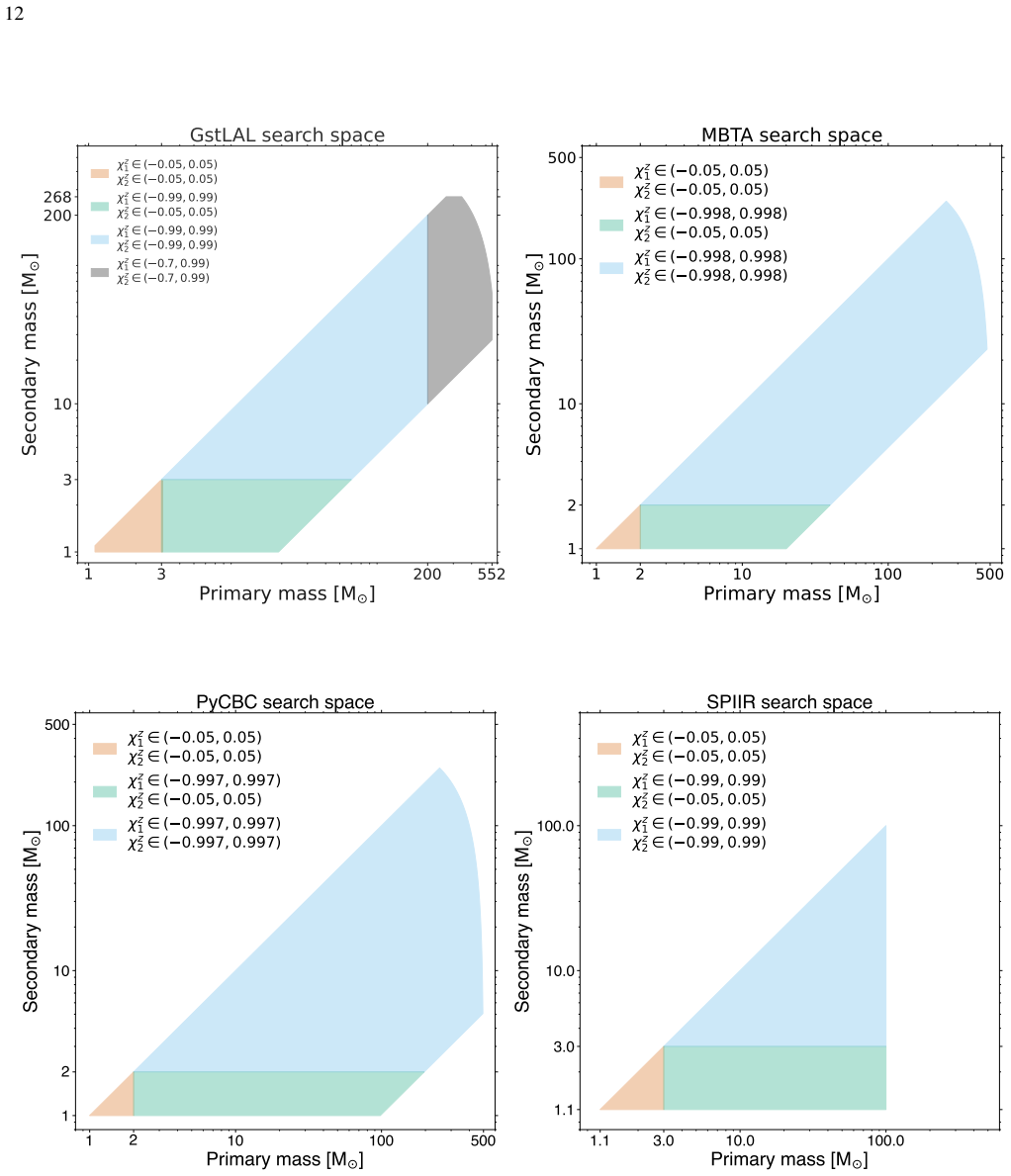
read the original abstract
The Gravitational-Wave Transient Catalog (GWTC) is a collection of candidate gravitational-wave transient signals identified and characterized by the LIGO-Virgo-KAGRA Collaboration. Producing the contents of the GWTC from detector data requires complex analysis methods. These comprise techniques to model the signal; identify the transients in the data; evaluate the quality of the data and mitigate possible instrumental issues; infer the parameters of each transient; compare the data with the waveform models for compact binary coalescences, and handle the large amount of results associated with all these different analyses. In this paper, we describe the methods employed to produce the catalog's fifth release, GWTC-5.0, focusing on the analysis of the second part of the fourth observing run of LIGO, Virgo and KAGRA.
Editorial analysis
A structured set of objections, weighed in public.
Referee Report
Summary. The manuscript describes the methods employed by the LIGO-Virgo-KAGRA Collaboration to produce the fifth release of the Gravitational-Wave Transient Catalog (GWTC-5.0) from the second part of the fourth observing run (O4b). These methods encompass signal modeling, transient identification in detector data, data quality evaluation and mitigation of instrumental issues, parameter inference for identified transients, comparison of data with waveform models for compact binary coalescences, and handling of large volumes of analysis results.
Significance. This methods paper is significant for documenting the analysis pipeline used to generate GWTC-5.0, thereby supporting transparency, reproducibility, and community understanding of the catalog contents. By detailing the application of established techniques to new O4b data, it provides a reference that aids in assessing the reliability of catalog entries and facilitates future analyses.
minor comments (1)
- Abstract: The scope is clearly stated, but a sentence noting any O4b-specific adaptations or updates to prior GWTC methods would help readers quickly identify novel aspects of the pipeline.
Simulated Author's Rebuttal
We thank the referee for their positive summary, assessment of significance, and recommendation to accept the manuscript. No major comments were provided in the report.
Circularity Check
No significant circularity in methods description
full rationale
This is a methods paper documenting the standard analysis pipeline (signal modeling, transient identification, data quality, parameter inference, result handling) applied to O4b data to produce GWTC-5.0. No derivation chain, predictions, fitted parameters renamed as outputs, uniqueness theorems, or ansatzes are present. The central claim is a factual description of techniques used on new data rather than a self-referential reduction; the work is self-contained against external benchmarks with no load-bearing self-citations or definitional loops.
Axiom & Free-Parameter Ledger
Forward citations
Cited by 4 Pith papers
-
Joint inference of line-of-sight acceleration and orbital eccentricity in neutron-star--black-hole binaries
All five NSBH events are consistent with zero line-of-sight acceleration; the joint posterior for GW200105_162426 disfavors both zero LOSA and zero eccentricity at 90% credibility.
-
Improving low-latency multi-messenger follow-up of neutron star-black hole mergers with mode-by-mode filtering
Mode-by-mode filtering of higher-order modes enables low-latency marginalization over mode information in NSBH gravitational-wave signals, tightening constraints on distance, inclination, and secondary mass.
-
Evidence for additional structure in the effective spin distribution hints at multiple formation pathways in GWTC-5.0
GWTC-5.0 analysis finds evidence for structure beyond a non-skewed Gaussian bulk in χ_eff, with suggestive mass-dependent excess of positive over negative spins outside the bulk at 13:1 odds in one mass bin.
-
The first decade of gravitational-wave measurements of black hole spins
A review summarizing formation-channel predictions, waveform effects, and population-level constraints on stellar-mass black hole spins from the first decade of gravitational-wave observations.
Reference graph
Works this paper leans on
-
[1]
Aasi, J., et al. 2013, Phys. Rev. D, 87, 022002, 10.1103/PhysRevD.87.022002
-
[2]
Aasi , J., Abbott , B. P., Abbott , R., et al. 2015, Classical and Quantum Gravity, 32, 074001, 10.1088/0264-9381/32/7/074001
-
[3]
G., Abouelfettouh, I., Acernese, F., et al
Abac, A. G., Abouelfettouh, I., Acernese, F., et al. 2026 a , To be published in this issue. https://dcc.ligo.org/LIGO-P2500701/public
2026
-
[4]
2026 b , To be published in this issue
---. 2026 b , To be published in this issue. https://dcc.ligo.org/LIGO-P2600152/public
2026
-
[5]
2026 c , To be published in this issue
---. 2026 c , To be published in this issue. https://dcc.ligo.org/LIGO-P2600085/public
2026
-
[6]
2026 d , To be published in this issue
---. 2026 d , To be published in this issue
2026
-
[7]
2026 e , To be published in this issue
---. 2026 e , To be published in this issue
2026
-
[8]
Abac , A. G., Abouelfettouh , I., Acernese , F., et al. 2025 a , , 993, L21, 10.3847/2041-8213/ae0d54
-
[9]
2025 g , , 135, 111403, 10.1103/kw5g-d732
---. 2025 b , , 135, 111403, 10.1103/kw5g-d732
-
[10]
---. 2025 c , arXiv e-prints, arXiv:2508.18082, 10.48550/arXiv.2508.18082
work page internal anchor Pith review Pith/arXiv arXiv doi:10.48550/arxiv.2508.18082 2025
-
[11]
GWTC-4.0: Methods for Identifying and Characterizing Gravitational-wave Transients
---. 2025 d , arXiv e-prints, arXiv:2508.18081, 10.48550/arXiv.2508.18081
work page internal anchor Pith review Pith/arXiv arXiv doi:10.48550/arxiv.2508.18081 2025
-
[12]
2025 c , , 995, L18, 10.3847/2041-8213/ae0c06
---. 2025 e , , 995, L18, 10.3847/2041-8213/ae0c06
-
[13]
---. 2025 f , , 993, L25, 10.3847/2041-8213/ae0c9c
-
[14]
G., Abouelfettouh, I., Acernese, F., et al
Abac, A. G., Abouelfettouh, I., Acernese, F., et al. 2026 f , Phys. Rev. Lett., 10.1103/gzrj-mwv3
-
[15]
Abadie , J., Abbott , B. P., Abbott , R., et al. 2012, , 760, 12, 10.1088/0004-637X/760/1/12
-
[16]
Abadie, J., et al. 2012, Phys. Rev. D, 85, 082002, 10.1103/PhysRevD.85.082002
-
[17]
Abbott , B. P., Abbott , R., Abbott , T. D., et al. 2016 a , , 833, L1, 10.3847/2041-8205/833/1/L1
-
[18]
2016 b , Physical Review X, 6, 041015, 10.1103/PhysRevX.6.041015
---. 2016 b , Physical Review X, 6, 041015, 10.1103/PhysRevX.6.041015
-
[19]
2016 c , , 227, 14, 10.3847/0067-0049/227/2/14
---. 2016 c , , 227, 14, 10.3847/0067-0049/227/2/14
-
[20]
2016 d , , 116, 241102, 10.1103/PhysRevLett.116.241102
---. 2016 d , , 116, 241102, 10.1103/PhysRevLett.116.241102
-
[21]
GW170817: Observation of Gravitational Waves from a Binary Neutron Star In- spiral
---. 2017 a , , 119, 161101, 10.1103/PhysRevLett.119.161101
-
[22]
2017 b , , 848, L12, 10.3847/2041-8213/aa91c9
---. 2017 b , , 848, L12, 10.3847/2041-8213/aa91c9
-
[23]
2019, Physical Review X, 9, 031040, 10.1103/PhysRevX.9.031040
---. 2019 a , Physical Review X, 9, 031040, 10.1103/PhysRevX.9.031040
-
[24]
2019 b , , 875, 161, 10.3847/1538-4357/ab0e8f
---. 2019 b , , 875, 161, 10.3847/1538-4357/ab0e8f
-
[25]
---. 2019 c , Physical Review X, 9, 011001, 10.1103/PhysRevX.9.011001
-
[26]
2020 a , Living Reviews in Relativity, 23, 3, 10.1007/s41114-020-00026-9
Abbott, B. P., et al. 2020, Living Rev. Rel., 23, 3, 10.1007/s41114-020-00026-9
-
[27]
2020 b , Classical and Quantum Gravity, 37, 055002, 10.1088/1361-6382/ab685e
Abbott , B. P., Abbott , R., Abbott , T. D., et al. 2020 a , Classical and Quantum Gravity, 37, 055002, 10.1088/1361-6382/ab685e
-
[28]
2020 c , , 892, L3, 10.3847/2041-8213/ab75f5
---. 2020 b , , 892, L3, 10.3847/2041-8213/ab75f5
-
[29]
Abbott , R., Abbott , T. D., Abraham , S., et al. 2020 c , , 102, 043015, 10.1103/PhysRevD.102.043015
-
[30]
2020 d , , 125, 101102, 10.1103/PhysRevLett.125.101102
---. 2020 d , , 125, 101102, 10.1103/PhysRevLett.125.101102
-
[31]
---. 2021 a , Physical Review X, 11, 021053, 10.1103/PhysRevX.11.021053
-
[32]
2021 c , , 915, L5, 10.3847/2041-8213/ac082e
---. 2021 b , , 915, L5, 10.3847/2041-8213/ac082e
-
[33]
Abbott , R., Abbott , T. D., Acernese , F., et al. 2023 a , Physical Review X, 13, 041039, 10.1103/PhysRevX.13.041039
-
[34]
2023 b , Physical Review X, 13, 011048, 10.1103/PhysRevX.13.011048
---. 2023 b , Physical Review X, 13, 011048, 10.1103/PhysRevX.13.011048
-
[35]
2024, , 109, 022001, 10.1103/PhysRevD.109.022001
---. 2024, , 109, 022001, 10.1103/PhysRevD.109.022001
-
[36]
2014, Classical and Quantum Gravity, 31, 165013, 10.1088/0264-9381/31/16/165013
Accadia , T., Acernese , F., Agathos , M., et al. 2014, Classical and Quantum Gravity, 31, 165013, 10.1088/0264-9381/31/16/165013
-
[37]
Acernese , F., Agathos , M., Agatsuma , K., et al. 2015, Classical and Quantum Gravity, 32, 024001, 10.1088/0264-9381/32/2/024001
-
[38]
2018, Classical and Quantum Gravity, 35, 205004, 10.1088/1361-6382/aadf1a
Acernese , F., Adams , T., Agatsuma , K., et al. 2018, Classical and Quantum Gravity, 35, 205004, 10.1088/1361-6382/aadf1a
-
[39]
2022, Classical and Quantum Gravity, 39, 045006, 10.1088/1361-6382/ac3c8e
Acernese , F., Agathos , M., Ain , A., et al. 2022, Classical and Quantum Gravity, 39, 045006, 10.1088/1361-6382/ac3c8e
-
[40]
2023, Classical and Quantum Gravity, 40, 185006, 10.1088/1361-6382/acd92d
---. 2023 a , Classical and Quantum Gravity, 40, 185006, 10.1088/1361-6382/acd92d
-
[41]
2023, Classical and Quantum Gravity, 40, 185005, 10.1088/1361-6382/acdf36
---. 2023 b , Classical and Quantum Gravity, 40, 185005, 10.1088/1361-6382/acdf36
-
[42]
2016, Classical and Quantum Gravity, 33, 175012, doi: 10.1088/0264-9381/33/17/175012
Adams , T., Buskulic , D., Germain , V., et al. 2016, Classical and Quantum Gravity, 33, 175012, 10.1088/0264-9381/33/17/175012
-
[43]
Ade , P. A. R., Aghanim , N., Arnaud , M., et al. 2016, , 594, A13, 10.1051/0004-6361/201525830
-
[44]
Agathos, M., Meidam, J., Del Pozzo, W., et al. 2015, Phys. Rev. D, 92, 023012, 10.1103/PhysRevD.92.023012
-
[45]
Ajith, P., et al. 2007, Class. Quant. Grav., 24, S689, 10.1088/0264-9381/24/19/S31
-
[46]
2011, PhRvL, 106, 241101, doi: 10.1103/PhysRevLett.106.241101
Ajith , P., Hannam , M., Husa , S., et al. 2011, , 106, 241101, 10.1103/PhysRevLett.106.241101
-
[47]
Akcay, S., Bernuzzi, S., Messina, F., et al. 2019, Phys. Rev. D, 99, 044051, 10.1103/PhysRevD.99.044051
-
[48]
2019, Nature Astronomy, 3, 35, 10.1038/s41550-018-0658-y
Akutsu , T., Ando , M., Arai , K., et al. 2019, Nature Astronomy, 3, 35, 10.1038/s41550-018-0658-y
-
[49]
2005, , 71, 062001, 10.1103/PhysRevD.71.062001
Allen , B. 2005, , 71, 062001, 10.1103/PhysRevD.71.062001
-
[50]
Allen , B., Anderson , W. G., Brady , P. R., Brown , D. A., & Creighton , J. D. E. 2012, , 85, 122006, 10.1103/PhysRevD.85.122006
-
[51]
2025, Classical and Quantum Gravity, 42, 105009, 10.1088/1361-6382/add234
All \'e n \'e , C., Aubin , F., Bentara , I., et al. 2025, Classical and Quantum Gravity, 42, 105009, 10.1088/1361-6382/add234
-
[52]
2024, Classical and Quantum Gravity, 41, 085007, 10.1088/1361-6382/ad2194
\'A lvarez-L \'o pez , S., Liyanage , A., Ding , J., Ng , R., & McIver , J. 2024, Classical and Quantum Gravity, 41, 085007, 10.1088/1361-6382/ad2194
-
[53]
2022, Classical and Quantum Gravity, 39, 055002, doi: 10.1088/1361-6382/ac482a
Andres , N., Assiduo , M., Aubin , F., et al. 2022, Classical and Quantum Gravity, 39, 055002, 10.1088/1361-6382/ac482a
-
[54]
2026, in Journal of Physics Conference Series, Vol
Arnaud , N., Driggers , J., O'Reilly , B., et al. 2026, in Journal of Physics Conference Series, Vol. 3177, Journal of Physics Conference Series (IOP), 012067, 10.1088/1742-6596/3177/1/012067
-
[55]
Ashton , G., & Talbot , C. 2021, , 507, 2037, 10.1093/mnras/stab2236
-
[56]
2022, CBC Workflow
Ashton, G., Udall, R., & Yarbrough, Z. 2022, CBC Workflow. https://git.ligo.org/cbc/projects/cbcflow
2022
-
[57]
Ashton , G., H \"u bner , M., Lasky , P. D., et al. 2019, , 241, 27, 10.3847/1538-4365/ab06fc
-
[58]
2021, Classical and Quantum Gravity, 38, 095004, doi: 10.1088/1361-6382/abe913
Aubin , F., Brighenti , F., Chierici , R., et al. 2021, Classical and Quantum Gravity, 38, 095004, 10.1088/1361-6382/abe913
-
[59]
2025, The MBTA PSD calculation for the O4a offline all-sky search , Tech
Aubin, F., Bentara, I., Buskulic, D., et al. 2025, The MBTA PSD calculation for the O4a offline all-sky search , Tech. Rep. TDS-0722A. https://tds.virgo-gw.eu/?r=25024
2025
-
[60]
Babak , S., Biswas , R., Brady , P. R., et al. 2013, , 87, 024033, 10.1103/PhysRevD.87.024033
-
[61]
2025, Correcting misspecification of calibration uncertainties in gravitational-wave data analysis with efficient reweighting, Tech
Baka, T., Wright, M., Romero-Shaw, I., et al. 2025, Correcting misspecification of calibration uncertainties in gravitational-wave data analysis with efficient reweighting, Tech. Rep. LIGO -T2500295, LIGO Project. https://dcc.ligo.org/LIGO-T2500295/public
2025
-
[62]
Barausse, E., Buonanno, A., Hughes, S. A., et al. 2012, Phys. Rev. D, 85, 024046, 10.1103/PhysRevD.85.024046
-
[63]
title Modeling the dynamics of tidally interacting binary neutron stars up to the merger
Bernuzzi , S., Nagar , A., Dietrich , T., & Damour , T. 2015, , 114, 161103, 10.1103/PhysRevLett.114.161103
-
[64]
Bhaumik, S., Gayathri, V., Bartos, I., et al. 2025, Phys. Rev. D, 111, 123032, 10.1103/hwr5-scp4
-
[65]
2021, , 104, 103018, 10.1103/PhysRevD.104.103018
Biscoveanu , S., Isi , M., Varma , V., & Vitale , S. 2021, , 104, 103018, 10.1103/PhysRevD.104.103018
-
[66]
Blackman , J., Field , S. E., Scheel , M. A., et al. 2017 a , , 95, 104023, 10.1103/PhysRevD.95.104023
-
[67]
2017 b , , 96, 024058, 10.1103/PhysRevD.96.024058
---. 2017 b , , 96, 024058, 10.1103/PhysRevD.96.024058
-
[68]
title Gravitational radiation from post-newtonian sources and inspiralling compact binaries
Blanchet , L. 2014, Living Reviews in Relativity, 17, 2, 10.12942/lrr-2014-2
-
[69]
2016, PhenomPv2 - Technical Notes for LAL Implementation, Tech
Boh \'e , A., Hannam, M., Husa, S., et al. 2016, PhenomPv2 - Technical Notes for LAL Implementation, Tech. Rep. LIGO -T1500602, LIGO Project. https://dcc.ligo.org/LIGO-T1500602
2016
-
[70]
Bohe, A., Marsat, S., Faye, G., & Blanchet, L. 2013, Class. Quant. Grav., 30, 075017, 10.1088/0264-9381/30/7/075017
-
[71]
2017, , 95, 044028, 10.1103/PhysRevD.95.044028
Boh \'e , A., Shao , L., Taracchini , A., et al. 2017, , 95, 044028, 10.1103/PhysRevD.95.044028
-
[72]
Borchers, A., Ohme, F., Mielke, J., & Ghosh, S. 2024, Phys. Rev. D, 110, 024037, 10.1103/PhysRevD.110.024037
-
[73]
2011, Classical and Quantum Gravity, 28, 134009, 10.1088/0264-9381/28/13/134009
Bose, S., Dayanga, T., Ghosh, S., & Talukder, D. 2011, Classical and Quantum Gravity, 28, 134009, 10.1088/0264-9381/28/13/134009
-
[74]
Boyle , M., Owen , R., & Pfeiffer , H. P. 2011, , 84, 124011, 10.1103/PhysRevD.84.124011
-
[75]
Brown , D. A., Kumar , P., & Nitz , A. H. 2013, , 87, 082004, 10.1103/PhysRevD.87.082004
-
[76]
2003, , 67, 104025, 10.1103/PhysRevD.67.104025
Buonanno , A., Chen , Y., & Vallisneri , M. 2003, , 67, 104025, 10.1103/PhysRevD.67.104025
-
[77]
title Effective one-body approach to general relativistic two-body dynamics
Buonanno , A., & Damour , T. 1999, , 59, 084006, 10.1103/PhysRevD.59.084006
-
[78]
2000, , 62, 064015, 10.1103/PhysRevD.62.064015
---. 2000, , 62, 064015, 10.1103/PhysRevD.62.064015
-
[79]
R., Ochsner , E., Pan , Y., & Sathyaprakash , B
Buonanno , A., Iyer , B. R., Ochsner , E., Pan , Y., & Sathyaprakash , B. S. 2009, , 80, 084043, 10.1103/PhysRevD.80.084043
-
[80]
Buonanno, A., Pan, Y., Baker, J. G., et al. 2007, Phys. Rev. D, 76, 104049, 10.1103/PhysRevD.76.104049
discussion (0)
Sign in with ORCID, Apple, or X to comment. Anyone can read and Pith papers without signing in.