REVIEW 4 major objections 5 minor 6 references
Barriers in Integrating Medical Visual Question Answering into Radiology Workflows: A Scoping Review and Clinicians' Insights
T0 review · 4 major / 5 minor · reviewed 2026-08-06 · deepseek-v4-flash
Pith's one-line read The paper claims that current medical visual question answering systems are misaligned with clinical radiology: nearly 60% of QA pairs in reviewed datasets are non-diagnostic, and only 29.8% of surveyed clinicians rate the systems as…
desk verdict A useful but under-substantiated synthesis: the new clinician survey and question taxonomy are worth engaging, but the headline '60% non-diagnostic' figure needs an auditable calculation before it can be trusted. read the letter →
The pith
A machine-rendered reading of the paper's core claim, the machinery that carries it, and where it could break.
The reading
What carries the argument
The load-bearing instrument is a manually constructed question taxonomy that sorts every QA pair into non-diagnostic and diagnostic categories. Non-diagnostic questions include attribute-based questions (size, shape, color), technical questions (modality, plane, quality), and basic interpretation questions (yes/no, counting); diagnostic questions include abnormality detection, condition presence, anatomical localization, and clinical interpretation. The taxonomy is what converts the raw dataset counts into the paper's headline figures, and the same clinical-reasoning distinction organizes the survey questions asked of clinicians.
What would settle it
Have an independent panel of practicing radiologists apply the paper's taxonomy to the same QA pairs: if the share judged non-diagnostic falls far below 60%, the dataset-relevance claim is weakened; separately, a random-sample survey of radiologists across several countries that found most rate current MedVQA as highly useful would undercut the clinician-disconnect claim.
Extended reading notes
Core claim
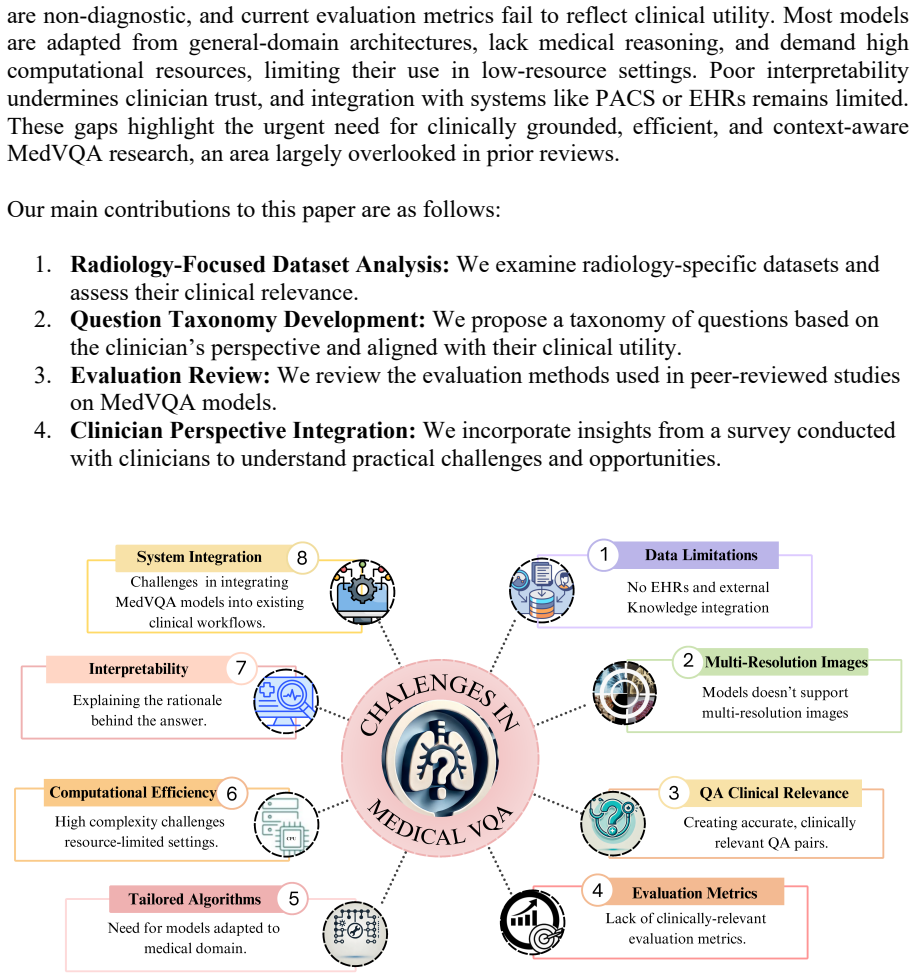
The paper's central claim is that MedVQA research, despite steady technical progress, is misaligned with the reality of radiology practice. In the datasets it reviews, nearly 60% of QA pairs are informational or technical—questions about modality, plane, size, color, presence of an organ—rather than diagnostic questions about abnormalities, localization, or clinical interpretation. None of the reviewed models support multi-view image input of the kind radiology standards require, most downsample images to 224x224 and lose diagnostic detail, and only about 20% of datasets incorporate any external knowledge such as electronic health records. The clinician survey reports a corresponding distrust: 87.2% of respondents consider integration with patient history or domain knowledge essential, 89.4% prefer dialogue-based interactive systems, 78.7% want multi-view support, 66% favor anatomy-specific models, and only 29.8% rate current systems as highly useful. The paper concludes that the field's evaluation culture—accuracy, BLEU, and similar surface metrics—cannot certify clinical value, and that bridging this gap requires new datasets, new model designs, and new evaluation criteria.
Load-bearing premise
The paper's clinician-side percentages assume that 50 self-selected clinicians from India and Thailand represent clinicians generally; if that small, regionally imbalanced sample is unrepresentative, the survey-based conclusions do not generalize.
Editorial extensions
If this is right
- Rebuilding MedVQA datasets with radiologist-validated, diagnostic, dialogue-format QA pairs would directly reduce the share of non-diagnostic questions that the review estimates at nearly 60%.
- Models that accept multi-view and multi-resolution inputs, instead of fixed 224x224 downsampling, would match the radiology standard that at least two views are needed for a confident diagnosis.
- Evaluation metrics should shift from surface similarity scores like BLEU and accuracy toward entity- and relation-level clinical checks of the kind used for radiology reports.
- Clinician preferences point toward dialogue-based, anatomy-specialized systems that integrate patient history and domain knowledge rather than single-turn open-world question answering.
- A clinically grounded MedVQA system will need to interoperate with existing radiology and hospital information systems, such as PACS and EHR platforms, rather than operate as a standalone research tool.
Reading between the lines
- Our editorial inference: the 60% non-diagnostic share is sensitive to where the taxonomy's boundary is drawn; independent clinician annotators applying a different boundary could move the number, so the size of the mismatch is less certain than its direction.
- Our editorial inference: if clinician preferences generalize, existing benchmark leaderboards that rank MedVQA models by accuracy on current datasets are weak proxies for clinical readiness; re-ranking models on a diagnostic-only question subset would test this quickly.
- Our editorial inference: the strong preference for dialogue-based systems implies that single-turn benchmarks understate what a clinically useful system must do; multi-turn follow-up and clarification ability would need to be part of any clinical evaluation.
- Our editorial inference: the survey's 50 self-selected respondents from two countries make the percentage figures directional; a multi-country, random-sample replication would be needed before treating them as population estimates.
Editorial analysis
A structured set of objections, weighed in public.
Referee Report
Summary. This manuscript combines a scoping review of 68 MedVQA publications (2018–2024) with a survey of 50 clinicians from India and Thailand. It argues that current MedVQA datasets, models, and evaluations are poorly aligned with clinical radiology workflows, and it identifies eight challenges, including non-diagnostic question–answer pairs, missing multi-view and multi-resolution inputs, lack of EHR and domain knowledge, and misaligned evaluation metrics. The paper introduces a taxonomy of informational versus diagnostic questions and reports clinician preferences for dialogue-based interaction, multi-view support, manually curated datasets, and anatomy-specific models. The central claims are that nearly 60% of QA pairs are non-diagnostic and that only 29.8% of surveyed clinicians consider current MedVQA systems highly useful.
Significance. If the headline claims are made reproducible, the paper would provide a valuable agenda-setting contribution by shifting MedVQA research toward clinically grounded datasets, dialogue-based systems, multi-view inputs, and clinically meaningful evaluation. The scoping review covers a useful time window, the proposed question taxonomy is a reasonable organizing device, and the inclusion of clinician perspectives is a strength that many prior surveys lack. The eight-challenge framework is a helpful synthesis for the community. However, the current quantitative core—especially the 60% non-diagnostic figure and several survey percentages—is not auditable from the manuscript, and the clinician survey is a small convenience sample. These issues must be addressed before the paper's central conclusions can be accepted as stated.
major comments (4)
- [Abstract; §3.3; §4.3] The headline claim that 'nearly 60% of QA pairs are non-diagnostic and lack clinical relevance' is not reproducible from the manuscript. No per-dataset counts, denominator, or classification protocol are provided, and Table S1(a) contains borderline cases (e.g., MIMIC CXR VQA's 'Is the cardiac silhouette's width larger than half of the total thorax width?') that could be coded either as an attribute/size question or as a diagnostic measurement. Please provide the full category-level coding for every included dataset, state the exact denominator, explain how ambiguous questions were resolved, and report inter-rater reliability or clinician validation for the taxonomy. As it stands, the central dataset-side claim cannot be audited.
- [Abstract; §3.6; Supplementary C Q11] The survey's headline dialogue-system preference is reported inconsistently: the Abstract states that 89.4% prefer dialogue-based interactive MedVQA systems, while §3.6 reports that only 51.1% preferred dialogue-based interaction over single-turn QA. If the 89.4% includes respondents who selected 'Both types' in Q11, this decomposition must be stated explicitly. All reported percentages should be traceable to the exact survey question and denominator; without this reconciliation, the clinician-side result cannot be interpreted.
- [§3.6; Supplementary C] The clinician survey is a convenience sample of 50 self-selected respondents (40 from India, 10 from Thailand), with no reported recruitment procedure or response rate, and only 8.5% use AI tools regularly. Given this, precise one-decimal percentages such as 87.2% and 78.7% should be presented as descriptive statistics for this sample, not as generalizable 'clinician insights.' The discussion should explicitly state the sampling limitations, the lack of a probability sample, and the potential effect of AI familiarity on responses, and should temper generalizations to the broader radiology community.
- [§3.3; Table S1(a)] The taxonomy is described as following 'mutual exclusivity,' but the table's example assignments overlap: for example, 'Presence' appears under both Anatomical Questions and Diagnostic Questions for MIMIC CXR VQA, and 'Organ' appears under both Informational and Diagnostic rows for other datasets. Please provide an operational definition for each category, a decision rule for questions that could belong to multiple categories, and a quantitative distribution of question types per dataset so that readers can see how the 60% figure was derived.
minor comments (5)
- [§2.2] The scoping review relies exclusively on Google Scholar for literature retrieval; this single-source strategy may miss relevant peer-reviewed work indexed only in PubMed, Scopus, or Web of Science. Please state this as a limitation or supplement the search with at least one additional database.
- [§3.1] The sentence 'These of 70 studies met the inclusion criteria' appears to be a typo for 'Of these, 70 studies...'; please proofread.
- [Table 1] Table 1 is difficult to read because the column alignment is broken; in particular, verify the 'No. of QA pair' values for RadVisDial Gold (shown as 500) and MIMIC CXR VQA (shown as 700,703) against the original sources, since these values are not consistent with the surrounding text.
- [Figure 4] The percentages displayed in Figure 4 should be checked against the text; as noted in Major Comment 2, the dialogue-preference value differs between the Abstract and §3.6, and the figure should make clear which question it refers to.
- [References] Several arXiv preprints are cited (e.g., references 5, 9, 16, 55) despite §2.2 stating that arXiv preprints were excluded from the review; this is acceptable for background citations but should be clarified so that the exclusion applies only to the reviewed studies.
Circularity Check
No significant circularity: the paper's claims rest on literature coding and a clinician survey, not on a derivation that assumes its conclusion.
full rationale
This is a scoping review plus survey. The central quantitative assertions—68 publications reviewed, roughly 60% of QA pairs non-diagnostic, 29.8% clinician usefulness, 87.2% demand for domain knowledge, and similar figures—are presented as empirical summaries of a literature screening, a manually applied question taxonomy in Table S1(a), and a 50-clinician survey. None of these numbers is obtained by fitting a parameter and then 'predicting' that same parameter, and none is justified by citing the present authors' prior work. The 'nearly 60%' figure is the only load-bearing result whose computation is not shown: Section 3.3 defines the diagnostic/non-diagnostic taxonomy but gives no per-dataset tallies or denominator, so the number is currently unauditable. That is a reproducibility or soundness weakness, not circularity: classifying a question as modality/plane/size and then counting it as non-diagnostic is an application of an explicit coding rule, not the conclusion being used as its own premise. The clinician percentages are direct self-report data; extrapolation from the small, regionally imbalanced sample (40 from India, 10 from Thailand; 74.5% with over 10 years of experience but only 8.5% regular AI users) is a generalizability concern, and the paper itself flags it: 'While the regional distribution reflects participant availability, we acknowledge the imbalance and interpret findings with caution.' No self-citations, uniqueness imports, or ansatz-by-citation appear. The taxonomy is a human construction used as an analytic lens, not a disguised restatement of the paper's conclusions.
Assumptions & free parameters
assumptions (3)
- domain assumption Peer-reviewed literature retrieved from Google Scholar using the stated keywords is representative of the MedVQA field.
- ad hoc to paper The authors' manually developed taxonomy of diagnostic vs non-diagnostic questions is reliable and consistently applied.
- domain assumption Survey respondents understood the MedVQA concept and answered accurately despite low AI familiarity.
Cite this review
Pith. "Pith review of Barriers in Integrating Medical Visual Question Answering into Radiology Workflows: A Scoping Review and Clinicians' Insights." pith.science (2026). https://pith.science/paper/VAWRSVQO
@misc{pith2026250708036,
  author       = {Pith},
  title        = {Pith review of: Barriers in Integrating Medical Visual Question Answering into Radiology Workflows: A Scoping Review and Clinicians' Insights},
  year         = {2026},
  howpublished = {\url{https://pith.science/paper/VAWRSVQO}},
  note         = {Machine review of arXiv:2507.08036}
}
read the original abstract
Medical Visual Question Answering (MedVQA) is a promising tool to assist radiologists by automating medical image interpretation through question answering. Despite advances in models and datasets, MedVQA's integration into clinical workflows remains limited. This study systematically reviews 68 publications (2018-2024) and surveys 50 clinicians from India and Thailand to examine MedVQA's practical utility, challenges, and gaps. Following the Arksey and O'Malley scoping review framework, we used a two-pronged approach: (1) reviewing studies to identify key concepts, advancements, and research gaps in radiology workflows, and (2) surveying clinicians to capture their perspectives on MedVQA's clinical relevance. Our review reveals that nearly 60% of QA pairs are non-diagnostic and lack clinical relevance. Most datasets and models do not support multi-view, multi-resolution imaging, EHR integration, or domain knowledge, features essential for clinical diagnosis. Furthermore, there is a clear mismatch between current evaluation metrics and clinical needs. The clinician survey confirms this disconnect: only 29.8% consider MedVQA systems highly useful. Key concerns include the absence of patient history or domain knowledge (87.2%), preference for manually curated datasets (51.1%), and the need for multi-view image support (78.7%). Additionally, 66% favor models focused on specific anatomical regions, and 89.4% prefer dialogue-based interactive systems. While MedVQA shows strong potential, challenges such as limited multimodal analysis, lack of patient context, and misaligned evaluation approaches must be addressed for effective clinical integration.
Figures


Figures from the paper (2 more)


Reference graph
Works this paper leans on
-
[11]
Is there a fracture in this image?
What type of MedVQA system do you think would be more useful in your practice? a. A system that answers a specific question about the image (e.g., "Is there a fracture in this image?") b. A system that interacts in a dialogue form (like a chatbot that asks and answers multiple questions in sequence) c. Both types 12. Would you trust a MedVQA system that i...
-
[12]
Multiple Meta-model Quantifying for Medical Visual Question Answering
Abacha AB, Hasan SA, Datla VV, Liu J, Muller H. VQA-Med: Overview of the Medical Visual Question Answering Task at ImageCLEF 2019. 13. Abacha AB, Datla VV, Hasan SA, Muller H. Overview of the VQA-Med Task at ImageCLEF 2020: Visual Question Answering and Generation in the Medical Domain. 14. Abacha AB, Sarrouti M, Demner-Fushman D, Hasan SA, Müller H. Over...
work page Pith review arXiv 2019
-
[26]
JUST at ImageCLEF 2019 Visual Question Answering in the Medical Domain
Al-Sadi A, Talafha B, Al-Ayyoub M, Jararweh Y, Costen F. JUST at ImageCLEF 2019 Visual Question Answering in the Medical Domain. 27. Allaouzi I, Benamrou B, Benamrou M, Ahmed MB. Deep Neural Networks and Decision Tree classifier for Visual Question Answering in the medical domain. 28. Yan X, Li L, Xie C, Xiao J, Gu L. Zhejiang University at ImageCLEF 2019...
work page 2019
-
[43]
NLM at VQA-Med 2020: Visual Question Answering and Generation in the Medical Domain
Sarrouti M. NLM at VQA-Med 2020: Visual Question Answering and Generation in the Medical Domain. 44. Ren F, Zhou Y. CGMVQA: A New Classification and Generative Model for Medical Visual Question Answering. IEEE Access [Internet] 2020 [cited 2024 Sep 22];8:50626–36. Available from: https://ieeexplore.ieee.org/document/9032109/ 45. Vu MH, Sznitman R, Nyholm ...
-
[57]
PMC-CLIP: Contrastive Language-Image Pre-training using Biomedical Documents [Internet]
Lin W, Zhao Z, Zhang X, et al. PMC-CLIP: Contrastive Language-Image Pre-training using Biomedical Documents [Internet]. 2023 [cited 2024 Sep 27];Available from: http://arxiv.org/abs/2303.07240 58. Wang Z, Wu Z, Agarwal D, Sun J. MedCLIP: Contrastive Learning from Unpaired Medical Images and Text [Internet]. 2022 [cited 2024 Sep 27];Available from: http://...
arXiv 2023
-
[70]
Why was this diagnosis suggested?
Silva JD, Martins B, Magalhães J. Contrastive training of a multimodal encoder for medical visual question answering. Intell Syst Appl [Internet] 2023 [cited 2024 Nov 24];18:200221. Available from: https://linkinghub.elsevier.com/retrieve/pii/S2667305323000467 71. Li Y, Long S, Yang Z, et al. A Bi-level representation learning model for medical visual que...
Reviewed August 6, 2026 · model on record in the stance chip above.
Discussion (0). Continue with ORCID to comment.