REVIEW 3 major objections 3 minor 34 references
Voice Conversion for Lombard Speaking Style with Implicit and Explicit Acoustic Feature Conditioning
T0 review · 3 major / 3 minor · reviewed 2026-08-06 · deepseek-v4-flash
Pith's one-line read A frozen style classifier can preserve Lombard intelligibility through voice conversion
desk verdict Useful empirical comparison of implicit vs explicit Lombard conditioning for voice conversion, but the abstract overstates the results and the same-corpus classifier leaves transfer untested. read the letter →
The pith
A machine-rendered reading of the paper's core claim, the machinery that carries it, and where it could break.
The reading
What carries the argument
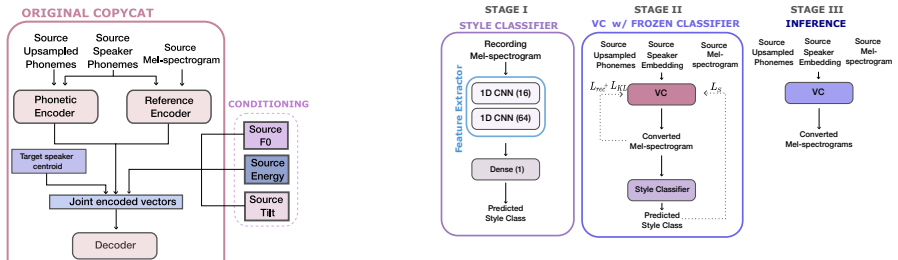
The load-bearing mechanism is a two-stage training pipeline. Stage I trains a 1D CNN classifier to distinguish Lombard from neutral oracle mel-spectrograms; Stage II freezes that classifier and adds its binary cross-entropy output as a style reconstruction loss on the converted mel-spectrograms, alongside the VC model's reconstruction and KL losses. At inference the classifier is dropped, so the VC model carries the Lombard constraint purely through weights learned under that loss; the explicit-conditioning baseline instead feeds WORLD-extracted f0, mgc0, and mgc1 from the source waveform into the decoder.
What would settle it
Take the same implicit VC pipeline but retrain the style classifier on Lombard recordings from a second, acoustically different corpus and measure SIIB on both corpora; if the intelligibility gain over the unconditioned VC baseline disappears or falls sharply on the held-out corpus, the classifier was capturing corpus-specific artifacts rather than transferable Lombard traits.
Extended reading notes
Core claim
The central claim is that Lombard speaking style can be preserved through many-to-many voice conversion by a learned style-reconstruction loss rather than by explicit acoustic conditioning. On the Audio-Visual Lombard Grid, a CopyCat-based VC model trained with a binary cross-entropy loss from a frozen Lombard/neutral classifier produces SIIB intelligibility scores and perceived-intelligibility ratings statistically on par with the same model given source f0, mgc0, and mgc1 features, and it does so with better perceived speaker similarity. The paper takes this as evidence that implicit conditioning captures the acoustic attributes that matter for intelligibility in noise, and that the method is a viable alternative to explicit feature engineering for style-preserving voice conversion.
Load-bearing premise
The load-bearing premise is that the style classifier, trained on oracle mel-spectrograms of the Lombard Grid, learns general Lombard acoustic attributes rather than dataset-specific quirks; if it keys on recording conditions or speaker artifacts, the intelligibility gains will not carry to other speakers or corpora.
Editorial extensions
If this is right
- If the implicit conditioning claim holds, Lombard voice conversion can serve as a data augmentation source for TTS without requiring manual acoustic analysis of the Lombard effect.
- The same frozen-classifier style loss should transfer to other source styles such as emotional or whispered speech, since it needs only a style-labelled corpus rather than hand-chosen acoustic features.
- Because speaker similarity was better preserved with the implicit loss, VC systems can rely less on explicitly transferred prosodic features that may leak source-identity cues.
- The feature ablations indicate that spectral tilt and energy alone can carry most of the Lombard intelligibility benefit, while f0 is a secondary, gender-dependent cue.
Reading between the lines
- A direct extension would be to probe the frozen classifier to discover which spectral bands or time spans drive the Lombard decision, turning the black-box loss into a quantitative map of Lombard cues.
- The within-corpus evaluation likely inflates the apparent intelligibility gain, since both the classifier and the intelligibility tests draw on the Lombard Grid; a cross-corpus verification would separate true Lombard attributes from corpus-specific biases.
- Because the model leaves durations untouched, a natural testable extension is to add duration or speaking-rate conditioning, which the paper itself identifies as a missing Lombard cue, and measure whether the intelligibility gap to source Lombard recordings closes further.
- The style reconstruction loss resembles an adversarial-free alternative to a style discriminator; combining it with an adversarial speaker-identity loss could more cleanly disentangle 'who' from 'how', which the paper flags as future work.
Editorial analysis
A structured set of objections, weighed in public.
Referee Report
Summary. This manuscript studies voice conversion (VC) for Lombard speaking style. It first reports a pilot study comparing neutral and Lombard speech with and without SSDRC in terms of objective (SIIB) and subjective intelligibility, naturalness, and speaker similarity. It then compares two VC conditioning strategies on a many-to-many CopyCat-based model: explicit conditioning on f0, mgc0, and mgc1, and implicit conditioning via a style reconstruction loss from a frozen Lombard/neutral classifier. Evaluations use the Audio-Visual Lombard Grid and include SIIB at SNR -1 and SNR -3 and MUSHRA-like listening tests. The central claim is that implicit conditioning achieves intelligibility gains comparable to explicit conditioning while better preserving speaker similarity.
Significance. If the central claim holds, the implicit approach is practically valuable because it avoids manual acoustic feature engineering and could enable Lombard TTS data augmentation. The paper includes a useful pilot study, objective and subjective evaluations, and multiple conditioning variants, and the architecture and training schedule are clearly described. However, the evidence does not yet fully support the abstract's 'comparable intelligibility' claim: the style classifier is trained and evaluated on the same corpus without speaker-disjoint validation, and the objective results in Table 2 are not consistently in line with the claim. These issues are load-bearing for the paper's main contribution.
major comments (3)
- [Section 3.3, Stage I and Section 3.4] The style classifier is trained on Oracle mel-spectrograms of the same Audio-Visual Lombard Grid corpus used for VC training and for all intelligibility evaluations. The paper does not report the classifier's accuracy, a speaker-disjoint split, a cross-dataset check, or any analysis of the learned features. A binary Lombard/neutral classifier trained and tested on the same corpus can achieve high accuracy by exploiting speaker, recording-session, or noise-elicitation confounds rather than generalizable Lombard cues. If L_s rewards such corpus-specific cues, the reported intelligibility gains of VC+L_s would not transfer to unseen speakers or other Lombard corpora, which is the deployment scenario motivating the work. This risk should be addressed with at least a speaker-disjoint classifier validation and an analysis of the features the classifier relies on.
- [Table 2 and Figure 4] The objective results do not consistently support the claim that implicit conditioning achieves intelligibility 'comparable' to explicit conditioning. For the male target at SNR-1, VC+L_s (107.26, CI 4.88) is 13.47 SIIB points below +f0+mgc0+mgc1 (120.73, CI 5.87), and the caption indicates no significance marker for these rows, implying the difference is significant. For the female target at SNR-1, VC+L_s (86.79) is 7.06 points below +f0+mgc0+mgc1 (93.85). The paper should report explicit pairwise significance tests and effect sizes for the VC+L_s versus explicit-conditioning comparison, and the abstract and discussion should be qualified accordingly; relying on the same-corpus subjective results in Figure 4 does not resolve the inconsistency.
- [Section 3.4 and Table 2, fusion results] The fusion model results are gender-dependent in a way that complicates the paper's interpretation. VC+L_s+f0+mgc0+mgc1 is best for the female target (115.13 at SNR-1), but for the male target it is lower (110.61) than +f0+mgc0+mgc1 (120.73) and only slightly above VC+L_s (107.26). The discussion in Section 4 states that 'the model with implicit conditioning performs similarly to L_s+f0+mgc0+mgc1,' but this is not the same as comparable to explicit conditioning, and the male-target numbers weaken the broad claim. The paper should either present a consistent statistical comparison across all systems or limit the claim to the configurations and conditions where it holds.
minor comments (3)
- [Title, Abstract, Section 1] The text contains recurring spacing artifacts, such as 'V oice' in the title and in Section 1, which should be corrected.
- [Table 1 and Figure 1 captions] The significance conventions are inconsistent: Table 1 states p≤0.005 while Figure 1 states p≤0.05; the paper should use a single, clearly defined significance level for all reported tests.
- [Table 2 caption] The caption does not explain what the absence of a significance marker means; it should state explicitly whether unmarked pairs are all significantly different from each other, and in particular clarify the VC+L_s versus +f0+mgc0+mgc1 comparison.
Circularity Check
No significant circularity: the implicit conditioning result is evaluated with an independent intelligibility metric, not with the style classifier that defines the training loss.
full rationale
The central claim is that a style-reconstruction loss (L_s) imposed by a frozen Lombard/neutral classifier yields intelligibility gains comparable to explicit f0/mgc0/mgc1 conditioning. The classifier (Stage I) is trained on Oracle mel-spectrograms of the Audio-Visual Lombard Grid and is used only as an auxiliary training signal; it is dropped at inference (Section 3.3, Stage III). Evaluations are SIIB scores (Section 3.4, Table 2) and MUSHRA-style listening tests for perceived intelligibility and speaker similarity, which are external to the classifier. The explicit features f0, mgc0, and mgc1 are grounded in prior literature on spectral tilt and energy rather than fitted to the current SIIB results. The paper's self-citations [4,5,27] define the CopyCat-based architecture and prior data-augmentation methodology, but the intelligibility comparison is not derived from those citations. The same-corpus training of the classifier and the evaluation is a generalization/transferability limitation, acknowledged indirectly in Section 4's dataset-size limitation, not a circular reduction. No equation or fitted parameter is renamed as a prediction. Hence score 0.
Assumptions & free parameters
assumptions (3)
- domain assumption The Lombard effect is adequately captured by f0, spectral energy (mgc0) and spectral tilt (mgc1).
- domain assumption A binary Lombard/neutral classifier trained on mel-spectrograms is a valid style proxy for the Lombard effect.
- domain assumption SIIB is a valid objective measure of intelligibility in noise.
Cite this review
Pith. "Pith review of Voice Conversion for Lombard Speaking Style with Implicit and Explicit Acoustic Feature Conditioning." pith.science (2026). https://pith.science/paper/DDQR5ERQ
@misc{pith2026250709310,
  author       = {Pith},
  title        = {Pith review of: Voice Conversion for Lombard Speaking Style with Implicit and Explicit Acoustic Feature Conditioning},
  year         = {2026},
  howpublished = {\url{https://pith.science/paper/DDQR5ERQ}},
  note         = {Machine review of arXiv:2507.09310}
}
read the original abstract
Text-to-Speech (TTS) systems in Lombard speaking style can improve the overall intelligibility of speech, useful for hearing loss and noisy conditions. However, training those models requires a large amount of data and the Lombard effect is challenging to record due to speaker and noise variability and tiring recording conditions. Voice conversion (VC) has been shown to be a useful augmentation technique to train TTS systems in the absence of recorded data from the target speaker in the target speaking style. In this paper, we are concerned with Lombard speaking style transfer. Our goal is to convert speaker identity while preserving the acoustic attributes that define the Lombard speaking style. We compare voice conversion models with implicit and explicit acoustic feature conditioning. We observe that our proposed implicit conditioning strategy achieves an intelligibility gain comparable to the model conditioned on explicit acoustic features, while also preserving speaker similarity.
Figures


Figures from the paper (2 more)


Reference graph
Works this paper leans on
-
[16]
Vocal effort modeling in neural TTS for improving the intelligibility of synthetic speech in noise
Tuomo Raitio, Petko Petkov, Jiangchuan Li, Muhammed Shifas, Andrea Davis, and Yannis Stylianou, “V ocal effort modeling in neural tts for improving the intelligibility of synthetic speech in noise,”arXiv preprint arXiv:2203.10637, 2022
work page Pith review arXiv 2022
-
[1]
Introduction Traditional approaches to improving speech intelligibility for in- dividuals with hearing aids primarily focus on signal processing and amplification at the receiving end. However, in this paper, we propose an alternative approach that seeks to enhance intelli- gibility by addressing the source of speech generation rather than relying solely ...
-
[2]
Analysis of the Lombard Speaking Style 2.1. Background Signal processing approaches that are noise independent such as spectral shaping (SS) and dynamic range compression (DRC) have shown to be helpful in improving speech intelligibility [17]. SS distributes the energy in the frequency domain, sharpens the formants and reduces the spectral tilt while DRC ...
arXiv 2025
-
[3]
Can we preserve the key properties of the Lombard effect during voice conversion
Lombard Style Transfer 3.1. V oice Conversion Model Our voice conversion model is based on CopyCat [27], a non- parallel many-to-many prosody transfer model. As shown on Figure 2, the model has a reference encoder that takes mel- spectrograms and speaker embeddings extracted from a speaker verification model. The speaker embeddings are also passed togethe...
-
[4]
Discussion The results show thatImplicit modelingvia the Lombard style classifier was able to achieve similar results to models with ex- plicit conditioning. This approach presents the advantage of not requiring domain knowledge and extensive linguistic and acoustics studies. We also observe thatf0extracted from male speakers in Lombard style has better i...
-
[5]
Conclusion In this work, we analyze the impact of the Lombard effect on the Intelligibility of voices in noise and investigate Lombard- preserving voice conversion. Confirming previous studies, we show that the Lombard effect increases the intelligibility in noise, and that while naturalness is lost, speaker similarity can still be observed by listeners i...
-
[6]
Bajibabu Bollepalli, Lauri Juvela, and Paavo Alku, “Speaking style adaptation in text-to-speech synthesis using sequence-to-sequence models with attention,”arXiv preprint arXiv:1810.12051, 2018
work page Pith review arXiv 2018
-
[7]
Whispered and lom- bard neural speech synthesis,
Qiong Hu, Tobias Bleisch, Petko Petkov, Tuomo Raitio, Erik Marchi, and Varun Lakshminarasimhan, “Whispered and lom- bard neural speech synthesis,” in2021 IEEE Spoken Language Technology Workshop (SLT). IEEE, 2021, pp. 454–461
work page 2021
Show all 34 references
-
[8]
Enhancing speech intelligibility in text-to- speech synthesis using speaking style conversion,
Dipjyoti Paul, Muhammed PV Shifas, Yannis Pantazis, and Yannis Stylianou, “Enhancing speech intelligibility in text-to- speech synthesis using speaking style conversion,”arXiv preprint arXiv:2008.05809, 2020
2008 arXiv
-
[9]
Cross-speaker style transfer for text-to-speech using data augmentation,
Manuel Sam Ribeiro, Julian Roth, Giulia Comini, Goeric Huy- brechts, Adam Gabry´s, and Jaime Lorenzo-Trueba, “Cross-speaker style transfer for text-to-speech using data augmentation,” in ICASSP 2022-2022 IEEE International Conference on Acoustics, Speech and Signal Processing ...
2022
-
[10]
Low-resource expres- sive text-to-speech using data augmentation,
Goeric Huybrechts, Thomas Merritt, Giulia Comini, Bartek Perz, Raahil Shah, and Jaime Lorenzo-Trueba, “Low-resource expres- sive text-to-speech using data augmentation,” inICASSP 2021- 2021 IEEE International Conference on Acoustics, Speech and Signal Processing (ICASSP). IEEE...
2021
-
[11]
Cross-speaker emotion transfer for low-resource text-to-speech using non-parallel voice conversion with pitch-shift data augmen- tation,
Ryo Terashima, Ryuichi Yamamoto, Eunwoo Song, Yuma Shira- hata, Hyun-Wook Yoon, Jae-Min Kim, and Kentaro Tachibana, “Cross-speaker emotion transfer for low-resource text-to-speech using non-parallel voice conversion with pitch-shift data augmen- tation,”arXiv preprint arXiv:22...
2022 arXiv
-
[12]
Normal-to-lombard speech conversion by lstm network and bgmm for intelligibility enhancement of telephone speech,
Gang Li, Xiaochen Wang, Ruimin Hu, Huyin Zhang, and Shanfa Ke, “Normal-to-lombard speech conversion by lstm network and bgmm for intelligibility enhancement of telephone speech,” in 2020 IEEE International Conference on Multimedia and Expo (ICME). IEEE, 2020, pp. 1–6
2020
-
[13]
Speaking style conversion from normal to lombard speech using a glottal vocoder and bayesian gmms.,
Ana Ram ´ırez L ´opez, Shreyas Seshadri, Lauri Juvela, Okko R¨as¨anen, and Paavo Alku, “Speaking style conversion from normal to lombard speech using a glottal vocoder and bayesian gmms.,” inInterspeech, 2017, pp. 1363–1367
2017
-
[14]
Lombard speech model for automatic enhancement of speech intelligibility over telephone channel,
D-Y Huang and EP Ong, “Lombard speech model for automatic enhancement of speech intelligibility over telephone channel,” in 2010 International Conference on Audio, Language and Image Processing. IEEE, 2010, pp. 429–434
2010
-
[15]
Analy- sis of hmm-based lombard speech synthesis,
Tuomo Raitio, Antti Suni, Martti Vainio, and Paavo Alku, “Analy- sis of hmm-based lombard speech synthesis,” inTwelfth Annual Conference of the International Speech Communication Associa- tion, 2011
2011
-
[17]
Augmented cyclegans for continuous scale normal-to-lombard speaking style conversion.,
Shreyas Seshadri, Lauri Juvela, Paavo Alku, Okko R¨as¨anen, et al., “Augmented cyclegans for continuous scale normal-to-lombard speaking style conversion.,” inInterspeech, 2019, pp. 2838–2842
2019
-
[18]
Emocat: Language-agnostic emotional voice conversion,
Bastian Schnell, Goeric Huybrechts, Bartek Perz, Thomas Drug- man, and Jaime Lorenzo-Trueba, “Emocat: Language-agnostic emotional voice conversion,”arXiv preprint arXiv:2101.05695, 2021
2021 arXiv
-
[19]
Speechsplit2. 0: Unsupervised speech disentanglement for voice conversion without tuning autoencoder bottlenecks,
Chak Ho Chan, Kaizhi Qian, Yang Zhang, and Mark Hasegawa- Johnson, “Speechsplit2. 0: Unsupervised speech disentanglement for voice conversion without tuning autoencoder bottlenecks,” in ICASSP 2022-2022 IEEE International Conference on Acoustics, Speech and Signal Processing (...
2022
-
[20]
Multi-reference tacotron by intercross training for style disentan- gling, transfer and control in speech synthesis,
Yanyao Bian, Changbin Chen, Yongguo Kang, and Zhenglin Pan, “Multi-reference tacotron by intercross training for style disentan- gling, transfer and control in speech synthesis,”arXiv preprint arXiv:1904.02373, 2019
1904 arXiv
-
[21]
Ex- pressive tts training with frame and style reconstruction loss,
Rui Liu, Berrak Sisman, Guanglai Gao, and Haizhou Li, “Ex- pressive tts training with frame and style reconstruction loss,” IEEE/ACM Transactions on Audio, Speech, and Language Pro- cessing, vol. 29, pp. 1806–1818, 2021
2021
-
[22]
Intelligibility-enhancing speech modifications-the hurricane challenge 2.0.,
Jan Rennies, Henning F Schepker, Cassia Valentini-Botinhao, and Martin Cooke, “Intelligibility-enhancing speech modifications-the hurricane challenge 2.0.,” inINTERSPEECH, 2020, pp. 1341– 1345
2020
-
[23]
The lombard reflex and its role on human listeners and automatic speech recognizers,
Jean-Claude Junqua, “The lombard reflex and its role on human listeners and automatic speech recognizers,”The Journal of the Acoustical Society of America, vol. 93, no. 1, pp. 510–524, 1993
1993
-
[24]
A speech perturbation strategy based on “lombard effect
John HL Hansen, Jaewook Lee, Hussnain Ali, and Juliana N Saba, “A speech perturbation strategy based on “lombard effect” for en- hanced intelligibility for cochlear implant listeners,”The Journal of the Acoustical Society of America, vol. 147, no. 3, pp. 1418–1428, 2020
2020
-
[25]
The effects of modulating fundamental frequency and speech rate on the intelligibility, communication efficiency, and perceived naturalness of synthetic speech,
Jennifer M V ojtech, Jacob P Noordzij Jr, Gabriel J Cler, and Cara E Stepp, “The effects of modulating fundamental frequency and speech rate on the intelligibility, communication efficiency, and perceived naturalness of synthetic speech,”American journal of speech-language pat...
2019
-
[26]
Human voice perception,
Marianne Latinus and Pascal Belin, “Human voice perception,” Current Biology, vol. 21, no. 4, pp. R143–R145, 2011
2011
-
[27]
Breaking voice identity perception: Expressive voices are more confusable for listeners,
Nadine Lavan, Luke FK Burston, Paayal Ladwa, Siobhan E Mer- riman, Sarah Knight, and Carolyn McGettigan, “Breaking voice identity perception: Expressive voices are more confusable for listeners,”Quarterly Journal of Experimental Psychology, vol. 72, no. 9, pp. 2240–2248, 2019
2019
-
[28]
Percep- tion of speech in noise: neural correlates,
Judy H Song, Erika Skoe, Karen Banai, and Nina Kraus, “Percep- tion of speech in noise: neural correlates,”Journal of cognitive neuroscience, vol. 23, no. 9, pp. 2268–2279, 2011
2011
-
[29]
A corpus of audio-visual lombard speech with frontal and profile views,
Najwa Alghamdi, Steve Maddock, Ricard Marxer, Jon Barker, and Guy J Brown, “A corpus of audio-visual lombard speech with frontal and profile views,”The Journal of the Acoustical Society of America, vol. 143, no. 6, pp. EL523–EL529, 2018
2018
-
[30]
An instrumental intelligibility metric based on information theory,
Steven Van Kuyk, W Bastiaan Kleijn, and Richard C Hendriks, “An instrumental intelligibility metric based on information theory,” IEEE Signal Processing Letters, vol. 25, no. 1, pp. 115–119, 2017
2017
-
[31]
Method for the subjective assessment of intermediate quality level of audio systems,
B Series, “Method for the subjective assessment of intermediate quality level of audio systems,”International Telecommunication Union Radiocommunication Assembly, 2014
2014
-
[32]
Copycat: Many- to-many fine-grained prosody transfer for neural text-to-speech,
Sri Karlapati, Alexis Moinet, Arnaud Joly, Viacheslav Klimkov, Daniel S´aez-Trigueros, and Thomas Drugman, “Copycat: Many- to-many fine-grained prosody transfer for neural text-to-speech,” arXiv preprint arXiv:2004.14617, 2020
2004 arXiv
-
[33]
World: a vocoder-based high-quality speech synthesis system for real- time applications,
Masanori Morise, Fumiya Yokomori, and Kenji Ozawa, “World: a vocoder-based high-quality speech synthesis system for real- time applications,”IEICE TRANSACTIONS on Information and Systems, vol. 99, no. 7, pp. 1877–1884, 2016
2016
-
[34]
Effects of noise on speech pro- duction: Acoustic and perceptual analyses,
W Van Summers, David B Pisoni, Robert H Bernacki, Robert I Pedlow, and Michael A Stokes, “Effects of noise on speech pro- duction: Acoustic and perceptual analyses,”The Journal of the Acoustical Society of America, vol. 84, no. 3, pp. 917–928, 1988
1988
Reviewed August 6, 2026 · model on record in the stance chip above.
Discussion (0). Continue with ORCID to comment.