REVIEW 4 major objections 5 minor 3 cited by
Modeling Open-World Cognition as On-Demand Synthesis of Probabilistic Models
T0 review · 4 major / 5 minor · reviewed 2026-08-06 · deepseek-v4-flash
Pith's one-line read A language model that writes probabilistic programs on demand matches human reasoning better than the language model alone.
desk verdict A useful framework and benchmark, but the headline human-likeness result is confounded by prompt leakage—treat the on-demand synthesis claim as unproven until an ablation without in-domain program examples is run. read the letter →
The pith
A machine-rendered reading of the paper's core claim, the machinery that carries it, and where it could break.
The reading
What carries the argument
The load-bearing mechanism is the Model Synthesis Architecture (MSA), a staged pipeline. Given a natural-language task, an LM parses observations into conditioning expressions and questions into query expressions; an LM retrieves additional background knowledge and proposes a conceptual dependency graph; an LM writes a WebPPL probabilistic program instantiating those variables and dependencies; and rejection sampling produces answers to the queries conditioned on the observations. Each stage is filtered by LM-based scoring functions. The paper also introduces a multi-click human judgment interface in which participants place five clicks per question, providing a sample-based posterior for comparison.
What would settle it
Run the MSA on the same vignettes while replacing the hand-crafted, gold-model-derived prompt examples with neutral examples and varying the hand-set prior parameters (injury probability, effort multipliers). If human-fit correlations drop to LM-only levels, the claim that synthesis—rather than prompt leakage—drives the result is falsified.
Extended reading notes
Core claim
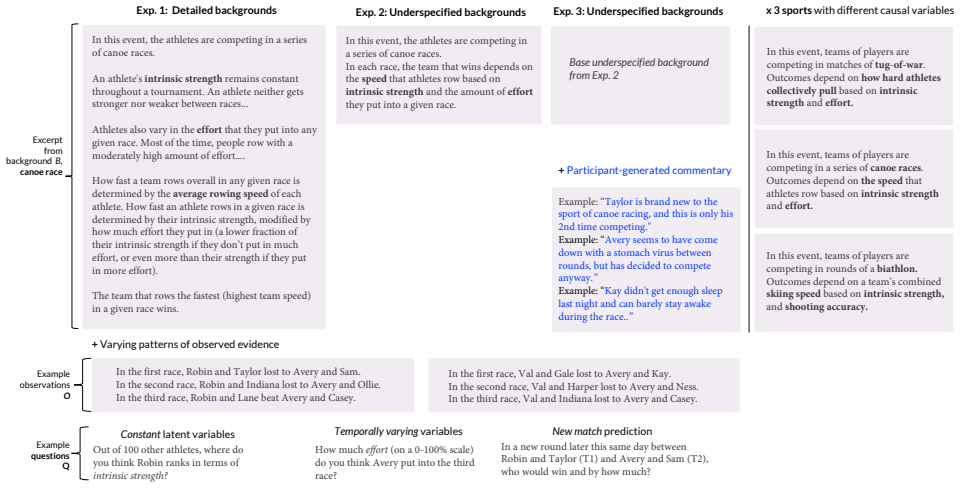
The paper's central claim is that a Model Synthesis Architecture—a language model that generates probabilistic programs on demand, followed by Bayesian inference in those programs—captures human probabilistic judgments better than language models used alone. In all three experiments, MSA predictions had higher correlation and lower Wasserstein distance to human judgments than direct or chain-of-thought versions of the base LM, and the gap was largest in the open-world experiment, where naive participants' comments introduced variables such as injuries, energy drinks, and inexperience that were not part of the hand-built causal models. The paper interprets this as evidence that people achieve locally coherent reasoning over globally relevant variables by constructing context-specific mental models, and that this construction can be implemented by interleaving language-model-based retrieval and synthesis with symbolic probabilistic inference.
Load-bearing premise
The assumption that the MSA's advantage comes from on-demand model synthesis rather than from the specific hand-written example models and priors the pipeline was prompted with; if those choices secretly encode the gold causal structure, the human-fit result would not show that the architecture itself recovers open-world reasoning.
Editorial extensions
If this is right
- If MSAs are right about human cognition, Bayesian models of reasoning need not be hand-built per domain; relevant causal structure can be recovered from language on demand.
- Open-world settings, where unanticipated variables enter a scenario, are not out of reach for probabilistic models: the LM front end can absorb new variables while the probabilistic program keeps inference coherent.
- Language models' weakness at integrating surprising evidence—such as treating a single loss as reversing a strong athlete's inferred strength—can be corrected by executing explicit probabilistic models rather than by more chain-of-thought computation.
- The MSA framework gives a concrete algorithmic target for studying the frame problem: model synthesis is an optimization over candidate models that trades usefulness against computational cost.
- The same staged synthesis could be pointed at planning and decision-making, where the query is a policy or action sequence rather than a posterior over latent variables.
Reading between the lines
- Beyond the paper, the same staged synthesis could be pointed at planning and decision-making problems, where the query is a policy or action sequence rather than a posterior over latent variables.
- The paper's own observation that synthesized models are less diverse than human judgments suggests a testable extension: sampling multiple models per participant, or conditioning synthesis on self-reported reasoning, should raise MSA variance toward human levels without hurting mean fit.
- Because the MSA struggled to invent temporal abstractions on its own, a natural next test is whether fine-tuning the synthesis LM on a library of temporal and modal primitives preserves the human-fit advantage in a wider range of open-world tasks.
- One way to stress-test the architecture is to let the human-generated commentary concern variables that cannot be expressed in the available WebPPL primitives; the current design would then need the LM to invent new primitives rather than reconfigure prompted ones.
Editorial analysis
A structured set of objections, weighed in public.
Referee Report
Summary. This paper proposes a Model Synthesis Architecture (MSA) in which a language model parses a natural-language vignette, retrieves background knowledge, builds a conceptual dependency graph, synthesizes a WebPPL probabilistic program, and then performs Bayesian inference. The authors introduce a 'Model Olympics' dataset of sports vignettes and three human experiments (detailed backgrounds, underspecified backgrounds, and participant-generated novel details) with multi-click probabilistic judgments. They report that MSA judgments correlate more strongly with human judgments than Llama-3.1-70B direct and chain-of-thought baselines, and that MSA fits are comparable to hand-crafted gold probabilistic models, with the largest advantage over LM baselines in the open-world Experiment 3.
Significance. If the reported advantage survives the controls identified below, the paper is a valuable proof of concept that interleaving LMs with probabilistic programs can produce locally coherent, open-world inference, going beyond LM-only cognitive models. The paper's concrete strengths include a novel benchmark, a staged and reproducible synthesis pipeline with a public repository, use of WebPPL rejection sampling, and a multi-click judgment interface that enables distributional comparisons. The central empirical claim is, however, currently vulnerable to a few-shot template confound and to the absence of inferential statistics, so the significance should be assessed after the requested revisions.
major comments (4)
- [Computational experiments; Limitations in Model Synthesis] The synthesis prompt at every stage includes sample vignettes, parses, dependency graphs, and full WebPPL programs for the other two sports in the domain, and the three sports are deliberately built on one causal template (constant latent plus time-varying latent combine into performance, and the higher-performance team wins; see Fig. 4 and Fig. 5). Thus, when the LM synthesizes a model for canoe racing, it has already been shown gold-derived programs for tug-of-war and biathlon that instantiate exactly the target structure, and it may only need to rename variables and insert sport-specific text. This makes the abstract's claim that the MSA 'captures human judgments better than language model-only baselines' ambiguous: the comparison is between an LM that is given the target model class in its prompt and LM baselines that are not. The paper's own limitation text states that 'model generations were often overly influenced by the example models given in our prompt' and that the MSA 'struggled to invent new primitives when these were called for,' which is precisely the concern. I request an ablation in which in-domain example programs are removed (or replaced with structurally dissimilar programs), and a quantitative analysis of how much of the synthesized code reuses functions and priors from the prompted templates.
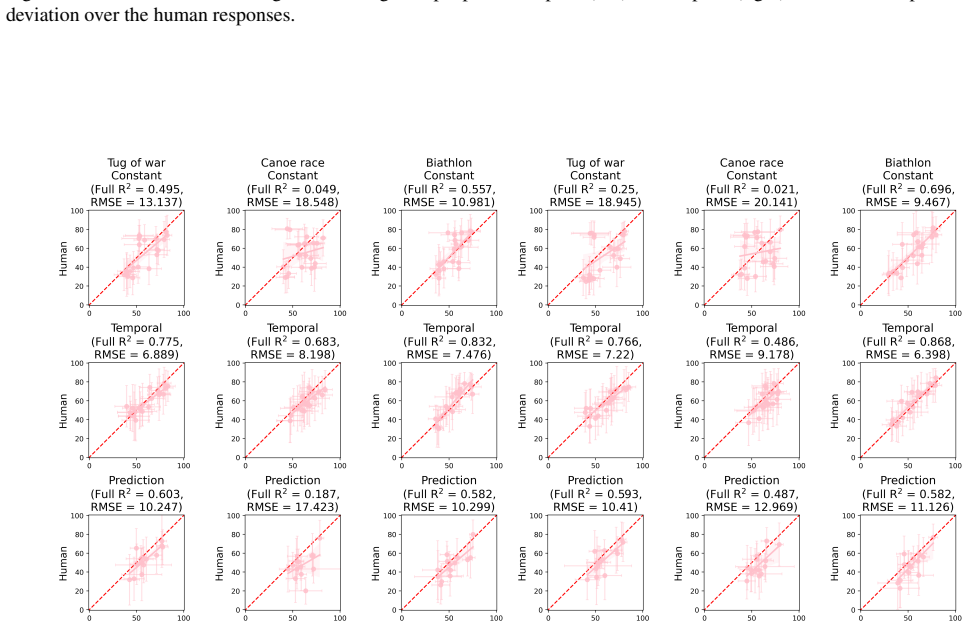
- [Comparing Probabilistic Judgments; Results] The R2 comparisons in Fig. 7(A-C) are point estimates without confidence intervals or significance tests, and the paper reports that split-half human-human correlations have wide confidence intervals. Because the R2 values aggregate over queries and vignettes and the model baselines share the same stimuli, the claim that MSA outperforms LM-Direct and LM-CoT is not statistically supported as presented. Please provide bootstrap or participant-level confidence intervals for the R2 differences and, where possible, paired tests at the vignette level. The WD error bars in Fig. 7(D-F) are bootstrapped over resamples of human data only and do not test differences between model classes.
- [Experiment 3; Supplement 'Exp. 3: human judgment experimental details'] The open-world experiment filtered participant-generated commentaries by excluding elicitors who did not change their judgment in the required direction, then selected nine commentaries favoring single-athlete, single-event observations; the judgment study used slightly different evidence patterns and question wording than Experiments 1 and 2. This curated selection may make the open-world test easier for the template-copying synthesis pipeline and harder to interpret as evidence about open-world generalization. Please report robustness to the selection rules (e.g., an unfiltered or less filtered set of commentaries) and state the wording and evidence-pattern differences in the main text.
- [Domain – Model Olympics vignettes; Computational experiments] The gold hand-crafted models were used to write the detailed Experiment 1 backgrounds and also serve as the symbolic baseline, so high Experiment 1 fits may partly reflect the MSA reconstructing the experimenters' model class rather than recovering human reasoning. This is not circularity in the strict sense (the MSA is not fitted to human judgments), but it is a confound for the claim that the MSA synthesizes the relevant model from language. Please clarify in the main text which sentences in the Experiment 1 backgrounds were derived from the gold model and whether any synthesis-stage prompt for a vignette included gold code or parse examples for that vignette's sport.
minor comments (5)
- [Human experiments; Supplement] The main text reports N_E1 = 78 participants for Experiment 1, while the supplement says 76 (and reports '57 of 76' in one batch); please reconcile these numbers.
- [Model Synthesis Architectures] In the paragraph describing the relevance-scoring stage, there is a stray 'W' at the end of the sentence about the evaluation function Φ_relevance; please remove it.
- [Supplement; Model Synthesis Architectures] The supplement uses K for retrieved informal background knowledge, while the main text uses B+ for the same object; align the notation.
- [Results; Discussion] The Discussion's statement that the MSA 'strongly outperforms LMs' in Experiment 3 should be softened to reflect the absence of a gold baseline in that experiment and the smaller, filtered stimulus set; Fig. 7 also shows comparable MSA and LM fits in the biathlon columns of Experiments 1 and 2.
- [Model Synthesis Architectures] Equations (2) and (3) assert that inference in the retrieved subset and in the ad-hoc model approximates full Bayesian reasoning, but the paper does not directly test these approximations; a sentence acknowledging this would help calibrate the theoretical claims.
Circularity Check
No derivation-level circularity: the MSA is evaluated on external human judgments, but a mild self-referential component (in-domain prompt examples drawn from the same gold-model template) and a non-load-bearing self-citation keep the score just above zero.
full rationale
The paper's central comparison is predictive rather than definitional: MSA posteriors are produced by parsing the vignette, retrieving background text, synthesizing a WebPPL program, and running rejection sampling, and these outputs are then compared to human multi-click judgments that were not used to fit any MSA parameter. No equation in the paper defines the target human judgments in terms of the model inputs, so the headline result does not reduce to its inputs by construction. The main self-referential element is in the experimental design: the paper states that 'all three sports share a general structure' and that prompt examples for a target sport 'consist of sample vignettes and models for the other two sports in our domain,' so the synthesized program for tug-of-war or canoe racing is prompted with full gold-derived programs instantiating the same latent-variable template. The limitations section concedes that 'model generations were often overly influenced by the example models given in our prompt' and that the system 'struggled to invent new primitives when these were called for.' This is a genuine threat to the open-world, on-demand-synthesis interpretation and should be weighed heavily in assessing the paper's claims, but it is an experimental-validity concern (template leakage into the few-shot prompt) rather than circularity in the derivation: the human judgments are external, the LM still performs non-trivial parse/retrieval/code-generation work, and no fitted parameter is renamed as a prediction. The self-citation to Brooke-Wilson (2023) for the MSA construct is not load-bearing; the empirical comparisons and the human-data fits stand independently of that citation. Overall, the result is not forced by definition or by a self-citation chain.
Assumptions & free parameters
free parameters (4)
- Intrinsic-strength prior mixture (weak/avg/strong means and probabilities) =
varies per synthesized model; e.g., categorical({ps: [weak_prior, average_prior, strong_prior], vs: [weak_mean…
- Effort-level prior thresholds =
0.05 / 0.8 / 0.2 (for strong / weak / average athletes)
- Injury probability per match =
0.05
- Multipliers for energy drink and shoulder injury =
1.3 (energy drink), 0.7 (pulled muscle)
assumptions (5)
- ad hoc to paper Equation (2): P(A|tau,K') approximately equals P(A|tau,K)
- ad hoc to paper Equation (3): P(A|M_ad-hoc) approximately equals P(A|tau,K')
- standard math Rejection sampling provides unbiased posterior estimates for the synthesized WebPPL programs
- domain assumption Llama-3.1-70B produces valid, representative parses, background retrievals, dependency graphs, and programs under the prompt scheme
- domain assumption Human reasoning in these vignettes is approximately Bayesian over some mental model
invented entities (2)
-
Model Synthesis Architecture (MSA)
-
Ad-hoc mental model M_ad-hoc
Cite this review
Pith. "Pith review of Modeling Open-World Cognition as On-Demand Synthesis of Probabilistic Models." pith.science (2026). https://pith.science/paper/RW2F66WK
@misc{pith2026250712547,
  author       = {Pith},
  title        = {Pith review of: Modeling Open-World Cognition as On-Demand Synthesis of Probabilistic Models},
  year         = {2026},
  howpublished = {\url{https://pith.science/paper/RW2F66WK}},
  note         = {Machine review of arXiv:2507.12547}
}
read the original abstract
When faced with novel situations, people are able to marshal relevant considerations from a wide range of background knowledge and put these to use in inferences and predictions. What permits us to draw in globally relevant information and reason over it coherently? Here, we explore the hypothesis that people use a combination of distributed and symbolic representations to construct bespoke mental models tailored to novel situations. We propose a computational implementation of this idea -- a ``Model Synthesis Architecture'' (MSA) -- using language models to implement global relevance-based retrieval and model synthesis and probabilistic programs to implement bespoke, coherent world models. We evaluate our MSA as a model of human judgments on a novel reasoning dataset. The dataset -- built around a `Model Olympics` domain of sports vignettes -- tests models' capacity for human-like, open-ended reasoning by requiring (i) judgments about novel causal structures described in language; (ii) drawing on large bodies of background knowledge; and (iii) doing both in light of observations that introduce arbitrary novel variables. Our MSA approach captures human judgments better than language model-only baselines, under both direct and chain-of-thought generations from the LM that supports model synthesis. These results suggest that MSAs can be implemented in a way that mirrors people's ability to deliver locally coherent reasoning over globally relevant variables, offering a path to understanding and replicating human reasoning in open-ended domains.
Figures


Figures from the paper (13 more)




Forward citations
Cited by 3 Pith papers
-
World Modeling with Probabilistic Structure Integration
A single probabilistic video model extracts optical flow, depth, and segments via counterfactual prompts, then integrates those structures as new token types to improve its own video predictions.
-
Computational models of pragmatic reasoning with flexible generation of meaning and expression alternatives
Combining language-model generation with rule-based selection reproduces several pragmatic phenomena, but the language models only worked reliably as idea generators, not as judges of formal linguistic properties.
-
Generation and Evaluation in the Human Invention Process through the Lens of Game Design
A two-stage model adding simulated-play funness to a language-model proposal prior best fits novice-invented games, but the model comparison is undermined by including the observed games in the normalization set and b...
Reference graph
Works this paper leans on
-
[1]
write newline
" write newline " cite write " FUNCTION editor.postfix editor num.names #1 > "( )" "( )" if FUNCTION editor.trans.postfix editor num.names #1 > "( )" "( )" if FUNCTION trans.postfix translator num.names #1 > "( )" "( )" if FUNCTION authors.editors.reflist.apa5 'field := 'dot := field num.names 'numnames := numnames 'format.num.names := format.num.names na...
-
[2]
, Jara-Ettinger, J
baker2017rational APACrefauthors Baker, C L. , Jara-Ettinger, J. , Saxe, R. \ Tenenbaum, J B. APACrefauthors \ 2017 . Rational quantitative attribution of beliefs, desires and percepts in human mentalizing Rational quantitative attribution of beliefs, desires and percepts in human mentalizing . Nature Human Behaviour 1 4 0064
2017
-
[3]
, Saxe, R
baker2009action APACrefauthors Baker, C L. , Saxe, R. \ Tenenbaum, J B. APACrefauthors \ 2009 . Action understanding as inverse planning Action understanding as inverse planning . Cognition 113 3 329--349
2009
-
[4]
battaglia2013simulation APACrefauthors Battaglia, P W. , Hamrick, J B. \ Tenenbaum, J B. APACrefauthors \ 2013 . Simulation as an Engine of Physical Scene Understanding Simulation as an engine of physical scene understanding . Proceedings of the National Academy of Sciences 110 45 18327--18332 . APACrefURL https://www.pnas.org/doi/pdf/10.1073/pnas.1306572...
-
[5]
beller2025language APACrefauthors Beller, A. \ Gerstenberg, T. APACrefauthors \ 2025 . Causation, meaning, and communication Causation, meaning, and communication . Psychological Review
work page 2025
-
[6]
bingham2019pyro APACrefauthors Bingham, E. , Chen, J P. , Jankowiak, M. , Obermeyer, F. , Pradhan, N. , Karaletsos, T. Goodman, N D. APACrefauthors \ 2019 . Pyro: Deep universal probabilistic programming Pyro: Deep universal probabilistic programming . Journal of machine learning research 20 28 1--6
work page 2019
-
[7]
binz2024centaur APACrefauthors Binz, M. , Akata, E. , Bethge, M. , Br \"a ndle, F. , Callaway, F. , Coda-Forno, J. others APACrefauthors \ 2024 . Centaur: a foundation model of human cognition Centaur: a foundation model of human cognition . arXiv preprint arXiv:2410.20268
arXiv 2024
-
[8]
brooke-wilson2023bounded APACrefauthors Brooke-Wilson, T. APACrefauthors \ 2023 . Bounded Rationality as a Strategy for Cognitive Science Bounded rationality as a strategy for cognitive science . , Massachusetts Institute of Technology, Cambridge, MA. APACrefURL https://philosophy.mit.edu/wp-content/uploads/brookewilson_dissertation.pdf APACrefURL
work page 2023
Show all 68 references
-
[9]
, Gelman, A
carpenter2017stan APACrefauthors Carpenter, B. , Gelman, A. , Hoffman, M D. , Lee, D. , Goodrich, B. , Betancourt, M. Riddell, A. APACrefauthors \ 2017 . Stan: A probabilistic programming language Stan: A probabilistic programming language . Journal of statistical software 76 1--32
2017
-
[10]
\ Lampinen, A
carvalho2025naturalistic APACrefauthors Carvalho, W. \ Lampinen, A. APACrefauthors \ 2025 . Naturalistic Computational Cognitive Science: Towards generalizable models and theories that capture the full range of natural behavior Naturalistic computational cognitive science: Tow...
2025 arXiv
-
[11]
, Tomasev, N
castro2025discovering APACrefauthors Castro, P S. , Tomasev, N. , Anand, A. , Sharma, N. , Mohanta, R. , Dev, A. others APACrefauthors \ 2025 . Discovering Symbolic Cognitive Models from Human and Animal Behavior Discovering symbolic cognitive models from human and animal beha...
2025
-
[12]
, Ragan-Kelley, J
chandra2025theories APACrefauthors Chandra, K. , Ragan-Kelley, J. \ Tenenbaum, J. APACrefauthors \ 2025 . Theories of Mind as Languages of Thought for Thought about Thought Theories of mind as languages of thought for thought about thought
2025
-
[13]
, Sucholutsky, I
collins2024building APACrefauthors Collins, K M. , Sucholutsky, I. , Bhatt, U. , Chandra, K. , Wong, L. , Lee, M. others APACrefauthors \ 2024 . Building Machines that Learn and Think with People Building machines that learn and think with people . Nature Human Behavior
2024
-
[14]
, Wong, C
collins2022structured APACrefauthors Collins, K M. , Wong, C. , Feng, J. , Wei, M. \ Tenenbaum, J. APACrefauthors \ 2022 . Structured, flexible, and robust: benchmarking and improving large language models towards more human-like behavior in out-of-distribution reasoning tasks...
2022
-
[15]
APACrefauthors \ 1943
craik1943nature APACrefauthors Craik, K J W. APACrefauthors \ 1943 . The nature of explanation The nature of explanation \ ( 445). CUP Archive
1943
-
[16]
, Xiang, V
cross2024hypothetical APACrefauthors Cross, L. , Xiang, V. , Bhatia, A. , Yamins, D L. \ Haber, N. APACrefauthors \ 2024 . Hypothetical minds: Scaffolding theory of mind for multi-agent tasks with large language models Hypothetical minds: Scaffolding theory of mind for multi-a...
2024 arXiv
-
[17]
, Saad, F A
cusumano2019gen APACrefauthors Cusumano-Towner, M F. , Saad, F A. , Lew, A K. \ Mansinghka, V K. APACrefauthors \ 2019 . Gen: a general-purpose probabilistic programming system with programmable inference Gen: a general-purpose probabilistic programming system with programmabl...
2019
-
[18]
dohan2022language APACrefauthors Dohan, D. , Xu, W. , Lewkowycz, A. , Austin, J. , Bieber, D. , Lopes, R G. others APACrefauthors \ 2022 . Language model cascades Language model cascades . arXiv preprint arXiv:2207.10342
2022 arXiv
-
[19]
APACrefauthors \ 2025
domke2025large APACrefauthors Domke, J. APACrefauthors \ 2025 . Large Language Bayes Large language bayes . arXiv preprint arXiv:2504.14025
2025
-
[20]
, Wong, C
ellis2021dreamcoder APACrefauthors Ellis, K. , Wong, C. , Nye, M. , Sabl \'e -Meyer, M. , Morales, L. , Hewitt, L. Tenenbaum, J B. APACrefauthors \ 2021 . Dreamcoder: Bootstrapping inductive program synthesis with wake-sleep library learning Dreamcoder: Bootstrapping inductive...
2021
-
[21]
, Zhou, B
feng2024bird APACrefauthors Feng, Y. , Zhou, B. , Lin, W. \ Roth, D. APACrefauthors \ 2024 . Bird: A trustworthy bayesian inference framework for large language models Bird: A trustworthy bayesian inference framework for large language models . arXiv preprint arXiv:2404.12494
2024
-
[22]
\ Goodman, N D
frank2012predicting APACrefauthors Frank, M C. \ Goodman, N D. APACrefauthors \ 2012 . Predicting pragmatic reasoning in language games Predicting pragmatic reasoning in language games . Science 336 6084 998--998
2012
-
[23]
\ Gentner, D R
gentner1983electricity APACrefauthors Gentner, D. \ Gentner, D R. APACrefauthors \ 1983 . Flowing Waters or Teeming Crowds: Mental Models of Electricity Flowing waters or teeming crowds: Mental models of electricity . D. Gentner\ A L. Stevens\ ( ), Mental Models Mental models ...
1983
-
[24]
\ Goodman, N D
gerstenberg2012pingpong APACrefauthors Gerstenberg, T. \ Goodman, N D. APACrefauthors \ 2012 . Ping Pong in Church: Productive use of concepts in human probabilistic inference Ping Pong in Church: Productive use of concepts in human probabilistic inference . N. Miyake, D. Peeb...
2012
-
[25]
, Goodman, N D
gerstenberg2021csm APACrefauthors Gerstenberg, T. , Goodman, N D. , Lagnado, D A. \ Tenenbaum, J B. APACrefauthors \ 2021 . A counterfactual simulation model of causal judgments for physical events A counterfactual simulation model of causal judgments for physical events . Psy...
2021
-
[26]
, Siegel, M H
gerstenberg2018happened APACrefauthors Gerstenberg, T. , Siegel, M H. \ Tenenbaum, J B. APACrefauthors \ 2018 . What happened? Recontructing the past through vision and sound What happened? recontructing the past through vision and sound . Proceedings of the Annual Meeting of ...
2018
-
[27]
\ Tenenbaum, J B
gerstenberg2017intuitive APACrefauthors Gerstenberg, T. \ Tenenbaum, J B. APACrefauthors \ 2017 . Intuitive theories Intuitive theories . Oxford handbook of causal reasoning Oxford handbook of causal reasoning \ ( \ 515--548)
2017
-
[28]
, Mansinghka, V
goodman2012church APACrefauthors Goodman, N. , Mansinghka, V. , Roy, D M. , Bonawitz, K. \ Tenenbaum, J B. APACrefauthors \ 2012 . Church: a language for generative models Church: a language for generative models . arXiv preprint arXiv:1206.3255
2012 arXiv
-
[29]
, Gerstenberg, T
goodman2024probabilistic APACrefauthors Goodman, N D. , Gerstenberg, T. \ Tenenbaum, J B. APACrefauthors \ 2024 . Probabilistic programs as a unifying language of thought Probabilistic programs as a unifying language of thought . T L. Griffiths, N. Chater \ J B. Tenenbaum\ ( )...
2024
-
[30]
, Tenenbaum, J B
goodman2014concepts APACrefauthors Goodman, N D. , Tenenbaum, J B. \ Gerstenberg, T. APACrefauthors \ 2014 . Concepts in a probabilistic language of thought Concepts in a probabilistic language of thought . E. Margolis\ S. Laurence\ ( ), The conceptual mind: New directions in ...
2014
-
[31]
, Glymour, C
gopnik2004theory APACrefauthors Gopnik, A. , Glymour, C. , Sobel, D M. , Schulz, L E. , Kushnir, T. \ Danks, D. APACrefauthors \ 2004 . A theory of causal learning in children: causal maps and Bayes nets. A theory of causal learning in children: causal maps and bayes nets. Psy...
2004
-
[32]
, Tenenbaum, J B
grand2025self APACrefauthors Grand, G. , Tenenbaum, J B. , Mansinghka, V K. , Lew, A K. \ Andreas, J. APACrefauthors \ 2025 . Self-Steering Language Models Self-steering language models . arXiv preprint arXiv:2504.07081
2025 arXiv
-
[33]
, Wong, L
grandlilo APACrefauthors Grand, G. , Wong, L. , Bowers, M. , Olausson, T X. , Liu, M. , Tenenbaum, J B. \ Andreas, J. APACrefauthors \ 2024 . LILO: Learning Interpretable Libraries by Compressing and Documenting Code Lilo: Learning interpretable libraries by compressing and do...
2024
-
[34]
, Kemp, C
griffithsbayesian APACrefauthors Griffiths, T L. , Kemp, C. \ Tenenbaum, J B. APACrefauthors \ 2008 . Bayesian models of cognition Bayesian models of cognition
2008
-
[35]
, Smith, K A
hamrick2015think APACrefauthors Hamrick, J B. , Smith, K A. , Griffiths, T L. \ Vul, E. APACrefauthors \ 2015 . Think again? The amount of mental simulation tracks uncertainty in the outcome Think again? the amount of mental simulation tracks uncertainty in the outcome . Proce...
2015
-
[36]
, Abel, D
ho2022people APACrefauthors Ho, M K. , Abel, D. , Correa, C G. , Littman, M L. , Cohen, J D. \ Griffiths, T L. APACrefauthors \ 2022 . People construct simplified mental representations to plan People construct simplified mental representations to plan . Nature 606 7912 129--136
2022
-
[37]
\ Goodman, N D
icard2015resource APACrefauthors Icard, T. \ Goodman, N D. APACrefauthors \ 2015 . A Resource-Rational Approach to the Causal Frame Problem. A resource-rational approach to the causal frame problem. CogSci. Cogsci
2015
-
[38]
, Gweon, H
jara2016naive APACrefauthors Jara-Ettinger, J. , Gweon, H. , Schulz, L E. \ Tenenbaum, J B. APACrefauthors \ 2016 . The Naïve Utility Calculus: Computational Principles Underlying Commonsense Psychology The naïve utility calculus: Computational principles underlying commonsens...
2016 doi
-
[39]
APACrefauthors \ 1980
johnson1980mental APACrefauthors Johnson-Laird, P N. APACrefauthors \ 1980 . Mental models in cognitive science Mental models in cognitive science . Cognitive science 4 1 71--115
1980
-
[40]
, Salakhutdinov, R
lake2015human APACrefauthors Lake, B M. , Salakhutdinov, R. \ Tenenbaum, J B. APACrefauthors \ 2015 . Human-level concept learning through probabilistic program induction Human-level concept learning through probabilistic program induction . Science 350 6266 1332--1338
2015
-
[41]
, Tessler, M H
lew2020leveraging APACrefauthors Lew, A K. , Tessler, M H. , Mansinghka, V K. \ Tenenbaum, J B. APACrefauthors \ 2020 . Leveraging Unstructured Statistical Knowledge in aProbabilistic Language of Thought Leveraging unstructured statistical knowledge in aprobabilistic language ...
2020
-
[42]
, Fox, E B
li2024automated APACrefauthors Li, M Y. , Fox, E B. \ Goodman, N D. APACrefauthors \ 2024 . Automated statistical model discovery with language models Automated statistical model discovery with language models . arXiv preprint arXiv:2402.17879
2024 arXiv
-
[43]
\ Griffiths, T L
lieder2020resource APACrefauthors Lieder, F. \ Griffiths, T L. APACrefauthors \ 2020 . Resource-rational analysis: Understanding human cognition as the optimal use of limited computational resources Resource-rational analysis: Understanding human cognition as the optimal use o...
2020
-
[44]
, LeBrun, B
loula2025syntactic APACrefauthors Loula, J. , LeBrun, B. , Du, L. , Lipkin, B. , Pasti, C. , Grand, G. others APACrefauthors \ 2025 . Syntactic and semantic control of large language models via sequential monte carlo Syntactic and semantic control of large language models via ...
2025 arXiv
-
[45]
, Yao, S
mccoy2023embers APACrefauthors McCoy, R T. , Yao, S. , Friedman, D. , Hardy, M. \ Griffiths, T L. APACrefauthors \ 2023 . Embers of autoregression: Understanding large language models through the problem they are trained to solve Embers of autoregression: Understanding large l...
2023 arXiv
-
[46]
, Alizadeh, K
mirzadeh2024gsm APACrefauthors Mirzadeh, I. , Alizadeh, K. , Shahrokhi, H. , Tuzel, O. , Bengio, S. \ Farajtabar, M. APACrefauthors \ 2024 . Gsm-symbolic: Understanding the limitations of mathematical reasoning in large language models Gsm-symbolic: Understanding the limitatio...
2024 arXiv
-
[47]
, Liang, Y
piriyakulkij2025poe APACrefauthors Piriyakulkij, W T. , Liang, Y. , Tang, H. , Weller, A. , Kryven, M. \ Ellis, K. APACrefauthors \ 2025 . PoE-World: Compositional World Modeling with Products of Programmatic Experts Poe-world: Compositional world modeling with products of pro...
2025
-
[48]
, Jagadish, A K
rmus2025generatingcomputationalcognitivemodels APACrefauthors Rmus, M. , Jagadish, A K. , Mathony, M. , Ludwig, T. \ Schulz, E. APACrefauthors \ 2025 . Generating Computational Cognitive Models using Large Language Models. Generating computational cognitive models using large ...
2025
-
[49]
, Key, D
tang2024worldcoder APACrefauthors Tang, H. , Key, D. \ Ellis, K. APACrefauthors \ 2024 . Worldcoder, a model-based llm agent: Building world models by writing code and interacting with the environment Worldcoder, a model-based llm agent: Building world models by writing code a...
2024
-
[50]
, Kemp, C
tenenbaum2011grow APACrefauthors Tenenbaum, J B. , Kemp, C. , Griffiths, T L. \ Goodman, N D. APACrefauthors \ 2011 . How to grow a mind: Statistics, structure, and abstraction How to grow a mind: Statistics, structure, and abstraction . science 331 6022 1279--1285
2011
-
[51]
, Loula, J
tsividis2021human APACrefauthors Tsividis, P A. , Loula, J. , Burga, J. , Foss, N. , Campero, A. , Pouncy, T. Tenenbaum, J B. APACrefauthors \ 2021 . Human-level reinforcement learning through theory-based modeling, exploration, and planning Human-level reinforcement learning ...
2021 arXiv
-
[52]
, Chen, J Y
vafa2024evaluating APACrefauthors Vafa, K. , Chen, J Y. , Kleinberg, J. , Mullainathan, S. \ Rambachan, A. APACrefauthors \ 2024 . Evaluating the World Model Implicit in a Generative Model Evaluating the world model implicit in a generative model . arXiv preprint arXiv:2406.03...
2024 arXiv
-
[53]
, Marquez, M
valmeekam2023planbench APACrefauthors Valmeekam, K. , Marquez, M. , Olmo, A. , Sreedharan, S. \ Kambhampati, S. APACrefauthors \ 2023 . Planbench: An extensible benchmark for evaluating large language models on planning and reasoning about change Planbench: An extensible bench...
2023
-
[54]
, Xie, Y
wang2023voyager APACrefauthors Wang, G. , Xie, Y. , Jiang, Y. , Mandlekar, A. , Xiao, C. , Zhu, Y. Anandkumar, A. APACrefauthors \ 2023 . Voyager: An open-ended embodied agent with large language models Voyager: An open-ended embodied agent with large language models . arXiv p...
2023 arXiv
-
[55]
Webppl probabilistic programming language
webppl WebPPL Probabilistic Programming Language. Webppl probabilistic programming language. . APACrefURL https://github.com/probmods/webppl APACrefURL
-
[56]
, Wang, X
wei2022chain APACrefauthors Wei, J. , Wang, X. , Schuurmans, D. , Bosma, M. , Xia, F. , Chi, E. others APACrefauthors \ 2022 . Chain-of-thought prompting elicits reasoning in large language models Chain-of-thought prompting elicits reasoning in large language models . Advances...
2022
-
[57]
, Grand, G
wong2023word APACrefauthors Wong, L. , Grand, G. , Lew, A K. , Goodman, N D. , Mansinghka, V K. , Andreas, J. \ Tenenbaum, J B. APACrefauthors \ 2023 . From word models to world models: Translating from natural language to the probabilistic language of thought From word models...
2023 arXiv
-
[58]
, Mao, J
wong2024learning APACrefauthors Wong, L. , Mao, J. , Sharma, P. , Siegel, Z. , Feng, J. , Korneev, N. Andreas, J. APACrefauthors \ 2024 . Learning adaptive planning representations with natural language guidance Learning adaptive planning representations with natural language guidance
2024
-
[59]
xia2024let APACrefauthors Xia, S. , Lu, B. \ Eisner, J. APACrefauthors \ 2024 . Let's Think Var-by-Var: Large Language Models Enable Ad Hoc Probabilistic Reasoning Let's think var-by-var: Large language models enable ad hoc probabilistic reasoning . arXiv preprint arXiv:2412.02081
2024 arXiv
-
[60]
\ Tenenbaum, J B
xu2007word APACrefauthors Xu, F. \ Tenenbaum, J B. APACrefauthors \ 2007 . Word learning as Bayesian inference. Word learning as bayesian inference. Psychological review 114 2 245
2007
-
[61]
, Collins, K M
ying2023neuro APACrefauthors Ying, L. , Collins, K M. , Wei, M. , Zhang, C E. , Zhi-Xuan, T. , Weller, A. Wong, L. APACrefauthors \ 2023 . The neuro-symbolic inverse planning engine (nipe): Modeling probabilistic social inferences from linguistic inputs The neuro-symbolic inve...
2023 arXiv
-
[62]
, Collins, K M
ying2025benchmarking APACrefauthors Ying, L. , Collins, K M. , Wong, L. , Sucholutsky, I. , Liu, R. , Weller, A. Tenenbaum, J B. APACrefauthors \ 2025 . On Benchmarking Human-Like Intelligence in Machines On benchmarking human-like intelligence in machines . arXiv preprint arX...
2025 arXiv
-
[63]
, Truong, R
ying2025languageinformedsynthesisrationalagent APACrefauthors Ying, L. , Truong, R. , Collins, K M. , Zhang, C E. , Wei, M. , Brooke-Wilson, T. Tenenbaum, J B. APACrefauthors \ 2025 . Language-Informed Synthesis of Rational Agent Models for Grounded Theory-of-Mind Reasoning On...
2025 arXiv
-
[64]
, Zhi-Xuan, T
ying2025understanding APACrefauthors Ying, L. , Zhi-Xuan, T. , Wong, L. , Mansinghka, V. \ Tenenbaum, J B. APACrefauthors \ 2025 . Understanding Epistemic Language with a Language-augmented Bayesian Theory of Mind Understanding epistemic language with a language-augmented baye...
2025
-
[65]
, Wong, L
zhang2023grounded APACrefauthors Zhang, C E. , Wong, L. , Grand, G. \ Tenenbaum, J B. APACrefauthors \ 2023 . Grounded physical language understanding with probabilistic programs and simulated worlds Grounded physical language understanding with probabilistic programs and simu...
2023
-
[66]
, Jin, C
zhang2025autotom APACrefauthors Zhang, Z. , Jin, C. , Jia, M Y. \ Shu, T. APACrefauthors \ 2025 . AutoToM: Automated Bayesian Inverse Planning and Model Discovery for Open-ended Theory of Mind Autotom: Automated bayesian inverse planning and model discovery for open-ended theo...
2025
-
[67]
APACrefauthors \ 2022
zhi2022pddl APACrefauthors Zhi-Xuan, T. APACrefauthors \ 2022 . Pddl. jl: An extensible interpreter and compiler interface for fast and flexible ai planning Pddl. jl: An extensible interpreter and compiler interface for fast and flexible ai planning . , Massachusetts Institute...
2022
-
[68]
, Mann, J
zhi2020online APACrefauthors Zhi-Xuan, T. , Mann, J. , Silver, T. , Tenenbaum, J. \ Mansinghka, V. APACrefauthors \ 2020 . Online bayesian goal inference for boundedly rational planning agents Online bayesian goal inference for boundedly rational planning agents . Advances in ...
2020
Reviewed August 6, 2026 · model on record in the stance chip above.
Discussion (0). Sign in to comment.