INTEGRAL, eROSITA and Voyager Constraints on Light Bosonic Dark Matter: ALPs, Dark Photons, Scalars, B-L and L_{i}-L_{j} Vectors
Pith reviewed 2026-05-19 04:09 UTC · model grok-4.3
The pith
511 keV line observations set the strongest limits on light bosonic dark matter decay below 1 GeV.
A machine-rendered reading of the paper's core claim, the machinery that carries it, and where it could break.
Core claim
Light bosonic dark matter decays into e+e- pairs, and the resulting flux and radiation can be directly compared to local measurements and sky maps. For models including electrophilic axion-like particles, dark photons, scalars, and B-L or Li-Lj vector bosons, the 511 keV data from INTEGRAL typically gives the best limits for masses under 1 GeV while eROSITA X-ray data dominates between 1 and 10 GeV. The analysis also includes a forecast for future 21 cm observations with HERA.
What carries the argument
The e+e- yield from dark matter decay and the resulting spectra for cosmic rays and X-rays, used to constrain decay lifetime and coupling in each model.
If this is right
- World-leading limits on bosonic dark matter decay lifetimes below 1 GeV from 511 keV observations.
- Strongest constraints in the 1-10 GeV range from eROSITA X-ray continuum.
- Improved bounds on couplings for ALPs, dark photons, scalars, and specific vector bosons.
- Future limits expected from 21 cm line searches with HERA data.
Where Pith is reading between the lines
- These constraints could guide the design of next-generation dark matter searches by highlighting the most promising mass ranges.
- Similar multi-messenger analyses might be applied to other decay channels or different dark matter candidates.
- If the background subtraction is accurate, it strengthens the case for using gamma-ray and X-ray data in dark matter studies.
- Extensions to extragalactic signals or other telescopes could provide independent checks.
Load-bearing premise
The signals observed by INTEGRAL, eROSITA and Voyager can be attributed to dark matter decay after subtracting known backgrounds, with dark matter following a standard galactic halo profile.
What would settle it
Finding that the 511 keV line or X-ray continuum is fully explained by astrophysical sources without any dark matter contribution would invalidate the derived limits on bosonic dark matter.
Figures




read the original abstract
The decay of light bosonic dark matter particles can produce a bright electron/positron ($e^+e^-$) flux that can be strongly constrained by local Voyager observations of the direct $e^+e^-$ flux, as well as 511 keV Line and X-ray continuum observations of $e^+e^-$ emission. We carefully analyze the $e^+e^-$ yield and resulting cosmic-ray and X-ray spectra from theoretically well-motivated light dark matter models, including: (a) electrophilic axion-like particles, (b) dark photons, (c) scalars, and (d) $B-L$ and $L_{i}-L_{j}$ vector bosons. We use the morphology and spectrum of the INTEGRAL 511 keV line data, the eROSITA X-ray continuum spectrum and the Voyager $e^+e^-$ spectrum to constrain the decay lifetime and coupling of each dark matter model. We find that 511 keV observations typically set world-leading limits on bosonic dark matter decay below masses of $\sim$1 GeV, while eROSITA observations provide the strongest constraints in the range from 1--10 GeV. Finally, we forecast future limits from 21 cm line searches with next-generation HERA data.
Editorial analysis
A structured set of objections, weighed in public.
Referee Report
Summary. The manuscript analyzes constraints on the decay of light bosonic dark matter (electrophilic ALPs, dark photons, scalars, B-L vectors, and Li-Lj vectors) into e+e- pairs. It employs Voyager local e+e- flux measurements, INTEGRAL 511 keV line morphology and spectrum, and eROSITA X-ray continuum data to bound the decay lifetime and couplings for each model. The central result is that 511 keV observations typically yield world-leading limits below ~1 GeV while eROSITA provides the strongest bounds from 1-10 GeV; forecasts for future HERA 21 cm searches are also presented.
Significance. If the results are robust, the work provides a systematic, multi-messenger update on constraints for several well-motivated light DM scenarios. The consistent treatment of e+e- yield, propagation, and radiation across models, combined with both spectral and morphological information from the 511 keV line, strengthens the analysis relative to single-probe studies. The forecasts for next-generation radio data add forward-looking value.
major comments (2)
- [DM density profile and 511 keV morphology section] § on galactic DM distribution and 511 keV flux calculation: the limits rely on a conventional cuspy halo profile (likely NFW) for the line-of-sight integral of DM density. For decay signals the flux scales linearly with density; a cored profile (isothermal or Burkert) reduces the bulge column density by O(1) factors relative to the fiducial choice. This directly impacts whether the derived lifetimes remain world-leading compared to beam-dump or supernova bounds below ~1 GeV. A quantitative sensitivity study to alternative profiles is required to support the strongest claim in the abstract.
- [Data analysis and limit extraction sections] § on background subtraction and error budget for INTEGRAL and eROSITA: the claim that DM decay can be isolated after standard astrophysical background subtraction needs an explicit propagation of uncertainties in the e+e- yield, propagation modeling, and residual backgrounds into the final lifetime limits. Without this, it is unclear whether the quoted world-leading status holds once systematic errors are folded in.
minor comments (2)
- [Model definitions] Table summarizing the different models and their couplings would improve readability and allow direct comparison of the derived limits.
- [Figures] Figure captions for the 511 keV morphology plots should explicitly state the assumed halo profile and the energy range used for the fit.
Simulated Author's Rebuttal
We thank the referee for their careful and constructive review. We address each major comment below and have revised the manuscript accordingly to strengthen the robustness of our results.
read point-by-point responses
-
Referee: [DM density profile and 511 keV morphology section] § on galactic DM distribution and 511 keV flux calculation: the limits rely on a conventional cuspy halo profile (likely NFW) for the line-of-sight integral of DM density. For decay signals the flux scales linearly with density; a cored profile (isothermal or Burkert) reduces the bulge column density by O(1) factors relative to the fiducial choice. This directly impacts whether the derived lifetimes remain world-leading compared to beam-dump or supernova bounds below ~1 GeV. A quantitative sensitivity study to alternative profiles is required to support the strongest claim in the abstract.
Authors: We agree that the DM density profile choice affects decay signals, which scale linearly with density. Our fiducial results use the standard NFW profile. In the revised manuscript we have added a quantitative sensitivity study employing isothermal and Burkert cored profiles. The bulge column density decreases by a factor of approximately 2–3, weakening the lifetime limits by a comparable amount. Nevertheless, the 511 keV constraints remain world-leading below ~1 GeV relative to beam-dump and supernova bounds. This analysis is now presented in a new subsection with an accompanying figure. revision: yes
-
Referee: [Data analysis and limit extraction sections] § on background subtraction and error budget for INTEGRAL and eROSITA: the claim that DM decay can be isolated after standard astrophysical background subtraction needs an explicit propagation of uncertainties in the e+e- yield, propagation modeling, and residual backgrounds into the final lifetime limits. Without this, it is unclear whether the quoted world-leading status holds once systematic errors are folded in.
Authors: We thank the referee for emphasizing the need for a complete error budget. The original manuscript discussed the primary uncertainty sources but did not fully propagate them. We have now added an explicit propagation of uncertainties arising from the e+e- yield, cosmic-ray propagation modeling, and residual astrophysical backgrounds for both INTEGRAL and eROSITA. The revised limits are presented with conservative systematic error bands, and the world-leading status of the constraints is confirmed even after these systematics are included. revision: yes
Circularity Check
No significant circularity: limits extracted from external datasets using standard models
full rationale
The paper computes e+e- yields and spectra from first-principles decay channels in each bosonic DM model (ALPs, dark photons, scalars, B-L and Li-Lj vectors), then compares the resulting line-of-sight integrals and propagated fluxes against three independent external datasets (INTEGRAL 511 keV morphology/spectrum, eROSITA X-ray continuum, Voyager local e+e- flux). The galactic halo profile, propagation parameters, and background subtraction are taken from the literature as fixed inputs; the derived lifetime/coupling limits are therefore falsifiable against those external observations and do not reduce to any fitted quantity or self-citation by construction. No load-bearing step invokes a self-citation chain, renames a known result, or defines a prediction in terms of itself.
Axiom & Free-Parameter Ledger
axioms (1)
- domain assumption Dark matter follows a standard galactic halo density profile for flux calculations.
Lean theorems connected to this paper
-
IndisputableMonolith/Foundation/RealityFromDistinction.leanreality_from_one_distinction unclear?
unclearRelation between the paper passage and the cited Recognition theorem.
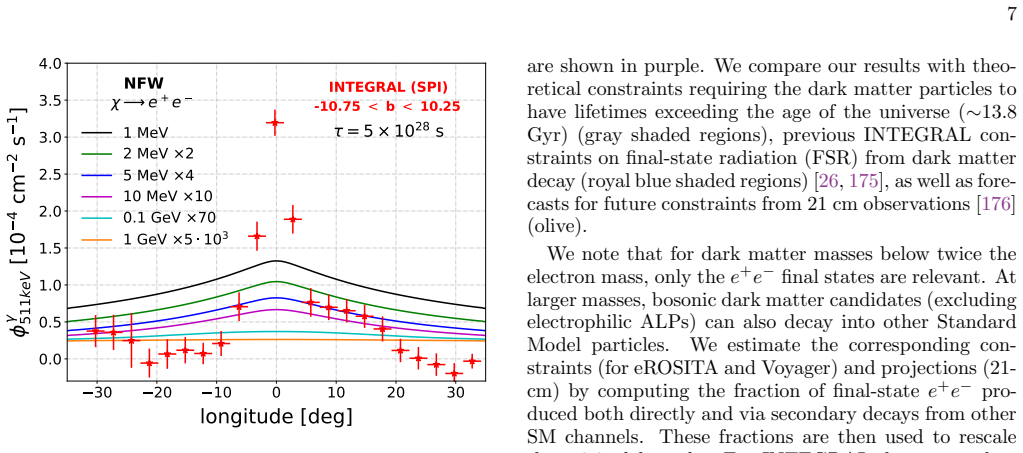
We use the morphology and spectrum of the INTEGRAL 511 keV line data, the eROSITA X-ray continuum spectrum and the Voyager e+e− spectrum to constrain the decay lifetime... We set ρ⊙=0.4 GeV cm−3 and ... γ=1 and R_scale=20 kpc, which are typical NFW parameters.
-
IndisputableMonolith/Cost/FunctionalEquation.leanwashburn_uniqueness_aczel unclear?
unclearRelation between the paper passage and the cited Recognition theorem.
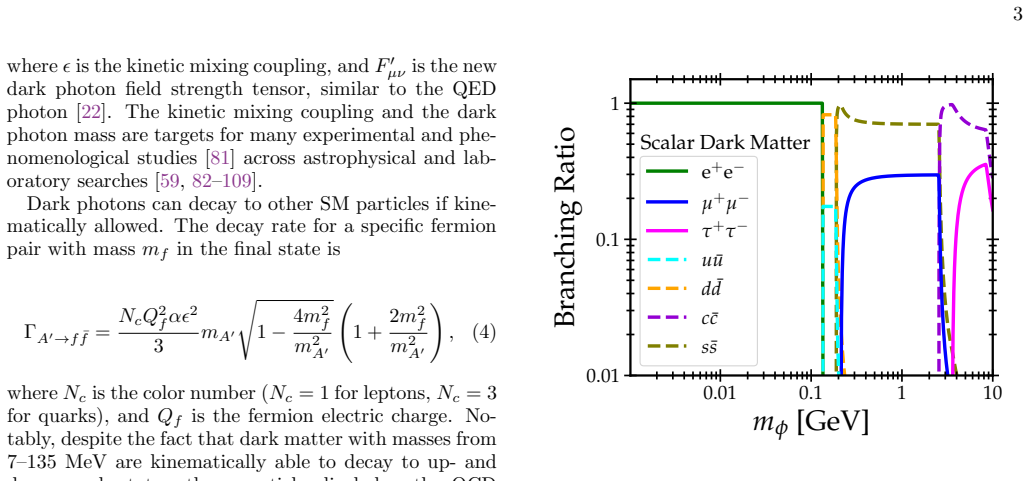
The decay rate ... Γ_A'→f f̄ = N_c Q_f² α ε² / (3 m_A') √(1−4m_f²/m_A'²) (1+2m_f²/m_A'²)
What do these tags mean?
- matches
- The paper's claim is directly supported by a theorem in the formal canon.
- supports
- The theorem supports part of the paper's argument, but the paper may add assumptions or extra steps.
- extends
- The paper goes beyond the formal theorem; the theorem is a base layer rather than the whole result.
- uses
- The paper appears to rely on the theorem as machinery.
- contradicts
- The paper's claim conflicts with a theorem or certificate in the canon.
- unclear
- Pith found a possible connection, but the passage is too broad, indirect, or ambiguous to say the theorem truly supports the claim.
Reference graph
Works this paper leans on
-
[1]
G. Bertone and D. Hooper, Rev. Mod. Phys. 90, 045002 (2018), arXiv:1605.04909 [astro-ph.CO]
work page internal anchor Pith review Pith/arXiv arXiv 2018
-
[2]
A New Era in the Quest for Dark Matter
G. Bertone and T. Tait, M. P., Nature 562, 51 (2018), arXiv:1810.01668 [astro-ph.CO]
work page internal anchor Pith review Pith/arXiv arXiv 2018
-
[3]
P. De la Torre Luque, P. Carenza, and T. T. Q. Nguyen, (2025), arXiv:2507.01962 [hep-ph]
- [4]
-
[5]
M. Cirelli, N. Fornengo, J. Koechler, E. Pinetti, and B. M. Roach, JCAP 07, 026 (2023), arXiv:2303.08854 [hep-ph]
-
[6]
M. Cirelli et al. , Phys. Rev. D 103, 063022 (2021), arXiv:2007.11493 [hep-ph]
- [7]
- [8]
-
[9]
P. Carenza, G. Lucente, and E. Vitagliano, Phys. Rev. D 107, 083032 (2023), arXiv:2301.06560 [hep-ph]
- [10]
-
[11]
Implications of the first AMS-02 measurement for dark matter annihilation and decay
H.-B. Jin, Y.-L. Wu, and Y.-F. Zhou, JCAP 11, 026 (2013), arXiv:1304.1997 [hep-ph]
work page internal anchor Pith review Pith/arXiv arXiv 2013
-
[12]
Constraints on Decaying Dark Matter from the Isotropic Gamma-Ray Background
C. Blanco and D. Hooper, JCAP 03, 019 (2019), arXiv:1811.05988 [astro-ph.HE]
work page internal anchor Pith review Pith/arXiv arXiv 2019
- [13]
-
[14]
Constraining Very Heavy Dark Matter Using Diffuse Backgrounds of Neutrinos and Cascaded Gamma Rays
K. Murase and J. F. Beacom, JCAP 10, 043 (2012), arXiv:1206.2595 [hep-ph]
work page internal anchor Pith review Pith/arXiv arXiv 2012
- [15]
- [16]
- [17]
-
[18]
Gamma-ray Constraints on Decaying Dark Matter and Implications for IceCube
T. Cohen, K. Murase, N. L. Rodd, B. R. Safdi, and Y. Soreq, Phys. Rev. Lett. 119, 021102 (2017), arXiv:1612.05638 [hep-ph]
work page internal anchor Pith review Pith/arXiv arXiv 2017
- [19]
- [20]
-
[21]
L. Calibbi, F. Goertz, D. Redigolo, R. Ziegler, and J. Zupan, Phys. Rev. D 95, 095009 (2017), arXiv:1612.08040 [hep-ph]
work page internal anchor Pith review Pith/arXiv arXiv 2017
-
[22]
M. Fabbrichesi, E. Gabrielli, and G. Lanfranchi, (2020), 10.1007/978-3-030-62519-1, arXiv:2005.01515 [hep-ph]
-
[23]
A. Hebecker, J. Jaeckel, and R. Kuespert, JHEP 04, 116 (2024), arXiv:2311.10817 [hep-th]
- [24]
- [25]
- [26]
- [27]
- [28]
- [29]
-
[30]
Constraints on dark matter and the shape of the Milky Way dark halo from the 511 keV line
Y. Ascasibar, P. Jean, C. Boehm, and J. Knoedlseder, Mon. Not. Roy. Astron. Soc. 368, 1695 (2006), arXiv:astro-ph/0507142
work page internal anchor Pith review Pith/arXiv arXiv 2006
-
[31]
Can annihilating Dark Matter be lighter than a few GeVs?
C. Boehm, T. A. Ensslin, and J. Silk, J. Phys. G 30, 279 (2004), arXiv:astro-ph/0208458
work page internal anchor Pith review Pith/arXiv arXiv 2004
- [32]
-
[33]
A. C. Vincent, P. Martin, and J. M. Cline, JCAP 04, 022 (2012), arXiv:1201.0997 [hep-ph]
work page internal anchor Pith review Pith/arXiv arXiv 2012
-
[34]
R. J. Wilkinson, A. C. Vincent, C. Bœhm, and C. McCabe, Phys. Rev. D 94, 103525 (2016), 13 arXiv:1602.01114 [astro-ph.CO]
work page internal anchor Pith review Pith/arXiv arXiv 2016
- [35]
- [36]
- [37]
-
[38]
P. De la Torre Luque, S. Balaji, and J. Silk, Astrophys. J. Lett. 973, L6 (2024), arXiv:2312.04907 [hep-ph]
-
[39]
P. De la Torre Luque, S. Balaji, M. Fairbairn, F. Sala, and J. Silk, (2024), arXiv:2410.16379 [astro-ph.HE]
-
[40]
Inverse Compton constraints on the Dark Matter e+e- excesses
M. Cirelli and P. Panci, Nucl. Phys. B 821, 399 (2009), arXiv:0904.3830 [astro-ph.CO]
work page internal anchor Pith review Pith/arXiv arXiv 2009
-
[41]
P. De la Torre Luque, S. Balaji, and J. Koechler, As- trophys. J. 968, 46 (2024), arXiv:2311.04979 [hep-ph]
-
[42]
P. De la Torre Luque, J. Koechler, and S. Balaji, Phys. Rev. D 110, 123022 (2024), arXiv:2406.11949 [astro- ph.HE]
-
[43]
eROSITA Science Book: Mapping the Structure of the Energetic Universe
A. Merloni, P. Predehl, W. Becker, H. B¨ ohringer, T. Boller, H. Brunner, M. Brusa, K. Dennerl, M. Freyberg, P. Friedrich, A. Georgakakis, F. Haberl, G. Hasinger, N. Meidinger, J. Mohr, K. Nandra, A. Rau, T. H. Reiprich, J. Robrade, M. Salvato, A. Santan- gelo, M. Sasaki, A. Schwope, J. Wilms, and t. German eROSITA Consortium, arXiv e-prints , arXiv:1209....
work page internal anchor Pith review Pith/arXiv arXiv 2012
- [44]
-
[45]
P. Predehl et al. (eROSITA), Astron. Astrophys. 647, A1 (2021), arXiv:2010.03477 [astro-ph.HE]
-
[46]
Antel et al.,Feebly-interacting particles: FIPs 2022 Workshop Report, Eur
C. Antel et al. , Eur. Phys. J. C 83, 1122 (2023), arXiv:2305.01715 [hep-ph]
-
[47]
The landscape of QCD axion models
L. Di Luzio, M. Giannotti, E. Nardi, and L. Visinelli, Phys. Rept. 870, 1 (2020), arXiv:2003.01100 [hep-ph]
work page internal anchor Pith review Pith/arXiv arXiv 2020
-
[48]
The Low-Energy Frontier of Particle Physics
J. Jaeckel and A. Ringwald, Ann. Rev. Nucl. Part. Sci. 60, 405 (2010), arXiv:1002.0329 [hep-ph]
work page internal anchor Pith review Pith/arXiv arXiv 2010
-
[49]
P. Svrcek and E. Witten, JHEP 06, 051 (2006), arXiv:hep-th/0605206
work page internal anchor Pith review Pith/arXiv arXiv 2006
-
[50]
The type IIB string axiverse and its low-energy phenomenology
M. Cicoli, M. Goodsell, and A. Ringwald, JHEP 10, 146 (2012), arXiv:1206.0819 [hep-th]
work page internal anchor Pith review Pith/arXiv arXiv 2012
-
[51]
On Axion Reheating in the String Landscape
J. Halverson, C. Long, B. Nelson, and G. Salinas, Phys. Rev. D 99, 086014 (2019), arXiv:1903.04495 [hep-th]
work page internal anchor Pith review Pith/arXiv arXiv 2019
-
[52]
P. Carenza, R. Pasechnik, and Z.-W. Wang, (2024), arXiv:2411.11716 [hep-ph]
-
[53]
P. Carenza, R. Pasechnik, and Z.-W. Wang, (2024), arXiv:2408.14245 [hep-ph]
- [54]
-
[55]
Limits on Axion Couplings from the first 80-day data of PandaX-II Experiment
C. Fu et al. (PandaX), Phys. Rev. Lett. 119, 181806 (2017), arXiv:1707.07921 [hep-ex]
work page internal anchor Pith review Pith/arXiv arXiv 2017
-
[56]
N. Abgrall et al. (Majorana), Phys. Rev. Lett. 118, 161801 (2017), arXiv:1612.00886 [nucl-ex]
work page internal anchor Pith review Pith/arXiv arXiv 2017
-
[57]
Searches for electron interactions induced by new physics in the EDELWEISS-III germanium bolometers
E. Armengaud et al. (EDELWEISS), Phys. Rev. D 98, 082004 (2018), arXiv:1808.02340 [hep-ex]
work page internal anchor Pith review Pith/arXiv arXiv 2018
-
[58]
T. Aralis et al. (SuperCDMS), Phys. Rev. D 101, 052008 (2020), [Erratum: Phys.Rev.D 103, 039901 (2021)], arXiv:1911.11905 [hep-ex]
-
[59]
E. Aprile et al. (XENON), Phys. Rev. D 102, 072004 (2020), arXiv:2006.09721 [hep-ex]
-
[60]
M. Agostini et al. (GERDA), Phys. Rev. Lett. 125, 011801 (2020), [Erratum: Phys.Rev.Lett. 129, 089901 (2022)], arXiv:2005.14184 [hep-ex]
-
[61]
D. S. Akerib et al. (LUX), Phys. Rev. Lett. 118, 261301 (2017), arXiv:1704.02297 [astro-ph.CO]
work page internal anchor Pith review Pith/arXiv arXiv 2017
- [62]
-
[63]
X. Zeng et al. (PandaX), Phys. Rev. Lett. 134, 041001 (2025), arXiv:2408.07641 [hep-ex]
-
[64]
J. Aalbers et al. (LZ), Phys. Rev. D 108, 072006 (2023), arXiv:2307.15753 [hep-ex]
-
[65]
P. Agnes et al. (DarkSide), Phys. Rev. Lett.130, 101002 (2023), arXiv:2207.11968 [hep-ex]
-
[66]
E. Aprile et al. (XENON), Phys. Rev. Lett. 129, 161805 (2022), arXiv:2207.11330 [hep-ex]
- [67]
-
[68]
P. Carenza and G. Lucente, Phys. Rev. D 103, 123024 (2021), arXiv:2104.09524 [hep-ph]
-
[69]
P. Carenza, M. Giannotti, J. Isern, A. Mirizzi, and O. Straniero, (2024), arXiv:2411.02492 [hep-ph]
-
[70]
D. Ghosh and D. Sachdeva, JCAP 10, 060 (2020), arXiv:2007.01873 [hep-ph]
-
[71]
P. Carenza and G. Lucente, Phys. Rev. D 104, 103007 (2021), [Erratum: Phys.Rev.D 110, 049901 (2024)], arXiv:2107.12393 [hep-ph]
- [72]
- [73]
- [74]
- [75]
-
[76]
Collider Probes of Axion-Like Particles
M. Bauer, M. Neubert, and A. Thamm, JHEP 12, 044 (2017), arXiv:1708.00443 [hep-ph]
work page internal anchor Pith review Pith/arXiv arXiv 2017
-
[77]
P. W. Graham, J. Mardon, and S. Rajendran, Phys. Rev. D 93, 103520 (2016), arXiv:1504.02102 [hep-ph]
work page internal anchor Pith review Pith/arXiv arXiv 2016
-
[78]
Is the Lightest Kaluza-Klein Particle a Viable Dark Matter Candidate?
G. Servant and T. M. P. Tait, Nucl. Phys. B 650, 391 (2003), arXiv:hep-ph/0206071
work page internal anchor Pith review Pith/arXiv arXiv 2003
-
[79]
A. E. Nelson and J. Scholtz, Phys. Rev. D 84, 103501 (2011), arXiv:1105.2812 [hep-ph]
work page internal anchor Pith review Pith/arXiv arXiv 2011
-
[80]
Naturally Light Hidden Photons in LARGE Volume String Compactifications
M. Goodsell, J. Jaeckel, J. Redondo, and A. Ringwald, JHEP 11, 027 (2009), arXiv:0909.0515 [hep-ph]
work page internal anchor Pith review Pith/arXiv arXiv 2009
discussion (0)
Sign in with ORCID, Apple, or X to comment. Anyone can read and Pith papers without signing in.