On the Distribution of a Two-Dimensional Random Walk with Restricted Angles
Pith reviewed 2026-05-22 00:38 UTC · model grok-4.3
The pith
A two-dimensional random walk with each angle restricted to an arbitrary subset of the circle has an exactly characterizable support and closed-form distributions for two steps.
A machine-rendered reading of the paper's core claim, the machinery that carries it, and where it could break.
Core claim
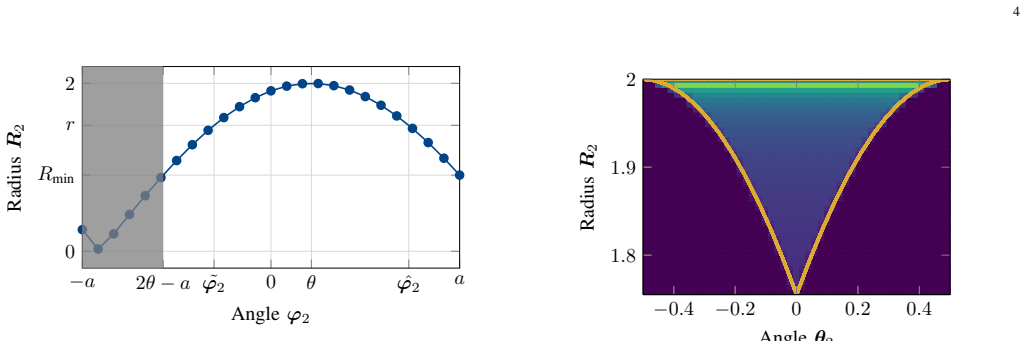
We derive the exact joint and marginal distributions for two steps, numerical solutions for a general number of steps, and approximations for a large number of steps. Furthermore, we provide an exact characterization of the support for an arbitrary number of steps.
What carries the argument
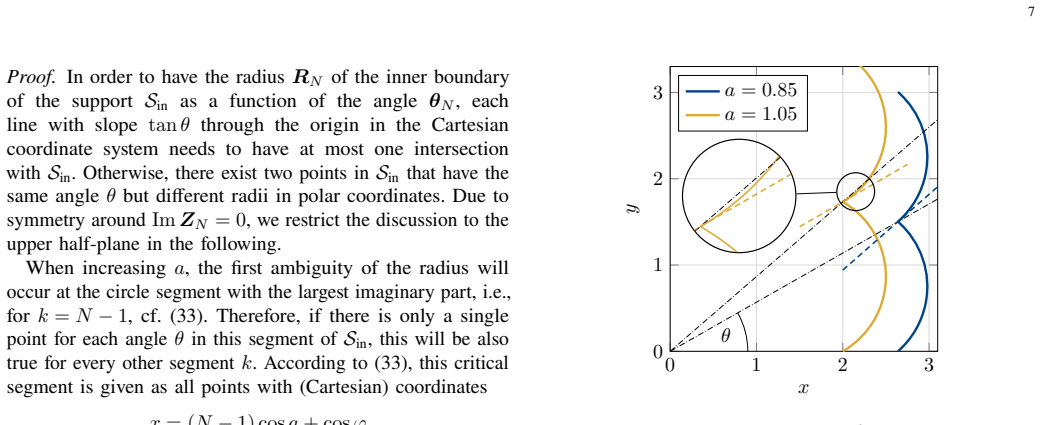
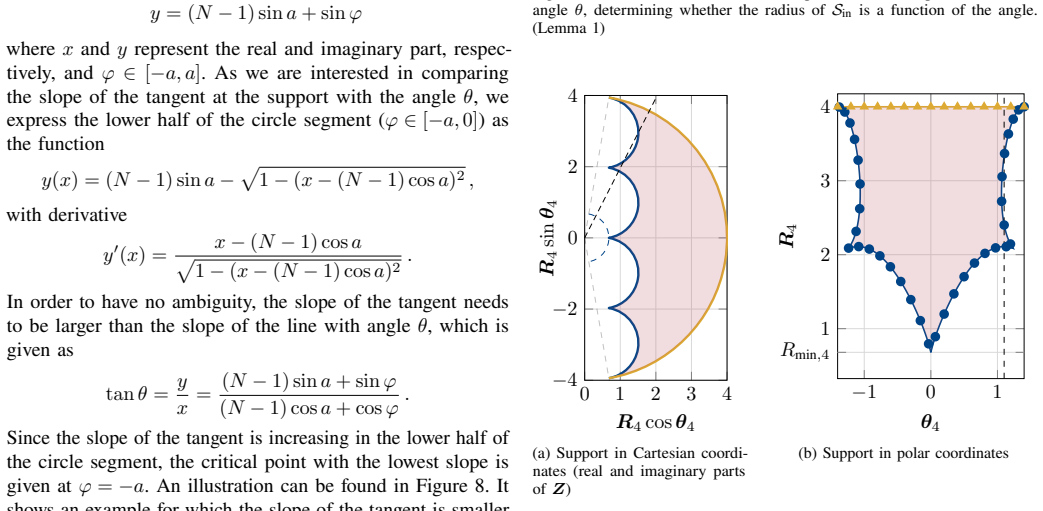
The exact characterization of the support as the set of all possible vector sums whose angles lie inside the allowed subset.
If this is right
- The joint distribution after two steps is obtained by integrating over pairs of allowed angles.
- Repeated convolution of the single-step distribution produces the position distribution for any fixed number of steps.
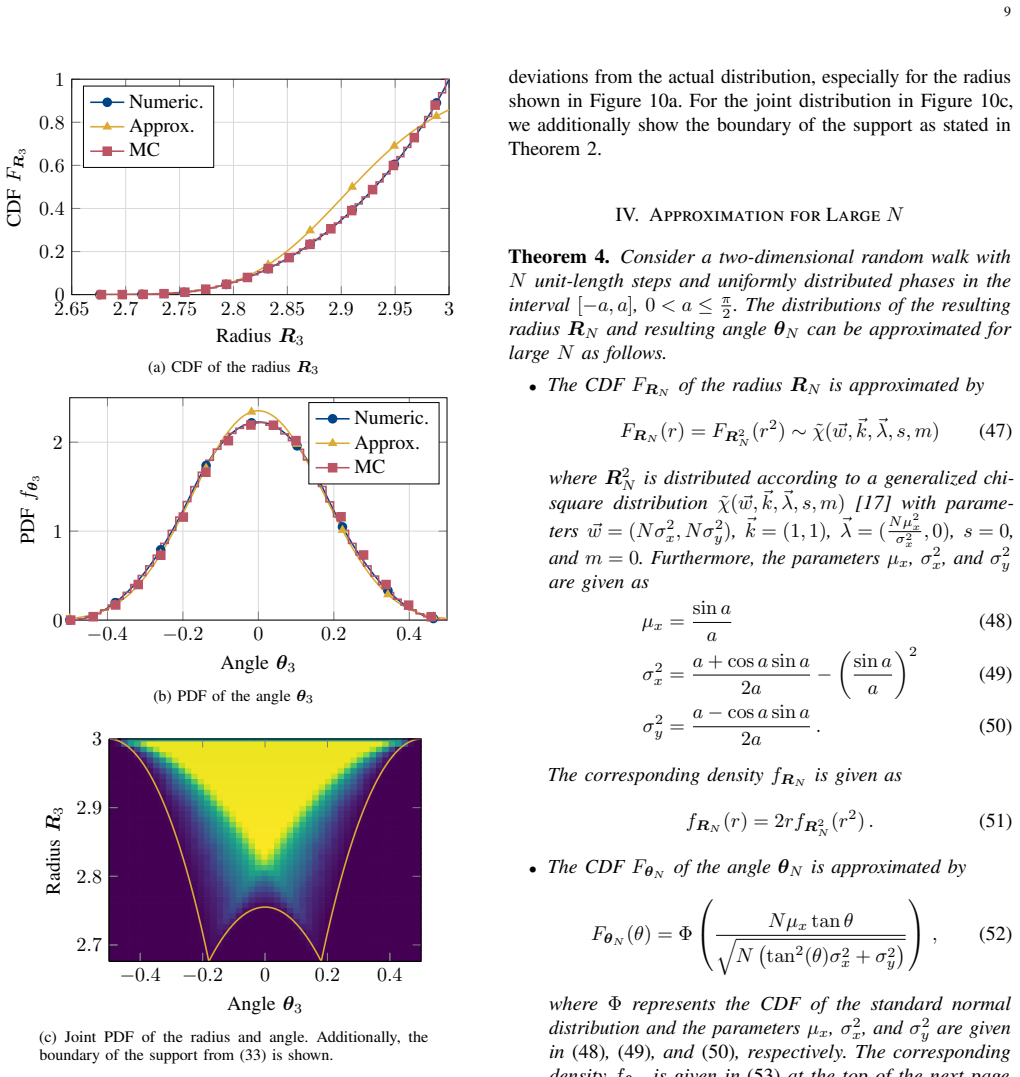
- For large step counts the position distribution approaches a Gaussian whose variance depends on the allowed angles.
- The reachable region after n steps is the n-fold vector sum of the allowed single-step set.
Where Pith is reading between the lines
- The support description could guide the choice of allowed angle sets to control coverage in wireless aggregation schemes.
- The same summation and integration approach may extend directly to walks with random step lengths.
- Numerical methods developed here could be adapted to check higher-dimensional versions of the same angle restriction.
Load-bearing premise
Each step angle is drawn independently from a distribution supported only inside the given subset of the circle.
What would settle it
A Monte Carlo sample of two-step positions that lies outside the analytically predicted support for a chosen angle subset, or a direct numerical check that disagrees with the derived two-step density formula.
Figures





read the original abstract
In this paper, we derive the distribution of a two-dimensional (complex) random walk in which the angle of each step is restricted to a subset of the circle. This setting appears in various domains, such as in over-the-air computation in signal processing. In particular, we derive the exact joint and marginal distributions for two steps, numerical solutions for a general number of steps, and approximations for a large number of steps. Furthermore, we provide an exact characterization of the support for an arbitrary number of steps. The results in this work provide a reference for future work involving such problems.
Editorial analysis
A structured set of objections, weighed in public.
Referee Report
Summary. The manuscript derives the exact joint and marginal distributions of a two-dimensional random walk whose step angles are restricted to an arbitrary subset of the circle. Exact results are obtained for two steps by direct integration over the allowed angles; numerical convolutions are used for a general number of steps; large-step approximations and an exact geometric characterization of the reachable support are also provided. The work is motivated by applications such as over-the-air computation in signal processing.
Significance. If the derivations are correct, the closed-form two-step distributions and the support characterization supply useful reference results for constrained random walks. These exact elements are independent of fitted parameters and rest on direct integration and vector-addition geometry, which strengthens their value as a foundation for future analytic work in signal processing.
major comments (1)
- [Numerical results / general-step section] The numerical convolution procedure presented for a general number of steps does not include error bounds, convergence rates, or validation against the exact two-step case, which limits the ability to assess the accuracy of the reported distributions for n>2.
minor comments (1)
- [Abstract] The abstract states that numerical solutions are provided but does not indicate the discretization method or any accuracy metric used.
Simulated Author's Rebuttal
We thank the referee for their careful review and constructive feedback on our manuscript. We address the single major comment below and have incorporated revisions to strengthen the numerical section.
read point-by-point responses
-
Referee: [Numerical results / general-step section] The numerical convolution procedure presented for a general number of steps does not include error bounds, convergence rates, or validation against the exact two-step case, which limits the ability to assess the accuracy of the reported distributions for n>2.
Authors: We agree that explicit validation and error analysis would improve the presentation of the numerical results. In the revised manuscript we have added a dedicated paragraph and accompanying figure that directly compares the numerical convolution output for n=2 against the exact closed-form joint and marginal distributions derived in Section III. We also include a short discussion of the discretization error arising from the angular quadrature, together with a conservative a-priori bound on the L1 error that scales with the angular step size; this bound is used to report practical error estimates for the n>2 cases shown in the paper. revision: yes
Circularity Check
No significant circularity; derivations are self-contained
full rationale
The paper's core results follow from direct integration of the joint density over independent angles drawn from a fixed subset, followed by convolution for additional steps and a geometric description of the reachable support set. These operations are standard probabilistic constructions that start from the stated independence and uniformity assumptions inside the subset and produce the claimed joint/marginal densities and support characterization without reducing any output to a fitted parameter, self-citation, or redefinition of the input. No load-bearing step equates a derived quantity to its own defining equation or to prior work by the same author.
Axiom & Free-Parameter Ledger
axioms (2)
- domain assumption Step angles are chosen independently according to a distribution supported on a fixed subset of the circle.
- domain assumption Step lengths are independent of angles and of each other.
Reference graph
Works this paper leans on
-
[1]
The problem of the random walk,
K. Pearson, “The problem of the random walk,”Nature, vol. 72, no. 1865, p. 294, Jul. 1905.doi: 10.1038/072294b0
-
[2]
K. V. Mardia, Statistics of Directional Data (Probability and Mathematical Statistics Monograph). Orlando, FL, USA: Academic Press, 1972.doi: 10.1016/C2013-0-07425-7
-
[3]
S. R. Jammalamadaka and A. SenGupta,Topics in Circular Statistics (Series on Multivariate Analysis 5). World Scientific,
-
[4]
M. Dahl, Z. Chen, and E. G. Larsson, “Over-the-air computation with reciprocity calibration: Detection and realignment of misaligned devices,” inProceedings of the 2024 58th Asilomar Conference on Signals, Systems, and Computers, IEEE, Oct. 2024, pp. 1832–1836.doi: 10.1109/ieeeconf60004.2024. 10942835
-
[5]
Massive synchrony in distributed antenna systems,
E. G. Larsson, “Massive synchrony in distributed antenna systems,”IEEE Transactions on Signal Processing, vol. 72, pp. 855–866, 2024.doi: 10.1109/TSP.2024.3358618
-
[6]
Distributed phased arrays: Challenges and recent advances,
J. A. Nanzer, S. R. Mghabghab, S. M. Ellison, and A. Schlegel, “Distributed phased arrays: Challenges and recent advances,” IEEE Transactions on Microwave Theory and Techniques, vol. 69, no. 11, pp. 4893–4907, Nov. 2021.doi: 10.1109/ tmtt.2021.3092401
-
[7]
A survey on over-the-air computation,
A. Şahin and R. Yang, “A survey on over-the-air computation,” IEEE Communications Surveys & Tutorials, vol. 25, no. 3, pp. 1877–1908, 2023.doi: 10.1109/comst.2023.3264649
-
[8]
Random walk models in biology,
E. A. Codling, M. J. Plank, and S. Benhamou, “Random walk models in biology,”Journal of The Royal Society Interface, vol. 5, no. 25, pp. 813–834, Apr. 2008.doi: 10.1098/rsif.2008. 0014
-
[9]
L. Marsh and R. Jones, “The form and consequences of random walk movement models,”Journal of Theoretical Biology, vol. 133, no. 1, pp. 113–131, Jul. 1988.doi: 10.1016/s0022- 5193(88)80028-6
-
[10]
The problem of the random walk,
Rayleigh, “The problem of the random walk,”Nature, vol. 72, no. 1866, p. 318, Aug. 1905.doi: 10.1038/072318a0
-
[11]
J. C. Kluyver, “A local probability theorem,”Proceedings of the Section of Sciences. Koninklijke Akademie van Wetenschappen te Amsterdam, vol. 8, pp. 341–350, Dec. 1905
work page 1905
-
[12]
Distribution of the sum of randomly phased components,
W. R. Bennett, “Distribution of the sum of randomly phased components,”Quarterly of Applied Mathematics, vol. 5, no. 4, pp. 385–393, Jan. 1948.doi: 10.1090/qam/24592
-
[13]
On the probability density function of the squared envelope of a sum of random phase vectors,
M. Simon, “On the probability density function of the squared envelope of a sum of random phase vectors,”IEEE Transactions on Communications, vol. 33, no. 9, pp. 993–996, 1985.doi: 10.1109/TCOM.1985.1096409
-
[14]
On the distribution of a two-dimensional random walk with restricted angles,
K.-L. Besser. “On the distribution of a two-dimensional random walk with restricted angles,” Supplementary Material. (2025), [Online]. Available: https://github.com/klb2/distribution- random-walk-restricted-angles
work page 2025
-
[15]
Reconfigurable intelligent surface phase hopping for ultra-reliable communications,
K.-L. Besser and E. A. Jorswieck, “Reconfigurable intelligent surface phase hopping for ultra-reliable communications,”IEEE Transactions on Wireless Communications, vol. 21, no. 11, pp. 9082–9095, Nov. 2022.doi: 10.1109/TWC.2022.3172760. arXiv: 2107.11852 [cs.IT]
-
[16]
W. Koepf, “Taylor polynomials of implicit functions, of inverse functions, and of solutions of ordinary differential equations,” Complex Variables, Theory and Application: An International Journal, vol. 25, no. 1, pp. 23–33, May 1994.doi: 10.1080/ 17476939408814727
work page 1994
-
[17]
Das,New methods to compute the generalized chi-square distribution, Feb
A. Das,New methods to compute the generalized chi-square distribution, Feb. 2025. arXiv: 2404.05062v3[stat.CO]
-
[18]
Computing the distribution of quadratic forms in normal variables,
J. P. Imhof, “Computing the distribution of quadratic forms in normal variables,”Biometrika, vol. 48, no. 3, pp. 419–426, Dec. 1961. doi: 10.1093/biomet/48.3-4.419
-
[19]
H. Ruben, “Probability content of regions under spherical normal distributions, IV: The distribution of homogeneous and non-homogeneous quadratic functions of normal variables,”The Annals of Mathematical Statistics, vol. 33, no. 2, pp. 542–570, Jun. 1962. doi: 10.1214/aoms/1177704580
-
[20]
On the ratio of two correlated normal random variables,
D. V. Hinkley, “On the ratio of two correlated normal random variables,”Biometrika, vol. 56, no. 3, pp. 635–639, 1969.doi: 10.1093/biomet/56.3.635
discussion (0)
Sign in with ORCID, Apple, or X to comment. Anyone can read and Pith papers without signing in.