REVIEW 3 major objections 6 minor 25 references
Human-Exoskeleton Kinematic Calibration to Improve Hand Tracking for Dexterous Teleoperation
T0 review · 3 major / 6 minor · reviewed 2026-08-06 · deepseek-v4-flash
Pith's one-line read Subject-specific tuning of virtual link parameters brings exoskeleton fingertip tracking to about 10 mm of error without cameras during use.
desk verdict A clear-headed kinematic calibration scheme for the MAESTRO exoskeleton, but the headline accuracy gains are in-sample because the weight search and validation share the same subjects. read the letter →
The pith
A machine-rendered reading of the paper's core claim, the machinery that carries it, and where it could break.
The reading
What carries the argument
The load-bearing object is the virtual link: an unmeasured, subject-specific link in each four-bar chain that connects the exoskeleton's measured joints to the anatomical finger segments. The calibration minimizes a weighted sum of squared residuals between measured and model-predicted redundant joint angles and reference-posture angles, with a number of error terms matched to the number of unknown virtual-link parameters so the optimization stays well-posed. A sensitivity analysis of the index-finger model shows that proximal virtual-link coordinates, mainly $x_1$ and $y_1$, move the fingertip by up to about 30 mm under a 10 percent perturbation, while distal coordinates move it only a few millimetres, which motivates the data-driven weighting and the emphasis on the proximal loops.
What would settle it
Repeat the same subject's calibration and tracking protocol on a second day after removing and re-donning the exoskeleton without recalibration, and compare fingertip MAE against motion capture. If the error returns toward the uncalibrated baseline rather than staying near 10 mm, the method is fitting one donning's slip pattern, not a stable subject-specific geometry.
Extended reading notes
Core claim
The central claim is that the human–exoskeleton interface can be modeled as closed four-bar linkages in which unmeasured virtual links absorb hand anatomy, hand size, and donning configuration, and that these virtual links can be solved for from the device's redundant sensors plus a short two-phase pose protocol. The paper reports that this calibration made tracking accurate and consistent across seven subjects with different hand geometries: average fingertip mean absolute error of roughly 10 mm, index-fingertip error reduced by up to 71.5 percent, and the largest joint-level gains at the thumb IP and index PIP joints. The paper further claims that averaging each subject's optimal cost weights yields a usable common weighting profile, so the motion-capture ground truth is needed only for offline weight selection, not during operation.
Load-bearing premise
The load-bearing premise is that the exoskeleton, the finger segments, and the virtual links form a rigid, planar, non-slipping four-bar linkage during calibration; if the device slides on the skin or the soft tissue compresses in ways the loop equations do not model, the fitted virtual links will absorb those effects and the accuracy gains may not transfer to other sessions or motions.
Editorial extensions
If this is right
- On the MAESTRO device, the two-phase calibration plus averaged optimal weights brings fingertip tracking to roughly 10 mm MAE, inside the 10–15 mm band that prior teleoperation work treats as tolerable.
- New users only need to perform a flat-hand hold and isolated MCP flexion; motion-capture ground truth is used once to pick weights, not for routine tracking.
- The approach transfers in principle to other exoskeletons with closed-loop kinematics and redundant sensing, provided the cost function is reformulated for that device's constraints.
- Residual joint-angle errors around 10 degrees remain at some joints, so the paper points to fingertip-level or task-level calibration as the next refinement for precision tasks.
Reading between the lines
- If the fitted virtual links reflect anatomy rather than one donning session, a re-donning test with no recalibration should keep fingertip MAE near 10 mm; that experiment would separate genuine person-specific geometry from slip that happened to be captured in calibration.
- The sensitivity ranking suggests a two-stage deployment: keep the averaged weights fixed and update only the proximal virtual-link coordinates ($x_1$, $y_1$) online from redundant sensors, since these dominate fingertip error.
- A glove or exoskeleton without redundant loop closures would need a different source of independent constraints; this method's reach is therefore tied to how much redundant sensing the hardware already has.
- Because the weights were averaged across only seven hands slightly smaller than the population mean, the claimed consistency across hand geometries would be strengthened by testing with larger hands and more diverse proportions.
Editorial analysis
A structured set of objections, weighed in public.
Referee Report
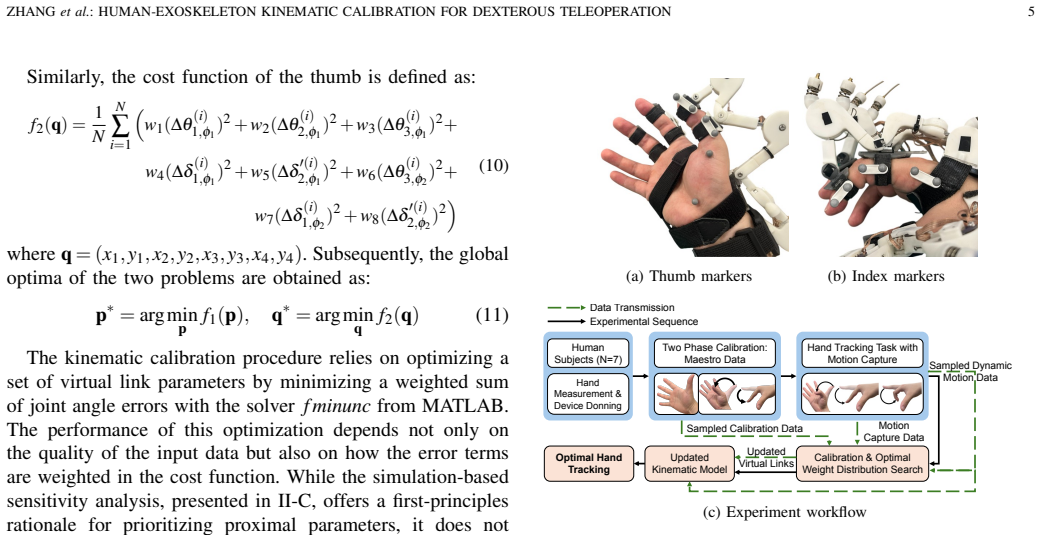
Summary. The paper proposes a subject-specific calibration framework for the MAESTRO hand exoskeleton, which uses closed-loop four-bar linkages with redundant joint sensors to track thumb, index, and middle finger motion. The method estimates virtual link parameters through a weighted least-squares optimization against two reference poses (flat hand and isolated MCP flexion), and then tunes the cost-function weights via a random search using motion-capture ground truth from each subject. The resulting averaged weights are applied to calibrate each subject's virtual links, and tracking accuracy is compared against an uncalibrated baseline and an even-weight calibration. Evaluated on seven participants, the paper reports reductions in joint-angle and fingertip mean absolute error, with the largest improvement being 71.5% for index fingertip position. Qualitative Unity-based visualizations are also presented. The authors claim the framework generalizes to other exoskeletons with similar closed-loop kinematics and minimal sensing.
Significance. If the reported accuracy gains survive an independent evaluation, the contribution is useful: it offers a calibration procedure that, at deployment time, requires only exoskeleton joint readings and a small set of reference poses, with no external cameras or runtime ground truth. The kinematic modeling of the four-bar loops is detailed, the sensitivity analysis provides a first-principles motivation for focusing on proximal virtual links, and the two-phase calibration protocol is simple and practical. However, the current validation protocol selects per-subject weights using the same motion-capture data on which the final errors are computed, so the headline error reductions are in-sample estimates. This makes the magnitude of the claimed improvements uncertain until cross-validation or held-out testing is provided. The paper also acknowledges several limitations that temper the 'diverse hand geometries' claim: only seven participants, hand sizes slightly below the population mean, and short isolated movement segments.
major comments (3)
- [Section III-A (Optimal Weight Search / Performance Validation)] The evaluation protocol does not provide an independent test of the claimed accuracy gains. The per-subject optimal weights are selected by minimizing MAE on that subject's motion-capture ground truth, then averaged, and the averaged weights are applied to the same seven subjects to produce the validation errors in Table II and Fig. 7. Because each subject's reported error is generated with a weight vector that includes that subject's own ground-truth-tuned optimum, the reported reductions (e.g., 71.5% index fingertip MAE) are in-sample estimates. No leave-one-subject-out, held-out session, or separate donning test is reported, so the claim that the method generalizes to new users or new donning sessions is unsupported. Please add a cross-validation or hold-out analysis (e.g., leave-one-subject-out, or split the six repetitions into tuning and test sets) and report error bars.
- [Table II / Section IV-A] The statement that 'calibration consistently led to notable reductions' is not fully supported by the per-subject data. Under optimal weights, thumb MCP MAE increases (negative percent reduction) for Subjects 1, 4, and 5, and index MCP MAE increases for Subject 3; similar inconsistencies appear in the even-weight condition. The averaged improvements are driven by a few large gains (e.g., Subject 6). Please report per-subject error distributions with confidence intervals or effect sizes, and discuss scenarios where the calibrated model may degrade MCP tracking.
- [Section II-D (Eqs. 9-11)] The paper states that matching the number of error terms to the number of virtual link parameters ensures a well-posed optimization, but no identifiability or conditioning analysis is given. Since fminunc is a local solver and the weight search evaluates 500 random candidates, the stability of the solution with respect to initialization and to small perturbations in the data should be assessed (e.g., via bootstrapping or repeated calibrations). This matters because the subsequent weight averaging assumes the per-subject optima are reliable.
minor comments (6)
- [Section III-A / Fig. 5] Motion-capture markers are placed only on the thumb and index finger; the middle finger is not validated. Since the device tracks three digits, the claims about 'hand tracking' should be scoped to the thumb and index, or middle-finger markers should be added.
- [Section IV-B] The qualitative visualization infers DIP joints from PIP joints via a fixed biomechanical coupling; this inference is not validated, so the visual fidelity shown in Fig. 10 may not reflect true DIP kinematics.
- [Section V (Limitations)] The paper acknowledges short isolated movement segments and hand sizes below the population mean; these limitations should be reflected in the abstract or introduction to avoid overstating the generality of the results.
- [Section II-B] The notation for the second redundant joint is inconsistent: the text and Figure 2 use both δ2 and δ′2 for the thumb, while Eq. (3) uses δ′2. Please unify the notation throughout.
- [Introduction] The phrase 'without requiring external cameras, sensors or ground-truth references' is misleading because the weight-search step in Section III-A relies on motion-capture ground truth. Please clarify that this applies to the deployment-time calibration, not to the weight-tuning development.
- [Section II-D] The fixed 70-degree thumb CMC reference angle in the flat-hand pose is a modeling assumption with acknowledged inter-subject inaccuracy; please state explicitly how sensitive the calibrated results are to this assumption, given that it is used as a reference in the cost function.
Circularity Check
The reported optimal-weight tracking improvements are in-sample: the same motion-capture data selects the per-subject weights and then validates the averaged weights, so the headline MAE reductions do not yet demonstrate generalization.
-
fitted input called prediction
[Section III-A, 'Optimal Weight Search' and 'Performance Validation'; results in Table II and Fig. 7]
"Motion capture trajectories served as ground truth to identify the weights that minimize the mean absolute error (MAE) in joint angle tracking. ... Final weights were obtained by averaging these optimal weights across all participants and applied consistently in subsequent analyses. ... Performance Validation: Using the averaged optimal weights, each participant's virtual link parameters were calibrated based on their two-phase calibration data. ..."
The calibration hyperparameters (the cost-function weights) are selected per subject by minimizing MAE against that subject's motion-capture trajectories, and the final averaged weights still include each subject's own ground-truth-tuned optimum. The 'Performance Validation' then evaluates those averaged weights on the same seven subjects and the same dynamic tasks, computing the same MAE metric that was minimized during weight selection. Therefore the reported reductions (e.g., 71.5% index fingertip improvement and roughly 10 mm fingertip MAE) are in-sample estimates, not predictions. No held-out subject, session, or donning split is described, so the optimal-weight advantage over even weights is statistically forced by the selection criterion rather than demonstrated to generalize.
full rationale
The virtual-link calibration itself is self-contained: Eqs. 7-11 optimize link parameters against static reference poses and redundant-sensor constraints, and the sensitivity analysis in Section II-C is simulation-based, so this part is not circular. However, the paper's central quantitative claim about the data-driven weighting scheme rests on the evaluation protocol in Section III-A. The weight search uses each subject's dynamic motion-capture ground truth to pick the best of 500 random weight vectors per subject, averages those per-subject optima, and then reports MAE reductions on the same subjects and tasks. Because each subject's validation error is computed with weights that include that subject's own label-tuned optimum, the reported improvements are in-sample fits. The Section V limitations list other gaps (short isolated movement segments, below-mean hand sizes, no cross-device benchmarking) but do not disclose this evaluation leakage. I therefore rate this as partial circularity (6): the headline 'optimal weights' result reduces to the fitting procedure, while the kinematic calibration retains independent content.
Assumptions & free parameters
free parameters (3)
- Virtual link parameters p (index/middle) and q (thumb) =
Subject-specific, values not reported
- Cost function weights w1...w6 (index) and w1...w8 (thumb) =
Averaged across 7 subjects; values shown in Fig. 6, not tabulated
- Thumb CMC reference angle in flat-hand pose =
70 degrees
assumptions (5)
- domain assumption The four-bar closed-loop kinematic model exactly represents the exoskeleton-finger interface with rigid links and no slip.
- domain assumption Index and middle fingers are mechanically and kinematically identical, so middle-finger performance can be inferred from index validation.
- domain assumption Motion capture markers on anatomical landmarks are accurate ground truth after synchronization.
- ad hoc to paper Fixed 70 degree thumb CMC reference in flat-hand pose provides a well-posed consistent calibration reference across subjects.
- domain assumption Optimal weights averaged across the seven participants are a reasonable global initialization and generalize to new users.
invented entities (1)
-
Virtual link parameters (virtual links)
Cite this review
Pith. "Pith review of Human-Exoskeleton Kinematic Calibration to Improve Hand Tracking for Dexterous Teleoperation." pith.science (2026). https://pith.science/paper/P65V6UEG
@misc{pith2026250723592,
  author       = {Pith},
  title        = {Pith review of: Human-Exoskeleton Kinematic Calibration to Improve Hand Tracking for Dexterous Teleoperation},
  year         = {2026},
  howpublished = {\url{https://pith.science/paper/P65V6UEG}},
  note         = {Machine review of arXiv:2507.23592}
}
read the original abstract
Hand exoskeletons are critical tools for dexterous teleoperation and immersive manipulation interfaces, but achieving accurate hand tracking remains a challenge due to user-specific anatomical variability and donning inconsistencies. These issues lead to kinematic misalignments that degrade tracking performance and limit applicability in precision tasks. We propose a subject-specific calibration framework for exoskeleton-based hand tracking that estimates virtual link parameters through residual-weighted optimization. A data-driven approach is introduced to empirically tune cost function weights using motion capture ground truth, enabling accurate and consistent calibration across users. Implemented on the Maestro hand exoskeleton with seven healthy participants, the method achieved substantial reductions in joint and fingertip tracking errors across diverse hand geometries. Qualitative visualizations using a Unity-based virtual hand further demonstrate improved motion fidelity. The proposed framework generalizes to exoskeletons with closed-loop kinematics and minimal sensing, laying the foundation for high-fidelity teleoperation and robot learning applications.
Figures


Figures from the paper (7 more)



Reference graph
Works this paper leans on
-
[1]
J. Zhang, H. Zhao, K. Chen, G. Fei, X. Li, Y . Wang, Z. Yang, S. Zheng, S. Liu, and H. Ding, “Dexterous hand towards intelligent manufacturing: A review of technologies, trends, and potential applications,” Robotics and Computer-Integrated Manufacturing, vol. 95, p. 103021, 2025
work page 2025
-
[2]
Dexterous manipulation for multi-fingered robotic hands with reinforcement learning: A review,
C. Yu and P. Wang, “Dexterous manipulation for multi-fingered robotic hands with reinforcement learning: A review,” Frontiers in Neurorobotics, vol. 16, p. 861825, 2022
work page 2022
-
[3]
Visual dexterity: In-hand reorientation of novel and complex object shapes,
T. Chen, M. Tippur, S. Wu, V . Kumar, E. Adelson, and P. Agrawal, “Visual dexterity: In-hand reorientation of novel and complex object shapes,” Science Robotics, vol. 8, no. 84, p. eadc9244, 2023
2023
-
[4]
A review on manipulation skill acquisition through teleoperation-based learning from demonstration,
W. Si, N. Wang, and C. Yang, “A review on manipulation skill acquisition through teleoperation-based learning from demonstration,” Cognitive Computation and Systems, vol. 3, no. 1, pp. 1–16, 2021
work page 2021
-
[5]
Evaluation of hand-tracking systems in teleoperation and virtual dexterous manipulation,
C. Mizera, T. Delrieu, V . Weistroffer, C. Andriot, A. Decatoire, and J.- P. Gazeau, “Evaluation of hand-tracking systems in teleoperation and virtual dexterous manipulation,” IEEE Sensors Journal, vol. 20, no. 3, pp. 1642–1655, 2019
work page 2019
-
[6]
J. Fu, M. Poletti, Q. Liu, E. Iovene, H. Su, G. Ferrigno, and E. De Momi, “Teleoperation control of an underactuated bionic hand: Comparison be- tween wearable and vision-tracking-based methods,” Robotics, vol. 11, no. 3, p. 61, 2022
work page 2022
-
[7]
Mediapipe hands: On-device real-time hand tracking,
A. Vakunov, C.-L. Chang, F. Zhang, G. Sung, M. Grundmann, and V . Bazarevsky, “Mediapipe hands: On-device real-time hand tracking,” in Workshop on Computer Vision for AR/VR, vol. 2, p. 5, 2020
work page 2020
-
[8]
Real-time hand tracking under occlusion from an egocen- tric rgb-d sensor,
F. Mueller, D. Mehta, O. Sotnychenko, S. Sridhar, D. Casas, and C. Theobalt, “Real-time hand tracking under occlusion from an egocen- tric rgb-d sensor,” in Proceedings of the IEEE international conference on computer vision, pp. 1154–1163, 2017
work page 2017
Show all 25 references
-
[9]
Hand tracking with vibrotactile feed- back enhanced presence, engagement, usability, and performance in a virtual reality rhythm game,
H. S. Moon, G. Orr, and M. Jeon, “Hand tracking with vibrotactile feed- back enhanced presence, engagement, usability, and performance in a virtual reality rhythm game,” International Journal of Human–Computer Interaction, vol. 39, no. 14, pp. 2840–2851, 2023
2023
-
[10]
Teleoperation of humanoid robots: A survey,
K. Darvish, L. Penco, J. Ramos, R. Cisneros, J. Pratt, E. Yoshida, S. Ivaldi, and D. Pucci, “Teleoperation of humanoid robots: A survey,” IEEE Transactions on Robotics, vol. 39, no. 3, pp. 1706–1727, 2023
2023
-
[11]
Hand teleoperation with combined ki- naesthetic and tactile feedback: A full upper limb exoskeleton interface enhanced by tactile linear actuators,
D. Leonardis, M. Gabardi, S. Marcheschi, M. Barsotti, F. Porcini, D. Chiaradia, and A. Frisoli, “Hand teleoperation with combined ki- naesthetic and tactile feedback: A full upper limb exoskeleton interface enhanced by tactile linear actuators,” Robotics, vol. 13, no. 8, p. 119, 2024
2024
-
[12]
Hand exoskeleton design and human–machine interaction strategies for rehabilitation,
K. Xia, X. Chen, X. Chang, C. Liu, L. Guo, X. Xu, F. Lv, Y . Wang, H. Sun, and J. Zhou, “Hand exoskeleton design and human–machine interaction strategies for rehabilitation,” Bioengineering, vol. 9, no. 11, p. 682, 2022
2022
-
[13]
Ex- perimental and simulation-based estimation of interface power during physical human-robot interaction in hand exoskeletons,
S. N. Yousaf, G. Mukherjee, R. King, and A. D. Deshpande, “Ex- perimental and simulation-based estimation of interface power during physical human-robot interaction in hand exoskeletons,” IEEE Robotics and Automation Letters, vol. 9, no. 3, pp. 2575–2581, 2023
2023
-
[14]
Ergonomics of exoskeletons: Objective performance met- rics,
A. Schiele, “Ergonomics of exoskeletons: Objective performance met- rics,” in World Haptics 2009-Third Joint EuroHaptics conference and Symposium on Haptic Interfaces for Virtual Environment and Teleoperator Systems, pp. 103–108, IEEE, 2009
2009
-
[15]
An adaptive hand exoskeleton for teleoperation system,
W. Wei, B. Zhou, B. Fan, M. Du, G. Bao, and S. Cai, “An adaptive hand exoskeleton for teleoperation system,” Chinese Journal of Mechanical Engineering, vol. 36, no. 1, p. 60, 2023
2023
-
[16]
Doglove: Dexterous manipulation with a low-cost open-source haptic force feedback glove,
H. Zhang, S. Hu, Z. Yuan, and H. Xu, “Doglove: Dexterous manipulation with a low-cost open-source haptic force feedback glove,” arXiv preprint arXiv:2502.07730, 2025
2025 arXiv
-
[17]
Improving data glove accuracy and usability using a neural network when measuring finger joint range of motion,
J. Connolly, J. Condell, K. Curran, and P. Gardiner, “Improving data glove accuracy and usability using a neural network when measuring finger joint range of motion,” Sensors, vol. 22, no. 6, p. 2228, 2022
2022
-
[18]
Comparison and improvement of cyberglove iii calibration methods,
S. Heinrich, J. Michaelis, I. Reiher, B. Coppers, M. Lohmayer, E. Fleis- chmann, A. Kleyer, G. Schett, A.-S. de Craemer, D. Elewaut, et al., “Comparison and improvement of cyberglove iii calibration methods,” IEEE Sensors Journal, vol. 24, no. 9, pp. 15283–15291, 2024
2024
-
[19]
Fsglove: An inertial- based hand tracking system with shape-aware calibration,
Y . Li, J. Zhang, W. Xu, T. Tang, and C. Lu, “Fsglove: An inertial- based hand tracking system with shape-aware calibration,”arXiv preprint arXiv:2509.21242, 2025
2025
-
[20]
Self-calibrated multi-sensor wearable for hand tracking and modeling,
N. Gosala, F. Wang, Z. Cui, H. Liang, O. Glauser, S. Wu, and O. Sorkine-Hornung, “Self-calibrated multi-sensor wearable for hand tracking and modeling,” IEEE Transactions on Visualization and Computer Graphics, vol. 29, no. 3, pp. 1769–1784, 2021
2021
-
[21]
Calibration of a hand exoskele- ton motion capture device using 3d magnetic sensors,
J.-K. Kim, W.-S. Choi, and B.-J. You, “Calibration of a hand exoskele- ton motion capture device using 3d magnetic sensors,” in 2023 20th International Conference on Ubiquitous Robots (UR), pp. 603–608, IEEE, 2023
2023
-
[22]
An index finger exoskeleton with series elastic actuation for rehabilitation: Design, control and performance characterization,
P. Agarwal, J. Fox, Y . Yun, M. K. O’Malley, and A. D. Deshpande, “An index finger exoskeleton with series elastic actuation for rehabilitation: Design, control and performance characterization,” The International Journal of Robotics Research, vol. 34, no. 14, pp. 1747–1772, 2015
2015
-
[23]
Design, control, and testing of a thumb exoskeleton with series elastic actuation,
P. Agarwal, Y . Yun, J. Fox, K. Madden, and A. D. Deshpande, “Design, control, and testing of a thumb exoskeleton with series elastic actuation,” The International Journal of Robotics Research, vol. 36, no. 3, pp. 355– 375, 2017
2017
-
[24]
A methodological framework to assess the accuracy of virtual reality hand-tracking systems: A case study with the meta quest 2,
D. Abdlkarim, M. Di Luca, P. Aves, M. Maaroufi, S.-H. Yeo, R. C. Miall, P. Holland, and J. M. Galea, “A methodological framework to assess the accuracy of virtual reality hand-tracking systems: A case study with the meta quest 2,” Behavior research methods, vol. 56, no. 2, pp....
2024
-
[25]
Dexpilot: Vision-based teleopera- tion of dexterous robotic hand-arm system,
A. Handa, K. Van Wyk, W. Yang, J. Liang, Y .-W. Chao, Q. Wan, S. Birchfield, N. Ratliff, and D. Fox, “Dexpilot: Vision-based teleopera- tion of dexterous robotic hand-arm system,” in 2020 IEEE International Conference on Robotics and Automation (ICRA), pp. 9164–9170, IEEE, 2020
2020
Reviewed August 6, 2026 · model on record in the stance chip above.
Discussion (0). Continue with ORCID to comment.