Testing Dark Matter with Generative Models for Extragalactic Stellar Streams
Pith reviewed 2026-05-19 00:28 UTC · model grok-4.3
The pith
Multiple stellar streams can constrain the full radial density profile of a dark matter halo from center to edge.
A machine-rendered reading of the paper's core claim, the machinery that carries it, and where it could break.
Core claim
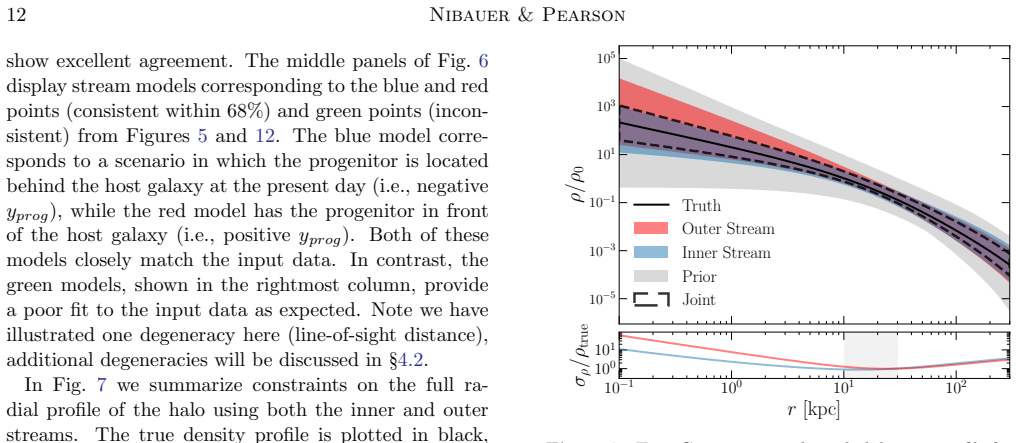
The authors show that multiple stellar streams can be used to constrain the entire radial density profile of a halo, including both its inner and outer density slopes. They achieve this with a generative approach that creates large numbers of stream realizations in varying trial potentials using GPU-accelerated simulations and fits the models to observations via nested sampling with a custom objective function.
What carries the argument
X-Stream, a generative model that produces thousands of stream realizations in trial gravitational potentials and uses nested sampling to identify density profiles consistent with observed stream morphologies.
Load-bearing premise
The gravitational potential is static and the shapes of the streams are set mainly by the dark matter density profile rather than by baryons or time changes in the potential.
What would settle it
Independent measurements of the same galaxy's halo density profile, for example from satellite kinematics or weak lensing, that disagree with the inner or outer slopes inferred from the streams at high statistical significance.
Figures




read the original abstract
Upcoming ground and space-based surveys are poised to illuminate low surface brightness tidal features, providing a new observable connection to dark matter physics. From imaging of tidal debris, the morphology of stellar streams can be used to infer the geometry of dark matter halos. In this paper, we develop a generative approach, X-Stream, which translates stream imaging into constraints on the radial density profile of dark matter halos--from the inner region out to the virial radius. Using the GPU-accelerated code streamsculptor, we generate thousands of stream realizations in trial gravitational potentials and apply nested sampling with a custom objective function to explore viable regions of parameter space. We find that multiple stellar streams can be used to constrain the entire radial density profile of a halo, including both its inner and outer density slopes. These constraints provide a test for alternatives to cold dark matter, such as self-interacting dark matter, which predicts cored density profiles. From cosmological simulations, the outer density slope is expected to correlate with merger histories though remains underexplored observationally. With ongoing and upcoming missions such as Euclid, the Rubin Observatory, ARRAKIHS, and the Nancy Grace Roman Space Telescope, X-Stream will enable detailed mapping of dark matter for thousands of galaxies across a wide range of redshifts and halo masses.
Editorial analysis
A structured set of objections, weighed in public.
Referee Report
Summary. The manuscript introduces X-Stream, a generative framework that employs the GPU-accelerated streamsculptor code to produce thousands of stellar stream realizations in trial gravitational potentials, followed by nested sampling with a custom objective function to infer the inner and outer slopes of dark matter halo density profiles from extragalactic stream imaging. The central claim is that multiple streams can constrain the full radial density profile, providing tests for alternatives to cold dark matter such as self-interacting dark matter.
Significance. If validated, the approach would supply a new observational route to map dark matter density profiles across a wide range of halo masses and redshifts using upcoming surveys (Euclid, Rubin, Roman), with particular value for distinguishing cored versus cuspy profiles and linking outer slopes to merger histories. The use of established simulation tools and nested sampling is a clear methodological strength.
major comments (3)
- [Abstract] Abstract: The claim that multiple stellar streams constrain both the inner and outer density slopes is not yet load-bearing without explicit demonstration that stream morphology in the generative model retains sensitivity to the inner halo (e.g., cusp/core) when streams orbit at large galactocentric radii typical of extragalactic detections.
- [Methods] Methods/Results: No recovery tests on mock data with known input profiles are reported, leaving the accuracy of the nested-sampling constraints on the two free parameters (inner and outer slopes) unquantified and weakening support for the central claim.
- [Assumptions] Assumptions section: The static-potential approximation and neglect of baryonic or time-dependent effects are load-bearing for the inner-slope constraints; a concrete test (e.g., comparison runs with live potentials) is needed to show that recovered inner slopes are driven by data rather than model assumptions.
minor comments (2)
- [Methods] Clarify the precise form of the custom objective function used in the nested sampling step and its relation to the streamsculptor output metrics.
- [Discussion] Add a brief discussion of how the method scales to the thousands of galaxies expected from future surveys, including computational cost estimates.
Simulated Author's Rebuttal
We thank the referee for their constructive and detailed report. The comments identify important areas for strengthening the manuscript, particularly around explicit demonstrations of sensitivity and validation. We address each major comment below and describe the revisions we will implement.
read point-by-point responses
-
Referee: [Abstract] Abstract: The claim that multiple stellar streams constrain both the inner and outer density slopes is not yet load-bearing without explicit demonstration that stream morphology in the generative model retains sensitivity to the inner halo (e.g., cusp/core) when streams orbit at large galactocentric radii typical of extragalactic detections.
Authors: We agree that an explicit demonstration is needed to show that the generative model retains sensitivity to the inner halo slope for streams at large galactocentric radii. Although the full radial potential is used throughout and the nested sampling explores the joint parameter space, we did not isolate this effect with a dedicated test in the submitted version. In the revised manuscript we will add a new analysis subsection and accompanying figure that varies only the inner slope (while holding outer parameters fixed) for mock streams with large apocenters and quantifies the resulting morphological changes. This will make the claim load-bearing. revision: yes
-
Referee: [Methods] Methods/Results: No recovery tests on mock data with known input profiles are reported, leaving the accuracy of the nested-sampling constraints on the two free parameters (inner and outer slopes) unquantified and weakening support for the central claim.
Authors: The referee is correct that recovery tests on mock data with known input profiles are required to quantify the accuracy and any biases in the recovered inner and outer slopes. We omitted these tests in the initial submission to focus on framework development. We will add a dedicated recovery-test section in the revised manuscript, generating mock streams from known density profiles, running the full X-Stream pipeline, and reporting recovered parameters, uncertainties, and performance metrics. This will directly support the central claim. revision: yes
-
Referee: [Assumptions] Assumptions section: The static-potential approximation and neglect of baryonic or time-dependent effects are load-bearing for the inner-slope constraints; a concrete test (e.g., comparison runs with live potentials) is needed to show that recovered inner slopes are driven by data rather than model assumptions.
Authors: We acknowledge that the static-potential approximation is load-bearing for the inner-slope results. A full set of live-potential comparison runs across the entire nested-sampling ensemble is computationally prohibitive at present. In the revised manuscript we will expand the Assumptions section with additional justification, references to the literature on static approximations for stream modeling, and a limited sensitivity test using a small number of live-potential realizations. We will also explicitly flag dynamic-potential modeling as future work. revision: partial
Circularity Check
No significant circularity; standard forward-modeling inference
full rationale
The paper's derivation chain consists of generating stream realizations via streamsculptor in trial gravitational potentials, then using nested sampling with a custom objective function to infer radial density profile parameters (inner and outer slopes) from stream morphology data. This is a conventional simulation-based inference procedure in which the claimed constraints emerge from comparing model outputs to observations rather than from any self-referential definition, renaming of fitted quantities as predictions, or load-bearing self-citation. No equations or steps in the abstract or described method reduce the target result to the inputs by construction; the sensitivity of stream morphology to the full potential is an empirical outcome of the generative setup, not an imposed equivalence. The approach remains self-contained against external benchmarks such as mock data tests.
Axiom & Free-Parameter Ledger
free parameters (2)
- inner density slope
- outer density slope
axioms (1)
- domain assumption Stellar stream morphology is a direct tracer of the underlying gravitational potential set by the dark matter halo.
Lean theorems connected to this paper
-
IndisputableMonolith/Cost/FunctionalEquation.leanwashburn_uniqueness_aczel unclear?
unclearRelation between the paper passage and the cited Recognition theorem.
We develop a generative approach, X-Stream, which translates stream imaging into constraints on the radial density profile... using the GPU-accelerated code streamsculptor... nested sampling with a custom objective function
-
IndisputableMonolith/Foundation/AlexanderDuality.leanalexander_duality_circle_linking unclear?
unclearRelation between the paper passage and the cited Recognition theorem.
density profiles of the form ρ(r) = ρ0 / (r/rs)^γ (1+r/rs)^(β-γ) ...
What do these tags mean?
- matches
- The paper's claim is directly supported by a theorem in the formal canon.
- supports
- The theorem supports part of the paper's argument, but the paper may add assumptions or extra steps.
- extends
- The paper goes beyond the formal theorem; the theorem is a base layer rather than the whole result.
- uses
- The paper appears to rely on the theorem as machinery.
- contradicts
- The paper's claim conflicts with a theorem or certificate in the canon.
- unclear
- Pith found a possible connection, but the passage is too broad, indirect, or ambiguous to say the theorem truly supports the claim.
Reference graph
Works this paper leans on
-
[1]
2024, ApJ, 962, 151, doi: 10.3847/1538-4357/ad159c
Aganze, C., Pearson, S., Starkenburg, T., et al. 2024, ApJ, 962, 151, doi: 10.3847/1538-4357/ad159c
-
[2]
Amorisco, N. C. 2015, MNRAS, 450, 575, doi: 10.1093/mnras/stv648
-
[3]
Arora, A., Sanderson, R. E., Panithanpaisal, N., et al. 2022, ApJ, 939, 2, doi: 10.3847/1538-4357/ac93fb
-
[4]
Arora, A., Garavito-Camargo, N., Sanderson, R. E., et al. 2025, ApJ, 988, 190, doi: 10.3847/1538-4357/ade30d Astropy Collaboration, Robitaille, T. P., Tollerud, E. J., et al. 2013, A&A, 558, A33, doi: 10.1051/0004-6361/201322068 Astropy Collaboration, Price-Whelan, A. M., Sip˝ ocz, B. M., et al. 2018, AJ, 156, 123, doi: 10.3847/1538-3881/aabc4f
-
[5]
Avila-Reese, V., Firmani, C., Klypin, A., & Kravtsov, A. V. 1999, MNRAS, 310, 527, doi: 10.1046/j.1365-8711.1999.02968.x
-
[6]
Belokurov, V., Koposov, S. E., Evans, N. W., et al. 2014, MNRAS, 437, 116, doi: 10.1093/mnras/stt1862
-
[7]
2008, Galactic Dynamics: Second Edition
Binney, J., & Tremaine, S. 2008, Galactic Dynamics: Second Edition
work page 2008
-
[8]
Bonaca, A., & Hogg, D. W. 2018, ApJ, 867, 101, doi: 10.3847/1538-4357/aae4da
-
[9]
Bonaca, A., & Price-Whelan, A. M. 2025, NewAR, 100, 101713, doi: 10.1016/j.newar.2024.101713
-
[10]
Bovy, J., Bahmanyar, A., Fritz, T. K., & Kallivayalil, N. 2016, ApJ, 833, 31, doi: 10.3847/1538-4357/833/1/31
-
[11]
2018, JAX: composable transformations of Python+NumPy programs, 0.3.13
Bradbury, J., Frostig, R., Hawkins, P., et al. 2018, JAX: composable transformations of Python+NumPy programs, 0.3.13. http://github.com/jax-ml/jax
work page 2018
-
[12]
Brooks, R. A. N., Garavito-Camargo, N., Johnston, K. V., et al. 2025, ApJ, 978, 79, doi: 10.3847/1538-4357/ad93a7
-
[13]
Buist, H. J. T., & Helmi, A. 2015, A&A, 584, A120, doi: 10.1051/0004-6361/201526203
-
[14]
Bullock, J. S., & Boylan-Kolchin, M. 2017, ARA&A, 55, 343, doi: 10.1146/annurev-astro-091916-055313
-
[15]
Bullock, J. S., & Johnston, K. V. 2005, ApJ, 635, 931, doi: 10.1086/497422
-
[16]
Carlin, J. L., Sand, D. J., Price, P., et al. 2016, ApJL, 828, L5, doi: 10.3847/2041-8205/828/1/L5
-
[17]
Carlin, J. L., Garling, C. T., Peter, A. H. G., et al. 2019, ApJ, 886, 109, doi: 10.3847/1538-4357/ab4c32
-
[18]
Cole, D. R., Dehnen, W., Read, J. I., & Wilkinson, M. I. 2012, MNRAS, 426, 601, doi: 10.1111/j.1365-2966.2012.21885.x Crnojevi´ c, D., Sand, D. J., Spekkens, K., et al. 2016, ApJ, 823, 19, doi: 10.3847/0004-637X/823/1/19
-
[19]
Diemer, B., & Kravtsov, A. V. 2014, ApJ, 789, 1, doi: 10.1088/0004-637X/789/1/1
-
[20]
Price-Whelan, A. M. 2022, MNRAS, 516, 1685, doi: 10.1093/mnras/stac2311
-
[21]
Dubinski, J., & Carlberg, R. G. 1991, ApJ, 378, 496, doi: 10.1086/170451
-
[22]
Erkal, D., Sanders, J. L., & Belokurov, V. 2016, MNRAS, 461, 1590, doi: 10.1093/mnras/stw1400
-
[23]
Erkal, D., Belokurov, V., Laporte, C. F. P., et al. 2019, MNRAS, 487, 2685, doi: 10.1093/mnras/stz1371 Euclid Collaboration: Laigle, C., Gouin, C., Sarron, F., et al. 2025, arXiv e-prints, arXiv:2503.15333, doi: 10.48550/arXiv.2503.15333
-
[24]
Fardal, M. A., Huang, S., & Weinberg, M. D. 2015, MNRAS, 452, 301, doi: 10.1093/mnras/stv1198
-
[25]
Fardal, M. A., Weinberg, M. D., Babul, A., et al. 2013, MNRAS, 434, 2779, doi: 10.1093/mnras/stt1121
-
[26]
Fielder, C. E., Sand, D. J., Jones, M. G., et al. 2025, ApJL, 982, L41, doi: 10.3847/2041-8213/adbf17
-
[27]
Flores, R. A., & Primack, J. R. 1994, ApJL, 427, L1, doi: 10.1086/187350
-
[28]
Frenk, C. S., White, S. D. M., Davis, M., & Efstathiou, G. 1988, ApJ, 327, 507, doi: 10.1086/166213
-
[29]
2004, MNRAS, 348, 1355, doi: 10.1111/j.1365-2966.2004.07453.x
Gentile, G., Salucci, P., Klein, U., Vergani, D., & Kalberla, P. 2004, MNRAS, 351, 903, doi: 10.1111/j.1365-2966.2004.07836.x
-
[30]
Goerdt, T., Moore, B., Read, J. I., Stadel, J., & Zemp, M. 2006, MNRAS, 368, 1073, doi: 10.1111/j.1365-2966.2006.10182.x
-
[31]
2022, in EAS2022, European Astronomical Society Annual Meeting, 1507
Guzman, R., G´ omez-Flechoso, M., Mart´ ınez-Delgado, D., et al. 2022, in EAS2022, European Astronomical Society Annual Meeting, 1507
work page 2022
-
[32]
2025, arXiv e-prints, arXiv:2503.15589, doi: 10.48550/arXiv.2503.15589
Hainje, C., Slone, O., Lisanti, M., & Erkal, D. 2025, arXiv e-prints, arXiv:2503.15589, doi: 10.48550/arXiv.2503.15589
-
[33]
2025, arXiv e-prints, arXiv:2507.22155, doi: 10.48550/arXiv.2507.22155
Hayashi, K., Kaneda, Y., Mori, M., & Shinozaki, M. 2025, arXiv e-prints, arXiv:2507.22155, doi: 10.48550/arXiv.2507.22155
-
[34]
Hendel, D., & Johnston, K. V. 2015, MNRAS, 454, 2472, doi: 10.1093/mnras/stv2035
-
[35]
Hui, L., Ostriker, J. P., Tremaine, S., & Witten, E. 2017, PhRvD, 95, 043541, doi: 10.1103/PhysRevD.95.043541
-
[36]
2001, Nature, 412, 49, doi: 10.1038/35083506
Tanvir, N. 2001, Nature, 412, 49, doi: 10.1038/35083506
-
[37]
Ivezic, Z., Axelrod, T., Brandt, W. N., et al. 2008, Serbian Astronomical Journal, 176, 1, doi: 10.2298/SAJ0876001I Ivezi´ c,ˇZ., Kahn, S. M., Tyson, J. A., et al. 2019, ApJ, 873, 111, doi: 10.3847/1538-4357/ab042c
-
[38]
Jing, Y. P., & Suto, Y. 2002, ApJ, 574, 538, doi: 10.1086/341065 23
-
[39]
Johnston, K. V. 1998, ApJ, 495, 297, doi: 10.1086/305273
-
[40]
Johnston, K. V., Sackett, P. D., & Bullock, J. S. 2001, ApJ, 557, 137, doi: 10.1086/321644
-
[41]
Kado-Fong, E., Greene, J. E., Hendel, D., et al. 2018, ApJ, 866, 103, doi: 10.3847/1538-4357/aae0f0
-
[42]
Kawata, D., & Gibson, B. K. 2003, MNRAS, 340, 908, doi: 10.1046/j.1365-8711.2003.06356.x
-
[43]
Kazantzidis, S., Abadi, M. G., & Navarro, J. F. 2010, ApJL, 720, L62, doi: 10.1088/2041-8205/720/1/L62
-
[44]
Koposov, S. E., Rix, H.-W., & Hogg, D. W. 2010, ApJ, 712, 260, doi: 10.1088/0004-637X/712/1/260
-
[45]
Koposov, S. E., Erkal, D., Li, T. S., et al. 2023, MNRAS, 521, 4936, doi: 10.1093/mnras/stad551
-
[46]
Kullback, S., & Leibler, R. A. 1951, The Annals of Mathematical Statistics, 22, 79, doi: 10.1214/aoms/1177729694 K¨ upper, A. H. W., Balbinot, E., Bonaca, A., et al. 2015, ApJ, 803, 80, doi: 10.1088/0004-637X/803/2/80 K¨ upper, A. H. W., Lane, R. R., & Heggie, D. C. 2012, MNRAS, 420, 2700, doi: 10.1111/j.1365-2966.2011.20242.x
-
[47]
Lange, J. U. 2023, Monthly Notices of the Royal Astronomical Society, 525, 3181, doi: 10.1093/mnras/stad2441
-
[48]
Law, D. R., & Majewski, S. R. 2010, ApJ, 714, 229, doi: 10.1088/0004-637X/714/1/229
-
[49]
Lelli, F., McGaugh, S. S., & Schombert, J. M. 2016, AJ, 152, 157, doi: 10.3847/0004-6256/152/6/157
-
[50]
Lilleengen, S., Petersen, M. S., Erkal, D., et al. 2023, MNRAS, 518, 774, doi: 10.1093/mnras/stac3108 Macci` o, A. V., Paduroiu, S., Anderhalden, D., Schneider, A., & Moore, B. 2012, MNRAS, 424, 1105, doi: 10.1111/j.1365-2966.2012.21284.x
-
[51]
1997, PASA, 14, 52, doi: 10.1071/AS97052 Mart´ ınez-Delgado, D., Pe˜ narrubia, J., Gabany, R
Malin, D., & Hadley, B. 1997, PASA, 14, 52, doi: 10.1071/AS97052 Mart´ ınez-Delgado, D., Pe˜ narrubia, J., Gabany, R. J., et al. 2008, ApJ, 689, 184, doi: 10.1086/592555 Mart´ ınez-Delgado, D., Romanowsky, A. J., Gabany, R. J., et al. 2012, ApJL, 748, L24, doi: 10.1088/2041-8205/748/2/L24 Mart´ ınez-Delgado, D., Cooper, A. P., Rom´ an, J., et al. 2023, A&...
-
[52]
McConnachie, A. W., Irwin, M. J., Ibata, R. A., et al. 2009, Nature, 461, 66, doi: 10.1038/nature08327 Mir´ o-Carretero, J., Mart´ ınez-Delgado, D., G´ omez-Flechoso, M. A., et al. 2024a, A&A, 691, A196, doi: 10.1051/0004-6361/202451685 —. 2024b, A&A, 691, A196, doi: 10.1051/0004-6361/202451685
-
[53]
2024, arXiv e-prints, arXiv:2409.03585, doi: 10.48550/arXiv.2409.03585
Martinez-Delgado, D., et al. 2024, arXiv e-prints, arXiv:2409.03585, doi: 10.48550/arXiv.2409.03585
- [54]
-
[55]
1994, Nature, 370, 629, doi: 10.1038/370629a0
Moore, B. 1994, Nature, 370, 629, doi: 10.1038/370629a0
-
[56]
Navarro, J. F., Frenk, C. S., & White, S. D. M. 1996, ApJ, 462, 563, doi: 10.1086/177173 —. 1997, ApJ, 490, 493, doi: 10.1086/304888
-
[57]
2023, PhRvD, 107, 043015, doi: 10.1103/PhysRevD.107.043015
Nguyen, T., Mishra-Sharma, S., Williams, R., & Necib, L. 2023, PhRvD, 107, 043015, doi: 10.1103/PhysRevD.107.043015
-
[58]
2022, ApJ, 940, 22, doi: 10.3847/1538-4357/ac93ee
Ho, S. 2022, ApJ, 940, 22, doi: 10.3847/1538-4357/ac93ee
-
[59]
2025, arXiv e-prints, arXiv:2504.07187, doi: 10.48550/arXiv.2504.07187
Nibauer, J., & Bonaca, A. 2025, arXiv e-prints, arXiv:2504.07187, doi: 10.48550/arXiv.2504.07187
-
[60]
Nibauer, J., Bonaca, A., & Johnston, K. V. 2023, ApJ, 954, 195, doi: 10.3847/1538-4357/ace9bc
-
[61]
2024, ApJ, 969, 55, doi: 10.3847/1538-4357/ad4299
Nibauer, J., Bonaca, A., Lisanti, M., Erkal, D., & Hastings, Z. 2024, ApJ, 969, 55, doi: 10.3847/1538-4357/ad4299
-
[62]
Nibauer, J., Bonaca, A., Spergel, D. N., et al. 2025, ApJ, 983, 68, doi: 10.3847/1538-4357/adb8e8
-
[63]
Oh, S.-H., Hunter, D. A., Brinks, E., et al. 2015, AJ, 149, 180, doi: 10.1088/0004-6256/149/6/180
-
[64]
Oman, K. A., Navarro, J. F., Fattahi, A., et al. 2015, MNRAS, 452, 3650, doi: 10.1093/mnras/stv1504
-
[65]
Pearson, S., Clark, S. E., Demirjian, A. J., et al. 2022a, ApJ, 926, 166, doi: 10.3847/1538-4357/ac4496
-
[66]
Price-Whelan, A. M. 2015, ApJ, 799, 28, doi: 10.1088/0004-637X/799/1/28
-
[67]
Pearson, S., Price-Whelan, A. M., Hogg, D. W., et al. 2022b, ApJ, 941, 19, doi: 10.3847/1538-4357/ac9bfb
-
[68]
Pearson, S., Starkenburg, T. K., Johnston, K. V., et al. 2019, ApJ, 883, 87, doi: 10.3847/1538-4357/ab3e06
-
[69]
Pineda, J. C. B., Hayward, C. C., Springel, V., & Mendes de Oliveira, C. 2017, MNRAS, 466, 63, doi: 10.1093/mnras/stw3004
-
[70]
Price-Whelan, A. M. 2017, The Journal of Open Source Software, 2, doi: 10.21105/joss.00388
-
[71]
D., Laureijs, R., Stagnaro, L., et al
Racca, G. D., Laureijs, R., Stagnaro, L., et al. 2016, in Society of Photo-Optical Instrumentation Engineers (SPIE) Conference Series, Vol. 9904, Space Telescopes and Instrumentation 2016: Optical, Infrared, and Millimeter Wave, ed. H. A. MacEwen, G. G. Fazio, M. Lystrup, N. Batalha, N. Siegler, & E. C. Tong, 99040O, doi: 10.1117/12.2230762
-
[72]
I., Iorio, G., Agertz, O., & Fraternali, F
Read, J. I., Iorio, G., Agertz, O., & Fraternali, F. 2017, MNRAS, 467, 2019, doi: 10.1093/mnras/stx147
-
[73]
H., Basu, K., Ettori, S., et al
Reiprich, T. H., Basu, K., Ettori, S., et al. 2013, SSRv, 177, 195, doi: 10.1007/s11214-013-9983-8 24Nibauer & Pearson
-
[74]
Sanders, J. L., & Binney, J. 2013, MNRAS, 433, 1813, doi: 10.1093/mnras/stt806
-
[75]
Sanderson, R. E., Helmi, A., & Hogg, D. W. 2015, ApJ, 801, 98, doi: 10.1088/0004-637X/801/2/98
-
[76]
2021, The Astrophysical Journal, 923, 149, doi: 10.3847/1538-4357/ac2e93
Shipp, N., Erkal, D., Drlica-Wagner, A., et al. 2021, ApJ, 923, 149, doi: 10.3847/1538-4357/ac2e93
-
[77]
Wide-Field InfrarRed Survey Telescope-Astrophysics Focused Telescope Assets WFIRST-AFTA 2015 Report
Spergel, D., Gehrels, N., Baltay, C., et al. 2015, arXiv e-prints, arXiv:1503.03757, doi: 10.48550/arXiv.1503.03757
work page internal anchor Pith review Pith/arXiv arXiv doi:10.48550/arxiv.1503.03757 2015
-
[78]
Spergel, D. N., & Steinhardt, P. J. 2000, PhRvL, 84, 3760, doi: 10.1103/PhysRevLett.84.3760
-
[79]
C., Boylan-Kolchin, M., Bullock, J
Straight, M. C., Boylan-Kolchin, M., Bullock, J. S., et al. 2025, arXiv e-prints, arXiv:2501.16602, doi: 10.48550/arXiv.2501.16602
-
[80]
E., Kaplinghat, M., & Bullock, J
Strigari, L. E., Kaplinghat, M., & Bullock, J. S. 2007, PhRvD, 75, 061303, doi: 10.1103/PhysRevD.75.061303
discussion (0)
Sign in with ORCID, Apple, or X to comment. Anyone can read and Pith papers without signing in.