REVIEW 3 major objections 6 minor 50 references
Learning Causal Structure Distributions for Robust Planning
T0 review · 3 major / 6 minor · reviewed 2026-08-05 · deepseek-v4-flash
Pith's one-line read The paper claims that a robot's learned dynamics model is more robust to sensor failure and dynamics changes when it samples causal masks from a distribution over structures rather than relying on a single causal graph.
desk verdict The method is a cheap, genuinely robust latent-masking trick, but the causal mechanism is unproven — the paper deserves review for the empirics, not the causal framing. read the letter →
The pith
A machine-rendered reading of the paper's core claim, the machinery that carries it, and where it could break.
The reading
What carries the argument
The load-bearing object is the causal structure distribution $P(p)$, a product of independent Bernoulli variables $E_{ij}$ indicating an edge from input $i$ to next-state variable $j$. Its parameters are set to normalized Integrated Gradients, $p_{ij} := \mathrm{IG}_{ij}(x, x'=0; f_C)$, clipped to $[\rho_{\min}, 1-\rho_{\min}]$, so feature attribution stands in for causal discovery. Every forward call samples a mask $M \sim P(p)$ and applies it in the latent space, $\tilde{z}_j = z \odot m_{:,j}$, before a per-output decoder produces a Gaussian over the next state. This turns structural uncertainty into a cheap training-time regularizer and an inference-time marginalization.
What would settle it
On a system with a known causal graph, compare CADY's behavior under three mask sources: Integrated-Gradient estimates, the ground-truth graph, and uniform random masks with matched sparsity. If random masks match IG masks in robustness, the causal estimator is not carrying the result; if ground-truth masks do not beat IG masks, the structure distribution itself is not the cause. A second check: rescale one input feature by a constant and see whether p_ij shifts; IG is sensitive to scaling, so a causally meaningful estimator should not arbitrarily flip the masks.
Extended reading notes
Core claim
The discovery is that uncertainty over causal structure, not just over function parameters, belongs inside a learned dynamics model. CADY represents the dynamics as $f(x) = f_{\mathrm{dec}}(f_{\mathrm{enc}}(x) \odot M)$ with $M \sim P(p)$, where $P$ is a product of independent Bernoulli edge distributions over the bipartite graphs allowed by the Markovian state-transition assumption. Each $p_{ij}$ is estimated as a normalized, clipped Integrated Gradient of a fully-wired contribution model, and every forward pass draws a fresh causal mask. In experiments this marginalization over plausible structures yields up to 13% lower performance degradation under frozen or noisy sensors, one-step post-
Load-bearing premise
The load-bearing premise is that Integrated Gradients on a fully-wired network trained on the same observational data yield valid edge probabilities for a causal structure distribution; if attribution values do not track true causal effects, the masks can drop predictive features or keep spurious ones and the claimed mechanism collapses.
Editorial extensions
If this is right
- A dynamics model that samples causal masks at inference time degrades 1.6-13% less than PETS when a sensor freezes or becomes noisy, with the gap growing in higher-dimensional systems.
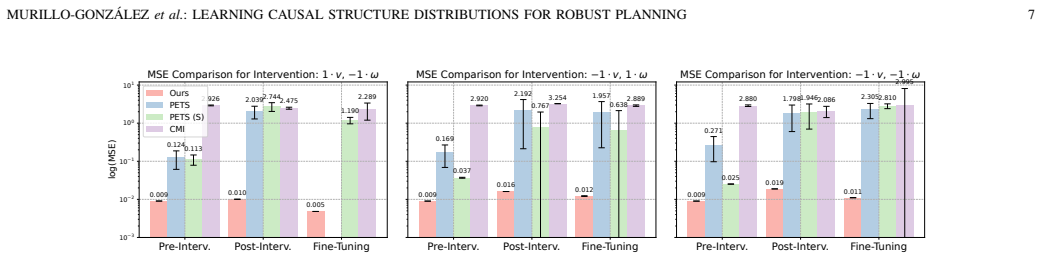
- Under an unmodeled control-gain intervention, CADY's one-step prediction error is 0.124 versus 2.039 for PETS, and fine-tuning on recent data recovers faster.
- On the Jackal ground vehicle under GPS-like state noise (variance 0.01), mission success rises to 85.7% from PETS's 55.7%; on a steep mountain mission, CADY keeps 27% success where PETS falls to 2.8%.
- Marginalizing over a distribution of structures rather than fixing one graph improves performance by 3.2% on Cartpole and 5.8% on Pusher.
- CADY uses 20x fewer FLOPs and parameters than PETS on Pusher and more than 250x fewer on Jackal, including the cost of sampling the mask.
Reading between the lines
- If the mechanism is general, the same encoder-multidecoder plus Bernoulli-mask recipe could apply to any controlled dynamical system with sparse interactions, not just robots.
- A natural testable extension is to replace the Integrated-Gradients estimator with a proper Bayesian structure-learning method; if the robustness gains survive that swap, the architecture is the contribution and the attribution estimator is incidental.
- The authors' own Cartpole sanity check shows one mismatched edge ($\dot{\theta}_t \to \dot{x}_{t+1}$); intervening on that specific edge would be a sharper test of whether the estimated masks track true causal structure.
Editorial analysis
A structured set of objections, weighed in public.
Referee Report
Summary. The paper proposes CADY, a probabilistic encoder-multidecoder dynamics model that masks its latent features with binary matrices sampled from a learned distribution over causal structures. The structure distribution is estimated by computing Integrated Gradients on a separately trained 'fully wired' network and normalizing the attributions to Bernoulli probabilities (Eqs. 3–4). The authors argue that marginalizing over structural uncertainty yields dynamics models that are more robust to missing/noisy observations and unexpected interventions, while using far fewer parameters and FLOPs than PETS. Experiments cover Cartpole, Pusher, and a Jackal ground vehicle in simulation and the real world, with robustness, intervention, and computational-cost evaluations.
Significance. If the causal-structure claim is substantiated, the paper offers a computationally cheap alternative to causal discovery for improving model-based planning robustness. The empirical evaluation is genuinely broad and includes several well-designed controls: held-out noise and missing-feature tests, a parameter-count control PETS(S) in the intervention study, and a real-world zero-shot deployment. The reported gains are large (e.g., Jackal Mission 1 success 85.7% vs. 55.7% at noise variance 0.01; post-intervention one-step MSE 0.124 vs. 2.039) and the computational savings are substantial. However, the central mechanism—that the Integrated-Gradients-derived mask probabilities carry causal information—is not isolated from generic stochastic masking or feature selection, so the paper's headline causal explanation remains conditional on additional controls.
major comments (3)
- [Section IV-A, Eqs. (3)–(4)] The causal structure distribution p_ij is defined as normalized Integrated Gradients of a network f_C trained on the same observational dataset D used to train the dynamics model. As the paper itself states, 'IG was not designed as a causality test.' The only ground-truth validation is the Cartpole comparison in Fig. 6, which visibly underestimates the θ̇→ẋ edge and is in the same environment used for training. The central claim that masks sampled from P(p) are 'causally informed' is thus not yet established. A concrete test: compare CADY's performance against the same architecture with (i) uniform p=0.5, (ii) p with shuffled entries, and (iii) IG computed from a model trained on label-randomized data. If these controls perform comparably, the gains are due to stochastic masking/regularization, not causal structure. This is load-bearing for the abstract's causal claim and must be address
- [Section V-D, fixed-graph ablation] The ablation showing that resampling from the learned p improves performance over a fixed graph is presented as evidence for the value of structural uncertainty. However, the fixed graph is presumably derived from p itself, and the comparison conflates the specific learned probabilities with the effect of stochastic mask sampling. Without a uniform-p or shuffled-p control, the result cannot distinguish causal information from generic mask diversity. The paper should report the fixed-graph result alongside the proposed uniform/shuffled controls, and clarify how the 'fixed graph' is selected (threshold, most-likely edge, etc.).
- [Section V-B, Fig. 6] The structural validation is limited to a single environment (Cartpole) and even there the estimated distribution misses the true θ̇→ẋ edge with low probability. For Pusher and Jackal no ground-truth structure is provided at all, yet the robustness narrative depends on the masks being causally meaningful in those settings. If the causal claim is retained, the authors should either provide structural validation in at least one more environment or show that the missing edge is not load-bearing for the robustness results. Alternatively, the text should be revised to characterize the masks as 'predictive-feature masks' rather than causal structures, with the causal terminology softened accordingly.
minor comments (6)
- [Section IV-A, Eq. (4)] The smoothing function s(·) and the clipping bound ρ_min are introduced in Eq. (4) but only defined in Section V-A ('cubic root' and 0.02). Define them at first use for clarity.
- [Section V-A, Baselines] PETS(S) is first mentioned in Fig. 10 but not defined in the baselines list; please define it explicitly (presumably 'PETS with reduced parameters') at first occurrence.
- [Fig. 6] The figure caption says the ground truth is for the state delta, but the text 'the figure does not show the ∆ symbol for ease of visualization' appears only in the body; please state this in the caption to prevent misinterpretation of the x_t → x_{t+1} relation.
- [References] Reference [25] appears in the bibliography between [24] and [26] but is not in numeric order in the text citation sequence; please reorder or renumber.
- [Table I] The parameter counts for CADY are very small (e.g., 230 for Cartpole). It would help to report the architecture breakdown (encoder/decoder sizes) or at least confirm that these counts include all trainable parameters.
- [Throughout] Minor typos: 'FLOPS' vs. 'FLOPs' is inconsistent; 'P(pD)' in Section IV-B is used before defining p_D. Please proofread notation consistency.
Circularity Check
No significant circularity: the IG-based structure estimate is a fixed modeling input, and the robustness results are measured on held-out conditions rather than re-derived from the fitted p.
full rationale
The paper's central derivation chain is not circular. The causal structure distribution P(p) is computed by a fixed formula (Eqs. 3-4) from the Integrated Gradients of a separately trained contribution model f_C on dataset D, and then used to sample masks for the dynamics model f_D. This is a modeling choice, not a reduction of the output to the input: the claimed robustness gains are measured on corrupted inputs, interventions, and held-out post-intervention conditions, and these measurements are not used to define p. The paper explicitly acknowledges a validity caveat in Section IV-A: 'Although IG was not designed as a causality test, we use it to estimate the likelihood of each feature being a cause in the underlying SCM.' That caveat concerns whether the attributions track true causal effects, which is a correctness/validity concern rather than a circularity concern. Similarly, the acknowledged mismatch in Fig. 6 (the theta-dot to x-dot edge) is an empirical validation failure, not a logical circularity. The only self-citation is reference [37] for the general statement that observational data can exhibit bias, which is not load-bearing for any core claim. A missing control (e.g., uniform p=0.5 or shuffled p) would be an ablation/comparison weakness, but it does not make the derivation circular. Therefore the paper is self-contained with respect to the circularity-specific failure modes considered here.
Assumptions & free parameters
free parameters (6)
- rho_min =
0.02
- smoothing function s(.) =
cubic root
- causal structure parameters p_D =
estimated via IG, initialized at 0.5
- batch size =
8
- decoder hidden sizes =
3, 13, 20 (Cartpole, Pusher, Jackal)
- planner hyperparameters (CEM alpha, elite ratio; MPPI gamma, sigma, beta) =
0.1, 0.1; 0.9, 0.01, 0.6
assumptions (6)
- ad hoc to paper Integrated Gradients attributions of a fully-wired network f_C trained on observational data D approximate the probabilities of true causal edges in the robot's SCM (Section IV-A: p_ij := IG_ij(x, x'; M), Eq. 3).
- domain assumption The dynamics causal graph is bipartite and Markovian: edges exist only from (s_t, a_t) to s_{t+1} (Section IV-A, 'Bounding the SCM Search Space').
- domain assumption Edge indicators E_ij are independent Bernoulli variables; the joint PMF factorizes (Eq. 1-2).
- domain assumption The null input x' = 0 satisfies M(x') ≈ 0 and is therefore a valid no-cause baseline for Integrated Gradients (Section III-B, used in Eq. 3).
- standard math Each decoder outputs a Gaussian over next-state deltas, capturing aleatoric uncertainty (Section IV-B).
- domain assumption The structure distribution estimated during training (from D) remains valid at deployment, in new environments, and under dynamics changes (Section IV-B inference description; Abstract claim of 'new tasks in novel environments').
invented entities (1)
-
Causal structure distribution P(p) over edge indicators E_ij
Cite this review
Pith. "Pith review of Learning Causal Structure Distributions for Robust Planning." pith.science (2026). https://pith.science/paper/W7JZQQK3
@misc{pith2026250806742,
  author       = {Pith},
  title        = {Pith review of: Learning Causal Structure Distributions for Robust Planning},
  year         = {2026},
  howpublished = {\url{https://pith.science/paper/W7JZQQK3}},
  note         = {Machine review of arXiv:2508.06742}
}
read the original abstract
Structural causal models describe how the components of a robotic system interact. They provide both structural and functional information about the relationships that are present in the system. The structural information outlines the variables among which there is interaction. The functional information describes how such interactions work, via equations or learned models. In this paper we find that learning the functional relationships while accounting for the uncertainty about the structural information leads to more robust dynamics models which improves downstream planning, while using significantly lower computational resources. This in contrast with common model-learning methods that ignore the causal structure and fail to leverage the sparsity of interactions in robotic systems. We achieve this by estimating a causal structure distribution that is used to sample causal graphs that inform the latent-space representations in an encoder-multidecoder probabilistic model. We show that our model can be used to learn the dynamics of a robot, which together with a sampling-based planner can be used to perform new tasks in novel environments, provided an objective function for the new requirement is available. We validate our method using manipulators and mobile robots in both simulation and the real-world. Additionally, we validate the learned dynamics' adaptability and increased robustness to corrupted inputs and changes in the environment, which is highly desirable in challenging real-world robotics scenarios. Video: https://youtu.be/X6k5t7OOnNc.
Figures


Figures from the paper (6 more)


Reference graph
Works this paper leans on
-
[1]
Causality
Judea Pearl. Causality. Cambridge university press, 2009
2009
-
[2]
Toward causal representation learning
Bernhard Schölkopf, Francesco Locatello, Stefan Bauer, Nan Rosemary Ke, Nal Kalchbrenner, Anirudh Goyal, and Yoshua Bengio. Toward causal representation learning. Proceedings of the IEEE , 2021
work page 2021
-
[3]
The cross-entropy method for optimization
Zdravko I Botev, Dirk P Kroese, Reuven Y Rubinstein, and Pierre L’Ecuyer. The cross-entropy method for optimization. In Handbook of statistics, volume 31, pages 35–59. Elsevier, 2013
2013
-
[4]
Robust model predictive path integral control: Analysis and performance guarantees
Manan S Gandhi, Bogdan Vlahov, Jason Gibson, Grady Williams, and Evangelos A Theodorou. Robust model predictive path integral control: Analysis and performance guarantees. IEEE RA-L, 2021
work page 2021
-
[5]
Counting unlabeled acyclic digraphs
Robert W Robinson. Counting unlabeled acyclic digraphs. In Combina- torial Mathematics V: Proceedings of the Fifth Australian Conference, Held at the Royal Melbourne Institute of Technology, August 24–26, 1976, pages 28–43. Springer, 1977
work page 1976
-
[6]
Car-despot: Causally-informed online pomdp planning for robots in confounded environments
Ricardo Cannizzaro and Lars Kunze. Car-despot: Causally-informed online pomdp planning for robots in confounded environments. Inter- national Conference on Intelligent Robots and Systems (IROS) , 2023
work page 2023
-
[7]
Causalaf: Causal autoregressive flow for safety-critical driving scenario generation
Wenhao Ding, Haohong Lin, Bo Li, and Ding Zhao. Causalaf: Causal autoregressive flow for safety-critical driving scenario generation. In Conference on Robot Learning , pages 812–823. PMLR, 2023
work page 2023
-
[8]
Causal dynamics learning for task-independent state abstraction
Zizhao Wang, Xuesu Xiao, Zifan Xu, Yuke Zhu, and Peter Stone. Causal dynamics learning for task-independent state abstraction. arXiv preprint arXiv:2206.13452, 2022
arXiv 2022
Show all 50 references
-
[9]
Axiomatic attribution for deep networks
Mukund Sundararajan, Ankur Taly, and Qiqi Yan. Axiomatic attribution for deep networks. In International conference on machine learning , pages 3319–3328. PMLR, 2017
2017
-
[10]
Causal diagrams for empirical research
Judea Pearl. Causal diagrams for empirical research. Biometrik, 1995
1995
-
[11]
Adarl: What, where, and how to adapt in transfer reinforcement learning
Biwei Huang, Fan Feng, Chaochao Lu, Sara Magliacane, and Kun Zhang. Adarl: What, where, and how to adapt in transfer reinforcement learning. In ICLR, 2022
2022
-
[12]
Learning dynamic attribute-factored world models for efficient multi-object reinforcement learning
Fan Feng and Sara Magliacane. Learning dynamic attribute-factored world models for efficient multi-object reinforcement learning. NeurIPS, 2023
2023
-
[13]
Causal structure discovery from distributions arising from mixture dag
Basil Saeed, Snigdha Panigrahi, and Caroline Uhler. Causal structure discovery from distributions arising from mixture dag. In ICML, 2020
2020
-
[14]
An algorithm for fast recovery of sparse causal graphs
Peter Spirtes and Clark Glymour. An algorithm for fast recovery of sparse causal graphs. Social science computer review , 9(1), 1991
1991
-
[15]
Amortized inference for causal structure learning
Lars Lorch, Scott Sussex, Jonas Rothfuss, Andreas Krause, and Bernhard Schölkopf. Amortized inference for causal structure learning. arXiv preprint arXiv:2205.12934, 2022
2022 arXiv
-
[16]
Dagma: Learning dags via m-matrices and a log-determinant acyclicity characterization
Kevin Bello, Bryon Aragam, and Pradeep Ravikumar. Dagma: Learning dags via m-matrices and a log-determinant acyclicity characterization. Advances in Neural Information Processing Systems , 2022
2022
-
[17]
Nonlinear learning method for local causal structures
Xingyu Wu, Yan Zhong, Zhaolong Ling, Jie Yang, Li Li, Weiguo Sheng, and Bingbing Jiang. Nonlinear learning method for local causal structures. Information Sciences, 654:119789, 2024
2024
-
[18]
Learning causal semantic representation for out-of-distribution prediction
Chang Liu, Xinwei Sun, Jindong Wang, Haoyue Tang, Tao Li, Tao Qin, Wei Chen, and Tie-Yan Liu. Learning causal semantic representation for out-of-distribution prediction. Advances in Neural Information Processing Systems, 34:6155–6170, 2021
2021
-
[19]
Invariant causal representation learning for out-of- distribution generalization
Chaochao Lu, Yuhuai Wu, José Miguel Hernández-Lobato, and Bern- hard Schölkopf. Invariant causal representation learning for out-of- distribution generalization. In ICLR, 2021
2021
-
[20]
Causpref: Causal preference learning for out-of-distribution recommendation
Yue He, Zimu Wang, Peng Cui, Hao Zou, Yafeng Zhang, Qiang Cui, and Yong Jiang. Causpref: Causal preference learning for out-of-distribution recommendation. In Proceedings of the ACM Web Conference 2022 , pages 410–421, 2022
2022
-
[21]
Counterfactual data augmentation using locally factored dynamics
Silviu Pitis, Elliot Creager, and Animesh Garg. Counterfactual data augmentation using locally factored dynamics. Advances in Neural Information Processing Systems , 33:3976–3990, 2020
2020
-
[22]
Seeing is not believing: Robust reinforcement learning against spurious correlation
Wenhao Ding, Laixi Shi, Yuejie Chi, and Ding Zhao. Seeing is not believing: Robust reinforcement learning against spurious correlation. NeurIPS, 36:66328–66363, 2023
2023
-
[23]
Mocoda: Model-based counterfactual data augmentation
Silviu Pitis, Elliot Creager, Ajay Mandlekar, and Animesh Garg. Mocoda: Model-based counterfactual data augmentation. Advances in Neural Information Processing Systems , 35:18143–18156, 2022
2022
-
[24]
Online dynamics learning for predictive control with an application to aerial robots
Tom Z Jiahao, Kong Yao Chee, and M Ani Hsieh. Online dynamics learning for predictive control with an application to aerial robots. In Conference on Robot Learning , pages 2251–2261. PMLR, 2023
2023
-
[25]
Dynamic learning from adaptive neural control of robot manipulators with prescribed performance
Min Wang and Anle Yang. Dynamic learning from adaptive neural control of robot manipulators with prescribed performance. IEEE Transactions on Systems, Man, and Cybernetics: Systems , 2017
2017
-
[26]
Dynamics learning with object-centric interaction networks for robot manipulation
Jiayu Wang, Chuxiong Hu, Yunan Wang, and Yu Zhu. Dynamics learning with object-centric interaction networks for robot manipulation. IEEE Access, 2021
2021
-
[27]
Real-time inverse dynamics learning for mus- culoskeletal robots based on echo state gaussian process regression
Christoph Hartmann, Joschka Boedecker, Oliver Obst, Shuhei Ikemoto, and Minoru Asada. Real-time inverse dynamics learning for mus- culoskeletal robots based on echo state gaussian process regression. Robotics: Science and Systems VIII , pages 113–120, 2013
2013
-
[28]
Cascaded gaus- sian processes for data-efficient robot dynamics learning
Sahand Rezaei-Shoshtari, David Meger, and Inna Sharf. Cascaded gaus- sian processes for data-efficient robot dynamics learning. International Conference on Intelligent Robots and Systems , 2019
2019
-
[29]
Introduction to dynamic systems: theory, models, and applications, volume 1
David G Luenberger. Introduction to dynamic systems: theory, models, and applications, volume 1. Wiley New York, 1979
1979
-
[30]
Parameter identification of robot dynamics
Pradeep K Khosla and Takeo Kanade. Parameter identification of robot dynamics. In 1985 24th IEEE CDC , pages 1754–1760. IEEE, 1985
1985
-
[31]
Differential equations, dynamical systems, and linear algebra
Hirsch MH. Differential equations, dynamical systems, and linear algebra. Pure and Appl. Math. , 5, 1974
1974
-
[32]
Bayesian structure learning with generative flow networks
Tristan Deleu, António Góis, Chris Emezue, Mansi Rankawat, Simon Lacoste-Julien, Stefan Bauer, and Yoshua Bengio. Bayesian structure learning with generative flow networks. In Uncertainty in Artificial Intelligence, pages 518–528. PMLR, 2022
2022
-
[33]
Bayesian learning of causal structure and mechanisms with gflownets and variational bayes
Mizu Nishikawa-Toomey, Tristan Deleu, Jithendaraa Subramanian, Yoshua Bengio, and Laurent Charlin. Bayesian learning of causal structure and mechanisms with gflownets and variational bayes. arXiv preprint arXiv:2211.02763, 2022
2022 arXiv
-
[34]
Why did i fail? a causal- based method to find explanations for robot failures
Maximilian Diehl and Karinne Ramirez-Amaro. Why did i fail? a causal- based method to find explanations for robot failures. IEEE Robotics and Automation Letters, 7(4):8925–8932, 2022
2022
-
[35]
Do feature attribution methods correctly attribute features? In Proceedings of the AAAI Conference on Artificial Intelligence , 2022
Yilun Zhou, Serena Booth, Marco Tulio Ribeiro, and Julie Shah. Do feature attribution methods correctly attribute features? In Proceedings of the AAAI Conference on Artificial Intelligence , 2022
2022
-
[36]
The effectiveness of feature attribution methods and its correlation with automatic evaluation scores
Giang Nguyen, Daeyoung Kim, and Anh Nguyen. The effectiveness of feature attribution methods and its correlation with automatic evaluation scores. Advances in Neural Information Processing Systems , 34:26422– 26436, 2021
2021
-
[37]
Causal inference for de-biasing motion estimation from robotic observational data
Junhong Xu, Kai Yin, Jason M Gregory, and Lantao Liu. Causal inference for de-biasing motion estimation from robotic observational data. arXiv preprint arXiv:2210.08679 , 2022
2022 arXiv
-
[38]
Review of causal discovery methods based on graphical models
Clark Glymour, Kun Zhang, and Peter Spirtes. Review of causal discovery methods based on graphical models. Frontiers in genetics , 10:524, 2019
2019
-
[39]
Causal imitation learning with unobserved confounders
Junzhe Zhang, Daniel Kumor, and Elias Bareinboim. Causal imitation learning with unobserved confounders. NeurIPS, 2020
2020
-
[40]
L. E. Dubins. On curves of minimal length with a constraint on average curvature, and with prescribed initial and terminal positions and tangents. American Journal of Mathematics , 79(3):497–516, 1957
1957
-
[41]
Deep reinforcement learning in a handful of trials using probabilistic dynamics models
Kurtland Chua, Roberto Calandra, Rowan McAllister, and Sergey Levine. Deep reinforcement learning in a handful of trials using probabilistic dynamics models. NeurIPS, 2018
2018
-
[42]
An approximate epistemic uncertainty analysis approach in the presence of epistemic and aleatory uncertainties
Eduard Hofer, Martina Kloos, Bernard Krzykacz-Hausmann, Jörg Peschke, and Martin Woltereck. An approximate epistemic uncertainty analysis approach in the presence of epistemic and aleatory uncertainties. Reliability Engineering & System Safety , 77(3):229–238, 2002
2002
-
[43]
Task independent causal state abstraction
Zizhao Wang, Xuesu Xiao, Yuke Zhu, and Peter Stone. Task independent causal state abstraction. In Robot Learning workshop , 2021
2021
-
[44]
Proximal policy optimization algorithms
John Schulman, Filip Wolski, Prafulla Dhariwal, Alec Radford, and Oleg Klimov. Proximal policy optimization algorithms. arXiv:1707.06347, 2017
2017 arXiv
-
[45]
Soft actor-critic: Off-policy maximum entropy deep reinforcement learning with a stochastic actor
Tuomas Haarnoja, Aurick Zhou, Pieter Abbeel, and Sergey Levine. Soft actor-critic: Off-policy maximum entropy deep reinforcement learning with a stochastic actor. In ICML. PMLR, 2018
2018
-
[46]
Addressing function approximation error in actor-critic methods
Scott Fujimoto, Herke Hoof, and David Meger. Addressing function approximation error in actor-critic methods. In ICML. PMLR, 2018
2018
-
[47]
Stable-baselines3: Reliable reinforcement learning implementations
Antonin Raffin, Ashley Hill, Adam Gleave, Anssi Kanervisto, Max- imilian Ernestus, and Noah Dormann. Stable-baselines3: Reliable reinforcement learning implementations. JMLR, 2021
2021
-
[48]
Lambert, and Roberto Calandra
Luis Pineda, Brandon Amos, Amy Zhang, Nathan O. Lambert, and Roberto Calandra. Mbrl-lib: A modular library for model-based re- inforcement learning. Arxiv, 2021
2021
-
[49]
Clearpath additional simulation worlds
Clearpath Robotics. Clearpath additional simulation worlds. https:// github.com/clearpathrobotics/cpr_gazebo, 2020
2020
-
[50]
Neural compression
Matthew Muckley, Jordan Juravsky, Daniel Severo, Mannat Singh, Quentin Duval, and Karen Ullrich. Neural compression. https://github. com/facebookresearch/NeuralCompression
Reviewed August 5, 2026 · model on record in the stance chip above.
Discussion (0). Sign in to comment.