Axion Star Bosenova in Axion Miniclusters
Pith reviewed 2026-05-18 22:41 UTC · model grok-4.3
The pith
For the QCD axion, bosenova occurs within the age of the Universe for miniclusters with initial overdensity δ≳100.
A machine-rendered reading of the paper's core claim, the machinery that carries it, and where it could break.
Core claim
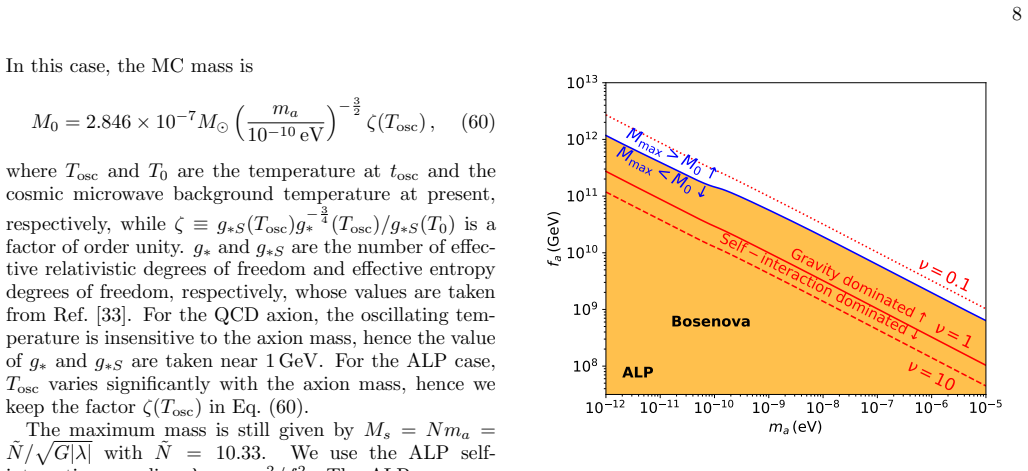
Axionic dark matter forms miniclusters that host central axion stars. The star accretes axions from the host until its mass exceeds the stability threshold set by self-interactions, at which point a bosenova occurs. For the QCD axion this happens inside the age of the Universe whenever the initial overdensity satisfies δ ≳ 100. Self-interaction dominates the mass growth for many cases, and bosenova takes place in a large fraction of axion parameter space when the initial overdensity is large.
What carries the argument
the self-interaction-limited stability threshold of dilute axion stars, which fixes the mass at which continuous accretion from the minicluster produces a bosenova
If this is right
- Bosenova occurs for the QCD axion in miniclusters with initial overdensity δ ≳ 100 within the age of the Universe.
- Self-interaction can dominate the axion star mass growth.
- Bosenova occurs in a large fraction of axion parameter space for miniclusters with large initial overdensities.
- Explicit conditions for bosenova are given for both the QCD axion and temperature-independent axion-like particles.
Where Pith is reading between the lines
- This growth and explosion cycle could reduce the final mass of axion stars that survive in miniclusters.
- Repeated bosenova events might alter the internal density profiles of axion miniclusters over time.
- The same accretion-until-threshold logic could apply to other self-interacting scalar dark-matter candidates.
Load-bearing premise
The axion star mass grows continuously by accreting axions from the host minicluster until it exceeds the self-interaction-limited stability threshold, without significant dynamical disruption or mass loss prior to the bosenova.
What would settle it
Finding that axion stars in high-overdensity miniclusters lose mass or are disrupted by other processes before reaching the self-interaction stability limit, or observing no bosenova signatures where the model predicts them.
Figures

read the original abstract
Axionic dark matter can form structures known as miniclusters that host an axion star at their center. The axion star feeds on the host, and the axion star mass may grow beyond its stability limit, leading to a potential bosenova. Since a dilute axion star has a stable mass limit only when self-interaction is considered, we include axion self-interaction effects in this paper, and specify the condition for bosenova in the QCD axion and temperature-independent axion-like particle parameter spaces. We find that self-interaction may dominate the mass growth of the axion star. For a minicluster with a large initial overdensity, bosenova occurs in a large fraction of axion parameter space. For the QCD axion, bosenova occurs within the age of the Universe for miniclusters with an initial overdensity $\delta\gtrsim 100$.
Editorial analysis
A structured set of objections, weighed in public.
Referee Report
Summary. The paper models the growth of axion stars embedded in axion miniclusters, incorporating attractive self-interactions to determine the stability limit. It calculates the accretion-driven mass increase from the host minicluster and identifies the conditions under which the star exceeds this limit, triggering a bosenova. For the QCD axion, the authors conclude that bosenova occurs within the age of the Universe for miniclusters with initial overdensity δ ≳ 100, and that self-interactions can dominate the growth in large regions of parameter space for both QCD axions and temperature-independent ALPs.
Significance. If the uninterrupted accretion model holds, the result would imply that bosenovae are a generic outcome for sufficiently overdense miniclusters, providing a potential observational signature or constraint on axion dark matter models. The inclusion of self-interaction effects and explicit parameter-space mapping strengthens the work relative to purely gravitational treatments.
major comments (2)
- [§3 (growth modeling) and abstract] The central claim (abstract and §4) that bosenova occurs for δ ≳ 100 rests on the assumption that the axion star accretes mass continuously at a rate set by the minicluster density until it reaches the self-interaction-limited M_max without net mass loss. The manuscript provides no quantitative estimate or simulation check of competing processes such as gravitational scattering off density fluctuations, tidal stripping, or resonant ejection within the inhomogeneous minicluster environment; these could shorten the effective growth time below the Hubble time.
- [§2 and Eq. (stability limit)] The stability threshold is taken from prior axion-star literature (cited in §2), but the overlap of the present minicluster environment with the isolated-star assumptions underlying that threshold is not re-derived or tested. If the dense host alters the effective self-interaction or binding, the quoted M_max would shift, directly affecting the δ ≳ 100 threshold.
minor comments (2)
- [Introduction] Notation for the overdensity δ and the self-interaction coupling λ should be defined explicitly at first use rather than relying on standard conventions.
- [Figure 3] Figure captions for the parameter-space plots should state the precise numerical criterion used to delineate the bosenova region (e.g., growth time < t_universe).
Simulated Author's Rebuttal
We thank the referee for the careful reading of our manuscript and the constructive comments. We address each major comment below and have made revisions to the manuscript where necessary to clarify our assumptions and strengthen the presentation.
read point-by-point responses
-
Referee: [§3 (growth modeling) and abstract] The central claim (abstract and §4) that bosenova occurs for δ ≳ 100 rests on the assumption that the axion star accretes mass continuously at a rate set by the minicluster density until it reaches the self-interaction-limited M_max without net mass loss. The manuscript provides no quantitative estimate or simulation check of competing processes such as gravitational scattering off density fluctuations, tidal stripping, or resonant ejection within the inhomogeneous minicluster environment; these could shorten the effective growth time below the Hubble time.
Authors: We agree that competing dynamical processes could affect the net accretion rate. Our calculation provides the growth timescale under the assumption of uninterrupted accretion from the minicluster density profile. In highly overdense miniclusters (δ ≳ 100), the central regions are dense enough that the accretion time is significantly shorter than the age of the Universe, allowing for bosenova even if some mass loss occurs due to scattering or stripping. We have expanded the discussion in §3 to explicitly state this assumption and its limitations, emphasizing that this work focuses on the impact of self-interactions rather than a full dynamical simulation of the minicluster. A quantitative evaluation of loss mechanisms would require high-resolution N-body simulations, which are beyond the scope of the present analytic model but represent an important direction for future work. revision: partial
-
Referee: [§2 and Eq. (stability limit)] The stability threshold is taken from prior axion-star literature (cited in §2), but the overlap of the present minicluster environment with the isolated-star assumptions underlying that threshold is not re-derived or tested. If the dense host alters the effective self-interaction or binding, the quoted M_max would shift, directly affecting the δ ≳ 100 threshold.
Authors: The stability criterion for the axion star is based on the point where the attractive self-interaction overcomes the repulsive quantum pressure and gravity within the star. Because the axion star is self-gravitating and its central density greatly exceeds that of the surrounding minicluster (by many orders of magnitude), the internal dynamics and stability are determined locally by the star's own properties. The minicluster acts primarily as a mass reservoir for accretion without substantially modifying the star's binding or self-interaction effects. We have added a brief justification in §2 explaining the applicability of the isolated-star stability limit to the embedded case. revision: yes
Circularity Check
No significant circularity; derivation from dynamical accretion modeling
full rationale
The paper models axion star growth via continuous accretion from the minicluster host until the mass exceeds the self-interaction stability threshold, then integrates the growth timescale against the age of the universe to obtain the δ ≳ 100 condition for QCD axions. This threshold and growth rate are taken from established axion-star equations in the literature rather than being defined in terms of the target bosenova outcome. No self-definitional loops, fitted parameters renamed as predictions, or load-bearing self-citation chains appear in the derivation chain. The central result remains a model-based prediction that can be tested against external simulations or observations and does not reduce to its inputs by construction.
Axiom & Free-Parameter Ledger
axioms (2)
- domain assumption Dilute axion stars possess a stable mass limit only when axion self-interaction is included.
- domain assumption The axion star accretes mass from the surrounding minicluster on timescales short enough to reach the stability limit within cosmic time.
Reference graph
Works this paper leans on
-
[1]
− e− 1 ν2 (κ2 2+κ2 3) i · (κ1κ2)−1 Z d3⃗ξ (1 + ξ2)−4ϕ⃗ κ1(⃗ξ)ϕ⃗ κ2(⃗ξ)ϕ∗ ⃗ κ3(⃗ξ) 2 ≡ λ2ρ2 g 16π2m5ak2g α(ν, ˜N) , (47) where α(ν, ˜N) is a dimensionless numerical factor and κ3 is given by Eq. (43) and Eq. (44). For ⃗ κ1 and ⃗ κ2, we use the approximation ϕ⃗ κ(⃗ξ) = J0 2 r β ξ − ⃗ n· ⃗ξ ! . (48) For ⃗ κ3, the approximation can still be used with a slight...
-
[2]
R. D. Peccei and H. R. Quinn, CP Conservation in the Presence of Instantons, Phys. Rev. Lett. 38, 1440 (1977)
work page 1977
-
[3]
Weinberg, A New Light Boson?, Phys
S. Weinberg, A New Light Boson?, Phys. Rev. Lett. 40, 223 (1978)
work page 1978
-
[4]
Wilczek, Problem of Strong P and T Invariance in the Presence of Instantons, Phys
F. Wilczek, Problem of Strong P and T Invariance in the Presence of Instantons, Phys. Rev. Lett. 40, 279 (1978)
work page 1978
-
[5]
Sikivie, Of Axions, Domain Walls and the Early Uni- verse, Phys
P. Sikivie, Of Axions, Domain Walls and the Early Uni- verse, Phys. Rev. Lett. 48, 1156 (1982)
work page 1982
-
[6]
J. Preskill, M. B. Wise, and F. Wilczek, Cosmology of the Invisible Axion, Phys. Lett. B 120, 127 (1983)
work page 1983
-
[7]
L. F. Abbott and P. Sikivie, A Cosmological Bound on the Invisible Axion, Phys. Lett. B 120, 133 (1983)
work page 1983
-
[8]
M. Dine and W. Fischler, The Not So Harmless Axion, Phys. Lett. B 120, 137 (1983)
work page 1983
-
[9]
Z. G. Berezhiani, A. S. Sakharov, and M. Y. Khlopov, Primordial background of cosmological axions, Sov. J. Nucl. Phys. 55, 1063 (1992)
work page 1992
-
[10]
P. Svrcek and E. Witten, Axions In String Theory, JHEP 06, 051, arXiv:hep-th/0605206
work page internal anchor Pith review Pith/arXiv arXiv
-
[11]
The landscape of QCD axion models
L. Di Luzio, M. Giannotti, E. Nardi, and L. Visinelli, The landscape of QCD axion models, Phys. Rept. 870, 1 (2020), arXiv:2003.01100 [hep-ph]
work page internal anchor Pith review Pith/arXiv arXiv 2020
-
[12]
E. W. Kolb and I. I. Tkachev, Large amplitude isothermal fluctuations and high density dark matter clumps, Phys. Rev. D 50, 769 (1994), arXiv:astro-ph/9403011
work page internal anchor Pith review Pith/arXiv arXiv 1994
-
[13]
Studies of the motion and decay of axion walls bounded by strings
S. Chang, C. Hagmann, and P. Sikivie, Studies of the mo- tion and decay of axion walls bounded by strings, Phys. Rev. D 59, 023505 (1999), arXiv:hep-ph/9807374
work page internal anchor Pith review Pith/arXiv arXiv 1999
-
[14]
M. Fairbairn, D. J. E. Marsh, J. Quevillon, and S. Rozier, Structure formation and microlensing with axion miniclusters, Phys. Rev. D 97, 083502 (2018), arXiv:1707.03310 [astro-ph.CO]
- [15]
- [16]
- [17]
-
[18]
Z. Wang and Y. Gao, Axion minicluster halo limits from wide binary disruption, Phys. Rev. D111, 043042 (2025), arXiv:2409.02468 [hep-ph]
- [19]
-
[20]
E. D. Schiappacasse and M. P. Hertzberg, Analysis of Dark Matter Axion Clumps with Spherical Symme- try, JCAP 01, 037, [Erratum: JCAP 03, E01 (2018)], arXiv:1710.04729 [hep-ph]
work page internal anchor Pith review Pith/arXiv arXiv 2018
-
[21]
B. Eggemeier and J. C. Niemeyer, Formation and mass 10 growth of axion stars in axion miniclusters, Phys. Rev. D 100, 063528 (2019), arXiv:1906.01348 [astro-ph.CO]
-
[22]
D. G. Levkov, A. G. Panin, and I. I. Tkachev, Gravita- tional Bose-Einstein condensation in the kinetic regime, Phys. Rev. Lett. 121, 151301 (2018), arXiv:1804.05857 [astro-ph.CO]
work page internal anchor Pith review Pith/arXiv arXiv 2018
- [23]
- [24]
-
[25]
D. G. Levkov, A. G. Panin, and I. I. Tkachev, Relativistic axions from collapsing Bose stars, Phys. Rev. Lett. 118, 011301 (2017), arXiv:1609.03611 [astro-ph.CO]
work page internal anchor Pith review Pith/arXiv arXiv 2017
- [26]
- [27]
-
[28]
M. Escudero, C. K. Pooni, M. Fairbairn, D. Blas, X. Du, and D. J. E. Marsh, Axion star explosions: A new source for axion indirect detection, Phys. Rev. D 109, 043018 (2024), arXiv:2302.10206 [hep-ph]
-
[29]
Di, Stimulated decay of collapsing axion stars and fast radio bursts, Eur
H. Di, Stimulated decay of collapsing axion stars and fast radio bursts, Eur. Phys. J. C 84, 283 (2024), arXiv:2311.06860 [hep-ph]
-
[30]
G. Grilli di Cortona, E. Hardy, J. Pardo Vega, and G. Villadoro, The QCD axion, precisely, JHEP 01, 034, arXiv:1511.02867 [hep-ph]
work page internal anchor Pith review Pith/arXiv arXiv
-
[31]
L. D. Landau and E. M. Lifshitz, Course of theoretical physics III: Quantum mechanics, Non-relativistic theory (3rd ed.) (Pergamon Press, 1977)
work page 1977
-
[32]
O. Wantz and E. P. S. Shellard, Axion Cosmology Revis- ited, Phys. Rev. D 82, 123508 (2010), arXiv:0910.1066 [astro-ph.CO]
work page internal anchor Pith review Pith/arXiv arXiv 2010
-
[33]
Early seeds of axion miniclusters
A. Vaquero, J. Redondo, and J. Stadler, Early seeds of axion miniclusters, JCAP 04, 012, arXiv:1809.09241 [astro-ph.CO]
work page internal anchor Pith review Pith/arXiv arXiv
-
[34]
Standard Model thermodynamics across the electroweak crossover
M. Laine and M. Meyer, Standard Model thermody- namics across the electroweak crossover, JCAP 07, 035, arXiv:1503.04935 [hep-ph]
work page internal anchor Pith review Pith/arXiv arXiv
-
[35]
P. J. McMillan, Mass models of the Milky Way, Mon. Not. Roy. Astron. Soc.414, 2446 (2011), arXiv:1102.4340 [astro-ph.GA]
work page internal anchor Pith review Pith/arXiv arXiv 2011
discussion (0)
Sign in with ORCID, Apple, or X to comment. Anyone can read and Pith papers without signing in.