Detecting Malicious Intents in Smart Contracts with Pre-trained Programming Language Models
Pith reviewed 2026-05-18 21:01 UTC · model grok-4.3
The pith
A BERT model pre-trained on 16,000 smart contracts detects malicious developer intents at 0.9279 F1 on 10,000 held-out contracts.
A machine-rendered reading of the paper's core claim, the machinery that carries it, and where it could break.
Core claim
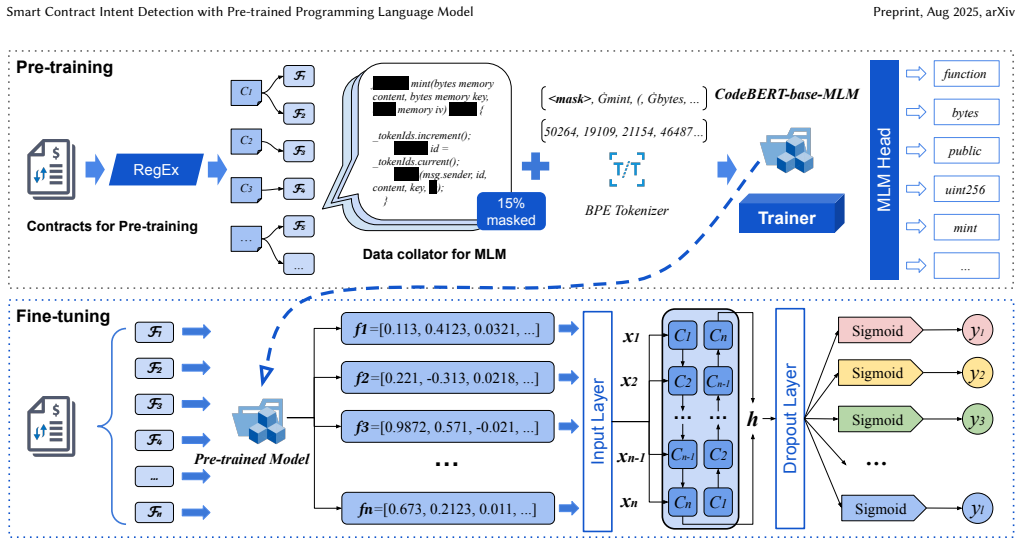
SmartIntentV2 integrates a BERT-based pre-trained programming language model that is domain-adaptively pre-trained on 16,000 real-world smart contracts using a Masked Language Modeling objective; the resulting representations are fed into a retained BiLSTM-based multi-label classification network for intent detection. On the evaluation set of 10,000 real-world smart contracts this yields accuracy 0.9789, precision 0.9090, recall 0.9476 and F1 score 0.9279, substantially outperforming the predecessor SmartIntentNN and other baselines including a 65.5 percent relative F1 improvement over GPT-4.1, thereby establishing a new state-of-the-art for smart contract intent detection.
What carries the argument
Domain-adaptive pre-training of a BERT-based programming language model on 16,000 smart contracts via Masked Language Modeling, whose learned representations are passed to a BiLSTM multi-label classifier for intent detection.
If this is right
- Smart contract developers can flag unsafe intents automatically before deployment, lowering the chance of exploits reaching the blockchain.
- Auditing tools for decentralized applications gain a higher-accuracy detector that covers ten distinct malicious intent categories.
- Future models for code security can use the same domain-adaptive pre-training recipe as a stronger baseline.
- The performance gap over general models like GPT-4.1 indicates that task-specific pre-training on contract code is particularly effective for this narrow detection problem.
Where Pith is reading between the lines
- The same pre-training strategy could be tested on larger or more diverse contract corpora to check whether accuracy continues to rise.
- The classifier might be extended to surface previously unseen intent patterns by treating the ten categories as a starting point rather than a fixed set.
- Integration of the detector into common Solidity development environments could shift security checks earlier in the coding workflow.
Load-bearing premise
The 16,000 contracts used for pre-training and the 10,000 contracts used for evaluation are disjoint, representative of real-world smart contracts, and free of significant label noise or distribution shift.
What would settle it
Running the trained model on a newly collected set of 10,000 smart contracts drawn from a later time period or different blockchain and obtaining an F1 score below 0.85 would show the reported gains do not hold under distribution shift.
Figures



read the original abstract
Malicious developer intents in smart contracts constitute significant security threats to decentralized applications, leading to substantial economic losses. Prior work introduced SmartIntentNN, a deep learning model for detecting unsafe developer intents. By combining the Universal Sentence Encoder, a K-means clustering-based intent highlighting mechanism, and a Bidirectional Long Short-Term Memory (BiLSTM) network, the model achieved an F1 score of 0.8633 on an evaluation set of 10,000 real-world smart contracts across ten distinct intent categories. This paper presents SmartIntentV2 (Smart Contract Intent Neural Network Version 2). The primary enhancement is the integration of a BERT-based pre-trained programming language model, which we domain-adaptively pre-train on a dataset of 16,000 real-world smart contracts using a Masked Language Modeling objective. SmartIntentV2 retains the BiLSTM-based multi-label classification network for intent detection. On the same evaluation set of 10,000 smart contracts, it achieves superior performance with an accuracy of 0.9789, precision of 0.9090, recall of 0.9476, and an F1 score of 0.9279, substantially outperforming its predecessor and other baseline models. Notably, SmartIntentV2 also delivers a 65.5% relative improvement in F1 score over GPT-4.1 on this specialized task. These results establish SmartIntentV2 as a new state-of-the-art model for smart contract intent detection.
Editorial analysis
A structured set of objections, weighed in public.
Referee Report
Summary. The paper proposes SmartIntentV2, an enhancement to SmartIntentNN for detecting malicious developer intents in smart contracts. It integrates domain-adaptive pre-training of a BERT-based programming language model on 16,000 real-world smart contracts via Masked Language Modeling, followed by a BiLSTM network for multi-label classification over ten intent categories. On the same 10,000-contract evaluation set, it reports accuracy 0.9789, precision 0.9090, recall 0.9476, and F1 0.9279, claiming substantial gains over the prior F1 of 0.8633 and a 65.5% relative improvement over GPT-4.1.
Significance. If the pre-training and evaluation sets are verifiably disjoint and the methodology is fully specified, the work would demonstrate the value of domain-adaptive pre-training for smart-contract security tasks and could set a new practical baseline for intent detection in blockchain applications.
major comments (3)
- [Abstract] Abstract: The manuscript states that the model is pre-trained on 16,000 contracts and evaluated on 10,000 contracts but supplies no statement of disjointness, no deduplication procedure, and no description of how the ten intent labels were obtained or validated. Any shared contracts would allow the pre-trained encoder to have modeled the exact test instances, rendering the superiority over SmartIntentNN and GPT-4.1 non-diagnostic.
- [Experimental setup] Experimental setup (likely §4 or §5): No details are provided on the training procedure for the BiLSTM classifier (e.g., whether a separate labeled training split was used, how the 10,000-contract set was partitioned, or any hyperparameter choices), making the reported F1 of 0.9279 difficult to interpret or reproduce.
- [Results] Results and baselines: The 65.5% relative F1 improvement over GPT-4.1 is presented without specifying the prompting strategy, temperature, or few-shot configuration used for GPT-4.1, and without statistical significance tests on the performance deltas.
minor comments (1)
- [Abstract] The abstract would be clearer if it briefly named the ten intent categories.
Simulated Author's Rebuttal
We thank the referee for the constructive and detailed comments, which have helped us improve the clarity and reproducibility of our work on SmartIntentV2. We address each major comment below and have revised the manuscript accordingly to incorporate the suggested clarifications.
read point-by-point responses
-
Referee: [Abstract] Abstract: The manuscript states that the model is pre-trained on 16,000 contracts and evaluated on 10,000 contracts but supplies no statement of disjointness, no deduplication procedure, and no description of how the ten intent labels were obtained or validated. Any shared contracts would allow the pre-trained encoder to have modeled the exact test instances, rendering the superiority over SmartIntentNN and GPT-4.1 non-diagnostic.
Authors: We agree that an explicit statement on dataset disjointness is necessary to validate the reported gains. The 16,000-contract pre-training set was collected independently from the 10,000-contract evaluation set with zero overlap, confirmed via unique contract addresses and SHA-256 hashes of source code. Deduplication was performed by removing exact bytecode duplicates across the entire corpus prior to splitting. The ten intent labels were obtained through a hybrid process of expert manual annotation by three blockchain security researchers using a fixed taxonomy of malicious developer intents, supplemented by rule-based pattern matching for known vulnerability signatures, with inter-annotator agreement of 0.82 Fleiss' kappa. We have added a new subsection (3.2) in the revised manuscript that fully documents the data collection, deduplication, disjointness verification, and labeling protocol. revision: yes
-
Referee: [Experimental setup] Experimental setup (likely §4 or §5): No details are provided on the training procedure for the BiLSTM classifier (e.g., whether a separate labeled training split was used, how the 10,000-contract set was partitioned, or any hyperparameter choices), making the reported F1 of 0.9279 difficult to interpret or reproduce.
Authors: We acknowledge that the original manuscript omitted key implementation details for the BiLSTM stage. The classifier was trained on a labeled 70/15/15 train/validation/test partition of the 10,000-contract evaluation set (stratified by intent labels to preserve class distribution). Hyperparameters were selected via grid search on the validation split: Adam optimizer with learning rate 1e-4, batch size 32, two BiLSTM layers with 256 hidden units, dropout 0.4, and binary cross-entropy loss with label smoothing. Training ran for a maximum of 15 epochs with early stopping (patience=3) on validation F1. We have expanded Section 5 with a complete description of the partitioning, all hyperparameter values, and the training algorithm, including pseudocode, to support full reproducibility. revision: yes
-
Referee: [Results] Results and baselines: The 65.5% relative F1 improvement over GPT-4.1 is presented without specifying the prompting strategy, temperature, or few-shot configuration used for GPT-4.1, and without statistical significance tests on the performance deltas.
Authors: We thank the referee for noting the missing baseline specifications. GPT-4.1 was queried in a strict zero-shot setting using the prompt template: 'Analyze the following Solidity smart contract and list all malicious developer intents from this set: [ten categories]. Return only the applicable intent labels separated by commas.' Temperature was fixed at 0.0 and top_p at 1.0 with no few-shot examples or chain-of-thought instructions. To quantify the improvement, we performed a paired bootstrap test (1,000 resamples) on the per-contract F1 scores, yielding p < 0.001 for the observed delta. These details, the exact prompt, and the statistical test results have been added to Section 6 and a new appendix on baseline configurations. revision: yes
Circularity Check
No significant circularity; evaluation on held-out set is independent
full rationale
The paper describes standard domain-adaptive pre-training of a BERT-based model on 16,000 contracts using MLM, followed by BiLSTM multi-label classification, with performance reported on the same 10,000-contract evaluation set used in prior work. This constitutes an empirical benchmark comparison rather than a derivation that reduces to its inputs by construction. No self-definitional steps, no fitted parameters renamed as predictions, and no load-bearing self-citations that force the central F1 result are present. The performance metrics (accuracy 0.9789, F1 0.9279) are measured quantities on the stated evaluation set and do not equate to the pre-training inputs.
Axiom & Free-Parameter Ledger
free parameters (1)
- BERT pre-training hyperparameters
axioms (1)
- domain assumption The Masked Language Modeling objective on smart contract code produces useful representations for downstream intent classification.
Lean theorems connected to this paper
-
IndisputableMonolith/Foundation/RealityFromDistinction.leanreality_from_one_distinction unclear?
unclearRelation between the paper passage and the cited Recognition theorem.
domain-adaptive pre-training on a dataset of 16,000 real-world smart contracts using a Masked Language Modeling objective... BiLSTM-based multi-label classification network
-
IndisputableMonolith/Cost/FunctionalEquation.leanwashburn_uniqueness_aczel unclear?
unclearRelation between the paper passage and the cited Recognition theorem.
SmartIntentNN2 achieves ... F1 score of 0.9279
What do these tags mean?
- matches
- The paper's claim is directly supported by a theorem in the formal canon.
- supports
- The theorem supports part of the paper's argument, but the paper may add assumptions or extra steps.
- extends
- The paper goes beyond the formal theorem; the theorem is a base layer rather than the whole result.
- uses
- The paper appears to rely on the theorem as machinery.
- contradicts
- The paper's claim conflicts with a theorem or certificate in the canon.
- unclear
- Pith found a possible connection, but the passage is too broad, indirect, or ambiguous to say the theorem truly supports the claim.
Reference graph
Works this paper leans on
-
[1]
Nick Szabo. Smart contracts: building blocks for digital markets.EXTROPY: The Journal of Transhumanist Thought,(16), 18(2):28, 1996
work page 1996
-
[2]
Andreas M Antonopoulos and Gavin Wood.Mastering ethereum: building smart contracts and dapps. O’reilly Media, 2018
work page 2018
-
[3]
Introduction to smart contracts, 2025
Ethereum Foundation. Introduction to smart contracts, 2025
work page 2025
-
[4]
Vitalik Buterin et al. A next-generation smart contract and decentralized appli- cation platform.white paper, 3(37):2–1, 2014
work page 2014
-
[5]
Gavin Wood et al. Ethereum: A secure decentralised generalised transaction ledger.Ethereum project yellow paper, 151(2014):1–32, 2014
work page 2014
-
[6]
Federico Cernera, Massimo La Morgia, Alessandro Mei, and Francesco Sassi. Token spammers, rug pulls, and sniper bots: An analysis of the ecosystem of tokens in ethereum and in the binance smart chain ({ { { { {BNB} } } } }). In32nd USENIX Security Symposium (USENIX Security 23), pages 3349–3366, 2023
work page 2023
-
[7]
Smart contract vulnerability analysis and security audit.IEEE Network, 34(5):276–282, 2020
Daojing He, Zhi Deng, Yuxing Zhang, Sammy Chan, Yao Cheng, and Nadra Guizani. Smart contract vulnerability analysis and security audit.IEEE Network, 34(5):276–282, 2020
work page 2020
-
[8]
A survey on smart contract vulnerabilities: Data sources, detection and repair
Hanting Chu, Pengcheng Zhang, Hai Dong, Yan Xiao, Shunhui Ji, and Wenrui Li. A survey on smart contract vulnerabilities: Data sources, detection and repair. Information and Software Technology, 159:107221, 2023
work page 2023
-
[9]
Chong Chen, Jianzhong Su, Jiachi Chen, Yanlin Wang, Tingting Bi, Jianxing Yu, Yanli Wang, Xingwei Lin, Ting Chen, and Zibin Zheng. When chatgpt meets smart contract vulnerability detection: How far are we?ACM Transactions on Software Engineering and Methodology, 34(4):1–30, 2025
work page 2025
-
[10]
Smartintentnn: Towards smart contract intent detection.arXiv preprint arXiv:2211.13670, 2022
Youwei Huang, Sen Fang, Jianwen Li, Bin Hu, and Tao Zhang. Smartintentnn: Towards smart contract intent detection.arXiv preprint arXiv:2211.13670, 2022
-
[11]
Deep smart contract intent detection
Youwei Huang, Sen Fang, Jianwen Li, Bin Hu, Jiachun Tao, and Tao Zhang. Deep smart contract intent detection. In2025 IEEE International Conference on Software Analysis, Evolution and Reengineering (SANER), pages 124–135. IEEE, 2025
work page 2025
-
[12]
Daniel Cer, Yinfei Yang, Sheng-yi Kong, Nan Hua, Nicole Limtiaco, Rhomni St John, Noah Constant, Mario Guajardo-Cespedes, Steve Yuan, Chris Tar, et al. Universal sentence encoder.arXiv preprint arXiv:1803.11175, 2018
work page internal anchor Pith review Pith/arXiv arXiv 2018
-
[13]
BERT: Pre-training of Deep Bidirectional Transformers for Language Understanding
Jacob Devlin. Bert: Pre-training of deep bidirectional transformers for language understanding.arXiv preprint arXiv:1810.04805, 2018
work page internal anchor Pith review Pith/arXiv arXiv 2018
-
[14]
RoBERTa: A Robustly Optimized BERT Pretraining Approach
Yinhan Liu. Roberta: A robustly optimized bert pretraining approach.arXiv preprint arXiv:1907.11692, 2019
work page internal anchor Pith review Pith/arXiv arXiv 1907
-
[15]
Codebert: A pre-trained model for programming and natural languages, 2020
Zhangyin Feng, Daya Guo, Duyu Tang, Nan Duan, Xiaocheng Feng, Ming Gong, Linjun Shou, Bing Qin, Ting Liu, Daxin Jiang, and Ming Zhou. Codebert: A pre-trained model for programming and natural languages, 2020
work page 2020
-
[16]
Long short-term memory.Neural computation, 9(8):1735–1780, 1997
Sepp Hochreiter and Jürgen Schmidhuber. Long short-term memory.Neural computation, 9(8):1735–1780, 1997
work page 1997
-
[17]
Alex Graves and Jürgen Schmidhuber. Framewise phoneme classification with bidirectional lstm and other neural network architectures.Neural networks, 18(5-6):602–610, 2005
work page 2005
-
[18]
Tensorflow: a system for large-scale machine learning
Martín Abadi, Paul Barham, Jianmin Chen, Zhifeng Chen, Andy Davis, Jeffrey Dean, Matthieu Devin, Sanjay Ghemawat, Geoffrey Irving, Michael Isard, et al. Tensorflow: a system for large-scale machine learning. In12th USENIX symposium on operating systems design and implementation (OSDI 16), pages 265–283, 2016
work page 2016
-
[19]
Daniel Smilkov, Nikhil Thorat, Yannick Assogba, Charles Nicholson, Nick Kreeger, Ping Yu, Shanqing Cai, Eric Nielsen, David Soegel, Stan Bileschi, et al. Tensorflow. js: Machine learning for the web and beyond.Proceedings of Machine Learning and Systems, 1:309–321, 2019
work page 2019
-
[20]
Focal loss for dense object detection
Tsung-Yi Lin, Priya Goyal, Ross Girshick, Kaiming He, and Piotr Dollár. Focal loss for dense object detection. InProceedings of the IEEE international conference on computer vision, pages 2980–2988, 2017
work page 2017
-
[21]
Vyper documentation.Vyper by Example, page 13, 2018
Vitalik Buterin. Vyper documentation.Vyper by Example, page 13, 2018
work page 2018
- [22]
-
[23]
Yue Wang, Weishi Wang, Shafiq Joty, and Steven CH Hoi. Codet5: Identifier- aware unified pre-trained encoder-decoder models for code understanding and generation.arXiv preprint arXiv:2109.00859, 2021
work page internal anchor Pith review Pith/arXiv arXiv 2021
-
[24]
CodeT5+: Open Code Large Language Models for Code Understanding and Generation
Yue Wang, Hung Le, Akhilesh Deepak Gotmare, Nghi DQ Bui, Junnan Li, and Steven CH Hoi. Codet5+: Open code large language models for code understand- ing and generation.arXiv preprint arXiv:2305.07922, 2023
work page internal anchor Pith review arXiv 2023
-
[25]
Learning and evaluating contextual embedding of source code
Aditya Kanade, Petros Maniatis, Gogul Balakrishnan, and Kensen Shi. Learning and evaluating contextual embedding of source code. InInternational conference on machine learning, pages 5110–5121. PMLR, 2020
work page 2020
-
[26]
Lei Yu, Zhirong Huang, Hang Yuan, Shiqi Cheng, Li Yang, Fengjun Zhang, Chenjie Shen, Jiajia Ma, Jingyuan Zhang, Junyi Lu, et al. Smart-llama-dpo: Reinforced large language model for explainable smart contract vulnerability detection. Proceedings of the ACM on Software Engineering, 2(ISSTA):182–205, 2025
work page 2025
-
[27]
Scalm: Detecting bad practices in smart contracts through llms
Zongwei Li, Xiaoqi Li, Wenkai Li, and Xin Wang. Scalm: Detecting bad practices in smart contracts through llms. InProceedings of the AAAI Conference on Artificial Intelligence, volume 39, pages 470–477, 2025
work page 2025
-
[28]
Mak- ing smart contracts smarter
Loi Luu, Duc-Hiep Chu, Hrishi Olickel, Prateek Saxena, and Aquinas Hobor. Mak- ing smart contracts smarter. InProceedings of the 2016 ACM SIGSAC conference on computer and communications security, pages 254–269, 2016
work page 2016
-
[29]
A framework for bug hunting on the ethereum blockchain
Bernhard Mueller. A framework for bug hunting on the ethereum blockchain. ConsenSys/mythril, 2017
work page 2017
-
[30]
Zeus: analyzing safety of smart contracts
Sukrit Kalra, Seep Goel, Mohan Dhawan, and Subodh Sharma. Zeus: analyzing safety of smart contracts. InNdss, pages 1–12, 2018
work page 2018
-
[31]
Securify: Practical security analysis of smart con- tracts
Petar Tsankov, Andrei Dan, Dana Drachsler-Cohen, Arthur Gervais, Florian Buenzli, and Martin Vechev. Securify: Practical security analysis of smart con- tracts. InProceedings of the 2018 ACM SIGSAC Conference on Computer and Communications Security, pages 67–82, 2018
work page 2018
-
[32]
Smartcheck: Static analysis of ethereum smart contracts
Sergei Tikhomirov, Ekaterina Voskresenskaya, Ivan Ivanitskiy, Ramil Takhaviev, Evgeny Marchenko, and Yaroslav Alexandrov. Smartcheck: Static analysis of ethereum smart contracts. InProceedings of the 1st International Workshop on Emerging Trends in Software Engineering for Blockchain, pages 9–16, 2018
work page 2018
-
[33]
Ægis: Shielding vulnerable smart con- tracts against attacks
Christof Ferreira Torres, Mathis Baden, Robert Norvill, Beltran Borja Fiz Pon- tiveros, Hugo Jonker, and Sjouke Mauw. Ægis: Shielding vulnerable smart con- tracts against attacks. InProceedings of the 15th ACM Asia Conference on Computer and Communications Security, pages 584–597, 2020
work page 2020
-
[34]
Towards Safer Smart Contracts: A Sequence Learning Approach to Detecting Security Threats
Wesley Joon-Wie Tann, Xing Jie Han, Sourav Sen Gupta, and Yew-Soon Ong. To- wards safer smart contracts: A sequence learning approach to detecting security threats.arXiv preprint arXiv:1811.06632, 2018
work page internal anchor Pith review Pith/arXiv arXiv 2018
-
[35]
Wei Wang, Jingjing Song, Guangquan Xu, Yidong Li, Hao Wang, and Chunhua Su. Contractward: Automated vulnerability detection models for ethereum smart contracts.IEEE Transactions on Network Science and Engineering, 8(2):1133–1144, 2020
work page 2020
-
[36]
Smart contract vulnerability detection using graph neural network
Yuan Zhuang, Zhenguang Liu, Peng Qian, Qi Liu, Xiang Wang, and Qinming He. Smart contract vulnerability detection using graph neural network. InIJCAI, pages 3283–3290, 2020
work page 2020
-
[37]
Smarter contracts: Detecting vulnerabilities in smart contracts with deep transfer learning
Christoph Sendner, Huili Chen, Hossein Fereidooni, Lukas Petzi, Jan König, Jasper Stang, Alexandra Dmitrienko, Ahmad-Reza Sadeghi, and Farinaz Koushanfar. Smarter contracts: Detecting vulnerabilities in smart contracts with deep transfer learning. InNDSS, 2023
work page 2023
-
[38]
Improving smart contract security with contrastive learning-based vulnerability detection
Yizhou Chen, Zeyu Sun, Zhihao Gong, and Dan Hao. Improving smart contract security with contrastive learning-based vulnerability detection. InProceedings of the IEEE/ACM 46th International Conference on Software Engineering, pages 1–11, 2024
work page 2024
-
[39]
The art of the scam: Demystifying honeypots in ethereum smart contracts
Christof Ferreira Torres, Mathis Steichen, et al. The art of the scam: Demystifying honeypots in ethereum smart contracts. In28th USENIX Security Symposium (USENIX Security 19), pages 1591–1607, 2019
work page 2019
-
[40]
Pengcheng Xia, Haoyu Wang, Bingyu Gao, Weihang Su, Zhou Yu, Xiapu Luo, Chao Zhang, Xusheng Xiao, and Guoai Xu. Trade or trick? detecting and char- acterizing scam tokens on uniswap decentralized exchange.Proceedings of the ACM on Measurement and Analysis of Computing Systems, 5(3):1–26, 2021
work page 2021
-
[41]
Phuong Duy Huynh, Son Hoang Dau, Xiaodong Li, Iqbal Gondal, Thisal De Silva, and Emanuele Viterbo. From programming bugs to multimillion-dollar scams: An analysis of trapdoor tokens on uniswap.Blockchain: Research and Applications, page 100370, 2025
work page 2025
-
[42]
Alfred Lehar and Christine Parlour. Decentralized exchange: The uniswap auto- mated market maker.The Journal of Finance, 80(1):321–374, 2025
work page 2025
-
[43]
Scsguard: Deep scam detection for ethereum smart contracts
Huiwen Hu, Qianlan Bai, and Yuedong Xu. Scsguard: Deep scam detection for ethereum smart contracts. InIEEE INFOCOM 2022-IEEE Conference on Computer Communications Workshops (INFOCOM WKSHPS), pages 1–6. IEEE, 2022
work page 2022
-
[44]
Smart contract scams detection with topological data analysis on account interaction
Shuhui Fan, Shaojing Fu, Yuchuan Luo, Haoran Xu, Xuyun Zhang, and Ming Xu. Smart contract scams detection with topological data analysis on account interaction. InProceedings of the 31st ACM International Conference on Information & Knowledge Management, pages 468–477, 2022
work page 2022
-
[45]
Fuchen Ma, Meng Ren, Lerong Ouyang, Yuanliang Chen, Juan Zhu, Ting Chen, Yingli Zheng, Xiao Dai, Yu Jiang, and Jiaguang Sun. Pied-piper: Revealing the backdoor threats in ethereum erc token contracts.ACM Transactions on Software Engineering and Methodology, 32(3):1–24, 2023
work page 2023
-
[46]
Stop pulling my rug: Exposing rug pull risks in crypto token to in- vestors
Yuanhang Zhou, Jingxuan Sun, Fuchen Ma, Yuanliang Chen, Zhen Yan, and Yu Jiang. Stop pulling my rug: Exposing rug pull risks in crypto token to in- vestors. InProceedings of the 46th International Conference on Software Engineering: Software Engineering in Practice, pages 228–239, 2024
work page 2024
-
[47]
Alisa Kalacheva, Pavel Kuznetsov, Igor Vodolazov, and Yury Yanovich. Detecting rug pulls in decentralized exchanges: The rise of meme coins.Blockchain: Research and Applications, page 100336, 2025
work page 2025
-
[48]
Phuong Duy Huynh, Son Hoang Dau, Nicholas Huppert, Joshua Cervenjak, Hoonie Sun, Hong Yen Tran, Xiaodong Li, and Emanuele Viterbo. Serial scam- mers and attack of the clones: How scammers coordinate multiple rug pulls on decentralized exchanges. InProceedings of the ACM on Web Conference 2025, pages 1016–1033, 2025
work page 2025
discussion (0)
Sign in with ORCID, Apple, or X to comment. Anyone can read and Pith papers without signing in.