REVIEW 3 major objections 5 minor 37 references
AImoclips: A Benchmark for Evaluating Emotion Conveyance in Text-to-Music Generation
T0 review · 3 major / 5 minor · reviewed 2026-08-05 · deepseek-v4-flash
Pith's one-line read The paper builds a benchmark of 991 AI music clips and 6,162 human ratings to test whether text-to-music systems deliver the emotions they are prompted with, and finds that all systems drift toward neutrality while commercial and open-sourc
desk verdict A genuinely useful new benchmark for emotion conveyance in text-to-music, but the headline commercial-vs-open-source valence claim is hostage to an unexamined English-norm/Korean-rater mismatch. read the letter →
The pith
A machine-rendered reading of the paper's core claim, the machinery that carries it, and where it could break.
The reading
What carries the argument
The load-bearing object is AImoclips itself: an open dataset of 991 ten-second clips, each generated from one of 12 emotion words chosen to cover the four quadrants of the valence–arousal plane, with each clip rated on valence and arousal by 4 to 9 of the 111 participants. The analytic mechanism is the deviation score, the difference between average listener ratings and the emotion word's English normative valence/arousal score, aggregated per model, per quadrant, and per emotion intent, then tested with two-way ANOVA and pairwise comparisons. This turns "does the music sound like the emotion word?" into a numeric quantity that can be compared across systems.
What would settle it
Recompute every model deviation using valence and arousal norms for the 12 emotion words collected from Korean-speaking raters. If the commercial-versus-open-source split or the universal pull toward neutrality disappears or reverses, the paper's central claim is an artifact of using English norms as ground truth rather than a stable property of the systems.
Extended reading notes
Core claim
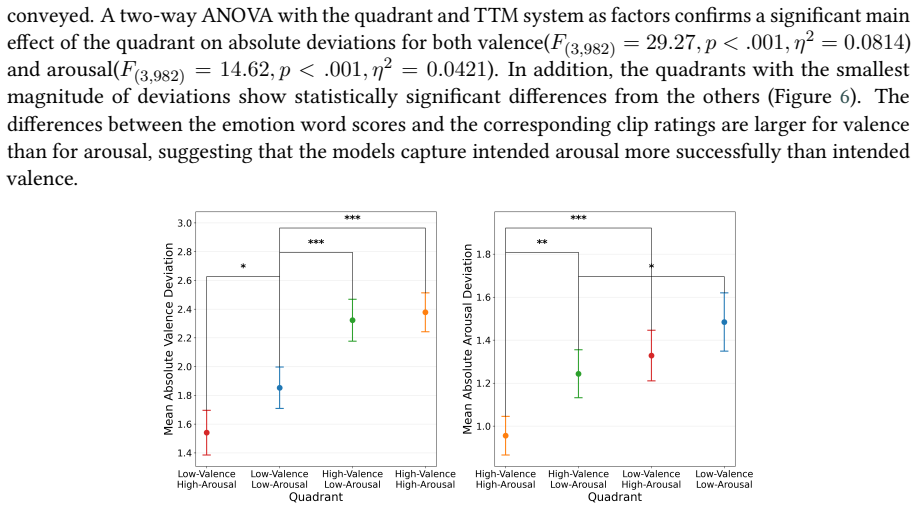
On its own terms, the paper's discovery is a reproducible, model-specific gap between the emotion a text prompt names and the emotion listeners actually hear. Averaging human ratings per clip and subtracting the emotion word's normative scores shows that all six systems pull perceived valence and arousal toward the center: generated music sounds emotionally blander than the word that prompted it. The pull is not symmetric. Suno and Udio, the two commercial systems, produce music rated as more pleasant than the intent, while the four open-source systems produce music rated as less pleasant; in arousal, AudioLDM 2 and Mustango skew low while the rest skew high. A two-way ANOVA and pairwise com
Load-bearing premise
The benchmark treats English word norms as the true valence and arousal of each emotion intent, even though all 111 raters were fluent Korean speakers; if affective word meanings differ across languages, the measured deviations shift by that difference.
Editorial extensions
If this is right
- If the centralizing tendency is general, emotion words alone are not a dependable control interface for TTM systems; expressive extremes need additional conditioning or post-generation editing.
- The reliable split between commercial and open-source valence biases gives model developers and auditors a concrete target: commercial systems appear to carry a positivity bias, open-source systems a negativity bias.
- Better conveyance of high-arousal intents implies that low-arousal affect is the harder control problem and should get focused attention in model training and evaluation.
- AImoclips can be reused as a training set for automatic emotion predictors or as a fine-tuning signal to align TTM models with perceived rather than intended emotion.
Reading between the lines
- Editorial inference: because ground-truth scores come from English word norms while all 111 raters are fluent Korean speakers, the reported deviations probably mix true model bias with cross-linguistic differences in what emotion words mean; collecting Korean norms for the same 12 words would separate the two.
- Editorial inference: the commercial pleasantness advantage could be explained by audio quality or production style rather than semantic emotion fidelity; a matched experiment controlling loudness, sample rate, and production would test this.
- Editorial inference: the tendency toward neutrality may be partly a measurement effect of averaging across raters or of cropping random 10-second segments; per-rater distributions or whole-clip ratings would show whether the center bias is in the models or the metric.
Editorial analysis
A structured set of objections, weighed in public.
Referee Report
Summary. The paper presents AImoclips, a benchmark for evaluating emotion conveyance in text-to-music (TTM) generation. The authors select 12 English emotion words spanning four valence–arousal quadrants, generate 1,008 clips with six TTM systems (four open-source, two commercial), and collect continuous valence/arousal ratings from 111 Korean-speaking participants. After excluding 17 clips with few ratings, 991 clips remain. Using Warriner et al.'s English affective norms as ground truth, the paper reports that all systems show a centralizing tendency toward neutrality, commercial models produce higher valence than intended while open-source models produce lower valence, and high-arousal intents are conveyed more accurately. Statistical significance is assessed with two-way ANOVAs and pairwise comparisons.
Significance. The dataset is a useful new resource: it provides publicly available AI-generated clips with dense valence/arousal annotations, covers a broader model set than prior work (cf. Gao et al. [23]), and addresses an underexplored evaluation dimension. The ANOVA results are reported with effect sizes, and the paper is generally transparent about clip generation and survey design. If the ground-truth norm issue is resolved, the benchmark could support future affective-controllability research. However, the headline signed-deviation claims are conditional on an unexamined cross-cultural assumption, and reliability evidence is missing; these issues must be addressed before the benchmark's conclusions can be taken as established.
major comments (3)
- [§3.1, §3.3, Fig. 3a] The signed deviations in Fig. 3a are computed as clip ratings (from 111 fluent Korean speakers, §3.3) minus Warriner et al. [26] English word norms (§4.2). If Korean valence/arousal norms for the 12 intent words differ from English norms, each clip's deviation shifts by an intent-specific constant, so the sign of per-model mean deviation—the basis for the claim that commercial systems are 'more pleasant than intended' and open-source systems are 'less pleasant'—can change even though the model main effect in the ANOVA is unchanged. The quadrant grouping in §4.3 also uses English norms; words such as 'scared' or 'dull' may cross valence/arousal boundaries for Korean raters. The authors should collect Korean norms from the same participant population, or provide a sensitivity analysis showing which conclusions survive plausible intent-level norm offsets, and discuss the limitation explicit
- [§3.3, §4.1] No inter-rater reliability statistic (e.g., ICC or Krippendorff's alpha) is reported. With only 4–9 ratings per clip, the benchmark's claim to measure 'conveyed emotion' per clip requires evidence of agreement; without it, model-specific deviations may partly reflect rater noise. Please report reliability per model and quadrant, and discuss the minimum number of ratings needed.
- [§3.3, §4.1] Seventeen clips with ≤3 ratings were excluded, but the per-model and per-intent distributions of excluded clips are not reported. If exclusions concentrate in one system (e.g., generation failures or extreme content), the reported means and ANOVAs could be biased. Please report the exclusion table and confirm the main results are stable when all 1,008 clips are analyzed (e.g., with appropriate weighting).
minor comments (5)
- [§3.3, §4.3] Typos: 'activites' should be 'activities' (§3.3); 'such ashappy' should be 'such as happy' (§4.3).
- [§4.1] Figure 2 is referenced as 'presented in 2'; should be 'presented in Figure 2'.
- [Author block] The corresponding author email contains a corrupted sequence ('envel⌢pe-⌢penrotation@kaist.ac.kr'); please fix.
- [§3.3] Please state whether the 12 intent words were presented to participants in English or Korean during the rating task; this is relevant to interpreting the ground-truth comparison.
- [§5] The sample-rate explanation for valence differences is speculative; consider citing supporting evidence or phrasing it as a hypothesis.
Circularity Check
No significant circularity: AImoclips is an empirical benchmark that measures clip ratings against external Warriner norms; self-citations are not load-bearing.
full rationale
The paper is an empirical benchmark study, not a derivation. The only potentially circular-looking step is using Warriner et al. English word norms both to select the 12 emotion-intent words (Section 3.1) and as the ground-truth 'intended' valence/arousal scores in the deviation analysis (Section 4.2). This is transparent and appropriate for the benchmark's purpose: the ground truth is an external, published norm dictionary, and the results are the human ratings of the generated clips. The central claims—commercial systems are more pleasant than intended, open-source systems less pleasant, and all systems centralize—are empirical observations that could have failed if ratings matched the selected extreme norms. No fitted parameter is renamed as a prediction; no uniqueness theorem or ansatz is imported from prior work. The self-citations (EMOPIA [11], YM2413-MDB [18]) are related-work dataset references and do not support the central argument. The cross-cultural mismatch between English Warriner norms and the Korean-speaking rater pool (Sections 3.1, 3.3, 4.2) is a legitimate measurement-validity concern that could bias signed deviations, but it is not circularity because the norms are not derived from the paper's own outputs. Overall, the derivation chain is self-contained and free of circular reduction.
Assumptions & free parameters
assumptions (3)
- domain assumption Valence-arousal dimensional model adequately represents music emotion for this evaluation
- domain assumption Warriner et al. English affective norms are valid reference values for intended emotion of each word
- standard math ANOVA assumptions (independence, normality, homogeneity of variance) hold for clip-mean ratings
Cite this review
Pith. "Pith review of AImoclips: A Benchmark for Evaluating Emotion Conveyance in Text-to-Music Generation." pith.science (2026). https://pith.science/paper/HYUJJX3F
@misc{pith2026250900813,
  author       = {Pith},
  title        = {Pith review of: AImoclips: A Benchmark for Evaluating Emotion Conveyance in Text-to-Music Generation},
  year         = {2026},
  howpublished = {\url{https://pith.science/paper/HYUJJX3F}},
  note         = {Machine review of arXiv:2509.00813}
}
read the original abstract
Recent advances in text-to-music (TTM) generation have enabled controllable and expressive music creation using natural language prompts. However, the emotional fidelity of TTM systems remains largely underexplored compared to human preference or text alignment. In this study, we introduce AImoclips, a benchmark for evaluating how well TTM systems convey intended emotions to human listeners, covering both open-source and commercial models. We selected 12 emotion intents spanning four quadrants of the valence-arousal space, and used six state-of-the-art TTM systems to generate over 1,000 music clips. A total of 111 participants rated the perceived valence and arousal of each clip on a 9-point Likert scale. Our results show that commercial systems tend to produce music perceived as more pleasant than intended, while open-source systems tend to perform the opposite. Emotions are more accurately conveyed under high-arousal conditions across all models. Additionally, all systems exhibit a bias toward emotional neutrality, highlighting a key limitation in affective controllability. This benchmark offers valuable insights into model-specific emotion rendering characteristics and supports future development of emotionally aligned TTM systems.
Figures


Figures from the paper (3 more)


Reference graph
Works this paper leans on
-
[23]
X. Gao, D. K. Chen, Z. Gou, L. Ma, R. Liu, D. Zhao, J. Ham, Ai-driven music generation and emotion conversion, Affective and Pleasurable Design 123 (2024)
work page 2024
-
[26]
A. B. Warriner, V. Kuperman, M. Brysbaert, Norms of valence, arousal, and dominance for 13,915 english lemmas, Behavior research methods 45 (2013) 1191–1207
work page 2013
-
[1]
A. van den Oord, S. Dieleman, H. Zen, K. Simonyan, O. Vinyals, A. Graves, N. Kalchbrenner, A. Senior, K. Kavukcuoglu, Wavenet: A generative model for raw audio, CoRR abs/1609.03499 (2016). URL: http://arxiv.org/abs/1609.03499, arXiv preprint
arXiv 2016
-
[2]
C.-Z. A. Huang, A. Vaswani, J. Uszkoreit, N. Shazeer, I. Simon, C. Hawthorne, A. M. Dai, M. D. Hoffman, M. Dinculescu, D. Eck, Music transformer, arXiv preprint arXiv:1809.04281 (2018)
arXiv 2018
-
[3]
Y.-S. Huang, Y.-H. Yang, Pop Music Transformer: Beat-based modeling and generation of expressive pop piano compositions, in: Proceedings of the 28th ACM International Conference on Multimedia, 2020, pp. 1180–1188
work page 2020
-
[4]
A. Roberts, J. Engel, C. Raffel, C. Hawthorne, D. Eck, Hierarchical latent vector models for learning long-term structure in music, in: International Conference on Machine Learning (ICML), PMLR, 2018
work page 2018
-
[5]
Payne, Musenet, https://openai.com/blog/musenet, 2019
C. Payne, Musenet, https://openai.com/blog/musenet, 2019. URL: https://openai.com/blog/musenet, openAI blog post
work page 2019
-
[6]
P. Dhariwal, H. Jun, C. Payne, J. W. Kim, A. Radford, I. Sutskever, Jukebox: A generative model for music, arXiv preprint arXiv:2005.00341 (2020)
arXiv 2005
Show all 37 references
-
[7]
Agostinelli, T
A. Agostinelli, T. I. Denk, Z. Borsos, J. Engel, M. Verzetti, A. Caillon, Q. Huang, A. Jansen, A. Roberts, M. Tagliasacchi, et al., Musiclm: Generating music from text, arXiv preprint arXiv:2301.11325 (2023)
2023 arXiv
-
[8]
Grötschla, A
F. Grötschla, A. Solak, L. A. Lanzendörfer, R. Wattenhofer, Benchmarking music generation models and metrics via human preference studies, in: ICASSP 2025-2025 IEEE International Conference on Acoustics, Speech and Signal Processing (ICASSP), IEEE, 2025, pp. 1–5
2025
-
[9]
Musiceval: A generative music dataset with expert ratings for automatic text-to-music evaluation, in: ICASSP 2025-2025 IEEE International Conference on Acoustics, Speech and Signal Processing (ICASSP), IEEE, 2025, pp. 1–5
2025
-
[10]
Huang, Z
Y. Huang, Z. Novack, K. Saito, J. Shi, S. Watanabe, Y. Mitsufuji, J. Thickstun, C. Donahue, Aligning text-to-music evaluation with human preferences, arXiv preprint arXiv:2503.16669 (2025)
2025 arXiv
-
[11]
H.-T. Hung, J. Ching, S. Doh, N. Kim, J. Nam, Y.-H. Yang, Emopia: A multi-modal pop piano dataset for emotion recognition and emotion-based music generation, arXiv preprint arXiv:2108.01374 (2021)
2021 arXiv
-
[12]
L. N. Ferreira, J. Whitehead, Learning to generate music with sentiment, Proceedings of 20th International Conference on Music Information Retrieval (ISMIR) (2019) 318–325
2019
-
[13]
Grekow, T
J. Grekow, T. Dimitrova-Grekow, Monophonic music generation with a given emotion using conditional variational autoencoder, IEEE Access 9 (2021) 129088–129101
2021
-
[14]
Sulun, M
S. Sulun, M. E. Davies, P. Viana, Symbolic music generation conditioned on continuous-valued emotions, IEEE Access 10 (2022) 44617–44626
2022
-
[15]
Huang, K
J. Huang, K. Chen, Y.-H. Yang, Emotion-driven piano music generation via two-stage disentangle- ment and functional representation, ISMIR (2024)
2024
-
[16]
Turnbull, L
D. Turnbull, L. Barrington, D. Torres, G. Lanckriet, Towards musical query-by-semantic-description using the cal500 data set, in: Proceedings of the 30th annual international ACM SIGIR conference on Research and development in information retrieval, 2007, pp. 439–446
2007
-
[17]
Wang, J.-C
S.-Y. Wang, J.-C. Wang, Y.-H. Yang, H.-M. Wang, Towards time-varying music auto-tagging based on cal500 expansion, in: 2014 IEEE International Conference on Multimedia and Expo (ICME), IEEE, 2014, pp. 1–6
2014
-
[18]
S. L. J. J. T. K. J. N. Eunjin Choi, Yoonjin Chung, YM2413-MDB: A multi-instrumental FM video game music dataset with emotion annotations, in: Proc. Int. Society for Music Information Retrieval Conf., 2022
2022
-
[19]
Soleymani, M
M. Soleymani, M. N. Caro, E. M. Schmidt, C.-Y. Sha, Y.-H. Yang, 1000 songs for emotional analysis of music, in: Proceedings of the 2nd ACM international workshop on Crowdsourcing for multimedia, 2013, pp. 1–6
2013
-
[20]
Aljanaki, Y.-H
A. Aljanaki, Y.-H. Yang, M. Soleymani, Developing a benchmark for emotional analysis of music, PloS one 12 (2017) e0173392
2017
-
[21]
J. A. Speck, E. M. Schmidt, B. G. Morton, Y. E. Kim, A comparative study of collaborative vs. traditional musical mood annotation., in: ISMIR, volume 104, 2011, pp. 549–554
2011
-
[22]
H. Lee, E. Çelen, P. Harrison, M. Anglada-Tort, P. van Rijn, M. Park, M. Schönwiesner, N. Ja- coby, Globalmood: A cross-cultural benchmark for music emotion recognition, arXiv preprint arXiv:2505.09539 (2025)
2025
-
[24]
J. A. Russell, A circumplex model of affect., Journal of personality and social psychology 39 (1980) 1161
1980
-
[25]
M. Yik, J. A. Russell, J. H. Steiger, A 12-point circumplex structure of core affect., Emotion 11 (2011) 705
2011
-
[27]
M. M. Bradley, P. J. Lang, Affective norms for English words (ANEW): Instruction manual and affec- tive ratings, Technical Report, Technical report C-1, the center for research in psychophysiology . . . , 1999
1999
-
[28]
H. Liu, Y. Yuan, X. Liu, X. Mei, Q. Kong, Q. Tian, Y. Wang, W. Wang, Y. Wang, M. D. Plumbley, Audioldm 2: Learning holistic audio generation with self-supervised pretraining, IEEE/ACM Transactions on Audio, Speech, and Language Processing (2024)
2024
-
[29]
Copet, F
J. Copet, F. Kreuk, I. Gat, T. Remez, D. Kant, G. Synnaeve, Y. Adi, A. Défossez, Simple and controllable music generation, Advances in Neural Information Processing Systems 36 (2023) 47704–47720
2023
-
[30]
Melechovsky, Z
J. Melechovsky, Z. Guo, D. Ghosal, N. Majumder, D. Herremans, S. Poria, Mustango: Toward controllable text-to-music generation, arXiv preprint arXiv:2311.08355 (2023)
2023 arXiv
-
[31]
Evans, J
Z. Evans, J. D. Parker, C. Carr, Z. Zukowski, J. Taylor, J. Pons, Stable audio open, in: ICASSP 2025-2025 IEEE International Conference on Acoustics, Speech and Signal Processing (ICASSP), IEEE, 2025, pp. 1–5
2025
-
[32]
Accessed: May-June, 2025
Suno, Suno, https://suno.com/, 2024. Accessed: May-June, 2025
2024
-
[33]
Accessed: May-June, 2025
Udio, Udio, https://www.udio.com/, 2024. Accessed: May-June, 2025
2024
-
[34]
J. Ho, A. Jain, P. Abbeel, Denoising diffusion probabilistic models, Advances in neural information processing systems 33 (2020) 6840–6851
2020
-
[35]
Vaswani, N
A. Vaswani, N. Shazeer, N. Parmar, J. Uszkoreit, L. Jones, A. N. Gomez, Ł. Kaiser, I. Polosukhin, Attention is all you need, Advances in neural information processing systems 30 (2017)
2017
-
[36]
H. W. Chung, L. Hou, S. Longpre, B. Zoph, Y. Tay, W. Fedus, Y. Li, X. Wang, M. Dehghani, S. Brahma, et al., Scaling instruction-finetuned language models, Journal of Machine Learning Research 25 (2024) 1–53
2024
-
[37]
X. He, N. Song, Emotional value in online education: A framework for service touchpoint assessment, Sustainability 15 (2023) 4772
2023
Reviewed August 5, 2026 · model on record in the stance chip above.
Discussion (0). Continue with ORCID to comment.