REVIEW 3 major objections 5 minor 3 cited by
Towards bridging the gap: Systematic sim-to-real transfer for diverse legged robots
T0 review · 3 major / 5 minor · reviewed 2026-08-15 · deepseek-v4-flash
Pith's one-line read About 20 seconds of encoder-only in-air data are enough to train legged-robot controllers that transfer zero-shot, without dynamics randomization.
desk verdict Solid engineering with real hardware validation, but the headline energy claim is a cross-paper comparison and the in-air-to-stance parameter assumption is asserted, not tested. read the letter →
The pith
A machine-rendered reading of the paper's core claim, the machinery that carries it, and where it could break.
The reading
What carries the argument
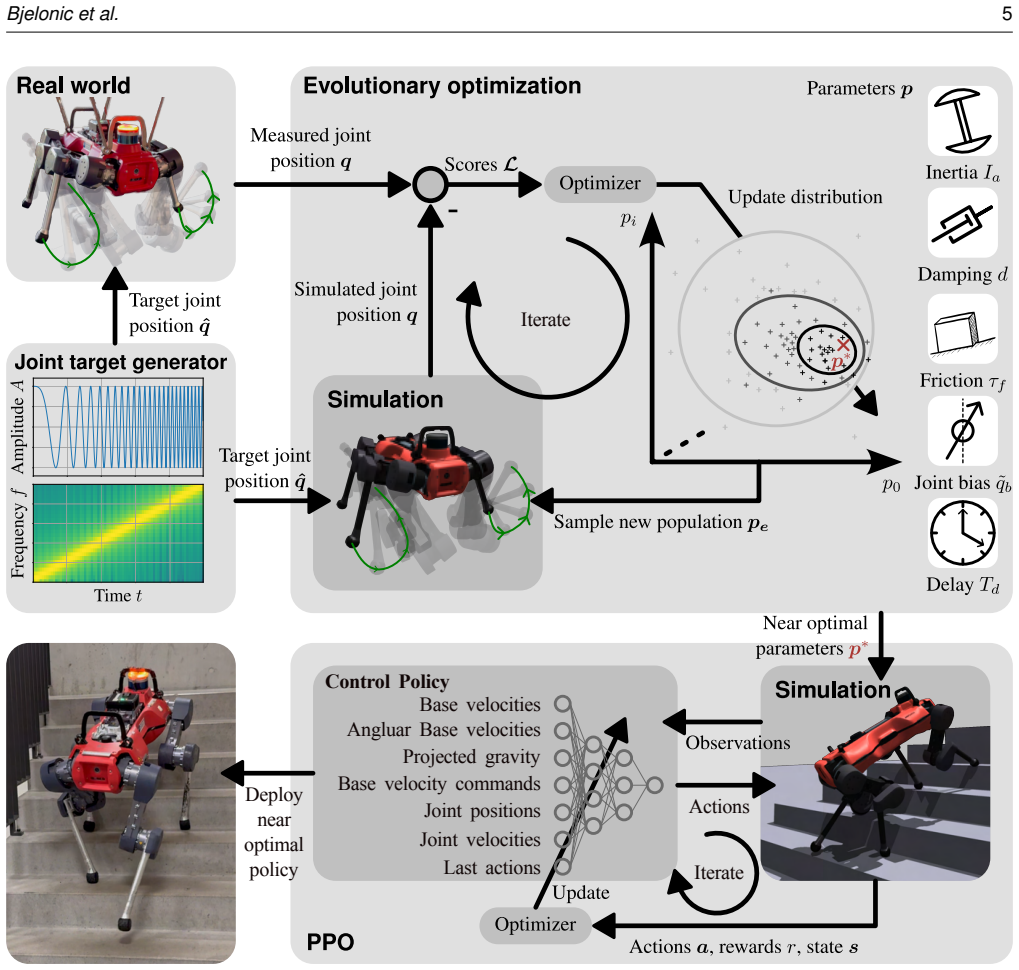
The engine of the argument is the per-joint closed-loop model in Eq. (6): each actuator is treated as a constant-inertia, constant-damping second-order system driven by saturated PD torque, with an added joint-position bias and a global command delay. The parameter vector $p=(I_a, d, \tau_f, \tilde{q}_b, T_d) \in \mathbb{R}^{4n+1}$ is fitted by minimizing the time-averaged squared joint-position error between real and simulated chirp replays, using CMA-ES over thousands of parallel environments. Once fitted, this model carries the sim-to-real transfer: the policy is trained in the fitted simulator with a compact reward whose energetic term is the PMSM electrical-plus-mechanical loss model, and it is deployed without dynamics randomization.
What would settle it
Fit the 4n+1 parameters from in-air chirps, then stand the robot on a force plate and inject a known PD torque perturbation during stance; if the simulated joint response diverges from the measured one as posture changes while the in-air fit is held fixed, the claim that in-air data suffices for contact tasks fails. A second decisive check is to train the PACE policy with no dynamics randomization and find any terrain or speed at which it fails while a randomization-trained policy succeeds.
Extended reading notes
Core claim
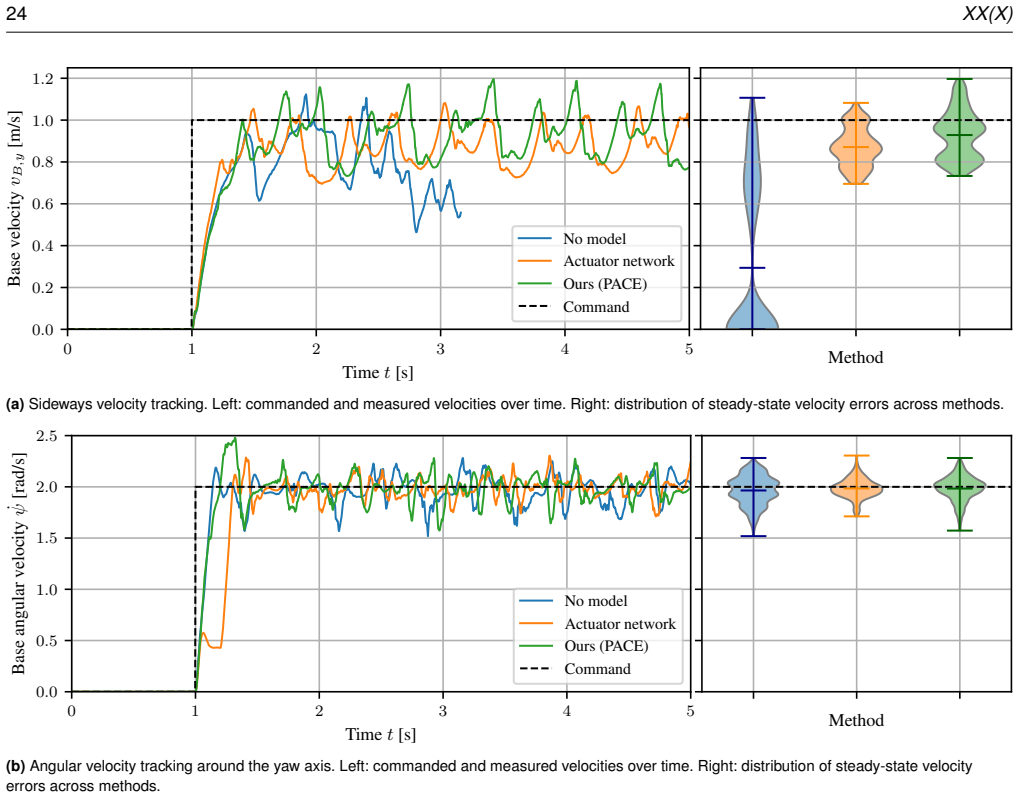
The paper's central discovery is a bottom-up identification recipe, called PACE: suspend the robot, drive all joints with chirp signals, replay the commands in a massively parallel simulator, and use evolutionary search to fit per-joint armature inertia, viscous damping, Coulomb friction, and joint bias, together with one global command delay. The fitted simulator reproduces in-air joint trajectories nearly exactly, generalizes to unseen PD gains and trajectories, and then serves as the training environment for a blind policy with a four-term reward built around a physics-grounded PMSM loss model. Deployed zero-shot on hardware, the policy walks, runs, balances on two legs, and climbs stairs; on ANYmal it lowers the cost of transport from 1.86 to 1.27 and extends a full-charge run from 2.64 km to 4.12 km. The same parameterization is reported to fit both open and closed platforms.
Load-bearing premise
The load-bearing premise is that a constant inertia and damping measured while the legs swing freely in air remain the right joint dynamics when the feet are on the ground, even though the effective inertia at each joint is then dominated by the body mass and varies with posture.
Editorial extensions
If this is right
- Robots without joint-torque sensors can obtain deployable locomotion policies from about 20 seconds of encoder-only, in-air data, removing a practical barrier for small or closed platforms.
- Because dynamics randomization is no longer needed, policies trained in the fitted simulator can exploit the machine's actual dynamics, producing the reported straighter-knee gaits and the ANYmal cost-of-transport drop to 1.27.
- The same 4n+1 parameterization is reported to transfer across platforms, from a 52 kg quadruped to a 4 kg largely 3D-printed one, suggesting the identification is not tied to one drive design.
- With the model fitted, the remaining ceiling on running speed is hardware, the battery current limit, rather than model error, which shifts the practical bottleneck to power electronics and sensing.
Reading between the lines
- The paper leaves implicit that the constant-parameter model may saturate at higher step frequencies or on strongly varying terrain, since the effective inertia at each joint changes with stance posture; a testable extension is to add a posture-dependent inertia term and see whether it widens the no-randomization envelope.
- The identification recipe is not obviously limited to quadrupeds: any articulated robot with PMSM drives and encoder-only joint sensing could in principle be fit from fixed-base chirps, so the claim suggests a general sim-to-real shortcut for arms and humanoids.
- A head-to-head study of the same policy with and without dynamics randomization on identical terrain could separate how much of the 32 percent cost-of-transport gain comes from removing randomization versus from the energy reward.
- Temperature and wear will shift the fitted parameters over time, so a lightweight online update of the global scale of the inertia and damping terms is a natural follow-up that the paper names as future work.
Signed reviews
Editorial analysis
A structured set of objections, weighed in public.
Referee Report
Summary. The paper proposes PACE, a sim-to-real framework for legged robots. The method identifies a compact per-joint parameter set (armature inertia, viscous damping, Coulomb friction, joint bias, and a global delay; 4n+1 parameters total) by fitting simulated fixed-base, in-air joint trajectories to real encoder-only chirp data using CMA-ES in massively parallel simulation. Policies are then trained with PPO in the fitted simulator without dynamics randomization, using a four-term reward that includes a physics-based electrical and mechanical loss model. The authors validate the pipeline bottom-up on a single drive, on full robots in air, and in on-ground locomotion on ANYmal, TYTAN, and MINIMAL, with additional deployments on ten other robots. They report a 32% reduction in ANYmal's full Cost of Transport to 1.27, and a TYTAN CoT of 0.97, measured on a 400 m running track via battery state of charge.
Significance. If the central claims hold, the paper would make a valuable practical contribution: roughly 20 seconds of encoder-only in-air data per robot would suffice to train deployable, blind locomotion policies without dynamics randomization, while also improving energy efficiency through a first-principle energy reward. The bottom-up validation is a genuine strength: the single-drive experiments recover analytic inertia values within 2--15%, the full-robot in-air comparison shows clear improvement over a URDF-only baseline and competitive behavior against a learned actuator network, and the cross-platform deployment across three primary and ten additional robots is impressive. The promise of open-sourced code, models, and data would enhance reproducibility. However, the two headline claims -- that in-air identification transfers to stance without randomization, and that the 32% CoT reduction is attributable to the proposed method -- are not yet established by the experiments as presented.
major comments (3)
- [Section 5, Section 2.2, Appendix B] The central takeaway (Section 6) asserts that constant per-joint parameters {Ia, d, tau_f, q_tilde_b, Td} identified from fixed-base, zero-contact in-air data are sufficient to eliminate dynamics randomization in stance. Section 2.2 itself concedes that load-independent damping is 'common but imperfect' and that torque--current maps can be state dependent, and Appendix B (Fig. 23c) shows that the effective inertia at the HFE joint during horizontal on-ground motion reaches roughly 8--10 kg m^2, orders of magnitude above the in-air values. Section 4.1.2 further reports a full-robot Ia about four times the single-drive value, indicating that the fitted inertia absorbs configuration-dependent link and compensation effects. The manuscript offers no experiment that re-identifies the parameters under load, compares simulated stance torques against measured torques on a torque-instrumented platform, or otherwise tests whether the load-independence assumption holds during contact. Since PACE deliberately omits dynamics randomization as a safety net, this extrapolation is load-bearing and needs direct evidence rather than the single-sentence assertion 'In-air data suffices for contact tasks.'
- [Section 3.3.3, Table 3, Abstract] The headline 32% Cost of Transport reduction compares ANYmal D (CoT 1.27) with ANYmal C (CoT 1.86) from the previously published reference [71], not with a same-hardware baseline. Table 3 shows that the two runs also differ in ambient temperature (26 deg C vs 10 deg C), and ANYmal C and ANYmal D may differ in actuators, firmware, mass, and controller generation. The entire reduction is attributed to PACE without controlling for these factors. To support the abstract's claim, the authors need a controlled comparison on the same robot unit, for example running the actuator-network baseline or a domain-randomized baseline on the same ANYmal D with the same reward and track protocol, or running PACE on ANYmal C, or otherwise demonstrating that hardware/firmware/temperature differences do not explain the CoT gap.
- [Section 2.3.3, Table 4] The paper claims the physics-grounded energy reward contributes to the reported efficiency gains, but no ablation isolates the effect of the energy term. The reward scales and scheduling (c_v, c_e, c_ftd, c_c, lambda half-life) are free parameters listed in Eq. (20) and Table 2, and P_pot in Eq. (14) averages to zero over flat cyclic locomotion, so it is unclear how much of the improvement comes from the energetic reward versus the fitted simulator enabling different gaits. Since one of the four stated contributions is the energetic assessment, an ablation on at least one platform -- same fitted simulator with and without the energy term, or with a torque-squared proxy -- measured by battery CoT would quantify this contribution.
minor comments (5)
- [Abstract and Data Accessibility Statement] The abstract states that all code, models, and datasets are publicly available, while the Data Accessibility Statement says the source code 'will be released soon' and the text elsewhere says 'will be released'; please align these statements.
- [Table 5] The header for the armature row reads 'Armature I_a [10^-3 kg m^3]'; the unit should be kg m^2, not kg m^3.
- [Section 6 and Section 4.2.4] The text refers to 'current limits (Section 12)', which appears to be an incorrect internal reference; it should point to Figure 12 or Section 4.2.4 where the 32 A battery limit is described.
- [Section 5] In the discussion of knee extension, the text says 'Table 4.2.3'; this should be 'Table 4'.
- [Appendix B, Eq. (42)] Equation (42) appears to have a typo: the inertia term should contain sin^2(q_k/2), not sin(q_k/2), based on the derivation from Eqs. (34)--(40).
Circularity Check
No significant circularity: the in-air parameter fit is an input to the simulator, while the headline transfer and CoT results are measured on hardware from battery state-of-charge and state estimation, not reconstructed from the fit.
full rationale
The paper's central derivation is not circular. The parameter vector p = [Ia, d, tau_f, q_tilde_b, Td] is optimized against an explicit in-air trajectory-matching objective (Eqs. 3-4), and the fitted quantities are joint-position tracking errors, not the deployment metrics (base-velocity tracking, zero-shot locomotion success, or Cost of Transport). The CoT reduction to 1.27 is measured from battery state-of-charge over a 400 m track (Eqs. 25-27), using hardware constants R, k_i, r in the energy model (Eq. 12); it is not derived from the fitted parameters by construction. The energy reward penalizes a physical loss model and is not fitted to the reported CoT. The paper's heavy self-citation (refs 20, 32, 45, 71) supplies baselines, RL infrastructure, reward templates, and a track protocol, but none of these is a load-bearing uniqueness theorem or an unverified ansatz smuggled in by citation; the core claim is supported by direct hardware deployment across three platforms and ten additional systems. The skeptic's concern that actuator parameters fitted in air may not remain valid under stance loads (Appendix B, Fig. 23) is an extrapolation-risk/correctness criticism, not a circularity: the ground behavior is not equivalent to the in-air fit by construction, and the paper explicitly lists load-independence as an empirically-satisfied assumption rather than as a definitional identity. Eq. (7) is used to argue for fixing PD gains during identification, which is an identifiability precaution, not a circular reduction. Therefore no specific circular step can be exhibited, and the appropriate finding is no significant circularity.
Assumptions & free parameters
free parameters (6)
- Per-joint armature inertia I_a =
Table 5, e.g. ANYmal 39-89 x10^-3 kg m^2, TYTAN HFE 106-120 x10^-3 kg m^2
- Per-joint viscous damping d =
Table 5, e.g. ANYmal 4.3-5.5, TYTAN 0.17-3.9 N m s rad^-1
- Per-joint Coulomb friction tau_f =
Table 5, e.g. ANYmal 0.0029-0.045 in normalized units
- Per-joint joint position bias q_bias =
Table 5, values in radians around +/-0.03
- Global command delay T_d =
7.5 ms for TYTAN and ANYmal; 0.0 for MINIMAL
- Reward scales and scheduling (c_v, c_e, c_ftd, c_c, lambda half-life) =
Table 2: c_v=0.2, c_e=-16e-5 (TYTAN/ANYmal) or -128e-5 (MINIMAL), c_c=-1.0, c_ftd=-0.1; half-life 500 iterations
assumptions (6)
- domain assumption The per-joint closed loop can be modeled as Ia*qdd + d*qd = sat(P*(qhat - q + qb) - D*qd + tau_comp) + tau_f (Eq. 6)
- domain assumption In-air fixed-base identification transfers to on-ground stance despite base-inertia dominance
- domain assumption High-bandwidth current control or LTI-approximable drive with the inner torque loop as near-unit gain
- domain assumption Electrical losses dominated by q-axis current with negligible i_d and constant R, k_i, gear ratio (Eq. 12)
- domain assumption Mild temperature dependence and sufficient structural stiffness during data collection
- domain assumption Correct kinematics (URDF/USD, frames) and an adequate rigid-body model in the simulator
Cite this review
Pith. "Pith review of Towards bridging the gap: Systematic sim-to-real transfer for diverse legged robots." pith.science (2026). https://pith.science/paper/JYTU36PO
@misc{pith2026250906342,
  author       = {Pith},
  title        = {Pith review of: Towards bridging the gap: Systematic sim-to-real transfer for diverse legged robots},
  year         = {2026},
  howpublished = {\url{https://pith.science/paper/JYTU36PO}},
  note         = {Machine review of arXiv:2509.06342}
}
read the original abstract
Legged robots must achieve both robust locomotion and energy efficiency to be practical in real-world environments. Yet controllers trained in simulation often fail to transfer reliably, and most existing approaches neglect actuator-specific energy losses or depend on complex, hand-tuned reward formulations. We propose a framework that integrates sim-to-real reinforcement learning with a physics-grounded energy model for permanent magnet synchronous motors. The framework requires a minimal parameter set to capture the simulation-to-reality gap and employs a compact four-term reward with a first-principle-based energetic loss formulation that balances electrical and mechanical dissipation. We evaluate and validate the approach through a bottom-up dynamic parameter identification study, spanning actuators, full-robot in-air trajectories and on-ground locomotion. The framework is tested on three primary platforms and deployed on ten additional robots, demonstrating reliable policy transfer without randomization of dynamic parameters. Our method improves energetic efficiency over state-of-the-art methods, achieving a 32 percent reduction in the full Cost of Transport of ANYmal (value 1.27). All code, models, and datasets are publicly available.
Figures


Figures from the paper (18 more)




Forward citations
Cited by 3 Pith papers
-
Mask2Real-WM: Segmentation Masks as a Sim-to-Real Bridge for Controllable Dexterous World Models
Segmentation-space dynamics pretrained on 50+ hours of simulation, then fine-tuned on under 2.5 hours of real data, plus a ControlNet RGB renderer, give per-DoF controllability across a 23-DoF dexterous hand.
-
Actuator Reality Shaping for Zero-Shot Sim-to-Real Robot Learning
A per-joint 2-DoF feedforward–feedback controller with disturbance observer shapes real actuators to match idealized second-order sim dynamics, enabling zero-shot RL policy transfer.
-
Efficient Real-World Online Reinforcement Learning for Robot Manipulation via Centralized Training and Critic Decomposition
A reinforcement learning framework that shares a decomposed critic between arm and gripper policies improves real-world pick-and-place success rates by 20 to 70 percentage points over a strong baseline.
Reference graph
Works this paper leans on
-
[71]
Bjelonic, F., J. Lee, P. Arm, D. Sako, D. Tateo, J. Peters, and M. Hutter. Learning-based design and control for quadrupedal robots with parallel-elastic actuators.IEEE Robotics and Automation Letters, V ol. 8, No. 3, 2023, pp. 1611–1618
work page 2023
-
[1]
Hutter, M., C. Gehring, A. Lauber, F. Gunther, C. D. Bellicoso, V . Tsounis, P. Fankhauser, R. Diethelm, S. Bachmann, M. Bl ¨osch, et al. Anymal-toward legged robots for harsh environments.Advanced Robotics, V ol. 31, No. 17, 2017, pp. 918–931
work page 2017
-
[2]
Unitree Robotics. Motor SDK Development Guide. Online:https://support.unitree.com/home/en/ Motor_SDK_Dev_Guide/overview, 2025. Accessed: Aug. 21, 2025
work page 2025
-
[3]
Aractingi, M., P.-A. L ´eziart, T. Flayols, J. Perez, T. Silander, and P. Sou `eres. Controlling the solo12 quadruped robot with deep reinforcement learning.scientific Reports, V ol. 13, No. 1, 2023, p. 11945
work page 2023
-
[4]
G.A low cost modular actuator for dynamic robots
Katz, B. G.A low cost modular actuator for dynamic robots. Ph.D. thesis, Massachusetts Institute of Technology, 2018
work page 2018
-
[5]
Liu, D., F. Yang, X. Liao, and X. Lyu. Diablo: A 6-dof wheeled bipedal robot composed entirely of direct-drive joints. In2024 IEEE/RSJ International Conference on Intelligent Robots and Systems (IROS). IEEE, 2024, pp. 3605–3612
work page 2024
-
[6]
Derammelaere, S., M. Haemers, J. De Viaene, F. Verbelen, and K. Stockman. A quantitative comparison between BLDC, PMSM, brushed DC and stepping motor technologies. In 2016 19th International Conference on Electrical Machines and Systems (ICEMS). Ieee, 2016, pp. 1–5
work page 2016
-
[7]
Gamazo-Real, J. C., E. V ´azquez-S´anchez, and J. G ´omez-Gil. Position and speed control of brushless DC motors using sensorless techniques and application trends.sensors, V ol. 10, No. 7, 2010, pp. 6901–6947
work page 2010
Show all 73 references
-
[8]
Clary, J
Xie, Z., P. Clary, J. Dao, P. Morais, J. Hurst, and M. Panne. Learning locomotion skills for cassie: Iterative design and sim- to-real. InConference on Robot Learning. PMLR, 2020, pp. 317–329
2020
-
[9]
Li, Y ., J. Li, W. Fu, and Y . Wu. Learning agile bipedal motions on a quadrupedal robot. In2024 IEEE International Conference on Robotics and Automation (ICRA). IEEE, 2024, pp. 9735– 9742. Prepared usingTRR.cls 18 XX(X)
2024
-
[10]
Bellegarda, G., Y . Chen, Z. Liu, and Q. Nguyen. Robust high- speed running for quadruped robots via deep reinforcement learning. In2022 IEEE/RSJ International Conference on Intelligent Robots and Systems (IROS). IEEE, 2022, pp. 10364– 10370
2022
-
[11]
Peng, X. B., E. Coumans, T. Zhang, T.-W. Lee, J. Tan, and S. Levine. Learning agile robotic locomotion skills by imitating animals.arXiv preprint arXiv:2004.00784
2004 arXiv
-
[12]
Allshire, V
Handa, A., A. Allshire, V . Makoviychuk, A. Petrenko, R. Singh, J. Liu, D. Makoviichuk, K. Van Wyk, A. Zhurkevich, B. Sundaralingam, et al. Dextreme: Transfer of agile in- hand manipulation from simulation to reality. In2023 IEEE International Conference on Robotics and Automa...
2023
-
[13]
Mehta, B., M. Diaz, F. Golemo, C. J. Pal, and L. Paull. Active domain randomization. InConference on Robot Learning. PMLR, 2020, pp. 1162–1176
2020
-
[14]
Ramos, F., R. C. Possas, and D. Fox. Bayessim: adaptive domain randomization via probabilistic inference for robotics simulators.arXiv preprint arXiv:1906.01728
1906 arXiv
-
[15]
Zhang, T
Shi, F., C. Zhang, T. Miki, J. Lee, M. Hutter, and S. Coros. Rethinking robustness assessment: Adversarial attacks on learning-based quadrupedal locomotion controllers.arXiv preprint arXiv:2405.12424
-
[16]
Arndt, and V
Tiboni, G., K. Arndt, and V . Kyrki. DROPO: Sim-to-real transfer with offline domain randomization.Robotics and Autonomous Systems, V ol. 166, 2023, p. 104432
2023
-
[17]
Ajay, A., J. Wu, N. Fazeli, M. Bauza, L. P. Kaelbling, J. B. Tenenbaum, and A. Rodriguez. Augmenting physical simulators with stochastic neural networks: Case study of planar pushing and bouncing. In2018 IEEE/RSJ International Conference on Intelligent Robots and Systems (IROS...
2018
-
[18]
Zhang, D
Jiang, Y ., T. Zhang, D. Ho, Y . Bai, C. K. Liu, S. Levine, and J. Tan. Simgan: Hybrid simulator identification for domain adaptation via adversarial reinforcement learning. In2021 IEEE International Conference on Robotics and Automation (ICRA). IEEE, 2021, pp. 2884–2890
2021
-
[19]
Golemo, F., A. A. Taiga, A. Courville, and P.-Y . Oudeyer. Sim- to-real transfer with neural-augmented robot simulation. In Conference on Robot Learning. PMLR, 2018, pp. 817–828
2018
-
[20]
Hwangbo, J., J. Lee, A. Dosovitskiy, D. Bellicoso, V . Tsounis, V . Koltun, and M. Hutter. Learning agile and dynamic motor skills for legged robots.Science Robotics, V ol. 4, No. 26, 2019, p. eaau5872
2019
-
[21]
Fey, N., G. B. Margolis, M. Peticco, and P. Agrawal. Bridging the Sim-to-Real Gap for Athletic Loco-Manipulation.arXiv preprint arXiv:2502.10894
-
[22]
Miller, A., F. Yu, M. Brauckmann, and F. Farshidian. High- Performance Reinforcement Learning on Spot: Optimizing Simulation Parameters with Distributional Measures.arXiv preprint arXiv:2504.17857
-
[23]
He, T., J. Gao, W. Xiao, Y . Zhang, Z. Wang, J. Wang, Z. Luo, G. He, N. Sobanbab, C. Pan, et al. Asap: Aligning simulation and real-world physics for learning agile humanoid whole-body skills.arXiv preprint arXiv:2502.01143
-
[24]
Sobanbabu, N., G. He, T. He, Y . Yang, and G. Shi. Sampling- based system identification with active exploration for legged robot sim2real learning.arXiv preprint arXiv:2505.14266
-
[25]
Tsai, Y .-Y ., H. Xu, Z. Ding, C. Zhang, E. Johns, and B. Huang. Droid: Minimizing the reality gap using single-shot human demonstration.IEEE Robotics and Automation Letters, V ol. 6, No. 2, 2021, pp. 3168–3175
2021
-
[26]
Sontakke, N., H. Chae, S. Lee, T. Huang, D. W. Hong, and S. Hal. Residual physics learning and system identification for sim-to-real transfer of policies on buoyancy assisted legged robots. In2023 IEEE/RSJ International Conference on Intelligent Robots and Systems (IROS). IEEE...
2023
-
[27]
Escontrela, D
Wu, P., A. Escontrela, D. Hafner, P. Abbeel, and K. Goldberg. Daydreamer: World models for physical robot learning. In Conference on robot learning. PMLR, 2023, pp. 2226–2240
2023
-
[28]
Krause, and M
Li, C., A. Krause, and M. Hutter. Offline Robotic World Model: Learning Robotic Policies without a Physics Simulator.arXiv preprint arXiv:2504.16680
-
[29]
Hanna, J. P., S. Desai, H. Karnan, G. Warnell, and P. Stone. Grounded action transformation for sim-to-real reinforcement learning.Machine Learning, V ol. 110, No. 9, 2021, pp. 2469– 2499
2021
-
[30]
Smith, L., J. C. Kew, X. B. Peng, S. Ha, J. Tan, and S. Levine. Legged robots that keep on learning: Fine-tuning locomotion policies in the real world. In2022 international conference on robotics and automation (ICRA). IEEE, 2022, pp. 1593–1599
2022
-
[31]
Song, X., Y . Yang, K. Choromanski, K. Caluwaerts, W. Gao, C. Finn, and J. Tan. Rapidly adaptable legged robots via evolutionary meta-learning. In2020 IEEE/RSJ International Conference on Intelligent Robots and Systems (IROS). IEEE, 2020, pp. 3769–3776
2020
-
[32]
Hwangbo, L
Lee, J., J. Hwangbo, L. Wellhausen, V . Koltun, and M. Hutter. Learning quadrupedal locomotion over challenging terrain. Science robotics, V ol. 5, No. 47, 2020, p. eabc5986
2020
-
[33]
Ramos, G
Muratore, F., F. Ramos, G. Turk, W. Yu, M. Gienger, and J. Peters. Robot learning from randomized simulations: A review.Frontiers in Robotics and AI, V ol. 9, 2022, p. 799893
2022
-
[34]
Ju, H., R. Juan, R. Gomez, K. Nakamura, and G. Li. Transferring policy of deep reinforcement learning from simulation to reality for robotics.Nature Machine Intelligence, V ol. 4, No. 12, 2022, pp. 1077–1087
2022
-
[35]
Jenelten, S
Grandia, R., F. Jenelten, S. Yang, F. Farshidian, and M. Hutter. Perceptive locomotion through nonlinear model-predictive control.IEEE Transactions on Robotics, V ol. 39, No. 5, 2023, pp. 3402–3421
2023
-
[36]
Miki, T., J. Lee, J. Hwangbo, L. Wellhausen, V . Koltun, and M. Hutter. Learning robust perceptive locomotion for quadrupedal robots in the wild.Science Robotics, V ol. 7, No. 62, 2022, p. eabk2822. Prepared usingTRR.cls Bjelonic et al. 19
2022
-
[37]
Xue, H., C. Pan, Z. Yi, G. Qu, and G. Shi. Full-order sampling- based mpc for torque-level locomotion control via diffusion- style annealing.arXiv preprint arXiv:2409.15610
-
[38]
Rudin, N., J. He, J. Aurand, and M. Hutter. Parkour in the Wild: Learning a General and Extensible Agile Locomotion Policy Using Multi-expert Distillation and RL Fine-tuning.arXiv preprint arXiv:2505.11164
-
[39]
Wolski, P
Schulman, J., F. Wolski, P. Dhariwal, A. Radford, and O. Klimov. Proximal policy optimization algorithms.arXiv preprint arXiv:1707.06347
-
[40]
Ding, and X
Liu, Y ., J. Ding, and X. Liu. Ipo: Interior-point policy optimization under constraints. InProceedings of the AAAI conference on artificial intelligence, V ol. 34. 2020, pp. 4940– 4947
2020
-
[41]
Kim, Y ., H. Oh, J. Lee, J. Choi, G. Ji, M. Jung, D. Youm, and J. Hwangbo. Not only rewards but also constraints: Applications on legged robot locomotion.IEEE Transactions on Robotics, V ol. 40, 2024, pp. 2984–3003
2024
-
[42]
Kaelbling, L. P., M. L. Littman, and A. R. Cassandra. Planning and acting in partially observable stochastic domains.Artificial intelligence, V ol. 101, No. 1-2, 1998, pp. 99–134
1998
-
[43]
Hausknecht, M. J. and P. Stone. Deep Recurrent Q-Learning for Partially Observable MDPs. InAAAI fall symposia, V ol. 45. 2015, p. 141
2015
-
[44]
Andrychowicz, P
Pinto, L., M. Andrychowicz, P. Welinder, W. Zaremba, and P. Abbeel. Asymmetric actor critic for image-based robot learning.arXiv preprint arXiv:1710.06542
-
[45]
Hoeller, P
Rudin, N., D. Hoeller, P. Reist, and M. Hutter. Learning to Walk in Minutes Using Massively Parallel Deep Reinforcement Learning. InProceedings of the 5th Conference on Robot Learning,Proceedings of Machine Learning Research, V ol. 164 (A. Faust, D. Hsu, and G. Neumann, eds.)....
2022
-
[46]
Ji, G., J. Mun, H. Kim, and J. Hwangbo. Concurrent training of a control policy and a state estimator for dynamic and robust legged locomotion.IEEE Robotics and Automation Letters, V ol. 7, No. 2, 2022, pp. 4630–4637
2022
-
[47]
Shin, Y .-H., T.-G. Song, G. Ji, and H.-W. Park. Actuator- constrained reinforcement learning for high-speed quadrupedal locomotion.arXiv preprint arXiv:2312.17507
-
[48]
Bellegarda, and A
Shafiee, M., G. Bellegarda, and A. Ijspeert. Manyquadrupeds: Learning a single locomotion policy for diverse quadruped robots. In2024 IEEE International Conference on Robotics and Automation (ICRA). IEEE, 2024, pp. 3471–3477
2024
-
[49]
Ma, Y . J., W. Liang, G. Wang, D.-A. Huang, O. Bastani, D. Jayaraman, Y . Zhu, L. Fan, and A. Anandkumar. Eureka: Human-level reward design via coding large language models. arXiv preprint arXiv:2310.12931
-
[50]
Gupta, J
Eysenbach, B., A. Gupta, J. Ibarz, and S. Levine. Diversity is all you need: Learning skills without a reward function.arXiv preprint arXiv:1802.06070
-
[51]
Zhang, E
Yang, Y ., T. Zhang, E. Coumans, J. Tan, and B. Boots. Fast and efficient locomotion via learned gait transitions. InConference on robot learning. PMLR, 2022, pp. 773–783
2022
-
[52]
Wensing, P. M., A. Wang, S. Seok, D. Otten, J. Lang, and S. Kim. Proprioceptive actuator design in the mit cheetah: Impact mitigation and high-bandwidth physical interaction for dynamic legged robots.Ieee transactions on robotics, V ol. 33, No. 3, 2017, pp. 509–522
2017
-
[53]
Flayols, A
Fadini, G., T. Flayols, A. Del Prete, N. Mansard, and P. Sou`eres. Computational design of energy-efficient legged robots: Optimizing for size and actuators. In2021 IEEE International Conference on Robotics and Automation (ICRA). IEEE, 2021, pp. 9898–9904
2021
-
[54]
Chane-Sane, L
Roux, C., E. Chane-Sane, L. De Matte ¨ıs, T. Flayols, J. Manhes, O. Stasse, and P. Sou`eres. Constrained Reinforcement Learning for Unstable Point-Feet Bipedal Locomotion Applied to the Bolt Robot.arXiv preprint arXiv:2508.02194
-
[55]
Ragazzo, G
Ferrari, S., P. Ragazzo, G. Dilevrano, and G. Pellegrino. Flux and loss map based evaluation of the efficiency map of synchronous machines.IEEE Transactions on Industry Applications, V ol. 59, No. 2, 2022, pp. 1500–1509
2022
-
[56]
Vicari, F
Valsecchi, G., A. Vicari, F. Tischhauser, M. Garabini, and M. Hutter. Accurate power consumption estimation method makes walking robots energy efficient and quiet. In2024 IEEE/RSJ International Conference on Intelligent Robots and Systems (IROS). IEEE, 2024, pp. 13282–13288
2024
-
[57]
Nomura, M. and M. Shibata. cmaes : A Simple yet Practical Python Library for CMA-ES.arXiv preprint arXiv:2402.01373
-
[58]
Tahmassebi, W
Telikani, A., A. Tahmassebi, W. Banzhaf, and A. H. Gandomi. Evolutionary machine learning: A survey.ACM Computing Surveys (CSUR), V ol. 54, No. 8, 2021, pp. 1–35
2021
-
[59]
The CMA evolution strategy: A tutorial.arXiv preprint arXiv:1604.00772
Hansen, N. The CMA evolution strategy: A tutorial.arXiv preprint arXiv:1604.00772
-
[60]
Hansen, N. and A. Ostermeier. Completely derandomized self- adaptation in evolution strategies.Evolutionary computation, V ol. 9, No. 2, 2001, pp. 159–195
2001
-
[61]
Rudin, L
Valsecchi, G., N. Rudin, L. Nachtigall, K. Mayer, F. Tis- chhauser, and M. Hutter. Barry: a high-payload and agile quadruped robot.IEEE Robotics and Automation Letters, V ol. 8, No. 11, 2023, pp. 6939–6946
2023
-
[62]
Gehring, D
Hutter, M., C. Gehring, D. Jud, A. Lauber, C. D. Bellicoso, V . Tsounis, J. Hwangbo, K. Bodie, P. Fankhauser, M. Bloesch, et al. Anymal-a highly mobile and dynamic quadrupedal robot. InIEEE/RSJ International conference on intelligent robots and systems (IROS). 2016, pp. 38–44
2016
-
[63]
Watanabe, R., T. Miki, F. Shi, Y . Kadokawa, F. Bjelonic, K. Kawaharazuka, A. Cramariuc, and M. Hutter. Learning quiet walking for a small home robot.arXiv preprint arXiv:2502.10983
-
[64]
Bellicoso, C. D., K. Kr ¨amer, M. St¨auble, D. Sako, F. Jenelten, M. Bjelonic, and M. Hutter. Alma-articulated locomotion and manipulation for a torque-controllable robot. In2019 International conference on robotics and automation (ICRA). IEEE, 2019, pp. 8477–8483. Prepared us...
2019
-
[65]
Cramariuc, F
Ma, Y ., A. Cramariuc, F. Farshidian, and M. Hutter. Learning coordinated badminton skills for legged manipulators.Science Robotics, V ol. 10, No. 102, 2025, p. eadu3922
2025
-
[66]
Buehler, M
Spiridonov, A., F. Buehler, M. Berclaz, V . Schelbert, J. Geurts, E. Krasnova, E. Steinke, J. Toma, J. Wuethrich, R. Polat, et al. Spacehopper: A small-scale legged robot for exploring low- gravity celestial bodies. In2024 IEEE International Conference on Robotics and Automati...
2024
-
[67]
Hildebrandt, K
Arnold, M., L. Hildebrandt, K. Janssen, E. Ongan, P. B ¨urge, ´A. G. G ´abriel, J. Kennedy, R. Lolla, Q. Oppliger, M. Schaaf, et al. LEV A: A high-mobility logistic vehicle with legged suspension.arXiv preprint arXiv:2503.10028
-
[68]
Eugster, N
Leuthard, S., T. Eugster, N. Faesch, R. Feingold, C. Flynn, M. Fritsche, N. H ¨urlimann, E. Morbach, F. Tischhauser, M. M ¨uller, et al. Magnecko: Design and Control of a Quadrupedal Magnetic Climbing Robot. InClimbing and Walking Robots Conference. Springer, 2024, pp. 55–67
2024
-
[69]
Zhang, F
He, J., C. Zhang, F. Jenelten, R. Grandia, M. B ¨Acher, and M. Hutter. Attention-Based Map Encoding for Learning Generalized Legged Locomotion.arXiv preprint arXiv:2506.09588
-
[70]
Gehring, and D
Hottiger, G., C. Gehring, and D. Bellicoso. signal logger: Signal logging and plotting tools for robotics.https: //github.com/ANYbotics/signal_logger, 2020. Accessed: 2025-07-09
2020
-
[72]
Bryce, C. M. and T. M. Williams. Comparative locomotor costs of domestic dogs reveal energetic economy of wolf-like breeds. Journal of Experimental Biology, V ol. 220, No. 2, 2017, pp. 312–321
2017
-
[73]
Springob, L. and J. Holtz. High-bandwidth current control for torque-ripple compensation in PM synchronous machines. IEEE Transactions on industrial electronics, V ol. 45, No. 5, 2002, pp. 713–721. A Voltage–Limited Torque Bandwidth of a PMSM Even with perfect control, a PMSM’...
2002
Reviewed August 15, 2026 · model on record in the stance chip above.
Discussion (0). Continue with ORCID to comment.