REVIEW 3 major objections 6 minor 38 references
Mask2Real-WM: Segmentation Masks as a Sim-to-Real Bridge for Controllable Dexterous World Models
T0 review · 3 major / 6 minor · reviewed 2026-07-11 · grok-4.5
Pith's one-line read Segmentation masks let a 23-DoF hand world model learn fine joint control from 50 h of simulation and under 2.5 h of real data.
desk verdict Solid systems paper: mask-space dynamics + ControlNet render gives real per-joint controllability on a 23-DoF hand with <2.5 h real data; the headline numbers rest on a thin human protocol. read the letter →
The pith
A machine-rendered reading of the paper's core claim, the machinery that carries it, and where it could break.
The reading
What carries the argument
The two-stage factorization of Mask2Real-WM: an action-conditioned dynamics model (WM1) that predicts future segmentation masks, pretrained on simulation and fine-tuned on real data, chained to a ControlNet-augmented Stable Video Diffusion renderer (WM2) that maps those masks to photorealistic multi-view RGB.
What would settle it
Re-run the single-DoF sinusoid protocol with more samples and multiple independent scorers; if the full model no longer clearly outscores the real-only and monolithic baselines on independent finger joints, the claim that mask dynamics plus sim pretraining are both required collapses.
Extended reading notes
Core claim
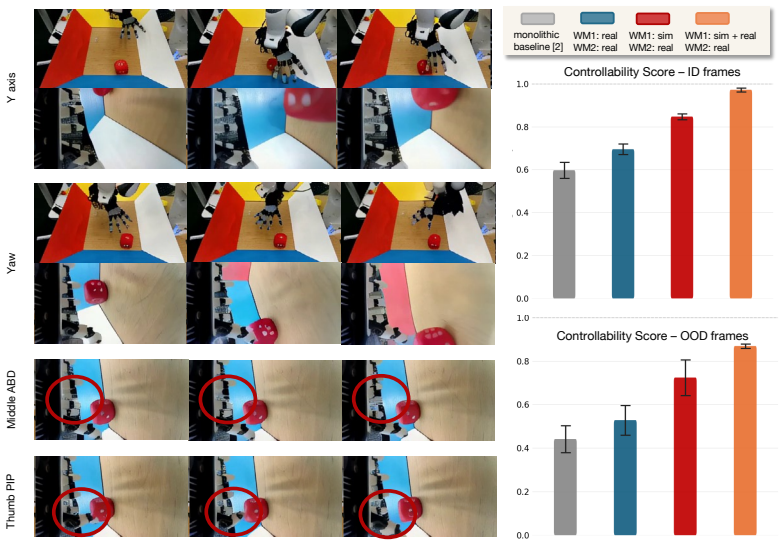
Mask conditioning and simulation pretraining of the dynamics model are both required for per-DoF action controllability across all 23 degrees of freedom of a dexterous hand. The full pipeline (simulation-pretrained then real-fine-tuned mask dynamics plus a real-data renderer) reaches roughly 0.95 in-distribution and 0.87 out-of-distribution controllability, while a real-only dynamics baseline and a monolithic video baseline capture broad motions but do not reliably reflect fine-grained, per-joint action effects.
Load-bearing premise
That a three-point human score of responses to single-joint sinusoids on only five in-distribution and five out-of-distribution samples is a stable measure of true per-DoF controllability.
Editorial analysis
A structured set of objections, weighed in public.
Referee Report
Summary. Mask2Real-WM is a two-stage action-conditioned world model for 23-DoF dexterous manipulation that factorizes future-frame prediction into (i) WM1, a video-diffusion dynamics model that predicts future segmentation masks from past masks and past/future actions, and (ii) WM2, a ControlNet-augmented Stable Video Diffusion renderer that paints photorealistic two-view RGB onto those masks. Because the sim-to-real gap is smaller in mask space, WM1 is pretrained on >50 h of IsaacLab synthetic data (MimicGen + exploratory sinusoids) and LoRA-fine-tuned on <2.5 h of real ORCA-hand demonstrations; WM2 is trained only on real data. The central experimental claim (Section 4.2, Figure 4) is that both mask conditioning and simulation pretraining are required for per-DoF action controllability across all 23 degrees of freedom, with the full model scoring ≈0.95 ID / ≈0.87 OOD versus substantially lower scores for real-only WM1 and a monolithic Ctrl-World-style baseline. Supporting analyses cover perceptual metrics under ID/OOD splits, WM2 conditioning ablations, sharpness (Laplacian variance), long-horizon rollouts, failure modes, and zero-shot transfer to objects unseen in real data.
Significance. Action-conditioned world models for high-DoF dexterous hands remain scarce because of data cost and contact complexity; a practical sim-to-real bridge that yields fine-grained action fidelity from a few hours of real data would be valuable for policy evaluation, planning, and data augmentation. The paper’s factorization is cleanly motivated, the ablations systematically vary WM1 training regime and WM2 conditioning, and the authors correctly diagnose blurry-prediction bias in pixel metrics via Laplacian sharpness (Appendix A/C). Strengths include an explicit GT-mask oracle isolating WM1 as the bottleneck (Appendix G), qualitative failure catalogs (Appendix E), and modular design notes (WM1 as lightweight dynamics checker). If the controllability results hold under a more rigorous protocol, the work would be a solid systems contribution to dexterous world models and a reusable template for mask-space midtraining.
major comments (3)
- Section 4.2 Protocol / Figure 4: The headline claim that mask conditioning and sim pretraining are both required for per-DoF controllability (0.68→0.95 ID, 0.51→0.87 OOD) rests almost entirely on a single independent evaluator’s 0/0.5/1 scores of single-component sinusoidal rollouts over only 5 ID + 5 OOD samples, then averaged across 23 dimensions. There is no inter-rater reliability, confidence interval, or objective proxy (e.g., predicted-mask IoU against a kinematics-driven mask, or recovered joint angles). Because real data lack isolated finger motion, any model that simply moves the correct finger more will score well under this probe; multi-joint coupling, contact-rich commands, and object-state consistency are never scored. This protocol is load-bearing for the abstract’s and Section 4.2’s central claim and needs strengthening (more samples, multiple raters or a calibrated object
- Section 4.2 and Appendix B vs. Section 5 Limitations: Controllability is defined purely on hand/EE response to free-space single-DoF sinusoids, yet the intended use cases (policy evaluation, planning) require faithful object-state prediction under contact and occlusion. Appendices E and G show that object vanishing/duplication in WM1 is the dominant failure mode and that WM2 is fine given GT masks. The paper should either (a) report an object-state controllability or contact-consistency metric under the same action-perturbation protocol, or (b) clearly scope the “per-DoF controllability” claim to hand kinematics and not imply readiness for policy evaluation without further object-dynamics work. As written, the gap between the scored claim and the acknowledged bottleneck is under-discussed in the main results.
- Section 4.3 / Figure 5 and Appendix A: On raw PSNR/SSIM/LPIPS the monolithic baseline is competitive or better on several OOD splits, which the authors attribute to blurry-prediction bias and support with Laplacian variance. That diagnosis is convincing, but the main text still leads with controllability numbers whose statistical reliability is unclear (see first major comment) while relegating the sharpness argument largely to the appendix. For the central “both required” narrative, the paper should either elevate a joint presentation of controllability + sharpness + mask-space metrics (Table 1) in the main results, or provide uncertainty estimates so readers can weigh the trade-off without relying on a single subjective score.
minor comments (6)
- Equation (2): The rendering term conditions on past RGB, full mask trajectory, and actions; the prose sometimes says WM2 is “mask-conditioned” without always noting residual action conditioning. Align wording with the equation and with the Figure 6 ablation labels.
- Figure 4: Controllability scores are reported as approximate (≈0.95, ≈0.87) without error bars or per-dimension breakdown in the main figure; Appendix B’s qualitative grid is helpful but does not replace quantitative per-DoF means ± variability.
- Section 3.1: Masks are described as R^{V×3×H×W} with a 3-class color vocabulary; clarify whether training uses hard RGB class colors only or soft/blurred labels beyond the stated σ=1.5 px on synthetic masks, and whether class imbalance (background dominance) is handled.
- Related Work: Concurrent MWM and BridgeV2W are appropriately distinguished; a short explicit comparison table (embodiment DoF, WAM vs. action-conditioned simulator, learned vs. URDF masks, sim pretraining) would help readers place the contribution.
- Appendix L / training: Batch sizes, GPU counts, and step counts are given; seed sensitivity and whether sim-only vs. sim+real used identical real fine-tune budgets for fair comparison could be stated once in the main experimental setup.
- Typos / polish: “midtraining” and “pretraining” are used interchangeably for the same sim stage; pick one term. “W AMs” spacing in the introduction is inconsistent. Acknowledgments still contain the CoRL-style placeholder paragraph.
Circularity Check
No significant circularity; empirical systems paper whose controllability and quality claims rest on held-out ablations and external baselines, not on definitions or self-fitted predictions.
full rationale
Mask2Real-WM is an engineering/systems paper that factorizes action-conditioned video prediction into a mask-space dynamics model (WM1) and a ControlNet-augmented RGB renderer (WM2), pretrains WM1 on >50 h of synthetic data, and fine-tunes on <2.5 h of real data. The central claims (mask conditioning + sim pretraining are both required for per-DoF controllability across 23 DoF; full model reaches ~0.95 ID / ~0.87 OOD) are supported by controlled ablations that change training regime or conditioning signals and by human-scored rollouts under single-DoF sinusoids plus standard perceptual metrics (PSNR/SSIM/LPIPS, Laplacian sharpness) on held-out ID/OOD splits. No equation defines a quantity in terms of the quantity it purports to predict; no free parameter is fitted to a subset of data and then re-labeled a prediction of a statistically forced related quantity; no uniqueness theorem or load-bearing premise is imported solely via overlapping-author citation; and the architecture (SVD + LoRA + ControlNet) is not a renaming of a known empirical pattern. Ordinary self-citations (own ORCA hand hardware, prior Ctrl-World baseline) are non-load-bearing. The evaluation protocol itself may be under-powered or subjective, but that is a correctness/validity concern, not circularity. The derivation chain is therefore self-contained against external benchmarks.
Assumptions & free parameters
free parameters (5)
- WM1 sim pretrain / real fine-tune steps and LRs =
55k@1e-4 then 45k@5e-6 (WM1); 70k@1e-4 (WM2)
- LoRA rank and alpha =
16 / 16
- Context k and horizon H, resolution =
k=5, H=5, 135x240
- Synthetic mask blur sigma =
1.5 px
- Conditional dropout rates for CFG =
10%/10%/5%
assumptions (5)
- domain assumption The sim-to-real gap is substantially smaller in 3-class segmentation mask space than in RGB, so dynamics learned in sim transfer after light real fine-tuning.
- domain assumption Off-the-shelf SAM 3 text-prompt masks provide sufficiently accurate, low-noise intermediate supervision for real data.
- ad hoc to paper A single independent evaluator’s 0/0.5/1 scores on sinusoidal single-DoF perturbations (5 ID + 5 OOD) average to a meaningful per-DoF controllability metric.
- domain assumption Stable Video Diffusion with frame-wise action cross-attention and ControlNet mask injection is an adequate generative backbone for multi-view robot video at the chosen resolution.
- domain assumption Simulation with system-identified PD/friction and ground-truth instance masks is geometrically/kinematically faithful enough for mask dynamics without photorealism.
invented entities (1)
-
Mask2Real-WM two-stage factorization (WM1 mask dynamics + WM2 ControlNet renderer)
Cite this review
Pith. "Pith review of Mask2Real-WM: Segmentation Masks as a Sim-to-Real Bridge for Controllable Dexterous World Models." pith.science (2026). https://pith.science/paper/YWUJEUVK
@misc{pith2026260704546,
  author       = {Pith},
  title        = {Pith review of: Mask2Real-WM: Segmentation Masks as a Sim-to-Real Bridge for Controllable Dexterous World Models},
  year         = {2026},
  howpublished = {\url{https://pith.science/paper/YWUJEUVK}},
  note         = {Machine review of arXiv:2607.04546}
}
read the original abstract
Action-conditioned world models allow robots to predict the future consequences of candidate actions without additional physical interaction, supporting policy evaluation, planning, and data augmentation. We present Mask2Real-WM, a two-stage action-conditioned world model for dexterous manipulation that decouples pixel prediction into a dynamics model and a rendering model. The dynamics model predicts future segmentation masks from past masks and 23-DoF action sequences. The rendering model maps the predicted masks to photorealistic RGB using a ControlNet-augmented Stable Video Diffusion backbone. The smaller sim-to-real gap in segmentation space enables the dynamics model to benefit from large-scale pretraining on over 50 h of synthetic simulation data, followed by fine-tuning on fewer than 2.5 h of real demonstrations. Experiments on a dexterous pick-and-place benchmark show that mask conditioning and simulation pretraining are both required for per-DoF action controllability across all 23 degrees of freedom. In contrast, monolithic baselines capture broad hand and end-effector trajectories but do not reliably reflect fine-grained, per-joint action effects.
Figures


Figures from the paper (21 more)


Reference graph
Works this paper leans on
-
[1]
B. Hou, G. Li, J. Jia, T. An, X. Guo, S. Leng, H. Geng, Y . Ze, T. Harada, P. Torr, O. Mees, M. Pollefeys, Z. Liu, J. Wu, P. Abbeel, J. Malik, Y . Du, and J. Yang. World model for robot learning: A comprehensive survey.arXiv preprint arXiv:2605.00080, 2026. URLhttps: //arxiv.org/abs/2605.00080
arXiv 2026
-
[2]
Y . Guo, L. X. Shi, J. Chen, and C. Finn. Ctrl-World: A controllable generative world model for robot manipulation. InInternational Conference on Learning Representations (ICLR), 2026. URLhttps://arxiv.org/abs/2510.10125
arXiv 2026
-
[3]
Y . Wang, R. Syed, F. Wu, M. Zhang, A. Onol, J. Barreiros, H. Nayyeri, T. Dear, H. Zhang, and Y . Li. Interactive world simulator for robot policy training and evaluation.arXiv preprint arXiv:2603.08546, 2026. URLhttps://arxiv.org/abs/2603.08546
arXiv 2026
-
[4]
R. G. Goswami, A. Bar, D. Fan, T.-Y . Yang, G. Zhou, P. Krishnamurthy, M. Rabbat, F. Khor- rami, and Y . LeCun. World models for learning dexterous hand-object interactions from human videos, 2026. URLhttps://arxiv.org/abs/2512.13644
arXiv 2026
- [5]
-
[6]
C. C. Christoph, M. Eberlein, F. Katsimalis, A. Roberti, A. Sympetheros, M. R. V ogt, D. Li- conti, C. Yang, B. G. Cangan, R. J. Hinchet, and R. K. Katzschmann. ORCA: An open-source, reliable, cost-effective, anthropomorphic robotic hand for uninterrupted dexterous task learn- ing, 2025. URLhttps://arxiv.org/abs/2504.04259
arXiv 2025
-
[7]
Y . Toshimitsu, B. Forrai, B. G. Cangan, U. Steger, M. Knecht, S. Weirich, and R. K. Katzschmann. Getting the ball rolling: Learning a dexterous policy for a biomimetic tendon- driven hand with rolling contact joints. InIEEE-RAS International Conference on Humanoid Robots (Humanoids), 2023. URLhttps://arxiv.org/abs/2308.02453
arXiv 2023
-
[8]
K. Shaw, A. Agarwal, and D. Pathak. LEAP hand: Low-cost, efficient, and anthropomorphic hand for robot learning. InRobotics: Science and Systems (RSS), 2023. URLhttps:// arxiv.org/abs/2309.06440
arXiv 2023
Show all 38 references
-
[9]
Wuji Hand: A 20-DoF direct-drive dexterous robotic hand
Wuji Technology. Wuji Hand: A 20-DoF direct-drive dexterous robotic hand. Product docu- mentation.https://wuji.tech, 2025. Wuji Technology, Shenzhen, China
2025
-
[10]
SharpaWave: A 22-DoF dexterous robotic hand with dynamic tactile array
Sharpa Robotics. SharpaWave: A 22-DoF dexterous robotic hand with dynamic tactile array. Product documentation.https://www.sharpa.com/pages/wave, 2025. Sharpa Robotics, Singapore
2025
-
[11]
Open X-embodiment: Robotic learning datasets and RT-X models
Open X-Embodiment Collaboration et al. Open X-embodiment: Robotic learning datasets and RT-X models. InIEEE International Conference on Robotics and Automation (ICRA), 2024. URLhttps://arxiv.org/abs/2310.08864
2024 arXiv
-
[12]
Khazatsky, K
A. Khazatsky, K. Pertsch, S. Nair, A. Balakrishna, S. Dasari, S. Karamcheti, S. Nasiriany, M. K. Srirama, L. Y . Chen, K. Ellis, et al. Droid: A large-scale in-the-wild robot manipulation dataset. 2024. 9
2024
-
[13]
Bruce, M
J. Bruce, M. D. Dennis, A. Edwards, J. Parker-Holder, Y . Shi, E. Hughes, M. Lai, A. Mavalankar, R. Steigerwald, C. Apps, Y . Aytar, S. M. E. Bechtle, F. Behbahani, S. C. Chan, N. Heess, L. Gonzalez, S. Osindero, S. Ozair, S. Reed, J. Zhang, K. Zolna, J. Clune, N. De Freitas, ...
2024
-
[14]
NVIDIA: Agarwal, A
N. NVIDIA: Agarwal, A. Ali, M. Bala, Y . Balaji, E. Barker, T. Cai, et al. Cosmos world foundation model platform for physical AI.arXiv preprint arXiv:2501.03575, 2025. URL https://arxiv.org/abs/2501.03575
2025 arXiv
-
[15]
NVIDIA: Ali, J
A. NVIDIA: Ali, J. Bai, M. Bala, Y . Balaji, A. Blakeman, T. Cai, J. Cao, et al. World simulation with video foundation models for physical AI.arXiv preprint arXiv:2511.00062, 2025. URL https://arxiv.org/abs/2511.00062
2025 arXiv
-
[16]
Wan: Open and advanced large-scale video generative models.arXiv preprint arXiv:2503.20314, 2025
Team Wan et al. Wan: Open and advanced large-scale video generative models.arXiv preprint arXiv:2503.20314, 2025. URLhttps://arxiv.org/abs/2503.20314
2025 arXiv
-
[17]
Blattmann, T
A. Blattmann, T. Dockhorn, S. Kulal, D. Mendelevitch, M. Kilian, D. Lorenz, Y . Levi, Z. En- glish, V . V oleti, A. Letts, V . Jampani, and R. Rombach. Stable video diffusion: Scaling la- tent video diffusion models to large datasets.arXiv preprint arXiv:2311.15127, 2023. URL ...
2023 arXiv
-
[18]
Zhang, A
L. Zhang, A. Rao, and M. Agrawala. Adding conditional control to text-to-image diffu- sion models. InProceedings of the IEEE/CVF International Conference on Computer Vision (ICCV), 2023. URLhttps://arxiv.org/abs/2302.05543
2023 arXiv
-
[19]
Y . Wang, C. Wen, H. Guo, S. Peng, M. Qin, H. Bao, X. Zhou, and R. Hu. Precise action-to- video generation through visual action prompts.arXiv preprint arXiv:2508.13104, 2025. URL https://arxiv.org/abs/2508.13104
2025 arXiv
-
[20]
Y . Lou, X. Chi, X. Zhang, Z. Qian, C. Li, R. Zhang, Y . Lyu, G. Song, C. Fu, H. Xu, P. Wang, and S. Zhang. Mask world model: Predicting what matters for robust robot policy learning,
-
[21]
URLhttps://arxiv.org/abs/2604.19683
-
[22]
Y . Chen, P. Li, J. Yang, K. He, X. Wu, Y . Xu, K. Wang, J. Liu, N. Liu, Y . Huang, and L. Wang. BridgeV2W: Bridging video generation models to embodied world models via embodiment masks.arXiv preprint arXiv:2602.03793, 2026. URLhttps://arxiv.org/abs/2602. 03793
2026
-
[23]
Carion, L
N. Carion, L. Gustafson, Y .-T. Hu, S. Debnath, R. Hu, D. Suris, C. Ryali, K. V . Alwala, H. Khedr, A. Huang, J. Lei, T. Ma, B. Guo, A. Kalla, M. Marks, J. Greer, M. Wang, P. Sun, R. R¨adle, T. Afouras, E. Mavroudi, K. Xu, T.-H. Wu, Y . Zhou, L. Momeni, R. Hazra, S. Ding, S. V...
2026 arXiv
-
[24]
Mandlekar, S
A. Mandlekar, S. Nasiriany, B. Wen, I. Akinola, Y . Narang, L. Fan, Y . Zhu, and D. Fox. MimicGen: A data generation system for scalable robot learning using human demonstrations. InProceedings of the Conference on Robot Learning (CoRL), 2023. URLhttps://arxiv. org/abs/2310.17596
2023 arXiv
-
[25]
Mittal, C
M. Mittal, C. Yu, Q. Yu, J. Liu, N. Rudin, D. Hoeller, J. L. Yuan, R. Singh, Y . Guo, H. Mazhar, et al. Orbit: A unified simulation framework for interactive robot learning environments.IEEE Robotics and Automation Letters, 2023. URLhttps://arxiv.org/abs/2301.04195
2023 arXiv
-
[26]
Bjelonic, F
F. Bjelonic, F. Tischhauser, and M. Hutter. Towards bridging the gap: Systematic sim-to-real transfer for diverse legged robots, 2025. URLhttps://arxiv.org/abs/2509.06342. 10
2025 arXiv
-
[27]
Rokoko smartgloves.https://www.rokoko.com/products/ smartgloves, 2025
Rokoko Electronics. Rokoko smartgloves.https://www.rokoko.com/products/ smartgloves, 2025. Rokoko Electronics, Copenhagen, Denmark
2025
-
[28]
E. J. Hu, Y . Shen, P. Wallis, Z. Allen-Zhu, Y . Li, S. Wang, L. Wang, and W. Chen. LoRA: Low-rank adaptation of large language models. InInternational Conference on Learning Rep- resentations (ICLR), 2022. URLhttps://arxiv.org/abs/2106.09685
2022 arXiv
-
[30]
URLhttps://arxiv.org/abs/2207.12598
-
[31]
Huynh-Thu and M
Q. Huynh-Thu and M. Ghanbari. Scope of validity of psnr in image/video quality assessment. Electronics Letters, 44(13):800–801, 2008. doi:10.1049/el:20080522
2008 doi
-
[32]
Z. Wang, A. C. Bovik, H. R. Sheikh, and E. P. Simoncelli. Image quality assessment: From error visibility to structural similarity.IEEE Transactions on Image Processing, 13(4):600– 612, 2004. doi:10.1109/TIP.2003.819861
2004 doi
-
[33]
Zhang, P
R. Zhang, P. Isola, A. A. Efros, E. Shechtman, and O. Wang. The unreasonable effectiveness of deep features as a perceptual metric. InProceedings of the IEEE Conference on Computer Vision and Pattern Recognition, pages 586–595, 2018
2018
-
[34]
Y . Song, P. Dhariwal, M. Chen, and I. Sutskever. Consistency models. InInternational Con- ference on Machine Learning (ICML), 2023. URLhttps://arxiv.org/abs/2303.01469
2023 arXiv
-
[35]
J. L. Pech-Pacheco, G. Crist ´obal, J. Chamorro-Mart´ınez, and J. Fern´andez-Valdivia. Diatom autofocusing in brightfield microscopy: a comparative study. InProceedings of the 15th Inter- national Conference on Pattern Recognition (ICPR), volume 3, pages 314–317, 2000
2000
-
[36]
Pertuz, D
S. Pertuz, D. Puig, and M. A. Garcia. Analysis of focus measure operators for shape-from- focus.Pattern Recognition, 46(5):1415–1432, 2013
2013
-
[37]
Mathieu, C
M. Mathieu, C. Couprie, and Y . LeCun. Deep multi-scale video prediction beyond mean square error. InInternational Conference on Learning Representations (ICLR), 2016. URL https://arxiv.org/abs/1511.05440
2016 arXiv
-
[38]
M. D. Zeiler and R. Fergus. Visualizing and understanding convolutional networks. In European Conference on Computer Vision (ECCV), pages 818–833, 2014. URLhttps: //arxiv.org/abs/1311.2901
2014 arXiv
-
[39]
hand"and the object name (e.g.,
S. Xie and Z. Tu. Holistically-nested edge detection. InProceedings of the IEEE International Conference on Computer Vision (ICCV), pages 1395–1403, 2015. URLhttps://arxiv. org/abs/1504.06375. 11 A Baseline Comparison and the Effect of Simulation Midtraining This appendix isol...
2015 arXiv
Reviewed July 11, 2026 · model on record in the stance chip above.
Discussion (0). Sign in to comment.