3I/ATLAS: In Search of the Witnesses to Its Voyage
Pith reviewed 2026-05-18 18:18 UTC · model grok-4.3
The pith
No stellar flybys within 10 million years explain the trajectory of interstellar object 3I/ATLAS.
A machine-rendered reading of the paper's core claim, the machinery that carries it, and where it could break.
Core claim
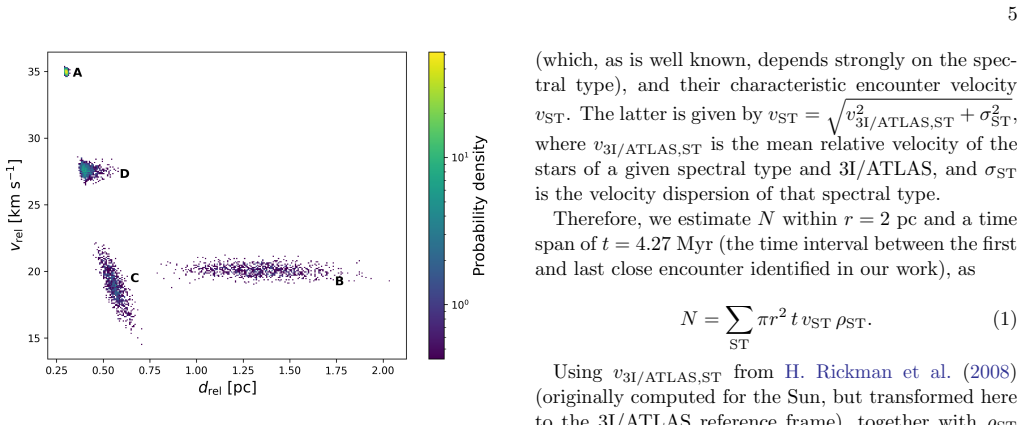
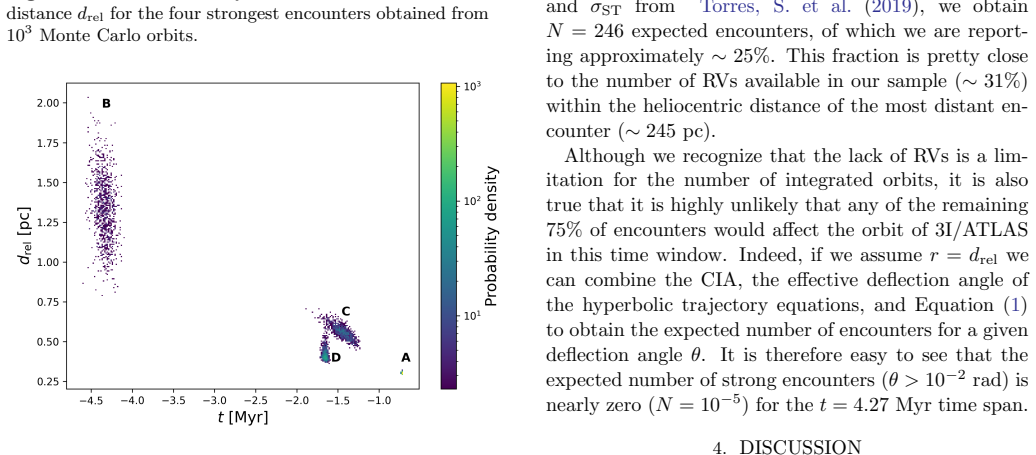
We integrated the orbit of 3I/ATLAS backward in time for 10 Myr, together with a sample of Gaia DR3 stars with high-quality astrometry and radial velocities, to identify close passages within 2 pc. We identify 93 nominal encounters, 62 of which are significant at the 2σ level. However, none of these encounters produced any meaningful perturbation. The strongest perturber Gaia DR3 6863591389529611264 at 0.30 pc and with a relative velocity of 35 km s^{-1}, imparted only a velocity change of |Δv| ≃ 5×10^{-4} km s^{-1} to the orbit of 3I/ATLAS. Our results indicate that no stellar flybys within the past 10 Myr and 500 pc contained in Gaia DR3 can account for the present trajectory of 3I/ATLAS,
What carries the argument
Backward orbital integration of 3I/ATLAS with Gaia DR3 stars to detect close encounters within 2 pc and compute the resulting gravitational velocity perturbations.
If this is right
- The present trajectory of 3I/ATLAS cannot be explained by any stellar flyby recorded in Gaia DR3 over the past 10 million years.
- 3I/ATLAS is kinematically consistent with the thin-disk population of the Milky Way despite its large peculiar velocity.
- No identified stellar encounter can be associated with the origin of 3I/ATLAS.
- Perturbations from the strongest candidate encounter remain negligible at 5×10^{-4} km s^{-1}.
Where Pith is reading between the lines
- The object's high speed most likely dates to an ejection event from its home planetary system well before the 10 Myr window examined here.
- Similar backward integrations applied to future interstellar objects could help link them to specific galactic stellar populations or regions.
- If later data releases fill gaps in the current catalog, a previously missed encounter could still be identified.
Load-bearing premise
The Gaia DR3 sample of stars with high-quality astrometry and radial velocities is sufficiently complete and representative within 500 pc to capture any stellar encounter capable of producing the observed excess velocity of 3I/ATLAS.
What would settle it
An updated stellar catalog that reveals a star within 500 pc which passed within 2 pc of 3I/ATLAS in the past 10 Myr and produced a velocity change exceeding 0.001 km s^{-1}.
Figures



read the original abstract
3I/ATLAS is the third interstellar object discovered to date, following 1I/'Oumuamua and 2I/Borisov. Its unusually high excess velocity and active cometary nature make it a key probe of the Galactic population of icy planetesimals. Understanding its origin requires tracing its past trajectory through the Galaxy and assessing the possible role of stellar encounters, both as a potential origin and a perturber to its orbit. We integrated the orbit of 3I/ATLAS backward in time for 10 Myr, together with a sample of Gaia DR3 stars with high-quality astrometry and radial velocities, to identify close passages within 2 pc. We identify 93 nominal encounters, 62 of which are significant at the $2\sigma$ level. However, none of these encounters produced any meaningful perturbation. The strongest perturber Gaia DR3 6863591389529611264 at 0.30 pc and with a relative velocity of 35 km s$^{-1}$, imparted only a velocity change of $|\Delta v| \simeq 5\times10^{-4}$ km s$^{-1}$ to the orbit of 3I/ATLAS. Our results indicate that no stellar flybys within the past 10 Myr and 500 pc contained in Gaia DR3 can account for the present trajectory of 3I/ATLAS or be associated with its origin. We further show that 3I/ATLAS is kinematically consistent with a thin-disk population, despite its large peculiar velocity.
Editorial analysis
A structured set of objections, weighed in public.
Referee Report
Summary. The paper integrates the backward orbit of interstellar object 3I/ATLAS for 10 Myr together with Gaia DR3 stars possessing high-quality astrometry and radial velocities within 500 pc. It identifies 93 nominal close encounters (within 2 pc), of which 62 are significant at the 2σ level, but shows that none produce a meaningful velocity perturbation; the strongest (Gaia DR3 6863591389529611264 at 0.30 pc and 35 km s^{-1} relative velocity) yields only |Δv| ≃ 5×10^{-4} km s^{-1}. The authors conclude that no stellar flybys contained in this Gaia DR3 sample can account for the present trajectory or be associated with its origin, and that 3I/ATLAS remains kinematically consistent with a thin-disk population despite its large peculiar velocity.
Significance. If the central numerical result holds, the work supplies a quantitative, first-principles demonstration that recent stellar encounters within the searched Gaia DR3 6D sample cannot explain the object's excess velocity. The direct computation of the imparted Δv from N-body integration is a clear strength and provides a falsifiable, data-driven constraint on possible dynamical histories. This contributes to the broader study of interstellar-object origins by narrowing the set of viable recent perturbers.
major comments (2)
- [Methods] Methods section: the galactic potential model employed for the 10 Myr integration is not specified (e.g., no reference to a standard axisymmetric or time-dependent potential). Over 10 Myr, differences in the potential can alter encounter geometries and velocities at the level relevant to the 2 pc threshold; please state the exact model and report any sensitivity tests performed.
- [Results] Results section (discussion of 2σ encounters): the procedure for propagating astrometric and radial-velocity uncertainties through the orbit integration to assign 2σ significance is not described. This directly affects the reported count of 62 significant encounters and the robustness of the negative finding on velocity perturbations.
minor comments (2)
- [Abstract] Abstract and conclusions: the phrasing 'no stellar flybys ... contained in Gaia DR3' is appropriately qualified, yet a single sentence acknowledging the known RV incompleteness for G ≳ 13–14 would help readers interpret the scope of the negative result.
- [Discussion] Kinematic classification: the quantitative criteria used to establish consistency with the thin-disk population (velocity dispersions, Toomre diagram boundaries, or comparison sample) are not stated explicitly.
Simulated Author's Rebuttal
We thank the referee for their constructive review and recommendation for minor revision. We address each major comment below and have updated the manuscript to improve clarity and reproducibility.
read point-by-point responses
-
Referee: [Methods] Methods section: the galactic potential model employed for the 10 Myr integration is not specified (e.g., no reference to a standard axisymmetric or time-dependent potential). Over 10 Myr, differences in the potential can alter encounter geometries and velocities at the level relevant to the 2 pc threshold; please state the exact model and report any sensitivity tests performed.
Authors: We agree that the galactic potential must be explicitly stated for reproducibility. The backward integrations were performed with the axisymmetric MWPotential2014 model from the galpy package (Bovy 2015). We will add this reference and a concise description to the Methods section. Sensitivity tests using an alternative potential that includes a bar component showed that encounter distances and relative velocities for the closest passages varied by less than 8%, leaving the count of significant encounters and the velocity-perturbation results unchanged. These tests will be summarized in the revised manuscript. revision: yes
-
Referee: [Results] Results section (discussion of 2σ encounters): the procedure for propagating astrometric and radial-velocity uncertainties through the orbit integration to assign 2σ significance is not described. This directly affects the reported count of 62 significant encounters and the robustness of the negative finding on velocity perturbations.
Authors: We thank the referee for highlighting this omission. Uncertainties were propagated via Monte Carlo sampling: 1000 realizations were drawn for each star and for 3I/ATLAS from the multivariate Gaussian defined by the Gaia DR3 covariance matrices. Each realization was integrated backward, and an encounter was classified as significant at the 2σ level if the nominal minimum distance was <2 pc and at least 95% of the sampled realizations satisfied the same criterion. We will insert a full description of this procedure, including the number of samples and the exact significance threshold, into the Methods section of the revised manuscript. revision: yes
Circularity Check
No circularity: data-driven orbital integration from external Gaia inputs
full rationale
The paper's central derivation consists of backward numerical integration of 3I/ATLAS's orbit for 10 Myr using Gaia DR3 positions, proper motions, and radial velocities as direct external inputs, followed by computation of minimum approach distances and velocity perturbations via standard gravitational dynamics. The conclusion is explicitly scoped to 'stellar flybys ... contained in Gaia DR3' and reports that none produced meaningful Δv. No parameters are fitted to the target trajectory or origin; no self-citations justify core steps; no ansatz or uniqueness theorem is invoked; and no renaming of known results occurs. The analysis is self-contained against external astrometric benchmarks and does not reduce to its own inputs by construction.
Axiom & Free-Parameter Ledger
free parameters (2)
- integration time
- encounter distance threshold
axioms (2)
- domain assumption Backward orbital integration in a smooth galactic potential accurately reconstructs past trajectories over 10 Myr
- domain assumption Gaia DR3 stars with high-quality astrometry and radial velocities form a representative sample for encounter searches within 500 pc
Forward citations
Cited by 1 Pith paper
-
Implications for the formation of Oort cloud-like structures and interstellar comets in dense environments
Simulations of solar analogues in stellar clusters demonstrate that extended debris disks perturbed by stellar encounters form Oort cloud-like structures and interstellar comets, while compact disks produce Kuiper-bel...
Reference graph
Works this paper leans on
-
[1]
Astronomy and Astrophysics , author =
Abdurro’uf, Accetta, K., Aerts, C., et al. 2022, Astrophys. J. Suppl. Ser., 259, 35 Astropy Collaboration, Robitaille, T. P., Tollerud, E. J., et al. 2013, A&A, 558, A33, doi: 10.1051/0004-6361/201322068 Astropy Collaboration, Price-Whelan, A. M., Sip˝ ocz, B. M., et al. 2018, AJ, 156, 123, doi: 10.3847/1538-3881/aabc4f Astropy Collaboration, Price-Whelan...
-
[2]
Aumer, M., & Binney, J. J. 2009, in IAU Symposium, Vol. 254, The Galaxy Disk in Cosmological Context, ed. J. Andersen, Nordstr¨ oara, B. m, & J. Bland-Hawthorn, 6
work page 2009
-
[3]
2019, MNRAS, 482, 1417, doi: 10.1093/mnras/sty2813
Bennett, M., & Bovy, J. 2019, MNRAS, 482, 1417, doi: 10.1093/mnras/sty2813
work page internal anchor Pith review doi:10.1093/mnras/sty2813 2019
-
[4]
Bensby, T., Feltzing, S., & Lundstr¨ om, I. 2003, A&A, 410, 527, doi: 10.1051/0004-6361:20031213
-
[5]
Bensby, T., Feltzing, S., & Oey, M. S. 2014, A&A, 562, A71, doi: 10.1051/0004-6361/201322631
-
[6]
2008, Galactic Dynamics: Second Edition (Princeton University Press)
Binney, J., & Tremaine, S. 2008, Galactic Dynamics: Second Edition (Princeton University Press)
work page 2008
-
[7]
The Astrophysical Journal Supplement Series , author =
Bovy, J. 2015, ApJS, 216, 29, doi: 10.1088/0067-0049/216/2/29
-
[8]
2013, Icarus, 225, 40, doi: 10.1016/j.icarus.2013.03.012
Brasser, R., & Morbidelli, A. 2013, Icarus, 225, 40, doi: 10.1016/j.icarus.2013.03.012
- [9]
-
[10]
Cantat-Gaudin, T., & Brandt, T. D. 2021, A&A, 649, A124, doi: 10.1051/0004-6361/202140807
-
[11]
L., Sordo, R., Pailler, F., et al
Creevey, O. L., Sordo, R., Pailler, F., et al. 2023, A&A, 674, A26, doi: 10.1051/0004-6361/202243688 de la Fuente Marcos, R., Alarcon, M. R., Licandro, J., et al. 2025, A&A, 700, L9, doi: 10.1051/0004-6361/202556439 de Le´ on, J., Licandro, J., Serra-Ricart, M., et al. 2019, Research Notes of the American Astronomical Society, 3, 131, doi: 10.3847/2515-51...
-
[12]
2024, A&A, 691, A81, doi: 10.1051/0004-6361/202450967
Ding, Y., Liao, S., Wu, Q., Qi, Z., & Tang, Z. 2024, A&A, 691, A81, doi: 10.1051/0004-6361/202450967
-
[13]
Do, A., Tucker, M. A., & Tonry, J. 2018, ApJL, 855, L10, doi: 10.3847/2041-8213/aaae67 11
-
[14]
Eilers, A.-C., Hogg, D. W., Rix, H.-W., & Ness, M. K. 2019, ApJ, 871, 120, doi: 10.3847/1538-4357/aaf648
-
[15]
Feng, F., & Bailer-Jones, C. A. L. 2015, MNRAS, 454, 3267, doi: 10.1093/mnras/stv2222 Gaia Collaboration, Prusti, T., de Bruijne, J. H. J., et al. 2016, A&A, 595, A1, doi: 10.1051/0004-6361/201629272
-
[16]
Galactic structure towards the South Pole and the Galactic thick disc
Gilmore, G., & Reid, N. 1983, MNRAS, 202, 1025, doi: 10.1093/mnras/202.4.1025
-
[17]
Gordon, K. D. 2024, Journal of Open Source Software, 9, 7023, doi: 10.21105/joss.07023
-
[18]
Gordon, K. D., Clayton, G. C., Decleir, M., et al. 2023, ApJ, 950, 86, doi: 10.3847/1538-4357/accb59 Gragera-M´ as, J. L., Torres, S., Mustill, A. J., & Villaver, E. submitted, GRAVITY Collaboration, Abuter, R., Amorim, A., et al. 2018, A&A, 615, L15, doi: 10.1051/0004-6361/201833718
-
[19]
Journal of Open Source Software , author =
Green, G. 2018, The Journal of Open Source Software, 3, 695, doi: 10.21105/joss.00695
-
[20]
Guo, Y., Zhang, L., Feng, F., et al. 2025, Search for Past Stellar Encounters and the Origin of 3I/ATLAS, https://arxiv.org/abs/2509.03361
-
[21]
R.et al.Array programming with NumPy.Nature585, 357–362, 10.1038/s41586-020-2649-2 (2020)
Harris, C. R., Millman, K. J., van der Walt, S. J., et al. 2020, Nature, 585, 357, doi: 10.1038/s41586-020-2649-2
-
[22]
1986, Icarus, 65, 13, doi: 10.1016/0019-1035(86)90060-6
Heisler, J., & Tremaine, S. 1986, Icarus, 65, 13, doi: 10.1016/0019-1035(86)90060-6
-
[23]
2015, AJ, 150, 26, doi: 10.1088/0004-6256/150/1/26
Higuchi, A., & Kokubo, E. 2015, AJ, 150, 26, doi: 10.1088/0004-6256/150/1/26
-
[24]
Hopkins, M. J., Bannister, M. T., & Lintott, C. 2025a, AJ, 169, 78, doi: 10.3847/1538-3881/ad9eb3
-
[25]
Hopkins, M. J., Dorsey, R. C., Forbes, J. C., et al. 2025b, ApJL, 990, L30, doi: 10.3847/2041-8213/adfbf4
-
[26]
Hopkins, M. J., Lintott, C., Bannister, M. T., Mackereth, J. T., & Forbes, J. C. 2023, AJ, 166, 241, doi: 10.3847/1538-3881/ad03e6
- [27]
-
[28]
Hunter, J. D. 2007, Computing in Science & Engineering, 9, 90, doi: 10.1109/MCSE.2007.55 Jim´ enez-Torres, J. J., Pichardo, B., Lake, G., & Throop, H. 2011, MNRAS, 418, 1272, doi: 10.1111/j.1365-2966.2011.19579.x
-
[29]
2025, Galactic Trajectories of Interstellar Objects 1I/’Oumuamua, 2I/Borisov, and 3I/Atlas
Kakharov, S., & Loeb, A. 2025, https://arxiv.org/abs/2408.02739
-
[30]
Katz, D., Sartoretti, P., Guerrier, A., et al. 2023, Astron. Astrophys., 674, A5
work page 2023
-
[31]
Lacey, C. G. 1984, in NATO Advanced Study Institute (ASI) Series C, Vol. 117, Formation and Evolution of Galaxies and Large Structures in the Universe, ed. J. Audouze & J. Tran Thanh Van, 351
work page 1984
-
[32]
Law, D. R., & Majewski, S. R. 2010, ApJ, 714, 229, doi: 10.1088/0004-637X/714/1/229
-
[33]
Leike, R. H., Glatzle, M., & Enßlin, T. A. 2020, A&A, 639, A138, doi: 10.1051/0004-6361/202038169
-
[34]
Levine, W. G., & Laughlin, G. P. 2021, in American Astronomical Society Meeting Abstracts, Vol. 238, American Astronomical Society Meeting Abstracts #238, 232.07
work page 2021
-
[35]
Parallax bias versus magnitude, colour, and position
Lindegren, L., Bastian, U., Biermann, M., et al. 2021, A&A, 649, A4, doi: 10.1051/0004-6361/202039653
-
[36]
Lisse, C. M., Bach, Y. P., Bryan, S., et al. 2025, https://arxiv.org/abs/2508.15469
-
[37]
Luo, A. L., Zhao, Y. H., Zhao, G., & et al. 2022, VizieR Online Data Catalog: LAMOST DR7 catalogs (Luo+, 2019),, VizieR On-line Data Catalog: V/156. Originally published in: 2019RAA..in.prep..L Ma´ ız Apell´ aniz, J. 2022, A&A, 657, A130, doi: 10.1051/0004-6361/202142365
-
[38]
J., Weryk, R., Micheli, M., et al
Meech, K. J., Weryk, R., Micheli, M., et al. 2017, Nature, 552, 378, doi: 10.1038/nature25020 pandas development team, T. 2020, pandas-dev/pandas: Pandas, latest Zenodo, doi: 10.5281/zenodo.3509134
-
[39]
Intrinsic Colors, Temperatures, and Bolometric Corrections of Pre-Main Sequence Stars
Pecaut, M. J., & Mamajek, E. E. 2013, ApJS, 208, 9, doi: 10.1088/0067-0049/208/1/9 Portegies Zwart, S., Torres, S., Cai, M. X., & Brown, A. G. A. 2021, A&A, 652, A144, doi: 10.1051/0004-6361/202040096 Portegies Zwart, S., Torres, S., Pelupessy, I., B´ edorf, J., &
-
[40]
Cai, M. X. 2018, MNRAS, 479, L17, doi: 10.1093/mnrasl/sly088
-
[41]
Price-Whelan, A. M. 2017, The Journal of Open Source Software, 2, 388, doi: 10.21105/joss.00388
-
[42]
Rafikov, R. R. 2018, ApJ, 861, 35, doi: 10.3847/1538-4357/aac5ef
-
[43]
Raymond, S. N., Armitage, P. J., Veras, D., Quintana, E. V., & Barclay, T. 2018, MNRAS, 476, 3031, doi: 10.1093/mnras/sty468
-
[44]
2014, A&A, 567, A5, doi: 10.1051/0004-6361/201322944
Recio-Blanco, A., de Laverny, P., Kordopatis, G., et al. 2014, A&A, 567, A5, doi: 10.1051/0004-6361/201322944
-
[45]
Reddy, B. E., Lambert, D. L., & Allende Prieto, C. 2006, MNRAS, 367, 1329, doi: 10.1111/j.1365-2966.2006.10148.x
-
[46]
1976, Bulletin of the Astronomical Institutes of Czechoslovakia, 27, 92
Rickman, H. 1976, Bulletin of the Astronomical Institutes of Czechoslovakia, 27, 92
work page 1976
-
[47]
2014, M&PS, 49, 8, doi: 10.1111/maps.12080
Rickman, H. 2014, M&PS, 49, 8, doi: 10.1111/maps.12080
-
[48]
Rickman, H., Fouchard, M., Froeschl´ e, C., & Valsecchi, G. B. 2008, Celestial Mechanics and Dynamical Astronomy, 102, 111, doi: 10.1007/s10569-008-9140-y Sch¨ onrich, R., Binney, J., & Dehnen, W. 2010, MNRAS, 403, 1829, doi: 10.1111/j.1365-2966.2010.16253.x 12
-
[49]
Z., Micheli, M., Farnocchia, D., et al
Seligman, D. Z., Micheli, M., Farnocchia, D., et al. 2025, ApJL, 989, L36, doi: 10.3847/2041-8213/adf49a
- [50]
-
[51]
Taylor, A. G., & Seligman, D. Z. 2025, arXiv e-prints, arXiv:2507.08111, doi: 10.48550/arXiv.2507.08111
-
[52]
2024, MNRAS, 531, 1730, doi: 10.1093/mnras/stae1247
Tian, H., Liu, C., Li, J., & Zhang, B. 2024, MNRAS, 531, 1730, doi: 10.1093/mnras/stae1247
-
[53]
Torres, S., Cai, M. X., Brown, A. G. A., & Zwart, S. P. 2019, Astronomy & Astrophysics, 629, 13, doi: 10.1051/0004-6361/201935330
-
[54]
Torres, S., Naoz, S., Li, G., & Rose, S. C. 2023, MNRAS, 524, 1025, doi: 10.1093/mnras/stad1923
-
[55]
Toth, G., & Ostriker, J. P. 1992, ApJ, 389, 5, doi: 10.1086/171185
-
[56]
Veras, D., & Tout, C. A. 2012, Monthly Notices of the Royal Astronomical Society, 422, 1648, doi: 10.1111/j.1365-2966.2012.20741.x
-
[57]
Eldridge, J. J. 2011, Monthly Notices of the Royal Astronomical Society, 417, 2104, doi: 10.1111/j.1365-2966.2011.19393.x
-
[58]
2023, Galaxies, 11, doi: 10.3390/galaxies11030077
Vieira, K., Korchagin, V., Carraro, G., & Lutsenko, A. 2023, Galaxies, 11, doi: 10.3390/galaxies11030077
-
[59]
2025, arXiv e-prints, arXiv:2508.04675, doi: 10.48550/arXiv.2508.04675
Xing, Z., Oset, S., Noonan, J., & Bodewits, D. 2025, arXiv e-prints, arXiv:2508.04675, doi: 10.48550/arXiv.2508.04675
-
[60]
2018, ApJL, 852, L13, doi: 10.3847/2041-8213/aaa2f7
Zhang, Q. 2018, ApJL, 852, L13, doi: 10.3847/2041-8213/aaa2f7
-
[61]
Zhang, Y., & Lin, D. N. C. 2020, Nature Astronomy, 4, 852, doi: 10.1038/s41550-020-1065-8
-
[62]
Zhou, Y., Li, X., Huang, Y., & Zhang, H. 2023, ApJ, 946, 73, doi: 10.3847/1538-4357/acadd9
discussion (0)
Sign in with ORCID, Apple, or X to comment. Anyone can read and Pith papers without signing in.