Implications for the formation of Oort cloud-like structures and interstellar comets in dense environments
Pith reviewed 2026-05-18 05:06 UTC · model grok-4.3
The pith
Extended debris disks around solar system analogues in stellar clusters are reshaped by stellar encounters into Oort cloud-like structures and sources of interstellar comets.
A machine-rendered reading of the paper's core claim, the machinery that carries it, and where it could break.
Core claim
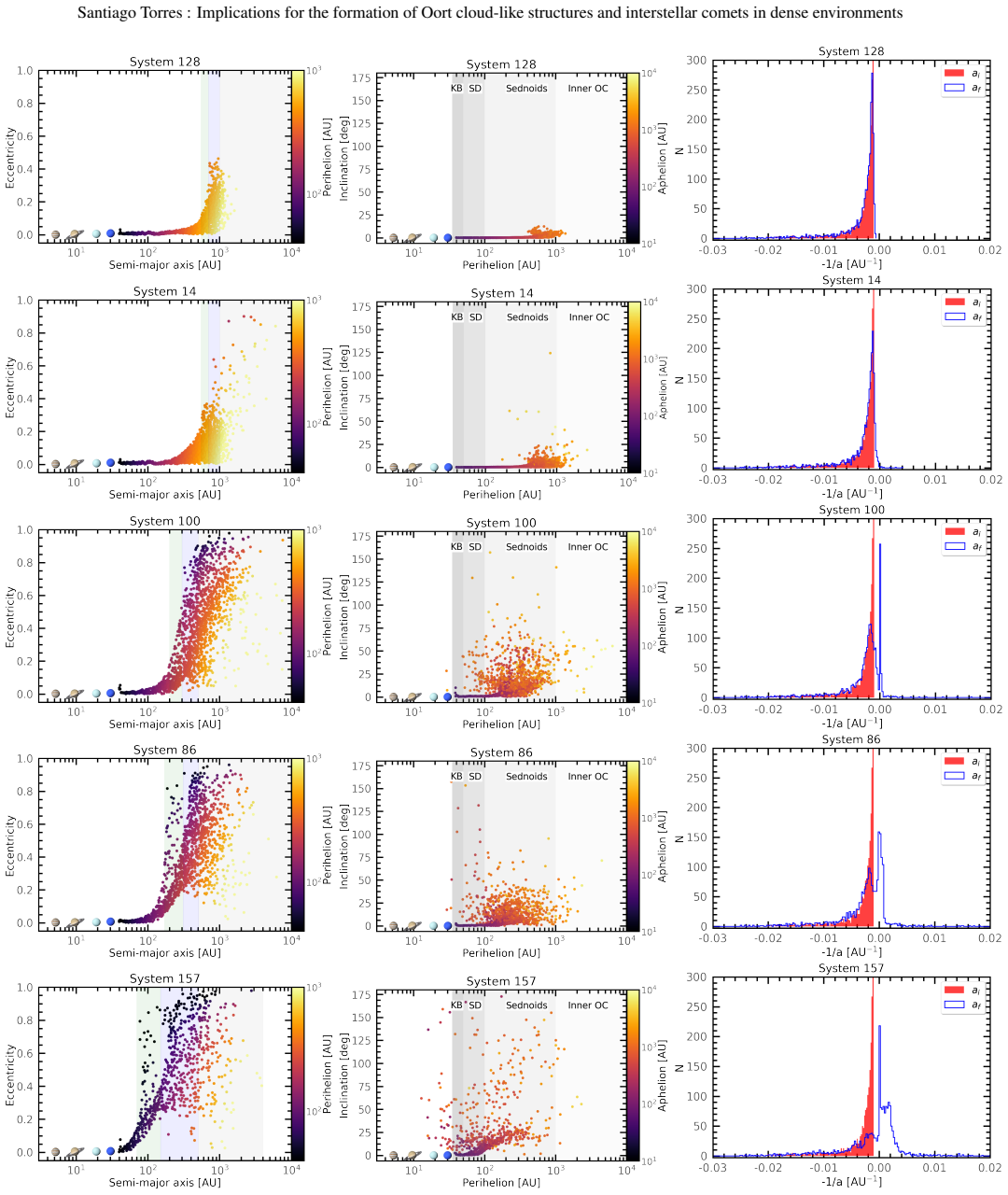
Simulations of solar system analogues in dense stellar clusters demonstrate that extended debris disks are strongly perturbed by stellar flybys to form Oort cloud-like structures and interstellar comets ejected at 1-3 km/s, while compact disks develop Kuiper belt-like populations primarily through planet-disk interactions; low-inclination encounters (0-30°) prove most effective, generating Sednoid-like objects and inner Oort cloud analogues with a characteristic semi-major axis-eccentricity tail, and polar flybys produce nearly isotropic outer populations.
What carries the argument
N-body simulations comparing extended and compact debris disks around solar system analogues in stellar clusters, tracking the combined effects of planetary perturbations and stellar flybys on disk architecture.
If this is right
- Extended disks produce Oort cloud analogues and interstellar comets with ejection velocities of 1-3 km/s through stellar encounters.
- Stellar perturbations are most effective at encounter inclinations between 0° and 30°, creating Sednoid-like populations and inner Oort cloud analogues.
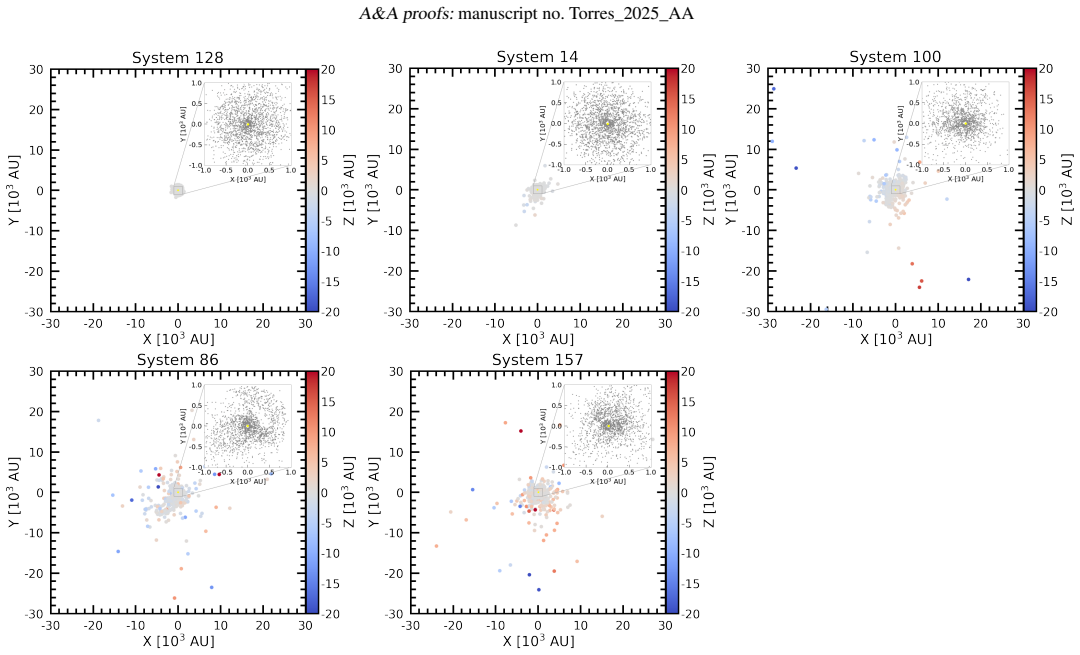
- Coplanar encounters keep the disk flattened while polar flybys redistribute angular momentum to yield nearly isotropic outer populations.
- Cometary reservoirs and interstellar objects are natural outcomes of planet-disk interactions and stellar flybys in dense clusters.
Where Pith is reading between the lines
- The solar system's own distant comet population may indicate that it formed inside a stellar cluster rather than in a sparse environment.
- Similar dynamical signatures could explain the origin and velocities of observed interstellar objects such as 'Oumuamua.
- Young exoplanetary systems in clusters should show an excess of distant, high-eccentricity comets compared with field stars of similar age.
- A characteristic tail in semi-major axis versus eccentricity diagrams could serve as an observable tracer of past stellar encounters in other systems.
Load-bearing premise
The two chosen initial disk configurations and the assumed stellar cluster density and encounter statistics are representative of the typical birth environments for solar system analogues.
What would settle it
Finding no Oort cloud analogues or interstellar comets with 1-3 km/s ejection velocities in young systems born in dense clusters, or observing similar outer populations in systems known to have formed in isolation, would falsify the central claim.
Figures





read the original abstract
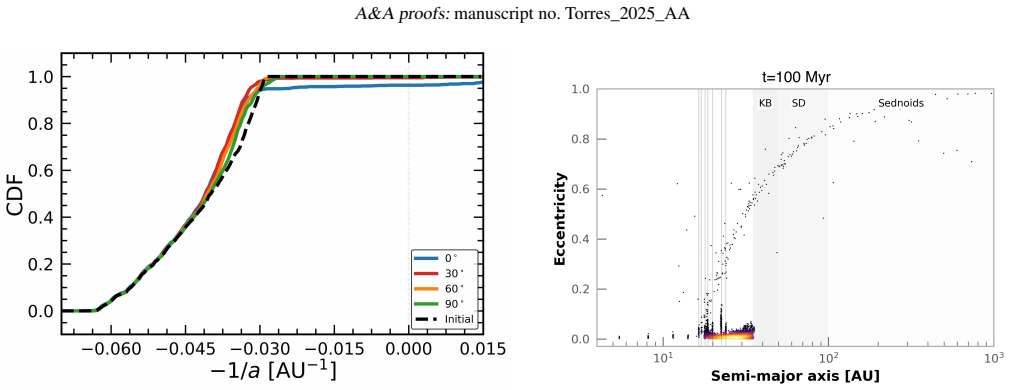
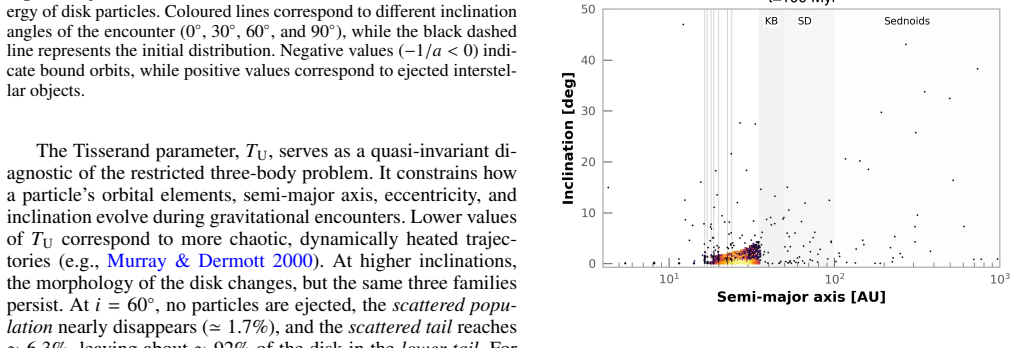
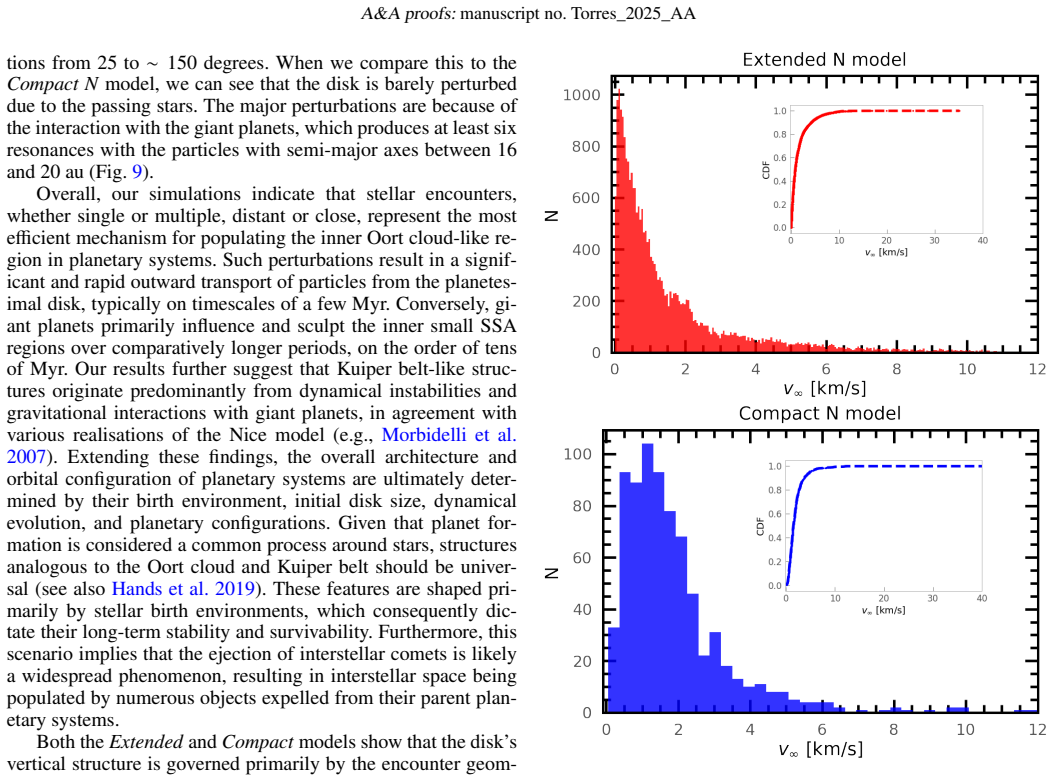
Most stars form in dense stellar environments, where frequent close encounters can strongly perturb and reshape the early architecture of planetary systems. The solar system, with its rich population of distant comets, provides a natural laboratory to study these processes. We perform detailed numerical simulations using the LonelyPlanets framework that combines NBODY6++GPU and REBOUND, to explore the evolution of debris disks around solar system analogues embedded in stellar clusters. Two initial configurations are considered, an $Extended$ and a $Compact$ model, each containing four giant planets and either an extended or compact debris disk. We find that compact disks primarily form Kuiper belt and scattered disk-like populations through planet-disk interactions, while extended disks are more strongly shaped by stellar encounters, producing Oort cloud-like structures and interstellar comets with ejection velocities of 1-3 km/s. Stellar perturbations are most effective for encounter inclinations between $0^{\circ}$ and $30^{\circ}$, giving rise to distinct dynamical populations, like Sednoids, and inner Oort cloud analogues, and a characteristic tail in semi-major axis-eccentricity space. In coplanar encounters, the disk remains largely flattened, whereas polar flybys redistribute angular momentum vertically, producing nearly isotropic outer populations that resemble an emerging Oort cloud. Our results suggest that cometary reservoirs and interstellar objects are natural byproducts of planet-disk interactions and stellar flybys in dense clusters, linking the architecture of outer planetary systems to their birth environments.
Editorial analysis
A structured set of objections, weighed in public.
Referee Report
Summary. The paper uses N-body simulations combining NBODY6++GPU and REBOUND to evolve solar-system analogues with four giant planets plus either an extended or compact debris disk inside a stellar cluster. It reports that compact disks develop Kuiper-belt and scattered-disk populations mainly via planet-disk scattering, whereas extended disks are sculpted by stellar flybys into Oort-cloud analogues and interstellar comets ejected at 1–3 km/s; stellar perturbations are stated to be most effective at inclinations 0–30°, producing Sednoid-like and inner-Oort-cloud analogues, with polar encounters yielding more isotropic outer populations.
Significance. If the numerical results are robust, the work would provide a concrete dynamical pathway linking birth-cluster environment to the observed architecture of distant cometary reservoirs and the production of interstellar objects, thereby strengthening the connection between planetary-system formation and stellar-cluster dynamics. The public-framework approach aids reproducibility, but the absence of reported particle counts, accuracy metrics, and parameter-space exploration limits the strength of the quantitative claims.
major comments (2)
- [Abstract/Methods] Abstract and Methods: the headline claims (ejection velocities 1–3 km/s, inclination dependence 0–30°, distinct Sednoid and inner-Oort populations) are presented without any stated number of disk particles, integration timestep, energy-error tolerance, or validation against analytic two-body scattering or isolated-planet limits; these omissions are load-bearing for the reliability of the reported velocity and population statistics.
- [Results] Results: the central conclusion that extended disks are preferentially shaped by stellar encounters while compact disks are dominated by planet-disk scattering rests on only two discrete initial radial extents and a single assumed cluster density/encounter-rate set; no sensitivity runs across a continuous range of disk radii, surface densities, or cluster parameters drawn from observed young clusters or self-consistent N-body cluster simulations are described, so the relative importance of stellar versus planetary perturbations cannot yet be regarded as general.
minor comments (1)
- [Abstract] The phrase 'LonelyPlanets framework' is introduced without a citation or explicit description of any additional code beyond the combination of NBODY6++GPU and REBOUND.
Simulated Author's Rebuttal
We thank the referee for their constructive and detailed review. The comments highlight important aspects of numerical robustness and generality that we address point by point below. We have revised the manuscript to incorporate additional technical details and clarifications where feasible.
read point-by-point responses
-
Referee: [Abstract/Methods] Abstract and Methods: the headline claims (ejection velocities 1–3 km/s, inclination dependence 0–30°, distinct Sednoid and inner-Oort populations) are presented without any stated number of disk particles, integration timestep, energy-error tolerance, or validation against analytic two-body scattering or isolated-planet limits; these omissions are load-bearing for the reliability of the reported velocity and population statistics.
Authors: We agree that these numerical specifications are essential for reproducibility and for assessing the reliability of the velocity and population statistics. In the revised manuscript we have expanded the Methods section to report the number of disk particles (10,000 per model), the integration timestep (0.05 yr), the energy-error tolerance criterion (relative energy error kept below 10^{-8}), and direct comparisons of selected scattering events against analytic two-body hyperbolic trajectories as well as against control integrations of isolated planetary systems. These additions confirm that the reported 1–3 km/s ejection velocities and the identified Sednoid-like and inner-Oort-cloud analogues are numerically robust within the stated tolerances. revision: yes
-
Referee: [Results] Results: the central conclusion that extended disks are preferentially shaped by stellar encounters while compact disks are dominated by planet-disk scattering rests on only two discrete initial radial extents and a single assumed cluster density/encounter-rate set; no sensitivity runs across a continuous range of disk radii, surface densities, or cluster parameters drawn from observed young clusters or self-consistent N-body cluster simulations are described, so the relative importance of stellar versus planetary perturbations cannot yet be regarded as general.
Authors: We acknowledge that a continuous parameter survey would provide stronger evidence for generality. The two radial extents were deliberately selected to bracket the range of observed debris-disk sizes in young clusters, thereby isolating the contrasting roles of stellar flybys versus planet-disk scattering. In the revised manuscript we have added a dedicated paragraph in the Discussion that places our chosen cluster density within the observed range for young open clusters and reports the outcome of a limited set of additional test runs at half and double the nominal encounter rate. These tests preserve the qualitative distinction between the extended and compact cases. We have also tempered the language to indicate that the reported pathways apply to the explored representative configurations and note that a full Monte-Carlo exploration of cluster parameters lies beyond the scope of the present study. revision: partial
Circularity Check
No significant circularity; results are direct outputs of N-body integrations from explicit initial conditions
full rationale
The paper conducts forward numerical simulations of gravitational dynamics using NBODY6++GPU and REBOUND on two explicitly stated initial configurations (extended and compact debris disks around solar-system analogues in a cluster). All reported outcomes—Oort-cloud analogues, interstellar comets with 1-3 km/s ejections, inclination-dependent populations, and Sednoid-like objects—are computed results of evolving those initial conditions under the chosen encounter statistics. No parameters are fitted to data and then relabeled as predictions, no quantities are defined in terms of themselves, and the abstract and described methods contain no load-bearing self-citations or uniqueness theorems that reduce the central claims to prior author work. The derivation chain is therefore self-contained computational evolution rather than any form of circular reduction.
Axiom & Free-Parameter Ledger
free parameters (2)
- Initial disk radial extent
- Stellar cluster density and encounter statistics
axioms (1)
- domain assumption NBODY6++GPU and REBOUND accurately integrate the gravitational dynamics of planets, debris disks, and stellar flybys over the relevant timescales.
Reference graph
Works this paper leans on
-
[1]
Adams, F. C. 2010, Annual Review of Astronomy and Astrophysics, 48, 47
work page 2010
-
[2]
T., Bhandare, A., Dybczy ´nski, P
Bannister, M. T., Bhandare, A., Dybczy ´nski, P. A., et al. 2019, Nature Astron- omy, 3, 594 Barrado y Navascués, D., Stauffer, J. R., Song, I., & Caillault, J. P. 1999, ApJ, 520, L123
work page 2019
- [3]
-
[4]
Binney, J. & Tremaine, S. 2008, Galactic Dynamics: Second Edition (Princeton University Press)
work page 2008
- [5]
-
[6]
Brasser, R., Duncan, M. J., Levison, H. F., Schwamb, M. E., & Brown, M. E. 2012, Icarus, 217, 1
work page 2012
- [7]
-
[8]
Cai, M. X., Kouwenhoven, M. B., Zwart, S. P., & Spurzem, R. 2017, Monthly Notices of the Royal Astronomical Society, 470, 4337
work page 2017
-
[9]
X., Meiron, Y ., Kouwenhoven, M
Cai, M. X., Meiron, Y ., Kouwenhoven, M. B., Assmann, P., & Spurzem, R. 2015, Astrophysical Journal, Supplement Series, 219
work page 2015
-
[10]
Cai, M. X., Zwart, S. P., Kouwenhoven, M. B. N., & Spurzem, R. 2019, 10, 1
work page 2019
-
[11]
Cai, M. X., Zwart, S. P., & van Elteren, A. 2018, Monthly Notices of the Royal Astronomical Society, 474, 5114
work page 2018
-
[12]
Chebotarev, G. A. 1965, Soviet Astronomy AJ, 8, 787
work page 1965
-
[13]
Do, A., Tucker, M. A., & Tonry, J. 2018, The Astrophysical Journal, 855, L10
work page 2018
-
[14]
Dohnanyi, J. S. 1969, J. Geophys. Res., 74, 2531
work page 1969
-
[15]
2015, Space Science Reviews, 197, 191
Dones, L., Brasser, R., Kaib, N., & Rickman, H. 2015, Space Science Reviews, 197, 191
work page 2015
-
[16]
Dones, L., Weissman, P. R., Levison, H. F., & Duncan, M. J. 2004, Comets II, 323, 153
work page 2004
-
[17]
1987, The Astronomical Journal, 94, 1330
Duncan, M., Quinn, T., & Tremaine, S. 1987, The Astronomical Journal, 94, 1330
work page 1987
-
[18]
Duncan, M. J. 2008, Space Science Reviews, 109 Flammini Dotti, F., Kouwenhoven, M. B. N., Cai, M. X., & Spurzem, R. 2019, MNRAS, 489, 2280
work page 2008
-
[19]
2020, Celestial Mechanics and Dynamical Astronomy, 132, 43
Fouchard, M., Emel’yanenko, V ., & Higuchi, A. 2020, Celestial Mechanics and Dynamical Astronomy, 132, 43
work page 2020
-
[20]
2006, Celestial Me- chanics and Dynamical Astronomy, 95, 299
Fouchard, M., Froeschlé, C., Valsecchi, G., & Rickman, H. 2006, Celestial Me- chanics and Dynamical Astronomy, 95, 299
work page 2006
- [21]
-
[22]
2018, Astronomy & Astro- physics, 620, A45
Fouchard, M., Higuchi, A., Ito, T., & Maquet, L. 2018, Astronomy & Astro- physics, 620, A45
work page 2018
-
[23]
Fouchard, M., Rickman, H., Froeschle, C., & Valsecchi, G. B. 2011, Astronomy and Astrophysics, 535, 86
work page 2011
-
[24]
Francis, P. J. 2005, The Astrophysical Journal, 635, 1348
work page 2005
-
[25]
F., Tsiganis, K., & Morbidelli, A
Gomes, R., Levison, H. F., Tsiganis, K., & Morbidelli, A. 2005, Nature, 435, 466 Gragera-Más, J. L., Torres, S., Mustill, A. J., & Villaver, E. 2025, in press As- tronomy and Astrophysics, arXiv:2510.02509
-
[26]
Guzik, P., Drahus, M., Rusek, K., et al. 2019, Nature Astronomy
work page 2019
-
[27]
O., Dehnen, W., Gration, A., Stadel, J., & Moore, B
Hands, T. O., Dehnen, W., Gration, A., Stadel, J., & Moore, B. 2019, Monthly Notices of the Royal Astronomical Society
work page 2019
- [28]
- [29]
-
[30]
M., Duchêne, G., & Matthews, B
Hughes, A. M., Duchêne, G., & Matthews, B. C. 2018, Annual Review of As- tronomy and Astrophysics, 56, 541
work page 2018
-
[31]
2024, arXiv e-prints, arXiv:2407.06475
Jewitt, D. 2024, arXiv e-prints, arXiv:2407.06475
-
[32]
2017, The Astrophysical Journal, 850, L36 Jílková, L., Hamers, A
Jewitt, D., Luu, J., Rajagopal, J., et al. 2017, The Astrophysical Journal, 850, L36 Jílková, L., Hamers, A. S., Hammer, M., & Zwart, S. P. 2016, Monthly Notices of the Royal Astronomical Society, 457, 4218 Jílková, L., Zwart, S. P., Pijloo, T., & Hammer, M. 2015, Monthly Notices of the Royal Astronomical Society, 453, 3158
work page 2017
-
[33]
Kaib, N. A. & Quinn, T. 2008, Icarus, 197, 221
work page 2008
-
[34]
2001, Monthly Notices of the Royal Astronomical Society, 322, 231
Kroupa, P. 2001, Monthly Notices of the Royal Astronomical Society, 322, 231
work page 2001
-
[35]
Lada, C. J. & Lada, E. A. 2003, Annual Review of Astronomy and Astrophysics, 41, 57 Lecavelier des Etangs, A., Cros, L., Hébrard, G., et al. 2022, Scientific Reports, 12, 5855
work page 2003
-
[36]
Levison, H. F., Duncan, M. J., Brasser, R., & Kaufmann, D. E. 2010, Science, 329, 187
work page 2010
-
[37]
F., Morbidelli, A., & Dones, L
Levison, H. F., Morbidelli, A., & Dones, L. 2004, The Astronomical Journal, 128, 2553 Martínez-Barbosa, C. A., Brown, A. G. A., Boekholt, T., et al. 2016, Monthly Notices of the Royal Astronomical Society, 457, 1062
work page 2004
-
[38]
J., Weryk, R., Micheli, M., et al
Meech, K. J., Weryk, R., Micheli, M., et al. 2017, Nature, 552, 378
work page 2017
-
[39]
Origin and Dynamical Evolution of Comets and their Reservoirs
Morbidelli, A. 2005, eprint arXiv:astro-ph/0512256, 86
work page internal anchor Pith review Pith/arXiv arXiv 2005
-
[40]
Morbidelli, A., Levison, H. F., Tsiganis, K., & Gomes, R. 2005, Nature, 435, 462
work page 2005
- [41]
-
[42]
Morbidelli, A., Tsiganis, K., Crida, A., Levison, H. F., & Gomes, R. 2007, The Astronomical Journal, 134, 1790 Moro-Martín, A. 2018, ApJ, 866, 131
work page 2007
- [43]
-
[44]
Murray, C. D. & Dermott, S. F. 2000, Solar System Dynamics (Cambridge Uni- versity Press) Nesvorný, D. 2018, Annual Review of Astronomy and Astrophysics, 56, 137 Nesvorný, D. & Morbidelli, A. 2012, The Astronomical Journal, 144, 117
work page 2000
-
[45]
2017, Astronomy & Astro- physics, 603, A112
Nordlander, T., Rickman, H., & Gustafsson, B. 2017, Astronomy & Astro- physics, 603, A112
work page 2017
-
[46]
Oort, J. H. 1950, Communication from the Observatory at Leiden, 408
work page 1950
- [47]
-
[48]
3I/ATLAS: In Search of the Witnesses to Its Voyage
Pelupessy, F. I., van Elteren, A., de Vries, N., et al. 2013, Astronomy & Astro- physics, 557, A84 Pérez-Couto, X., Torres, S., Villaver, E., Mustill, A. J., & Manteiga, M. 2025, arXiv e-prints, arXiv:2509.07678
work page internal anchor Pith review Pith/arXiv arXiv 2013
-
[49]
Pfalzner, S., Aizpuru Vargas, L. L., Bhandare, A., & Veras, D. 2021, A&A, 651, A38
work page 2021
-
[50]
2018, The Astrophysical Journal, 863, 45
Pfalzner, S., Bhandare, A., Vincke, K., & Lacerda, P. 2018, The Astrophysical Journal, 863, 45
work page 2018
-
[51]
2024, Nature Astronomy, 8, 1380
Pfalzner, S., Govind, A., & Portegies Zwart, S. 2024, Nature Astronomy, 8, 1380
work page 2024
-
[52]
2012, The Astronomical Journal, 143, 73
Pichardo, B., Moreno, E., Allen, C., et al. 2012, The Astronomical Journal, 143, 73
work page 2012
-
[53]
Plummer, H. C. 1911, Monthly Notices of the Royal Astronomical Society, 71, 460 Portegies Zwart, S. 2009, Astrophysical Journal, 696, 2007 Portegies Zwart, S. 2021, A&A, 647, A136 Portegies Zwart, S. & Jílková, L. 2015, MNRAS, 451, 144 Portegies Zwart, S. & McMillan, S. 2018, Astrophysical Recipes: The art of AMUSE (IOP Publishing) Portegies Zwart, S., Mc...
work page 1911
-
[54]
Punzo, D., Capuzzo-Dolcetta, R., & Zwart, S. P. 2014, Monthly Notices of the Royal Astronomical Society, 444, 2808
work page 2014
-
[55]
Raymond, S. N., Armitage, P. J., & Gorelick, N. 2010, Astrophysical Journal, 711, 772
work page 2010
- [56]
-
[57]
Rebollido, I., Stark, C. C., Kammerer, J., et al. 2024, AJ, 167, 69
work page 2024
- [58]
-
[59]
Rein, H. & Spiegel, D. S. 2014, Monthly Notices of the Royal Astronomical Society, 446, 1424
work page 2014
-
[60]
Z., Micheli, M., Farnocchia, D., et al
Seligman, D. Z., Micheli, M., Farnocchia, D., et al. 2025, ApJ, 989, L36
work page 2025
-
[61]
Shannon, A., Jackson, A. P., Veras, D., & Wyatt, M. 2014, Monthly Notices of the Royal Astronomical Society, 446, 2059
work page 2014
-
[62]
Shannon, A., Jackson, A. P., & Wyatt, M. C. 2019, Monthly Notices of the Royal Astronomical Society, 485, 5511
work page 2019
- [63]
-
[64]
Stark, C. C., Kuchner, M. J., Traub, W. A., et al. 2009, Astrophysical Journal, 703, 1188
work page 2009
-
[65]
X., Spurzem, R., Kouwenhoven, M
Stock, K., Cai, M. X., Spurzem, R., Kouwenhoven, M. B. N., & Portegies Zwart, S. 2020, MNRAS, 497, 1807
work page 2020
-
[66]
Torres, S., Cai, M. X., Brown, A. G. A., & Zwart, S. P. 2019, Astronomy & Astrophysics, 629, 13
work page 2019
-
[67]
Torres, S., Naoz, S., Li, G., & Rose, S. C. 2023, MNRAS, 524, 1025
work page 2023
-
[68]
Tsiganis, K., Gomes, R., Morbidelli, A., & Levison, H. F. 2005, Nature, 435, 459
work page 2005
- [69]
-
[70]
2015, Monthly Notices of the Royal Astronomical Society, 450, 4070
Wang, L., Spurzem, R., Aarseth, S., et al. 2015, Monthly Notices of the Royal Astronomical Society, 450, 4070
work page 2015
-
[71]
Weissman, P. R. 1996, Earth, Moon and Planets, 72, 25
work page 1996
- [72]
-
[73]
2017, Minor Planet Electronic Circular, 2017-U181
Williams, G. 2017, Minor Planet Electronic Circular, 2017-U181
work page 2017
-
[74]
Winter, A. J., Clarke, C. J., Rosotti, G., & Booth, R. A. 2018, MNRAS, 475, 2314
work page 2018
-
[75]
Wu, K., Kouwenhoven, M. B. N., Flammini Dotti, F., & Spurzem, R. 2024, MN- RAS, 533, 4485
work page 2024
-
[76]
Wu, K., Kouwenhoven, M. B. N., Spurzem, R., & Pang, X. 2023, MNRAS, 523, 4801
work page 2023
-
[77]
Wyatt, M. C. 2008, Annual Review of Astronomy and Astrophysics, 46, 339 Article number, page 17 of 19 A&A proofs:manuscript no. Torres_2025_AA Appendix A: The Effect of A and B-type stars In Section 3, we examined the dynamical evolution of the SSA under full cluster dynamics. Because of the adopted IMF (see Section 2), the vast majority of encounters inv...
work page 2008
discussion (0)
Sign in with ORCID, Apple, or X to comment. Anyone can read and Pith papers without signing in.