Search for Higgs bosons produced in association with a high-energy photon via vector-boson fusion and decaying to a pair of b-quarks in the ATLAS detector
Pith reviewed 2026-05-18 16:25 UTC · model grok-4.3
The pith
The ATLAS experiment measures a Higgs boson signal strength of 0.2 ± 0.7 relative to the Standard Model in the high-energy photon plus vector-boson fusion to b-quark channel.
A machine-rendered reading of the paper's core claim, the machinery that carries it, and where it could break.
Core claim
The paper establishes that, after applying improved background characterization, a neural-network classifier, and a binned-likelihood fit directly to the classifier output, the measured Higgs boson signal strength in the photon-associated vector-boson fusion to bb channel is 0.2 ± 0.7 relative to the Standard Model prediction, yielding an observed significance of 0.3 standard deviations compared to an expectation of 1.5 standard deviations.
What carries the argument
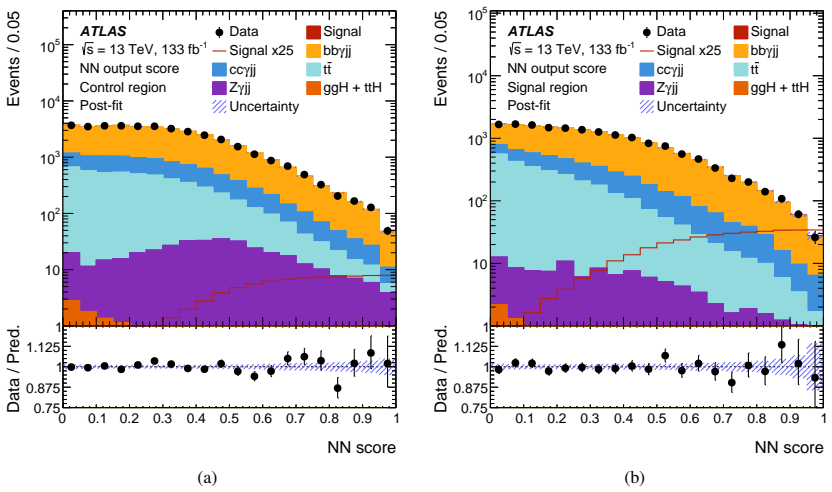
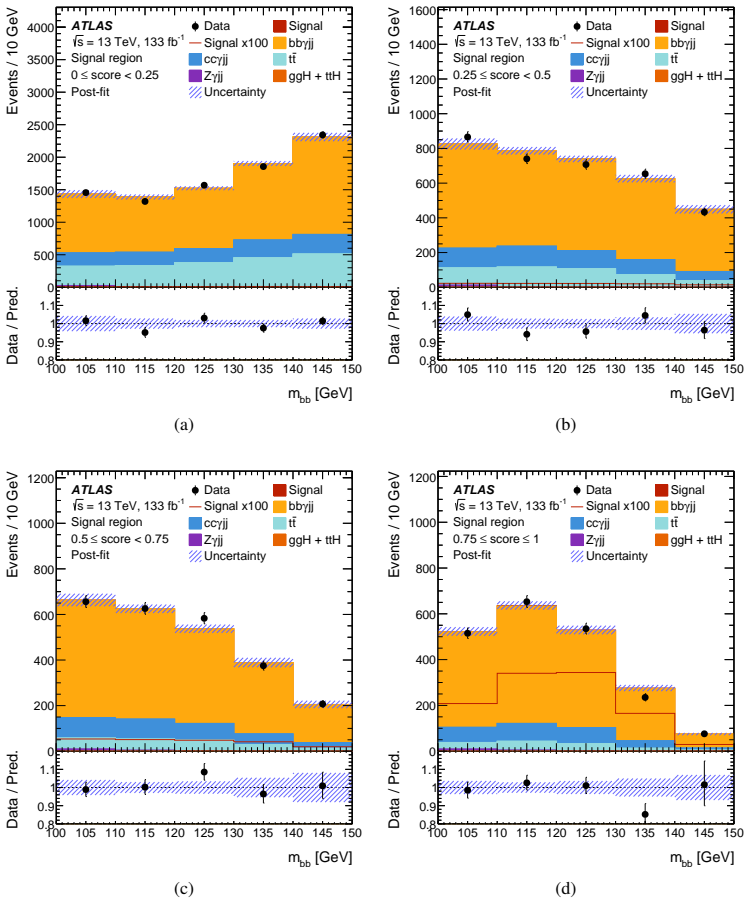
Neural-network classifier whose output is fitted in bins via a likelihood function to extract the signal strength while modeling backgrounds.
If this is right
- The measured value remains compatible with the Standard Model within uncertainties.
- Improved background modeling and the neural-network approach reduce the impact of systematic effects on the final result.
- The analysis sets the stage for higher-sensitivity searches with additional collision data at the LHC.
- Limits on deviations in the Higgs coupling to vector bosons can be derived from this channel.
Where Pith is reading between the lines
- The same classifier-plus-fit strategy could be ported to other rare Higgs production modes to reduce reliance on cut-based selections.
- Combining this result with other Higgs measurements would tighten global constraints on possible new physics contributions to photon-associated production.
- Null outcomes in this channel help prioritize which production mechanisms deserve the most attention in future runs.
Load-bearing premise
The neural-network classifier output and background model accurately represent the data without significant mismodeling or bias that would distort the extracted signal strength in the binned likelihood fit.
What would settle it
A larger dataset or refined analysis yielding a measured signal strength inconsistent with 0.2 within the stated uncertainty or an observed significance significantly exceeding the expected 1.5 standard deviations.
Figures

read the original abstract
A search for Standard Model Higgs bosons produced in association with a high-energy photon and decaying to $b\bar{b}$ is performed using 133 fb$^{-1}$ of $\sqrt{s}=13$ TeV $pp$ collision data collected with the ATLAS detector at the Large Hadron Collider at CERN. The photon requirement reduces the multijet background, and the $H \rightarrow b\bar b$ decay is the dominant decay mode. Event selection requirements target events produced by vector-boson fusion, the dominant production mode in this channel. Several improvements enhance the search sensitivity compared to previous measurements. These improvements include better background modelling and characterization, the use of a neural-network classifier, and an updated signal extraction strategy adopting a direct binned-likelihood fit to the classifier output. With these improvements, the Higgs boson signal strength is measured to be $0.2 \pm 0.7$ relative to the Standard Model prediction. This corresponds to an observed significance of $0.3$ standard deviations, compared to an expectation of $1.5$ standard deviations assuming the Standard Model.
Editorial analysis
A structured set of objections, weighed in public.
Referee Report
Summary. The manuscript reports a search for Standard Model Higgs bosons produced in association with a high-energy photon via vector-boson fusion and decaying to a pair of b-quarks. Using 133 fb^{-1} of 13 TeV ATLAS pp collision data, the analysis applies VBF-targeted event selection, a neural-network classifier, and extracts the Higgs signal strength via a direct binned-likelihood fit to the classifier output, yielding a measured value of 0.2 ± 0.7 relative to the SM prediction (observed significance 0.3σ versus 1.5σ expected).
Significance. If the central result holds, the work provides an updated constraint on the VBF+γ, H→bb channel and demonstrates incremental gains from refined background modeling and machine-learning classification. The low expected significance underscores the statistical limitations of this final state, so the primary value lies in methodological refinements that could inform future analyses rather than in a high-precision measurement or discovery.
major comments (1)
- The binned-likelihood fit to the neural-network classifier output (described in the signal extraction strategy) is load-bearing for the quoted signal strength of 0.2 ± 0.7. The abstract states that background modelling has been improved, yet the manuscript must supply quantitative validation—such as data-to-background agreement plots or χ² tests in the high-score region of the classifier distribution—to demonstrate that residual mismodeling (e.g., from multijet or other backgrounds after VBF+photon selection) does not bias the fitted signal strength or its uncertainty.
minor comments (2)
- The abstract would benefit from a brief quantitative statement of the sensitivity gain relative to the previous measurement to help readers gauge the impact of the listed improvements.
- Notation for the neural-network output variable should be defined explicitly at first use in the text and figures for clarity.
Simulated Author's Rebuttal
We thank the referee for their careful reading of the manuscript and for the constructive major comment. We address the point below and have revised the manuscript to strengthen the presentation of background validation.
read point-by-point responses
-
Referee: The binned-likelihood fit to the neural-network classifier output (described in the signal extraction strategy) is load-bearing for the quoted signal strength of 0.2 ± 0.7. The abstract states that background modelling has been improved, yet the manuscript must supply quantitative validation—such as data-to-background agreement plots or χ² tests in the high-score region of the classifier distribution—to demonstrate that residual mismodeling (e.g., from multijet or other backgrounds after VBF+photon selection) does not bias the fitted signal strength or its uncertainty.
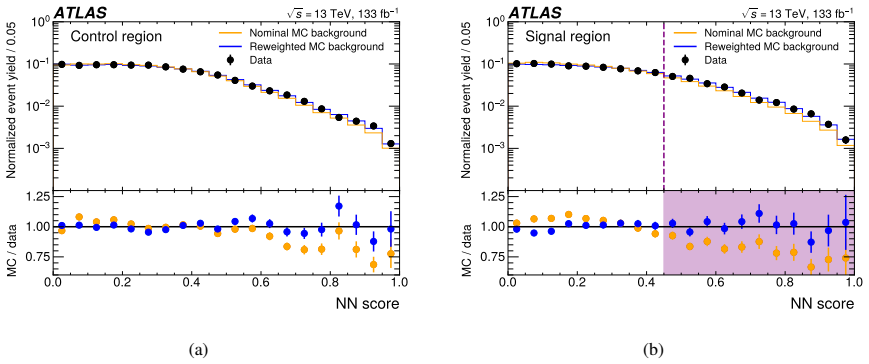
Authors: We agree that explicit quantitative validation of the background model in the high-score region of the neural-network classifier is valuable for supporting the robustness of the signal extraction. The current manuscript presents data-to-simulation comparisons in several control regions used to constrain the background normalizations and shapes, together with the full set of systematic uncertainties propagated in the fit. In the revised version we will add a dedicated figure showing the post-fit classifier output distribution restricted to the high-score region (score > 0.8), with data overlaid on the total background prediction and the fitted signal component. We will also include the χ² per degree of freedom for the agreement between data and the background-only hypothesis in that region. These additions will directly demonstrate that residual mismodeling does not introduce a significant bias in the extracted signal strength of 0.2 ± 0.7. The binned-likelihood fit already incorporates nuisance parameters for background shape uncertainties derived from data-driven methods and from simulation variations, which further mitigate potential mismodeling effects. revision: yes
Circularity Check
No circularity: direct binned-likelihood fit to experimental data
full rationale
The paper reports a signal-strength measurement extracted via a binned-likelihood fit to the neural-network classifier output in 133 fb^{-1} of collision data. This is a standard statistical extraction comparing observed distributions against Monte Carlo templates for signal and background; the fitted value (0.2 ± 0.7) is not defined in terms of itself by any equation in the paper, nor does any central result reduce to a self-citation or ansatz that was fitted to the same quantity. The background-modeling improvements and classifier are inputs to the fit, not outputs renamed as predictions. The derivation chain is therefore self-contained against external data and does not exhibit any of the enumerated circularity patterns.
Axiom & Free-Parameter Ledger
free parameters (1)
- Higgs signal strength =
0.2
axioms (2)
- domain assumption Standard Model predictions for Higgs production cross sections, branching ratios, and kinematic distributions are sufficiently accurate for normalization and shape templates.
- domain assumption Background processes are correctly modeled in simulation and data-driven estimates after the photon and VBF selection.
Lean theorems connected to this paper
-
IndisputableMonolith/Cost/FunctionalEquation.leanwashburn_uniqueness_aczel unclear?
unclearRelation between the paper passage and the cited Recognition theorem.
An improved multivariate analysis technique is key to this analysis. An NN replaced the BDT... The data-fitting approach is also quite different... it now extracts the signal strength directly from the classifier’s output score distribution
-
IndisputableMonolith/Foundation/ArithmeticFromLogic.leanLogicNat_equivNat unclear?
unclearRelation between the paper passage and the cited Recognition theorem.
a binned likelihood fitting strategy to the NN score, based on signal and background templates derived from MC simulations
What do these tags mean?
- matches
- The paper's claim is directly supported by a theorem in the formal canon.
- supports
- The theorem supports part of the paper's argument, but the paper may add assumptions or extra steps.
- extends
- The paper goes beyond the formal theorem; the theorem is a base layer rather than the whole result.
- uses
- The paper appears to rely on the theorem as machinery.
- contradicts
- The paper's claim conflicts with a theorem or certificate in the canon.
- unclear
- Pith found a possible connection, but the passage is too broad, indirect, or ambiguous to say the theorem truly supports the claim.
Reference graph
Works this paper leans on
-
[1]
ATLAS Collaboration,Observation of a new particle in the search for the Standard Model Higgs boson with the ATLAS detector at the LHC, Phys. Lett. B716(2012) 1, arXiv:1207.7214 [hep-ex]
work page internal anchor Pith review Pith/arXiv arXiv 2012
-
[2]
CMS Collaboration, Observation of a new boson at a mass of 125 GeV with the CMS experiment at the LHC, Phys. Lett. B716(2012) 30, arXiv:1207.7235 [hep-ex]. 18
work page internal anchor Pith review Pith/arXiv arXiv 2012
-
[3]
Asking for an extra photon in Higgs production at the LHC and beyond
E. Gabrielli, B. Mele, F. Piccinini, and R. Pittau, Asking for an extra photon in Higgs production at the LHC and beyond, JHEP07(2016) 003, arXiv:1601.03635 [hep-ph]
work page internal anchor Pith review Pith/arXiv arXiv 2016
- [4]
- [5]
- [6]
-
[7]
Denby,Neural networks and cellular automata in experimental high energy physics, Comput
B. Denby,Neural networks and cellular automata in experimental high energy physics, Comput. Phys. Commun.49(1988) 429
work page 1988
-
[8]
ATLAS Collaboration,The ATLAS Experiment at the CERN Large Hadron Collider, JINST3(2008) S08003
work page 2008
-
[9]
ATLAS Collaboration,Performance of the ATLAS trigger system in 2015, Eur. Phys. J. C77(2017) 317, arXiv:1611.09661 [hep-ex]
work page internal anchor Pith review Pith/arXiv arXiv 2015
- [10]
-
[11]
J. Alwall et al.,The automated computation of tree-level and next-to-leading order differential cross sections, and their matching to parton shower simulations, JHEP07(2014) 079, arXiv:1405.0301 [hep-ph]
work page internal anchor Pith review Pith/arXiv arXiv 2014
-
[12]
M. Bähr et al.,Herwig++ physics and manual, Eur. Phys. J. C58(2008) 639, arXiv:0803.0883 [hep-ph]
work page internal anchor Pith review Pith/arXiv arXiv 2008
-
[13]
Herwig 7.0 / Herwig++ 3.0 Release Note
J. Bellm et al.,Herwig 7.0/Herwig++ 3.0 release note, Eur. Phys. J. C76(2016) 196, arXiv:1512.01178 [hep-ph]
work page internal anchor Pith review Pith/arXiv arXiv 2016
-
[14]
PDF4LHC recommendations for LHC Run II
J. Butterworth et al.,PDF4LHC recommendations for LHC Run II, J. Phys. G43(2016) 023001, arXiv:1510.03865 [hep-ph]
work page internal anchor Pith review Pith/arXiv arXiv 2016
-
[15]
A New Method for Combining NLO QCD with Shower Monte Carlo Algorithms
P. Nason,A new method for combining NLO QCD with shower Monte Carlo algorithms, JHEP11(2004) 040, arXiv:hep-ph/0409146
work page internal anchor Pith review Pith/arXiv arXiv 2004
-
[16]
Matching NLO QCD computations with Parton Shower simulations: the POWHEG method
S. Frixione, P. Nason, and C. Oleari, Matching NLO QCD computations with parton shower simulations: the POWHEG method, JHEP11(2007) 070, arXiv:0709.2092 [hep-ph]
work page internal anchor Pith review Pith/arXiv arXiv 2007
-
[17]
A general framework for implementing NLO calculations in shower Monte Carlo programs: the POWHEG BOX
S. Alioli, P. Nason, C. Oleari, and E. Re,A general framework for implementing NLO calculations in shower Monte Carlo programs: the POWHEG BOX, JHEP06(2010) 043, arXiv:1002.2581 [hep-ph]
work page internal anchor Pith review Pith/arXiv arXiv 2010
-
[18]
T. Sjöstrand et al.,An introduction to PYTHIA 8.2, Comput. Phys. Commun.191(2015) 159, arXiv:1410.3012 [hep-ph]
work page internal anchor Pith review Pith/arXiv arXiv 2015
-
[19]
NNPDF Collaboration, R. D. Ball, et al.,Parton distributions for the LHC run II, JHEP04(2015) 040, arXiv:1410.8849 [hep-ph]. 19
work page internal anchor Pith review Pith/arXiv arXiv 2015
- [20]
-
[21]
Top++: a program for the calculation of the top-pair cross-section at hadron colliders
M. Czakon and A. Mitov, Top++: A program for the calculation of the top-pair cross-section at hadron colliders, Comput. Phys. Commun.185(2014) 2930, arXiv:1112.5675 [hep-ph]
work page internal anchor Pith review Pith/arXiv arXiv 2014
-
[22]
D. J. Lange,The EvtGen particle decay simulation package, Nucl. Instrum. Meth. A462(2001) 152
work page 2001
-
[23]
A Brief Introduction to PYTHIA 8.1
T. Sjöstrand, S. Mrenna, and P. Skands,A brief introduction to PYTHIA 8.1, Comput. Phys. Commun.178(2008) 852, arXiv:0710.3820 [hep-ph]
work page internal anchor Pith review Pith/arXiv arXiv 2008
- [24]
-
[25]
ATLAS Collaboration,The ATLAS Simulation Infrastructure, Eur. Phys. J. C70(2010) 823, arXiv:1005.4568 [physics.ins-det]
work page internal anchor Pith review Pith/arXiv arXiv 2010
-
[26]
Agostinelli et al.,Geant4– a simulation toolkit, Nucl
S. Agostinelli et al.,Geant4– a simulation toolkit, Nucl. Instrum. Meth. A506(2003) 250
work page 2003
- [27]
- [28]
- [29]
- [30]
-
[31]
The anti-k_t jet clustering algorithm
M. Cacciari, G. P. Salam, and G. Soyez,The anti-𝑘𝑡 jet clustering algorithm, JHEP04(2008) 063, arXiv:0802.1189 [hep-ph]
work page internal anchor Pith review Pith/arXiv arXiv 2008
-
[32]
M. Cacciari, G. P. Salam, and G. Soyez,FastJet user manual, Eur. Phys. J. C72(2012) 1896, arXiv:1111.6097 [hep-ph]
work page internal anchor Pith review Pith/arXiv arXiv 2012
-
[33]
ATLAS Collaboration, Jet reconstruction and performance using particle flow with the ATLAS Detector, Eur. Phys. J. C77(2017) 466, arXiv:1703.10485 [hep-ex]
work page internal anchor Pith review Pith/arXiv arXiv 2017
-
[34]
ATLAS Collaboration,Performance of pile-up mitigation techniques for jets in𝑝 𝑝collisions at√𝑠=8TeV using the ATLAS detector, Eur. Phys. J. C76(2016) 581, arXiv:1510.03823 [hep-ex]
work page internal anchor Pith review Pith/arXiv arXiv 2016
- [35]
- [36]
- [37]
- [38]
- [39]
- [40]
- [41]
- [42]
-
[43]
ATLAS Collaboration,Muon reconstruction performance of the ATLAS detector in proton–proton collision data at√𝑠=13TeV, Eur. Phys. J. C76(2016) 292, arXiv:1603.05598 [hep-ex]
work page internal anchor Pith review Pith/arXiv arXiv 2016
-
[44]
Chollet et al.,Keras, 2015,url:https://keras.io
F. Chollet et al.,Keras, 2015,url:https://keras.io
work page 2015
-
[45]
Martín Abadi et al.,TensorFlow: Large-Scale Machine Learning on Heterogeneous Systems, Software available from tensorflow.org, 2015,url:https://www.tensorflow.org/
work page 2015
-
[46]
A. D. Martin, W. J. Stirling, R. S. Thorne, and G. Watt, Uncertainties on𝛼𝑆 in global PDF analyses and implications for predicted hadronic cross sections, Eur. Phys. J. C64(2009) 653, arXiv:0905.3531 [hep-ph]
work page internal anchor Pith review Pith/arXiv arXiv 2009
-
[47]
ATLAS Collaboration,Observation of electroweak production of two jets in association with an isolated photon and missing transverse momentum, and search for a Higgs boson decaying into invisible particles at13TeV with the ATLAS detector, Eur. Phys. J. C82(2022) 105, arXiv:2109.00925 [hep-ex]
-
[48]
The PDF4LHC Working Group Interim Recommendations
M. Botje et al.,The PDF4LHC Working Group Interim Recommendations, 2011, arXiv:1101.0538 [hep-ph],url:https://arxiv.org/abs/1101.0538
work page internal anchor Pith review Pith/arXiv arXiv 2011
- [49]
- [50]
-
[51]
K. Cranmer, G. Lewis, L. Moneta, A. Shibata, and W. Verkerke, HistFactory: A tool for creating statistical models for use with RooFit and RooStats, (2012), url:https://cds.cern.ch/record/1456844
-
[52]
The RooFit toolkit for data modeling
W. Verkerke and D. Kirkby,The RooFit toolkit for data modeling, 2003, arXiv:physics/0306116 [physics.data-an]
work page internal anchor Pith review Pith/arXiv arXiv 2003
-
[53]
W. A. Rolke, A. M. López, and J. Conrad, Limits and confidence intervals in the presence of nuisance parameters, Nucl. Instrum. Meth. A551(2005) 493, ed. by L. Lyons and M. Karagoz, arXiv:physics/0403059. 21
work page internal anchor Pith review Pith/arXiv arXiv 2005
-
[54]
ATLAS Collaboration,ATLAS Computing Acknowledgements, ATL-SOFT-PUB-2025-001, 2025, url:https://cds.cern.ch/record/2922210. 22 The ATLAS Collaboration G. Aad 105, E. Aakvaag 17, B. Abbott 124, S. Abdelhameed 120a, K. Abeling 56, N.J. Abicht 50, S.H. Abidi 30, M. Aboelela 46, A. Aboulhorma 36e, H. Abramowicz 158, Y. Abulaiti 121, B.S. Acharya 70a,70b,o, A. ...
discussion (0)
Sign in with ORCID, Apple, or X to comment. Anyone can read and Pith papers without signing in.