A Robust and Efficient F-statistic-based Framework for Consistent Bayesian Inference of Compact Binary Coalescences
Pith reviewed 2026-05-18 16:11 UTC · model grok-4.3
The pith
The F-statistic method enables consistent Bayesian inference of gravitational wave signals from compact binary coalescences by analytically maximizing over luminosity distance and polarization angle.
A machine-rendered reading of the paper's core claim, the machinery that carries it, and where it could break.
Core claim
By analytically maximizing the likelihood over luminosity distance and polarization angle, the F-statistic method yields posterior distributions and Bayesian evidence in good agreement with full frequency-domain analyses for gravitational wave events from compact binary coalescences, while substantially lowering computational cost and providing more honest uncertainty estimates in high-dimensional spaces.
What carries the argument
The F-statistic obtained by analytically maximizing the likelihood over luminosity distance and polarization angle to reduce the effective dimensionality of the Bayesian parameter space.
If this is right
- The F-statistic produces results in good agreement with full frequency-domain Bayesian inference for representative events including GW190412, GW190814, and GW170817.
- Computational cost is significantly reduced compared to standard methods.
- Including calibration uncertainty generally improves agreement between the F-statistic and full frequency-domain results.
- Under physical priors the F-statistic-based analyses yield higher Bayesian evidence.
- Slightly broader constraints are produced that represent a more honest uncertainty quantification in complex posterior spaces.
Where Pith is reading between the lines
- The reduced computational demand could support analysis of the much higher detection rates expected from next-generation gravitational wave observatories.
- The analytic marginalization technique might be adapted to other signal classes where distance or orientation parameters can be treated similarly.
- Direct tests on large ensembles of simulated injections with known parameters would quantify any residual biases introduced by the dimensionality reduction.
Load-bearing premise
Analytically maximizing the likelihood over luminosity distance and polarization angle preserves the integrity of the posterior distributions for the remaining parameters and does not introduce systematic biases when calibration uncertainties are included.
What would settle it
A systematic comparison of recovered posteriors from the F-statistic and full frequency-domain methods on simulated signals with known true parameters, checking for shifts or inconsistencies in key quantities such as component masses or spins.
Figures


read the original abstract
We present a comprehensive investigation of the F-statistic method for parameter estimation of gravitational wave (GW) signals from compact binary coalescences. By analytically maximizing the likelihood over the luminosity distance and polarization angle, this approach reduces the dimensionality of the parameter space to enhance computational efficiency. We also introduce a novel formulation for calculating the Bayesian evidence for the F-statistic, enabling a quantitative assessment of its performance against standard full frequency-domain (FFD) Bayesian inference. Applying these two methods to analyze several representative GW events (GW190412, GW190814, and GW170817), we find that the F-statistic consistently yields results in good agreement with the FFD approach, while offering a significant reduction in computational cost. We demonstrate that including calibration uncertainty generally improves the agreement between the two methods. Furthermore, under the assumption of physical priors, the F-statistic-based analyses consistently yield higher Bayesian evidence than the corresponding FFD analyses. While the F-statistic produces slightly broader constraints on some parameters, we argue this represents a more honest uncertainty quantification, particularly in high-dimensional parameter spaces with complex posterior structures. These results highlight the significant advantages of the F-statistic method for GW data analysis, positioning it as a powerful tool for the era of high-rate detections with future observatories.
Editorial analysis
A structured set of objections, weighed in public.
Referee Report
Summary. The manuscript presents an F-statistic-based framework for Bayesian parameter estimation of gravitational-wave signals from compact binary coalescences. By analytically maximizing the likelihood over luminosity distance and polarization angle, the method reduces the dimensionality of the search space. A novel formulation for the Bayesian evidence is introduced to enable direct comparison with standard full frequency-domain (FFD) inference. The two approaches are applied to the events GW190412, GW190814, and GW170817, with the paper reporting good agreement, substantial computational savings, improved consistency once calibration uncertainties are included, and systematically higher evidence for the F-statistic under physical priors. The authors argue that the slightly broader posteriors obtained with the F-statistic constitute a more honest uncertainty quantification.
Significance. If the central claims are substantiated, the work offers a computationally efficient route to Bayesian inference that could scale to the high event rates expected from future gravitational-wave observatories. The explicit construction of a Bayesian evidence for the analytically maximized likelihood is a concrete technical contribution that permits quantitative model comparison. The demonstration on three real events provides an external grounding for the consistency claim, and the observation that calibration uncertainties improve agreement is a useful practical result.
major comments (2)
- [Results on real events (GW190412, GW190814, GW170817)] The headline consistency claim between the F-statistic and FFD posteriors rests on the analytic maximization over luminosity distance and polarization angle preserving unbiased marginals for the remaining parameters. When calibration uncertainties are folded in, the effective noise covariance becomes parameter-dependent, so the location of the maximum can shift in a manner correlated with other parameters. The manuscript states that including calibration uncertainty improves agreement, yet supplies no explicit diagnostic (difference in medians, 90 % credible-interval widths, or overlap metrics before versus after the maximization step) to confirm that any distortion remains negligible. This check is load-bearing for both the “good agreement” and “higher evidence” statements.
- [Abstract and comparison sections] The abstract and main text report “good agreement” and “significant reduction in computational cost” without accompanying quantitative metrics (e.g., Jensen-Shannon divergence between posteriors, ratio of wall-clock times, or evidence ratios with uncertainties). Absence of these numbers makes it difficult to judge whether the observed differences are within the expected statistical scatter or indicate a systematic offset.
minor comments (2)
- [Methods] The notation for the maximized likelihood and the new evidence expression should be introduced with an explicit equation number and a short derivation sketch so that readers can reproduce the evidence calculation without ambiguity.
- [Figures] Figure captions for the posterior comparisons should state the exact prior choices and whether calibration marginalization was active in each panel.
Simulated Author's Rebuttal
We thank the referee for their careful and constructive review of our manuscript. We address each major comment below with clarifications and proposed revisions to strengthen the presentation of our results.
read point-by-point responses
-
Referee: [Results on real events (GW190412, GW190814, GW170817)] The headline consistency claim between the F-statistic and FFD posteriors rests on the analytic maximization over luminosity distance and polarization angle preserving unbiased marginals for the remaining parameters. When calibration uncertainties are folded in, the effective noise covariance becomes parameter-dependent, so the location of the maximum can shift in a manner correlated with other parameters. The manuscript states that including calibration uncertainty improves agreement, yet supplies no explicit diagnostic (difference in medians, 90 % credible-interval widths, or overlap metrics before versus after the maximization step) to confirm that any distortion remains negligible. This check is load-bearing for both the “good agreement” and “higher evidence” statements.
Authors: We agree that explicit quantitative diagnostics would make the consistency claims more rigorous. In the revised manuscript we will add a supplementary table reporting median shifts, 90% credible-interval width ratios, and overlap metrics (including Jensen-Shannon divergence) for the principal parameters of each event, both before and after the inclusion of calibration uncertainties. These diagnostics will be computed directly from the posterior samples already generated. On the technical point of parameter-dependent noise covariance, the analytic maximization is performed at every point in the remaining parameter space during sampling, and the evidence integral is constructed to marginalize over the maximized parameters consistently with this dependence; the improvement in agreement when calibration is included is visible in the existing posterior overlays, but the new table will quantify that the residual shifts lie within the expected statistical variation. revision: yes
-
Referee: [Abstract and comparison sections] The abstract and main text report “good agreement” and “significant reduction in computational cost” without accompanying quantitative metrics (e.g., Jensen-Shannon divergence between posteriors, ratio of wall-clock times, or evidence ratios with uncertainties). Absence of these numbers makes it difficult to judge whether the observed differences are within the expected statistical scatter or indicate a systematic offset.
Authors: We accept that the absence of numerical metrics limits the reader’s ability to assess the magnitude of the reported agreement and savings. In the revised version we will insert concrete values into both the abstract and the comparison sections: Jensen-Shannon divergences between the F-statistic and FFD marginal posteriors for chirp mass, mass ratio, and effective spin; wall-clock time ratios (typically a factor of several) measured on identical hardware; and log-evidence differences together with the Monte-Carlo uncertainties returned by the nested-sampling runs. These numbers will replace the qualitative statements currently present. revision: yes
Circularity Check
No circularity: method derived from standard likelihood maximization and validated externally against independent FFD runs
full rationale
The paper derives the F-statistic approach by analytically maximizing the likelihood over luminosity distance and polarization angle (reducing dimensionality), introduces a novel but explicitly formulated Bayesian evidence expression based on that maximized likelihood, and then directly compares posterior samples and evidence values to independent full frequency-domain Bayesian inference performed on the identical events (GW190412, GW190814, GW170817). This comparison supplies external grounding rather than any internal fit or self-referential prediction. No load-bearing step reduces by construction to its own inputs, no self-citation chain substitutes for a derivation, and the stated assumptions about maximization preserving marginal posteriors are tested via reported agreement metrics rather than assumed true by definition. The derivation chain is therefore self-contained.
Axiom & Free-Parameter Ledger
axioms (1)
- domain assumption Analytic maximization over luminosity distance and polarization angle produces an equivalent marginal likelihood for the remaining parameters.
Lean theorems connected to this paper
-
IndisputableMonolith/Cost/FunctionalEquation.leanwashburn_uniqueness_aczel unclear?
unclearRelation between the paper passage and the cited Recognition theorem.
By analytically maximizing the likelihood over the luminosity distance and polarization angle, this approach reduces the dimensionality of the parameter space
-
IndisputableMonolith/Foundation/AlphaCoordinateFixation.leanJ_uniquely_calibrated_via_higher_derivative unclear?
unclearRelation between the paper passage and the cited Recognition theorem.
ln Λ(θ) = ½ sμ Mμν sν (the F-statistic)
What do these tags mean?
- matches
- The paper's claim is directly supported by a theorem in the formal canon.
- supports
- The theorem supports part of the paper's argument, but the paper may add assumptions or extra steps.
- extends
- The paper goes beyond the formal theorem; the theorem is a base layer rather than the whole result.
- uses
- The paper appears to rely on the theorem as machinery.
- contradicts
- The paper's claim conflicts with a theorem or certificate in the canon.
- unclear
- Pith found a possible connection, but the passage is too broad, indirect, or ambiguous to say the theorem truly supports the claim.
Reference graph
Works this paper leans on
-
[1]
linear” param- eters—from the remaining “non-linear
Waveform Reformulation A frequency-domain IMR signal from a BBH merger is composed of two polarization modes,h +(f) andh ×(f). The signal observed in a detector,h(f), is a linear combi- nation of these modes, weighted by the antenna pattern functions,F + andF ×: h(f) =F +h+(f) +F ×h×(f).(4) 3 The antenna patterns are functions of the source’s sky location...
-
[2]
Deriving the Profile Likelihood By substituting the reformulated waveform from Eq. (7) into the log-likelihood ratio of Eq. (3), the likeli- hood can be expressed in terms of the linear parameters Bµ and non-linear parametersθ: ln Λ(Θ) =B µsµ(θ)− 1 2 BµMµν(θ)B ν,(8) 1 In this work, we adopt the Einstein summation convention. wheres µ ≡ ⟨d|h µ⟩is the proje...
-
[3]
Parameter definitions follow the conventions used in thePESummarypackage [42]
-
[4]
the Fundamental Re- search Funds for the Central Universities
The geocenter timet c is reported as an offset from the GW150914 trigger time,t 0 = 1126259462.4 s. theF-statistic method achieved a∼70.6% reduc- tion in sampling time compared to the FFD ap- proach, while producing a comparable number of posterior samples. This enhanced stability is particularly valuable for an- alyzing complex signals where high-dimensi...
-
[5]
B. P. Abbottet al.(LIGO Scientific Collaboration and Virgo Collaboration), Phys. Rev. X9, 031040 (2019)
work page 2019
-
[6]
R. Abbottet al., Phys. Rev. X11, 021053 (2021), arXiv:2010.14527 [gr-qc]
work page internal anchor Pith review Pith/arXiv arXiv 2021
-
[7]
R. Abbottet al.(KAGRA, VIRGO, LIGO Scientific), Phys. Rev. X13, 041039 (2023), arXiv:2111.03606 [gr- qc]
work page internal anchor Pith review Pith/arXiv arXiv 2023
-
[8]
B. P. Abbottet al.(LIGO Scientific, Virgo), Phys. Rev. Lett.116, 221101 (2016), [Erratum: Phys.Rev.Lett. 121, 129902 (2018)], arXiv:1602.03841 [gr-qc]
work page internal anchor Pith review Pith/arXiv arXiv 2016
-
[9]
R. Abbottet al.(LIGO Scientific, Virgo), Phys. Rev. D 103, 122002 (2021), arXiv:2010.14529 [gr-qc]
work page internal anchor Pith review Pith/arXiv arXiv 2021
-
[10]
Tests of General Relativity with GWTC-3
R. Abbottet al.(LIGO Scientific, VIRGO, KAGRA), (2021), arXiv:2112.06861 [gr-qc]
work page internal anchor Pith review Pith/arXiv arXiv 2021
-
[11]
J. Veitchet al., Phys. Rev. D91, 042003 (2015), arXiv:1409.7215 [gr-qc]
work page internal anchor Pith review Pith/arXiv arXiv 2015
- [12]
-
[13]
Bilby: A user-friendly Bayesian inference library for gravitational-wave astronomy
G. Ashtonet al., Astrophys. J. Suppl.241, 27 (2019), arXiv:1811.02042 [astro-ph.IM]
work page internal anchor Pith review Pith/arXiv arXiv 2019
-
[14]
C. M. Biwer, C. D. Capano, S. De, M. Cabero, D. A. Brown, A. H. Nitz, and V. Raymond, Publ. Astron. Soc. Pac.131, 024503 (2019), arXiv:1807.10312 [astro-ph.IM]
work page internal anchor Pith review Pith/arXiv arXiv 2019
-
[15]
E. Thrane and C. Talbot, Publ. Astron. Soc. Austral. 36, e010 (2019), [Erratum: Publ.Astron.Soc.Austral. 37, e036 (2020)], arXiv:1809.02293 [astro-ph.IM]
- [16]
- [17]
-
[18]
Two-step greedy algorithm for reduced order quadratures
H. Antil, S. E. Field, F. Herrmann, R. H. No- chetto, and M. Tiglio, J. Sci. Comput.57, 604 (2013), arXiv:1210.0577 [cs.NA]
work page internal anchor Pith review Pith/arXiv arXiv 2013
-
[19]
Fast and Accurate Inference on Gravitational Waves from Precessing Compact Binaries
R. Smith, S. E. Field, K. Blackburn, C.-J. Haster, M. P¨ urrer, V. Raymond, and P. Schmidt, Phys. Rev. D94, 044031 (2016), arXiv:1604.08253 [gr-qc]
work page internal anchor Pith review Pith/arXiv arXiv 2016
-
[20]
R. Smithet al., Phys. Rev. Lett.127, 081102 (2021), arXiv:2103.12274 [gr-qc]
-
[21]
K. Cranmer, J. Brehmer, and G. Louppe, Proc. Nat. Acad. Sci.117, 30055 (2020), arXiv:1911.01429 [stat.ML]
- [22]
- [23]
-
[24]
E. Marxet al., Phys. Rev. D111, 042010 (2025), arXiv:2403.18661 [gr-qc]
-
[25]
K. D. Kokkotas, G. Tsegas, and A. Krolak, Class. Quant. Grav.11, 1901 (1994)
work page 1901
-
[26]
P. Jaranowski, A. Krolak, and B. F. Schutz, Phys. Rev. D58, 063001 (1998), arXiv:gr-qc/9804014
work page internal anchor Pith review Pith/arXiv arXiv 1998
- [27]
-
[28]
Abbottet al.(KAGRA, LIGO Scientific, VIRGO), Phys
R. Abbottet al.(KAGRA, LIGO Scientific, VIRGO), Phys. Rev. D106, 102008 (2022), arXiv:2201.00697 [gr- qc]
-
[29]
F-statistic search for white-dwarf binaries in the first Mock LISA Data Challenge
R. Prix and J. T. Whelan, Class. Quant. Grav.24, S565 (2007), arXiv:0707.0128 [gr-qc]
work page internal anchor Pith review Pith/arXiv arXiv 2007
-
[30]
Y. Wang, S. D. Mohanty, and F. A. Jenet, Astrophys. J.795, 96 (2014), arXiv:1406.5496 [astro-ph.IM]
work page internal anchor Pith review Pith/arXiv arXiv 2014
-
[31]
Y. Wang, Y. Shang, and S. Babak, Phys. Rev. D86, 104050 (2012), arXiv:1207.4956 [gr-qc]
work page internal anchor Pith review Pith/arXiv arXiv 2012
- [32]
- [33]
-
[34]
I. W. Harry and S. Fairhurst, Phys. Rev. D83, 084002 (2011), arXiv:1012.4939 [gr-qc]
work page internal anchor Pith review Pith/arXiv arXiv 2011
-
[35]
D. Keppel, Phys. Rev. D86, 123010 (2012), arXiv:1208.2340 [gr-qc]
work page internal anchor Pith review Pith/arXiv arXiv 2012
-
[36]
Searching for Gravitational Waves from Compact Binaries with Precessing Spins
I. Harry, S. Privitera, A. Boh´ e, and A. Buonanno, Phys. Rev. D94, 024012 (2016), arXiv:1603.02444 [gr-qc]
work page internal anchor Pith review Pith/arXiv arXiv 2016
-
[37]
G. Prattenet al., Phys. Rev. D103, 104056 (2021), arXiv:2004.06503 [gr-qc]
work page internal anchor Pith review Pith/arXiv arXiv 2021
-
[38]
Abbottet al.(LIGO Scientific, Virgo), Phys
R. Abbottet al.(LIGO Scientific, Virgo), Phys. Rev. D 102, 043015 (2020), arXiv:2004.08342 [astro-ph.HE]
-
[39]
R. Abbottet al.(LIGO Scientific, Virgo), Astrophys. J. Lett.896, L44 (2020), arXiv:2006.12611 [astro-ph.HE]
work page internal anchor Pith review Pith/arXiv arXiv 2020
-
[40]
B. P. Abbottet al.(LIGO Scientific Collaboration and Virgo Collaboration), Phys. Rev. Lett.116, 061102 (2016)
work page 2016
-
[41]
B. P. Abbottet al.(LIGO Scientific, Virgo), Class. Quant. Grav.33, 134001 (2016), arXiv:1602.03844 [gr- qc]
work page internal anchor Pith review Pith/arXiv arXiv 2016
-
[42]
J. T. Whelan, R. Prix, C. J. Cutler, and J. L. Willis, Class. Quant. Grav.31, 065002 (2014), arXiv:1311.0065 [gr-qc]. 10
work page internal anchor Pith review Pith/arXiv arXiv 2014
-
[43]
Y. Dong, Z. Wang, H.-T. Wang, J. Zhao, and L. Shao, (2025), arXiv:2502.01093 [gr-qc]
work page internal anchor Pith review Pith/arXiv arXiv 2025
-
[44]
H.-T. Wang, S.-P. Tang, P.-C. Li, and Y.-Z. Fan, (2025), arXiv:2509.02047 [gr-qc]
-
[45]
H.-T. Wang and L. Shao, Phys. Rev. D109, 043027 (2024), arXiv:2401.13997 [gr-qc]
- [46]
- [47]
-
[48]
(2025), arXiv:2508.18082 [gr-qc]. [45]https://gwosc.org
work page internal anchor Pith review Pith/arXiv arXiv 2025
-
[49]
Abbottet al.(KAGRA, VIRGO, LIGO Scientific), Astrophys
R. Abbottet al.(KAGRA, VIRGO, LIGO Scientific), Astrophys. J. Suppl.267, 29 (2023), arXiv:2302.03676 [gr-qc]
-
[50]
Wang, Zenodo (2025), 10.5281/zenodo.16484750
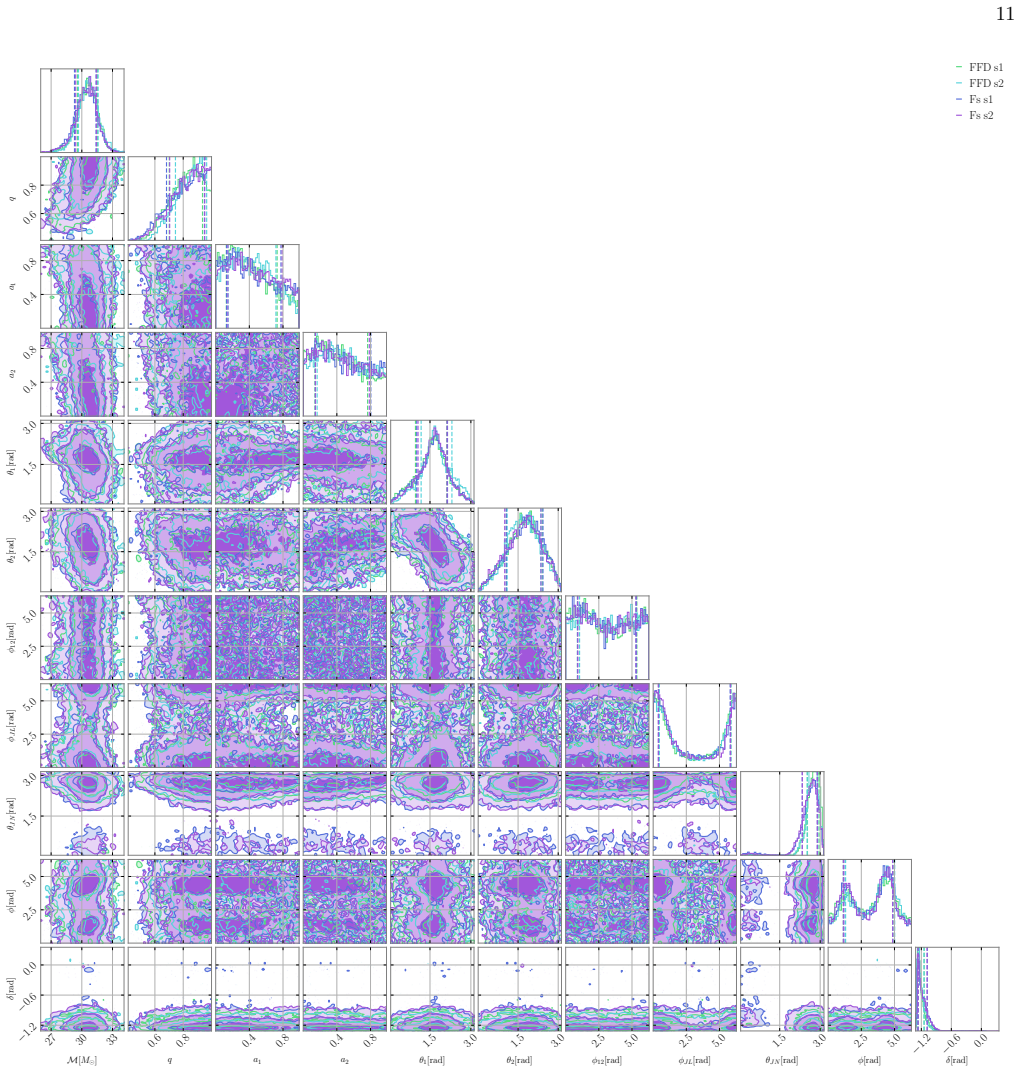
H.-T. Wang, Zenodo (2025), 10.5281/zenodo.16484750. 11 0.6 0.8 q 0.4 0.8 a1 0.4 0.8 a2 1.5 3.0 θ1[rad] 1.5 3.0 θ2[rad] 2.5 5.0 φ12[rad] 2.5 5.0 φJL[rad] 1.5 3.0 θJN [rad] 2.5 5.0 φ[rad] 27 30 33 M[M⊙] −1.2 −0.6 0.0 δ[rad] 0.6 0.8 q 0.4 0.8 a1 0.4 0.8 a2 1.5 3.0 θ1[rad] 1.5 3.0 θ2[rad] 2.5 5.0 φ12[rad] 2.5 5.0 φJL[rad] 1.5 3.0 θJN [rad] 2.5 5.0 φ[rad] −1.2...
discussion (0)
Sign in with ORCID, Apple, or X to comment. Anyone can read and Pith papers without signing in.