Enhancing Physical Plausibility in Video Generation by Reasoning the Implausibility
Pith reviewed 2026-05-18 12:51 UTC · model grok-4.3
The pith
A training-free pipeline reasons about physics violations to guide diffusion models away from implausible video motions at inference time.
A machine-rendered reading of the paper's core claim, the machinery that carries it, and where it could break.
Core claim
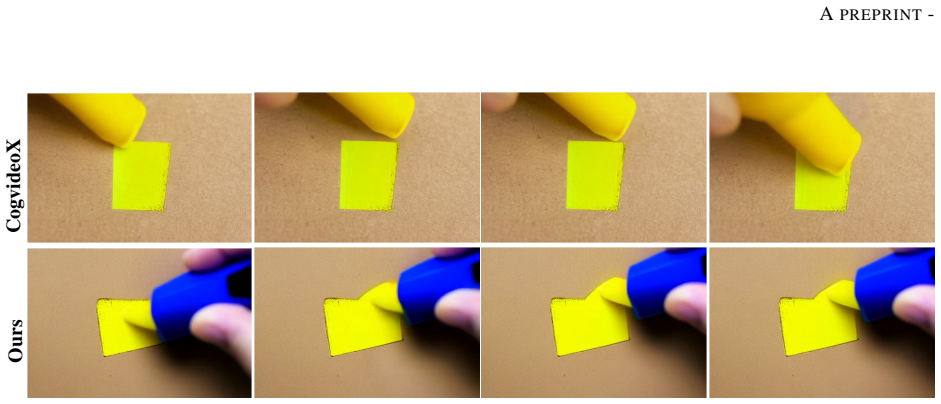
We introduce a training-free framework that improves physical plausibility at inference time by explicitly reasoning about implausibility and guiding the generation away from it. Specifically, we employ a lightweight physics-aware reasoning pipeline to construct counterfactual prompts that deliberately encode physics-violating behaviors. Then, we propose a novel Synchronized Decoupled Guidance (SDG) strategy, which leverages these prompts through synchronized directional normalization to counteract lagged suppression and trajectory-decoupled denoising to mitigate cumulative trajectory bias, ensuring that implausible content is suppressed immediately and consistently throughout denoising. Abl
What carries the argument
Synchronized Decoupled Guidance (SDG), which combines synchronized directional normalization to prevent lagged suppression with trajectory-decoupled denoising to avoid cumulative bias when steering away from physics-violating counterfactual prompts.
If this is right
- Physical fidelity improves substantially across domains while photorealism is preserved without extra training.
- The physics-aware reasoning component and the full SDG strategy prove complementary through ablation.
- Each element of SDG individually aids suppression of implausible content and overall plausibility gains.
- The method supplies a plug-and-play physics-aware paradigm usable on existing diffusion video generators.
Where Pith is reading between the lines
- Similar counterfactual reasoning could be tested on image or 3D generation tasks where logical consistency matters.
- Wider use of inference-time guidance might lessen the data volume needed to train future generative models for physical domains.
- The approach could be paired with existing video editing tools to correct specific implausible segments after initial generation.
Load-bearing premise
The lightweight physics-aware reasoning pipeline can reliably build counterfactual prompts that capture genuine physics violations, and the synchronized decoupled guidance can suppress those violations without introducing new artifacts or lowering photorealism.
What would settle it
A side-by-side evaluation on a fixed set of text prompts measuring the rate of physics violations such as incorrect gravity or interpenetration in generated videos, alongside unchanged or improved scores on standard visual quality metrics like FID or user preference for realism.
Figures




read the original abstract
Diffusion models can generate realistic videos, but existing methods rely on implicitly learning physical reasoning from large-scale text-video datasets, which is costly, difficult to scale, and still prone to producing implausible motions that violate fundamental physical laws. We introduce a training-free framework that improves physical plausibility at inference time by explicitly reasoning about implausibility and guiding the generation away from it. Specifically, we employ a lightweight physics-aware reasoning pipeline to construct counterfactual prompts that deliberately encode physics-violating behaviors. Then, we propose a novel Synchronized Decoupled Guidance (SDG) strategy, which leverages these prompts through synchronized directional normalization to counteract lagged suppression and trajectory-decoupled denoising to mitigate cumulative trajectory bias, ensuring that implausible content is suppressed immediately and consistently throughout denoising. Experiments across different physical domains show that our approach substantially enhances physical fidelity while maintaining photorealism, despite requiring no additional training. Ablation studies confirm the complementary effectiveness of both the physics-aware reasoning component and SDG. In particular, the aforementioned two designs of SDG are also individually validated to contribute critically to the suppression of implausible content and the overall gains in physical plausibility. This establishes a new and plug-and-play physics-aware paradigm for video generation.
Editorial analysis
A structured set of objections, weighed in public.
Referee Report
Summary. The paper claims to introduce a training-free framework for improving physical plausibility in diffusion-based video generation. It employs a lightweight physics-aware reasoning pipeline to construct counterfactual prompts that encode physics-violating behaviors, followed by a novel Synchronized Decoupled Guidance (SDG) strategy that uses synchronized directional normalization to address lagged suppression and trajectory-decoupled denoising to reduce cumulative trajectory bias. Experiments across physical domains and ablation studies are said to demonstrate substantial gains in physical fidelity while preserving photorealism.
Significance. If the central claims hold, the work offers a practical inference-time alternative to costly retraining for addressing physical implausibilities in video models, which could be broadly applicable as a plug-and-play module. The explicit focus on reasoning about implausibility rather than implicit dataset learning represents a potentially useful paradigm shift, provided the pipeline and guidance mechanisms deliver the promised targeted suppression without side effects.
major comments (2)
- [Method] The central claim depends on the physics-aware reasoning pipeline reliably producing counterfactual prompts that encode genuine physics violations rather than superficial changes. However, the manuscript provides insufficient detail on the pipeline's identification and encoding process (e.g., in the method description), leaving open whether observed gains arise from true physical reasoning or generic prompt guidance.
- [Experiments and Ablations] Ablation studies are cited as confirming the effectiveness of the physics-aware component and the two SDG designs, but they do not include controls isolating physics-specific reasoning from non-physics prompt modifications. This is load-bearing for validating that improvements in physical fidelity stem from the proposed mechanisms rather than broader guidance effects.
minor comments (1)
- [Abstract] The abstract states that experiments show 'substantial' enhancements but does not reference specific quantitative metrics, datasets, or error bars; adding these references would improve clarity even if full details appear later.
Simulated Author's Rebuttal
We thank the referee for the constructive and detailed feedback on our manuscript. We have carefully addressed each major comment below and revised the paper to strengthen the presentation of the method and experiments.
read point-by-point responses
-
Referee: [Method] The central claim depends on the physics-aware reasoning pipeline reliably producing counterfactual prompts that encode genuine physics violations rather than superficial changes. However, the manuscript provides insufficient detail on the pipeline's identification and encoding process (e.g., in the method description), leaving open whether observed gains arise from true physical reasoning or generic prompt guidance.
Authors: We agree that additional detail on the physics-aware reasoning pipeline would improve clarity. In the revised manuscript, we have expanded Section 3.1 with a step-by-step description of the identification process, which queries a language model against a fixed set of physical principles (e.g., conservation of momentum, gravity) to detect violations in the initial prompt. We also provide concrete examples of how violations are encoded into counterfactual prompts, such as inverting gravitational direction or violating object rigidity. A new algorithmic pseudocode box and illustrative figure have been added to demonstrate that the pipeline targets genuine physics violations rather than generic modifications. These changes make explicit that the observed gains derive from physics-specific reasoning. revision: yes
-
Referee: [Experiments and Ablations] Ablation studies are cited as confirming the effectiveness of the physics-aware component and the two SDG designs, but they do not include controls isolating physics-specific reasoning from non-physics prompt modifications. This is load-bearing for validating that improvements in physical fidelity stem from the proposed mechanisms rather than broader guidance effects.
Authors: We acknowledge the value of explicit isolation controls. In the revised manuscript, we have added a new ablation experiment (Table 4) that replaces the physics-aware counterfactual prompts with non-physics prompt modifications of comparable complexity (e.g., stylistic alterations or addition of unrelated descriptors). Quantitative results on physical fidelity metrics (e.g., violation detection scores) show that only the physics-specific prompts produce substantial gains, while generic modifications yield minimal or no improvement. These controls confirm that the benefits arise from the targeted physics reasoning rather than general guidance effects. The updated ablation section now includes this comparison alongside the original studies. revision: yes
Circularity Check
No significant circularity; new inference-time method with independent experimental validation
full rationale
The paper introduces a training-free framework consisting of a lightweight physics-aware reasoning pipeline for counterfactual prompts and a Synchronized Decoupled Guidance (SDG) strategy with directional normalization and trajectory-decoupled denoising. These are presented as novel procedural components applied at inference time rather than derived from equations or parameters that reduce to the inputs by construction. No self-definitional steps, fitted inputs renamed as predictions, or load-bearing self-citations appear in the abstract or described approach. Ablation studies are cited as independent confirmation of component contributions, and the central claims rest on empirical results across physical domains rather than tautological reductions. The derivation chain is self-contained against external benchmarks.
Axiom & Free-Parameter Ledger
axioms (2)
- domain assumption Physical laws can be reliably encoded in counterfactual text prompts by a lightweight reasoning pipeline.
- domain assumption Synchronized directional normalization and trajectory-decoupled denoising can suppress implausible content consistently across the denoising process.
Lean theorems connected to this paper
-
IndisputableMonolith/Cost/FunctionalEquation.leanwashburn_uniqueness_aczel unclear?
unclearRelation between the paper passage and the cited Recognition theorem.
lightweight physics-aware reasoning pipeline to construct counterfactual prompts that deliberately encode physics-violating behaviors... Synchronized Decoupled Guidance (SDG) strategy, which leverages these prompts through synchronized directional normalization... trajectory-decoupled denoising
-
IndisputableMonolith/Foundation/RealityFromDistinction.leanreality_from_one_distinction unclear?
unclearRelation between the paper passage and the cited Recognition theorem.
no mention of cost functions, golden ratio, or recognition ladder
What do these tags mean?
- matches
- The paper's claim is directly supported by a theorem in the formal canon.
- supports
- The theorem supports part of the paper's argument, but the paper may add assumptions or extra steps.
- extends
- The paper goes beyond the formal theorem; the theorem is a base layer rather than the whole result.
- uses
- The paper appears to rely on the theorem as machinery.
- contradicts
- The paper's claim conflicts with a theorem or certificate in the canon.
- unclear
- Pith found a possible connection, but the passage is too broad, indirect, or ambiguous to say the theorem truly supports the claim.
Reference graph
Works this paper leans on
-
[1]
Cosmos World Foundation Model Platform for Physical AI
Niket Agarwal, Arslan Ali, Maciej Bala, Yogesh Balaji, et al. Cosmos world: Foundation model platform for physical ai.arXiv preprint arXiv:2501.03575,
work page internal anchor Pith review Pith/arXiv arXiv
-
[2]
Motioncraft: Physics-based zero-shot video generation.arXiv preprint arXiv:2405.13557,
Luca Savant Aira, Antonio Montanaro, Emanuele Aiello, Diego Valsesia, and Enrico Magli. Motioncraft: Physics-based zero-shot video generation.arXiv preprint arXiv:2405.13557,
-
[3]
Perp-neg: Re-imagine the negative prompt algorithm.arXiv preprint arXiv:2304.04968,
Mohammadreza Armandpour, Ali Sadeghian, Huangjie Zheng, Amir Sadeghian, and Mingyuan Zhou. Perp-neg: Re-imagine the negative prompt algorithm.arXiv preprint arXiv:2304.04968,
-
[4]
Hritik Bansal, Clark Peng, Yonatan Bitton, Roman Goldenberg, Aditya Grovera, and Kai-Wei Chang. Videophy-2: A challenging action-centric physical commonsense evaluation in video generation.arXiv preprint arXiv:2503.06800,
-
[5]
Stable Video Diffusion: Scaling Latent Video Diffusion Models to Large Datasets
Andreas Blattmann, Tim Dockhorn, Sumith Kulal, Daniel Mendelevitch, Maciej Kilian, Dominik Lorenz, Yam Levi, Zion English, Vikram V oleti, Adam Letts, Varun Jampani, and Robin Rombach. Stable video diffusion: Scaling latent video diffusion models to large datasets.arXiv preprint arXiv:2311.15127,
work page internal anchor Pith review Pith/arXiv arXiv
-
[6]
Videocrafter2: Overcoming data limitations for high-quality video diffusion models
Chen Chen, Daochang Liu, Mubarak Shah, and Chang Xu. Exploring local memorization in diffusion models via bright ending attention.ICLR, 2025a. Haoxin Chen, Yong Zhang, Xiaodong Cun, Menghan Xia, Xintao Wang, Chao Weng, and Ying Shan. Videocrafter2: Overcoming data limitations for high-quality video diffusion models.arXiv preprint arXiv:2401.09047,
-
[7]
Harold Haodong Chen, Haojian Huang, Qifeng Chen, Harry Yang, and Ser-Nam Lim. Hierarchical fine-grained preference optimization for physically plausible video generation.arXiv preprint arXiv:2508.10858, 2025b. 9 APREPRINT- Yunuo Chen, Junli Cao, Anil Kag, Vidit Goel, Sergei Korolev, Chenfanfu Jiang, Sergey Tulyakov, and Jian Ren. Towards physical understa...
-
[8]
Structure and content-guided video synthesis with diffusion models.arXiv preprint arXiv:2302.03011,
Patrick Esser, Johnathan Chiu, Parmida Atighehchian, Jonathan Granskog, and Anastasis Germanidis. Structure and content-guided video synthesis with diffusion models.arXiv preprint arXiv:2302.03011,
-
[9]
Weichen Fan, Chenyang Si, Junhao Song, Zhenyu Yang, Yinan He, Long Zhuo, Ziqi Huang, Ziyue Dong, Jingwen He, Dongwei Pan, Yi Wang, Yuming Jiang, Yaohui Wang, Peng Gao, Xinyuan Chen, Hengjie Li, Dahua Lin, Yu Qiao, Ziwei Liu, et al. Vchitect-2.0: Parallel transformer for scaling up video diffusion models.arXiv preprint arXiv:2501.08453,
-
[10]
Emu video: Factorizing text-to-video generation by explicit image conditioning
Rohit Girdhar, Mannat Singh, Andrew Brown, Quentin Duval, Samaneh Azadi, Sai Saketh Rambhatla, Akbar Shah, Xi Yin, Devi Parikh, and Ishan Misra. Emu video: Factorizing text-to-video generation by explicit image conditioning. arXiv preprint arXiv:2311.10709,
-
[11]
Classifier-Free Diffusion Guidance
Accessed: 2025-09-21. Jonathan Ho and Tim Salimans. Classifier-free diffusion guidance.arXiv:2207.12598,
work page internal anchor Pith review Pith/arXiv arXiv 2025
-
[12]
Imagen Video: High Definition Video Generation with Diffusion Models
Jonathan Ho, William Chan, Chitwan Saharia, Jay Whang, Ruiqi Gao, Alexey Gritsenko, Diederik P. Kingma, Ben Poole, Mohammad Norouzi, David J. Fleet, and Tim Salimans. Imagen video: High definition video generation with diffusion models.arXiv preprint arXiv:2210.02303, 2022a. Jonathan Ho, Tim Salimans, Alexey Gritsenko, William Chan, Mohammad Norouzi, and ...
work page internal anchor Pith review Pith/arXiv arXiv
-
[13]
Chenyu Li, Oscar Michel, Xichen Pan, Sainan Liu, Mike Roberts, and Saining Xie
Accessed: 2025-09-21. Chenyu Li, Oscar Michel, Xichen Pan, Sainan Liu, Mike Roberts, and Saining Xie. Pisa experiments: Exploring physics post-training for video diffusion models by watching stuff drop.arXiv preprint arXiv:2503.09595,
-
[14]
Wang Lin, Liyu Jia, Wentao Hu, Kaihang Pan, Zhongqi Yue, Wei Zhao, Jingyuan Chen, Fei Wu, and Hanwang Zhang. Reasoning physical video generation with diffusion timestep tokens via reinforcement learning.arXiv preprint arXiv:2504.15932,
-
[15]
Generative physical ai in vision: A survey.arXiv preprint arXiv:2501.10928,
Daochang Liu, Junyu Zhang, Anh-Dung Dinh, Eunbyung Park, Shichao Zhang, and Chang Xu. Generative physical ai in vision: A survey.arXiv preprint arXiv:2501.10928,
-
[16]
Step-Video-T2V Technical Report: The Practice, Challenges, and Future of Video Foundation Model
Guoqing Ma, Haoyang Huang, Kun Yan, et al. Step-video-t2v technical report: The practice, challenges, and future of video foundation model.arXiv preprint arXiv:2502.10248,
work page internal anchor Pith review arXiv
-
[17]
Towards World Simulator: Crafting Physical Commonsense-Based Benchmark for Video Generation
Fanqing Meng, Jiaqi Liao, Xinyu Tan, Wenqi Shao, Quanfeng Lu, Kaipeng Zhang, Yu Cheng, Dianqi Li, Yu Qiao, and Ping Luo. Towards world simulator: Crafting physical commonsense-based benchmark for video generation.arXiv preprint arXiv:2410.05363,
work page internal anchor Pith review arXiv
-
[18]
Saman Motamed, Laura Culp, Kevin Swersky, Priyank Jaini, and Robert Geirhos. Do generative video models understand physical principles?arXiv preprint arXiv:2501.09038,
-
[19]
Scalable Diffusion Models with Transformers
URL https://openai.com/index/ video-generation-models-as-world-simulators/. William Peebles and Saining Xie. Scalable diffusion models with transformers.arXiv preprint arXiv:2212.09748,
work page internal anchor Pith review Pith/arXiv arXiv
-
[20]
Make-A-Video: Text-to-Video Generation without Text-Video Data
URLhttps://runwayml.com/research/introducing-gen-3-alpha. Uriel Singer, Adam Polyak, Thomas Hayes, Xi Yin, Jie An, Songyang Zhang, Qiyuan Hu, Harry Yang, Oron Ashual, Oran Gafni, Devi Parikh, Sonal Gupta, and Yaniv Taigman. Make-a-video: Text-to-video generation without text-video data.arXiv preprint arXiv:2209.14792,
work page internal anchor Pith review Pith/arXiv arXiv
-
[21]
Wan: Open and Advanced Large-Scale Video Generative Models
Team Wan, Ang Wang, Baole Ai, Bin Wen, Chaojie Mao, et al. Wan: Open and advanced large-scale video generative models.arXiv preprint arXiv:2503.20314,
work page internal anchor Pith review Pith/arXiv arXiv
-
[22]
Wisa: World simulator assistant for physics-aware text-to-video generation
Jing Wang, Ao Ma, Ke Cao, Jun Zheng, Zhanjie Zhang, Jiasong Feng, Shanyuan Liu, Yuhang Ma, Bo Cheng, Dawei Leng, Yuhui Yin, and Xiaodan Liang. Wisa: World simulator assistant for physics-aware text-to-video generation. arXiv preprint arXiv:2503.08153,
-
[23]
ModelScope Text-to-Video Technical Report
Jiuniu Wang, Hangjie Yuan, Dayou Chen, Yingya Zhang, Xiang Wang, and Shiwei Zhang. Modelscope text-to-video technical report.arXiv preprint arXiv:2308.06571, 2023a. Yaohui Wang, Xinyuan Chen, Xin Ma, Shangchen Zhou, Ziqi Huang, Yi Wang, Ceyuan Yang, Yinan He, Jiashuo Yu, Peiqing Yang, Yuwei Guo, Tianxing Wu, Chenyang Si, Yuming Jiang, Cunjian Chen, Chen C...
work page internal anchor Pith review Pith/arXiv arXiv
-
[24]
Stable diffusion 2.0 and the importance of negative prompts for good results
Max Woolf. Stable diffusion 2.0 and the importance of negative prompts for good results. https://minimaxir.com/ 2022/11/stable-diffusion-negative-prompt/,
work page 2022
-
[25]
Xindi Yang, Baolu Li, Yiming Zhang, Zhenfei Yin, Lei Bai, Liqian Ma, Zhiyong Wang, Jianfei Cai, Tien-Tsin Wong, Huchuan Lu, and Xu Jia. Vlipp: Towards physically plausible video generation with vision and language informed physical prior.arXiv preprint arXiv:2503.23368, 2025a. Zhuoyi Yang, Jiayan Teng, Wendi Zheng, Ming Ding, Shiyu Huang, Jiazheng Xu, Yua...
-
[26]
Open-Sora: Democratizing Efficient Video Production for All
Zangwei Zheng, Xiangyu Peng, Tianji Yang, Chenhui Shen, Shenggui Li, Hongxin Liu, Yukun Zhou, Tianyi Li, and Yang You. Open-sora: Democratizing efficient video production for all.arXiv preprint arXiv:2412.20404,
work page internal anchor Pith review Pith/arXiv arXiv
-
[27]
11 APREPRINT- 6 Appendix Outline.This appendix provides additional results, implementation details, ablation analyses, a literature review, and a declaration on our LLM usage to further support the main paper. It is organized as follows: • Sec. 6.1presentsadditional qualitative comparisonswith CogVideoX-5B and Wan2.1-14B across mechanics, thermodynamics, ...
work page 2023
discussion (0)
Sign in with ORCID, Apple, or X to comment. Anyone can read and Pith papers without signing in.