Zeta expansion for long-range interactions under periodic boundary conditions with applications to micromagnetics
Pith reviewed 2026-05-18 12:07 UTC · model grok-4.3
The pith
Infinite lattice sums for dipolar and power-law interactions can be computed exactly using a small direct sum plus zeta function derivative corrections.
A machine-rendered reading of the paper's core claim, the machinery that carries it, and where it could break.
Core claim
For general interacting geometries, the exact infinite sum for both dipolar interactions and generalized Riesz power-law potentials can be obtained by complementing a small direct sum by a correction term that involves efficiently computable derivatives of generalized zeta functions. The resulting representation converges exponentially in the derivative order, reaching machine precision at a computational cost no greater than that of truncated summation schemes.
What carries the argument
zeta expansion correction term involving derivatives of generalized zeta functions
Load-bearing premise
The required derivatives of generalized zeta functions admit a superexponentially convergent algorithm that remains practical and stable for the geometries and derivative orders needed in micromagnetics.
What would settle it
Direct comparison of the zeta-corrected sum against an extremely large truncated summation for a specific periodic cuboidal geometry, verifying agreement to machine precision.
Figures



read the original abstract
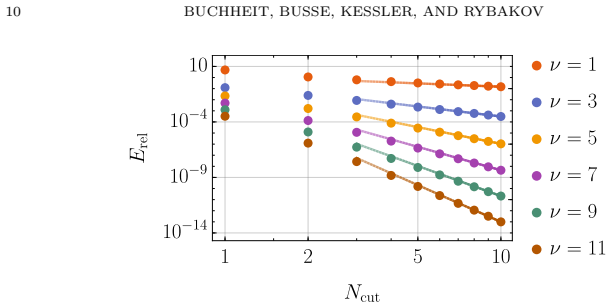
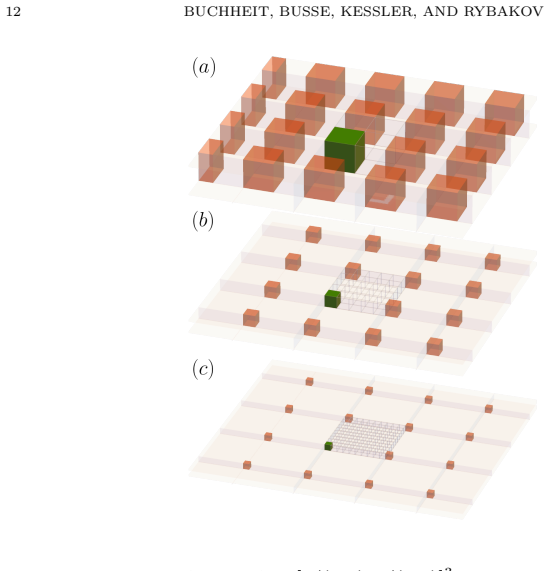
We address the efficient computation of power-law-based interaction potentials of homogeneous $d$-dimensional bodies with an infinite $n$-dimensional array of copies, including their higher-order derivatives. This problem forms a serious challenge in micromagnetics with periodic boundary conditions and related fields. Nowadays, it is common practice to truncate the associated infinite lattice sum to a finite number of images, introducing uncontrolled errors. We show that, for general interacting geometries, the exact infinite sum for both dipolar interactions and generalized Riesz power-law potentials can be obtained by complementing a small direct sum by a correction term that involves efficiently computable derivatives of generalized zeta functions. We show that the resulting representation converges exponentially in the derivative order, reaching machine precision at a computational cost no greater than that of truncated summation schemes. In order to compute the generalized zeta functions efficiently, we provide a superexponentially convergent algorithm for their evaluation, as well as for all required special functions, such as incomplete Bessel functions. Magnetic fields and related quantities can thus be evaluated to machine precision in arbitrary cuboidal domains periodically extended along one or two dimensions. We benchmark our method against known formulas for magnetic interactions and against direct summation for Riesz potentials with sufficiently large exponents, consistently achieving full precision. In addition, we identify new corrections to the asymptotic limit of the demagnetization field and tabulate high-precision benchmark values that can be used as a reliable reference for micromagnetic solvers. The techniques developed are broadly applicable, with direct impact in other areas such as molecular dynamics.
Editorial analysis
A structured set of objections, weighed in public.
Referee Report
Summary. The manuscript develops a zeta-expansion technique for computing exact infinite lattice sums of power-law (Riesz) and dipolar interactions for homogeneous bodies under 1D or 2D periodic boundary conditions. The central construction supplements a small direct sum over nearby images with a correction assembled from derivatives of generalized zeta functions and incomplete Bessel functions; a superexponentially convergent algorithm is supplied for these special functions. The resulting scheme is asserted to reach machine precision at a cost comparable to truncation, with benchmarks against analytic formulas and direct summation for large exponents, plus new corrections to the demagnetization-field asymptotics and tabulated high-precision reference values for micromagnetic solvers.
Significance. If the convergence and numerical-stability claims hold, the work supplies a practical, controllable-precision alternative to truncation for long-range periodic sums in micromagnetics and molecular dynamics. The explicit identification of new asymptotic corrections and the release of high-precision benchmark tables constitute concrete, reusable contributions to the field. The generality to arbitrary cuboids and to both dipolar and Riesz potentials broadens the potential impact beyond the immediate application.
major comments (2)
- [§3] §3 (algorithm for generalized zeta derivatives): the claim that the representation converges exponentially in derivative order and reaches machine precision is load-bearing for the central result, yet no a-priori bounds on conditioning, round-off propagation, or stability of the recurrence relations are given for derivative orders 10–30 in 3D cuboids with 1D/2D periodicity; this directly addresses the weakest assumption identified in the stress test.
- [§5] §5 (numerical benchmarks): while full precision is reported against analytic formulas and direct summation, the tables do not list the derivative orders employed, the lattice spacings tested, or any observed condition numbers, preventing independent verification that the method remains stable for the geometries and Riesz exponents required in micromagnetics.
minor comments (2)
- The notation for the incomplete Bessel functions and the precise definition of the generalized zeta function could be collected in a single preliminary subsection to improve readability for readers outside the immediate special-functions community.
- Figure captions for the convergence plots should explicitly state the Riesz exponent, periodicity dimensions, and derivative order used in each panel.
Simulated Author's Rebuttal
We thank the referee for the careful reading and constructive comments on our manuscript. The points raised regarding numerical stability analysis and the completeness of benchmark reporting are well taken, and we address them point by point below, indicating the revisions we will make.
read point-by-point responses
-
Referee: [§3] §3 (algorithm for generalized zeta derivatives): the claim that the representation converges exponentially in derivative order and reaches machine precision is load-bearing for the central result, yet no a-priori bounds on conditioning, round-off propagation, or stability of the recurrence relations are given for derivative orders 10–30 in 3D cuboids with 1D/2D periodicity; this directly addresses the weakest assumption identified in the stress test.
Authors: We acknowledge that the manuscript does not supply a-priori bounds on conditioning or round-off propagation for the recurrence relations at high derivative orders. The central construction relies on the observed superexponential convergence, which in practice limits the required orders to moderate values (typically below 20) for machine precision. Extensive numerical experiments confirm stability in double precision across the relevant geometries and periodicity settings. In the revised manuscript we will add a dedicated paragraph in §3 summarizing these stability observations, including representative condition-number estimates for derivative orders up to 30, while noting that a complete theoretical error analysis lies beyond the present scope. revision: partial
-
Referee: [§5] §5 (numerical benchmarks): while full precision is reported against analytic formulas and direct summation, the tables do not list the derivative orders employed, the lattice spacings tested, or any observed condition numbers, preventing independent verification that the method remains stable for the geometries and Riesz exponents required in micromagnetics.
Authors: We agree that the benchmark tables would benefit from explicit reporting of the derivative orders, lattice spacings, and observed condition numbers. This information will be added to all tables in §5, together with a short note on the parameter ranges chosen to match typical micromagnetics applications. These updates will allow readers to reproduce and verify the stability claims directly. revision: yes
Circularity Check
Derivation self-contained via standard zeta-function identities
full rationale
The paper obtains the exact periodic lattice sum by writing it as a small direct sum plus a correction built from derivatives of generalized zeta functions (and incomplete Bessel functions). This representation follows from classical Poisson-summation or Mellin-transform techniques applied to power-law kernels; the zeta functions themselves are independent special functions whose properties are not defined in terms of the target micromagnetic sum. No parameter is fitted to the output quantity, no uniqueness theorem is imported from the authors' prior work, and no ansatz is smuggled via self-citation. The claimed superexponential convergence of the special-function algorithm is an independent numerical claim that does not presuppose the final result. Consequently the derivation chain does not reduce to its inputs by construction.
Axiom & Free-Parameter Ledger
axioms (1)
- standard math Generalized zeta functions and their derivatives admit a superexponentially convergent evaluation algorithm for the required arguments and orders.
discussion (0)
Sign in with ORCID, Apple, or X to comment. Anyone can read and Pith papers without signing in.