Measurement of the dineutrino system kinematic variables in dileptonic top quark pair production in proton-proton collisions atsqrt{s} = 13 TeV
Pith reviewed 2026-05-22 12:26 UTC · model grok-4.3
The pith
Differential cross sections for top quark pair production match standard model predictions in dineutrino kinematic variables.
A machine-rendered reading of the paper's core claim, the machinery that carries it, and where it could break.
Core claim
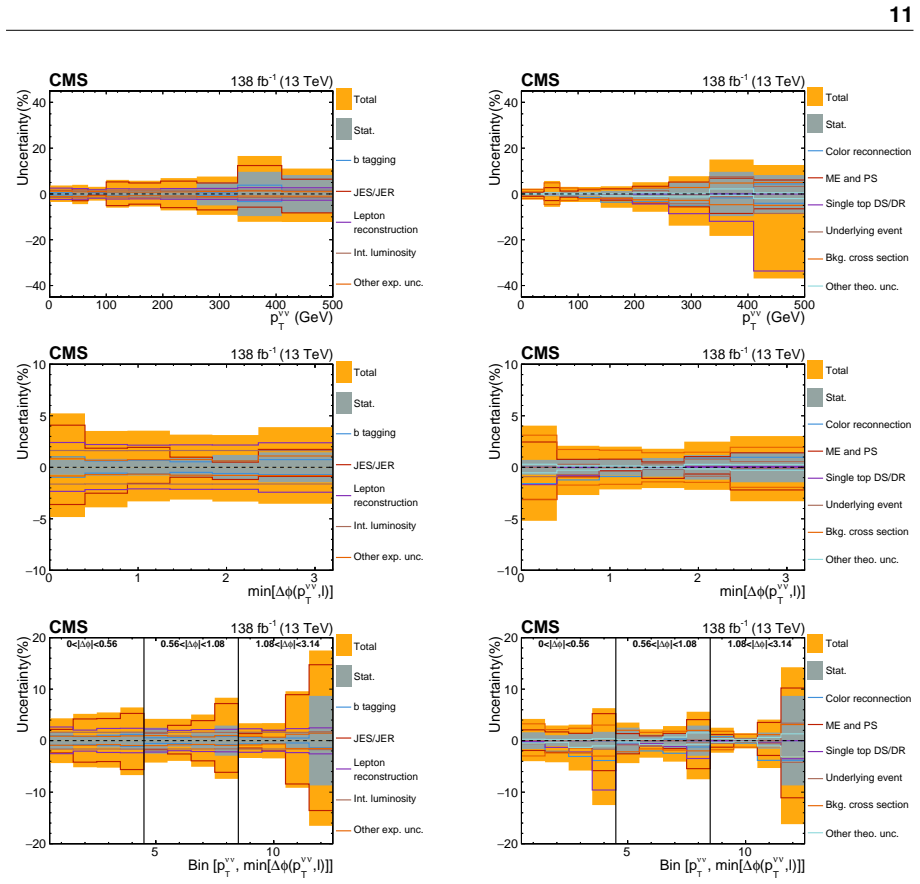
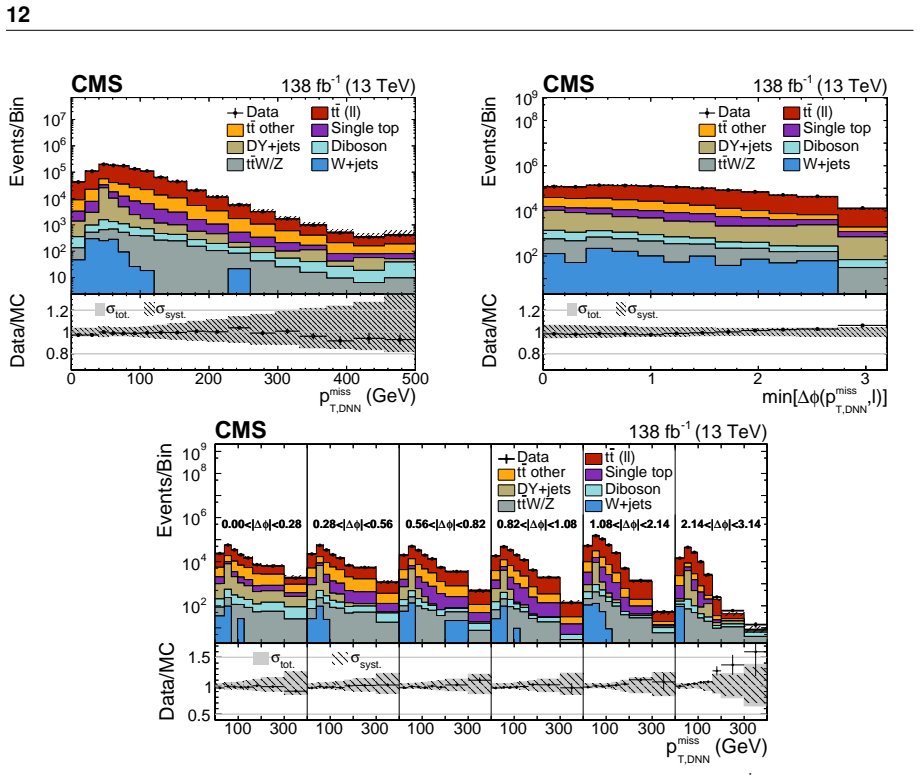
Differential top quark pair production cross sections are measured in the dilepton final states e+e−, μ+μ−, and e±μ∓, as a function of kinematic variables of the two-neutrino system: the transverse momentum pTνν of the dineutrino system, the minimum distance in azimuthal angle between pTνν and leptons, and in two dimensions in bins of both observables. The measurements are performed using CERN LHC proton-proton collisions at √s = 13 TeV, recorded by the CMS detector between 2016 and 2018, corresponding to an integrated luminosity of 138 fb−1. The measured cross sections are unfolded to the particle level using an unregularized least squares method. Results are compared with predictions by 0.
What carries the argument
Unfolding detector-level distributions to the particle level via an unregularized least squares method applied to the transverse momentum and azimuthal separation observables of the dineutrino system.
If this is right
- The unfolded cross sections validate the accuracy of Monte Carlo simulations for neutrino kinematics in top pair events.
- These measurements can serve as benchmarks for improving theoretical predictions of top quark production.
- Agreement in the two-dimensional distributions confirms that correlations between momentum and angular variables are correctly modeled.
- Future analyses can use these results to search for subtle deviations that might indicate new physics.
Where Pith is reading between the lines
- Similar unfolding approaches could be applied to other LHC processes involving missing transverse energy to extract particle-level information.
- The focus on dineutrino variables highlights how invisible particles' kinematics can be inferred from visible decay products in complex events.
- Extending these measurements to higher center-of-mass energies or with more data could tighten constraints on parton distribution functions.
Load-bearing premise
The Monte Carlo simulations used both for unfolding the detector-level distributions to particle level and for comparison with data accurately reproduce the experimental acceptance, resolution, and underlying physics processes in the dilepton final state.
What would settle it
Observation of a statistically significant mismatch between the unfolded data and the predicted cross sections in one or more kinematic bins would falsify the agreement with the standard model.
Figures




read the original abstract
Differential top quark pair production cross sections are measured in the dilepton final states e$^+$e$^-$, $\mu^+\mu^-$, and e$^\pm\mu^\mp$, as a function of kinematic variables of the two-neutrino system: the transverse momentum $p_\mathrm{T}^{\nu\nu}$ of the dineutrino system, the minimum distance in azimuthal angle between $\vec{p}_\mathrm{T}^{\,\nu\nu}$ and leptons, and in two dimensions in bins of both observables. The measurements are performed using CERN LHC proton-proton collisions at $\sqrt{s}$ = 13 TeV, recorded by the CMS detector between 2016 and 2018, corresponding to an integrated luminosity of 138 fb$^{-1}$. The measured cross sections are unfolded to the particle level using an unregularized least squares method. Results are compared with predictions by the standard model of particle physics, and found to be in agreement with theoretical calculations as well as Monte Carlo simulations.
Editorial analysis
A structured set of objections, weighed in public.
Referee Report
Summary. The manuscript reports measurements of differential cross sections for top-quark pair production in the dilepton final states (ee, μμ, eμ) at √s = 13 TeV. The observables are the transverse momentum of the dineutrino system p_T^{νν}, the minimum azimuthal separation Δφ_min between the dineutrino p_T vector and the leptons, and the two-dimensional distribution in these variables. Using 138 fb^{-1} of CMS data collected in 2016–2018, detector-level distributions are unfolded to particle level via an unregularized least-squares method. The unfolded results are compared to Standard Model theoretical calculations and Monte Carlo simulations and reported to be in agreement.
Significance. If the central claim holds, the result supplies a direct experimental constraint on the modeling of neutrino kinematics in dileptonic ttbar events, which is sensitive to higher-order QCD corrections and potential spin correlations. The explicit use of an unregularized unfolding method is a positive feature that avoids regularization-induced bias. The large data set and multi-channel combination add statistical power, and the focus on these specific observables fills a gap in existing differential ttbar measurements.
major comments (2)
- [Unfolding section] Unfolding section: The response matrix employed in the unregularized least-squares unfolding is constructed exclusively from Monte Carlo simulation of the signal process. Because the same simulation family is subsequently used for the particle-level comparisons, any residual mismatch between the MC modeling of detector response or neutrino kinematics and reality can propagate into the unfolded cross sections, potentially inflating the apparent agreement. A dedicated closure test or comparison with an independent generator for the response matrix is required to substantiate that the agreement constitutes an independent test rather than a consistency check.
- [Results section] Results section (comparison plots and tables): The manuscript states agreement with theoretical calculations and Monte Carlo simulations but does not quantify the level of agreement (e.g., via χ² per degree of freedom or pull distributions) after accounting for the full experimental covariance matrix. Without this, it is difficult to judge whether the reported agreement is statistically meaningful or merely consistent within large uncertainties.
minor comments (2)
- [Abstract and Introduction] The abstract and introduction should explicitly reference prior CMS or ATLAS measurements of similar neutrino-related observables in ttbar to place the novelty of the current work in context.
- [Figures] Figure captions for the unfolded distributions should state the binning scheme and the integrated luminosity used in each panel for clarity.
Simulated Author's Rebuttal
We thank the referee for the thorough review and valuable suggestions. We address each major comment below and plan to incorporate the recommended improvements in the revised manuscript.
read point-by-point responses
-
Referee: [Unfolding section] Unfolding section: The response matrix employed in the unregularized least-squares unfolding is constructed exclusively from Monte Carlo simulation of the signal process. Because the same simulation family is subsequently used for the particle-level comparisons, any residual mismatch between the MC modeling of detector response or neutrino kinematics and reality can propagate into the unfolded cross sections, potentially inflating the apparent agreement. A dedicated closure test or comparison with an independent generator for the response matrix is required to substantiate that the agreement constitutes an independent test rather than a consistency check.
Authors: We appreciate the referee's concern regarding potential bias in the unfolding procedure. The response matrix is indeed derived from the nominal Monte Carlo simulation of the signal process. However, the comparisons at particle level are performed not only with the nominal generator but also with alternative Monte Carlo models and theoretical calculations that employ different modeling of neutrino kinematics and higher-order corrections. To further substantiate the independence of the test, we will add a dedicated closure test in the revised manuscript. Specifically, we will generate pseudo-data using an alternative event generator, unfold it using the nominal response matrix, and verify that the unfolded distributions recover the input particle-level distributions within the expected uncertainties. This will demonstrate that the unfolding does not introduce artificial agreement. revision: yes
-
Referee: [Results section] Results section (comparison plots and tables): The manuscript states agreement with theoretical calculations and Monte Carlo simulations but does not quantify the level of agreement (e.g., via χ² per degree of freedom or pull distributions) after accounting for the full experimental covariance matrix. Without this, it is difficult to judge whether the reported agreement is statistically meaningful or merely consistent within large uncertainties.
Authors: We agree that providing quantitative measures of agreement would enhance the clarity and rigor of the results section. In the revised manuscript, we will include χ² per degree of freedom calculations for each comparison, utilizing the full covariance matrix obtained from the unfolding procedure, which incorporates both statistical and systematic uncertainties. Where feasible, we will also present pull distributions to allow readers to assess the agreement in a more detailed manner. These additions will help quantify the level of consistency with the predictions. revision: yes
Circularity Check
No significant circularity; measurement extracted from data and tested against independent predictions
full rationale
The paper reports a direct measurement of differential cross sections from 138 fb^{-1} of LHC collision data in the dilepton channel. The unregularized least-squares unfolding corrects detector-level distributions to particle level using a response matrix derived from Monte Carlo, after which the unfolded results are compared to separate theoretical calculations and Monte Carlo generators. No equation or step reduces the reported cross sections to parameters defined by the result itself; the data-driven extraction remains independent of the comparison predictions. This is the standard, externally falsifiable procedure in high-energy physics and does not meet any of the enumerated circularity patterns.
Axiom & Free-Parameter Ledger
axioms (2)
- domain assumption Monte Carlo simulations accurately model detector response, acceptance, and physics processes for unfolding and comparison.
- domain assumption Standard model calculations provide reliable predictions for the measured observables in the dilepton channel.
Lean theorems connected to this paper
-
IndisputableMonolith/Foundation/RealityFromDistinction.leanreality_from_one_distinction unclear?
unclearRelation between the paper passage and the cited Recognition theorem.
The measured cross sections are unfolded to the particle level using an unregularized least squares method and found to be in agreement with theoretical calculations as well as Monte Carlo simulations.
-
IndisputableMonolith/Cost/FunctionalEquation.leanwashburn_uniqueness_aczel unclear?
unclearRelation between the paper passage and the cited Recognition theorem.
Differential top quark pair production cross sections are measured ... as a function of kinematic variables of the two-neutrino system
What do these tags mean?
- matches
- The paper's claim is directly supported by a theorem in the formal canon.
- supports
- The theorem supports part of the paper's argument, but the paper may add assumptions or extra steps.
- extends
- The paper goes beyond the formal theorem; the theorem is a base layer rather than the whole result.
- uses
- The paper appears to rely on the theorem as machinery.
- contradicts
- The paper's claim conflicts with a theorem or certificate in the canon.
- unclear
- Pith found a possible connection, but the passage is too broad, indirect, or ambiguous to say the theorem truly supports the claim.
Reference graph
Works this paper leans on
-
[1]
ATLAS Collaboration, “Measurements of top quark pair relative differential cross-sections with ATLAS in pp collisions at √s=7 TeV”,Eur. Phys. J. C73(2013) 2261, doi:10.1140/epjc/s10052-012-2261-1,arXiv:1207.5644
work page internal anchor Pith review Pith/arXiv arXiv doi:10.1140/epjc/s10052-012-2261-1 2013
-
[2]
CMS Collaboration, “Measurement of differential top-quark pair production cross sections in pp colisions at √s=7 TeV”,Eur. Phys. J. C73(2013) 2339, doi:10.1140/epjc/s10052-013-2339-4,arXiv:1211.2220
work page internal anchor Pith review Pith/arXiv arXiv doi:10.1140/epjc/s10052-013-2339-4 2013
-
[3]
ATLAS Collaboration, “Measurements of normalized differential cross sections for t t production in pp collisions at √s=7 TeV using the ATLAS detector”,Phys. Rev. D90 (2014) 072004,doi:10.1103/PhysRevD.90.072004,arXiv:1407.0371
work page internal anchor Pith review Pith/arXiv arXiv doi:10.1103/physrevd.90.072004 2014
-
[4]
ATLAS Collaboration, “Differential top-antitop cross-section measurements as a function of observables constructed from final-state particles using pp collisions at √s=7 TeV in the ATLAS detector”,JHEP06(2015) 100,doi:10.1007/JHEP06(2015)100, arXiv:1502.05923. 20
work page internal anchor Pith review Pith/arXiv arXiv doi:10.1007/jhep06(2015)100 2015
-
[5]
ATLAS Collaboration, “Measurement of top quark pair differential cross-sections in the dilepton channel in pp collisions at √s=7 and 8 TeV with ATLAS”,Phys. Rev. D94 (2016) 092003,doi:10.1103/PhysRevD.94.092003,arXiv:1607.07281. [Addendum:doi:10.1103/PhysRevD.101.119901]
work page internal anchor Pith review Pith/arXiv arXiv doi:10.1103/physrevd.94.092003 2016
-
[6]
CMS Collaboration, “Measurement of the differential cross section for top quark pair production in pp collisions at √s= 8 TeV”,Eur. Phys. J. C75(2015) 542, doi:10.1140/epjc/s10052-015-3709-x,arXiv:1505.04480
work page internal anchor Pith review Pith/arXiv arXiv doi:10.1140/epjc/s10052-015-3709-x 2015
-
[7]
ATLAS Collaboration, “Measurements of top-quark pair differential cross-sections in the lepton+jets channel in pp collisions at √s=8 TeV using the ATLAS detector”,Eur. Phys. J. C76(2016) 538,doi:10.1140/epjc/s10052-016-4366-4,arXiv:1511.04716
work page internal anchor Pith review Pith/arXiv arXiv doi:10.1140/epjc/s10052-016-4366-4 2016
-
[8]
ATLAS Collaboration, “Measurement of the differential cross-section of highly boosted top quarks as a function of their transverse momentum in √s=8 TeV proton-proton collisions using the ATLAS detector”,Phys. Rev. D93(2016) 032009, doi:10.1103/PhysRevD.93.032009,arXiv:1510.03818
work page internal anchor Pith review Pith/arXiv arXiv doi:10.1103/physrevd.93.032009 2016
-
[9]
CMS Collaboration, “Measurement of the t t production cross section in the all-jets final state in pp collisions at √s=8 TeV”,Eur. Phys. J. C76(2016) 128, doi:10.1140/epjc/s10052-016-3956-5,arXiv:1509.06076
work page internal anchor Pith review Pith/arXiv arXiv doi:10.1140/epjc/s10052-016-3956-5 2016
-
[10]
CMS Collaboration, “Measurement of the integrated and differential t t production cross sections for high-pT top quarks in pp collisions at √s=8 TeV”,Phys. Rev. D94(2016) 072002,doi:10.1103/PhysRevD.94.072002,arXiv:1605.00116
work page internal anchor Pith review Pith/arXiv arXiv doi:10.1103/physrevd.94.072002 2016
-
[11]
CMS Collaboration, “Measurement of double-differential cross sections for top quark pair production in pp collisions at √s=8 TeV and impact on parton distribution functions”,Eur. Phys. J. C77(2017) 459,doi:10.1140/epjc/s10052-017-4984-5, arXiv:1703.01630
work page internal anchor Pith review Pith/arXiv arXiv doi:10.1140/epjc/s10052-017-4984-5 2017
-
[12]
ATLAS Collaboration, “Measurement of the top-quark mass in t t+1-jet events collected with the ATLAS detector in pp collisions at √s=8 TeV”,JHEP11(2019) 150, doi:10.1007/JHEP11(2019)150,arXiv:1905.02302
-
[13]
CMS Collaboration, “Measurement of differential cross sections for top quark pair production using the lepton+jets final state in proton-proton collisions at 13 TeV”,Phys. Rev. D95(2017) 092001,doi:10.1103/PhysRevD.95.092001,arXiv:1610.04191
work page internal anchor Pith review Pith/arXiv arXiv doi:10.1103/physrevd.95.092001 2017
-
[14]
ATLAS Collaboration, “Measurement of jet activity produced in top-quark events with an electron, a muon and two b-tagged jets in the final state in pp collisions at√s=13 TeV with the ATLAS detector”,Eur. Phys. J. C77(2017) 220, doi:10.1140/epjc/s10052-017-4766-0,arXiv:1610.09978
work page internal anchor Pith review Pith/arXiv arXiv doi:10.1140/epjc/s10052-017-4766-0 2017
-
[15]
ATLAS Collaboration, “Measurements of top-quark pair differential cross-sections in the eµchannel inppcollisions at √s=13 TeV using the ATLAS detector”,Eur. Phys. J. C77 (2017) 292,doi:10.1140/epjc/s10052-017-4821-x,arXiv:1612.05220
work page internal anchor Pith review Pith/arXiv arXiv doi:10.1140/epjc/s10052-017-4821-x 2017
-
[16]
CMS Collaboration, “Measurement of normalized differential t t cross sections in the dilepton channel from pp collisions at √s=13 TeV”,JHEP04(2018) 060, doi:10.1007/JHEP04(2018)060,arXiv:1708.07638. References 21
work page internal anchor Pith review Pith/arXiv arXiv doi:10.1007/jhep04(2018)060 2018
-
[17]
CMS Collaboration, “Measurement of differential cross sections for the production of top quark pairs and of additional jets in lepton+jets events from pp collisions at√s=13 TeV”,Phys. Rev. D97(2018) 112003,doi:10.1103/PhysRevD.97.112003, arXiv:1803.08856
work page internal anchor Pith review Pith/arXiv arXiv doi:10.1103/physrevd.97.112003 2018
-
[18]
CMS Collaboration, “Measurements of t t differential cross sections in proton-proton collisions at √s=13 TeV using events containing two leptons”,JHEP02(2019) 149, doi:10.1007/JHEP02(2019)149,arXiv:1811.06625
work page internal anchor Pith review Pith/arXiv arXiv doi:10.1007/jhep02(2019)149 2019
-
[19]
CMS Collaboration, “Measurement of t t normalised multi-differential cross sections in pp collisions at √s=13 TeV, and simultaneous determination of the strong coupling strength, top quark pole mass, and parton distribution functions”,Eur. Phys. J. C80 (2020) 658,doi:10.1140/epjc/s10052-020-7917-7,arXiv:1904.05237
-
[20]
ATLAS Collaboration, “Measurements of top-quark pair differential and double-differential cross-sections in theℓ+jets channel with pp collisions at √s=13 TeV using the ATLAS detector”,Eur. Phys. J. C79(2019) 1028, doi:10.1140/epjc/s10052-019-7525-6,arXiv:1908.07305. [Erratum: doi:10.1140/epjc/s10052-020-08541-3]
-
[21]
ATLAS Collaboration, “Measurement of the t t production cross-section and lepton differential distributions in eµdilepton events from pp collisions at √s=13 TeV with the ATLAS detector”,Eur. Phys. J. C80(2020) 528, doi:10.1140/epjc/s10052-020-7907-9,arXiv:1910.08819
-
[22]
ATLAS Collaboration, “Measurements of top-quark pair single- and double-differential cross-sections in the all-hadronic channel in pp collisions at √s=13 TeV using the ATLAS detector”,JHEP01(2021) 033,doi:10.1007/JHEP01(2021)033, arXiv:2006.09274
-
[23]
CMS Collaboration, “Measurement of differential t t production cross sections in the full kinematic range using lepton+jets events from proton-proton collisions at √s=13 TeV”, Phys. Rev. D104(2021) 092013,doi:10.1103/PhysRevD.104.092013, arXiv:2108.02803
-
[24]
Supersymmetry at ordinary energies. Masses and conservation laws
S. Weinberg, “Supersymmetry at ordinary energies. Masses and conservation laws”, Phys. Rev. D26(1982) 287,doi:10.1103/PhysRevD.26.287
-
[25]
NNLL resummation for stop pair-production at the LHC
W. Beenakker et al., “NNLL resummation for stop pair-production at the LHC”,JHEP 05(2016) 153,doi:10.1007/JHEP05(2016)153,arXiv:1601.02954
work page internal anchor Pith review Pith/arXiv arXiv doi:10.1007/jhep05(2016)153 2016
-
[26]
CMS Collaboration, “Search for top squark pair production using dilepton final states in pp collision data collected at √s=13 TeV”,Eur. Phys. J. C81(2021) 3, doi:10.1140/epjc/s10052-020-08701-5,arXiv:2008.05936
-
[27]
CMS Collaboration, “Combined searches for the production of supersymmetric top quark partners in proton-proton collisions at √s=13 TeV”,Eur. Phys. J. C81(2021) 970, doi:10.1140/epjc/s10052-021-09721-5,arXiv:2107.10892
-
[28]
NNLO QCD corrections to leptonic observables in top-quark pair production and decay
M. Czakon, A. Mitov, and R. Poncelet, “NNLO QCD corrections to leptonic observables in top-quark pair production and decay”,JHEP05(2021) 212, doi:10.1007/JHEP05(2021)212,arXiv:2008.11133
-
[29]
HEPData record for this analysis, 2025.doi:10.17182/hepdata.153302. 22
-
[30]
The CMS experiment at the CERN LHC
CMS Collaboration, “The CMS experiment at the CERN LHC”,JINST3(2008) S08004, doi:10.1088/1748-0221/3/08/S08004
-
[31]
Development of the CMS detector for the CERN LHC Run 3
CMS Collaboration, “Development of the CMS detector for the CERN LHC Run 3”, JINST19(2024) P05064,doi:10.1088/1748-0221/19/05/P05064, arXiv:2309.05466
-
[32]
Performance of the CMS Level-1 trigger in proton-proton collisions at √s=13 TeV
CMS Collaboration, “Performance of the CMS Level-1 trigger in proton-proton collisions at √s=13 TeV”,JINST15(2020) P10017,doi:10.1088/1748-0221/15/10/P10017, arXiv:2006.10165
-
[33]
CMS Collaboration, “The CMS trigger system”,JINST12(2017) P01020, doi:10.1088/1748-0221/12/01/P01020,arXiv:1609.02366
work page internal anchor Pith review Pith/arXiv arXiv doi:10.1088/1748-0221/12/01/p01020 2017
-
[34]
Performance of the CMS high-level trigger during LHC Run 2
CMS Collaboration, “Performance of the CMS high-level trigger during LHC Run 2”, JINST19(2024) P11021,doi:10.1088/1748-0221/19/11/P11021, arXiv:2410.17038
-
[35]
Electron and photon reconstruction and identification with the CMS experiment at the CERN LHC
CMS Collaboration, “Electron and photon reconstruction and identification with the CMS experiment at the CERN LHC”,JINST16(2021) P05014, doi:10.1088/1748-0221/16/05/P05014,arXiv:2012.06888
-
[36]
CMS Collaboration, “Performance of the CMS muon detector and muon reconstruction with proton-proton collisions at √s=13 TeV”,JINST13(2018) P06015, doi:10.1088/1748-0221/13/06/P06015,arXiv:1804.04528
work page internal anchor Pith review Pith/arXiv arXiv doi:10.1088/1748-0221/13/06/p06015 2018
-
[37]
Description and performance of track and primary-vertex reconstruction with the CMS tracker
CMS Collaboration, “Description and performance of track and primary-vertex reconstruction with the CMS tracker”,JINST9(2014) P10009, doi:10.1088/1748-0221/9/10/P10009,arXiv:1405.6569
work page internal anchor Pith review Pith/arXiv arXiv doi:10.1088/1748-0221/9/10/p10009 2014
-
[38]
Precision luminosity measurement in proton-proton collisions at√s=13 TeV in 2015 and 2016 at CMS
CMS Collaboration, “Precision luminosity measurement in proton-proton collisions at√s=13 TeV in 2015 and 2016 at CMS”,Eur. Phys. J. C81(2021) 800, doi:10.1140/epjc/s10052-021-09538-2,arXiv:2104.01927
-
[39]
CMS luminosity measurement for the 2017 data-taking period at√s=13 TeV
CMS Collaboration, “CMS luminosity measurement for the 2017 data-taking period at√s=13 TeV”, CMS Physics Analysis Summary CMS-PAS-LUM-17-004, 2018
work page 2017
-
[40]
CMS luminosity measurement for the 2018 data-taking period at√s=13 TeV
CMS Collaboration, “CMS luminosity measurement for the 2018 data-taking period at√s=13 TeV”, CMS Physics Analysis Summary CMS-PAS-LUM-18-002, 2019
work page 2018
-
[41]
Unbiased global determination of parton distributions and their uncertainties at NNLO and at LO
NNPDF Collaboration, “Unbiased global determination of parton distributions and their uncertainties at NNLO and at LO”,Nucl. Phys. B855(2012) 153, doi:10.1016/j.nuclphysb.2011.09.024,arXiv:1107.2652
work page internal anchor Pith review Pith/arXiv arXiv doi:10.1016/j.nuclphysb.2011.09.024 2012
-
[42]
Parton distributions from high-precision collider data
NNPDF Collaboration, “Parton distributions from high-precision collider data”,Eur. Phys. J. C77(2017) 663,doi:10.1140/epjc/s10052-017-5199-5, arXiv:1706.00428
work page internal anchor Pith review Pith/arXiv arXiv doi:10.1140/epjc/s10052-017-5199-5 2017
-
[43]
T. Sj ¨ostrand et al., “An introduction toPYTHIA8.2”,Comput. Phys. Commun.191(2015) 159,doi:10.1016/j.cpc.2015.01.024,arXiv:1410.3012
work page internal anchor Pith review Pith/arXiv arXiv doi:10.1016/j.cpc.2015.01.024 2015
-
[44]
Extraction and validation of a new set of CMS PYTHIA8 tunes from underlying-event measurements
CMS Collaboration, “Extraction and validation of a new set of CMSPYTHIA8 tunes from underlying-event measurements”,Eur. Phys. J. C80(2020) 4, doi:10.1140/epjc/s10052-019-7499-4,arXiv:1903.12179. References 23
-
[45]
GEANT4 Collaboration, “GEANT4—a simulation toolkit”,Nucl. Instrum. Meth. A506 (2003) 250,doi:10.1016/S0168-9002(03)01368-8
-
[46]
A New Method for Combining NLO QCD with Shower Monte Carlo Algorithms
P . Nason, “A new method for combining NLO QCD with shower Monte Carlo algorithms”,JHEP11(2004) 040,doi:10.1088/1126-6708/2004/11/040, arXiv:hep-ph/0409146
work page internal anchor Pith review Pith/arXiv arXiv doi:10.1088/1126-6708/2004/11/040 2004
-
[47]
Matching NLO QCD computations with Parton Shower simulations: the POWHEG method
S. Frixione, P . Nason, and C. Oleari, “Matching NLO QCD computations with parton shower simulations: thePOWHEGmethod”,JHEP11(2007) 070, doi:10.1088/1126-6708/2007/11/070,arXiv:0709.2092
work page internal anchor Pith review Pith/arXiv arXiv doi:10.1088/1126-6708/2007/11/070 2007
-
[48]
A general framework for implementing NLO calculations in shower Monte Carlo programs: the POWHEG BOX
S. Alioli, P . Nason, C. Oleari, and E. Re, “A general framework for implementing NLO calculations in shower Monte Carlo programs: thePOWHEG BOX”,JHEP06(2010) 043, doi:10.1007/JHEP06(2010)043,arXiv:1002.2581
work page internal anchor Pith review Pith/arXiv arXiv doi:10.1007/jhep06(2010)043 2010
-
[49]
J. Alwall et al., “The automated computation of tree-level and next-to-leading order differential cross sections, and their matching to parton shower simulations”,JHEP07 (2014) 079,doi:10.1007/JHEP07(2014)079,arXiv:1405.0301
work page internal anchor Pith review Pith/arXiv arXiv doi:10.1007/jhep07(2014)079 2014
-
[50]
Merging meets matching in MC@NLO
R. Frederix and S. Frixione, “Merging meets matching inMC@NLO”,JHEP12(2012) 061, doi:10.1007/JHEP12(2012)061,arXiv:1209.6215
work page internal anchor Pith review Pith/arXiv arXiv doi:10.1007/jhep12(2012)061 2012
-
[51]
Herwig 7.0 / Herwig++ 3.0 Release Note
J. Bellm et al., “HERWIG7.0/HERWIG++ 3.0 release note”,Eur. Phys. J. C76(2016) 196, doi:10.1140/epjc/s10052-016-4018-8,arXiv:1512.01178
work page internal anchor Pith review Pith/arXiv arXiv doi:10.1140/epjc/s10052-016-4018-8 2016
-
[52]
Development and validation ofHERWIG7 tunes from CMS underlying-event measurements
CMS Collaboration, “Development and validation ofHERWIG7 tunes from CMS underlying-event measurements”,Eur. Phys. J. C81(2021) 312, doi:10.1140/epjc/s10052-021-08949-5,arXiv:2011.03422
-
[53]
J. Alwall et al., “Comparative study of various algorithms for the merging of parton showers and matrix elements in hadronic collisions”,Eur. Phys. J. C53(2008) 473, doi:10.1140/epjc/s10052-007-0490-5,arXiv:0706.2569
work page internal anchor Pith review Pith/arXiv arXiv doi:10.1140/epjc/s10052-007-0490-5 2008
-
[54]
NLO single-top production matched with shower in POWHEG: s- and t-channel contributions
S. Alioli, P . Nason, C. Oleari, and E. Re, “NLO single-top production matched with shower inPOWHEG:s- andt-channel contributions”,JHEP09(2009) 111, doi:10.1088/1126-6708/2009/09/111,arXiv:0907.4076. [Erratum: doi:10.1007/JHEP02(2010)011]
work page internal anchor Pith review Pith/arXiv arXiv doi:10.1088/1126-6708/2009/09/111 2009
-
[55]
Single-top Wt-channel production matched with parton showers using the POWHEG method
E. Re, “Single-top Wt-channel production matched with parton showers using the POWHEGmethod”,Eur. Phys. J. C71(2011) 1547, doi:10.1140/epjc/s10052-011-1547-z,arXiv:1009.2450
work page internal anchor Pith review Pith/arXiv arXiv doi:10.1140/epjc/s10052-011-1547-z 2011
-
[56]
Top++: a program for the calculation of the top-pair cross-section at hadron colliders
M. Czakon and A. Mitov, “TOP++: a program for the calculation of the top-pair cross-section at hadron colliders”,Comput. Phys. Commun.185(2014) 2930, doi:10.1016/j.cpc.2014.06.021,arXiv:1112.5675
work page internal anchor Pith review Pith/arXiv arXiv doi:10.1016/j.cpc.2014.06.021 2014
-
[57]
The total top quark pair production cross-section at hadron colliders through O(alpha_S^4)
M. Czakon, P . Fiedler, and A. Mitov, “Total top-quark pair-production cross section at hadron colliders throughO(α S 4)”,Phys. Rev. Lett.110(2013) 252004, doi:10.1103/PhysRevLett.110.252004,arXiv:1303.6254
work page internal anchor Pith review Pith/arXiv arXiv doi:10.1103/physrevlett.110.252004 2013
-
[58]
M. Cacciari et al., “Top-pair production at hadron colliders with next-to-next-to-leading logarithmic soft-gluon resummation”,Phys. Lett. B710(2012) 612, doi:10.1016/j.physletb.2012.03.013,arXiv:1111.5869. 24
work page internal anchor Pith review Pith/arXiv arXiv doi:10.1016/j.physletb.2012.03.013 2012
-
[59]
P . B¨arnreuther, M. Czakon, and A. Mitov, “Percent level precision physics at the Tevatron: Next-to-next-to-leading order QCD corrections to qq→t t+X”,Phys. Rev. Lett.109 (2012) 132001,doi:10.1103/PhysRevLett.109.132001,arXiv:1204.5201
work page internal anchor Pith review Pith/arXiv arXiv doi:10.1103/physrevlett.109.132001 2012
-
[60]
NNLO corrections to top-pair production at hadron colliders: the all-fermionic scattering channels
M. Czakon and A. Mitov, “NNLO corrections to top-pair production at hadron colliders: the all-fermionic scattering channels”,JHEP12(2012) 054, doi:10.1007/JHEP12(2012)054,arXiv:1207.0236
work page internal anchor Pith review Pith/arXiv arXiv doi:10.1007/jhep12(2012)054 2012
-
[61]
Top-pair production at the LHC through NNLO QCD and NLO EW
M. Czakon et al., “Top-pair production at the LHC through NNLO QCD and NLO EW”, JHEP10(2017) 186,doi:10.1007/JHEP10(2017)186,arXiv:1705.04105
work page internal anchor Pith review Pith/arXiv arXiv doi:10.1007/jhep10(2017)186 2017
-
[62]
FEWZ 2.0: A code for hadronic Z production at next-to-next-to-leading order
R. Gavin, Y. Li, F. Petriello, and S. Quackenbush, “FEWZ2.0: A code for hadronic Z production at next-to-next-to-leading order”,Comput. Phys. Commun.182(2011) 2388, doi:10.1016/j.cpc.2011.06.008,arXiv:1011.3540
work page internal anchor Pith review Pith/arXiv arXiv doi:10.1016/j.cpc.2011.06.008 2011
-
[63]
Combining QCD and electroweak corrections to dilepton production in FEWZ
Y. Li and F. Petriello, “Combining QCD and electroweak corrections to dilepton production inFEWZ”,Phys. Rev. D86(2012) 094034, doi:10.1103/PhysRevD.86.094034,arXiv:1208.5967
work page internal anchor Pith review Pith/arXiv arXiv doi:10.1103/physrevd.86.094034 2012
-
[64]
Two-loop soft anomalous dimensions for single top quark associated production with a W- or H-
N. Kidonakis, “Two-loop soft anomalous dimensions for single top quark associated production with a W− or H−”,Phys. Rev. D82(2010) 054018, doi:10.1103/PhysRevD.82.054018,arXiv:1005.4451
work page internal anchor Pith review Pith/arXiv arXiv doi:10.1103/physrevd.82.054018 2010
-
[65]
-- HATHOR -- HAdronic Top and Heavy quarks crOss section calculatoR
M. Aliev et al., “HATHOR: Hadronic top and heavy quarks cross section calculator”, Comput. Phys. Commun.182(2011) 1034,doi:10.1016/j.cpc.2010.12.040, arXiv:1007.1327
work page internal anchor Pith review Pith/arXiv arXiv doi:10.1016/j.cpc.2010.12.040 2011
-
[66]
P . Kant et al., “HATHORfor single top-quark production: Updated predictions and uncertainty estimates for single top-quark production in hadronic collisions”,Comput. Phys. Commun.191(2015) 74,doi:10.1016/j.cpc.2015.02.001, arXiv:1406.4403
work page internal anchor Pith review Pith/arXiv arXiv doi:10.1016/j.cpc.2015.02.001 2015
-
[67]
$W^+W^-$ production at hadron colliders in NNLO QCD
T. Gehrmann et al., “W +W− production at hadron colliders in next to next to leading order QCD”,Phys. Rev. Lett.113(2014) 212001, doi:10.1103/PhysRevLett.113.212001,arXiv:1408.5243
work page internal anchor Pith review Pith/arXiv arXiv doi:10.1103/physrevlett.113.212001 2014
-
[68]
Vector boson pair production at the LHC
J. M. Campbell, R. K. Ellis, and C. Williams, “Vector boson pair production at the LHC”, JHEP07(2011) 018,doi:10.1007/JHEP07(2011)018,arXiv:1105.0020
work page internal anchor Pith review Pith/arXiv arXiv doi:10.1007/jhep07(2011)018 2011
-
[69]
Technical proposal for the Phase-II upgrade of the Compact Muon Solenoid
CMS Collaboration, “Technical proposal for the Phase-II upgrade of the Compact Muon Solenoid”, CMS Technical Proposal CERN-LHCC-2015-010, CMS-TDR-15-02, 2015. doi:10.17181/CERN.VU8I.D59J
-
[70]
Particle-flow reconstruction and global event description with the CMS detector
CMS Collaboration, “Particle-flow reconstruction and global event description with the CMS detector”,JINST12(2017) P10003,doi:10.1088/1748-0221/12/10/P10003, arXiv:1706.04965
work page internal anchor Pith review Pith/arXiv arXiv doi:10.1088/1748-0221/12/10/p10003 2017
-
[71]
Performance of the CMS electromagnetic calorimeter in pp collisions at √s=13 TeV
CMS Collaboration, “Performance of the CMS electromagnetic calorimeter in pp collisions at √s=13 TeV”,JINST19(2024) P09004, doi:10.1088/1748-0221/19/09/P09004,arXiv:2403.15518
-
[72]
Performance of CMS muon reconstruction from proton-proton to heavy ion collisions
CMS Collaboration, “Performance of CMS muon reconstruction from proton-proton to heavy ion collisions”,JINST19(2024) P09012, doi:10.1088/1748-0221/19/09/P09012,arXiv:2404.17377. References 25
-
[73]
The anti-k_t jet clustering algorithm
M. Cacciari, G. P . Salam, and G. Soyez, “The anti-kT jet clustering algorithm”,JHEP04 (2008) 063,doi:10.1088/1126-6708/2008/04/063,arXiv:0802.1189
work page internal anchor Pith review Pith/arXiv arXiv doi:10.1088/1126-6708/2008/04/063 2008
-
[74]
M. Cacciari, G. P . Salam, and G. Soyez, “FASTJETuser manual”,Eur. Phys. J. C72(2012) 1896,doi:10.1140/epjc/s10052-012-1896-2,arXiv:1111.6097
work page internal anchor Pith review Pith/arXiv arXiv doi:10.1140/epjc/s10052-012-1896-2 2012
-
[75]
Pileup mitigation at CMS in 13 TeV data
CMS Collaboration, “Pileup mitigation at CMS in 13 TeV data”,JINST15(2020) P09018, doi:10.1088/1748-0221/15/09/P09018,arXiv:2003.00503
-
[76]
Jet flavour classification using DeepJet
E. Bols et al., “Jet flavour classification using DeepJet”,JINST15(2020) P12012, doi:10.1088/1748-0221/15/12/P12012,arXiv:2008.10519
-
[77]
CMS Collaboration, “Performance of missing transverse momentum reconstruction in proton-proton collisions at √s=13 TeV using the CMS detector”,JINST14(2019) P07004,doi:10.1088/1748-0221/14/07/P07004,arXiv:1903.06078
work page internal anchor Pith review Pith/arXiv arXiv doi:10.1088/1748-0221/14/07/p07004 2019
-
[78]
Pileup Per Particle Identification
D. Bertolini, P . Harris, M. Low, and N. Tran, “Pileup per particle identification”,JHEP10 (2014) 059,doi:10.1007/JHEP10(2014)059,arXiv:1407.6013
work page internal anchor Pith review Pith/arXiv arXiv doi:10.1007/jhep10(2014)059 2014
-
[79]
Particle Data Group, S. Navas et al., “Review of particle physics”,Phys. Rev. D110 (2024) 030001,doi:10.1103/PhysRevD.110.030001
-
[80]
Identification of heavy-flavour jets with the CMS detector in pp collisions at 13 TeV
CMS Collaboration, “Identification of heavy-flavour jets with the CMS detector in pp collisions at 13 TeV”,JINST13(2018) P05011, doi:10.1088/1748-0221/13/05/P05011,arXiv:1712.07158
work page internal anchor Pith review Pith/arXiv arXiv doi:10.1088/1748-0221/13/05/p05011 2018
discussion (0)
Sign in with ORCID, Apple, or X to comment. Anyone can read and Pith papers without signing in.