Multi Language Models for On-the-Fly Syntax Highlighting
Pith reviewed 2026-05-18 10:32 UTC · model grok-4.3
The pith
A single model can highlight syntax for up to six programming languages at once.
A machine-rendered reading of the paper's core claim, the machinery that carries it, and where it could break.
Core claim
The central discovery is a unified deep-learning model trained to perform on-the-fly syntax highlighting across up to six mainstream programming languages by encoding the behavior of language-specific brute-force resolvers into a single statistical predictor. A novel normalization technique is applied to the input to improve generalization, and few-shot experiments demonstrate that a small set of oracle-highlighted samples can substitute for large datasets derived from slow generators, thereby cutting both training cost and dependence on language-specific infrastructure.
What carries the argument
The unified multi-language model that uses a normalization technique to align inputs from different languages and few-shot learning to adapt with minimal oracle examples.
If this is right
- Deployment complexity drops from maintaining six models to one.
- Performance improves on programming languages absent from the main training set.
- Training data requirements shrink because a handful of oracle samples can replace large brute-force-generated corpora.
- Real-time serving remains feasible under strict latency and memory budgets for web-based editors.
- The same normalization and few-shot approach can be reused when adding further languages.
Where Pith is reading between the lines
- The method could be tested on code analysis tasks beyond highlighting, such as error detection or auto-completion, by swapping the target labels.
- Production systems could adopt an incremental update path where new languages are added with a few dozen labeled examples rather than full retraining.
- The normalization step might be inspected to see which code features it preserves or discards across languages, offering clues for other cross-language transfer settings.
- If the model maintains accuracy on very short or malformed snippets, it could support live preview in low-bandwidth environments.
Load-bearing premise
A single statistical model can learn to replicate the highlighting behavior of separate brute-force tools for partial or invalid code in multiple languages without language-specific retraining or large per-language datasets.
What would settle it
Measure whether the unified model produces fewer correct highlights than six separate single-language models when both are tested on the same set of incomplete code snippets from a held-out language after training on only five oracle examples per language.
Figures
read the original abstract
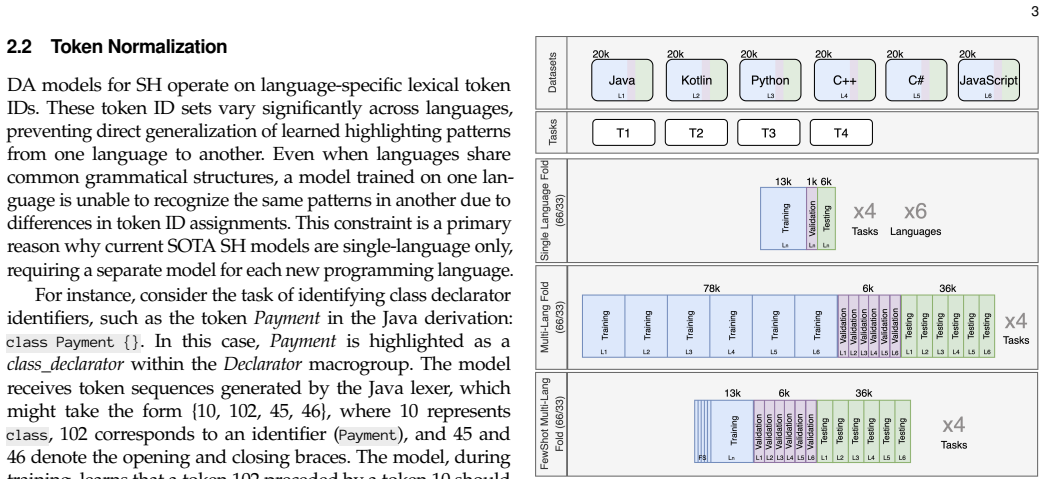
Syntax highlighting is a critical feature in modern software development environments, enhancing code readability and developer productivity. However, delivering accurate highlighting in real time remains challenging for online and web-based development tools due to strict time and memory constraints on backend services. These systems must serve highlights rapidly and frequently, even when code is partially valid or invalid. This has led to on-the-fly syntax highlighting, where visual annotations are generated just before content is served, often at high request rates and under incomplete input conditions. To meet these demands efficiently, state-of-the-art models use deep learning to learn the behavior of brute-force syntax highlighting resolvers, tools that are easy to implement but too slow for production. Through the Deep Abstraction process, brute-force strategies are encoded into fast statistical models that achieve both high accuracy and low-latency inference. Despite their success, such models face key challenges: they support only one programming language per model, require large datasets from slow brute-force generators, and involve resource-intensive training. In multi-language environments, this means maintaining multiple independent models, increasing system complexity and operational cost. This work addresses these issues by introducing a unified model capable of highlighting up to six mainstream programming languages, reducing deployment complexity by a factor of six and improving performance on unseen languages. A novel normalization technique significantly enhances model generalization, while few-shot learning experiments show that a small number of oracle samples can replace large datasets, minimizing dependence on brute-force generators. Combined, these innovations enable efficient, scalable, and cost-effective syntax highlighting across diverse programming languages.
Editorial analysis
A structured set of objections, weighed in public.
Referee Report
Summary. The manuscript proposes a unified deep learning model for on-the-fly syntax highlighting supporting up to six programming languages. It introduces a novel normalization technique claimed to improve generalization to unseen languages and uses few-shot learning with oracle samples to reduce dependence on large brute-force generated datasets, thereby cutting deployment complexity by a factor of six compared to maintaining separate per-language models.
Significance. If the empirical claims are substantiated, the work would provide a practical reduction in operational overhead for multi-language web and online IDE backends by consolidating six models into one while demonstrating that normalization plus minimal oracle data can approximate language-specific brute-force behavior on partial or invalid inputs. This extends prior single-language deep abstraction approaches and could lower costs in high-request-rate environments if cross-language accuracy holds.
major comments (2)
- [Abstract and §1] Abstract and §1: The central claims of 'performance gains', 'improving performance on unseen languages', and 'significantly enhances model generalization' are asserted without any reported accuracy metrics, F1 scores, dataset sizes, baseline comparisons (e.g., against six separate models), or error analysis on partial/invalid code. This absence is load-bearing because the entire contribution rests on demonstrating that the unified model matches or exceeds per-language performance.
- [Model architecture section (likely §3–4)] Model architecture section (likely §3–4): The unified model is presented without explicit language conditioning, language ID tokens, or per-language heads. Given divergent syntax recovery rules (Python indentation vs. C braces vs. JavaScript ASI), it is unclear whether the described normalization (rescaling token statistics) prevents the model from learning averaged, conflicting heuristics that would degrade accuracy on edge cases for any single language. This directly challenges the feasibility of the multi-language and unseen-language generalization claims.
minor comments (2)
- [Abstract] Abstract: The term 'Deep Abstraction process' is used without a reference to the prior single-language work it extends; adding the citation would improve traceability.
- [Experiments section] Experiments section: Claims of 'reducing deployment complexity by a factor of six' should be supported by explicit measurements of memory footprint and inference latency for the unified model versus six separate models.
Simulated Author's Rebuttal
We thank the referee for their constructive and detailed feedback. We address each major comment below, indicating where revisions have been made to strengthen the presentation of results and clarify the technical approach.
read point-by-point responses
-
Referee: [Abstract and §1] Abstract and §1: The central claims of 'performance gains', 'improving performance on unseen languages', and 'significantly enhances model generalization' are asserted without any reported accuracy metrics, F1 scores, dataset sizes, baseline comparisons (e.g., against six separate models), or error analysis on partial/invalid code. This absence is load-bearing because the entire contribution rests on demonstrating that the unified model matches or exceeds per-language performance.
Authors: We agree that the abstract and §1 would be strengthened by explicit quantitative support. The manuscript reports accuracy metrics, F1 scores, dataset sizes, and baseline comparisons against six separate per-language models in Section 5, along with error analysis on partial and invalid inputs. To address the concern directly, we have revised the abstract and §1 to include a concise summary of these key results with cross-references to Section 5 and added a summary table of performance metrics. revision: yes
-
Referee: [Model architecture section (likely §3–4)] Model architecture section (likely §3–4): The unified model is presented without explicit language conditioning, language ID tokens, or per-language heads. Given divergent syntax recovery rules (Python indentation vs. C braces vs. JavaScript ASI), it is unclear whether the described normalization (rescaling token statistics) prevents the model from learning averaged, conflicting heuristics that would degrade accuracy on edge cases for any single language. This directly challenges the feasibility of the multi-language and unseen-language generalization claims.
Authors: The normalization rescales token statistics to produce a shared representation that emphasizes common syntactic signals while attenuating language-specific surface differences. This design choice is intended to avoid learning conflicting heuristics by operating in a normalized space rather than requiring explicit conditioning. We have expanded §3 with a step-by-step derivation of the normalization and its effect on edge-case behavior, and we have added targeted experiments evaluating accuracy on partial/invalid snippets for Python, C, and JavaScript to demonstrate that performance does not degrade relative to single-language baselines. revision: partial
Circularity Check
No circularity: derivation builds on external oracles with independent normalization and few-shot components
full rationale
The paper describes a unified multi-language model trained to approximate brute-force syntax highlighting oracles, augmented by a novel normalization technique and few-shot learning. No equations, derivations, or self-referential definitions appear in the provided text that would reduce the claimed performance gains or generalization improvements to fitted parameters or prior self-citations by construction. The approach explicitly contrasts with single-language models and large-dataset requirements, introducing distinct elements (normalization, few-shot) that are not shown to be tautological with the inputs. The central claim therefore remains self-contained against external benchmarks rather than reducing to its own training data or definitions.
Axiom & Free-Parameter Ledger
Lean theorems connected to this paper
-
IndisputableMonolith/Foundation/RealityFromDistinction.leanreality_from_one_distinction unclear?
unclearRelation between the paper passage and the cited Recognition theorem.
CNN32, CNN64, and CNN128... embedding layer... convolutional layers... fully connected feedforward layer
What do these tags mean?
- matches
- The paper's claim is directly supported by a theorem in the formal canon.
- supports
- The theorem supports part of the paper's argument, but the paper may add assumptions or extra steps.
- extends
- The paper goes beyond the formal theorem; the theorem is a base layer rather than the whole result.
- uses
- The paper appears to rely on the theorem as machinery.
- contradicts
- The paper's claim conflicts with a theorem or certificate in the canon.
- unclear
- Pith found a possible connection, but the passage is too broad, indirect, or ambiguous to say the theorem truly supports the claim.
Reference graph
Works this paper leans on
-
[1]
The Impact of Syntax Colouring on Program Comprehension,
A. Sarkar , “The Impact of Syntax Colouring on Program Comprehension,” inAnnual Meeting of the Psychology of Programming Interest Group (PPIG), 2015
work page 2015
-
[2]
The effect of richer visualizations on code comprehension,
D. Asenov , O. Hilliges, and P . Müller , “The effect of richer visualizations on code comprehension,” inProceedings of the 2016 CHI Conference on Human Factors in Computing Systems, ser . CHI ’16. New Y ork, NY , USA: Association for Computing Machinery , 2016, p. 5040–5045. [Online]. A vailable: https://doi.org/10.1145/2858036.2858372
-
[3]
On-the-fly syntax highlighting using neural networks,
M. E. Palma, P . Salza, and H. C. Gall, “On-the-fly syntax highlighting using neural networks,” inProceedings of the 30th ACM Joint European Software Engineering Conference and Symposium on the Foundations of Software Engineering, ser . ESEC/FSE 2022. New Y ork, NY , USA: Association for Computing Machinery , 2022, p. 269–280. [Online]. A vailable: https:...
-
[4]
G. Brandl. (2022) Pygments. [Online]. A vailable: https://pygments.org
work page 2022
-
[5]
On-the-fly syntax highlighting: Generalisation and speed-ups,
M. E. Palma, A. W olf, P . Salza, and H. C. Gall, “On-the-fly syntax highlighting: Generalisation and speed-ups,”arXiv preprint arXiv:2402.08754, 2024
-
[6]
T ree-sitter contributors, “T ree-sitter ,” https://tree-sitter .github. io/tree-sitter/, 2024, version X.X.X. [Online]. A vailable: https://github.com/tree-sitter/tree-sitter
work page 2024
-
[7]
M. E. Palma, P . Rani, and H. C. Gall. (2025) Multi Language Models for On-the-Fly Syntax Highlighting. [Online]. A vailable: https://doi.org/10.5281/zenodo.17266387
-
[8]
(2025) StackExchange Data Explorer
Stack Exchange, Inc. (2025) StackExchange Data Explorer . [Online]. A vailable: https://data.stackexchange.com
work page 2025
-
[9]
CodeBERT: A Pre-Trained Model for Programming and Natural Languages
Z. Feng, D. Guo, D. T ang, N. Duan, X. Feng, M. Gong, L. Shou, B. Qin, T . Liu, D. Jianget al., “Codebert: A pre-trained model for programming and natural languages,”arXiv preprint arXiv:2002.08155, 2020
work page internal anchor Pith review Pith/arXiv arXiv 2002
-
[10]
Y . W ang, W . W ang, S. Joty , and S. C. Hoi, “Codet5: Identifier-aware unified pre-trained encoder-decoder models for code understanding and generation,”arXiv preprint arXiv:2109.00859, 2021
work page internal anchor Pith review Pith/arXiv arXiv 2021
-
[11]
W . U. Ahmad, S. Chakraborty , B. Ray , and K.-W . Chang, “Unified pre-training for program understanding and generation,”arXiv preprint arXiv:2103.06333, 2021
-
[12]
UniXcoder: Unified Cross-Modal Pre-training for Code Representation
D. Guo, S. Lu, N. Duan, Y . W ang, M. Zhou, and J. Yin, “Unixcoder: Unified cross-modal pre-training for code representation,”arXiv preprint arXiv:2203.03850, 2022
work page internal anchor Pith review arXiv 2022
-
[13]
GraphCodeBERT: Pre-training Code Representations with Data Flow
D. Guo, S. Ren, S. Lu, Z. Feng, D. T ang, S. Liu, L. Zhou, N. Duan, A. Svyatkovskiy , S. Fuet al., “Graphcodebert: Pre-training code representations with data flow ,”arXiv preprint arXiv:2009.08366, 2020
work page internal anchor Pith review Pith/arXiv arXiv 2009
-
[14]
On the effectiveness of transfer learning for code search,
P . Salza, C. Schwizer , J. Gu, and H. C. Gall, “On the effectiveness of transfer learning for code search,”IEEE T ransactions on Software Engineering, vol. 49, no. 4, pp. 1804–1822, 2022
work page 2022
-
[15]
Neural Machine Translation of Rare Words with Subword Units
R. Sennrich, B. Haddow , and A. Birch, “Neural machine translation of rare words with subword units,”arXiv preprint arXiv:1508.07909, 2015
work page internal anchor Pith review Pith/arXiv arXiv 2015
-
[16]
T . Kudo and J. Richardson, “Sentencepiece: A simple and language independent subword tokenizer and detokenizer for neural text processing,”arXiv preprint arXiv:1808.06226, 2018
work page internal anchor Pith review Pith/arXiv arXiv 2018
-
[17]
Few-shot training llms for project-specific code-summarization,
T . Ahmed and P . Devanbu, “Few-shot training llms for project-specific code-summarization,” inProceedings of the 37th IEEE/ACM international conference on automated software engineering, 2022, pp. 1–5
work page 2022
-
[18]
Language Models are Few-Shot Learners
B. Mann, N. Ryder , M. Subbiah, J. Kaplan, P . Dhariwal, A. Neelakantan, P . Shyam, G. Sastry , A. Askell, S. Agarwalet al., “Language models are few-shot learners,”arXiv preprint arXiv:2005.14165, vol. 1, p. 3, 2020
work page internal anchor Pith review Pith/arXiv arXiv 2005
-
[19]
Evaluating Large Language Models Trained on Code
M. Chen, J. T worek, H. Jun, Q. Y uan, H. P . D. O. Pinto, J. Kaplan, H. Edwards, Y . Burda, N. Joseph, G. Brockmanet al., “Evaluating large language models trained on code,”arXiv preprint arXiv:2107.03374, 2021
work page internal anchor Pith review Pith/arXiv arXiv 2021
-
[20]
CodeXGLUE: A Machine Learning Benchmark Dataset for Code Understanding and Generation
S. Lu, D. Guo, S. Ren, J. Huang, A. Svyatkovskiy , A. Blanco, C. Clement, D. Drain, D. Jiang, D. T anget al., “Codexglue: A machine learning benchmark dataset for code understanding and generation,”arXiv preprint arXiv:2102.04664, 2021
work page internal anchor Pith review Pith/arXiv arXiv 2021
discussion (0)
Sign in with ORCID, Apple, or X to comment. Anyone can read and Pith papers without signing in.